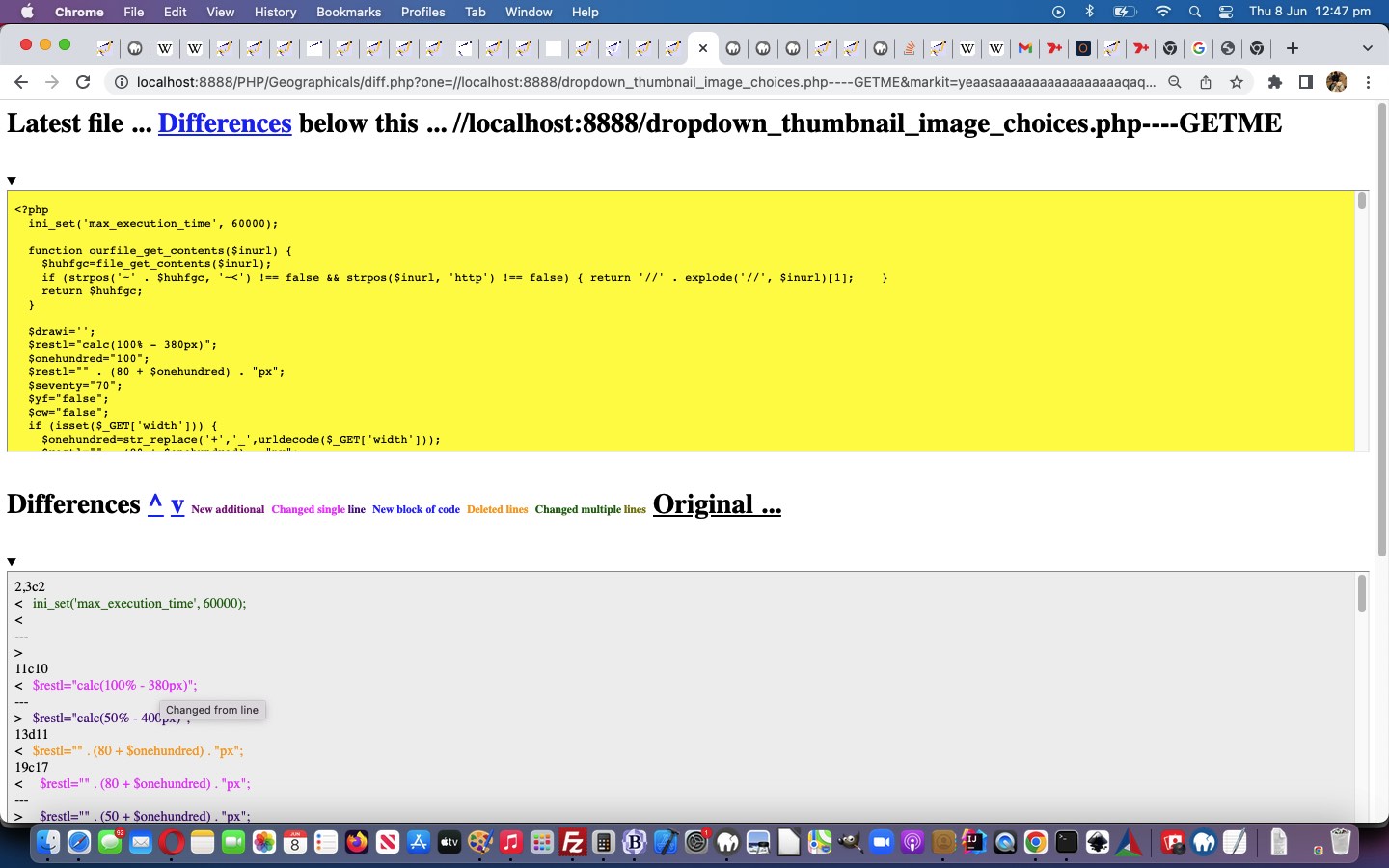
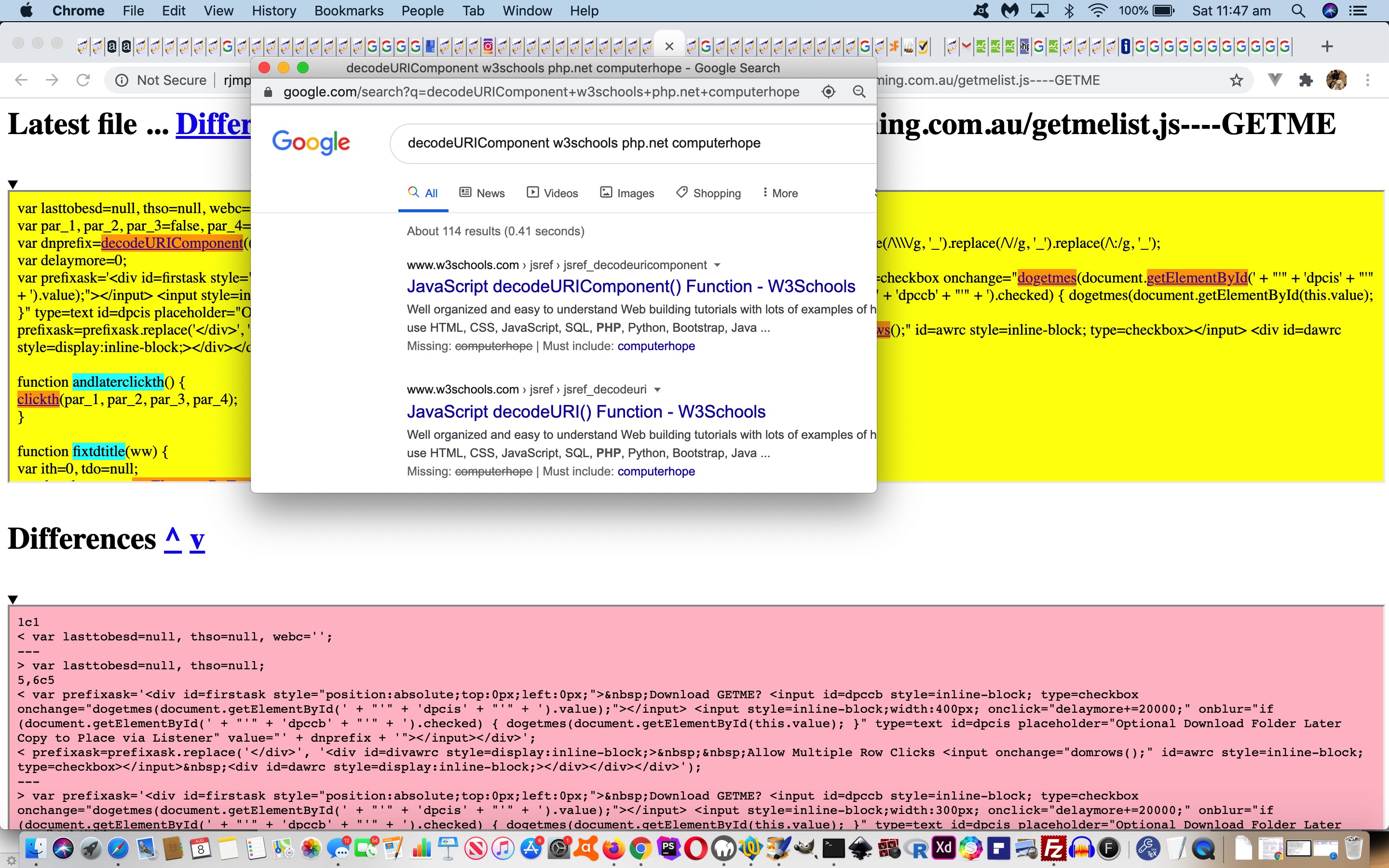
It’s coming up to a few years now, since we looked at the code differences reporting we offer the reader, as a way to scrutinize code changes, around here, when we presented Code Download Table Difference Functional Hover Tutorial. Well, we thought we might try some colour coding to perhaps lift the fog on the cryptic nature of Linux diff (difference) command based reports. They can be cryptic because they can feed into the automation feeding of the report into other Linux commands to facilitate ongoing editing endeavours, but we do not want to go into that here, at least today.
But on examining the reports we came up with the following difference report “categories” if you will …
New additional
Changed single line
New block of lines
Deleted lines
Changed multiple lines
… the header (of a block of interest) the dead give away, depending on the existence of “a” or “c” or “d” and/or “,” for a common sense reinterpretation by us not visiting “man diff” ourselves, yet, regarding this work.
Is it worth adding “onmouseover” event logic onto yesterday’s Code Download Table Difference Functional Linking Tutorial? You bet it is! Just because “onmouseover” has no relevance to mobile platforms, so, obversely, developing software with version control systems is irrelevant to mobile platforms.
… we figure. But this is of relevance to the programmer. Sometimes, rather than cater for all the platforms, settling on a subset (of those platforms) can be apt because …
one of mobile or non-mobile subsets of platforms is irrelevant to the scenario … as for today … or …
you try to reinvent the wheel on the pretext that you are waiting for a particular web browser or platform to allow the functionality in, into the future … you could be waiting a while, with the complexity of app arrangements going on around the net these days
Anyway, back to the “onmouseover” event on non-mobile platforms … it was the case that this event was a favourite for the conduit towards Ajax (client) functionality. And thinking on what we do today to nuance our Code Differences PHP web application, we were thinking …
What would Ajax (like to) do?
… and we decided Ajax would really like to …
populate a “div” style=display:inline-block; element adjacent to the functional detail to inform about … but this was not possible … so, instead, we …
populate a popup window near to the functional detail to inform about
… for a non-mobile “hover” (ie. “onmouseover”) event.
Along the way we add some more hashtag navigations and set up more colour coding to the output of (the optional) “functional links” Code Difference reporting.
So take a look at our changeddiff.php Code Differences helper applied to itself below …
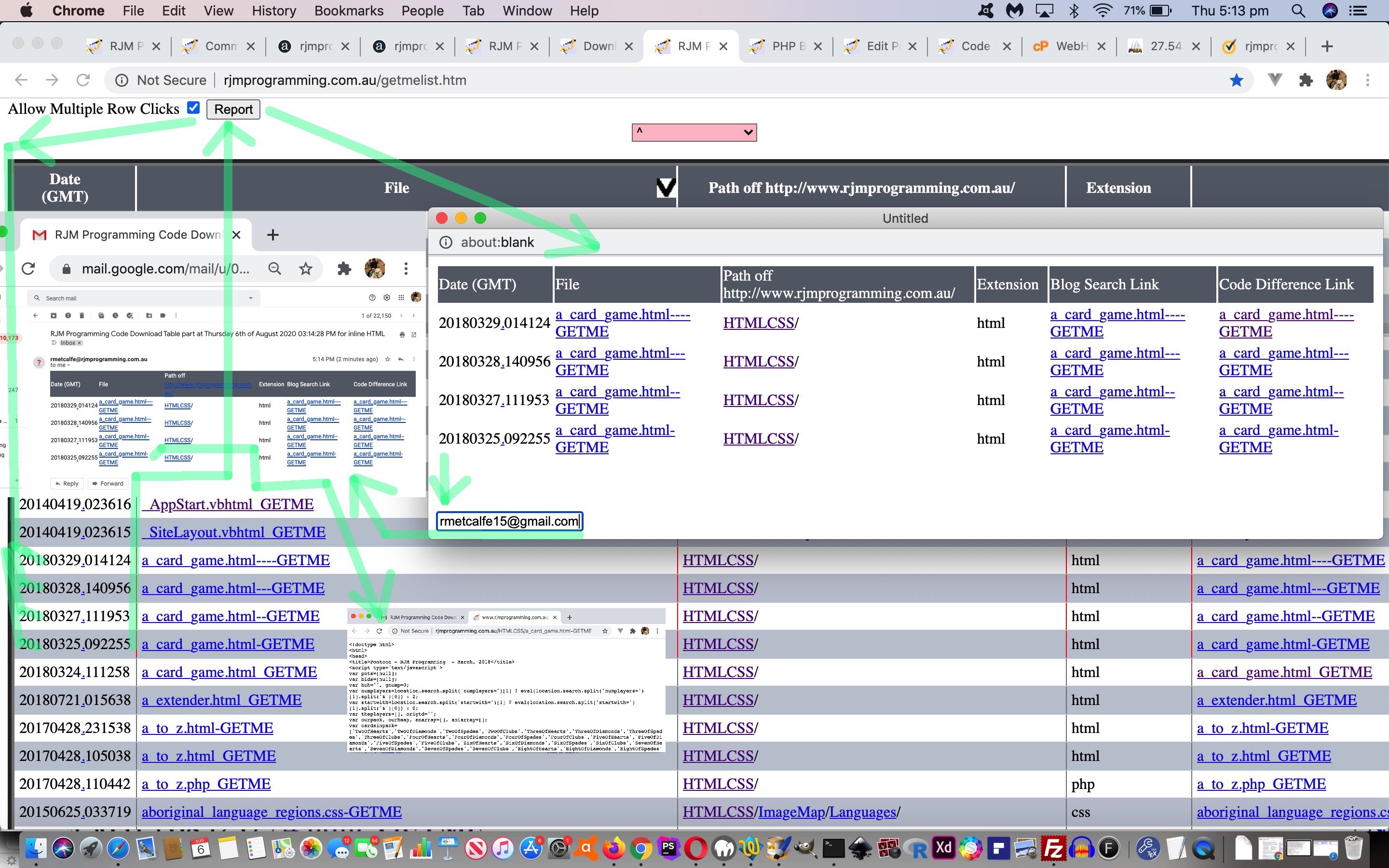
“Report” button shows to its right …
function domrows() {

  document.getElementById('dawrc').innerHTML='<input style=inline-block; type=button onclick=treportdo(); value=Report></input>';

  var trsis=document.getElementsByTagName('tr');

  for (var itrsis=0; itrsis<trsis.length; itrsis++) {

    trsis[itrsis].onclick = function(e) { if (e.target.innerHTML != '') { var trs=document.getElementsByTagName('tr'); for (var itrs=0; itrs<trs.length; itrs++) { if (trs[itrs].outerHTML.indexOf(e.target.innerHTML) != -1) {  trs[itrs].style.border='2px dotted red'; } } } };

  }

}
… and table row onclick logic is dynamically applied to those “tr” elements
User clicks somewhere within rows they are interested in seeing be included in a report (which is a snippet of the whole Code Download Table, perhaps to do with a project of interest, or a learning topic of interest)
User optionally clicks the “Report” button …
function treportdo() {

  var trsis=document.getElementsByTagName('tr');

  webc='<html><head><script type="text/javascript"> function emailto(eto) { window.opener.parentemailto(eto); } function xemailto(eto) { if (eto.indexOf("@") != -1) {  var zhr=new XMLHttpRequest(); var zform=new FormData(); zform.append("inline",""); zform.append("to",eto);  zform.append("subj","Code Download Table part");   zform.append("body",document.getElementById("mytable").outerHTML);   zhr.open("post", "//www.rjmprogramming.com.au/HTMLCSS/emailhtml.php", true);  zhr.send(zform); alert("Email sent to " + eto);  } }  </script></head><body><table id=mytable></table><br><br><br><input onblur=emailto(this.value); placeholder="Email to" type=email></input></body></html>';

  for (var itrsis=0; itrsis<trsis.length; itrsis++) {

    if (itrsis == 0) {

      webc=webc.replace('</table>', trsis[itrsis].outerHTML + '</table>');

    }

    if (trsis[itrsis].outerHTML.indexOf('>') > trsis[itrsis].outerHTML.indexOf('border:')) {

    if (trsis[itrsis].outerHTML.indexOf('dotted') > trsis[itrsis].outerHTML.indexOf('border:')) {

      webc=webc.replace('</table>', trsis[itrsis].outerHTML + '</table>');

    }

    }

  }

  var woois=window.open('','_blank','top=20,left=20,width=600,height=600');

  woois.document.write(webc);

}
… which causes a …
New popup window opens showing the relevant snippet of Code Download Table of interest to the user … including …
Textbox for an optional emailee entry that can be filled in … to …
Set off Ajax/FormData methodology means …
function parentemailto(eto) {

 if (eto.indexOf("@") != -1) {

  var zhr=new XMLHttpRequest();

  var zform=new FormData();

  zform.append("inline","");

  zform.append("to",eto);

  zform.append("subj","RJM Programming Code Download Table part");

  zform.append("body", reltoabs('<table' + webc.split('</table>')[0].split('<table')[1] + '</table>'));

  zhr.open("post", "//www.rjmprogramming.com.au/HTMLCSS/emailhtml.php", true);

  zhr.send(zform);

  alert("Email sent to " + eto);

 }

}
… to send off an Inline HTML Email report to the emailee … including …
Links of email can be clicked to get back to source code and other links back at the RJM Programming domain web server
… and … lo and behold … we saw a good use for the idea of …
download from “the net” to a Downloads folder on your computer or device … and more often than not …
you, the user, copies or renames this data to another location on your computer or device with command line or with operating system GUI
… and allowing for that second step above be programmatical with the most apt functionality that had ever passed our cotton pickin’ mind … our Code Download Table … wi’ all tho’ GETME’s!
But we don’t want to interfere too much with the Code Download Table “flow” here, so create up the top left 20 seconds worth of time (extendable by their actions) available to the user to create “download” attributes on all …
“a” links … with …
“href” attribute containing “GETME” …
but not “diff.php” … and …
“download” attribute (the attribute necessary to “download” rather than our default displaying of source code in a new webpage)
… plus no href attribute containing “?s=” either, for today’s purposes with a changedgetmelist.js external Javascript code file (that you can try out for yourself at this live run link) … via its new …
var dnprefix=decodeURIComponent(('' + localStorage.getItem('download_copy_to_folder')).replace(/^null$/g,'')); //.replace(/\+/g,' ').replace(/\\\\/g, '_').replace(/\//g, '_').replace(/\:/g, '_');
var delaymore=0;
var prefixask='<div id=firstask style="position:absolute;top:0px;left:0px;"> Download GETME? <input id=dpccb style=inline-block; type=checkbox onchange="dogetmes(document.getElementById(' + "'" + 'dpcis' + "'" + ').value);"></input> <input style=inline-block;width:300px; onclick="delaymore+=20000;" onblur="if (document.getElementById(' + "'" + 'dpccb' + "'" + ').checked) { dogetmes(document.getElementById(this.value); }" type=text id=dpcis placeholder="Optional Download Folder Later Copy to Place via Listener" value="' + dnprefix + '"></input></div>';
function dogetmes(dpprefix) {
delaymore+=20000;
var asis=document.getElementsByTagName('a');
if (dpprefix != dnprefix && 1 == 7) {
localStorage.setItem('download_copy_to_folder', dpprefix);
}
for (var iasis=0; iasis<asis.length; iasis++) {
if (asis[iasis].href.indexOf('diff.php') == -1 && asis[iasis].href.indexOf('?s=') == -1 && asis[iasis].href.indexOf('GETME') != -1) {
asis[iasis].download=dpprefix.replace(/\//g,'_').replace(/\\\\/g,'_').replace(/\:/g,'_') + asis[iasis].href.split('/')[eval(-1 + asis[iasis].href.split('/').length)];
}
}
}
function nomorepa() {
if (eval('' + delaymore) == 0) {
if (document.getElementById('firstask')) {
document.getElementById('firstask').innerHTML='';
}
} else {
setTimeout(nomorepa, eval('' + delaymore));
delaymore=0;
}
}
function lastdivpop() {
var wasih='';
if (document.getElementById('lastdiv')) {
if (document.getElementById('lastdiv').innerHTML == '') {
wasih=wasih;
setTimeout(lastdivpop, 3000);
} else if (document.getElementById('lastdiv').innerHTML.indexOf('firstask') == -1) {
wasih=document.getElementById('lastdiv').innerHTML;
document.getElementById('lastdiv').innerHTML=prefixask + wasih;
prefixask='';
setTimeout(nomorepa, 20000);
} else {
setTimeout(lastdivpop, 3000);
}
}
}
… and we’ve just “tweaked” (albeit, very importantly, in our books (… but the pamphlettes are still not playing ball)) to ensure no “file clobbering” takes place so that the Korn Shell now does …
    suf=""

    isuf=-1

    while [ -f "${dpath}/${brest}${suf}" ]; do

      ((isuf=isuf+1))

      suf="_${isuf}"

    done

    if [ ! -z "$suf" ]; then

      echo "mv ${dpath}/${brest} ${dpath}/${brest}${suf} # `date`" >> download_to_place.out

      mv ${dpath}/${brest} ${dpath}/${brest}${suf} >> download_to_place.out 2>> download_to_place.err

    fi
But today is mainly about filling in the missing bits on the “server” side. This (need for a) “conduit” we referred to yesterday is because we accept no folder paths can be mentioned at the “server” end. Suppose, though, that the “non-pathed” filename we supply to an “a” link’s “download” attribute can be prefixed by a mildly mashed up version of that path we copy to from the Downloads folder of your “client” computer or device, as you perform a “download” via the clicking of an “a” link.
Well, at this blog we’d already started functionality to toggle the use or not of …
“a” links … with …
“href” attribute containing “GETME” …
but not “diff.php” … and …
“download” attribute (the attribute necessary to “download” rather than our default displaying of source code in a new webpage)
displaying of source code in a new webpage for GETME “a” links … versus …
use the changed PHPtoggle_download.php in conjunction with a changed good ‘ol TwentyTen Theme header.php as below …
<?php
if (outs == null) {
var dnprefix=decodeURIComponent(('' + localStorage.getItem('download_copy_to_folder')).replace(/^null$/g,'')).replace(/\+/g,' ').replace(/\\\\/g, '_').replace(/\//g, '_').replace(/\:/g, '_');
for (idmjk=0; idmjk<admjk.length; idmjk++) {
if (admjk[idmjk].href.indexOf('GETME') != -1 && admjk[idmjk].href.indexOf('diff.php') == -1) {
big = '----------------------GETME';
stuffs = newaspare.split('/');
if (dnprefix != '') {
admjk[idmjk].download = dnprefix + prestuffs[stuffs.length - 1];
} else {
admjk[idmjk].download = dnprefix + stuffs[stuffs.length - 1];
}
admjk[idmjk].title = "(Really download) " + admjk[idmjk].title + ' ... welcome to the long hover functionality that shows allows for a Download Mode for the blog that can be toggled';
admjk[idmjk].onmouseover = " getDownloadMode(); ";
admjk[idmjk].onmouseout = " yehBut(); ";
admjk[idmjk].ontouchstart = " getDownloadMode(); ";
admjk[idmjk].ontouchend = " yehBut(); ";
}
} else if (admjk[idmjk].href.indexOf('GETME') != -1 && origcafd < 0) { //!cafd) {
xp=admjk[idmjk].href.split("GETME");
prexp=xp[0].split("/");
postprexp=prexp[-1 + prexp.length].split(".");
extis = postprexp[-1 + postprexp.length].replace(/_/g,"").replace(/-/g,"").replace(/GETME/g,"");
outs="//www.rjmprogramming.com.au/getmelist.htm?topoff=150&tsp=" + (Math.floor(Math.random() * 1999900) + 100) + "#" + postprexp[0] + "." + postprexp[-1 + postprexp.length].replace(extis,"").replace(extis,"").replace(extis,"") + "GETME" + extis;
aorig=admjk[idmjk].innerHTML;
selbitis=allthecombos((admjk[idmjk].href + '=').split('=')[1].split('&')[0]);
admjk[idmjk].innerHTML=admjk[idmjk].innerHTML.replace(".","<span data-alt='" + outs + "' id='spn" + cafd + "' title=\" + Code Download Table\" onclick=\"if (cafd == cafd) { cafd=" + cafd + "; changeasfordownload(); } else { window.open('" + outs + "','_blank','top=100,left=100,width=500,height=500'); } return false; \"><select onchange=\" if (this.value.length > 0) { window.open(this.value,'_blank'); } return false; \" style='margin-bottom:0px;width:40px;' id='sel" + cafd + "'><option value=>⚫</option>" + selbitis + "</select></span>");
if (aorig == admjk[idmjk].innerHTML && admjk[idmjk].innerHTML.indexOf('er posts') == -1) admjk[idmjk].innerHTML=admjk[idmjk].innerHTML.replace(" ","<span data-alt='" + outs + "' id='spn" + cafd + "' title=\" + Code Download Table\" onclick=\"if (cafd == cafd) { cafd=" + cafd + "; changeasfordownload(); } else { window.open('" + outs + "','_blank','top=100,left=100,width=500,height=500'); } return false; \"><select onchange=\" if (this.value.length > 0) { window.open(this.value,'_blank'); } return false; \" style='margin-bottom:0px;width:40px;' id='sel" + cafd + "'><option value=>⚪</option>" + selbitis + "</select></span>");
cafd++;
} else if ((admjk[idmjk].innerHTML.indexOf('live run') != -1 || admjk[idmjk].title.toLowerCase().indexOf('click picture') != -1) && origcafd < 0) { //!cafd) {
outs="//www.rjmprogramming.com.au/slideshow.html#tuts";
admjk[idmjk].innerHTML=admjk[idmjk].innerHTML.replace(" ","<span data-alt='" + outs + "' id='spn" + cafd + "' title=\" + Cut to the Chase ... see the blog post list related to live runs and slideshows ... ie. the main point of the blog posting\" onclick=\"if (cafd == cafd) { cafd=" + cafd + "; changeasfordownload(); } else { window.open('" + outs + "','_blank','top=100,left=100,width=650,height=100'); } return false; \">✂</span>");
cafd++;
}
}
}
?>
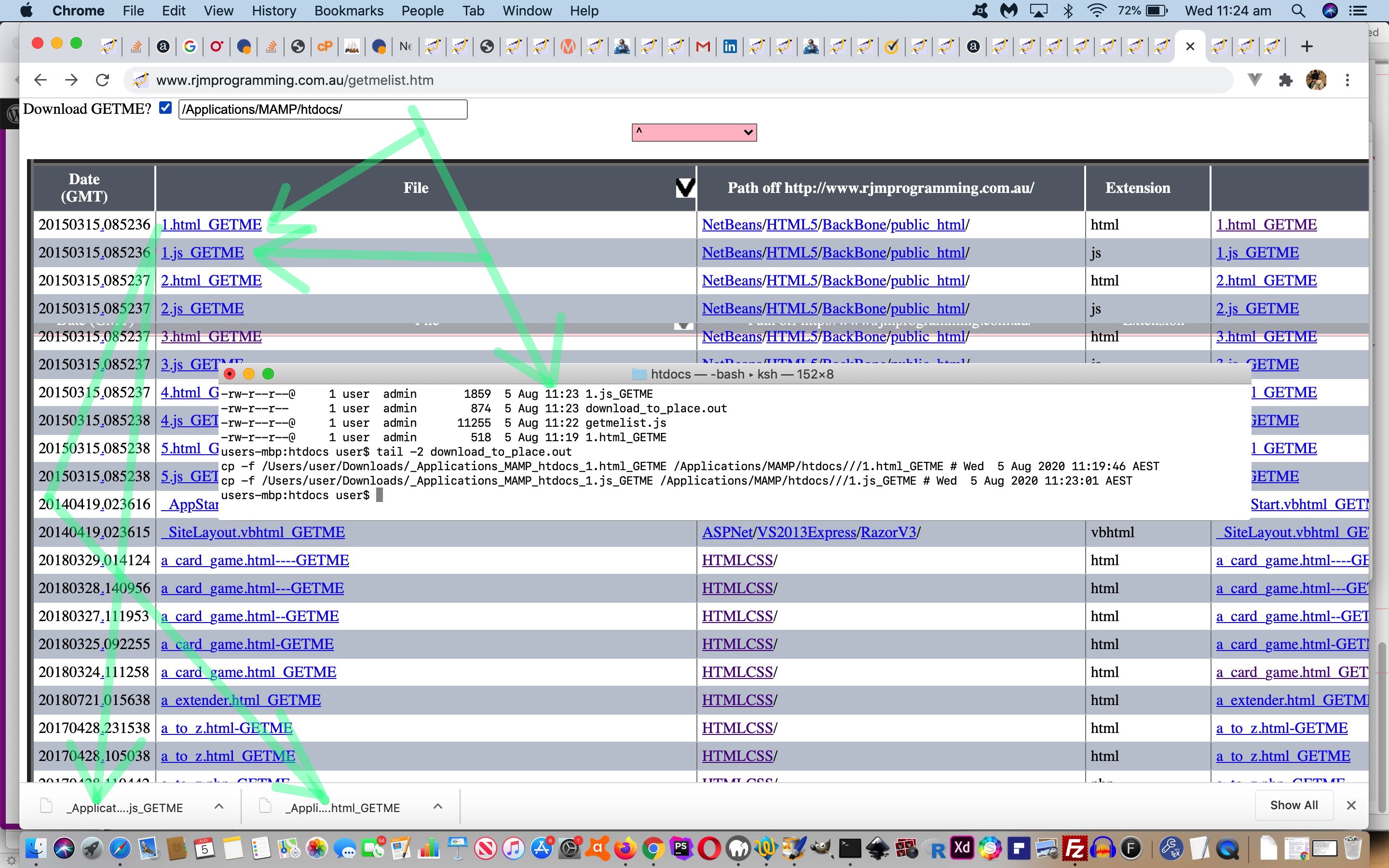
… to, depending on whether the user specifies in the “All Posts” toggling’s Javascript prompt window presented, specifies a new comma separated “client folder of interest to copy to” place (stored in window.localStorage), will …
download with the GETME to the Downloads folder and copy off to the specified folder of interest (backing up as necessary) … versus …
the default download mode downloads to the Downloads folder without the GETME parts
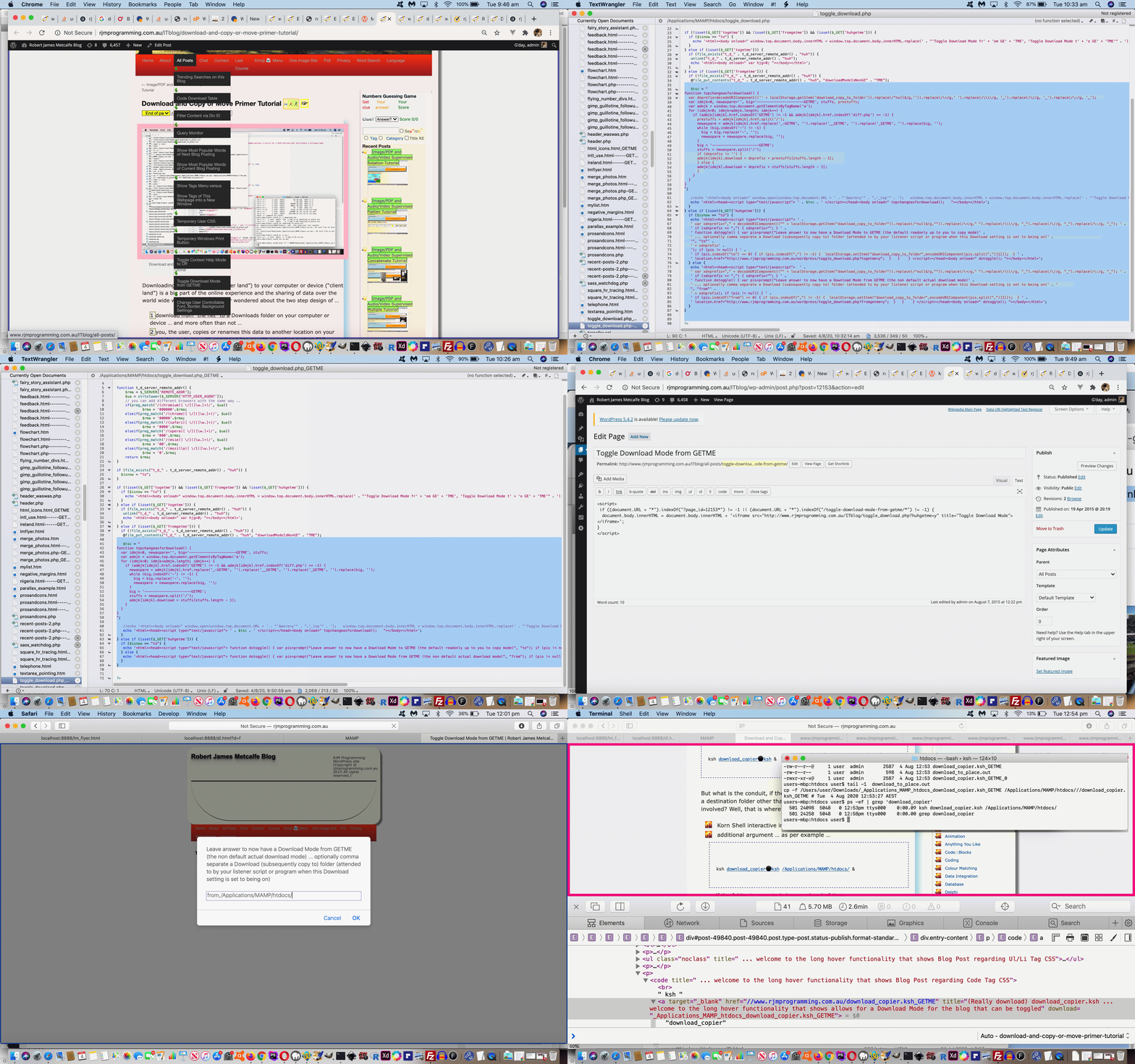
See these changes in action below, contextualizing “server” and “client” codes in the full picture of assisted Downloads (copied on to a folder of the user’s interest) …
Downloading from “the net” (“server land”) to your computer or device (“client land”) is a big part of the online experience and the sharing of data over the world wide web. But have you ever wondered about the two step design of …
download from “the net” to a Downloads folder on your computer or device … and more often than not …
you, the user, copies or renames this data to another location on your computer or device with command line or with operating system GUI
… ? Why not allow the “server” side define where it can download to on the “client”? Well, that would be a security nightmare, allowing a highjacking of mission critical files on your computer or device. So, I get it, that is a “no no”. But could we have a controlled “arrangement” between …
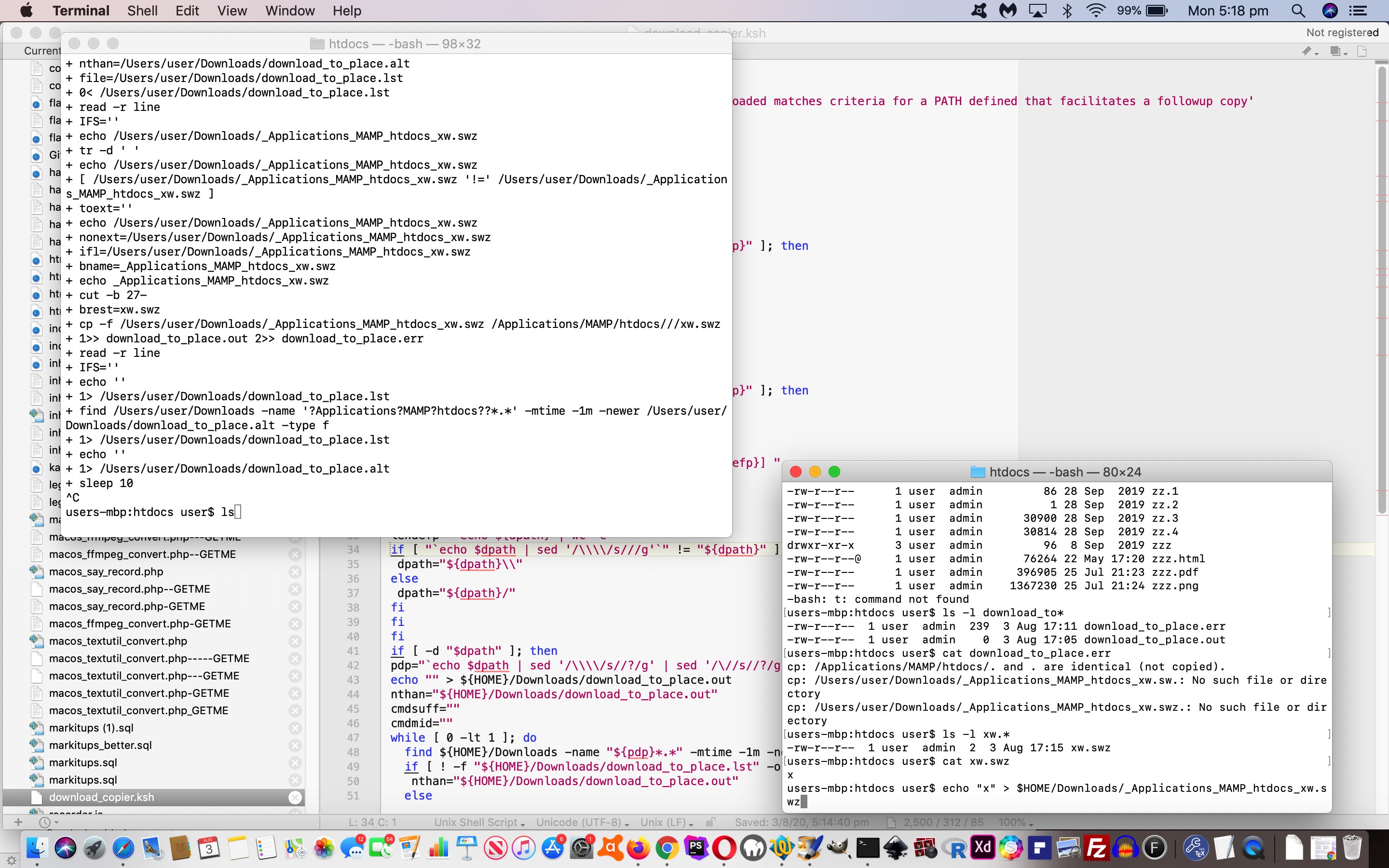
… ? We think that sounds reasonable and so, today, we start our (two parts or more) mini-project (making step 2 above be considered to be programmatically handled, sometimes) designing a Korn Shell (“client” side) listener to suit our macOS “client” computer, executed as a background process via …
But what is the conduit, if the “server” web applications/pages cannot define a destination folder other than the macOS Downloads folder for the user involved? Well, that is where we need either …
Korn Shell interactive input (via read command) … or …
… to define a “client land” folder to copy to (from the user’s Download folder (receiving the downloaded data).
That first Korn Shell read command interactive input was interesting to us for a command backgrounded via the “&” command suffix. But if stdin and stdout are not mentioned in the command you can answer this interactive input and then the processing the Korn Shell performs proceeds in the background. Exactly what we were hoping for, but weren’t sure that this was the case!
The picture is filled in better tomorrow as we discuss the conduit in more detail tomorrow.
If this was interesting you may be interested in this too.
If this was interesting you may be interested in this too.
If this was interesting you may be interested in this too.
If this was interesting you may be interested in this too.
If this was interesting you may be interested in this too.
If this was interesting you may be interested in this too.
If this was interesting you may be interested in this too.
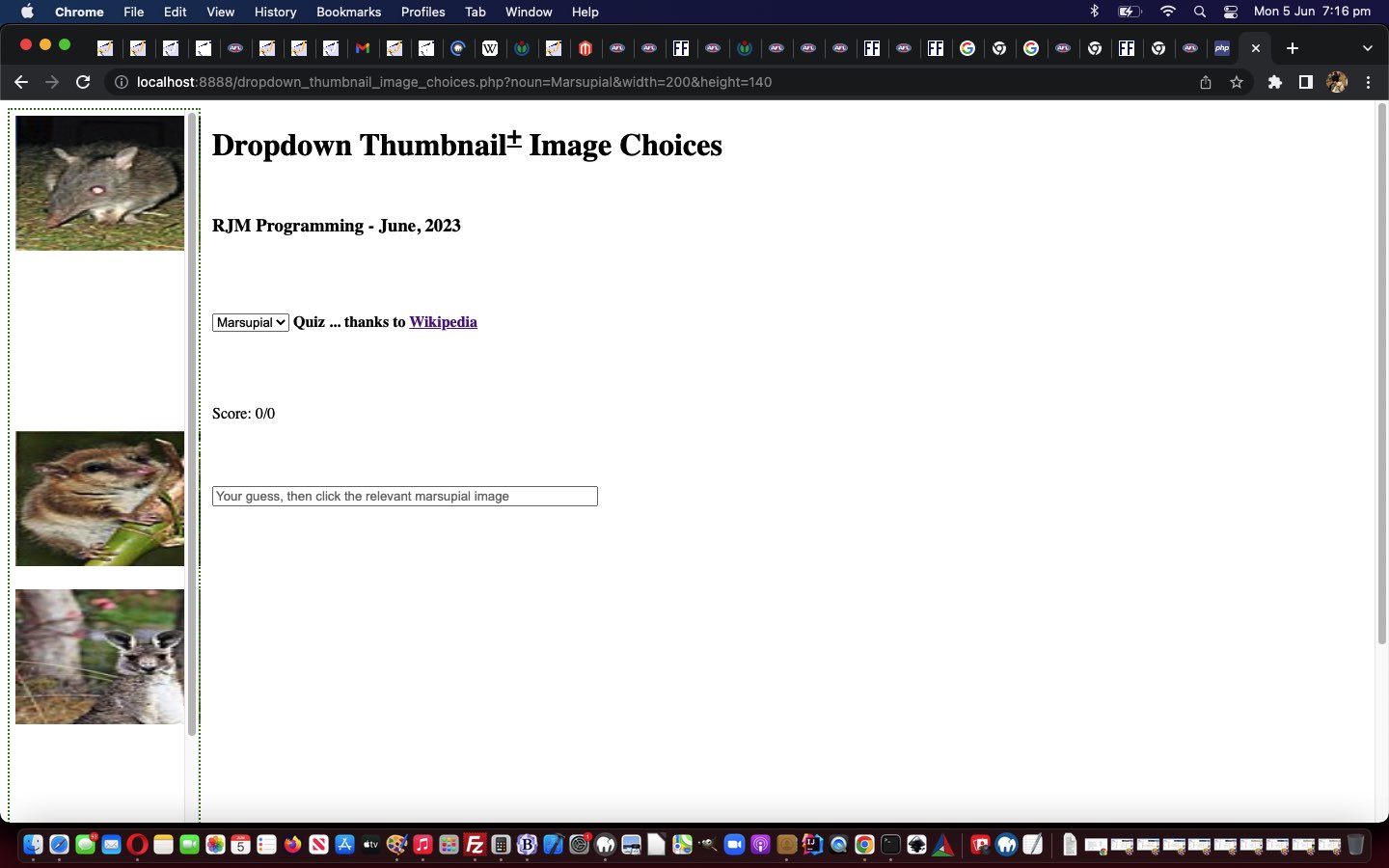
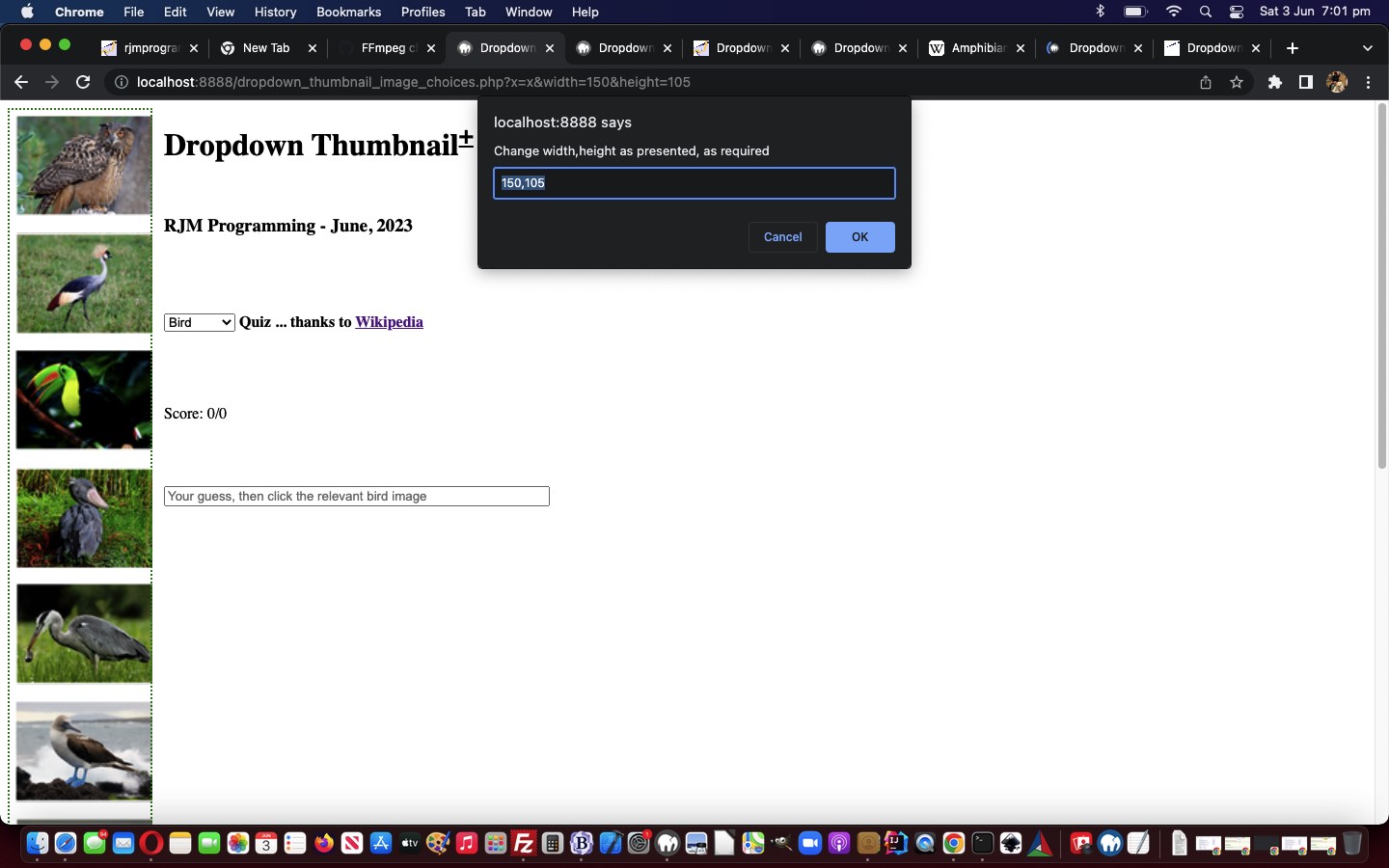
Thumbnail images are all well and good, but for web applications, such as our quiz one, that might benefit from scrutiny of images, in the recent Dropdown Image Idea Map Genericization Tutorial, it would be good to offer the user some control over the size of the images in their biology themed Quiz.
We want to funnel this ask through a Javascript window.prompt scenario, given it is optional functionality, and we think it is over the top to dedicate one or two textboxes to the asking of …
image display width … and …
image display height
… dimensions. And then, as far as the arrangements go to make use of these collected user settings go, we just start using GET URL arguments for width= and height= respectively …
<?php
  $three="3"; // number of image map columns

  $six="6"; // number of image map rows

  $restl="calc(50% - 600px)";

  $onehundred="100";

  $seventy="70";

  if (isset($_GET['width'])) {

    $onehundred=str_replace('+','_',urldecode($_GET['width']));

    $restl="" . (20 + $onehundred) . "px";

  } else if (isset($_POST['width'])) {

    $onehundred=str_replace('+','_',urldecode($_POST['width']));

    $restl="" . (20 + $onehundred) . "px";

  }
?>
… in the pure PHP initializations. Then up the top of the PHP written Javascript we now have …
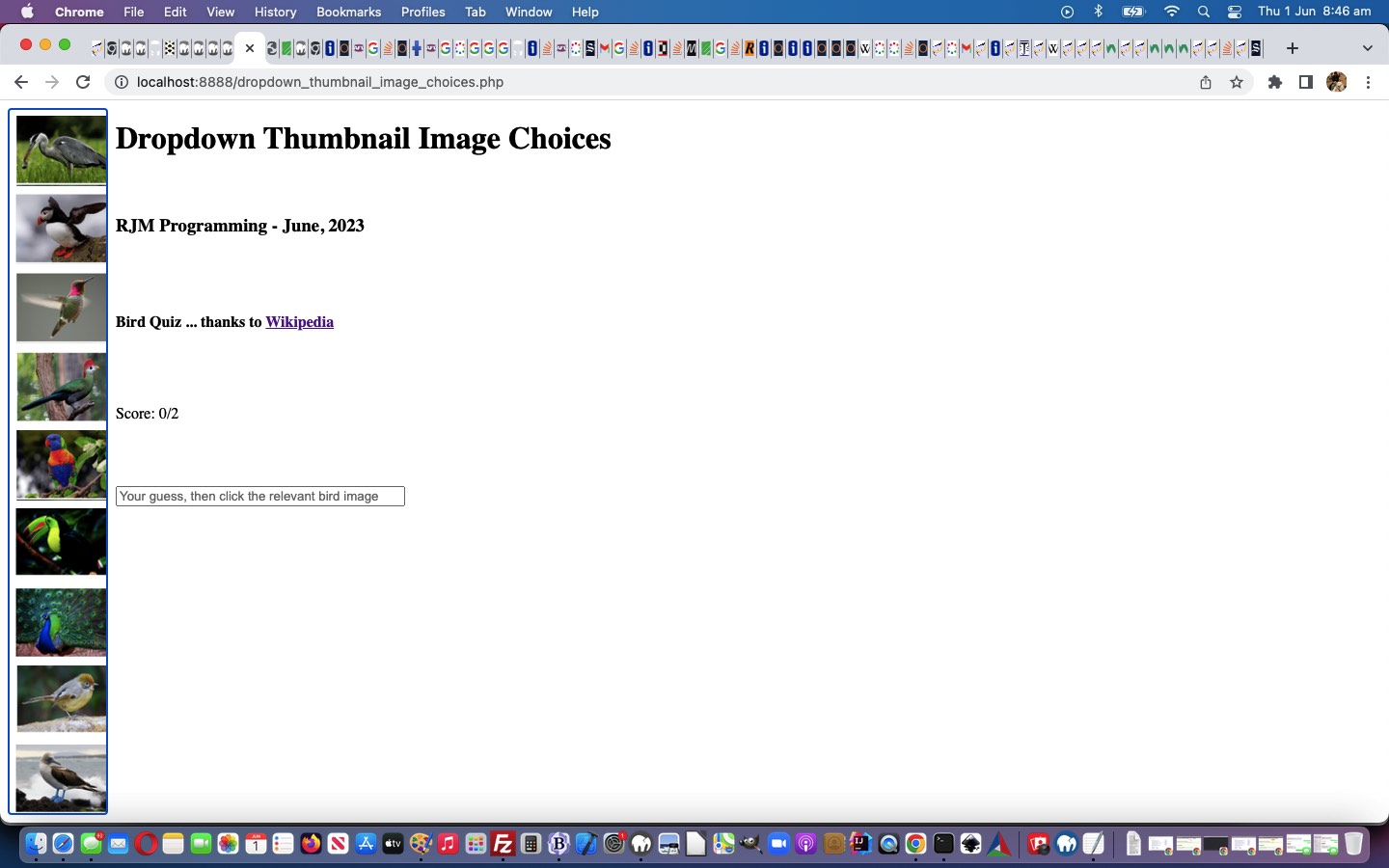
There is a certain level of genericization we can apply to yesterday’s Dropdown Image Idea Primer Tutorial‘s Bird Quiz “proof of concept” start, to begin to extend its functionality, today.
We say “certain level” because Wikipedia content is written by a myriad of expert Wiki Page Writers out there, thanks one and all. There are not hard and fast rules about how that content is formed, any more than the content here, in this WordPress blog, is presented, and appears as a webpage before your very (yes, very) eyes! But, there can be patterns, and in this biology field of content, we’ve noticed, our biology images can often be presented in the form …
HTML image map element contains the answer data we need for our current (biology) quiz project … and …
HTML img element accompanying that image map element can contain the base graphics we need
… to derive data URI image thumbnails via an inhouse canvas element’s talents regarding …
… slicing and dicing of imagery. If you’d have looked yesterday at this Javascript function you’d have seen much less PHP interventional code, and this increased “intervention” forms the basis for our “genericization drive” today, where we identify tasks that PHP can help with in that initial phase …
… and use them, rather than hardcodings, where we see those hardcodings that used to just involve our guinea pig project topic, “Birds”, in the context of a quiz, so we now offer dropdown selectable …
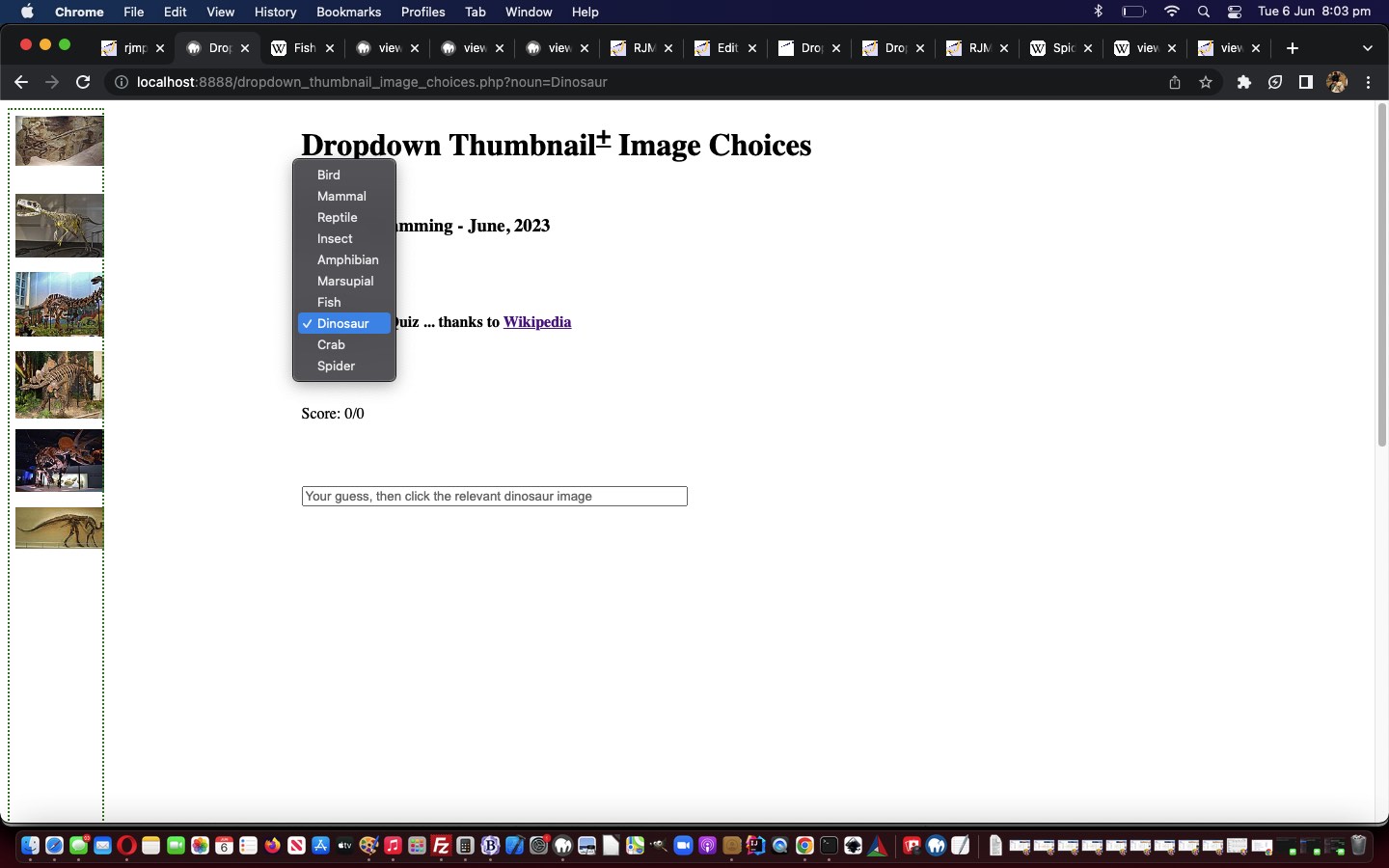
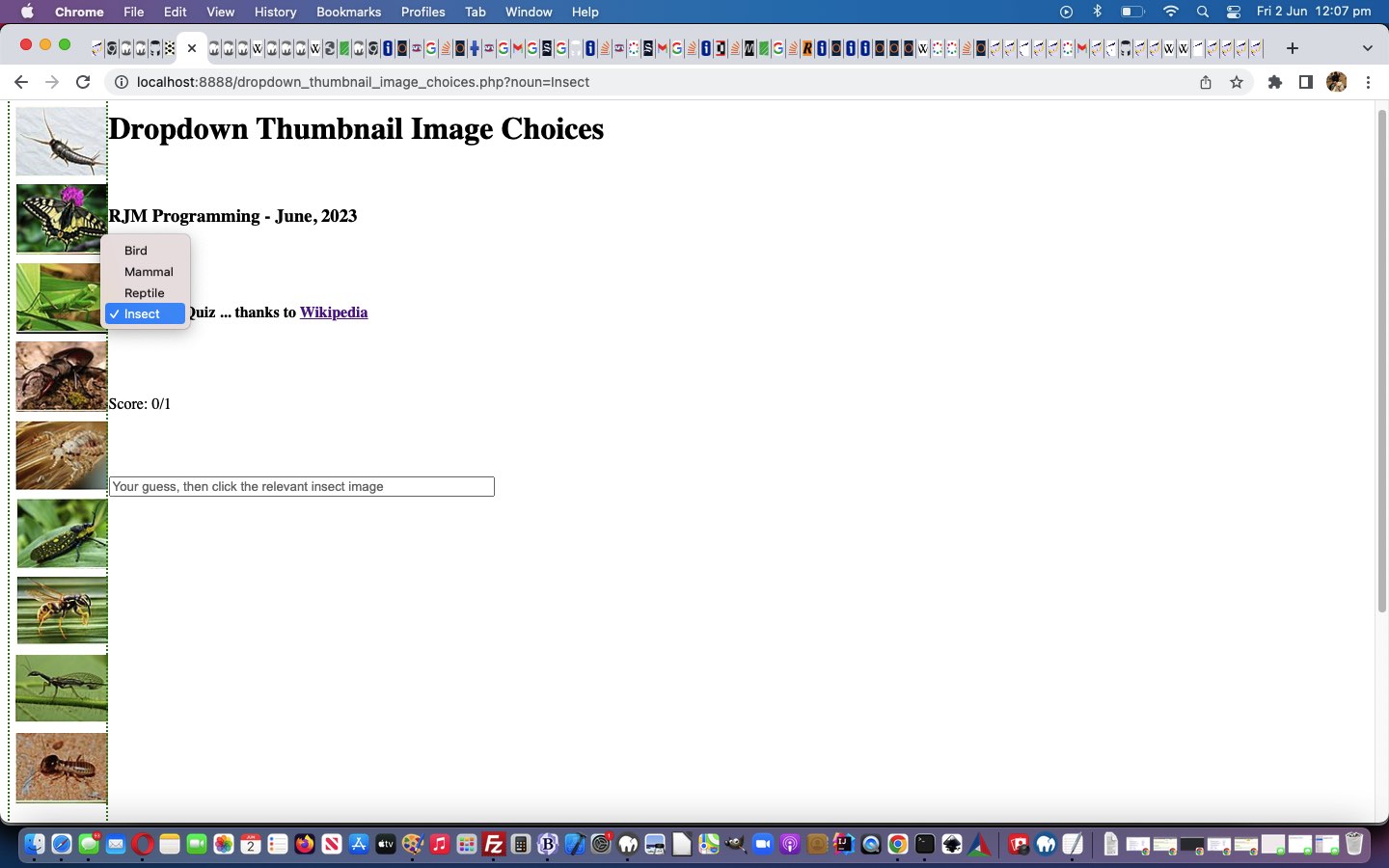
We’ve long mused about the idea that an HTML select (ie. dropdown) element can have images as a background. Well, we’re here to tell you that a dropdown element on its own is not capable of this, it being an element associated with operating system functionality. But we can …
dropdown background transparency … combined with …
underlaid, precisely, div z-index smaller
… and what’s to stop us setting a multiple background image arrangement for the div element above? Anyone? Anyone? Yes, Aristotle, it is clearly self-evident that an earthquake might stop us, yes, or an anti-clockwise hurricane, perhaps, yes … but you do realize our class is taking place in the Blue Mountains, near Sydney, Australia?!
Thumbnail images are all well and good, but for web applications, such as our quiz one, that might benefit from scrutiny of images, in the recent Dropdown Image Idea Map Genericization Tutorial, it would be good to offer the user some control over the size of the images in their biology themed Quiz.
We want to funnel this ask through a Javascript window.prompt scenario, given it is optional functionality, and we think it is over the top to dedicate one or two textboxes to the asking of …
image display width … and …
image display height
… dimensions. And then, as far as the arrangements go to make use of these collected user settings go, we just start using GET URL arguments for width= and height= respectively …
<?php
  $three="3"; // number of image map columns

  $six="6"; // number of image map rows

  $restl="calc(50% - 600px)";

  $onehundred="100";

  $seventy="70";

  if (isset($_GET['width'])) {

    $onehundred=str_replace('+','_',urldecode($_GET['width']));

    $restl="" . (20 + $onehundred) . "px";

  } else if (isset($_POST['width'])) {

    $onehundred=str_replace('+','_',urldecode($_POST['width']));

    $restl="" . (20 + $onehundred) . "px";

  }
?>
… in the pure PHP initializations. Then up the top of the PHP written Javascript we now have …
There is a certain level of genericization we can apply to yesterday’s Dropdown Image Idea Primer Tutorial‘s Bird Quiz “proof of concept” start, to begin to extend its functionality, today.
We say “certain level” because Wikipedia content is written by a myriad of expert Wiki Page Writers out there, thanks one and all. There are not hard and fast rules about how that content is formed, any more than the content here, in this WordPress blog, is presented, and appears as a webpage before your very (yes, very) eyes! But, there can be patterns, and in this biology field of content, we’ve noticed, our biology images can often be presented in the form …
HTML image map element contains the answer data we need for our current (biology) quiz project … and …
HTML img element accompanying that image map element can contain the base graphics we need
… to derive data URI image thumbnails via an inhouse canvas element’s talents regarding …
… slicing and dicing of imagery. If you’d have looked yesterday at this Javascript function you’d have seen much less PHP interventional code, and this increased “intervention” forms the basis for our “genericization drive” today, where we identify tasks that PHP can help with in that initial phase …
… and use them, rather than hardcodings, where we see those hardcodings that used to just involve our guinea pig project topic, “Birds”, in the context of a quiz, so we now offer dropdown selectable …
We’ve long mused about the idea that an HTML select (ie. dropdown) element can have images as a background. Well, we’re here to tell you that a dropdown element on its own is not capable of this, it being an element associated with operating system functionality. But we can …
dropdown background transparency … combined with …
underlaid, precisely, div z-index smaller
… and what’s to stop us setting a multiple background image arrangement for the div element above? Anyone? Anyone? Yes, Aristotle, it is clearly self-evident that an earthquake might stop us, yes, or an anti-clockwise hurricane, perhaps, yes … but you do realize our class is taking place in the Blue Mountains, near Sydney, Australia?!
Thumbnail images are all well and good, but for web applications, such as our quiz one, that might benefit from scrutiny of images, in the recent Dropdown Image Idea Map Genericization Tutorial, it would be good to offer the user some control over the size of the images in their biology themed Quiz.
We want to funnel this ask through a Javascript window.prompt scenario, given it is optional functionality, and we think it is over the top to dedicate one or two textboxes to the asking of …
image display width … and …
image display height
… dimensions. And then, as far as the arrangements go to make use of these collected user settings go, we just start using GET URL arguments for width= and height= respectively …
<?php
  $three="3"; // number of image map columns

  $six="6"; // number of image map rows

  $restl="calc(50% - 600px)";

  $onehundred="100";

  $seventy="70";

  if (isset($_GET['width'])) {

    $onehundred=str_replace('+','_',urldecode($_GET['width']));

    $restl="" . (20 + $onehundred) . "px";

  } else if (isset($_POST['width'])) {

    $onehundred=str_replace('+','_',urldecode($_POST['width']));

    $restl="" . (20 + $onehundred) . "px";

  }
?>
… in the pure PHP initializations. Then up the top of the PHP written Javascript we now have …
There is a certain level of genericization we can apply to yesterday’s Dropdown Image Idea Primer Tutorial‘s Bird Quiz “proof of concept” start, to begin to extend its functionality, today.
We say “certain level” because Wikipedia content is written by a myriad of expert Wiki Page Writers out there, thanks one and all. There are not hard and fast rules about how that content is formed, any more than the content here, in this WordPress blog, is presented, and appears as a webpage before your very (yes, very) eyes! But, there can be patterns, and in this biology field of content, we’ve noticed, our biology images can often be presented in the form …
HTML image map element contains the answer data we need for our current (biology) quiz project … and …
HTML img element accompanying that image map element can contain the base graphics we need
… to derive data URI image thumbnails via an inhouse canvas element’s talents regarding …
… slicing and dicing of imagery. If you’d have looked yesterday at this Javascript function you’d have seen much less PHP interventional code, and this increased “intervention” forms the basis for our “genericization drive” today, where we identify tasks that PHP can help with in that initial phase …
… and use them, rather than hardcodings, where we see those hardcodings that used to just involve our guinea pig project topic, “Birds”, in the context of a quiz, so we now offer dropdown selectable …
We’ve long mused about the idea that an HTML select (ie. dropdown) element can have images as a background. Well, we’re here to tell you that a dropdown element on its own is not capable of this, it being an element associated with operating system functionality. But we can …
dropdown background transparency … combined with …
underlaid, precisely, div z-index smaller
… and what’s to stop us setting a multiple background image arrangement for the div element above? Anyone? Anyone? Yes, Aristotle, it is clearly self-evident that an earthquake might stop us, yes, or an anti-clockwise hurricane, perhaps, yes … but you do realize our class is taking place in the Blue Mountains, near Sydney, Australia?!
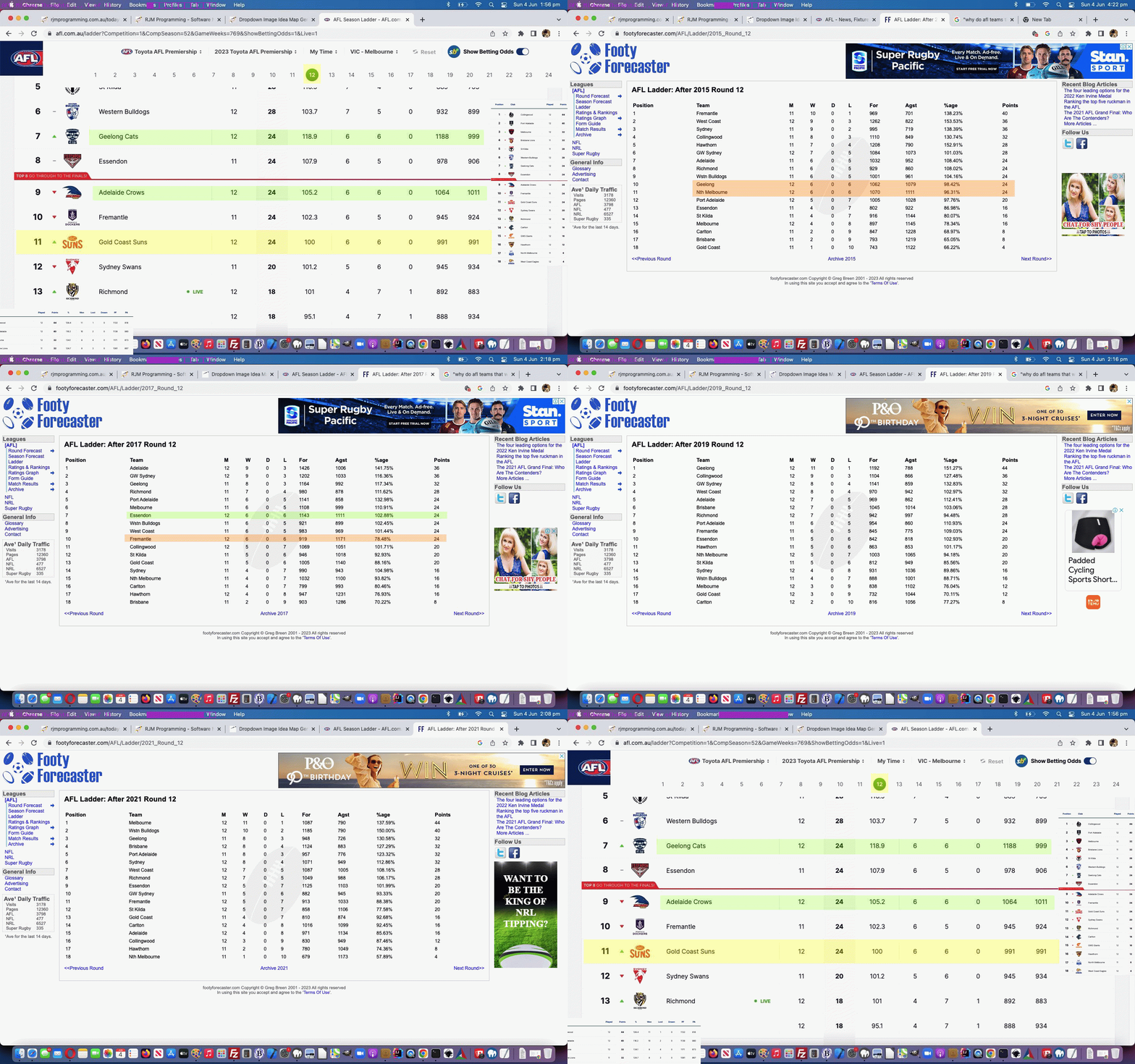
It’s midway through our home and away part to the AFL (Australian Football League) season here in Australia. Of course we’d like to rave about the brilliance of the all-conquering 2023 Collingwood magpies, but now is not the time … it’s only “midway”!
However, statistically, we watchers of the AFL Ladder (whether live, on weekends, or not) might see a bit of “spookiness” in the middle of the ladder, where top 8 finals aspirations still run deep, where …
… ladder list (because all 6/6 others have a percentage above 100.0%) here at this halfway point. Does aspiration beat statistics, and mathematics? We tried Google searches in case there is an “aspiration bias”, but could not frame a proper working question, so any mathematicians or statisticians out there with ideas, feel free to leave a comment?!
But we decided to leave “spookiness” thoughts behind, and tried a more “scientific approach” by looking at past Round 12 snapshots, and it somewhat eased my “spookiness” thoughts. Some 6/6 teams over recent years have had percentages below 100.0%. Actually, my relief was palpable, as we do believe in logic and mathematics and non-warped statistics. Still, and all, if someone does have a second hand ouija board you know that the comments section is only a short downward distance away?!
If this was interesting you may be interested in this too.
There is a certain level of genericization we can apply to yesterday’s Dropdown Image Idea Primer Tutorial‘s Bird Quiz “proof of concept” start, to begin to extend its functionality, today.
We say “certain level” because Wikipedia content is written by a myriad of expert Wiki Page Writers out there, thanks one and all. There are not hard and fast rules about how that content is formed, any more than the content here, in this WordPress blog, is presented, and appears as a webpage before your very (yes, very) eyes! But, there can be patterns, and in this biology field of content, we’ve noticed, our biology images can often be presented in the form …
HTML image map element contains the answer data we need for our current (biology) quiz project … and …
HTML img element accompanying that image map element can contain the base graphics we need
… to derive data URI image thumbnails via an inhouse canvas element’s talents regarding …
… slicing and dicing of imagery. If you’d have looked yesterday at this Javascript function you’d have seen much less PHP interventional code, and this increased “intervention” forms the basis for our “genericization drive” today, where we identify tasks that PHP can help with in that initial phase …
… and use them, rather than hardcodings, where we see those hardcodings that used to just involve our guinea pig project topic, “Birds”, in the context of a quiz, so we now offer dropdown selectable …
We’ve long mused about the idea that an HTML select (ie. dropdown) element can have images as a background. Well, we’re here to tell you that a dropdown element on its own is not capable of this, it being an element associated with operating system functionality. But we can …
dropdown background transparency … combined with …
underlaid, precisely, div z-index smaller
… and what’s to stop us setting a multiple background image arrangement for the div element above? Anyone? Anyone? Yes, Aristotle, it is clearly self-evident that an earthquake might stop us, yes, or an anti-clockwise hurricane, perhaps, yes … but you do realize our class is taking place in the Blue Mountains, near Sydney, Australia?!
We’ve long mused about the idea that an HTML select (ie. dropdown) element can have images as a background. Well, we’re here to tell you that a dropdown element on its own is not capable of this, it being an element associated with operating system functionality. But we can …
dropdown background transparency … combined with …
underlaid, precisely, div z-index smaller
… and what’s to stop us setting a multiple background image arrangement for the div element above? Anyone? Anyone? Yes, Aristotle, it is clearly self-evident that an earthquake might stop us, yes, or an anti-clockwise hurricane, perhaps, yes … but you do realize our class is taking place in the Blue Mountains, near Sydney, Australia?!
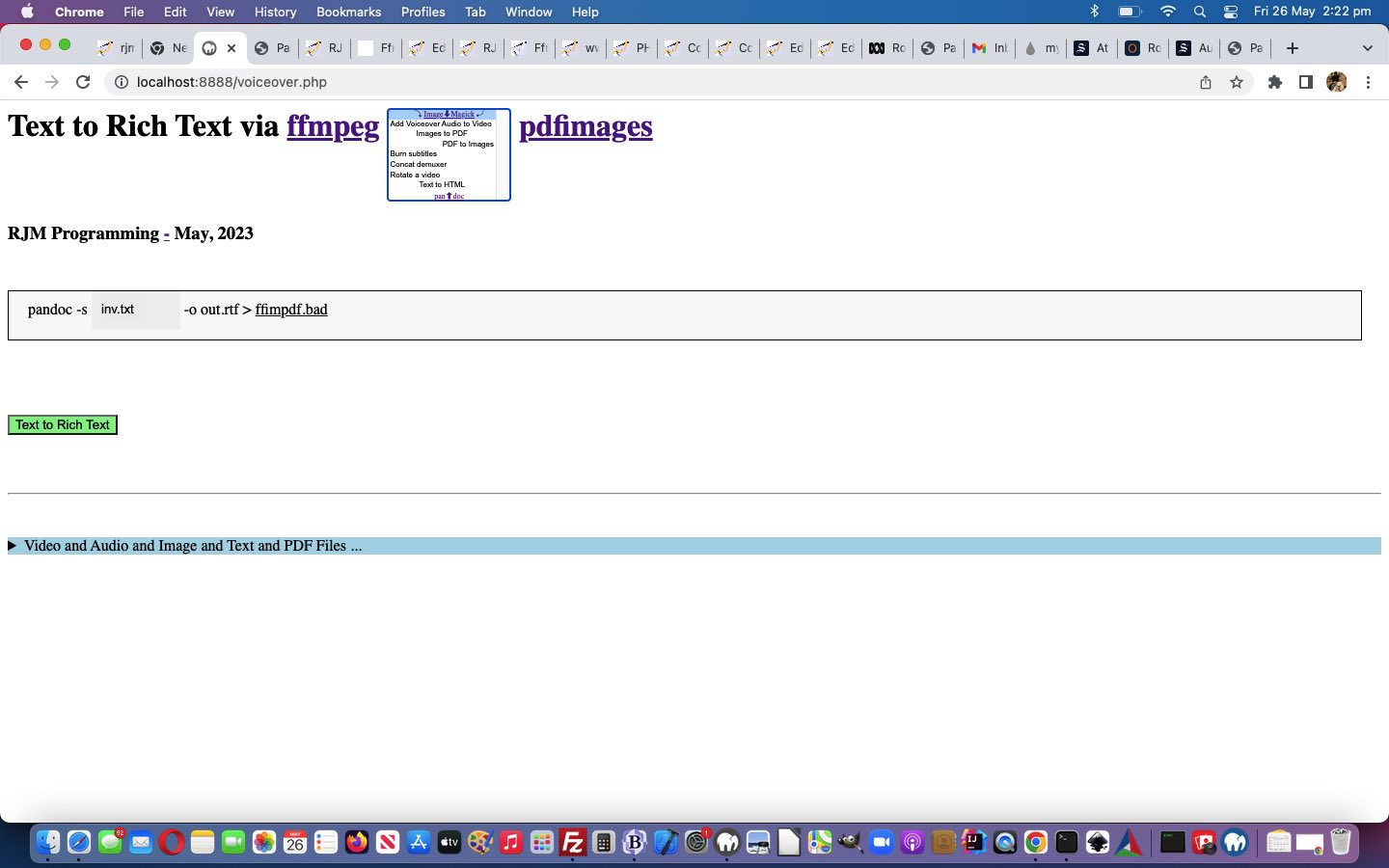
Well, our wish to “shell peas” setting up more ffmpeg media options based on the excellent FFmpeg cheat sheet, thanks, today, had its ups and downs for speed of progress, but, yes, to have a solid “framework” to work within, that you are happy with, barring those tweaks you inevitably discover in projects as they gain complexity, is the best first endeavour you might need to do, to feel more relaxed about the parts of the project requiring that third party expertise, which it is your job to test that you have successfully merged into the project. And so, onto yesterday’s Ffmpeg and Pandoc and ImageMagick and Pdfimages Dropdown Linear Gradient Tutorial, we have included new …
?>
<?php echo ”
var ffstr=' Concat demuxer, Display the frame number on each frame, Trimming, Delay video, Delay audio, Extract a frame per second, Extract the frames from a video, Mute some of the audio, Extract one frame, Create a video slideshow from images,', offstr=null, kffstr=0, affstr=[];
//
// And then ... later ...
//
if (newv == 'Trimming') {
document.getElementById('minusi').innerHTML='-r 1/5 -i ';
document.getElementById('minusi').title='Parameter -r marks the image framerate (inverse time of each image); -vf fps=25 marks the true framerate of the output';
document.getElementById('sswitches').innerHTML='-ss 00:00:10.000<span id=svframes contenteditable=false> -vframes 1 </span>';
document.getElementById('sswitches').title='Extract one frame at 10 second mark';
document.getElementById('mysub').value=newv;
}
“; ?>
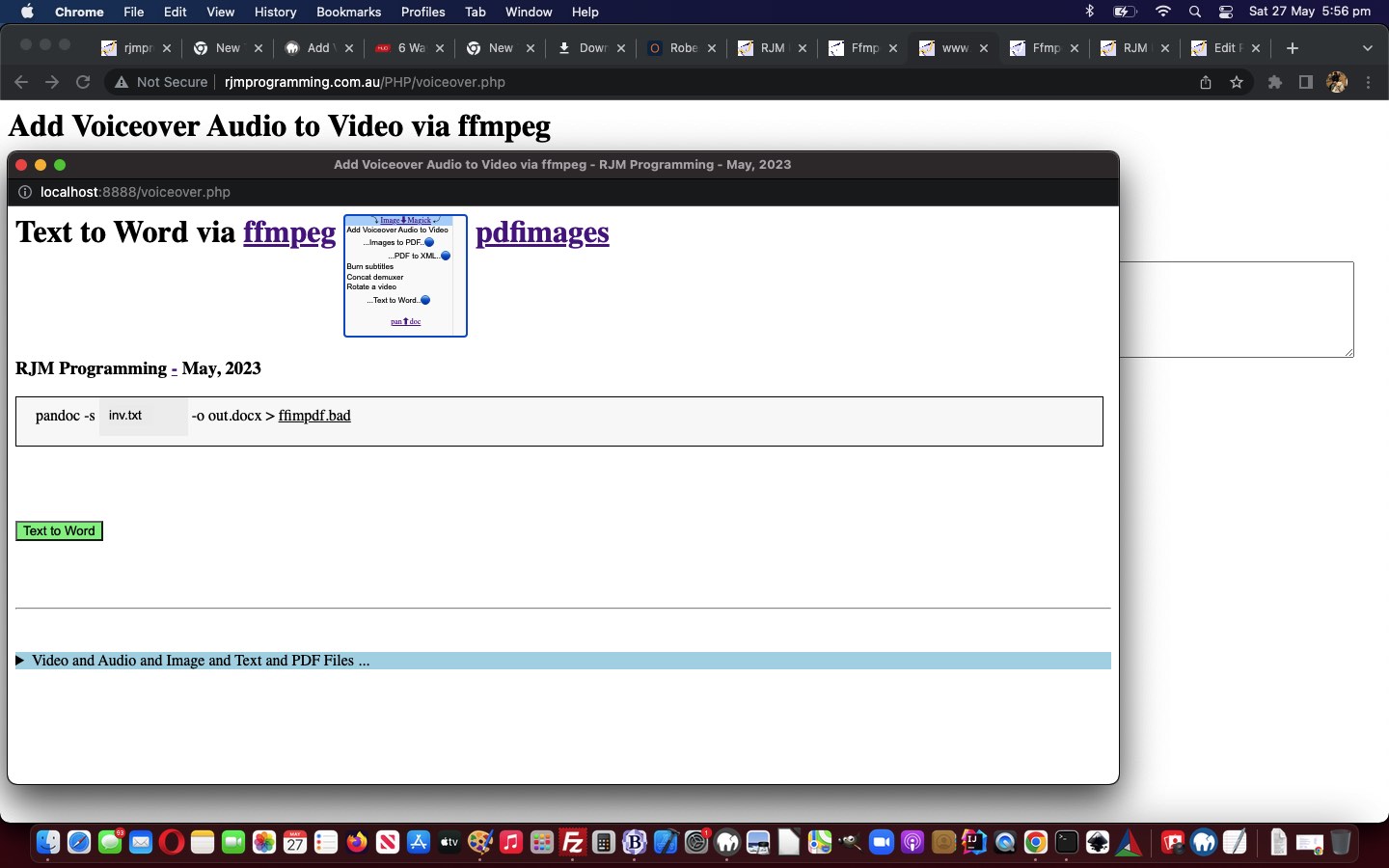
… ffmpeg media functionality talents for you to try yourself, today, in the changedvoiceover.php PHP (we’d want you to download to a local MAMP Apache web server’s Document Root folder and which you can run that PHP there).
it is hard to “hover swipe” with no linework to show where one option starts and another ends, in Y (or top) co-ordinates … and …
the user has trouble knowing whether their swipe attempt worked
… for which we supply ideas …
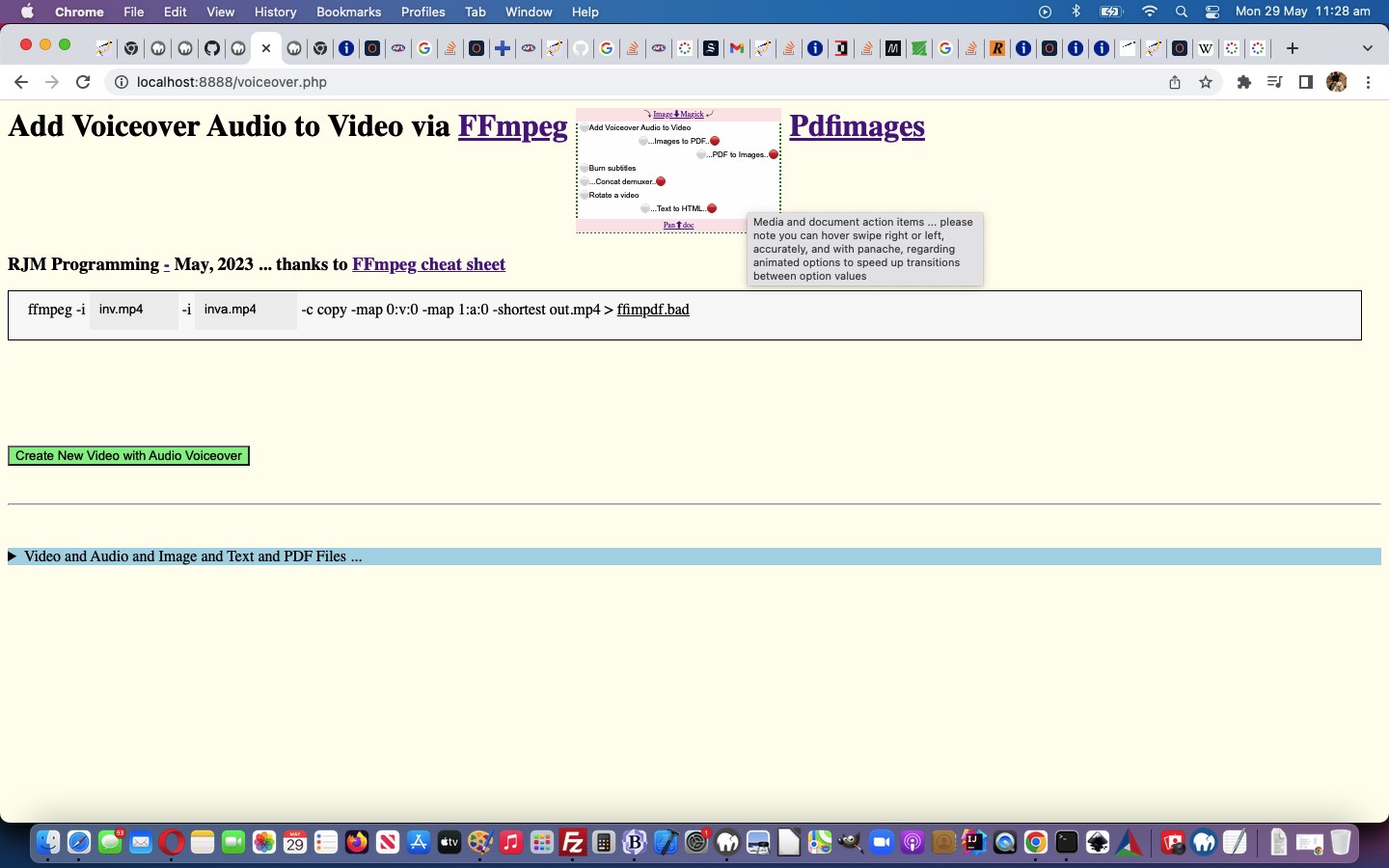
linear-gradient background, in the form of a colourful “underlay” div element under (now transparent backgrounded) select (ie. dropdown) element (and associated “overlay” div) … and …
emoji for swipe left ⬅ (⬅) and for swipe right ➡ (➡) shown briefly
class a swipe right (if deltax > 0) else swipe left … resulting in …
immediately show next option innerText if swipe right and show previous option innerText if swipe left
… for you to try for yourself …
Media and document action items … please note you can hover swipe right or left, accurately, and with panache, regarding animated options to speed up transitions between option values
Ffmpeg and Pandoc and ImageMagick and Pdfimages Dropdown Onhover Marquee Tutorial
The non-mobile platforms have that useful wooooorrrrllllddd, the “onhover wooooorrrrllllddd” (to be precise) that can be a great partner for Javascript Ajax methodologies. This onhover (actually the “onmouseover”) event is also useful whereby as a user hovers over an HTML element, and that element’s title attribute has a value, then the user can see that value displayed.
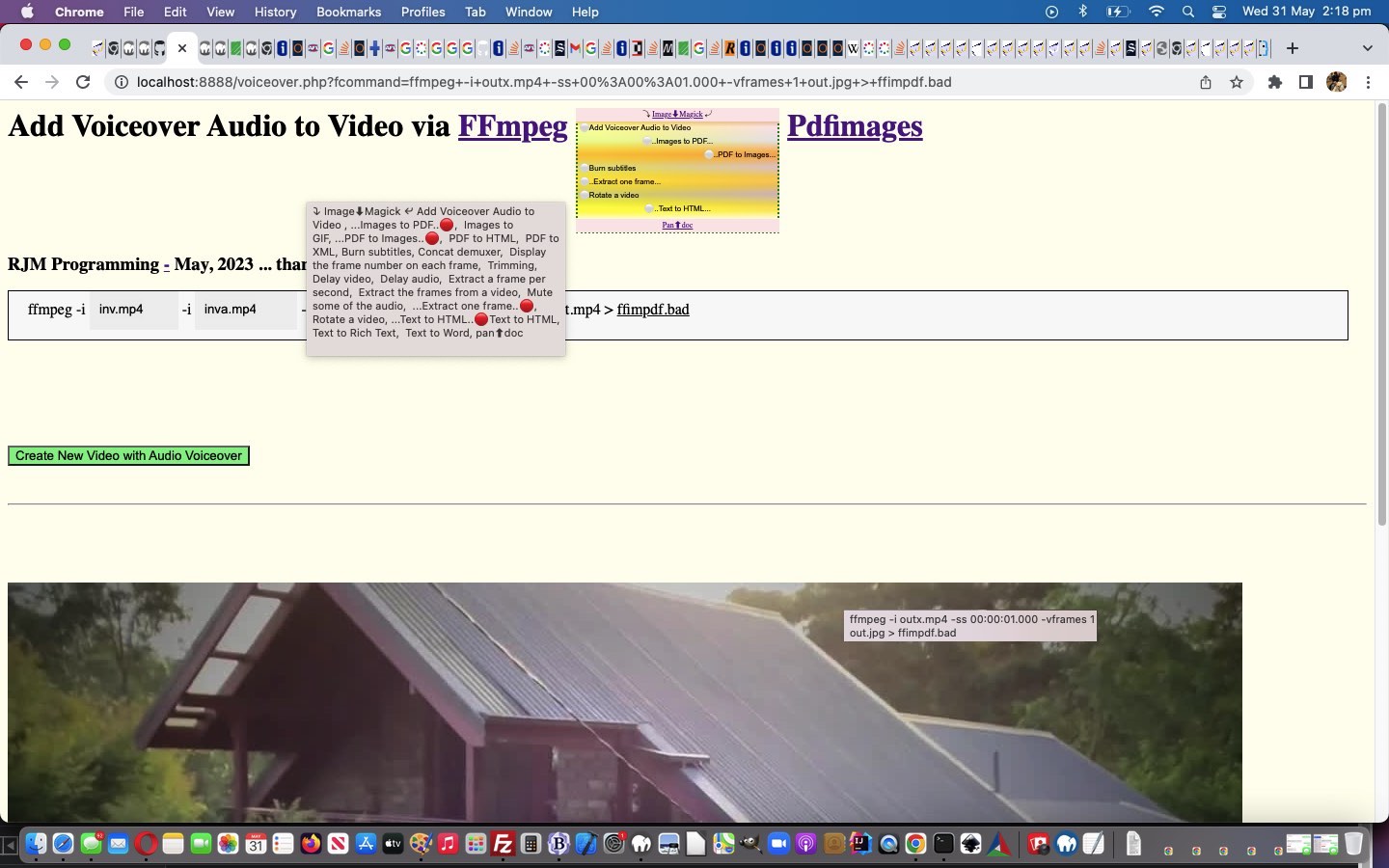
… regarding the dropdown option innerText “look”, there is, for non-mobile, this “onhover wooooorrrrllllddd” we can use to try a form of marquee “look” there, as per …
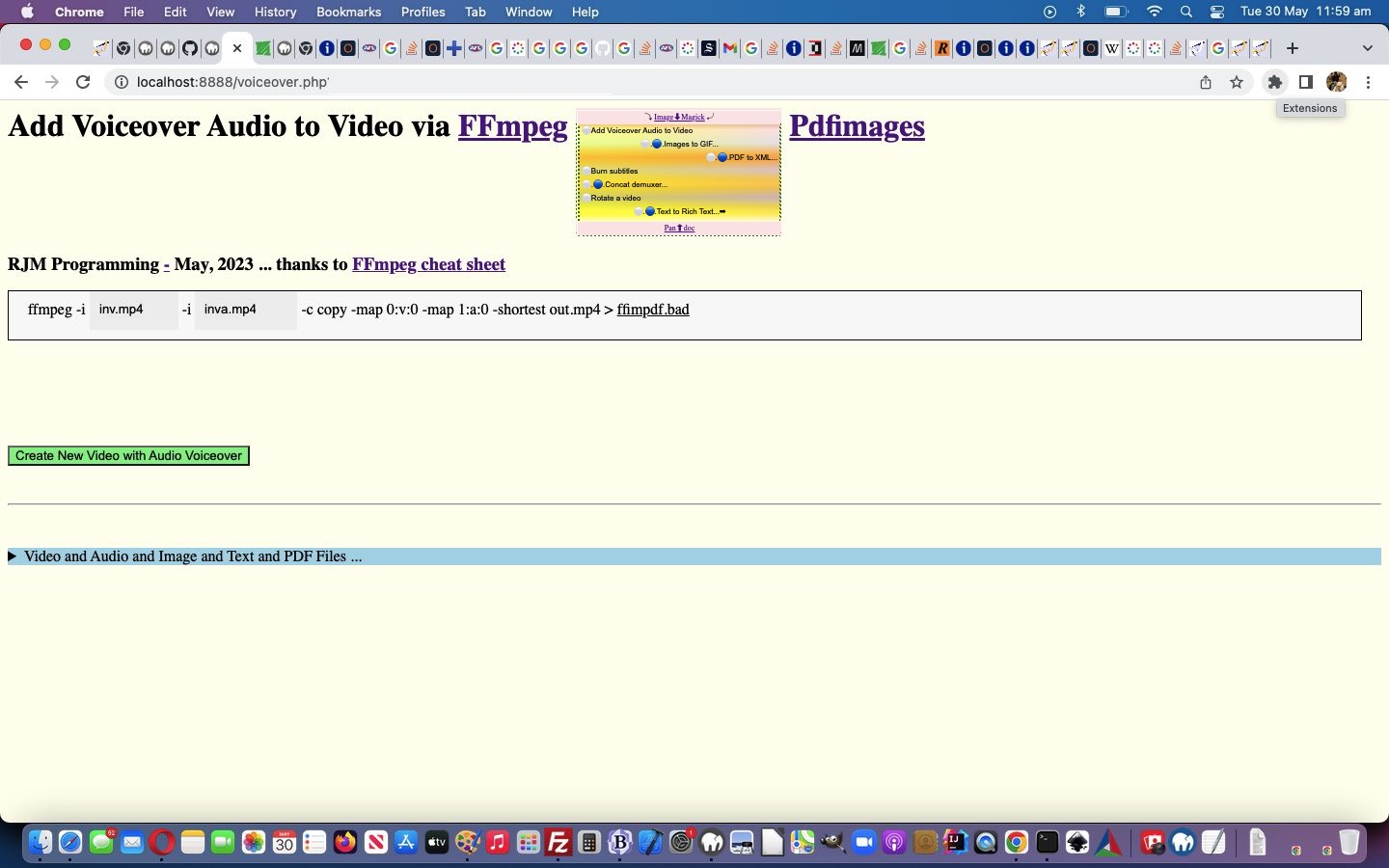
Proof positive that emojis are text, and can help provide a graphic display interest for a webpage. As well, as a CSS means by which we stop “dropdown Y jitteriness”, we introduce the use of an emoji ⚪ (⚪ or ⚪) for most option element Clayton innerText parts, always …
<?php
  var mlook=false, kcnt=0, kprefix='', ksuffix='';

  var imstr='  Images to PDF,  Images to GIF,', oimstr=null, kimstr=0, aimstr=[];

  var pdstr='  PDF to Images,  PDF to HTML,  PDF to XML,', opdstr=null, kpdstr=0, apdstr=[];

  var pastr='  Text to HTML,  Text to Rich Text,  Text to Word,', opastr=null, kpastr=0, apastr=[];

  var ffstr='  Concat demuxer,  Display the frame number on each frame,', offstr=null, kffstr=0, affstr=[];
the wording of option elements within the dropdown … and though we’re not going “full marquee Eat at Joes” we are accentuating “midway”, today, by …
adding emoji 🔵 (🔵) movement to the animation for interest sake, as well as being informative (in that the user can anticipate when the new innerText text will arrive, as the emoji moves from left to right)
… that we team with more instances of multiple animation settings …
<?php echo ”
  var mlook=false, kcnt=0, kprefix='', ksuffix='';

  var imstr='  Images to PDF,  Images to GIF,', oimstr=null, kimstr=0, aimstr=[];

  var pdstr='  PDF to Images,  PDF to HTML,  PDF to XML,', opdstr=null, kpdstr=0, apdstr=[];

  var pastr='  Text to HTML,  Text to Rich Text,  Text to Word,', opastr=null, kpastr=0, apastr=[];

  var ffstr='  Concat demuxer,  ', offstr=null, kffstr=0, affstr=[];
“; ?>
… and a new “between the 8 second setInterval wording refreshes” Javascript function …
function andthen(iidea) {
var outidea=iidea;
var fndpos=-1;
var optsare=document.getElementsByTagName('option'), ioptsare=0;
var iimstr=(imstr.indexOf(',') == -1 ? -1 : outidea.indexOf(imstr.split(',')[0].trim() + ','));
mlook=false;
if (iimstr != -1) {
if ((imstr.split(',')[0].trim() + ',') != imstr.trim()) {
if (document.getElementById('oimagemagick')) {
oimstr=document.getElementById('oimagemagick');
mlook=true;
aimstr=imstr.trim().replace(/\,\ \ /g,',').replace(/\,\ /g,',').replace(/\,$/g,'').split(',');
} else {
for (ioptsare=0; ioptsare<optsare.length; ioptsare++) {
if (optsare[ioptsare].value == imstr.split(',')[0].trim()) {
oimstr=optsare[ioptsare];
mlook=true;
aimstr=imstr.trim().replace(/\,\ \ /g,',').replace(/\,\ /g,',').replace(/\,$/g,'').split(',');
}
}
}
outidea=outidea.replace(imstr.split(',')[0].trim(), imstr.split(',')[0].trim() + '' + (imstr.replace(imstr.split(',')[0],'').trim() + ',').replace(',,',',').replace(/\,$/g,''));
}
}
var ipdstr=(pdstr.indexOf(',') == -1 ? -1 : outidea.indexOf(pdstr.split(',')[0].trim() + ','));
if (ipdstr != -1) {
if ((pdstr.split(',')[0].trim() + ',') != pdstr.trim()) {
if (document.getElementById('opdfimages')) {
opdstr=document.getElementById('opdfimages');
mlook=true;
apdstr=pdstr.trim().replace(/\,\ \ /g,',').replace(/\,\ /g,',').replace(/\,$/g,'').split(',');
} else {
for (ioptsare=0; ioptsare<optsare.length; ioptsare++) {
if (optsare[ioptsare].value == pdstr.split(',')[0].trim()) {
opdstr=optsare[ioptsare];
mlook=true;
apdstr=pdstr.trim().replace(/\,\ \ /g,',').replace(/\,\ /g,',').replace(/\,$/g,'').split(',');
}
}
}
outidea=outidea.replace(pdstr.split(',')[0].trim(), pdstr.split(',')[0].trim() + '' + (pdstr.replace(imstr.split(',')[0],'').trim() + ',').replace(',,',',').replace(/\,$/g,''));
}
}
var ipastr=(pastr.indexOf(',') == -1 ? -1 : outidea.indexOf(pastr.split(',')[0].trim() + ','));
if (ipastr != -1) {
if ((pastr.split(',')[0].trim() + ',') != pastr.trim()) {
if (document.getElementById('opandoc')) {
opastr=document.getElementById('opandoc');
mlook=true;
apastr=pastr.trim().replace(/\,\ \ /g,',').replace(/\,\ /g,',').replace(/\,$/g,'').split(',');
} else {
for (ioptsare=0; ioptsare<optsare.length; ioptsare++) {
if (optsare[ioptsare].value == pastr.split(',')[0].trim()) {
opastr=optsare[ioptsare];
mlook=true;
apastr=pastr.trim().replace(/\,\ \ /g,',').replace(/\,\ /g,',').replace(/\,$/g,'').split(',');
}
}
}
outidea=outidea.replace(pastr.split(',')[0].trim(), pastr.split(',')[0].trim() + '' + (pastr.replace(imstr.split(',')[0],'').trim() + ',').replace(',,',',').replace(/\,$/g,''));
}
}
var iffstr=(ffstr.indexOf(',') == -1 ? -1 : outidea.indexOf(ffstr.split(',')[0].trim() + ','));
if (iffstr != -1) {
if ((ffstr.split(',')[0].trim() + ',') != ffstr.trim()) {
if (document.getElementById('offmpeg')) {
offstr=document.getElementById('offmpeg');
mlook=true;
affstr=ffstr.trim().replace(/\,\ \ /g,',').replace(/\,\ /g,',').replace(/\,$/g,'').split(',');
} else {
for (ioptsare=0; ioptsare<optsare.length; ioptsare++) {
if (optsare[ioptsare].value == ffstr.split(',')[0].trim()) {
offstr=optsare[ioptsare];
mlook=true;
affstr=ffstr.trim().replace(/\,\ \ /g,',').replace(/\,\ /g,',').replace(/\,$/g,'').split(',');
}
}
}
outidea=outidea.replace(ffstr.split(',')[0].trim(), ffstr.split(',')[0].trim() + '' + (ffstr.replace(imstr.split(',')[0],'').trim() + ',').replace(',,',',').replace(/\,$/g,''));
}
}
if (mlook) { setInterval(eatatjoes, 8000); }
return outidea;
}
“; ?>
… helped out via the original setInterval Javascript “eatatjoes” function (all kicked off via modified document.body onload logic document.getElementById(‘mainspan’).title = andthen(document.getElementById(‘schoices’).innerText.replace(/\ \;/g,’ ‘).replace(/\ \ /g,’, ‘)); ), as modified, above.
Ffmpeg and Pandoc and ImageMagick and Pdfimages Animated Dropdown Tutorial
Lemon curry?! Animated dropdown?! What gives? Well, it’s not “shelling peas”, yet!
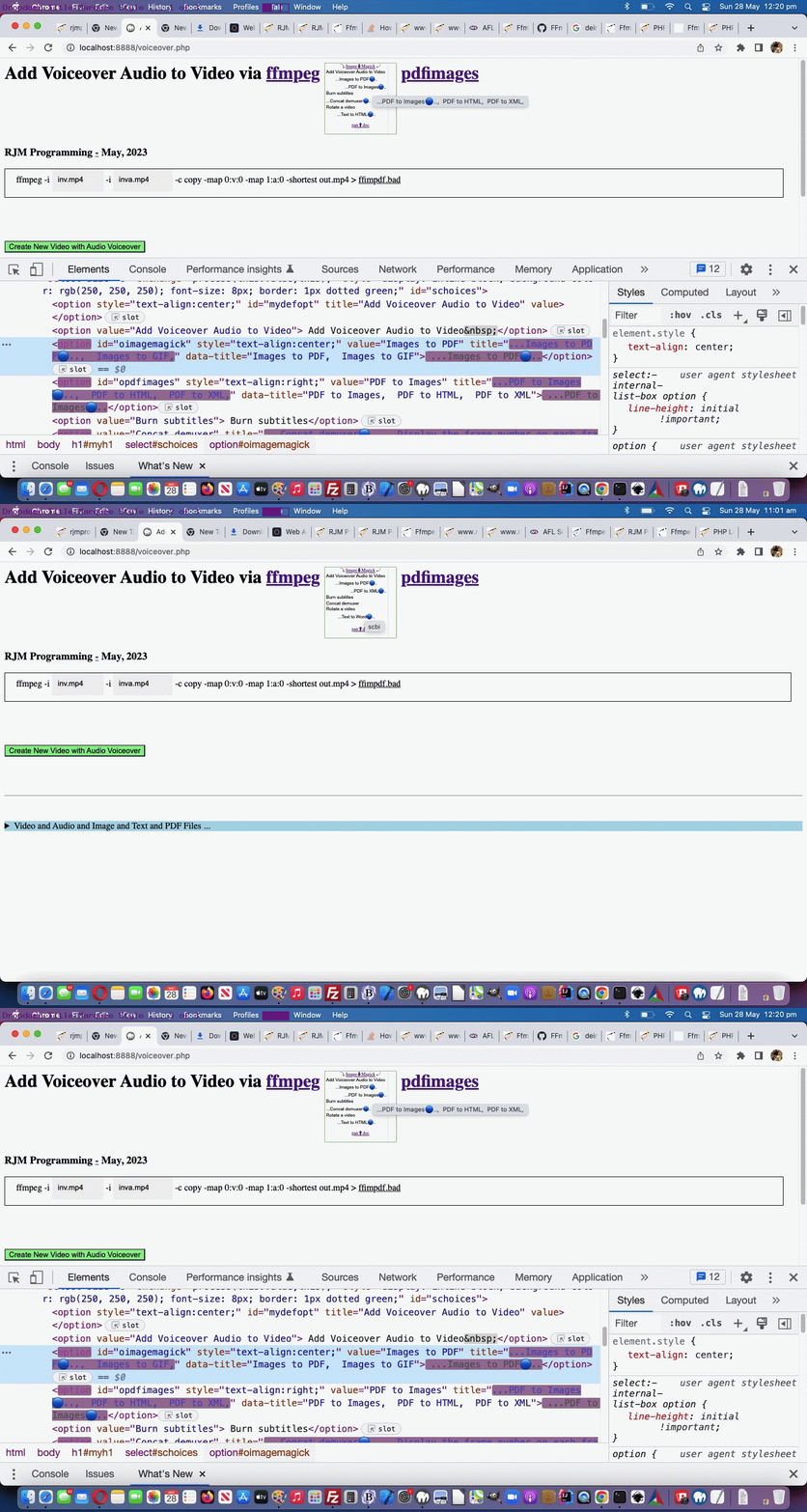
Yes, there is another “framework” step forward we wanted to implement before the peas. And yes, no surprises there, the “framework” work relates to adding functionality to our main dropdown. We’re adding a layer of functionality we’re going to refer to as “animated dropdown”. It amounts to …
has size attribute equal to the number of option elements it contains
logic wise, because our non-nothing option innerTexts have equalled option values (if you Javascript trim() the option innerText, that is), we have the opportunity to start taking more notice of the …
<?php echo ”
  function process(tv, tvo) {

    var newval='';

    var ourtv=tvo.value;

    if (tv != '') {

      ourtv=tvo.options[tvo.selectedIndex].innerText.trim();

    }

    if (origval == '') { origval=document.getElementById('mydefopt').title;  }

    if (tv == '') {

      document.getElementById('mainspan').innerHTML=document.getElementById('mydefopt').title;

    } else {

      document.getElementById('mydefopt').title=ourtv; //tv;

      document.getElementById('mainspan').innerHTML=document.getElementById('mydefopt').title;

      document.getElementById('schoices').value='';

    }

    newval=document.getElementById('mydefopt').title;

    //alert('origval,newval=' + origval + ' ' + newval);

    if (newval != origval) {

      origval=newval;

      wentfrom(origval, newval);

    } else {

      origval=newval;

    }

  }
“; ?>
… option innerHTML as above, meaning …
we can set up Javascript code facilitating the animated feel of some option innerHTML looks that are taken notice of as selected via …
Global variables arranged via each “verb” involved … for today’s “proof of concept” we add one extra Pandoc “Text to Rich Text” option, for now, before the flood of peas arrives …
<?php echo ”
  var mlook=false;

  var imstr='  Images to PDF,  ', oimstr=null, kimstr=0, aimstr=[];

  var pdstr='  PDF to Images,  ', opdstr=null, kpdstr=0, apdstr=[];

  var pastr='  Text to HTML,  Text to Rich Text,', opastr=null, kpastr=0, apastr=[];

  var ffstr='  Concat demuxer,  ', offstr=null, kffstr=0, affstr=[];
“; ?>
As heading title is determined at document.body onload document.getElementById(‘mainspan’).title=andthen(document.getElementById(‘schoices’).innerText.replace(/\ \;/g,’ ‘).replace(/\ \ /g,’, ‘)); …
<?php echo ”
  function andthen(iidea) {

     var outidea=iidea;

     var fndpos=-1;

     var optsare=document.getElementsByTagName('option'), ioptsare=0;

     var iimstr=(imstr.indexOf(',') == -1 ? -1 : outidea.indexOf(imstr.split(',')[0].trim() + ','));

     mlook=false;

     if (iimstr != -1) {

        if ((imstr.split(',')[0].trim() + ',') != imstr.trim()) {

          if (document.getElementById('oimagemagick')) {

             oimstr=document.getElementById('oimagemagick');

             mlook=true;

             aimstr=imstr.trim().replace(/\,\ \ /g,',').replace(/\,\ /g,',').replace(/\,$/g,'').split(',');

          } else {

             for (ioptsare=0; ioptsare<optsare.length; ioptsare++) {

                if (optsare[ioptsare].value == imstr.split(',')[0].trim()) {

                  oimstr=optsare[ioptsare];

                  mlook=true;

                  aimstr=imstr.trim().replace(/\,\ \ /g,',').replace(/\,\ /g,',').replace(/\,$/g,'').split(',');

                }

             }

          }

          outidea=outidea.replace(imstr.split(',')[0].trim(), imstr.split(',')[0].trim() + '' + (imstr.replace(imstr.split(',')[0],'').trim() + ',').replace(',,',',').replace(/\,$/g,''));

        }

     }

     var ipdstr=(pdstr.indexOf(',') == -1 ? -1 : outidea.indexOf(pdstr.split(',')[0].trim() + ','));

     if (ipdstr != -1) {

        if ((pdstr.split(',')[0].trim() + ',') != pdstr.trim()) {

          if (document.getElementById('opdfimages')) {

             opdstr=document.getElementById('opdfimages');

             mlook=true;

             aipdtr=pdstr.trim().replace(/\,\ \ /g,',').replace(/\,\ /g,',').replace(/\,$/g,'').split(',');

          } else {

             for (ioptsare=0; ioptsare<optsare.length; ioptsare++) {

                if (optsare[ioptsare].value == pdstr.split(',')[0].trim()) {

                  opdstr=optsare[ioptsare];

                  mlook=true;

                  apdstr=pdstr.trim().replace(/\,\ \ /g,',').replace(/\,\ /g,',').replace(/\,$/g,'').split(',');

                }

             }

          }

          outidea=outidea.replace(pdstr.split(',')[0].trim(), pdstr.split(',')[0].trim() + '' + (pdstr.replace(imstr.split(',')[0],'').trim() + ',').replace(',,',',').replace(/\,$/g,''));

        }

     }

     var ipastr=(pastr.indexOf(',') == -1 ? -1 : outidea.indexOf(pastr.split(',')[0].trim() + ','));

     if (ipastr != -1) {

        if ((pastr.split(',')[0].trim() + ',') != pastr.trim()) {

          if (document.getElementById('opandoc')) {

             opastr=document.getElementById('opandoc');

             mlook=true;

             apastr=pastr.trim().replace(/\,\ \ /g,',').replace(/\,\ /g,',').replace(/\,$/g,'').split(',');

          } else {

             for (ioptsare=0; ioptsare<optsare.length; ioptsare++) {

                if (optsare[ioptsare].value == pastr.split(',')[0].trim()) {

                  opastr=optsare[ioptsare];

                  mlook=true;

                  apastr=pastr.trim().replace(/\,\ \ /g,',').replace(/\,\ /g,',').replace(/\,$/g,'').split(',');

                }

             }

          }

          outidea=outidea.replace(pastr.split(',')[0].trim(), pastr.split(',')[0].trim() + '' + (pastr.replace(imstr.split(',')[0],'').trim() + ',').replace(',,',',').replace(/\,$/g,''));

        }

     }

     var iffstr=(ffstr.indexOf(',') == -1 ? -1 : outidea.indexOf(ffstr.split(',')[0].trim() + ','));

     if (iffstr != -1) {

        if ((ffstr.split(',')[0].trim() + ',') != ffstr.trim()) {

          if (document.getElementById('offmpeg')) {

             offstr=document.getElementById('offmpeg');

             mlook=true;

             affstr=ffstr.trim().replace(/\,\ \ /g,',').replace(/\,\ /g,',').replace(/\,$/g,'').split(',');

          } else {

             for (ioptsare=0; ioptsare<optsare.length; ioptsare++) {

                if (optsare[ioptsare].value == ffstr.split(',')[0].trim()) {

                  offstr=optsare[ioptsare];

                  mlook=true;

                  affstr=ffstr.trim().replace(/\,\ \ /g,',').replace(/\,\ /g,',').replace(/\,$/g,'').split(',');

                }

             }

          }

          outidea=outidea.replace(ffstr.split(',')[0].trim(), ffstr.split(',')[0].trim() + '' + (ffstr.replace(imstr.split(',')[0],'').trim() + ',').replace(',,',',').replace(/\,$/g,''));

        }

     }

     if (mlook) { setInterval(eatatjoes, 8000); }

     return outidea;

  }
“; ?>
… the appeal of all this being that the dropdown height can be controlled by swapping animation for height extension (and user experience downgrades)
Animated dropdown setInterval Javascript function (bit like marquee Eat at Joes type of animation (we’ll see if it gets more like it into the future, perhaps?)) …
ffmpeg … two more media manipulation “verb” stars today …
ImageMagick (can help us with new “Images to PDF” option)
pdfimages (can help us with new “PDF to Images” option) … “verb” collection, today, we wanted to add …
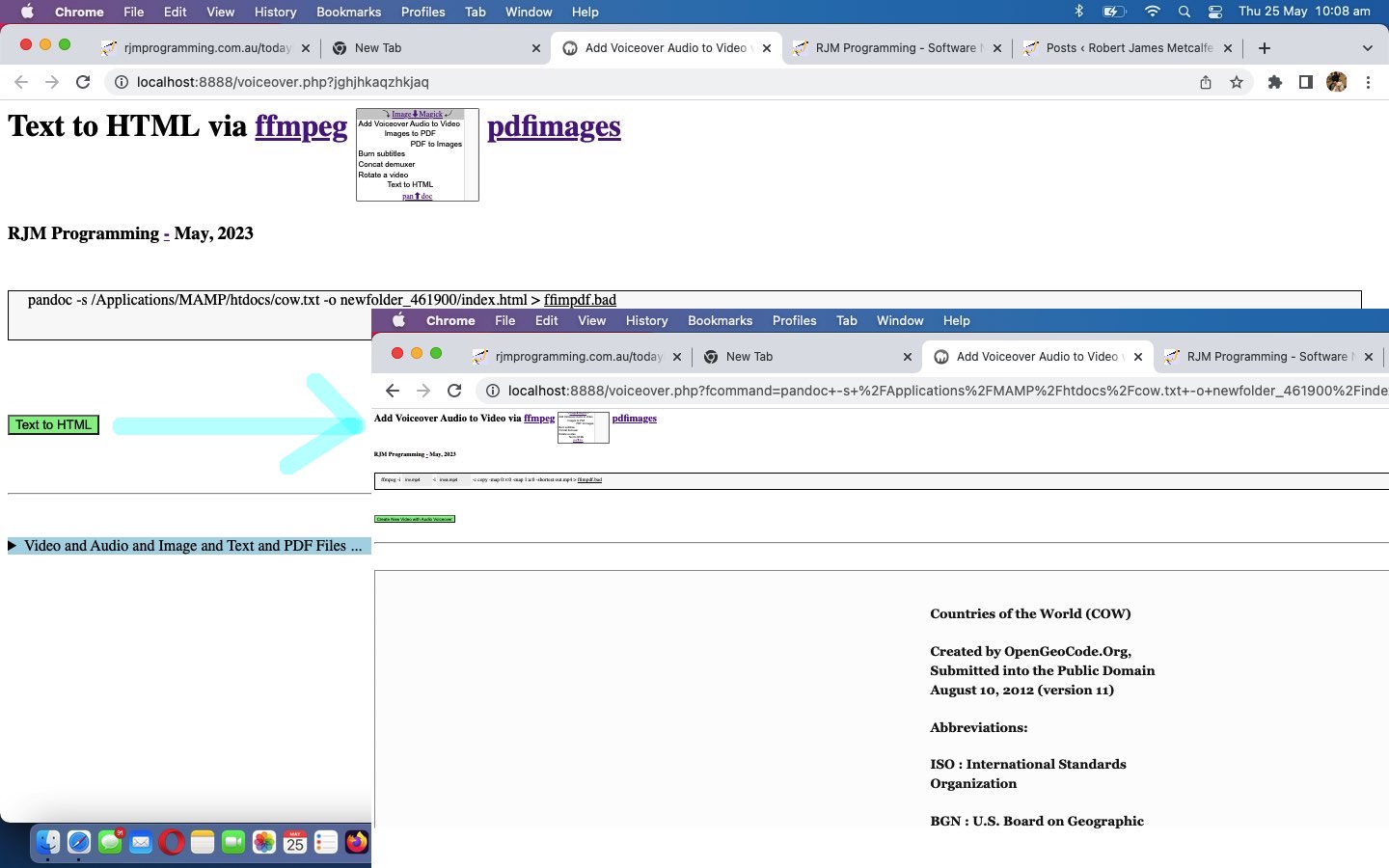
pandoc (can help us with new “Text to HTML” option) …
If you need to convert files from one markup format into another, pandoc is your swiss-army knife.
… to help improve the “one stop shop” aspects, especially regarding “documents”, to our current Intranet feeling web application in the changedvoiceover.php PHP (we’d want you to download to a local MAMP Apache web server’s Document Root folder and which you can run that PHP there).
We now present those four in “an expanded out” (at least on non-mobile) dropdown HTML element. Maybe you can guess why?
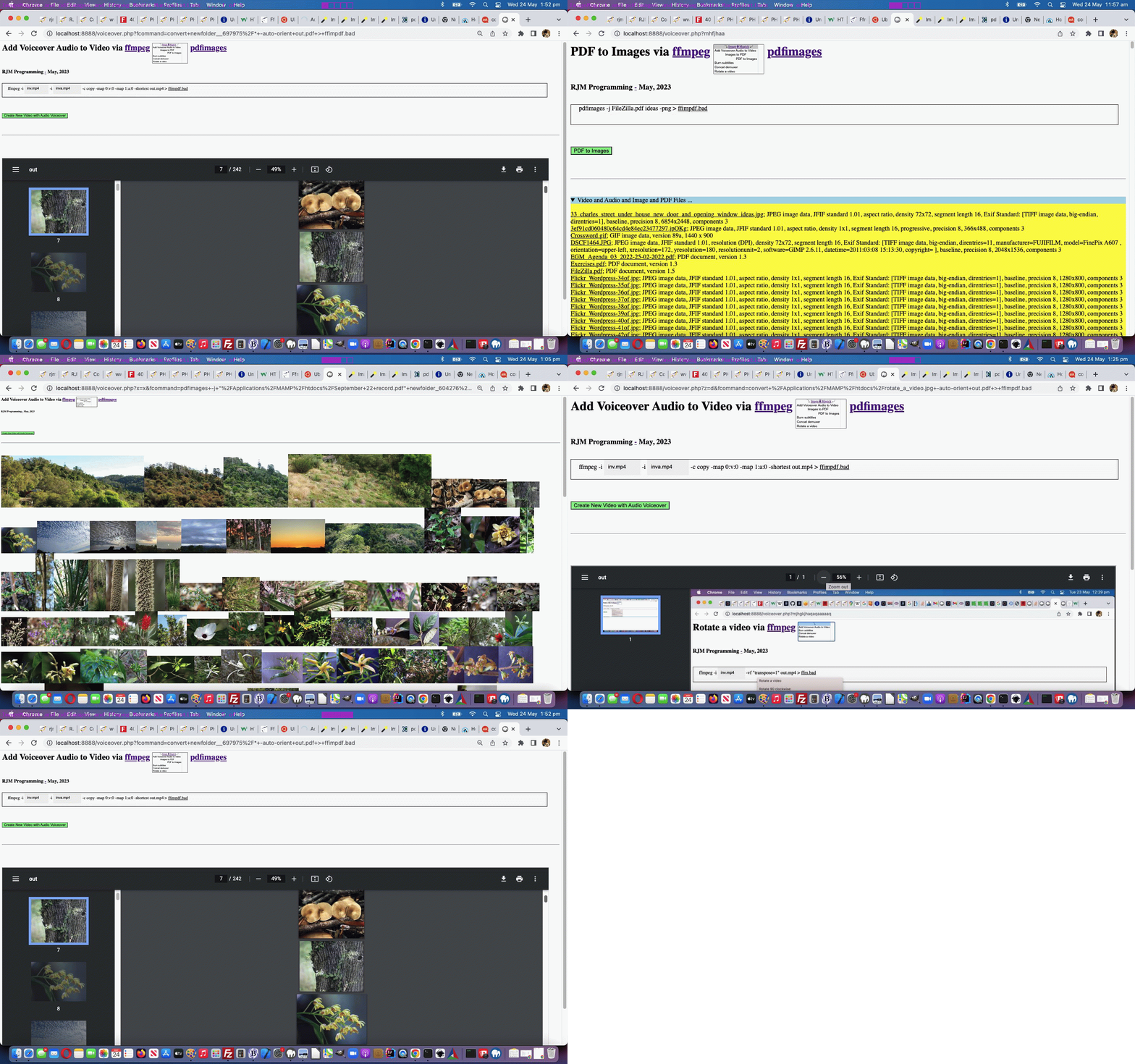
… and today we are deploying the framework parts and two new media manipulation options regarding PDF that add to our PHP web application’s functionality.
Operating system commands can be thought of to start with …
an action item (to be precise a desktop software file specification) … and, what we often think is, like …
the command’s “verb” part (as funny as that is to think of a “noun” sounding desktop software file specification being like a “verb”) … verbs being action items in a sentence … down to being essential in any sentence … to the point a “verb” can be the whole sentence
We want to add functionality by adding to our first “verb” …
ffmpeg … two more media manipulation “verb” stars today …
ImageMagick (can help us with new “Images to PDF” option)
pdfimages (can help us with new “PDF to Images” option)
…
<select size=7 onchange=process(this.value,this); style=display:inline-block;font-size:8px; id=schoices><option style=text-align:center; id=mydefopt title='Add Voiceover Audio to Video' value=''>⤵ Image⬇Magick ⤶</option><option value='Add Voiceover Audio to Video'> Add Voiceover Audio to Video </option><option style='text-align:center;' value='Images to PDF'> Images to PDF</option><option style='text-align:right;' value='PDF to Images'> PDF to Images</option><option value='Burn subtitles'> Burn subtitles</option><option value='Concat demuxer'> Concat demuxer</option><option value='Rotate a video'> Rotate a video</option></select>
… and then in order to offer the “center” ImageMagick be a link back to the product we introduce some new overlay code …
<?php echo ”
function overlay() {
origval=document.getElementById('schoices').value;
var rect=document.getElementById('fcommand').getBoundingClientRect();
document.getElementById('moreb').style.position='absolute';
document.getElementById('moreb').style.left='' + rect.left + 'px';
document.getElementById('moreb').style.top='' + rect.top + 'px';
document.getElementById('moreb').style.width='96%'; //' + rect.width + 'px';
document.getElementById('moreb').style.height='' + rect.height + 'px';
document.getElementById('moreb').style.border='1px solid black';
document.getElementById('moreb').style.paddingLeft='20px';
document.getElementById('moreb').style.backgroundColor='#f9f9f9';
document.getElementById('fcommand').style.opacity='0.0';
document.getElementById('fcommand').style.cursor='pointer';
document.getElementById('moreb').innerHTML='<span id=precmds></span><span id=verb>ffmpeg" . $ffmpegsuf . "</span> <span id=prescbi></span><span id=minusi> -i </span><span id=scbi><iframe onload=checkif(this,\"inv.mp4\"); scrolling=no frameborder=0 id=cbi data-type=file data-value=inv.mp4 data-accept=\"video/*\" style=\"display:inline-block;height:40px;width:92px;vertical-align:middle;\" src=\"/HTMLCSS/client_browsing.htm?d=69075964842271&left=y\"></iframe></span> <span id=betweenis></span> <span id=secondi>-i <span id=scbix><iframe onload=checkiftwo(this,\"inva.mp4\"); scrolling=no frameborder=0 id=cbix data-type=file data-value=inva.mp4 data-accept=\"video/*\" style=\"display:inline-block;height:40px;width:106px;vertical-align:middle;\" src=\"/HTMLCSS/client_browsing.htm?d=69075964842271&right=y\"></iframe></span></span> <span id=sswitches>-c copy -map 0:v:0 -map 1:a:0 -shortest</span> out.mp4 > <a target=_blank title=ffimpdf.bad onclick=getvb(); style=cursor:pointer;text-decoration:underline; data-href=./ffimpdf.bad>ffimpdf.bad</a>';
if (firstdivih == '') { firstdivih=document.getElementById('moreb').innerHTML; }
if (firstbutval == '') { firstbutval=document.getElementById('mysub').value; }
document.getElementById('schoices').style.display='inline-block';
function fhoc() {
var rectx=document.getElementById('schoices').getBoundingClientRect();
document.getElementById('doverlay').style.left='' + rectx.left + 'px';
document.getElementById('doverlay').title=document.getElementById('mydefopt').title;
if (document.getElementById('scbi')) {
if (document.getElementById('scbi').innerHTML.indexOf('<') == -1) {
if (document.getElementById('scbi').innerHTML.trim().indexOf(' ') != -1) {
if (document.getElementById('scbi').innerHTML.trim().indexOf(String.fromCharCode(34)) == -1) {
document.getElementById('scbi').innerHTML=String.fromCharCode(34) + document.getElementById('scbi').innerHTML.trim() + String.fromCharCode(34);
}
}
}
}
if (document.getElementById('scbix')) {
if (document.getElementById('scbix').innerHTML.indexOf('<') == -1) {
if (document.getElementById('scbix').innerHTML.trim().indexOf(' ') != -1) {
if (document.getElementById('scbix').innerHTML.trim().indexOf(String.fromCharCode(34)) == -1) {
document.getElementById('scbix').innerHTML=String.fromCharCode(34) + document.getElementById('scbix').innerHTML.trim() + String.fromCharCode(34);
}
}
}
}
}
“; ?>
Javascript to set up the HTML div contenteditable=true look for these two new options …
<?php echo ”
if (newv == 'PDF to Images') {
document.getElementById('moreb').innerHTML=firstdivih.replace(' out.mp4',' " . $minuspng . "');
document.getElementById('secondi').innerHTML='';
document.getElementById('sswitches').innerHTML=\"<span id=sfolder contenteditable=false>newfolder_" . rand(0,784534) . str_replace("\\","\\\\",$ddn) . "\" + '</span>ideas';
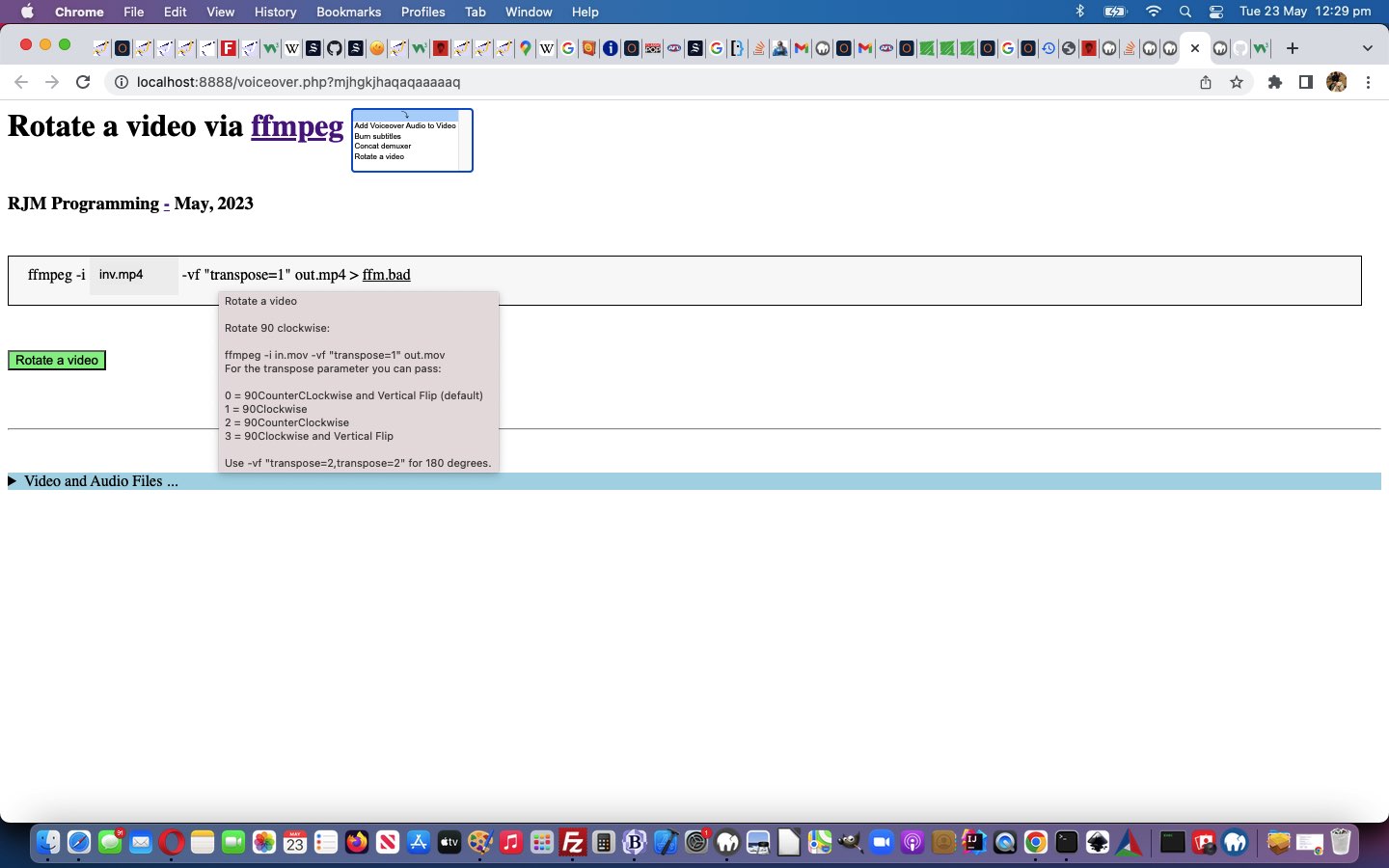
It’s getting closer to “shelling peas”, are today’s “Rotate a video via ffmpeg” changes, but we are not there yet. Yes, most programmers want to be “shelling peas” adding functionality to web applications, once they have set up a framework in which they are happy to work. Yesterday’s Ffmpeg Concat Demuxer Tutorial“defence talk” is getting us closer to that “shelling peas” “homeostasis feel” (with an “Intranet” pike, no doubt?!) as you can see from a Javascript “Rotate a video” code snippet below …
<?php echo ”
if (newv == 'Rotate a video') {
document.getElementById('moreb').innerHTML=firstdivih;
… ffmpeg switch definition, by the user, to changing that 1 above as per the hover over advice, to help the user, straight from Mux Video and Audio from another Video, thanks, to advise …
<?php
$rotateadvice="Rotate a video


Rotate 90 clockwise:


ffmpeg -i in.mov -vf \"transpose=1\" out.mov

For the transpose parameter you can pass:


0 = 90CounterCLockwise and Vertical Flip (default)

1 = 90Clockwise

2 = 90CounterClockwise

3 = 90Clockwise and Vertical Flip


Use -vf \"transpose=2,transpose=2\" for 180 degrees.";
?>
Yes, the user can still put a bad entry there, but at least the web application has attempted to point them in the right direction, here.
If you examine the changes the changedvoiceover.php PHP (we’d want you to download to a local MAMP Apache web server’s Document Root folder and which you can run that PHP there), am sure that you will concur …
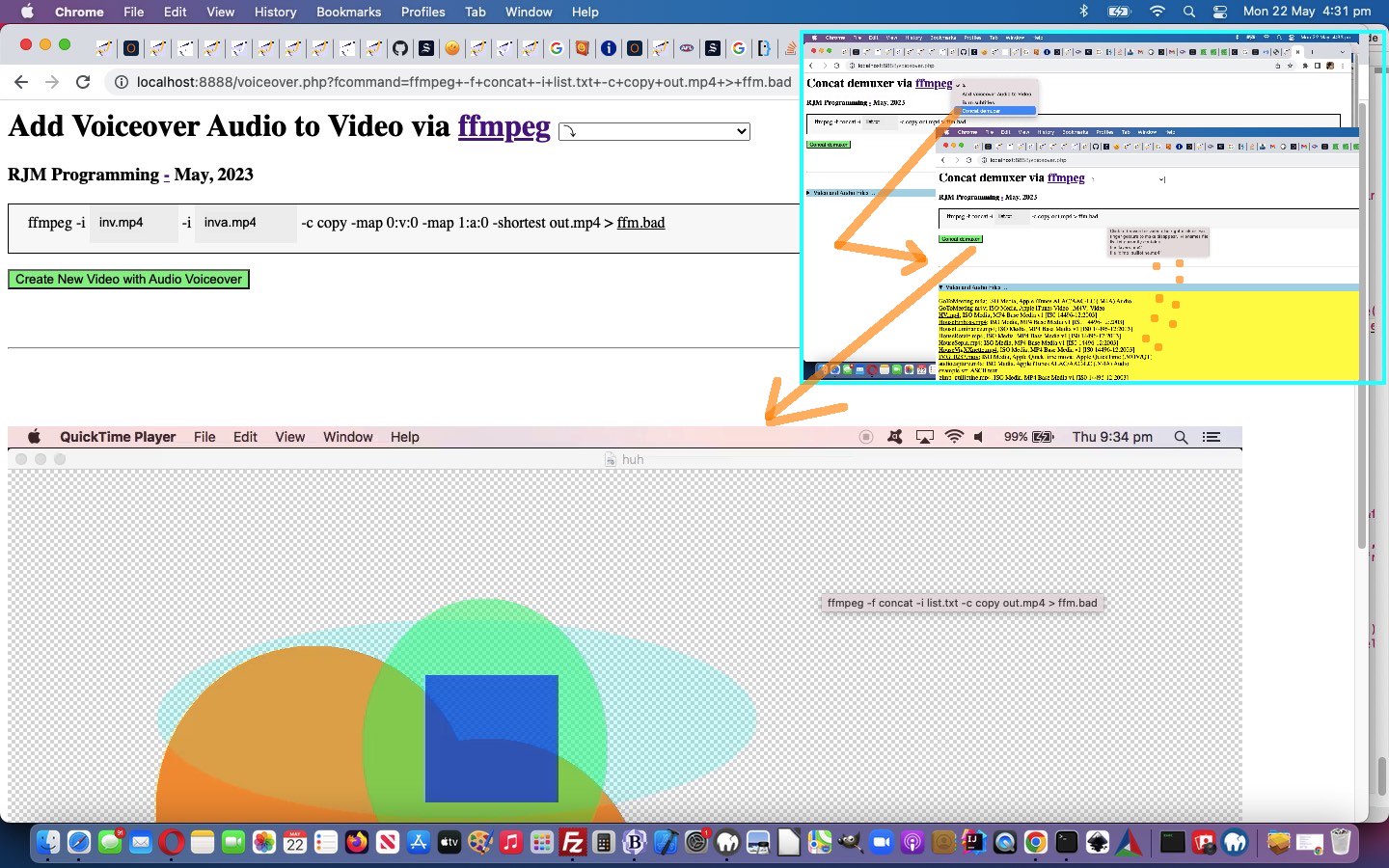
Concat demuxer concatenation of videos ffmpeg functionality, onto the “as of yesterday” …
Voiceovers … and …
Burn subtitles
Rotate a video
… was the simplest functionality component, yet, of the four. We now present those four in “an expanded out” (at least on non-mobile) dropdown HTML element. Maybe you can guess why?
Concat demuxer concatenation of videos ffmpeg functionality, onto the “as of yesterday” …
Voiceovers … and …
Burn subtitles
… progress.
What’s different this time? Well, ffmpeg works the command, we again thank Mux Video and Audio from another Video for (regarding “the plan”), using an interim file …
… and for File API browsing (with our, once again, tweaked inhouse client_browsing.htm) there will be a delay, deriving the file path in “second call PHP”. We handle this by writing two new Javascript functions …
<?php echo ”
var ifile=0, ibfile=0;
function takeoffone() {
ibfile--;
if (ibfile <= 0) {
document.getElementById('mysub').style.cursor='pointer';
} else {
document.getElementById('mysub').style.cursor='progress';
}
}
… available to call from child iframes via parent.takeoneoff(); (from voiceover.php second PHP call) and parent.organizefilenamesize(files[ij].name, files[ij].size); (from client_browsing.htm) respectively, to facilitate a progress cursor on the submit button to remind the user we’d like more time. Along the way, too, we found …
… are the SpongeBob, Patrick, and Squidward of the online woooorrrrllllddd, in an “offence” line of “piecing together an operating system command” thinking, thinking “defence” regarding this we added one (we were pleasantly surprised to discover worked, so as) to have …
div contenteditable=true
spanizing within that div
innerText
mask off parts the programmer wants left untouched via span contenteditable=false
… being like the Hall and Oates meets Everything But the Girl (on a yacht, of course) step back into the ’80s!
The initial inspiration for this current ffmpeg themed series of blog posting was, and still is, Mux Video and Audio from another Video, thanks. So many great ideas, we found, that today we add onto the …
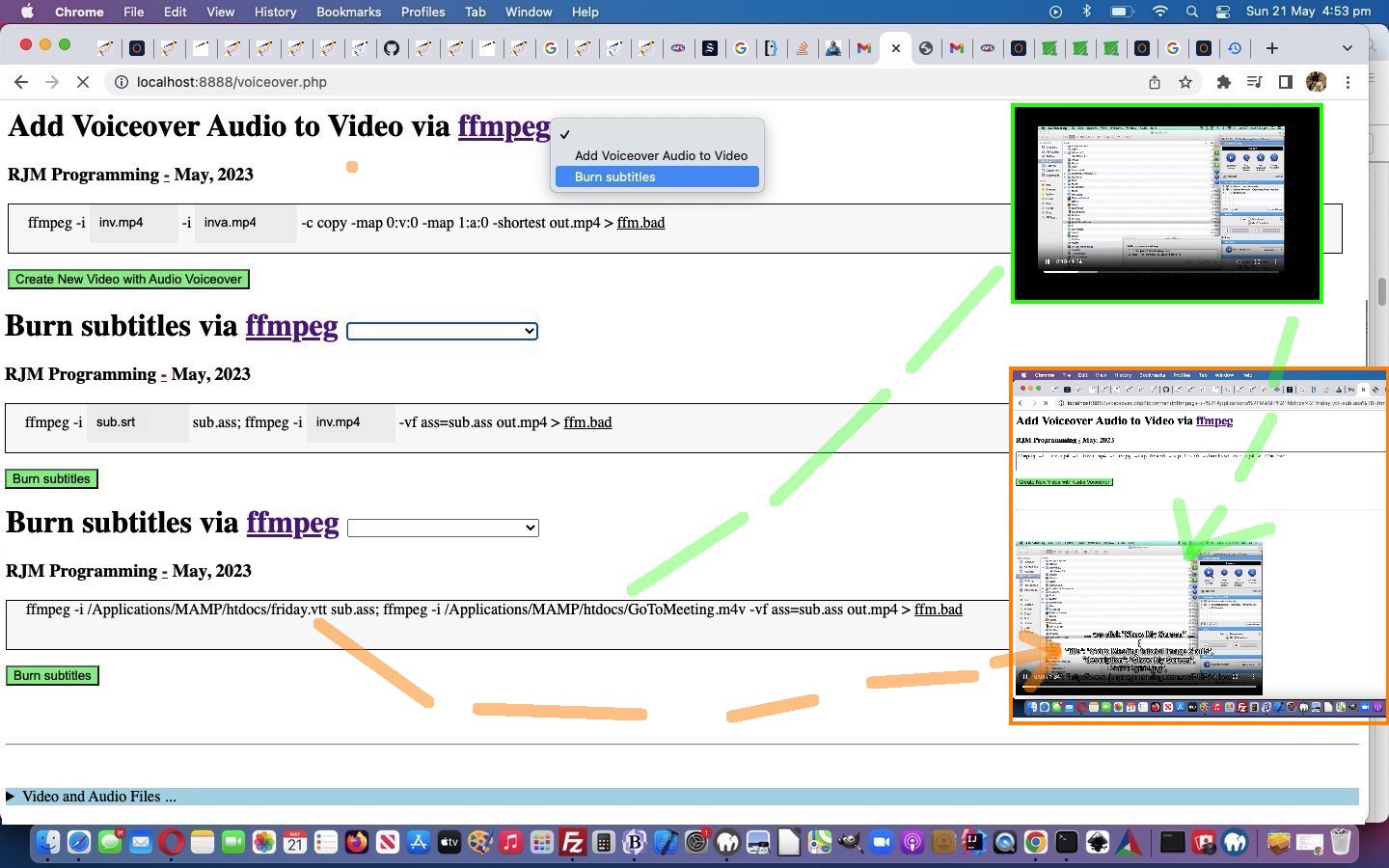
first idea of Voiceovers we’ve established to work with MAMP in macOS and Windows over the previous days, allowing us to now think to add a first suboption idea of …
Burn subtitles … as per our link’s …
Burn subtitles
Use the libass library (make sure your ffmpeg install has the library in the configuration –enable-libass).
First convert the subtitles to .ass format:
ffmpeg -i sub.srt sub.ass
Then add them using a video filter:
ffmpeg -i in.mp4 -vf ass=sub.ass out.mp4
… as a useful video piece of functionality we’d say.
To get this going, easily (from a programming perspective) …
our textarea element remains as the form conduit to the ffmpeg command via the onsubmit event final analysis of the …
underlying div contenteditable=true is “spanned” up a lot more as per …
<?php echo ”
document.getElementById('moreb').innerHTML='<span id=precmds></span><span id=verb>ffmpeg" . $ffmpegsuf . "</span> -i <span id=scbi><iframe onload=checkif(this,\"inv.mp4\"); scrolling=no frameborder=0 id=cbi data-type=file data-value=inv.mp4 data-accept=\"video/*\" style=\"display:inline-block;height:40px;width:92px;vertical-align:middle;\" src=\"/HTMLCSS/client_browsing.htm?d=9075964842271&left=y\"></iframe></span> <span id=betweenis></span> <span id=secondi>-i <span id=scbix><iframe onload=checkiftwo(this,\"inva.mp4\"); scrolling=no frameborder=0 id=cbix data-type=file data-value=inva.mp4 data-accept=\"video/*\" style=\"display:inline-block;height:40px;width:106px;vertical-align:middle;\" src=\"/HTMLCSS/client_browsing.htm?d=9075964842271&right=y\"></iframe></span></span> <span id=sswitches>-c copy -map 0:v:0 -map 1:a:0 -shortest</span> out.mp4 > <a target=_blank title=ffm.bad onclick=getvb(); style=cursor:pointer;text-decoration:underline; data-href=./ffm.bad>ffm.bad</a>';
“; ?>
… and at the onsubmit event Javascript the innerText attribute usage makes it fairly easy to say …
<?php echo ”
  function mergechanges() {

     if (document.getElementById('scbi').innerHTML.indexOf('<') == -1) {

       if (document.getElementById('precmds').innerHTML != '') {

       document.getElementById('fcommand').value=document.getElementById('moreb').innerText;

       } else {

       document.getElementById('fcommand').value=document.getElementById('fcommand').value.replace(' inv.mp4 ', ' ' + document.getElementById('scbi').innerHTML + ' ');

       }

       //alert('not oops ' + document.getElementById('fcommand').value);

     } //else {

       //alert('oops');

     //}

     if (document.getElementById('scbix').innerHTML.indexOf('<') == -1) {

       //alert('zoops');

       document.getElementById('fcommand').value=document.getElementById('fcommand').value.replace(' inva.mp4 ', ' ' + document.getElementById('scbix').innerHTML + ' ');

     }

     if (document.getElementById('moreb').innerText.indexOf(' -c ') != -1 && document.getElementById('fcommand').value.indexOf(' -c ') != -1) {

      //alert('azoops');

      if (document.getElementById('moreb').innerText.split(' -c ')[1] != document.getElementById('fcommand').value.split(' -c ')[1]) {

       //alert('bzoops');

       document.getElementById('fcommand').value=document.getElementById('fcommand').value.split(' -c ')[0] + ' -c ' + document.getElementById('moreb').innerText.split(' -c ')[1];

      }

     }

     return true;

  }
“; ?>
… to slice through that “span” complexity like margarine (or butter that’s been left out on a hot day for approximately 7 hours 17 minutes 23 seconds)
… to work out a file path when supplied a file base name and a file size and you call as above with starting folders. That works well (for deriverability (if that is a word!)) in the “cmd” window but not when called under the auspices of PHP exec or shell_exec. It could be that you lose a lot of a Windows user environment when asking PHP to do some operating system work.
… was “only partially” the story. We found out that that ” | find ” command piping could cause problems on Windows MAMP using shell_exec or exec to do some operating system functionality. But before your enthusiasm oozes over the edges, Windows “forfiles” is still very hard to get working with PHP shell_exec or exec, even using PHP to perform that ” | find ” filtering of results.
Ffmpeg Mux Video and Audio Windows Media Browsing Tutorial
You know it’s “Intranet feely land”?
You look out the train window (tee hee) and see macOS racing through their usual routine.
Of course you’ll pick the buffet car containing the rice bubbles ahead of the vegemite corn flakes?!
But do we need to reiterate that in “Intranet feely land” you’ve got your macOS typose of work not suiting “arch Windows” methodologies? Take the case of …
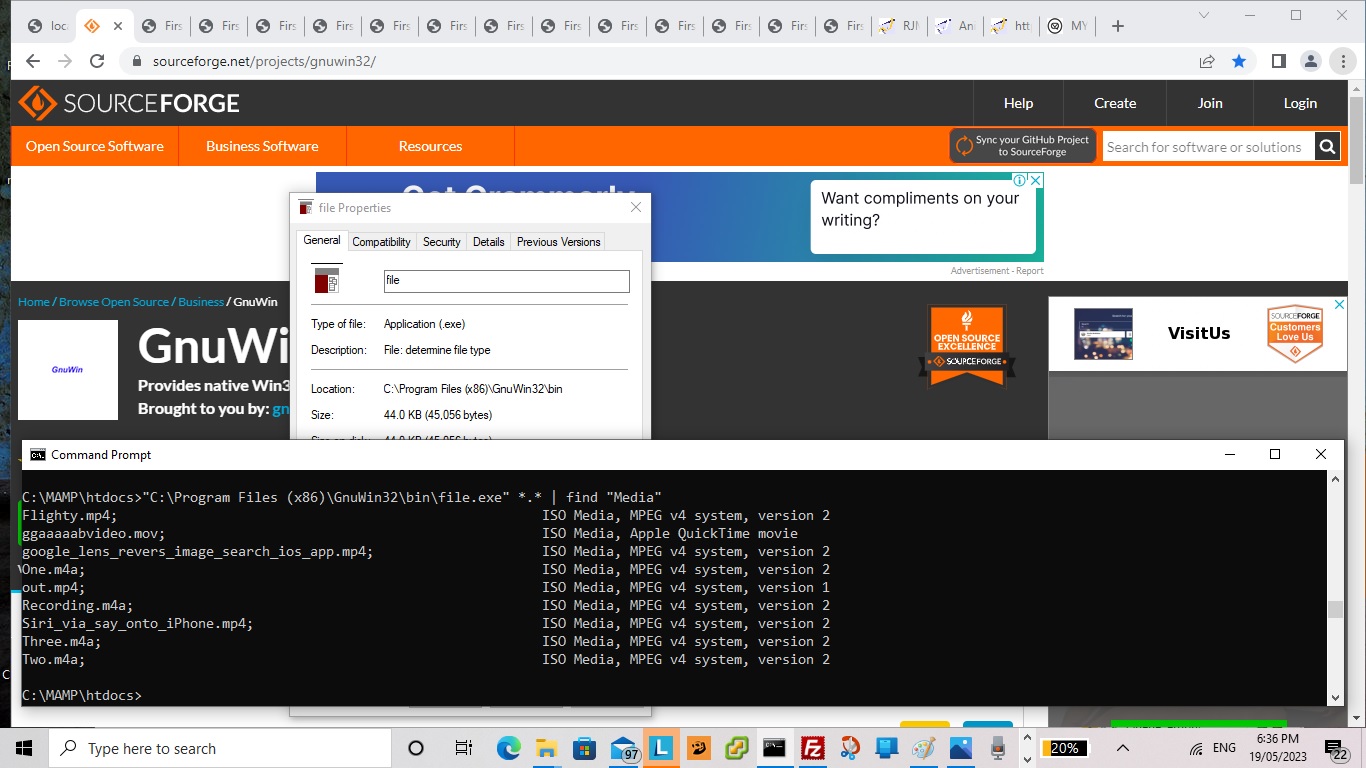
At least, with macOS MAMP there is the excellent command line “file” we can use to show information about some potential input files you could use in this, so far, user unfriendly, “first draft” version of the PHP.
I command thee mux, hey you, with audible you, over yonder, by dale and meadow be, yea!
… when it occurred to us we could turn the base filename parts of those “file.exe” reports into links that when clicked mapped those clicked files into place into the “ffmpeg” command being developed above (as alternative input file designator idea to browsing or div contenteditable=true typing ways), in the changedvoiceover.php PHP (we’d want you to download to a local MAMP Apache web server’s Document Root folder) and which you can run that PHP there.
There be a flowerin’ of inner warmth and glo’ towards all our readers, youngins and oldins alike … like!
Yes, we’re involving good ol’ HTML5 File API Object Javascript logic, so our “Intranet” savvy downloaders out there …
Full o’ inner warmth and glo’ towards each other … like!
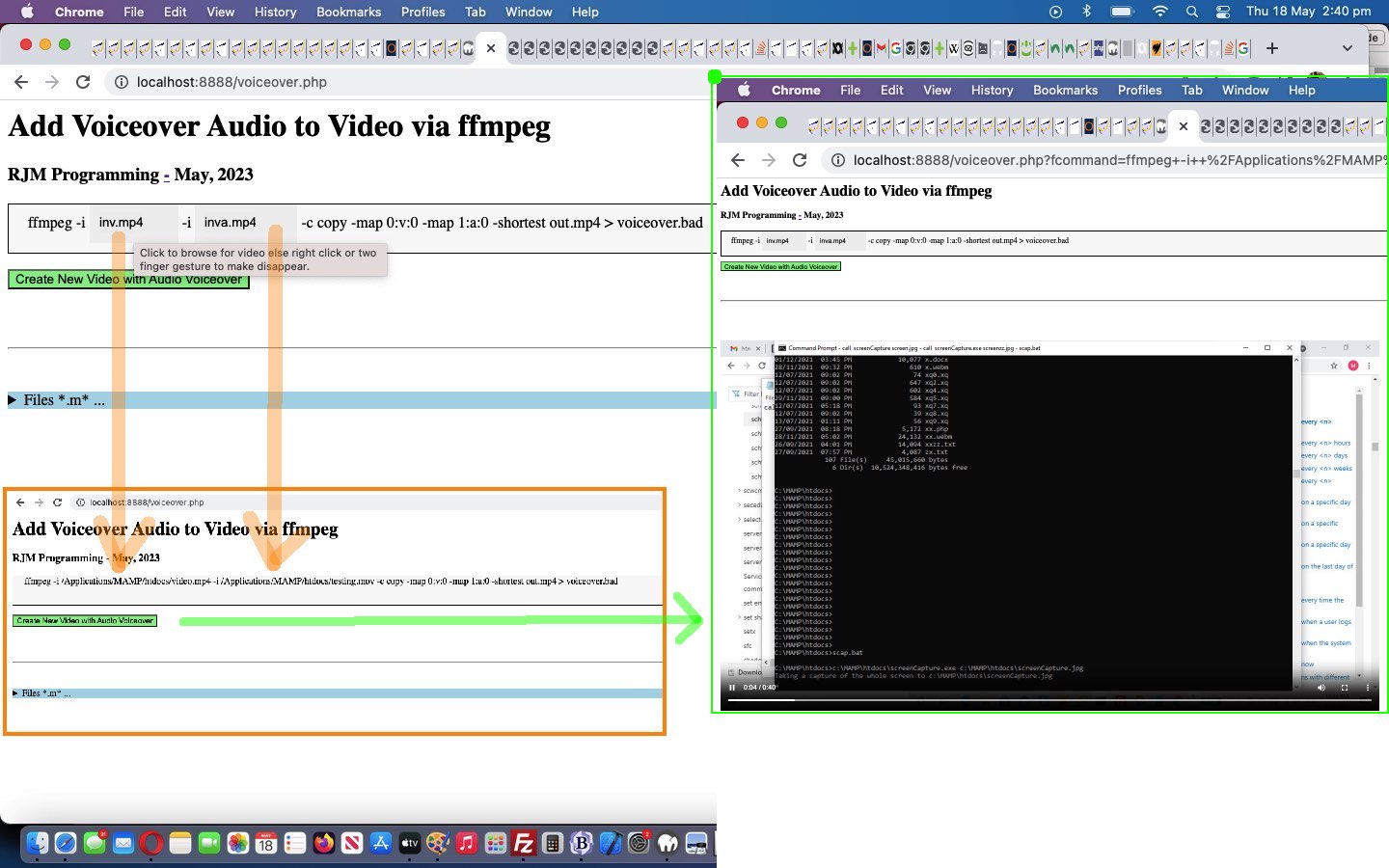
… can easily browse for their two media input files, and for the first time ever integrating our ever tweaked inhouse client_browsing.htm (also a standalone proposition) (we’d like you to download to MAMP Document Root’s HTMLCSS subfolder) we add “oncontextmenu” event changes to its input type=file browser hosting parent iframe element onload event Javascript function as per …
<?php echo ”
  var voaf='', voaftwo='';


  function checkif(iois, ival) {

    if (iois.src.indexOf('?d=') != -1) {

    var aconto = (iois.contentWindow || iois.contentDocument);

    if (aconto != null) {

       if (aconto.document) { aconto = aconto.document; }

       if (aconto.getElementById('files')) {

         if (voaf == '') {

         voaf=iois.src;

         iois.setAttribute('data-parentspan', 's' + ival.replace('inv.mp4','cbi').replace('inva.mp4','cbix'));

         document.getElementById('myh1').title='s' + ival.replace('inv.mp4','cbi').replace('inva.mp4','cbix');

         document.getElementById('myh1').setAttribute('data-url', iois.src);

         setInterval(voaff, 1000);

         } else if (voaftwo == '') {

         voaftwo=iois.src;

         iois.setAttribute('data-parentspan', 's' + ival.replace('inv.mp4','cbi').replace('inva.mp4','cbix'));

         document.getElementById('myh3').title='s' + ival.replace('inv.mp4','cbi').replace('inva.mp4','cbix');

         document.getElementById('myh3').setAttribute('data-url', iois.src);

         //alert(iois.id + ' data-parentspan=' + iois.getAttribute('data-parentspan'));

         }

         //alert(iois.id + ' data-parentspan=' + iois.getAttribute('data-parentspan'));

         aconto.getElementsByTagName('h1')[0].style.opacity='0.0';

         //alert('here');

         aconto.getElementById('files').style.position='absolute';

         aconto.getElementById('files').style.left='0px';

         aconto.getElementById('files').style.top='0px';

         aconto.getElementById('files').style.zIndex='99';

         aconto.getElementById('files').style.marginLeft='10px';

         aconto.getElementById('files').style.marginTop='8px';

         aconto.getElementById('files').style.visibility='visible';

         aconto.getElementById('files').style.display='block';

         aconto.getElementById('files').style.backgroundColor='#eeeeee';

         aconto.getElementById('files').setAttribute('data-hostcont', ival);

         aconto.getElementById('files').setAttribute('data-hostspan', 's' + ival.replace('inv.mp4','cbi').replace('inva.mp4','cbix'));

         aconto.getElementById('files').oncontextmenu = function(event) { var suf=event.target.getAttribute('data-hostspan');  parent.document.getElementById(suf).innerHTML=\"" . str_replace("\\","\\\\",dirname(__FILE__) . DIRECTORY_SEPARATOR) . "\" + event.target.getAttribute('data-hostcont');  }

         if (ival == 'inv.mp4') {

           aconto.getElementById('files').accept='video/*';

           aconto.getElementById('files').title='Click to browse for video else right click or two finger gesture to make disappear.';

         } else {

           aconto.getElementById('files').accept='video/*,audio/*';

           aconto.getElementById('files').title='Click to browse for video or audio else right click or two finger gesture to make disappear.';

         }

         //alert('there');

         aconto.getElementById('dwstyle').innerHTML+=\"<style> #files::before { content: '\" + ival + \"'; } </style>\";

       }

    }

    }

  }
“; ?>
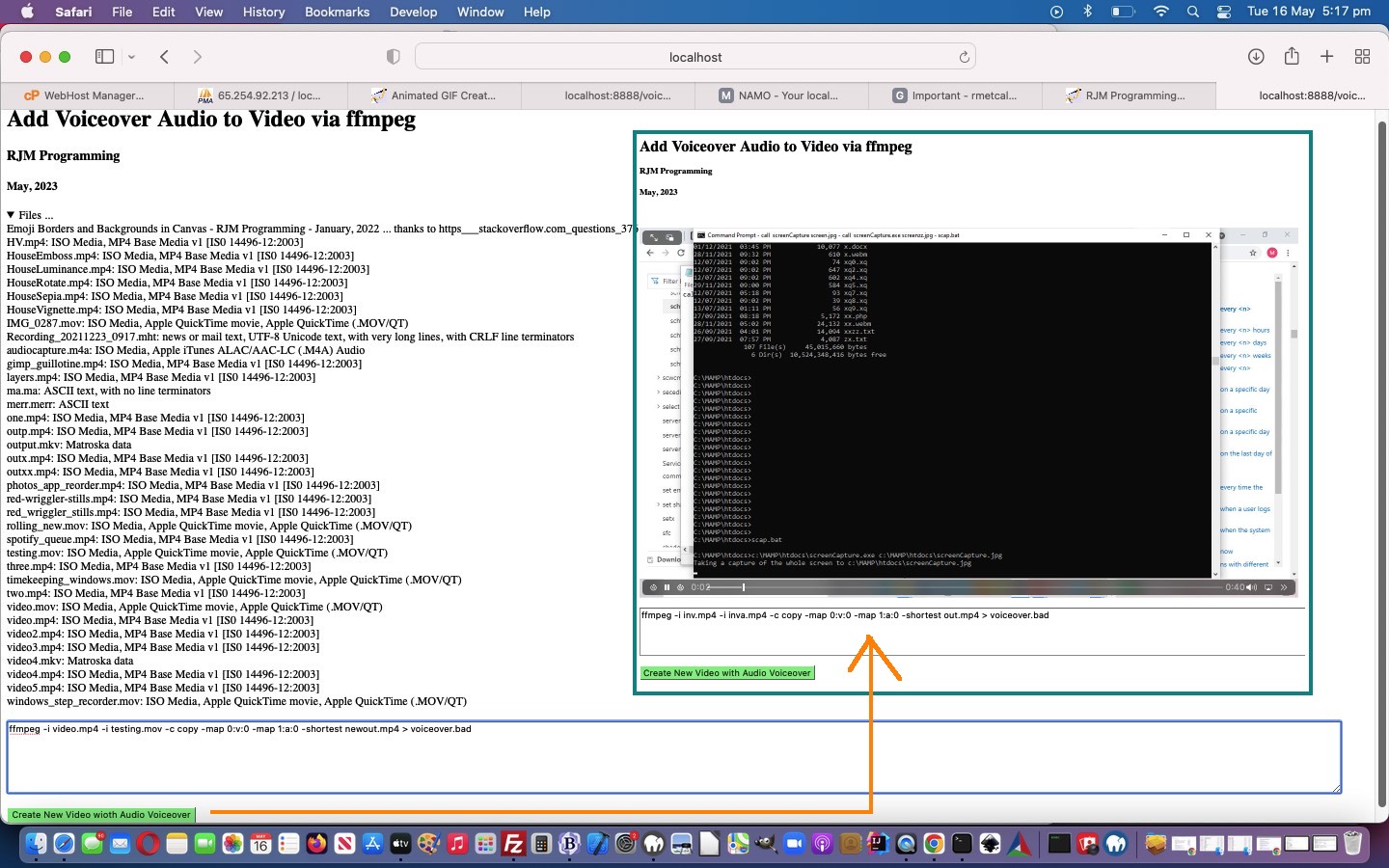
… to allow a user who prefers the overlayed div contenteditable=true alternative (which speaks back to the HTML form textarea conduit when that form’s “onsubmit” event is called) onto yesterday’s exclusively textarea methodology …
… reign supreme collecting their media file specification information in the changedvoiceover.php PHP (we’d want you to download to a local MAMP Apache web server’s Document Root folder) and which you can run that PHP there.
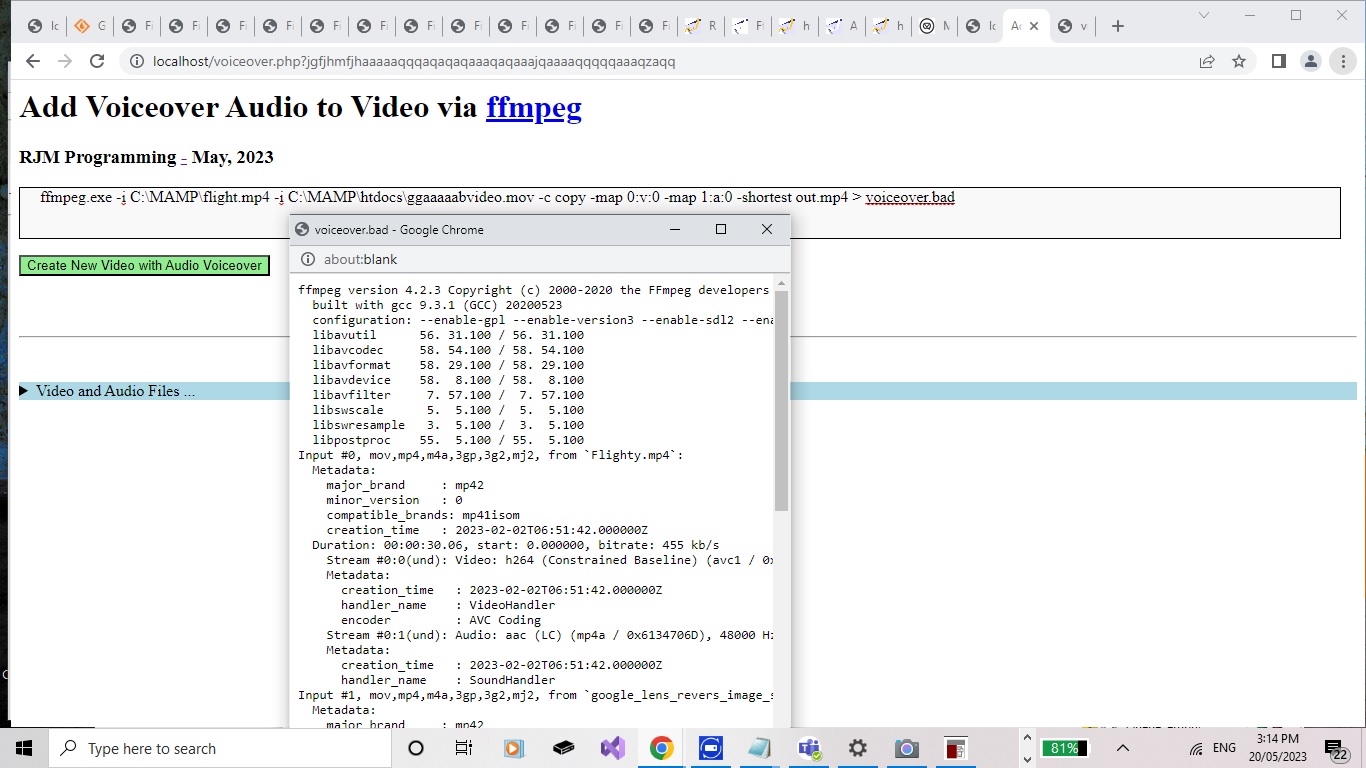
The previous work of Animated GIF Creation Install Paths Tutorial‘s thread of blog postings has been a great help with this ffmpeg “Intranet feeling” integration work we use, around here, in conjunction with macOS or Windows operating system MAMP Apache local web server environments.
We’ve got another “Intranet feeling” PHP web application “first draft” for you today. The reason we’re opting for “Intranet feeling” (ie. we’re asking you to download the voiceover.php PHP to a local MAMP Apache web server and run the PHP there from its Document Root folder) is that we want to further explore the brilliant …
At least, with macOS MAMP there is the excellent command line “file” we can use to show information about some potential input files you could use in this, so far, user unfriendly, “first draft” version of the PHP.
If this was interesting you may be interested in this too.
If this was interesting you may be interested in this too.
If this was interesting you may be interested in this too.
If this was interesting you may be interested in this too.
If this was interesting you may be interested in this too.
If this was interesting you may be interested in this too.
If this was interesting you may be interested in this too.
If this was interesting you may be interested in this too.
If this was interesting you may be interested in this too.
If this was interesting you may be interested in this too.
If this was interesting you may be interested in this too.
If this was interesting you may be interested in this too.
If this was interesting you may be interested in this too.
If this was interesting you may be interested in this too.
If this was interesting you may be interested in this too.