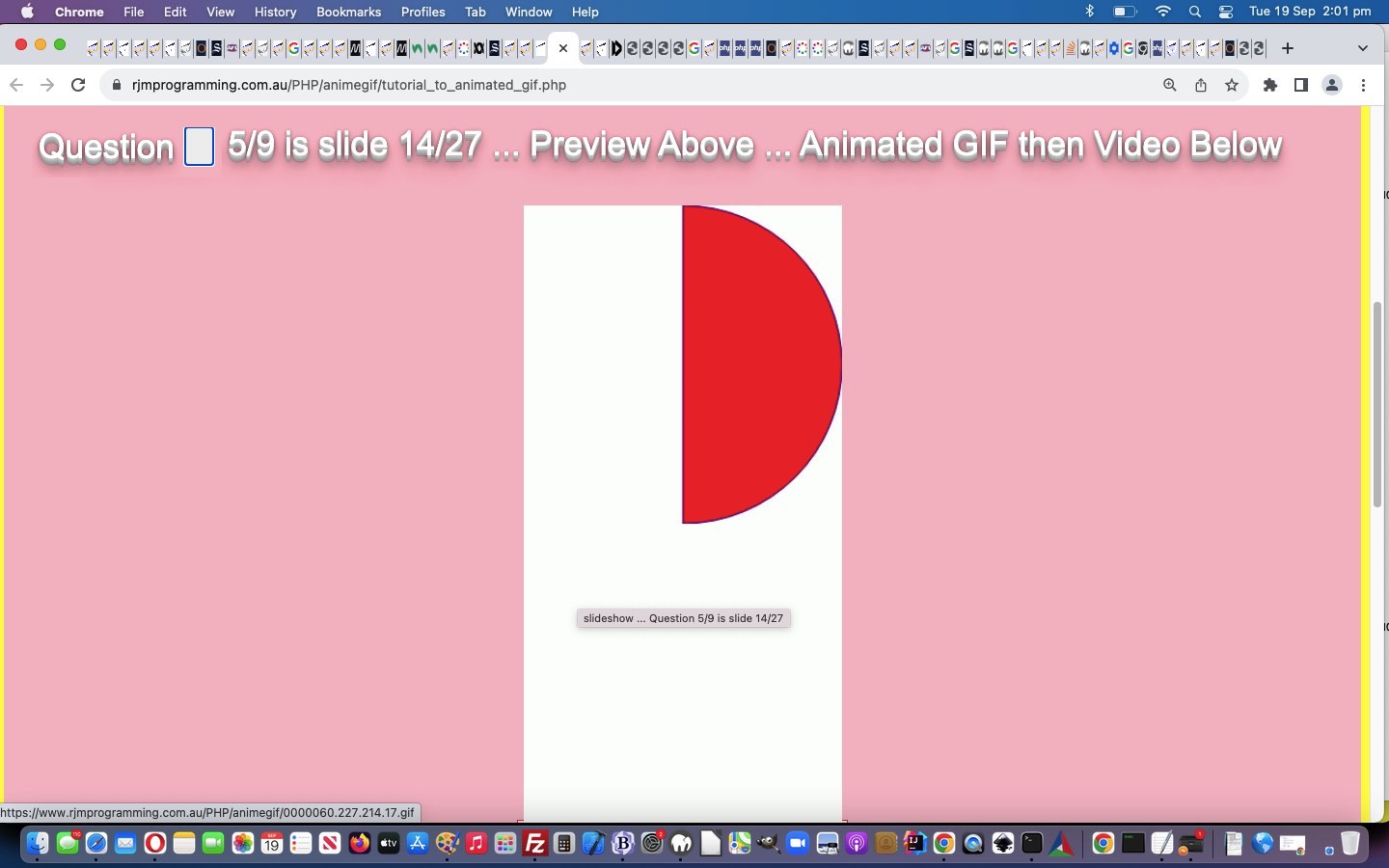
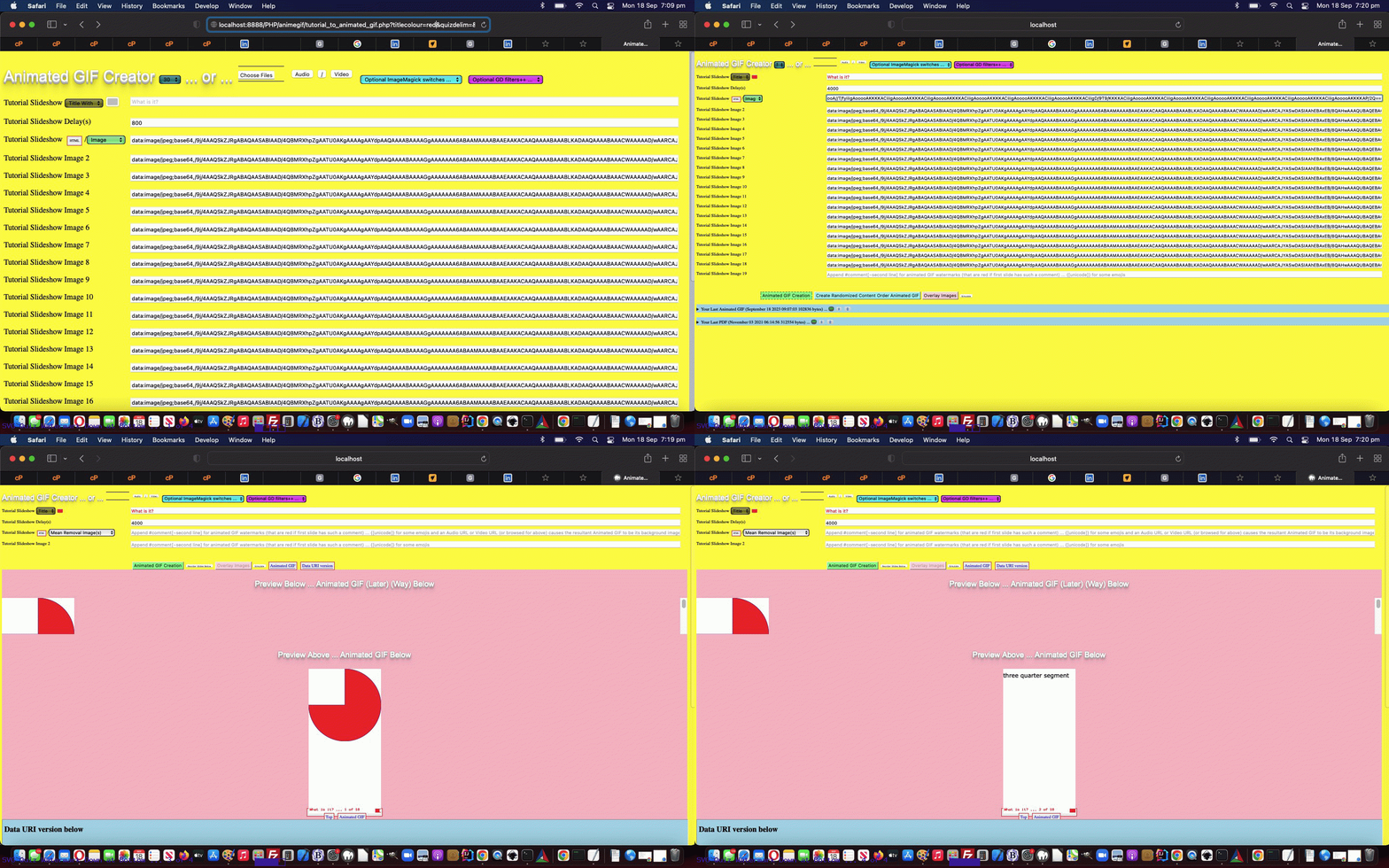
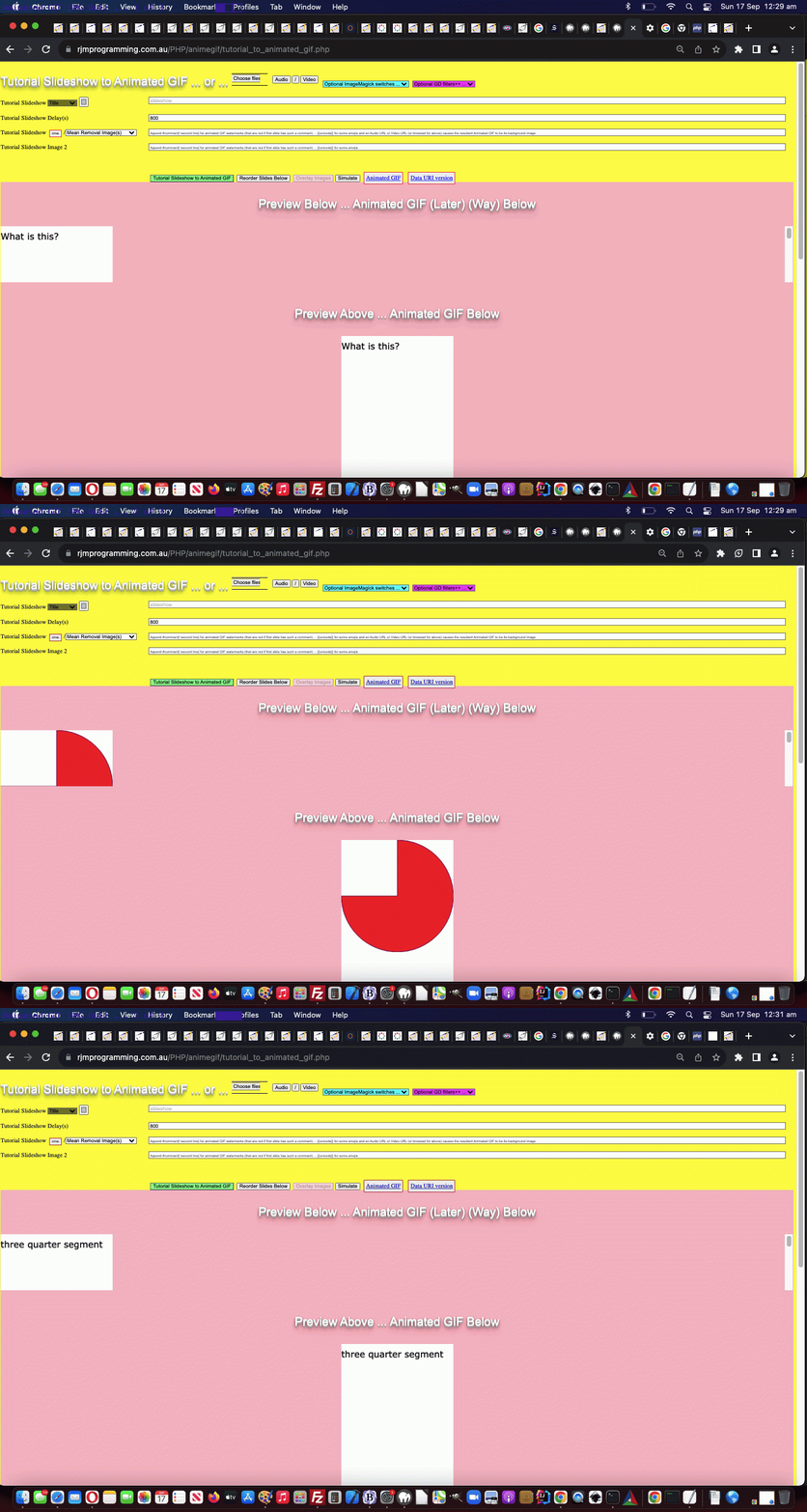
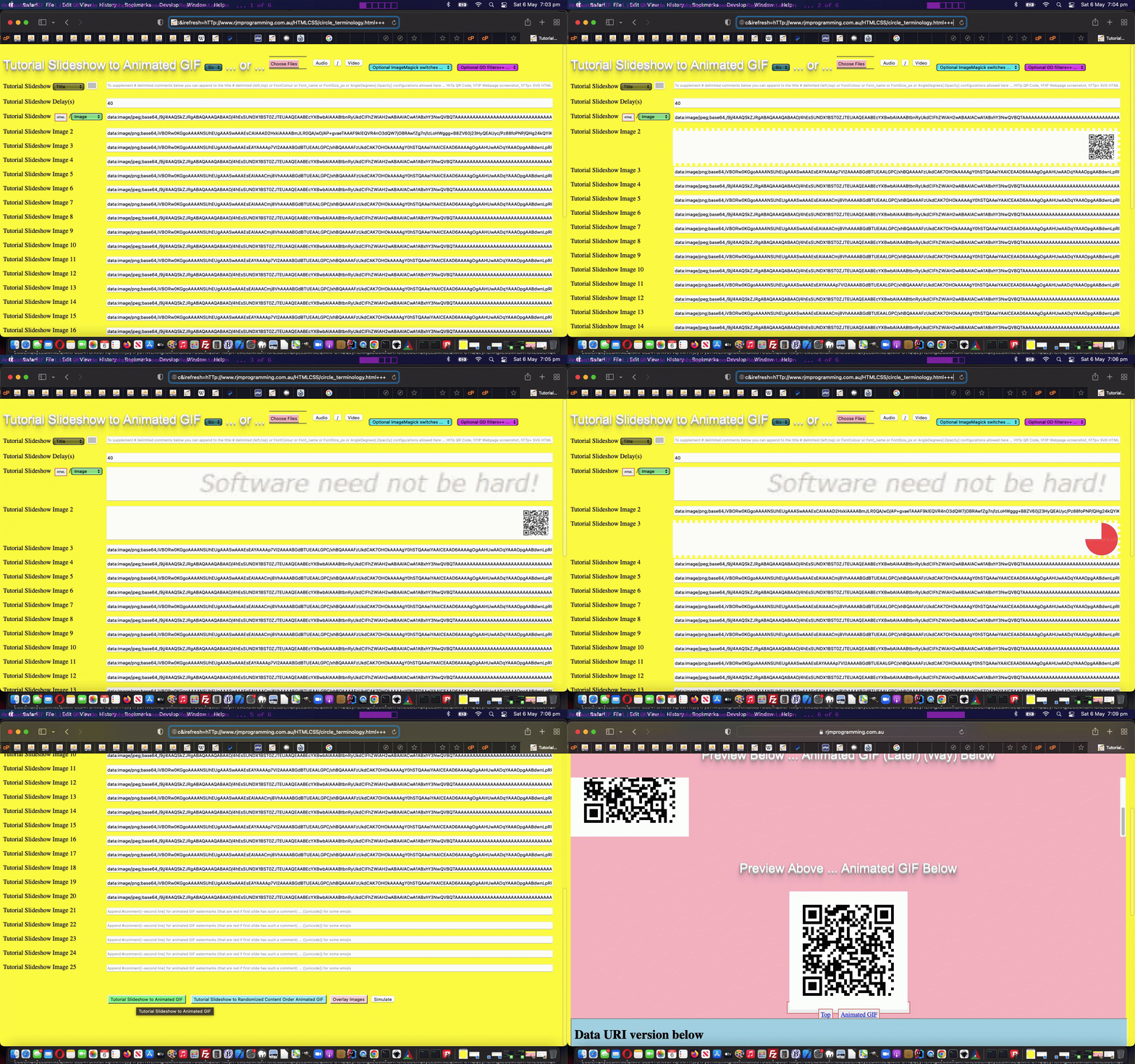
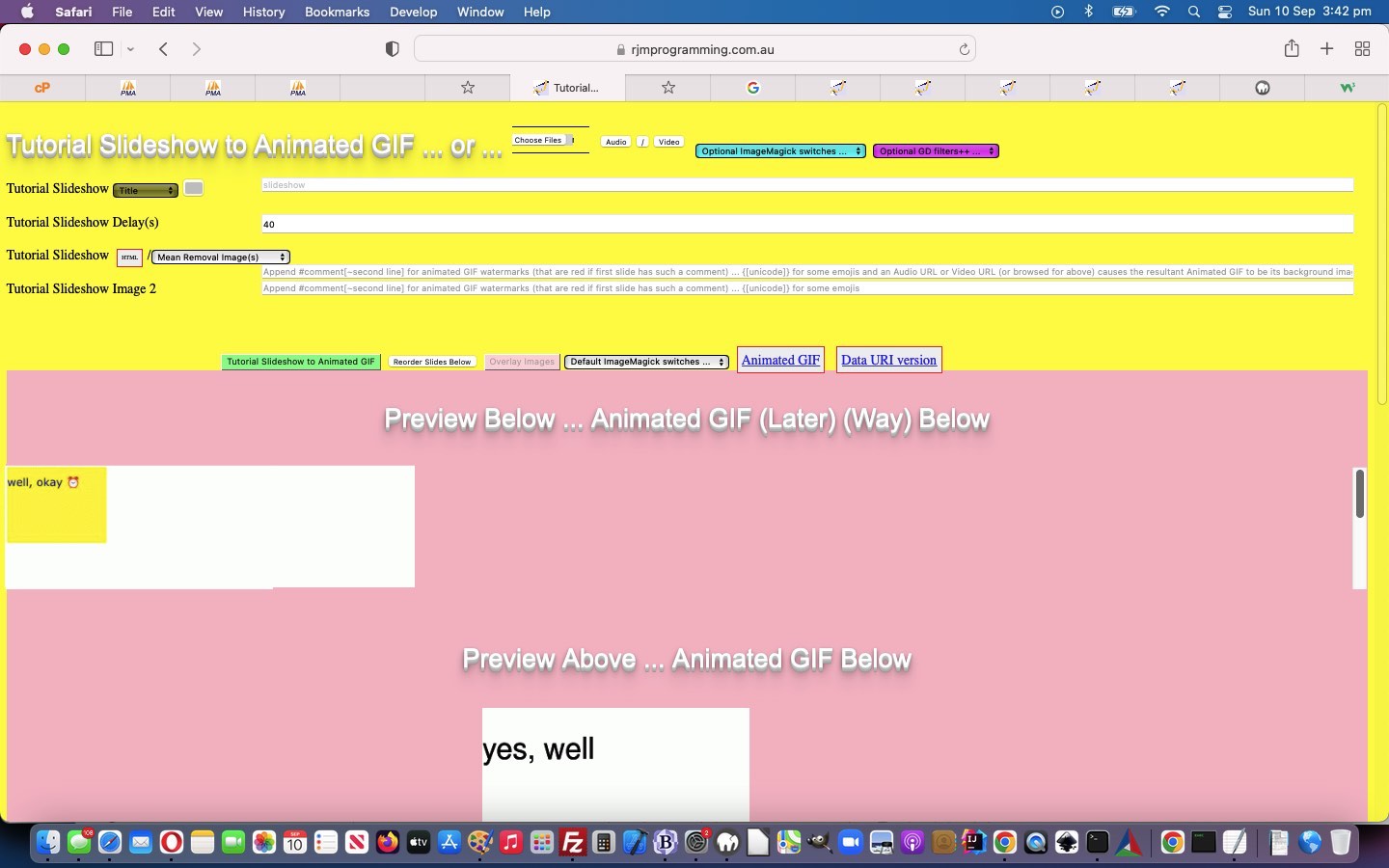
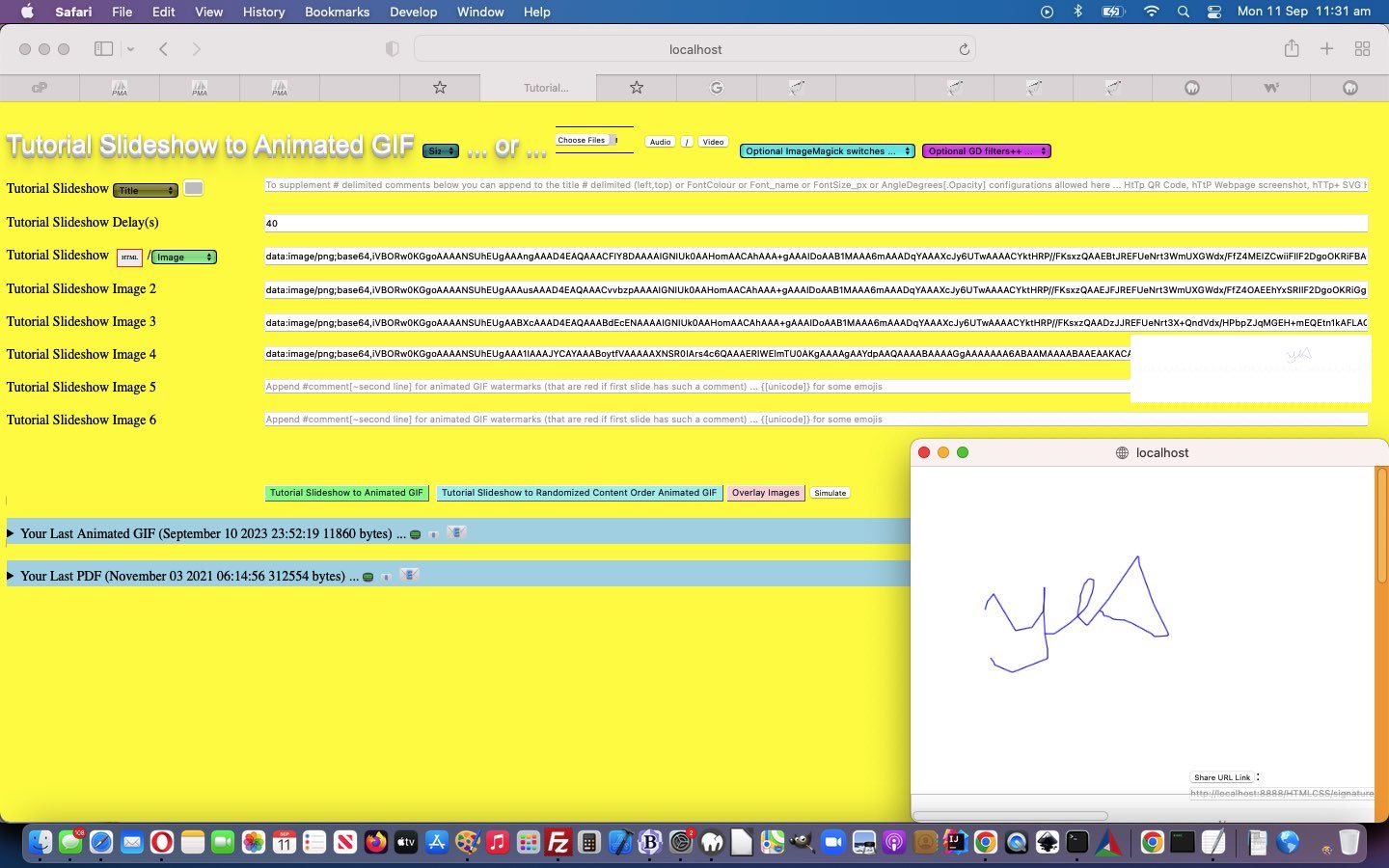
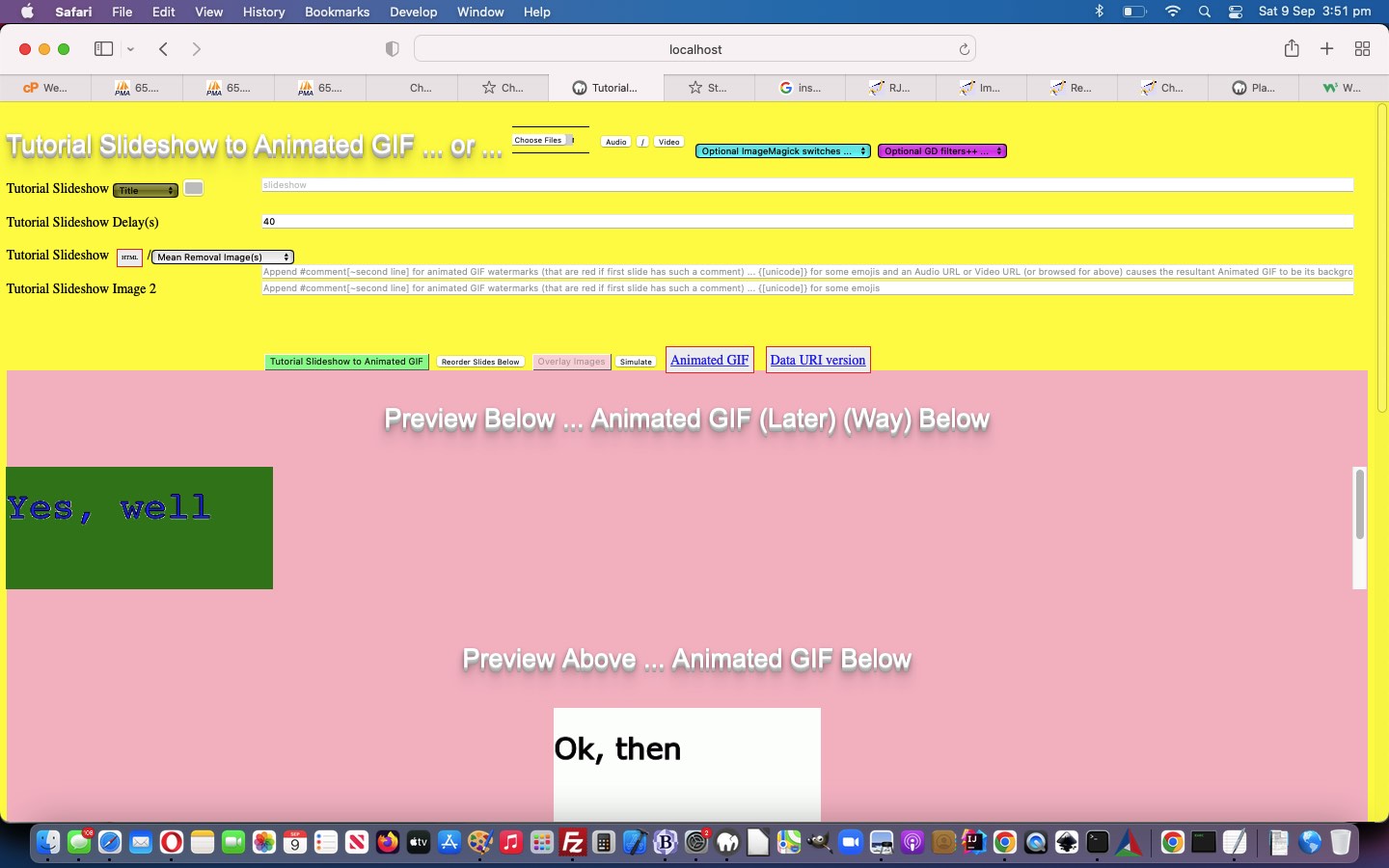
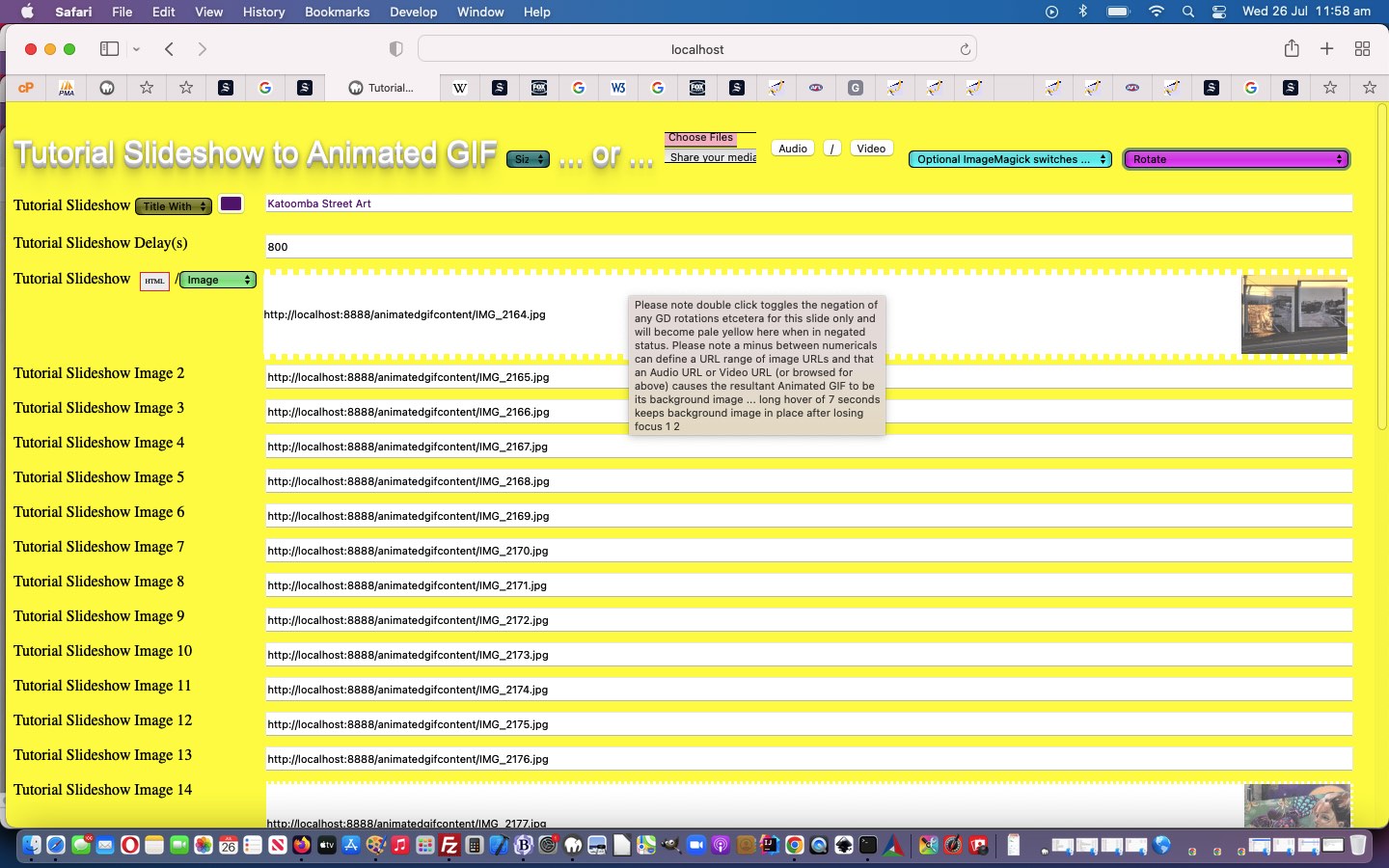
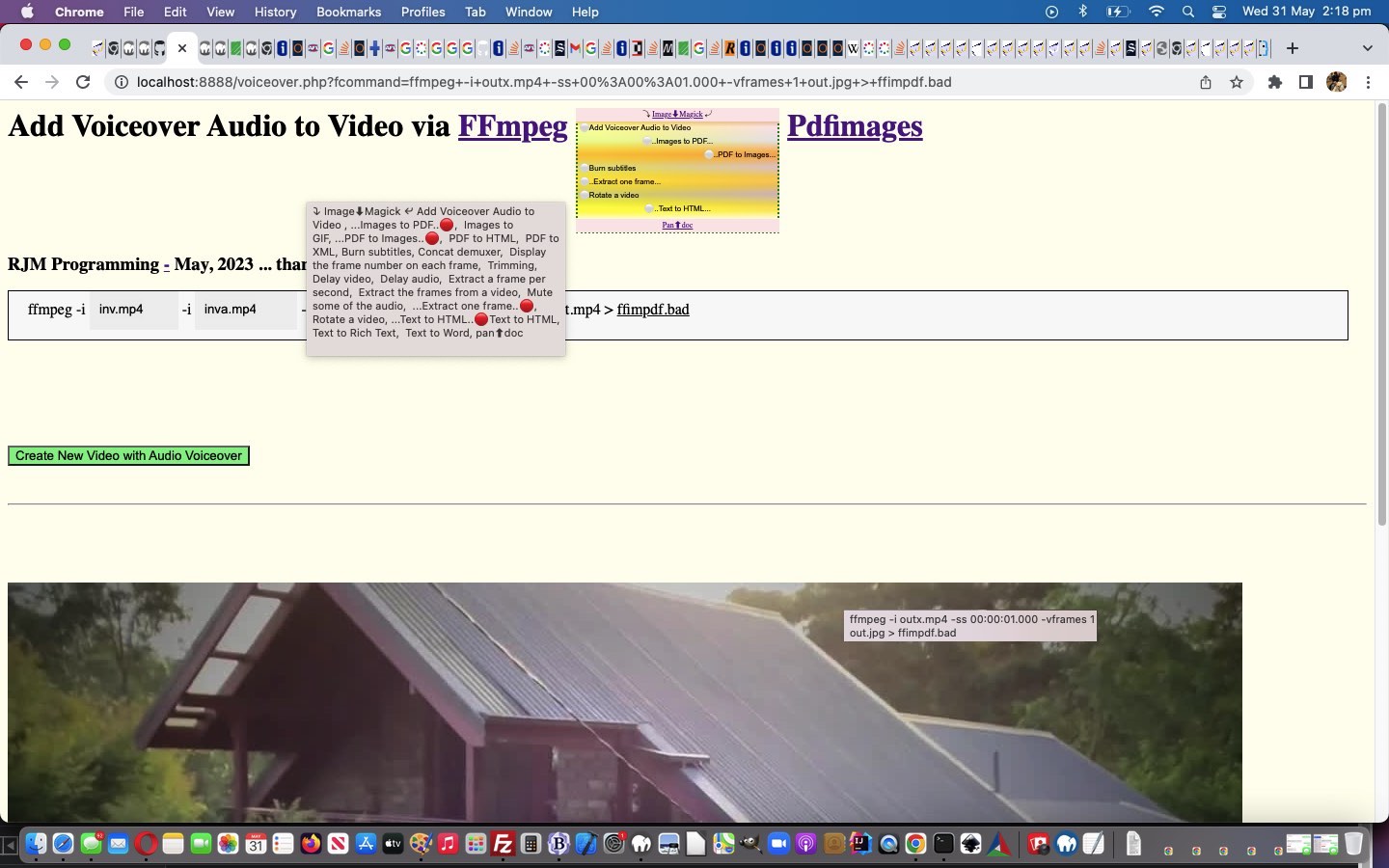
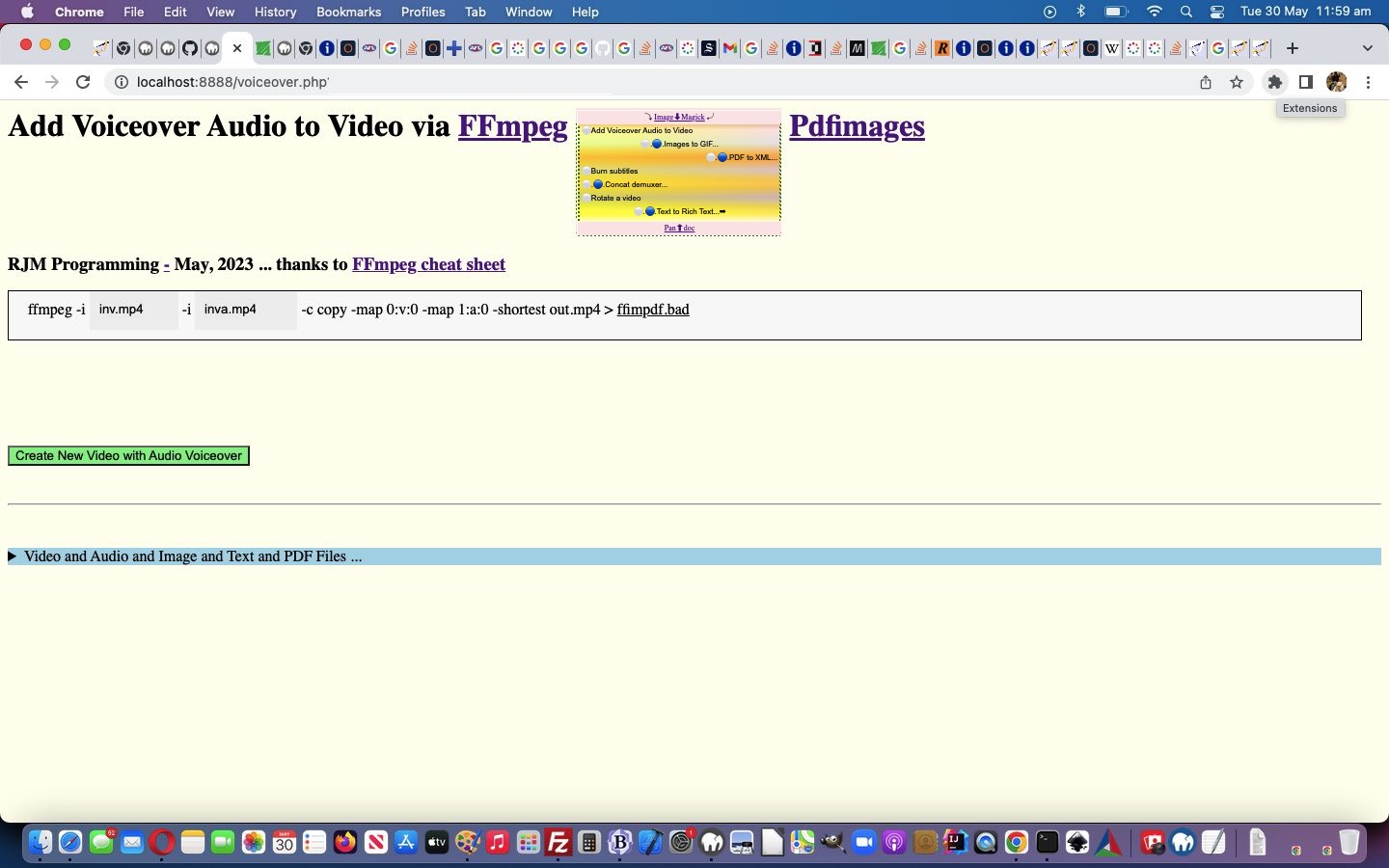
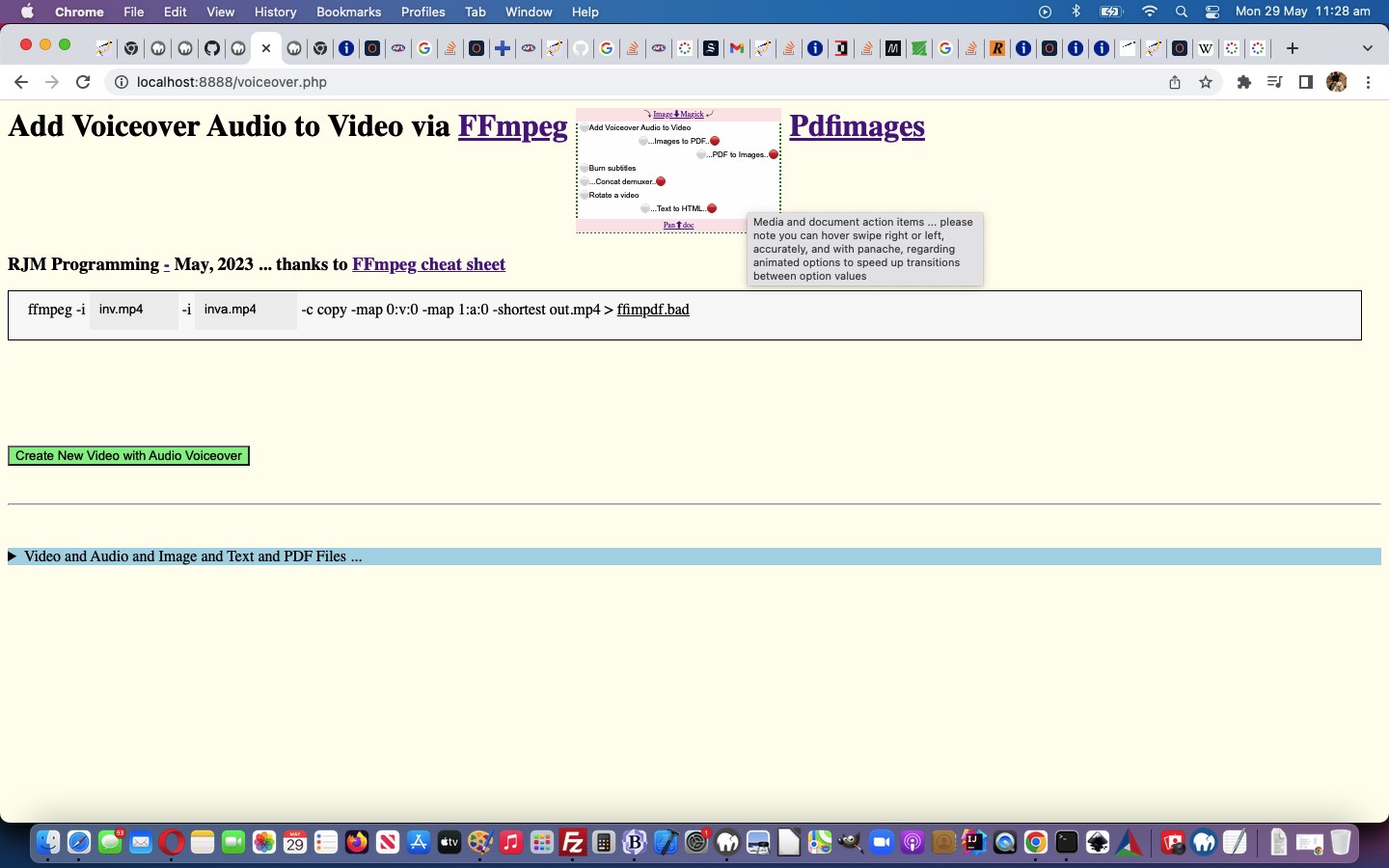
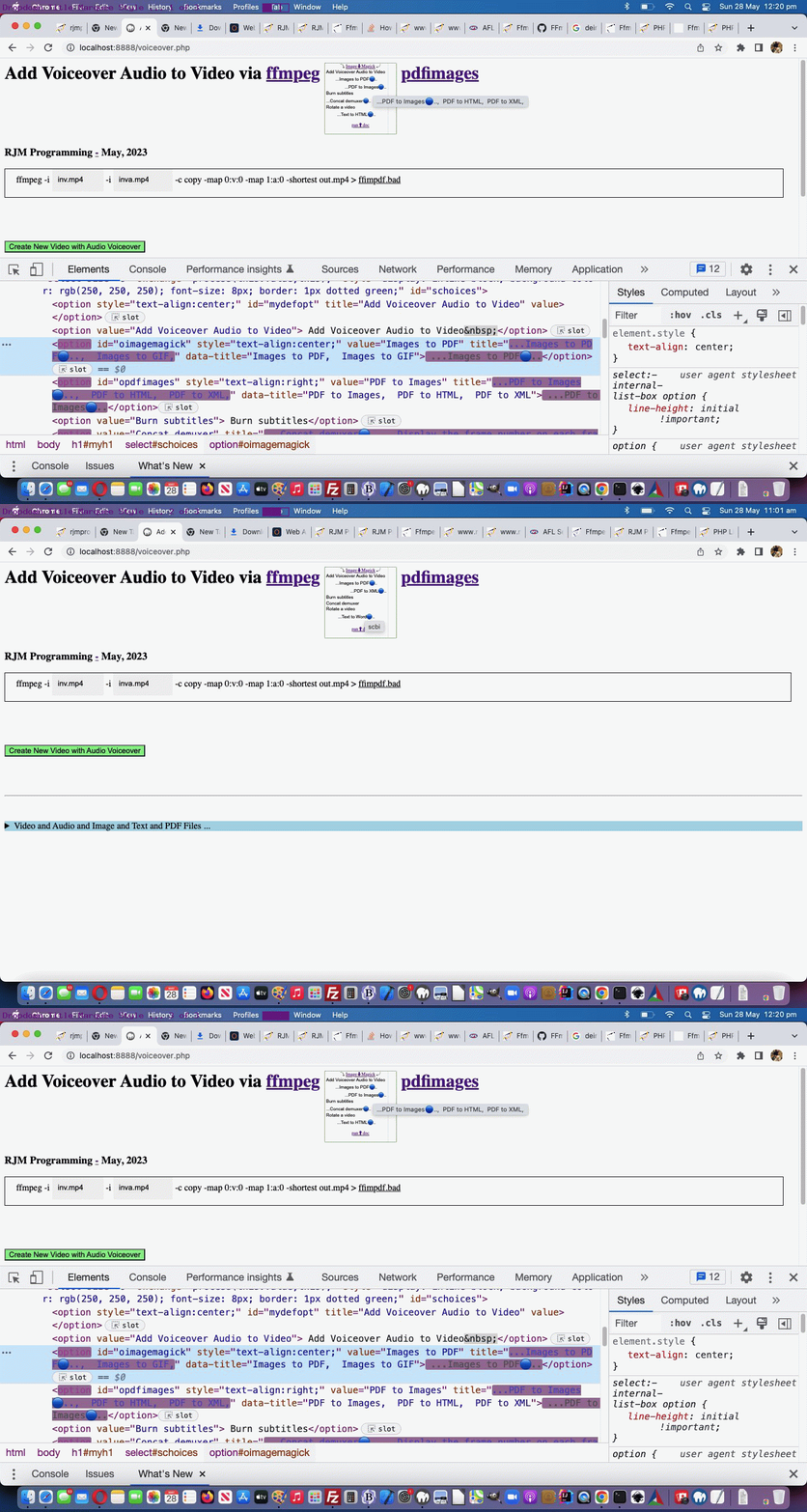
… the reason this being interesting, is that if we send to the “second phase” PHP web application pass which creates the animated GIF …
the number of slides …
<?php
$tvalsn="-1";

$ttitled="";

if (isset($_GET['tvalsn'])) { $tvalsn=(str_replace("+"," ",urldecode($_GET['tvalsn']))); $ttitled=''; }

if (isset($_POST['tvalsn'])) { $tvalsn=(str_replace("+"," ",urldecode($_POST['tvalsn']))); $ttitled=''; }
?>
an indication of whether there are 2 slides or 3 slides per original SVG+xml based image …
a comma separated list of answers …
$tvalsa="";

$atitled="";

$detsum="";

$sumdet="";

if (isset($_GET['tvalsa'])) { $detsum="<details><summary>Show ...</summary>"; $sumdet="</details>"; $tvalsa=(str_replace("+"," ",urldecode($_GET['tvalsa']))); $atitled='<input type=hidden id=tvalsa name=tvalsa value="' . $tvalsa . '"></input>'; }

if (isset($_POST['tvalsa'])) { $detsum="<details><summary>Show ...</summary>"; $sumdet="</details>"; $tvalsa=(str_replace("+"," ",urldecode($_POST['tvalsa']))); $atitled='<input type=hidden id=tvalsa name=tvalsa value="' . $tvalsa . '"></input>'; }
?>
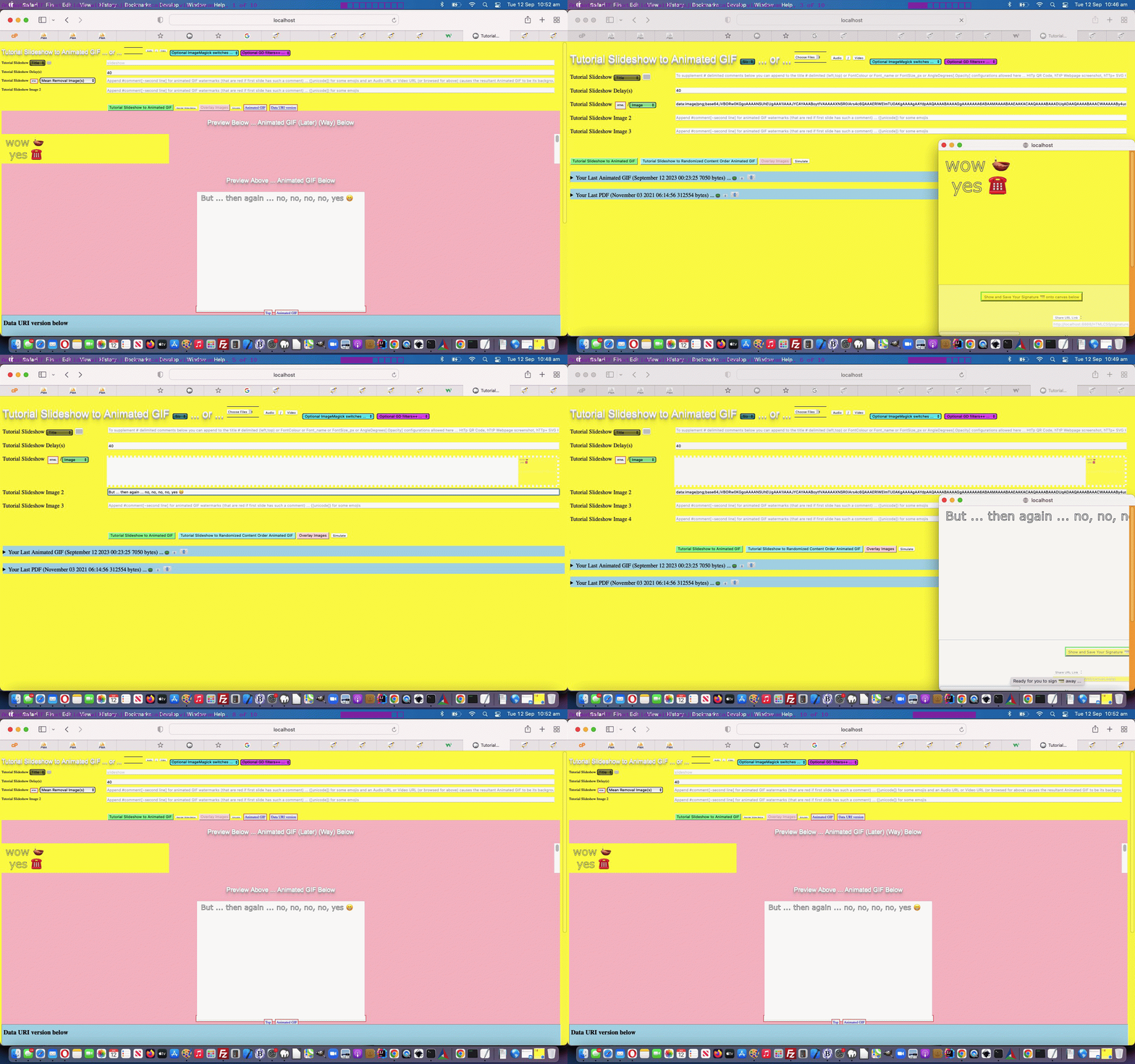
… we can use that “animated GIF duration” calculation to know, at any one point, which slide is showing, effectively giving “faux intelligence” enough to our operation, to the extent that we could, then, optionally, interactively ask for user entered answers to the SVG Quiz Questions asked (and keep track of a score for those “quiz interactives” out there).
function startyourengines(imgo) { // called as animated GIF onload event function
if (ctvalsn.split('.')[0].replace('-1','') != '') {
setInterval(sofard, 200);
totalsno=eval(ctvalsn.split('.')[0]);
if (ctvalsn.indexOf('.3') != -1) { setsof=3; } else { setsof=2; }
if (imgo.src.indexOf('/') == -1) {
prefetch(document.URL.replace('index.php', 'tutorial_to_animated_gif.php').split('tutorial_to_animated_gif.php')[0] + imgo.src.split('?')[0].split('#')[0]);
} else {
prefetch(imgo.src.split('?')[0].split('#')[0]);
}
setTimeout(function(){ document.getElementById('midway').scrollIntoView(); }, 500);
}
}
function prefetch(whatgifmaybe) { // thanks to https://stackoverflow.com/questions/69564118/how-to-get-duration-of-gif-image-in-javascript#:~:text=Mainly%20use%20parseGIF()%20%2C%20then,duration%20of%20a%20GIF%20image.
if ((whatgifmaybe.toLowerCase().trim().split('#')[0] + '?').indexOf('.gif?') != -1) {
ingif=whatgifmaybe;
document.body.style.cursor='progress';
fetch(whatgifmaybe)
.then(res => res.arrayBuffer())
.then(ab => isGifAnimated(new Uint8Array(ab)))
.then(console.log);
}
}
/** @param {Uint8Array} uint8 */
function isGifAnimated (uint8) { // thanks to https://stackoverflow.com/questions/69564118/how-to-get-duration-of-gif-image-in-javascript#:~:text=Mainly%20use%20parseGIF()%20%2C%20then,duration%20of%20a%20GIF%20image.
let duration = 0;
for (let i = 0, len = uint8.length; i < len; i++) {
if (uint8[i] == 0x21
&& uint8[i + 1] == 0xF9
&& uint8[i + 2] == 0x04
&& uint8[i + 7] == 0x00)
{
const delay = (uint8[i + 5] << 8) | (uint8[i + 4] & 0xFF);
duration += delay < 2 ? 10 : delay;
}
}
totaldur=eval(eval('' + duration) / 100);
if (totalsno > 0) {
eachdur=eval(totaldur / totalsno)
}
//document.getElementsByTagName('h1')[1].innerHTML='totalsno=' + totalsno + ' totaldur=' + totaldur + ' eachdur=' + eachdur + ' setsof=' + setsof + ' sofardur=' + sofardur;
return duration / 100; // if 0.1 is not an animated GIF
}
“; ?>
… using a newly introduced HTML span element with contenteditable=true to manage the user interaction. And did you know, at least for non-mobile platforms, you can set the focus (on non-mobile platforms only, as there are the “keyboard getting in the way” issues we’re thankful for with mobile platforms which preclude any thoughts of a programmed [element].focus() operation) to one of these “contenteditable=true style elements”? We’d never been sure, only focussing to HTML input textboxes and textareas up to now, we believe.
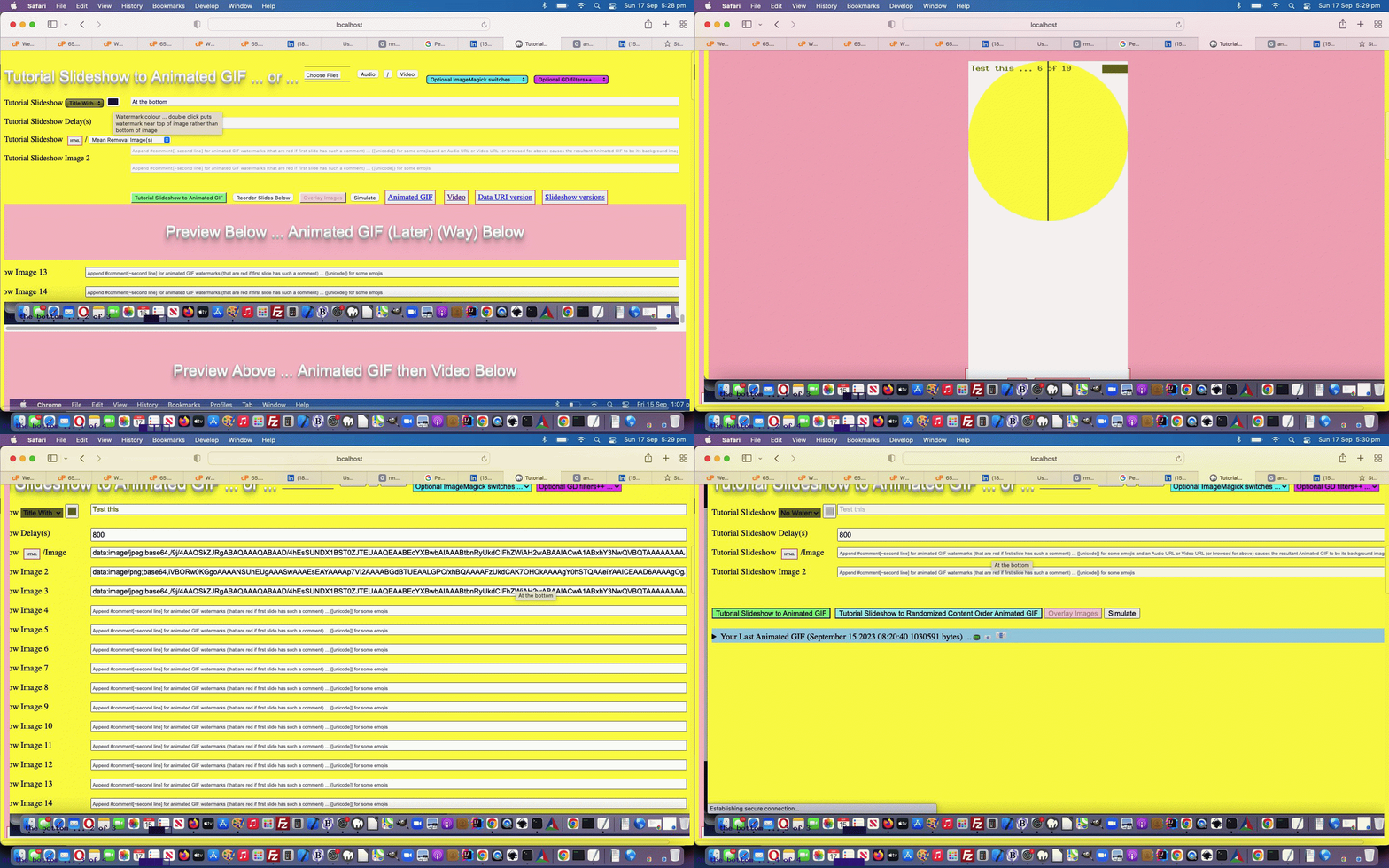
To usefully offer automation ideas for our Animated GIF Creator we need more flexibility regarding how the watermarks are presented. Get good with this, and this automation of Animated GIF creations could be quite productive. And so, in a similar line of thinking to yesterday’s Animated GIF SVG Quiz Argument Tutorial, today, we offer the user one new “get” titledown URL argument to work with a toggling Watermark Positioning arrangement, between the default top way and the new bottom way, with our input type=color Colour Picker we have going for the user to select a Watermark Colour. For the first time ever, we use …
input type=color ondblclick event
… logic. This event is both harmless regarding any other implications, and useful for toggling logic …
<?php echo ”
function bottomize(cpalo) {

 if (document.getElementById('dtitled').innerHTML == '' && cpalo.title.indexOf('double click puts watermark near bottom of image rather than top of image') != -1) {

  document.getElementById('dtitled').innerHTML='<input id=titledown name=titledown value=\"\" type=hidden></input>';

  cpalo.title=cpalo.title.replace('double click puts watermark near bottom of image rather than top of image', 'double click puts watermark near top of image rather than bottom of image');

 } else if (document.getElementById('dtitled').innerHTML != '' && cpalo.title.indexOf('double click puts watermark near top of image rather than bottom of image') != -1) {

  document.getElementById('dtitled').innerHTML='';

  cpalo.title=cpalo.title.replace('double click puts watermark near top of image rather than bottom of image', 'double click puts watermark near bottom of image rather than top of image');

 }

}
In line with the URL arguments theme of yesterday’s Animated GIF Creation Automation Arguments Tutorial, today we wanted to try automating the Animated GIF Creator web application to serve as an agent to create a Quiz based on SVG input, as per …
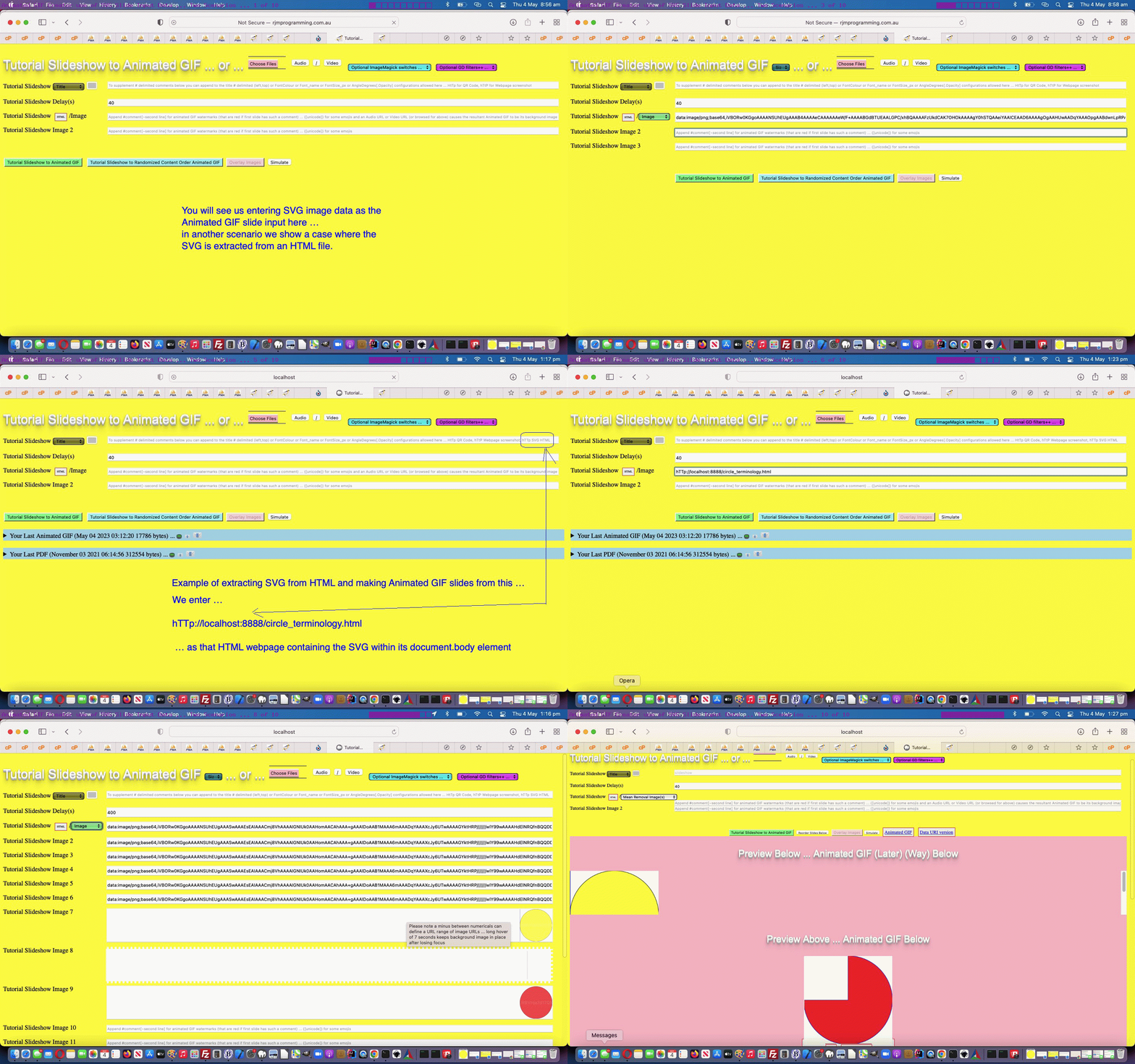
… involving one new “get” delimquiz URL argument that we default to the value answer. The PHP code goes and looks above the place where it extracts the image information from that HTML circle_terminology.html source for where it mentions where the quiz answer aligned with that image can be found, in our case within a “get” part of a URL preceeded by “&answer=” …
<?php echo ”
  var quizmode=false;

  var atobis='';

    //alert('Tval=' + tval);

  if (tval.indexOf(encodeURIComponent('data:image/svg+xml')) != -1) {

    tvals=tval.split(encodeURIComponent('data:image/svg+xml'));

    if (blankend != '') { gtid='slideshow' + ('' + tid).replace('slideshow',''); addtotothers(); tid=gtid; }

    thistval=1;


    if (document.URL.indexOf('delimquiz=') != -1) { // typically &delimquiz=answer

      if (document.getElementById('delay').value == '40') { document.getElementById('delay').value='800';  }

      var svgshell='';

      if (tvals[1].indexOf(encodeURIComponent(';utf8,')) == 0) {

       svgshell=tvals[1].split(encodeURIComponent('>'))[0] + encodeURIComponent(' style=\"font-family:Verdana;font-size:24px;\"></svg>');

      } else if (tvals[1].indexOf(encodeURIComponent(';base64,')) == 0) {

       atobis=window.atob(tvals[1].substring(eval('' + encodeURIComponent(';base64,').length)).split(String.fromCharCode(34))[0].split(String.fromCharCode(39))[0].split(')')[0].split('&')[0].split('>')[0]);

       svgshell=encodeURIComponent(';utf8,') + encodeURIComponent(atobis.split(encodeURIComponent('>'))[0].split('>')[0] + (' style=\"font-family:Verdana;font-size:24px;\"></svg>'));

      } else {

       svgshell=encodeURIComponent(';utf8,') + tvals[1].split(encodeURIComponent('>'))[0] + encodeURIComponent(' style=\"font-family:Verdana;font-size:24px;\"></svg>');

      }

      var dsvgshell=decodeURIComponent(svgshell);

      var dlq=(decodeURIComponent(document.URL.split('delimquiz=')[1].split('&')[0].split('#')[0].split('>')[0]).replace(/\+/g,' ') + '=').replace(/\=\=$/g, '=');

      if (dlq.replace('=','').trim() == '') { dlq='answer='; }

      if (tvals[0].indexOf(dlq) != -1) {

        // eg. answer= precursor idea to make into quiz

        quizmode=true;

        var sparetvals=tval.split(encodeURIComponent('data:image/svg+xml'));

        tvals=[''];

        for (var iipo=1; iipo<sparetvals.length; iipo++) {

          tvals.push( svgshell.replace(encodeURIComponent('></svg>'), encodeURIComponent('><text y=\"12%\">What is this?</text></svg>')) + '><img SRC=\"  data:image/svg+xml' + dsvgshell.replace('></svg>','><text y=\"22%\">What is this?</text></svg>').replace(/\\\"/g, String.fromCharCode(39)) + '\"></img>'   ); // question

          tvals.push(sparetvals[eval(0 + iipo)]); // image

          tvals.push( svgshell.replace(encodeURIComponent('></svg>'), encodeURIComponent('><text y=\"12%\">' + decodeURIComponent(sparetvals[eval(-1 + iipo)].split(dlq)[1].split('&')[0].split('#')[0].split('>')[0]).replace(/\+/g,' ') + '</text></svg>')) + '><img SRC=\"  data:image/svg+xml' + dsvgshell.replace('></svg>','><text y=\"22%\">' + decodeURIComponent(sparetvals[eval(-1 + iipo)].split(dlq)[1].split('&')[0].split('#')[0].split('>')[0]).replace(/\+/g,' ') + '</text></svg>').replace(/\\\"/g, String.fromCharCode(39)) + '\"></img>'  ); // answer

        }

       }

    }

    // more code follows

  }
“; ?>
… and we use that to end up with three animated GIF slides per image covering …
The automation measures in yesterday’s Animated GIF Creation Transparency Tutorial get an “arguments consideration” (maybe a five minute one, or perhaps ten minutes for “the outraged”) to help out ideas for our aspirational readers and users out there, who we are always keen to motivate, this Animated GIF Creator project potentially linked to user productivity, at its best.
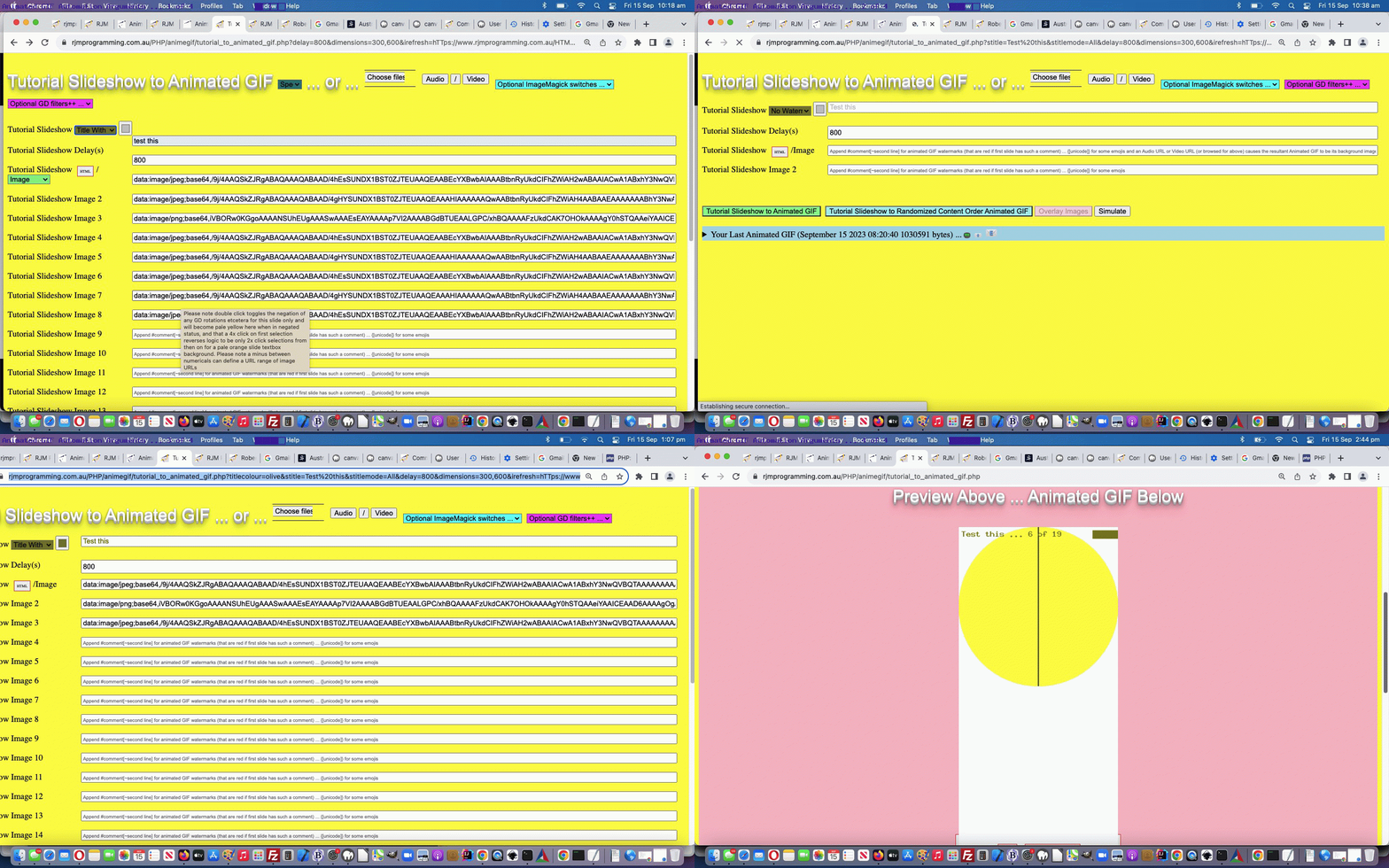
If we want to improve automation ideas for these Animated GIF creations we need to use (initially ? and & “get”) arguments up at the web browser address bar for our exploratory user to not only allow for definition of …
their hTTp style animated GIF slide content basis (in a “get” irefresh labelled optional argument) … but as of today, how about …
new “get” dimensions labelled optional argument defines the output Animated GIF dimensions in terms of width,height … eg. 300,600
new “get” title labelled optional argument defines the wording of the watermark style Animated GIF title (basis) … eg. My+Animated+GIF
new “get” titlecolour labelled optional argument defines the colour of the watermark style Animated GIF title … eg. olive
new “get” titlemode labelled optional argument defines the watermark style Animated GIF title mode … eg. All
… and please do not forget an optional argument we’re always havingthat’s always been there …
the “get” delay labelled optional argument defining the delay between animated GIF slides … eg. 800
? That would complete some pictures out there, we’re hoping?!
Does this feel like a step sideways to you, “the regular reader”? We’d agree, and are a little surprised a revisit (to this project) shows this need, but there you are. Sometimes, revisits help clarify!
… deserves our consideration, we’ve decided, today … because …
Transparency begins at home.
We’ll just try our best here, but we have discovered a nuance that hadn’t tweaked with us before, considering “transparency” and using “canvas” elements. The …
[canvasElementContext].clearRect(0, 0, [canvasWidth], [canvasHeight]); // idea causes the canvas to become transparent ... different to the other concept like ...
[canvasElementContext].fillStyle='white';
[canvasElementContext].fillRect(0, 0, [canvasWidth], [canvasHeight]); // this example idea causes the canvas to become white
It’s affected two “avenues of effect” (or is this a book?!) with our Animated GIF Creator logic …
if a SVG+xml element data URI utf8 format representation mentions the word “transparent” we are now going to make the relevant helper canvas element background be transparent …
<?php echo ”
function drawInlineSVG(rawSVG, slidename) { // thanks to https://stackoverflow.com/questions/27230293/how-to-draw-an-inline-svg-in-dom-to-a-canvas
var rsvg = new Blob([rawSVG], {type:'image/svg+xml;charset=utf-8'}),
rdomURL = self.URL || self.webkitURL || self,
rurl = rdomURL.createObjectURL(rsvg),
rslidename=slidename,
imgc = new Image;
if (rawSVG.indexOf('transparent') != -1 || rawSVG.indexOf(window.btoa('transparent')) != -1) {
istransparent=true;
imgc.onload = function () {
if (istransparent) {
document.getElementById('mycanvas').width=imgc.width;
document.getElementById('mycanvas').height=imgc.height;
document.getElementById('mycanvas').getContext('2d').clearRect(0,0,document.getElementById('mycanvas').width,document.getElementById('mycanvas').height);
} else if (1 == 1) {
document.getElementById('mycanvas').getContext('2d').fillStyle='white';
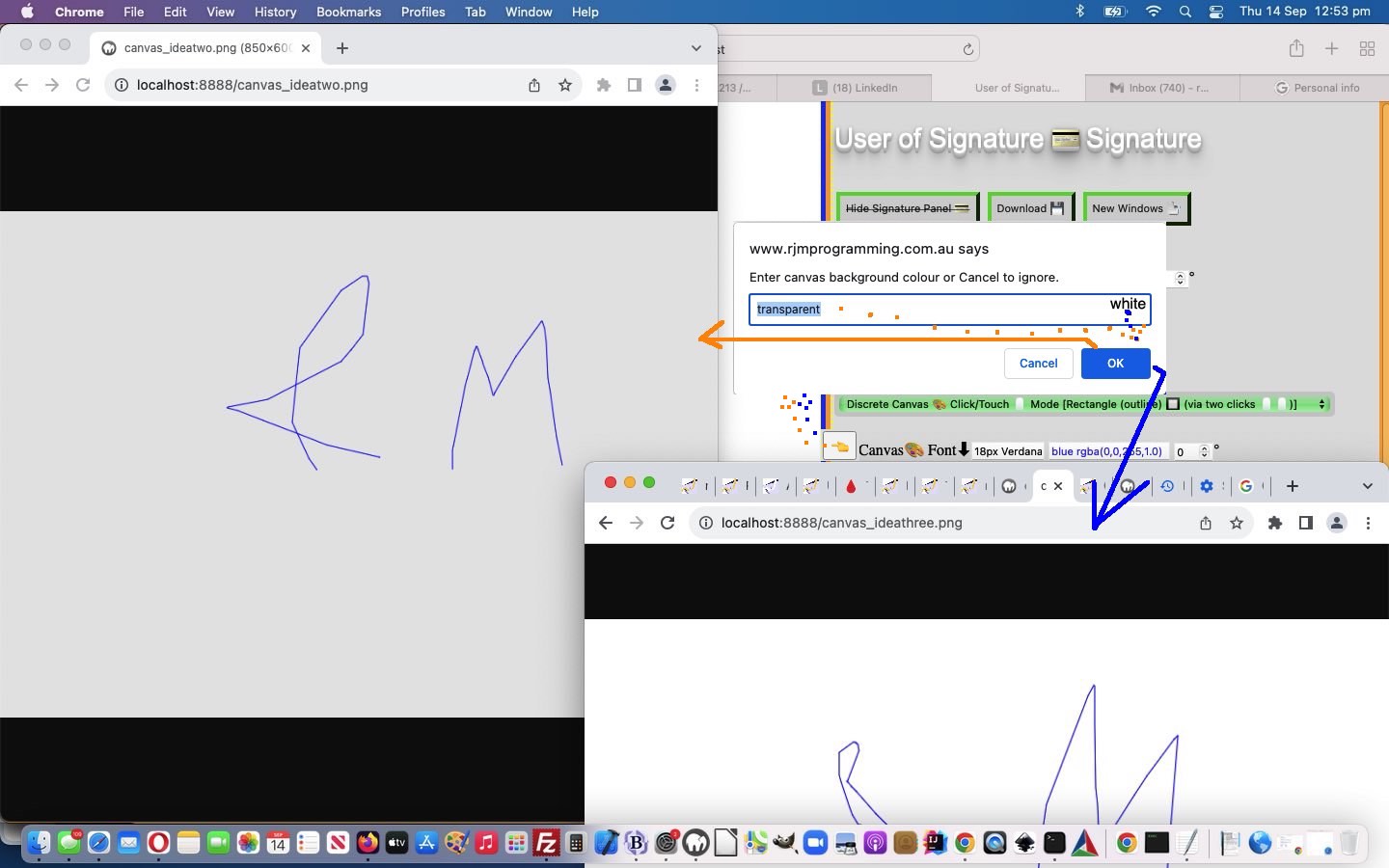
the “+” means by which we involve our Scribble and Annotation helper (of animated GIF slide content) now has a new button (with its onclick event function) to ask about its main canvas element background colour …
function colourize() {
var huhcol=prompt('Enter canvas background colour or Cancel to ignore.', 'transparent');
if (huhcol != null) {
if (huhcol.trim() != '') {
if (huhcol == 'transparent') {
//alert(987);
//alert('topielem.width=' + topielem.width);
parent.document.getElementById('topcanvas').getContext('2d').fillStyle = huhcol;
And so, we reckon it’s “transparent” (chortle, chortle) that yesterday’s Animated GIF Creation Automation Tutorial, created at home, and where (the vast majority of some readers know) …
Transparency begins at home. Can someone please hand me the lemon juice.
There are two competing issues going on with software development, of complexity, to challenge the skillset of the programmer …
keeping at an issue as it is fresh, and not letting go, as much as anything to keep up with where you are at, as with it being fresh in the mind … versus …
useful revisits after a bit of time to review the issue with fresher eyes, can often iron out issues not seen in “the heat of battle”
Today sees us relieved, undertaking a “second of the options above” scenario, regarding us creeping up on more Animated GIF Creation automation ideas we last talked about, with any depth, at Animated GIF Link Image Slide Tutorial.
[canvasElement].toDataURL(‘image/jpeg’, 10) … way to derive a data URI for …
textbox … representing an Animated GIF slide content mechanism
… rather than rely on ImageMagick converting from SVG to PNG was a bit of a game changer for us. We thought the extending of its use to other parts of the web application would be a good move. Along this way we also worked out that our Animated GIF dimensioning also needed some tweaking at a new HTML form onsubmit event function intervention point …
<?php echo ”
function dothem() {

  for (var iijj=0; iijj<slidecmds.length; iijj++) {

    eval(slidecmds[iijj]);

  }

  if (document.getElementById('selwhs')) {

  if (document.getElementById('selwhs').value.indexOf(',') != -1) {

  owoh(document.getElementById('selwhs'));

  }

  }

}
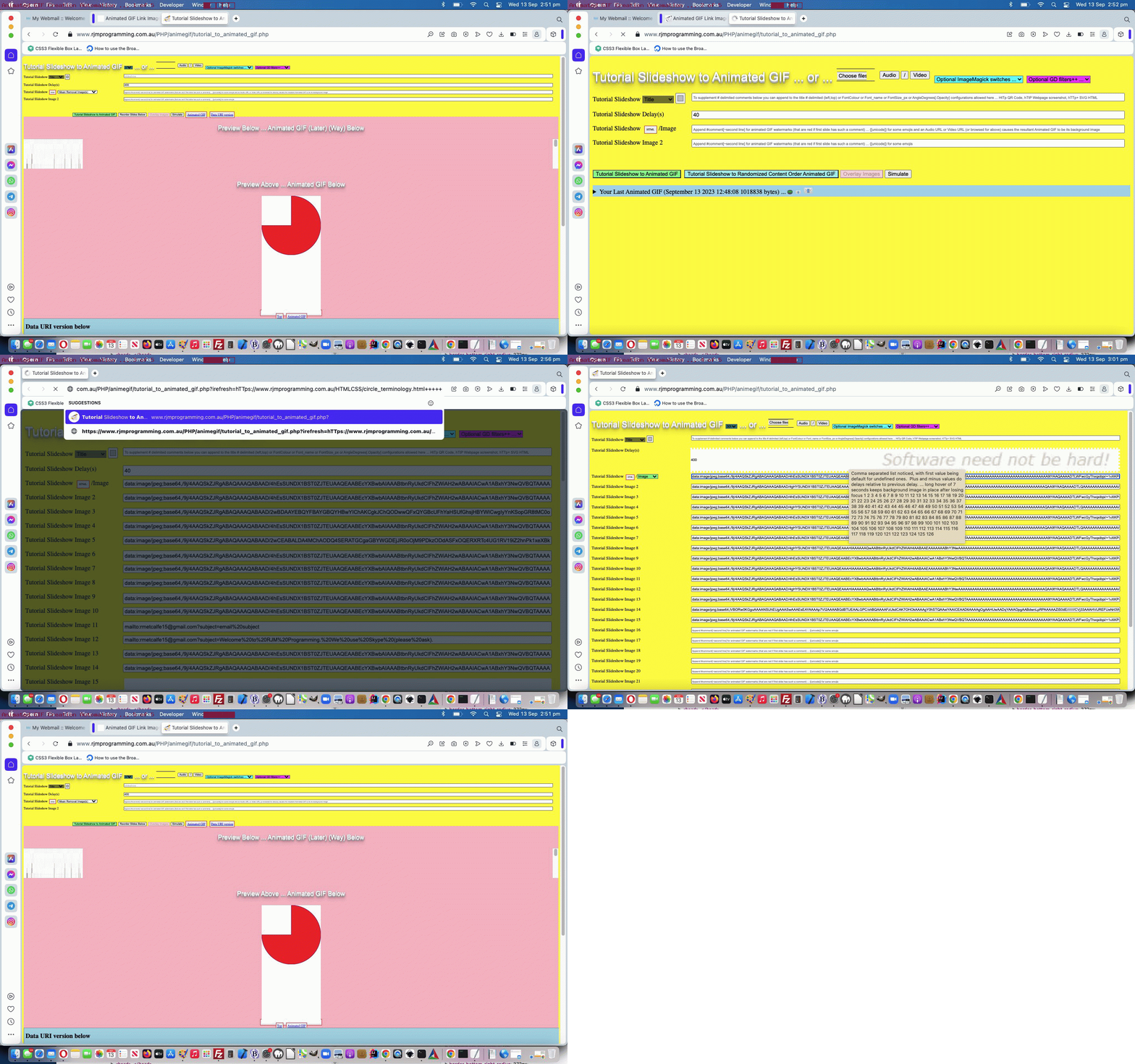
other image extraction from HTML user input via + … and today …
“a” link to either …
QR Code … via ++ … or …
Webpage Screenshot … via ++++
Do you see the pattern here? If you have a favoured character (ie. “+” here) involved in a user functionality behaviour decision you can give each a …
power of 2 number of characters
… (functionality meaning) and at the Javascript or PHP interpretive end of this arrangement you can know exactly what the user wants (in a way akin to how a bitmap can often be used) … so far this Javascript working (and tailorable into the future with some tweaking) as per …
<?php echo ”
function srchrefit(inbg) {

  var outbg=inbg, outbis=[], ibis=0;

  var ourblankend=blankend;

  if (blankend != '') {

    if (eval(eval('' + ourblankend.length) % 2) == 1) {  // process img

       ourblankend=ourblankend.substring(1);

       outbg=outbg.replace(/data\:image\/svg\+xml/g, '!@#$%^&');

       outbg=outbg.replace(/data\:image/g, ' SRC=\"  data:image');

       outbg=outbg.replace(/\!\@\#\$\%\^\&/g, 'data:image/svg+xml');

       outbis=outbg.split('<img');

       console.log('outbis.length=' + outbis.length + ' and outbg=' + outbg);

       for (ibis=1; ibis<eval('' + outbis.length); ibis++) {

         if (outbis[ibis].split('>')[0].indexOf(' src=\"') != -1) {

          outbg=outbg.replace('<img' + outbis[ibis].split('>')[0], '<img' + outbis[ibis].split('>')[0].replace(' src=\"', ' SRC=\"  '));

        }

       }

   }

    if (eval('' + ourblankend.length) == 4) {  // process "a" links to Webpage Screenshot

       outbis=outbg.split('<a');

       console.log('outbis.length=' + outbis.length);

       for (ibis=1; ibis<eval('' + outbis.length); ibis++) {

         if (outbis[ibis].split('>')[0].indexOf(' href=\"') != -1) {

           outbg=outbg.replace('<a' + outbis[ibis].split('>')[0], '<a' + outbis[ibis].split('>')[0].replace(' href=\"', ' SRC=\"    '));

         }

       }     // ... or ...

    } else if (eval('' + ourblankend.length) == 2) { // process "a" links to QR Code

       outbis=outbg.split('<a');

       console.log('outbis.length=' + outbis.length);

       for (ibis=1; ibis<eval('' + outbis.length); ibis++) {

         if (outbis[ibis].split('>')[0].indexOf(' href=\"') != -1) {

           outbg=outbg.replace('<a' + outbis[ibis].split('>')[0], '<a' + outbis[ibis].split('>')[0].replace(' href=\"', ' SRC=\"   '));

         }

       }

    }

    return outbg;

  }

  return inbg;

}
… which fills in the slide data (the link above hooking up to the web application featuring in Circle Terminology in Mathematics Tutorial extracting SVG and hidden non-SVG images and one “a” link presented as a QR Code) …
… which fills in the slide data (the link above hooking up to the web application featuring in Circle Terminology in Mathematics Tutorial extracting SVG and hidden non-SVG images and one “a” link presented as a Webpage Screenshot).
The PHP GD library we use to help create animated GIFs (along with a whole lot of other help, it goes without saying) is not into vector graphics which is what …
… are really into … ooooohhh, aaaaahhhh … but luckily for us, the great ImageMagick offers functionality to convert a SVG image file into a PNG image file, via …
Non Windows
Windows
convert infile.svg outfile.png
magick.exe infile.svg outfile.png
… and we’re using that talent ImageMagick has to offer the user the chance, at any animated GIF slide textbox, the chance to enter encodeURIComponent and window.btoa sensitive entries whose (content) format could match (one of) …
… which fills in the slide data and then goes and tries to create the resultant animated GIF (the link above hooking up to the web application featuring in Circle Terminology in Mathematics Tutorial)
Below is a new (PHP writes) Javascript iframe (iois object below) onload event function for recognizing hTTps://[HtmlWebpageWithSVG].html as above, and setting the iframe’s “src” attribute to its value …
<?php echo ”
var mm1='', mm2='', mm3='';
var gdgebimm='', gtval='', onealready='';
var tvals=[], thistval=0, thistdelim='', thistid='';
function latermm() {
maybemore(mm3.value, mm2, mm3);
mm1='';
mm2='';
mm3='';
}
function svgmmcallol(iois, tid) {
//alert('TID=' + tid);
var tval='', it=0, dgebimm='';
var tis=document.getElementById(tid);
thistid=tid;
tvals=[];
thistval=0;
thistdelim='';
if (iois != null) {
var aconto = (iois.contentWindow || iois.contentDocument);
if (aconto != null) {
if (aconto.document) { aconto = aconto.document; }
if (aconto.body != null) {
tval=aconto.body.innerHTML;
//alert('Tval=' + tval);
if (tval.indexOf(encodeURIComponent('data:image/svg+xml')) != -1) {
thistval=1;
tvals=tval.split(encodeURIComponent('data:image/svg+xml'));
thistdelim=encodeURIComponent('data:image/svg+xml');
//alert('thistdeliM=' + thistdelim);
Animated GIF Slide QR Code and Webpage Screenshot URL Tutorial
We wanted, today, to channel the (cruel might say “warped”) thinking behind the recent URL …
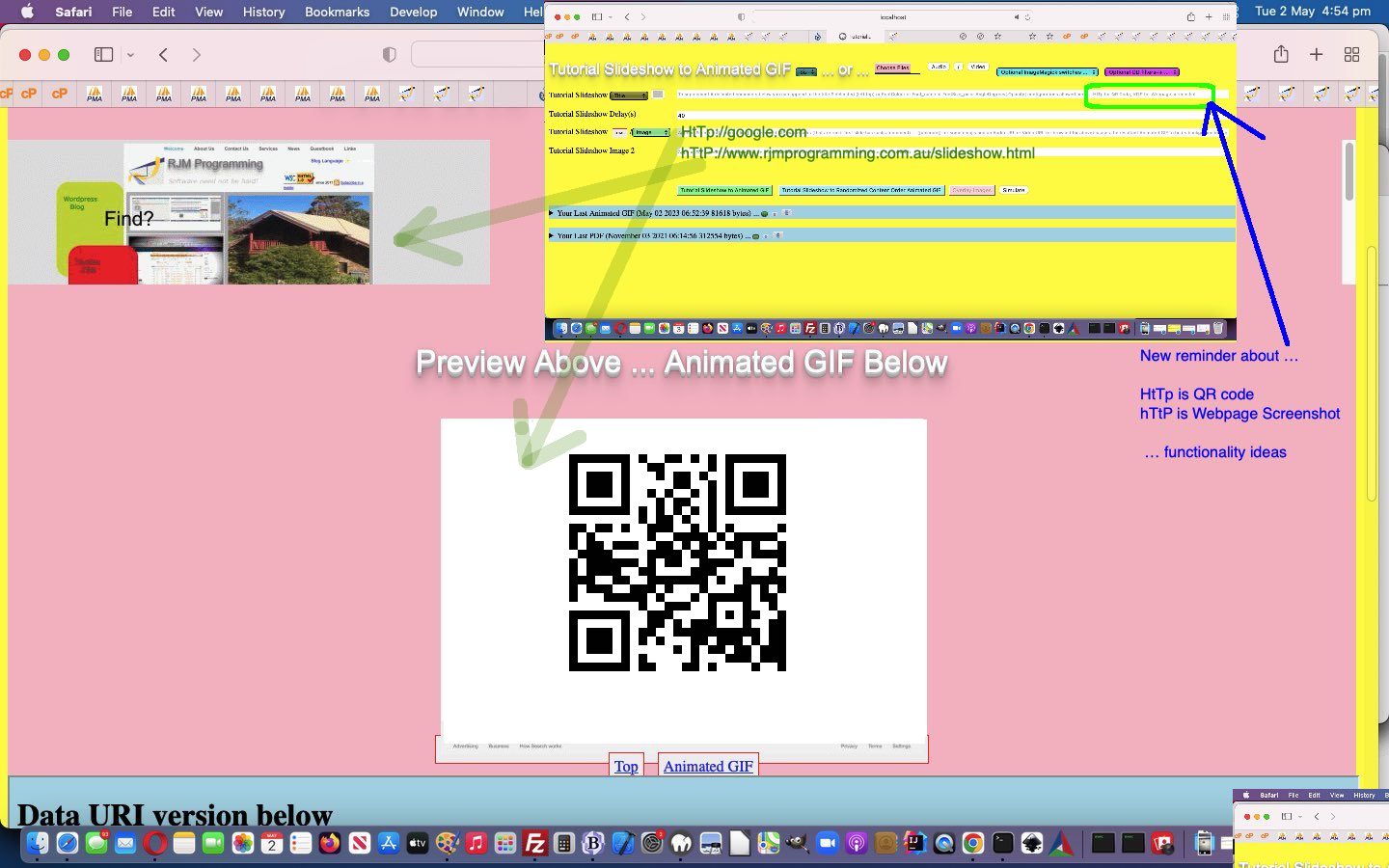
interactive entry of absolute URL starting with HtTp means you want a QR Code … and …
interactive entry of absolute URL starting with hTtP means you want (to involve, along the line, creating an animated QR Code scenario) a Webpage Screenshot
create animated GIF of QR Code means by which a smart device user using their Camera might navigate to a series of interesting webpage(s) … or …
create animated GIF of “current snapshot looks” of a series of URLs of interest (with even more currency than Google Earth shows your place!)
It might be you design an animated GIF chapter of slides and always want to follow it up with a “further reading” webpage you could present as a QR Code or Webpage Screenshot.
Anyway, at the “onblur” event Javascript function logic we intervened to end up with an image/png data URI substitute for the HtTp or hTtP URL the user enters to re-enter the normal animated GIF image definition workflow of the animated GIF creator …
<?php echo ”
var mm1='', mm2='', mm3='';
function latermm() {
maybemore(mm3.value, mm2, mm3);
mm1='';
mm2='';
mm3='';
}
To usefully offer automation ideas for our Animated GIF Creator we need more flexibility regarding how the watermarks are presented. Get good with this, and this automation of Animated GIF creations could be quite productive. And so, in a similar line of thinking to yesterday’s Animated GIF SVG Quiz Argument Tutorial, today, we offer the user one new “get” titledown URL argument to work with a toggling Watermark Positioning arrangement, between the default top way and the new bottom way, with our input type=color Colour Picker we have going for the user to select a Watermark Colour. For the first time ever, we use …
input type=color ondblclick event
… logic. This event is both harmless regarding any other implications, and useful for toggling logic …
<?php echo ”
function bottomize(cpalo) {

 if (document.getElementById('dtitled').innerHTML == '' && cpalo.title.indexOf('double click puts watermark near bottom of image rather than top of image') != -1) {

  document.getElementById('dtitled').innerHTML='<input id=titledown name=titledown value=\"\" type=hidden></input>';

  cpalo.title=cpalo.title.replace('double click puts watermark near bottom of image rather than top of image', 'double click puts watermark near top of image rather than bottom of image');

 } else if (document.getElementById('dtitled').innerHTML != '' && cpalo.title.indexOf('double click puts watermark near top of image rather than bottom of image') != -1) {

  document.getElementById('dtitled').innerHTML='';

  cpalo.title=cpalo.title.replace('double click puts watermark near top of image rather than bottom of image', 'double click puts watermark near bottom of image rather than top of image');

 }

}
In line with the URL arguments theme of yesterday’s Animated GIF Creation Automation Arguments Tutorial, today we wanted to try automating the Animated GIF Creator web application to serve as an agent to create a Quiz based on SVG input, as per …
… involving one new “get” delimquiz URL argument that we default to the value answer. The PHP code goes and looks above the place where it extracts the image information from that HTML circle_terminology.html source for where it mentions where the quiz answer aligned with that image can be found, in our case within a “get” part of a URL preceeded by “&answer=” …
<?php echo ”
  var quizmode=false;

  var atobis='';

    //alert('Tval=' + tval);

  if (tval.indexOf(encodeURIComponent('data:image/svg+xml')) != -1) {

    tvals=tval.split(encodeURIComponent('data:image/svg+xml'));

    if (blankend != '') { gtid='slideshow' + ('' + tid).replace('slideshow',''); addtotothers(); tid=gtid; }

    thistval=1;


    if (document.URL.indexOf('delimquiz=') != -1) { // typically &delimquiz=answer

      if (document.getElementById('delay').value == '40') { document.getElementById('delay').value='800';  }

      var svgshell='';

      if (tvals[1].indexOf(encodeURIComponent(';utf8,')) == 0) {

       svgshell=tvals[1].split(encodeURIComponent('>'))[0] + encodeURIComponent(' style=\"font-family:Verdana;font-size:24px;\"></svg>');

      } else if (tvals[1].indexOf(encodeURIComponent(';base64,')) == 0) {

       atobis=window.atob(tvals[1].substring(eval('' + encodeURIComponent(';base64,').length)).split(String.fromCharCode(34))[0].split(String.fromCharCode(39))[0].split(')')[0].split('&')[0].split('>')[0]);

       svgshell=encodeURIComponent(';utf8,') + encodeURIComponent(atobis.split(encodeURIComponent('>'))[0].split('>')[0] + (' style=\"font-family:Verdana;font-size:24px;\"></svg>'));

      } else {

       svgshell=encodeURIComponent(';utf8,') + tvals[1].split(encodeURIComponent('>'))[0] + encodeURIComponent(' style=\"font-family:Verdana;font-size:24px;\"></svg>');

      }

      var dsvgshell=decodeURIComponent(svgshell);

      var dlq=(decodeURIComponent(document.URL.split('delimquiz=')[1].split('&')[0].split('#')[0].split('>')[0]).replace(/\+/g,' ') + '=').replace(/\=\=$/g, '=');

      if (dlq.replace('=','').trim() == '') { dlq='answer='; }

      if (tvals[0].indexOf(dlq) != -1) {

        // eg. answer= precursor idea to make into quiz

        quizmode=true;

        var sparetvals=tval.split(encodeURIComponent('data:image/svg+xml'));

        tvals=[''];

        for (var iipo=1; iipo<sparetvals.length; iipo++) {

          tvals.push( svgshell.replace(encodeURIComponent('></svg>'), encodeURIComponent('><text y=\"12%\">What is this?</text></svg>')) + '><img SRC=\"  data:image/svg+xml' + dsvgshell.replace('></svg>','><text y=\"22%\">What is this?</text></svg>').replace(/\\\"/g, String.fromCharCode(39)) + '\"></img>'   ); // question

          tvals.push(sparetvals[eval(0 + iipo)]); // image

          tvals.push( svgshell.replace(encodeURIComponent('></svg>'), encodeURIComponent('><text y=\"12%\">' + decodeURIComponent(sparetvals[eval(-1 + iipo)].split(dlq)[1].split('&')[0].split('#')[0].split('>')[0]).replace(/\+/g,' ') + '</text></svg>')) + '><img SRC=\"  data:image/svg+xml' + dsvgshell.replace('></svg>','><text y=\"22%\">' + decodeURIComponent(sparetvals[eval(-1 + iipo)].split(dlq)[1].split('&')[0].split('#')[0].split('>')[0]).replace(/\+/g,' ') + '</text></svg>').replace(/\\\"/g, String.fromCharCode(39)) + '\"></img>'  ); // answer

        }

       }

    }

    // more code follows

  }
“; ?>
… and we use that to end up with three animated GIF slides per image covering …
The automation measures in yesterday’s Animated GIF Creation Transparency Tutorial get an “arguments consideration” (maybe a five minute one, or perhaps ten minutes for “the outraged”) to help out ideas for our aspirational readers and users out there, who we are always keen to motivate, this Animated GIF Creator project potentially linked to user productivity, at its best.
If we want to improve automation ideas for these Animated GIF creations we need to use (initially ? and & “get”) arguments up at the web browser address bar for our exploratory user to not only allow for definition of …
their hTTp style animated GIF slide content basis (in a “get” irefresh labelled optional argument) … but as of today, how about …
new “get” dimensions labelled optional argument defines the output Animated GIF dimensions in terms of width,height … eg. 300,600
new “get” title labelled optional argument defines the wording of the watermark style Animated GIF title (basis) … eg. My+Animated+GIF
new “get” titlecolour labelled optional argument defines the colour of the watermark style Animated GIF title … eg. olive
new “get” titlemode labelled optional argument defines the watermark style Animated GIF title mode … eg. All
… and please do not forget an optional argument we’re always havingthat’s always been there …
the “get” delay labelled optional argument defining the delay between animated GIF slides … eg. 800
? That would complete some pictures out there, we’re hoping?!
Does this feel like a step sideways to you, “the regular reader”? We’d agree, and are a little surprised a revisit (to this project) shows this need, but there you are. Sometimes, revisits help clarify!
… deserves our consideration, we’ve decided, today … because …
Transparency begins at home.
We’ll just try our best here, but we have discovered a nuance that hadn’t tweaked with us before, considering “transparency” and using “canvas” elements. The …
[canvasElementContext].clearRect(0, 0, [canvasWidth], [canvasHeight]); // idea causes the canvas to become transparent ... different to the other concept like ...
[canvasElementContext].fillStyle='white';
[canvasElementContext].fillRect(0, 0, [canvasWidth], [canvasHeight]); // this example idea causes the canvas to become white
It’s affected two “avenues of effect” (or is this a book?!) with our Animated GIF Creator logic …
if a SVG+xml element data URI utf8 format representation mentions the word “transparent” we are now going to make the relevant helper canvas element background be transparent …
<?php echo ”
function drawInlineSVG(rawSVG, slidename) { // thanks to https://stackoverflow.com/questions/27230293/how-to-draw-an-inline-svg-in-dom-to-a-canvas
var rsvg = new Blob([rawSVG], {type:'image/svg+xml;charset=utf-8'}),
rdomURL = self.URL || self.webkitURL || self,
rurl = rdomURL.createObjectURL(rsvg),
rslidename=slidename,
imgc = new Image;
if (rawSVG.indexOf('transparent') != -1 || rawSVG.indexOf(window.btoa('transparent')) != -1) {
istransparent=true;
imgc.onload = function () {
if (istransparent) {
document.getElementById('mycanvas').width=imgc.width;
document.getElementById('mycanvas').height=imgc.height;
document.getElementById('mycanvas').getContext('2d').clearRect(0,0,document.getElementById('mycanvas').width,document.getElementById('mycanvas').height);
} else if (1 == 1) {
document.getElementById('mycanvas').getContext('2d').fillStyle='white';
the “+” means by which we involve our Scribble and Annotation helper (of animated GIF slide content) now has a new button (with its onclick event function) to ask about its main canvas element background colour …
function colourize() {
var huhcol=prompt('Enter canvas background colour or Cancel to ignore.', 'transparent');
if (huhcol != null) {
if (huhcol.trim() != '') {
if (huhcol == 'transparent') {
//alert(987);
//alert('topielem.width=' + topielem.width);
parent.document.getElementById('topcanvas').getContext('2d').fillStyle = huhcol;
And so, we reckon it’s “transparent” (chortle, chortle) that yesterday’s Animated GIF Creation Automation Tutorial, created at home, and where (the vast majority of some readers know) …
Transparency begins at home. Can someone please hand me the lemon juice.
There are two competing issues going on with software development, of complexity, to challenge the skillset of the programmer …
keeping at an issue as it is fresh, and not letting go, as much as anything to keep up with where you are at, as with it being fresh in the mind … versus …
useful revisits after a bit of time to review the issue with fresher eyes, can often iron out issues not seen in “the heat of battle”
Today sees us relieved, undertaking a “second of the options above” scenario, regarding us creeping up on more Animated GIF Creation automation ideas we last talked about, with any depth, at Animated GIF Link Image Slide Tutorial.
[canvasElement].toDataURL(‘image/jpeg’, 10) … way to derive a data URI for …
textbox … representing an Animated GIF slide content mechanism
… rather than rely on ImageMagick converting from SVG to PNG was a bit of a game changer for us. We thought the extending of its use to other parts of the web application would be a good move. Along this way we also worked out that our Animated GIF dimensioning also needed some tweaking at a new HTML form onsubmit event function intervention point …
<?php echo ”
function dothem() {

  for (var iijj=0; iijj<slidecmds.length; iijj++) {

    eval(slidecmds[iijj]);

  }

  if (document.getElementById('selwhs')) {

  if (document.getElementById('selwhs').value.indexOf(',') != -1) {

  owoh(document.getElementById('selwhs'));

  }

  }

}
other image extraction from HTML user input via + … and today …
“a” link to either …
QR Code … via ++ … or …
Webpage Screenshot … via ++++
Do you see the pattern here? If you have a favoured character (ie. “+” here) involved in a user functionality behaviour decision you can give each a …
power of 2 number of characters
… (functionality meaning) and at the Javascript or PHP interpretive end of this arrangement you can know exactly what the user wants (in a way akin to how a bitmap can often be used) … so far this Javascript working (and tailorable into the future with some tweaking) as per …
<?php echo ”
function srchrefit(inbg) {

  var outbg=inbg, outbis=[], ibis=0;

  var ourblankend=blankend;

  if (blankend != '') {

    if (eval(eval('' + ourblankend.length) % 2) == 1) {  // process img

       ourblankend=ourblankend.substring(1);

       outbg=outbg.replace(/data\:image\/svg\+xml/g, '!@#$%^&');

       outbg=outbg.replace(/data\:image/g, ' SRC=\"  data:image');

       outbg=outbg.replace(/\!\@\#\$\%\^\&/g, 'data:image/svg+xml');

       outbis=outbg.split('<img');

       console.log('outbis.length=' + outbis.length + ' and outbg=' + outbg);

       for (ibis=1; ibis<eval('' + outbis.length); ibis++) {

         if (outbis[ibis].split('>')[0].indexOf(' src=\"') != -1) {

          outbg=outbg.replace('<img' + outbis[ibis].split('>')[0], '<img' + outbis[ibis].split('>')[0].replace(' src=\"', ' SRC=\"  '));

        }

       }

   }

    if (eval('' + ourblankend.length) == 4) {  // process "a" links to Webpage Screenshot

       outbis=outbg.split('<a');

       console.log('outbis.length=' + outbis.length);

       for (ibis=1; ibis<eval('' + outbis.length); ibis++) {

         if (outbis[ibis].split('>')[0].indexOf(' href=\"') != -1) {

           outbg=outbg.replace('<a' + outbis[ibis].split('>')[0], '<a' + outbis[ibis].split('>')[0].replace(' href=\"', ' SRC=\"    '));

         }

       }     // ... or ...

    } else if (eval('' + ourblankend.length) == 2) { // process "a" links to QR Code

       outbis=outbg.split('<a');

       console.log('outbis.length=' + outbis.length);

       for (ibis=1; ibis<eval('' + outbis.length); ibis++) {

         if (outbis[ibis].split('>')[0].indexOf(' href=\"') != -1) {

           outbg=outbg.replace('<a' + outbis[ibis].split('>')[0], '<a' + outbis[ibis].split('>')[0].replace(' href=\"', ' SRC=\"   '));

         }

       }

    }

    return outbg;

  }

  return inbg;

}
… which fills in the slide data (the link above hooking up to the web application featuring in Circle Terminology in Mathematics Tutorial extracting SVG and hidden non-SVG images and one “a” link presented as a QR Code) …
… which fills in the slide data (the link above hooking up to the web application featuring in Circle Terminology in Mathematics Tutorial extracting SVG and hidden non-SVG images and one “a” link presented as a Webpage Screenshot).
The PHP GD library we use to help create animated GIFs (along with a whole lot of other help, it goes without saying) is not into vector graphics which is what …
… are really into … ooooohhh, aaaaahhhh … but luckily for us, the great ImageMagick offers functionality to convert a SVG image file into a PNG image file, via …
Non Windows
Windows
convert infile.svg outfile.png
magick.exe infile.svg outfile.png
… and we’re using that talent ImageMagick has to offer the user the chance, at any animated GIF slide textbox, the chance to enter encodeURIComponent and window.btoa sensitive entries whose (content) format could match (one of) …
… which fills in the slide data and then goes and tries to create the resultant animated GIF (the link above hooking up to the web application featuring in Circle Terminology in Mathematics Tutorial)
Below is a new (PHP writes) Javascript iframe (iois object below) onload event function for recognizing hTTps://[HtmlWebpageWithSVG].html as above, and setting the iframe’s “src” attribute to its value …
<?php echo ”
var mm1='', mm2='', mm3='';
var gdgebimm='', gtval='', onealready='';
var tvals=[], thistval=0, thistdelim='', thistid='';
function latermm() {
maybemore(mm3.value, mm2, mm3);
mm1='';
mm2='';
mm3='';
}
function svgmmcallol(iois, tid) {
//alert('TID=' + tid);
var tval='', it=0, dgebimm='';
var tis=document.getElementById(tid);
thistid=tid;
tvals=[];
thistval=0;
thistdelim='';
if (iois != null) {
var aconto = (iois.contentWindow || iois.contentDocument);
if (aconto != null) {
if (aconto.document) { aconto = aconto.document; }
if (aconto.body != null) {
tval=aconto.body.innerHTML;
//alert('Tval=' + tval);
if (tval.indexOf(encodeURIComponent('data:image/svg+xml')) != -1) {
thistval=1;
tvals=tval.split(encodeURIComponent('data:image/svg+xml'));
thistdelim=encodeURIComponent('data:image/svg+xml');
//alert('thistdeliM=' + thistdelim);
Animated GIF Slide QR Code and Webpage Screenshot URL Tutorial
We wanted, today, to channel the (cruel might say “warped”) thinking behind the recent URL …
interactive entry of absolute URL starting with HtTp means you want a QR Code … and …
interactive entry of absolute URL starting with hTtP means you want (to involve, along the line, creating an animated QR Code scenario) a Webpage Screenshot
create animated GIF of QR Code means by which a smart device user using their Camera might navigate to a series of interesting webpage(s) … or …
create animated GIF of “current snapshot looks” of a series of URLs of interest (with even more currency than Google Earth shows your place!)
It might be you design an animated GIF chapter of slides and always want to follow it up with a “further reading” webpage you could present as a QR Code or Webpage Screenshot.
Anyway, at the “onblur” event Javascript function logic we intervened to end up with an image/png data URI substitute for the HtTp or hTtP URL the user enters to re-enter the normal animated GIF image definition workflow of the animated GIF creator …
<?php echo ”
var mm1='', mm2='', mm3='';
function latermm() {
maybemore(mm3.value, mm2, mm3);
mm1='';
mm2='';
mm3='';
}
To usefully offer automation ideas for our Animated GIF Creator we need more flexibility regarding how the watermarks are presented. Get good with this, and this automation of Animated GIF creations could be quite productive. And so, in a similar line of thinking to yesterday’s Animated GIF SVG Quiz Argument Tutorial, today, we offer the user one new “get” titledown URL argument to work with a toggling Watermark Positioning arrangement, between the default top way and the new bottom way, with our input type=color Colour Picker we have going for the user to select a Watermark Colour. For the first time ever, we use …
input type=color ondblclick event
… logic. This event is both harmless regarding any other implications, and useful for toggling logic …
<?php echo ”
function bottomize(cpalo) {

 if (document.getElementById('dtitled').innerHTML == '' && cpalo.title.indexOf('double click puts watermark near bottom of image rather than top of image') != -1) {

  document.getElementById('dtitled').innerHTML='<input id=titledown name=titledown value=\"\" type=hidden></input>';

  cpalo.title=cpalo.title.replace('double click puts watermark near bottom of image rather than top of image', 'double click puts watermark near top of image rather than bottom of image');

 } else if (document.getElementById('dtitled').innerHTML != '' && cpalo.title.indexOf('double click puts watermark near top of image rather than bottom of image') != -1) {

  document.getElementById('dtitled').innerHTML='';

  cpalo.title=cpalo.title.replace('double click puts watermark near top of image rather than bottom of image', 'double click puts watermark near bottom of image rather than top of image');

 }

}
In line with the URL arguments theme of yesterday’s Animated GIF Creation Automation Arguments Tutorial, today we wanted to try automating the Animated GIF Creator web application to serve as an agent to create a Quiz based on SVG input, as per …
… involving one new “get” delimquiz URL argument that we default to the value answer. The PHP code goes and looks above the place where it extracts the image information from that HTML circle_terminology.html source for where it mentions where the quiz answer aligned with that image can be found, in our case within a “get” part of a URL preceeded by “&answer=” …
<?php echo ”
  var quizmode=false;

  var atobis='';

    //alert('Tval=' + tval);

  if (tval.indexOf(encodeURIComponent('data:image/svg+xml')) != -1) {

    tvals=tval.split(encodeURIComponent('data:image/svg+xml'));

    if (blankend != '') { gtid='slideshow' + ('' + tid).replace('slideshow',''); addtotothers(); tid=gtid; }

    thistval=1;


    if (document.URL.indexOf('delimquiz=') != -1) { // typically &delimquiz=answer

      if (document.getElementById('delay').value == '40') { document.getElementById('delay').value='800';  }

      var svgshell='';

      if (tvals[1].indexOf(encodeURIComponent(';utf8,')) == 0) {

       svgshell=tvals[1].split(encodeURIComponent('>'))[0] + encodeURIComponent(' style=\"font-family:Verdana;font-size:24px;\"></svg>');

      } else if (tvals[1].indexOf(encodeURIComponent(';base64,')) == 0) {

       atobis=window.atob(tvals[1].substring(eval('' + encodeURIComponent(';base64,').length)).split(String.fromCharCode(34))[0].split(String.fromCharCode(39))[0].split(')')[0].split('&')[0].split('>')[0]);

       svgshell=encodeURIComponent(';utf8,') + encodeURIComponent(atobis.split(encodeURIComponent('>'))[0].split('>')[0] + (' style=\"font-family:Verdana;font-size:24px;\"></svg>'));

      } else {

       svgshell=encodeURIComponent(';utf8,') + tvals[1].split(encodeURIComponent('>'))[0] + encodeURIComponent(' style=\"font-family:Verdana;font-size:24px;\"></svg>');

      }

      var dsvgshell=decodeURIComponent(svgshell);

      var dlq=(decodeURIComponent(document.URL.split('delimquiz=')[1].split('&')[0].split('#')[0].split('>')[0]).replace(/\+/g,' ') + '=').replace(/\=\=$/g, '=');

      if (dlq.replace('=','').trim() == '') { dlq='answer='; }

      if (tvals[0].indexOf(dlq) != -1) {

        // eg. answer= precursor idea to make into quiz

        quizmode=true;

        var sparetvals=tval.split(encodeURIComponent('data:image/svg+xml'));

        tvals=[''];

        for (var iipo=1; iipo<sparetvals.length; iipo++) {

          tvals.push( svgshell.replace(encodeURIComponent('></svg>'), encodeURIComponent('><text y=\"12%\">What is this?</text></svg>')) + '><img SRC=\"  data:image/svg+xml' + dsvgshell.replace('></svg>','><text y=\"22%\">What is this?</text></svg>').replace(/\\\"/g, String.fromCharCode(39)) + '\"></img>'   ); // question

          tvals.push(sparetvals[eval(0 + iipo)]); // image

          tvals.push( svgshell.replace(encodeURIComponent('></svg>'), encodeURIComponent('><text y=\"12%\">' + decodeURIComponent(sparetvals[eval(-1 + iipo)].split(dlq)[1].split('&')[0].split('#')[0].split('>')[0]).replace(/\+/g,' ') + '</text></svg>')) + '><img SRC=\"  data:image/svg+xml' + dsvgshell.replace('></svg>','><text y=\"22%\">' + decodeURIComponent(sparetvals[eval(-1 + iipo)].split(dlq)[1].split('&')[0].split('#')[0].split('>')[0]).replace(/\+/g,' ') + '</text></svg>').replace(/\\\"/g, String.fromCharCode(39)) + '\"></img>'  ); // answer

        }

       }

    }

    // more code follows

  }
“; ?>
… and we use that to end up with three animated GIF slides per image covering …
The automation measures in yesterday’s Animated GIF Creation Transparency Tutorial get an “arguments consideration” (maybe a five minute one, or perhaps ten minutes for “the outraged”) to help out ideas for our aspirational readers and users out there, who we are always keen to motivate, this Animated GIF Creator project potentially linked to user productivity, at its best.
If we want to improve automation ideas for these Animated GIF creations we need to use (initially ? and & “get”) arguments up at the web browser address bar for our exploratory user to not only allow for definition of …
their hTTp style animated GIF slide content basis (in a “get” irefresh labelled optional argument) … but as of today, how about …
new “get” dimensions labelled optional argument defines the output Animated GIF dimensions in terms of width,height … eg. 300,600
new “get” title labelled optional argument defines the wording of the watermark style Animated GIF title (basis) … eg. My+Animated+GIF
new “get” titlecolour labelled optional argument defines the colour of the watermark style Animated GIF title … eg. olive
new “get” titlemode labelled optional argument defines the watermark style Animated GIF title mode … eg. All
… and please do not forget an optional argument we’re always havingthat’s always been there …
the “get” delay labelled optional argument defining the delay between animated GIF slides … eg. 800
? That would complete some pictures out there, we’re hoping?!
Does this feel like a step sideways to you, “the regular reader”? We’d agree, and are a little surprised a revisit (to this project) shows this need, but there you are. Sometimes, revisits help clarify!
… deserves our consideration, we’ve decided, today … because …
Transparency begins at home.
We’ll just try our best here, but we have discovered a nuance that hadn’t tweaked with us before, considering “transparency” and using “canvas” elements. The …
[canvasElementContext].clearRect(0, 0, [canvasWidth], [canvasHeight]); // idea causes the canvas to become transparent ... different to the other concept like ...
[canvasElementContext].fillStyle='white';
[canvasElementContext].fillRect(0, 0, [canvasWidth], [canvasHeight]); // this example idea causes the canvas to become white
It’s affected two “avenues of effect” (or is this a book?!) with our Animated GIF Creator logic …
if a SVG+xml element data URI utf8 format representation mentions the word “transparent” we are now going to make the relevant helper canvas element background be transparent …
<?php echo ”
function drawInlineSVG(rawSVG, slidename) { // thanks to https://stackoverflow.com/questions/27230293/how-to-draw-an-inline-svg-in-dom-to-a-canvas
var rsvg = new Blob([rawSVG], {type:'image/svg+xml;charset=utf-8'}),
rdomURL = self.URL || self.webkitURL || self,
rurl = rdomURL.createObjectURL(rsvg),
rslidename=slidename,
imgc = new Image;
if (rawSVG.indexOf('transparent') != -1 || rawSVG.indexOf(window.btoa('transparent')) != -1) {
istransparent=true;
imgc.onload = function () {
if (istransparent) {
document.getElementById('mycanvas').width=imgc.width;
document.getElementById('mycanvas').height=imgc.height;
document.getElementById('mycanvas').getContext('2d').clearRect(0,0,document.getElementById('mycanvas').width,document.getElementById('mycanvas').height);
} else if (1 == 1) {
document.getElementById('mycanvas').getContext('2d').fillStyle='white';
the “+” means by which we involve our Scribble and Annotation helper (of animated GIF slide content) now has a new button (with its onclick event function) to ask about its main canvas element background colour …
function colourize() {
var huhcol=prompt('Enter canvas background colour or Cancel to ignore.', 'transparent');
if (huhcol != null) {
if (huhcol.trim() != '') {
if (huhcol == 'transparent') {
//alert(987);
//alert('topielem.width=' + topielem.width);
parent.document.getElementById('topcanvas').getContext('2d').fillStyle = huhcol;
And so, we reckon it’s “transparent” (chortle, chortle) that yesterday’s Animated GIF Creation Automation Tutorial, created at home, and where (the vast majority of some readers know) …
Transparency begins at home. Can someone please hand me the lemon juice.
There are two competing issues going on with software development, of complexity, to challenge the skillset of the programmer …
keeping at an issue as it is fresh, and not letting go, as much as anything to keep up with where you are at, as with it being fresh in the mind … versus …
useful revisits after a bit of time to review the issue with fresher eyes, can often iron out issues not seen in “the heat of battle”
Today sees us relieved, undertaking a “second of the options above” scenario, regarding us creeping up on more Animated GIF Creation automation ideas we last talked about, with any depth, at Animated GIF Link Image Slide Tutorial.
[canvasElement].toDataURL(‘image/jpeg’, 10) … way to derive a data URI for …
textbox … representing an Animated GIF slide content mechanism
… rather than rely on ImageMagick converting from SVG to PNG was a bit of a game changer for us. We thought the extending of its use to other parts of the web application would be a good move. Along this way we also worked out that our Animated GIF dimensioning also needed some tweaking at a new HTML form onsubmit event function intervention point …
<?php echo ”
function dothem() {

  for (var iijj=0; iijj<slidecmds.length; iijj++) {

    eval(slidecmds[iijj]);

  }

  if (document.getElementById('selwhs')) {

  if (document.getElementById('selwhs').value.indexOf(',') != -1) {

  owoh(document.getElementById('selwhs'));

  }

  }

}
other image extraction from HTML user input via + … and today …
“a” link to either …
QR Code … via ++ … or …
Webpage Screenshot … via ++++
Do you see the pattern here? If you have a favoured character (ie. “+” here) involved in a user functionality behaviour decision you can give each a …
power of 2 number of characters
… (functionality meaning) and at the Javascript or PHP interpretive end of this arrangement you can know exactly what the user wants (in a way akin to how a bitmap can often be used) … so far this Javascript working (and tailorable into the future with some tweaking) as per …
<?php echo ”
function srchrefit(inbg) {

  var outbg=inbg, outbis=[], ibis=0;

  var ourblankend=blankend;

  if (blankend != '') {

    if (eval(eval('' + ourblankend.length) % 2) == 1) {  // process img

       ourblankend=ourblankend.substring(1);

       outbg=outbg.replace(/data\:image\/svg\+xml/g, '!@#$%^&');

       outbg=outbg.replace(/data\:image/g, ' SRC=\"  data:image');

       outbg=outbg.replace(/\!\@\#\$\%\^\&/g, 'data:image/svg+xml');

       outbis=outbg.split('<img');

       console.log('outbis.length=' + outbis.length + ' and outbg=' + outbg);

       for (ibis=1; ibis<eval('' + outbis.length); ibis++) {

         if (outbis[ibis].split('>')[0].indexOf(' src=\"') != -1) {

          outbg=outbg.replace('<img' + outbis[ibis].split('>')[0], '<img' + outbis[ibis].split('>')[0].replace(' src=\"', ' SRC=\"  '));

        }

       }

   }

    if (eval('' + ourblankend.length) == 4) {  // process "a" links to Webpage Screenshot

       outbis=outbg.split('<a');

       console.log('outbis.length=' + outbis.length);

       for (ibis=1; ibis<eval('' + outbis.length); ibis++) {

         if (outbis[ibis].split('>')[0].indexOf(' href=\"') != -1) {

           outbg=outbg.replace('<a' + outbis[ibis].split('>')[0], '<a' + outbis[ibis].split('>')[0].replace(' href=\"', ' SRC=\"    '));

         }

       }     // ... or ...

    } else if (eval('' + ourblankend.length) == 2) { // process "a" links to QR Code

       outbis=outbg.split('<a');

       console.log('outbis.length=' + outbis.length);

       for (ibis=1; ibis<eval('' + outbis.length); ibis++) {

         if (outbis[ibis].split('>')[0].indexOf(' href=\"') != -1) {

           outbg=outbg.replace('<a' + outbis[ibis].split('>')[0], '<a' + outbis[ibis].split('>')[0].replace(' href=\"', ' SRC=\"   '));

         }

       }

    }

    return outbg;

  }

  return inbg;

}
… which fills in the slide data (the link above hooking up to the web application featuring in Circle Terminology in Mathematics Tutorial extracting SVG and hidden non-SVG images and one “a” link presented as a QR Code) …
… which fills in the slide data (the link above hooking up to the web application featuring in Circle Terminology in Mathematics Tutorial extracting SVG and hidden non-SVG images and one “a” link presented as a Webpage Screenshot).
The PHP GD library we use to help create animated GIFs (along with a whole lot of other help, it goes without saying) is not into vector graphics which is what …
… are really into … ooooohhh, aaaaahhhh … but luckily for us, the great ImageMagick offers functionality to convert a SVG image file into a PNG image file, via …
Non Windows
Windows
convert infile.svg outfile.png
magick.exe infile.svg outfile.png
… and we’re using that talent ImageMagick has to offer the user the chance, at any animated GIF slide textbox, the chance to enter encodeURIComponent and window.btoa sensitive entries whose (content) format could match (one of) …
… which fills in the slide data and then goes and tries to create the resultant animated GIF (the link above hooking up to the web application featuring in Circle Terminology in Mathematics Tutorial)
Below is a new (PHP writes) Javascript iframe (iois object below) onload event function for recognizing hTTps://[HtmlWebpageWithSVG].html as above, and setting the iframe’s “src” attribute to its value …
<?php echo ”
var mm1='', mm2='', mm3='';
var gdgebimm='', gtval='', onealready='';
var tvals=[], thistval=0, thistdelim='', thistid='';
function latermm() {
maybemore(mm3.value, mm2, mm3);
mm1='';
mm2='';
mm3='';
}
function svgmmcallol(iois, tid) {
//alert('TID=' + tid);
var tval='', it=0, dgebimm='';
var tis=document.getElementById(tid);
thistid=tid;
tvals=[];
thistval=0;
thistdelim='';
if (iois != null) {
var aconto = (iois.contentWindow || iois.contentDocument);
if (aconto != null) {
if (aconto.document) { aconto = aconto.document; }
if (aconto.body != null) {
tval=aconto.body.innerHTML;
//alert('Tval=' + tval);
if (tval.indexOf(encodeURIComponent('data:image/svg+xml')) != -1) {
thistval=1;
tvals=tval.split(encodeURIComponent('data:image/svg+xml'));
thistdelim=encodeURIComponent('data:image/svg+xml');
//alert('thistdeliM=' + thistdelim);
Animated GIF Slide QR Code and Webpage Screenshot URL Tutorial
We wanted, today, to channel the (cruel might say “warped”) thinking behind the recent URL …
interactive entry of absolute URL starting with HtTp means you want a QR Code … and …
interactive entry of absolute URL starting with hTtP means you want (to involve, along the line, creating an animated QR Code scenario) a Webpage Screenshot
create animated GIF of QR Code means by which a smart device user using their Camera might navigate to a series of interesting webpage(s) … or …
create animated GIF of “current snapshot looks” of a series of URLs of interest (with even more currency than Google Earth shows your place!)
It might be you design an animated GIF chapter of slides and always want to follow it up with a “further reading” webpage you could present as a QR Code or Webpage Screenshot.
Anyway, at the “onblur” event Javascript function logic we intervened to end up with an image/png data URI substitute for the HtTp or hTtP URL the user enters to re-enter the normal animated GIF image definition workflow of the animated GIF creator …
<?php echo ”
var mm1='', mm2='', mm3='';
function latermm() {
maybemore(mm3.value, mm2, mm3);
mm1='';
mm2='';
mm3='';
}
In line with the URL arguments theme of yesterday’s Animated GIF Creation Automation Arguments Tutorial, today we wanted to try automating the Animated GIF Creator web application to serve as an agent to create a Quiz based on SVG input, as per …
… involving one new “get” delimquiz URL argument that we default to the value answer. The PHP code goes and looks above the place where it extracts the image information from that HTML circle_terminology.html source for where it mentions where the quiz answer aligned with that image can be found, in our case within a “get” part of a URL preceeded by “&answer=” …
<?php echo ”
  var quizmode=false;

  var atobis='';

    //alert('Tval=' + tval);

  if (tval.indexOf(encodeURIComponent('data:image/svg+xml')) != -1) {

    tvals=tval.split(encodeURIComponent('data:image/svg+xml'));

    if (blankend != '') { gtid='slideshow' + ('' + tid).replace('slideshow',''); addtotothers(); tid=gtid; }

    thistval=1;


    if (document.URL.indexOf('delimquiz=') != -1) { // typically &delimquiz=answer

      if (document.getElementById('delay').value == '40') { document.getElementById('delay').value='800';  }

      var svgshell='';

      if (tvals[1].indexOf(encodeURIComponent(';utf8,')) == 0) {

       svgshell=tvals[1].split(encodeURIComponent('>'))[0] + encodeURIComponent(' style=\"font-family:Verdana;font-size:24px;\"></svg>');

      } else if (tvals[1].indexOf(encodeURIComponent(';base64,')) == 0) {

       atobis=window.atob(tvals[1].substring(eval('' + encodeURIComponent(';base64,').length)).split(String.fromCharCode(34))[0].split(String.fromCharCode(39))[0].split(')')[0].split('&')[0].split('>')[0]);

       svgshell=encodeURIComponent(';utf8,') + encodeURIComponent(atobis.split(encodeURIComponent('>'))[0].split('>')[0] + (' style=\"font-family:Verdana;font-size:24px;\"></svg>'));

      } else {

       svgshell=encodeURIComponent(';utf8,') + tvals[1].split(encodeURIComponent('>'))[0] + encodeURIComponent(' style=\"font-family:Verdana;font-size:24px;\"></svg>');

      }

      var dsvgshell=decodeURIComponent(svgshell);

      var dlq=(decodeURIComponent(document.URL.split('delimquiz=')[1].split('&')[0].split('#')[0].split('>')[0]).replace(/\+/g,' ') + '=').replace(/\=\=$/g, '=');

      if (dlq.replace('=','').trim() == '') { dlq='answer='; }

      if (tvals[0].indexOf(dlq) != -1) {

        // eg. answer= precursor idea to make into quiz

        quizmode=true;

        var sparetvals=tval.split(encodeURIComponent('data:image/svg+xml'));

        tvals=[''];

        for (var iipo=1; iipo<sparetvals.length; iipo++) {

          tvals.push( svgshell.replace(encodeURIComponent('></svg>'), encodeURIComponent('><text y=\"12%\">What is this?</text></svg>')) + '><img SRC=\"  data:image/svg+xml' + dsvgshell.replace('></svg>','><text y=\"22%\">What is this?</text></svg>').replace(/\\\"/g, String.fromCharCode(39)) + '\"></img>'   ); // question

          tvals.push(sparetvals[eval(0 + iipo)]); // image

          tvals.push( svgshell.replace(encodeURIComponent('></svg>'), encodeURIComponent('><text y=\"12%\">' + decodeURIComponent(sparetvals[eval(-1 + iipo)].split(dlq)[1].split('&')[0].split('#')[0].split('>')[0]).replace(/\+/g,' ') + '</text></svg>')) + '><img SRC=\"  data:image/svg+xml' + dsvgshell.replace('></svg>','><text y=\"22%\">' + decodeURIComponent(sparetvals[eval(-1 + iipo)].split(dlq)[1].split('&')[0].split('#')[0].split('>')[0]).replace(/\+/g,' ') + '</text></svg>').replace(/\\\"/g, String.fromCharCode(39)) + '\"></img>'  ); // answer

        }

       }

    }

    // more code follows

  }
“; ?>
… and we use that to end up with three animated GIF slides per image covering …
The automation measures in yesterday’s Animated GIF Creation Transparency Tutorial get an “arguments consideration” (maybe a five minute one, or perhaps ten minutes for “the outraged”) to help out ideas for our aspirational readers and users out there, who we are always keen to motivate, this Animated GIF Creator project potentially linked to user productivity, at its best.
If we want to improve automation ideas for these Animated GIF creations we need to use (initially ? and & “get”) arguments up at the web browser address bar for our exploratory user to not only allow for definition of …
their hTTp style animated GIF slide content basis (in a “get” irefresh labelled optional argument) … but as of today, how about …
new “get” dimensions labelled optional argument defines the output Animated GIF dimensions in terms of width,height … eg. 300,600
new “get” title labelled optional argument defines the wording of the watermark style Animated GIF title (basis) … eg. My+Animated+GIF
new “get” titlecolour labelled optional argument defines the colour of the watermark style Animated GIF title … eg. olive
new “get” titlemode labelled optional argument defines the watermark style Animated GIF title mode … eg. All
… and please do not forget an optional argument we’re always havingthat’s always been there …
the “get” delay labelled optional argument defining the delay between animated GIF slides … eg. 800
? That would complete some pictures out there, we’re hoping?!
Does this feel like a step sideways to you, “the regular reader”? We’d agree, and are a little surprised a revisit (to this project) shows this need, but there you are. Sometimes, revisits help clarify!
… deserves our consideration, we’ve decided, today … because …
Transparency begins at home.
We’ll just try our best here, but we have discovered a nuance that hadn’t tweaked with us before, considering “transparency” and using “canvas” elements. The …
[canvasElementContext].clearRect(0, 0, [canvasWidth], [canvasHeight]); // idea causes the canvas to become transparent ... different to the other concept like ...
[canvasElementContext].fillStyle='white';
[canvasElementContext].fillRect(0, 0, [canvasWidth], [canvasHeight]); // this example idea causes the canvas to become white
It’s affected two “avenues of effect” (or is this a book?!) with our Animated GIF Creator logic …
if a SVG+xml element data URI utf8 format representation mentions the word “transparent” we are now going to make the relevant helper canvas element background be transparent …
<?php echo ”
function drawInlineSVG(rawSVG, slidename) { // thanks to https://stackoverflow.com/questions/27230293/how-to-draw-an-inline-svg-in-dom-to-a-canvas
var rsvg = new Blob([rawSVG], {type:'image/svg+xml;charset=utf-8'}),
rdomURL = self.URL || self.webkitURL || self,
rurl = rdomURL.createObjectURL(rsvg),
rslidename=slidename,
imgc = new Image;
if (rawSVG.indexOf('transparent') != -1 || rawSVG.indexOf(window.btoa('transparent')) != -1) {
istransparent=true;
imgc.onload = function () {
if (istransparent) {
document.getElementById('mycanvas').width=imgc.width;
document.getElementById('mycanvas').height=imgc.height;
document.getElementById('mycanvas').getContext('2d').clearRect(0,0,document.getElementById('mycanvas').width,document.getElementById('mycanvas').height);
} else if (1 == 1) {
document.getElementById('mycanvas').getContext('2d').fillStyle='white';
the “+” means by which we involve our Scribble and Annotation helper (of animated GIF slide content) now has a new button (with its onclick event function) to ask about its main canvas element background colour …
function colourize() {
var huhcol=prompt('Enter canvas background colour or Cancel to ignore.', 'transparent');
if (huhcol != null) {
if (huhcol.trim() != '') {
if (huhcol == 'transparent') {
//alert(987);
//alert('topielem.width=' + topielem.width);
parent.document.getElementById('topcanvas').getContext('2d').fillStyle = huhcol;
And so, we reckon it’s “transparent” (chortle, chortle) that yesterday’s Animated GIF Creation Automation Tutorial, created at home, and where (the vast majority of some readers know) …
Transparency begins at home. Can someone please hand me the lemon juice.
There are two competing issues going on with software development, of complexity, to challenge the skillset of the programmer …
keeping at an issue as it is fresh, and not letting go, as much as anything to keep up with where you are at, as with it being fresh in the mind … versus …
useful revisits after a bit of time to review the issue with fresher eyes, can often iron out issues not seen in “the heat of battle”
Today sees us relieved, undertaking a “second of the options above” scenario, regarding us creeping up on more Animated GIF Creation automation ideas we last talked about, with any depth, at Animated GIF Link Image Slide Tutorial.
[canvasElement].toDataURL(‘image/jpeg’, 10) … way to derive a data URI for …
textbox … representing an Animated GIF slide content mechanism
… rather than rely on ImageMagick converting from SVG to PNG was a bit of a game changer for us. We thought the extending of its use to other parts of the web application would be a good move. Along this way we also worked out that our Animated GIF dimensioning also needed some tweaking at a new HTML form onsubmit event function intervention point …
<?php echo ”
function dothem() {

  for (var iijj=0; iijj<slidecmds.length; iijj++) {

    eval(slidecmds[iijj]);

  }

  if (document.getElementById('selwhs')) {

  if (document.getElementById('selwhs').value.indexOf(',') != -1) {

  owoh(document.getElementById('selwhs'));

  }

  }

}
other image extraction from HTML user input via + … and today …
“a” link to either …
QR Code … via ++ … or …
Webpage Screenshot … via ++++
Do you see the pattern here? If you have a favoured character (ie. “+” here) involved in a user functionality behaviour decision you can give each a …
power of 2 number of characters
… (functionality meaning) and at the Javascript or PHP interpretive end of this arrangement you can know exactly what the user wants (in a way akin to how a bitmap can often be used) … so far this Javascript working (and tailorable into the future with some tweaking) as per …
<?php echo ”
function srchrefit(inbg) {

  var outbg=inbg, outbis=[], ibis=0;

  var ourblankend=blankend;

  if (blankend != '') {

    if (eval(eval('' + ourblankend.length) % 2) == 1) {  // process img

       ourblankend=ourblankend.substring(1);

       outbg=outbg.replace(/data\:image\/svg\+xml/g, '!@#$%^&');

       outbg=outbg.replace(/data\:image/g, ' SRC=\"  data:image');

       outbg=outbg.replace(/\!\@\#\$\%\^\&/g, 'data:image/svg+xml');

       outbis=outbg.split('<img');

       console.log('outbis.length=' + outbis.length + ' and outbg=' + outbg);

       for (ibis=1; ibis<eval('' + outbis.length); ibis++) {

         if (outbis[ibis].split('>')[0].indexOf(' src=\"') != -1) {

          outbg=outbg.replace('<img' + outbis[ibis].split('>')[0], '<img' + outbis[ibis].split('>')[0].replace(' src=\"', ' SRC=\"  '));

        }

       }

   }

    if (eval('' + ourblankend.length) == 4) {  // process "a" links to Webpage Screenshot

       outbis=outbg.split('<a');

       console.log('outbis.length=' + outbis.length);

       for (ibis=1; ibis<eval('' + outbis.length); ibis++) {

         if (outbis[ibis].split('>')[0].indexOf(' href=\"') != -1) {

           outbg=outbg.replace('<a' + outbis[ibis].split('>')[0], '<a' + outbis[ibis].split('>')[0].replace(' href=\"', ' SRC=\"    '));

         }

       }     // ... or ...

    } else if (eval('' + ourblankend.length) == 2) { // process "a" links to QR Code

       outbis=outbg.split('<a');

       console.log('outbis.length=' + outbis.length);

       for (ibis=1; ibis<eval('' + outbis.length); ibis++) {

         if (outbis[ibis].split('>')[0].indexOf(' href=\"') != -1) {

           outbg=outbg.replace('<a' + outbis[ibis].split('>')[0], '<a' + outbis[ibis].split('>')[0].replace(' href=\"', ' SRC=\"   '));

         }

       }

    }

    return outbg;

  }

  return inbg;

}
… which fills in the slide data (the link above hooking up to the web application featuring in Circle Terminology in Mathematics Tutorial extracting SVG and hidden non-SVG images and one “a” link presented as a QR Code) …
… which fills in the slide data (the link above hooking up to the web application featuring in Circle Terminology in Mathematics Tutorial extracting SVG and hidden non-SVG images and one “a” link presented as a Webpage Screenshot).
The PHP GD library we use to help create animated GIFs (along with a whole lot of other help, it goes without saying) is not into vector graphics which is what …
… are really into … ooooohhh, aaaaahhhh … but luckily for us, the great ImageMagick offers functionality to convert a SVG image file into a PNG image file, via …
Non Windows
Windows
convert infile.svg outfile.png
magick.exe infile.svg outfile.png
… and we’re using that talent ImageMagick has to offer the user the chance, at any animated GIF slide textbox, the chance to enter encodeURIComponent and window.btoa sensitive entries whose (content) format could match (one of) …
… which fills in the slide data and then goes and tries to create the resultant animated GIF (the link above hooking up to the web application featuring in Circle Terminology in Mathematics Tutorial)
Below is a new (PHP writes) Javascript iframe (iois object below) onload event function for recognizing hTTps://[HtmlWebpageWithSVG].html as above, and setting the iframe’s “src” attribute to its value …
<?php echo ”
var mm1='', mm2='', mm3='';
var gdgebimm='', gtval='', onealready='';
var tvals=[], thistval=0, thistdelim='', thistid='';
function latermm() {
maybemore(mm3.value, mm2, mm3);
mm1='';
mm2='';
mm3='';
}
function svgmmcallol(iois, tid) {
//alert('TID=' + tid);
var tval='', it=0, dgebimm='';
var tis=document.getElementById(tid);
thistid=tid;
tvals=[];
thistval=0;
thistdelim='';
if (iois != null) {
var aconto = (iois.contentWindow || iois.contentDocument);
if (aconto != null) {
if (aconto.document) { aconto = aconto.document; }
if (aconto.body != null) {
tval=aconto.body.innerHTML;
//alert('Tval=' + tval);
if (tval.indexOf(encodeURIComponent('data:image/svg+xml')) != -1) {
thistval=1;
tvals=tval.split(encodeURIComponent('data:image/svg+xml'));
thistdelim=encodeURIComponent('data:image/svg+xml');
//alert('thistdeliM=' + thistdelim);
Animated GIF Slide QR Code and Webpage Screenshot URL Tutorial
We wanted, today, to channel the (cruel might say “warped”) thinking behind the recent URL …
interactive entry of absolute URL starting with HtTp means you want a QR Code … and …
interactive entry of absolute URL starting with hTtP means you want (to involve, along the line, creating an animated QR Code scenario) a Webpage Screenshot
create animated GIF of QR Code means by which a smart device user using their Camera might navigate to a series of interesting webpage(s) … or …
create animated GIF of “current snapshot looks” of a series of URLs of interest (with even more currency than Google Earth shows your place!)
It might be you design an animated GIF chapter of slides and always want to follow it up with a “further reading” webpage you could present as a QR Code or Webpage Screenshot.
Anyway, at the “onblur” event Javascript function logic we intervened to end up with an image/png data URI substitute for the HtTp or hTtP URL the user enters to re-enter the normal animated GIF image definition workflow of the animated GIF creator …
<?php echo ”
var mm1='', mm2='', mm3='';
function latermm() {
maybemore(mm3.value, mm2, mm3);
mm1='';
mm2='';
mm3='';
}
The automation measures in yesterday’s Animated GIF Creation Transparency Tutorial get an “arguments consideration” (maybe a five minute one, or perhaps ten minutes for “the outraged”) to help out ideas for our aspirational readers and users out there, who we are always keen to motivate, this Animated GIF Creator project potentially linked to user productivity, at its best.
If we want to improve automation ideas for these Animated GIF creations we need to use (initially ? and & “get”) arguments up at the web browser address bar for our exploratory user to not only allow for definition of …
their hTTp style animated GIF slide content basis (in a “get” irefresh labelled optional argument) … but as of today, how about …
new “get” dimensions labelled optional argument defines the output Animated GIF dimensions in terms of width,height … eg. 300,600
new “get” title labelled optional argument defines the wording of the watermark style Animated GIF title (basis) … eg. My+Animated+GIF
new “get” titlecolour labelled optional argument defines the colour of the watermark style Animated GIF title … eg. olive
new “get” titlemode labelled optional argument defines the watermark style Animated GIF title mode … eg. All
… and please do not forget an optional argument we’re always havingthat’s always been there …
the “get” delay labelled optional argument defining the delay between animated GIF slides … eg. 800
? That would complete some pictures out there, we’re hoping?!
Does this feel like a step sideways to you, “the regular reader”? We’d agree, and are a little surprised a revisit (to this project) shows this need, but there you are. Sometimes, revisits help clarify!
… deserves our consideration, we’ve decided, today … because …
Transparency begins at home.
We’ll just try our best here, but we have discovered a nuance that hadn’t tweaked with us before, considering “transparency” and using “canvas” elements. The …
[canvasElementContext].clearRect(0, 0, [canvasWidth], [canvasHeight]); // idea causes the canvas to become transparent ... different to the other concept like ...
[canvasElementContext].fillStyle='white';
[canvasElementContext].fillRect(0, 0, [canvasWidth], [canvasHeight]); // this example idea causes the canvas to become white
It’s affected two “avenues of effect” (or is this a book?!) with our Animated GIF Creator logic …
if a SVG+xml element data URI utf8 format representation mentions the word “transparent” we are now going to make the relevant helper canvas element background be transparent …
<?php echo ”
function drawInlineSVG(rawSVG, slidename) { // thanks to https://stackoverflow.com/questions/27230293/how-to-draw-an-inline-svg-in-dom-to-a-canvas
var rsvg = new Blob([rawSVG], {type:'image/svg+xml;charset=utf-8'}),
rdomURL = self.URL || self.webkitURL || self,
rurl = rdomURL.createObjectURL(rsvg),
rslidename=slidename,
imgc = new Image;
if (rawSVG.indexOf('transparent') != -1 || rawSVG.indexOf(window.btoa('transparent')) != -1) {
istransparent=true;
imgc.onload = function () {
if (istransparent) {
document.getElementById('mycanvas').width=imgc.width;
document.getElementById('mycanvas').height=imgc.height;
document.getElementById('mycanvas').getContext('2d').clearRect(0,0,document.getElementById('mycanvas').width,document.getElementById('mycanvas').height);
} else if (1 == 1) {
document.getElementById('mycanvas').getContext('2d').fillStyle='white';
the “+” means by which we involve our Scribble and Annotation helper (of animated GIF slide content) now has a new button (with its onclick event function) to ask about its main canvas element background colour …
function colourize() {
var huhcol=prompt('Enter canvas background colour or Cancel to ignore.', 'transparent');
if (huhcol != null) {
if (huhcol.trim() != '') {
if (huhcol == 'transparent') {
//alert(987);
//alert('topielem.width=' + topielem.width);
parent.document.getElementById('topcanvas').getContext('2d').fillStyle = huhcol;
And so, we reckon it’s “transparent” (chortle, chortle) that yesterday’s Animated GIF Creation Automation Tutorial, created at home, and where (the vast majority of some readers know) …
Transparency begins at home. Can someone please hand me the lemon juice.
There are two competing issues going on with software development, of complexity, to challenge the skillset of the programmer …
keeping at an issue as it is fresh, and not letting go, as much as anything to keep up with where you are at, as with it being fresh in the mind … versus …
useful revisits after a bit of time to review the issue with fresher eyes, can often iron out issues not seen in “the heat of battle”
Today sees us relieved, undertaking a “second of the options above” scenario, regarding us creeping up on more Animated GIF Creation automation ideas we last talked about, with any depth, at Animated GIF Link Image Slide Tutorial.
[canvasElement].toDataURL(‘image/jpeg’, 10) … way to derive a data URI for …
textbox … representing an Animated GIF slide content mechanism
… rather than rely on ImageMagick converting from SVG to PNG was a bit of a game changer for us. We thought the extending of its use to other parts of the web application would be a good move. Along this way we also worked out that our Animated GIF dimensioning also needed some tweaking at a new HTML form onsubmit event function intervention point …
<?php echo ”
function dothem() {

  for (var iijj=0; iijj<slidecmds.length; iijj++) {

    eval(slidecmds[iijj]);

  }

  if (document.getElementById('selwhs')) {

  if (document.getElementById('selwhs').value.indexOf(',') != -1) {

  owoh(document.getElementById('selwhs'));

  }

  }

}
other image extraction from HTML user input via + … and today …
“a” link to either …
QR Code … via ++ … or …
Webpage Screenshot … via ++++
Do you see the pattern here? If you have a favoured character (ie. “+” here) involved in a user functionality behaviour decision you can give each a …
power of 2 number of characters
… (functionality meaning) and at the Javascript or PHP interpretive end of this arrangement you can know exactly what the user wants (in a way akin to how a bitmap can often be used) … so far this Javascript working (and tailorable into the future with some tweaking) as per …
<?php echo ”
function srchrefit(inbg) {

  var outbg=inbg, outbis=[], ibis=0;

  var ourblankend=blankend;

  if (blankend != '') {

    if (eval(eval('' + ourblankend.length) % 2) == 1) {  // process img

       ourblankend=ourblankend.substring(1);

       outbg=outbg.replace(/data\:image\/svg\+xml/g, '!@#$%^&');

       outbg=outbg.replace(/data\:image/g, ' SRC=\"  data:image');

       outbg=outbg.replace(/\!\@\#\$\%\^\&/g, 'data:image/svg+xml');

       outbis=outbg.split('<img');

       console.log('outbis.length=' + outbis.length + ' and outbg=' + outbg);

       for (ibis=1; ibis<eval('' + outbis.length); ibis++) {

         if (outbis[ibis].split('>')[0].indexOf(' src=\"') != -1) {

          outbg=outbg.replace('<img' + outbis[ibis].split('>')[0], '<img' + outbis[ibis].split('>')[0].replace(' src=\"', ' SRC=\"  '));

        }

       }

   }

    if (eval('' + ourblankend.length) == 4) {  // process "a" links to Webpage Screenshot

       outbis=outbg.split('<a');

       console.log('outbis.length=' + outbis.length);

       for (ibis=1; ibis<eval('' + outbis.length); ibis++) {

         if (outbis[ibis].split('>')[0].indexOf(' href=\"') != -1) {

           outbg=outbg.replace('<a' + outbis[ibis].split('>')[0], '<a' + outbis[ibis].split('>')[0].replace(' href=\"', ' SRC=\"    '));

         }

       }     // ... or ...

    } else if (eval('' + ourblankend.length) == 2) { // process "a" links to QR Code

       outbis=outbg.split('<a');

       console.log('outbis.length=' + outbis.length);

       for (ibis=1; ibis<eval('' + outbis.length); ibis++) {

         if (outbis[ibis].split('>')[0].indexOf(' href=\"') != -1) {

           outbg=outbg.replace('<a' + outbis[ibis].split('>')[0], '<a' + outbis[ibis].split('>')[0].replace(' href=\"', ' SRC=\"   '));

         }

       }

    }

    return outbg;

  }

  return inbg;

}
… which fills in the slide data (the link above hooking up to the web application featuring in Circle Terminology in Mathematics Tutorial extracting SVG and hidden non-SVG images and one “a” link presented as a QR Code) …
… which fills in the slide data (the link above hooking up to the web application featuring in Circle Terminology in Mathematics Tutorial extracting SVG and hidden non-SVG images and one “a” link presented as a Webpage Screenshot).
The PHP GD library we use to help create animated GIFs (along with a whole lot of other help, it goes without saying) is not into vector graphics which is what …
… are really into … ooooohhh, aaaaahhhh … but luckily for us, the great ImageMagick offers functionality to convert a SVG image file into a PNG image file, via …
Non Windows
Windows
convert infile.svg outfile.png
magick.exe infile.svg outfile.png
… and we’re using that talent ImageMagick has to offer the user the chance, at any animated GIF slide textbox, the chance to enter encodeURIComponent and window.btoa sensitive entries whose (content) format could match (one of) …
… which fills in the slide data and then goes and tries to create the resultant animated GIF (the link above hooking up to the web application featuring in Circle Terminology in Mathematics Tutorial)
Below is a new (PHP writes) Javascript iframe (iois object below) onload event function for recognizing hTTps://[HtmlWebpageWithSVG].html as above, and setting the iframe’s “src” attribute to its value …
<?php echo ”
var mm1='', mm2='', mm3='';
var gdgebimm='', gtval='', onealready='';
var tvals=[], thistval=0, thistdelim='', thistid='';
function latermm() {
maybemore(mm3.value, mm2, mm3);
mm1='';
mm2='';
mm3='';
}
function svgmmcallol(iois, tid) {
//alert('TID=' + tid);
var tval='', it=0, dgebimm='';
var tis=document.getElementById(tid);
thistid=tid;
tvals=[];
thistval=0;
thistdelim='';
if (iois != null) {
var aconto = (iois.contentWindow || iois.contentDocument);
if (aconto != null) {
if (aconto.document) { aconto = aconto.document; }
if (aconto.body != null) {
tval=aconto.body.innerHTML;
//alert('Tval=' + tval);
if (tval.indexOf(encodeURIComponent('data:image/svg+xml')) != -1) {
thistval=1;
tvals=tval.split(encodeURIComponent('data:image/svg+xml'));
thistdelim=encodeURIComponent('data:image/svg+xml');
//alert('thistdeliM=' + thistdelim);
Animated GIF Slide QR Code and Webpage Screenshot URL Tutorial
We wanted, today, to channel the (cruel might say “warped”) thinking behind the recent URL …
interactive entry of absolute URL starting with HtTp means you want a QR Code … and …
interactive entry of absolute URL starting with hTtP means you want (to involve, along the line, creating an animated QR Code scenario) a Webpage Screenshot
create animated GIF of QR Code means by which a smart device user using their Camera might navigate to a series of interesting webpage(s) … or …
create animated GIF of “current snapshot looks” of a series of URLs of interest (with even more currency than Google Earth shows your place!)
It might be you design an animated GIF chapter of slides and always want to follow it up with a “further reading” webpage you could present as a QR Code or Webpage Screenshot.
Anyway, at the “onblur” event Javascript function logic we intervened to end up with an image/png data URI substitute for the HtTp or hTtP URL the user enters to re-enter the normal animated GIF image definition workflow of the animated GIF creator …
<?php echo ”
var mm1='', mm2='', mm3='';
function latermm() {
maybemore(mm3.value, mm2, mm3);
mm1='';
mm2='';
mm3='';
}
… deserves our consideration, we’ve decided, today … because …
Transparency begins at home.
We’ll just try our best here, but we have discovered a nuance that hadn’t tweaked with us before, considering “transparency” and using “canvas” elements. The …
[canvasElementContext].clearRect(0, 0, [canvasWidth], [canvasHeight]); // idea causes the canvas to become transparent ... different to the other concept like ...
[canvasElementContext].fillStyle='white';
[canvasElementContext].fillRect(0, 0, [canvasWidth], [canvasHeight]); // this example idea causes the canvas to become white
It’s affected two “avenues of effect” (or is this a book?!) with our Animated GIF Creator logic …
if a SVG+xml element data URI utf8 format representation mentions the word “transparent” we are now going to make the relevant helper canvas element background be transparent …
<?php echo ”
function drawInlineSVG(rawSVG, slidename) { // thanks to https://stackoverflow.com/questions/27230293/how-to-draw-an-inline-svg-in-dom-to-a-canvas
var rsvg = new Blob([rawSVG], {type:'image/svg+xml;charset=utf-8'}),
rdomURL = self.URL || self.webkitURL || self,
rurl = rdomURL.createObjectURL(rsvg),
rslidename=slidename,
imgc = new Image;
if (rawSVG.indexOf('transparent') != -1 || rawSVG.indexOf(window.btoa('transparent')) != -1) {
istransparent=true;
imgc.onload = function () {
if (istransparent) {
document.getElementById('mycanvas').width=imgc.width;
document.getElementById('mycanvas').height=imgc.height;
document.getElementById('mycanvas').getContext('2d').clearRect(0,0,document.getElementById('mycanvas').width,document.getElementById('mycanvas').height);
} else if (1 == 1) {
document.getElementById('mycanvas').getContext('2d').fillStyle='white';
the “+” means by which we involve our Scribble and Annotation helper (of animated GIF slide content) now has a new button (with its onclick event function) to ask about its main canvas element background colour …
function colourize() {
var huhcol=prompt('Enter canvas background colour or Cancel to ignore.', 'transparent');
if (huhcol != null) {
if (huhcol.trim() != '') {
if (huhcol == 'transparent') {
//alert(987);
//alert('topielem.width=' + topielem.width);
parent.document.getElementById('topcanvas').getContext('2d').fillStyle = huhcol;
And so, we reckon it’s “transparent” (chortle, chortle) that yesterday’s Animated GIF Creation Automation Tutorial, created at home, and where (the vast majority of some readers know) …
Transparency begins at home. Can someone please hand me the lemon juice.
There are two competing issues going on with software development, of complexity, to challenge the skillset of the programmer …
keeping at an issue as it is fresh, and not letting go, as much as anything to keep up with where you are at, as with it being fresh in the mind … versus …
useful revisits after a bit of time to review the issue with fresher eyes, can often iron out issues not seen in “the heat of battle”
Today sees us relieved, undertaking a “second of the options above” scenario, regarding us creeping up on more Animated GIF Creation automation ideas we last talked about, with any depth, at Animated GIF Link Image Slide Tutorial.
[canvasElement].toDataURL(‘image/jpeg’, 10) … way to derive a data URI for …
textbox … representing an Animated GIF slide content mechanism
… rather than rely on ImageMagick converting from SVG to PNG was a bit of a game changer for us. We thought the extending of its use to other parts of the web application would be a good move. Along this way we also worked out that our Animated GIF dimensioning also needed some tweaking at a new HTML form onsubmit event function intervention point …
<?php echo ”
function dothem() {

  for (var iijj=0; iijj<slidecmds.length; iijj++) {

    eval(slidecmds[iijj]);

  }

  if (document.getElementById('selwhs')) {

  if (document.getElementById('selwhs').value.indexOf(',') != -1) {

  owoh(document.getElementById('selwhs'));

  }

  }

}
other image extraction from HTML user input via + … and today …
“a” link to either …
QR Code … via ++ … or …
Webpage Screenshot … via ++++
Do you see the pattern here? If you have a favoured character (ie. “+” here) involved in a user functionality behaviour decision you can give each a …
power of 2 number of characters
… (functionality meaning) and at the Javascript or PHP interpretive end of this arrangement you can know exactly what the user wants (in a way akin to how a bitmap can often be used) … so far this Javascript working (and tailorable into the future with some tweaking) as per …
<?php echo ”
function srchrefit(inbg) {

  var outbg=inbg, outbis=[], ibis=0;

  var ourblankend=blankend;

  if (blankend != '') {

    if (eval(eval('' + ourblankend.length) % 2) == 1) {  // process img

       ourblankend=ourblankend.substring(1);

       outbg=outbg.replace(/data\:image\/svg\+xml/g, '!@#$%^&');

       outbg=outbg.replace(/data\:image/g, ' SRC=\"  data:image');

       outbg=outbg.replace(/\!\@\#\$\%\^\&/g, 'data:image/svg+xml');

       outbis=outbg.split('<img');

       console.log('outbis.length=' + outbis.length + ' and outbg=' + outbg);

       for (ibis=1; ibis<eval('' + outbis.length); ibis++) {

         if (outbis[ibis].split('>')[0].indexOf(' src=\"') != -1) {

          outbg=outbg.replace('<img' + outbis[ibis].split('>')[0], '<img' + outbis[ibis].split('>')[0].replace(' src=\"', ' SRC=\"  '));

        }

       }

   }

    if (eval('' + ourblankend.length) == 4) {  // process "a" links to Webpage Screenshot

       outbis=outbg.split('<a');

       console.log('outbis.length=' + outbis.length);

       for (ibis=1; ibis<eval('' + outbis.length); ibis++) {

         if (outbis[ibis].split('>')[0].indexOf(' href=\"') != -1) {

           outbg=outbg.replace('<a' + outbis[ibis].split('>')[0], '<a' + outbis[ibis].split('>')[0].replace(' href=\"', ' SRC=\"    '));

         }

       }     // ... or ...

    } else if (eval('' + ourblankend.length) == 2) { // process "a" links to QR Code

       outbis=outbg.split('<a');

       console.log('outbis.length=' + outbis.length);

       for (ibis=1; ibis<eval('' + outbis.length); ibis++) {

         if (outbis[ibis].split('>')[0].indexOf(' href=\"') != -1) {

           outbg=outbg.replace('<a' + outbis[ibis].split('>')[0], '<a' + outbis[ibis].split('>')[0].replace(' href=\"', ' SRC=\"   '));

         }

       }

    }

    return outbg;

  }

  return inbg;

}
… which fills in the slide data (the link above hooking up to the web application featuring in Circle Terminology in Mathematics Tutorial extracting SVG and hidden non-SVG images and one “a” link presented as a QR Code) …
… which fills in the slide data (the link above hooking up to the web application featuring in Circle Terminology in Mathematics Tutorial extracting SVG and hidden non-SVG images and one “a” link presented as a Webpage Screenshot).
The PHP GD library we use to help create animated GIFs (along with a whole lot of other help, it goes without saying) is not into vector graphics which is what …
… are really into … ooooohhh, aaaaahhhh … but luckily for us, the great ImageMagick offers functionality to convert a SVG image file into a PNG image file, via …
Non Windows
Windows
convert infile.svg outfile.png
magick.exe infile.svg outfile.png
… and we’re using that talent ImageMagick has to offer the user the chance, at any animated GIF slide textbox, the chance to enter encodeURIComponent and window.btoa sensitive entries whose (content) format could match (one of) …
… which fills in the slide data and then goes and tries to create the resultant animated GIF (the link above hooking up to the web application featuring in Circle Terminology in Mathematics Tutorial)
Below is a new (PHP writes) Javascript iframe (iois object below) onload event function for recognizing hTTps://[HtmlWebpageWithSVG].html as above, and setting the iframe’s “src” attribute to its value …
<?php echo ”
var mm1='', mm2='', mm3='';
var gdgebimm='', gtval='', onealready='';
var tvals=[], thistval=0, thistdelim='', thistid='';
function latermm() {
maybemore(mm3.value, mm2, mm3);
mm1='';
mm2='';
mm3='';
}
function svgmmcallol(iois, tid) {
//alert('TID=' + tid);
var tval='', it=0, dgebimm='';
var tis=document.getElementById(tid);
thistid=tid;
tvals=[];
thistval=0;
thistdelim='';
if (iois != null) {
var aconto = (iois.contentWindow || iois.contentDocument);
if (aconto != null) {
if (aconto.document) { aconto = aconto.document; }
if (aconto.body != null) {
tval=aconto.body.innerHTML;
//alert('Tval=' + tval);
if (tval.indexOf(encodeURIComponent('data:image/svg+xml')) != -1) {
thistval=1;
tvals=tval.split(encodeURIComponent('data:image/svg+xml'));
thistdelim=encodeURIComponent('data:image/svg+xml');
//alert('thistdeliM=' + thistdelim);
Animated GIF Slide QR Code and Webpage Screenshot URL Tutorial
We wanted, today, to channel the (cruel might say “warped”) thinking behind the recent URL …
interactive entry of absolute URL starting with HtTp means you want a QR Code … and …
interactive entry of absolute URL starting with hTtP means you want (to involve, along the line, creating an animated QR Code scenario) a Webpage Screenshot
create animated GIF of QR Code means by which a smart device user using their Camera might navigate to a series of interesting webpage(s) … or …
create animated GIF of “current snapshot looks” of a series of URLs of interest (with even more currency than Google Earth shows your place!)
It might be you design an animated GIF chapter of slides and always want to follow it up with a “further reading” webpage you could present as a QR Code or Webpage Screenshot.
Anyway, at the “onblur” event Javascript function logic we intervened to end up with an image/png data URI substitute for the HtTp or hTtP URL the user enters to re-enter the normal animated GIF image definition workflow of the animated GIF creator …
<?php echo ”
var mm1='', mm2='', mm3='';
function latermm() {
maybemore(mm3.value, mm2, mm3);
mm1='';
mm2='';
mm3='';
}
There are two competing issues going on with software development, of complexity, to challenge the skillset of the programmer …
keeping at an issue as it is fresh, and not letting go, as much as anything to keep up with where you are at, as with it being fresh in the mind … versus …
useful revisits after a bit of time to review the issue with fresher eyes, can often iron out issues not seen in “the heat of battle”
Today sees us relieved, undertaking a “second of the options above” scenario, regarding us creeping up on more Animated GIF Creation automation ideas we last talked about, with any depth, at Animated GIF Link Image Slide Tutorial.
[canvasElement].toDataURL(‘image/jpeg’, 10) … way to derive a data URI for …
textbox … representing an Animated GIF slide content mechanism
… rather than rely on ImageMagick converting from SVG to PNG was a bit of a game changer for us. We thought the extending of its use to other parts of the web application would be a good move. Along this way we also worked out that our Animated GIF dimensioning also needed some tweaking at a new HTML form onsubmit event function intervention point …
<?php echo ”
function dothem() {

  for (var iijj=0; iijj<slidecmds.length; iijj++) {

    eval(slidecmds[iijj]);

  }

  if (document.getElementById('selwhs')) {

  if (document.getElementById('selwhs').value.indexOf(',') != -1) {

  owoh(document.getElementById('selwhs'));

  }

  }

}
other image extraction from HTML user input via + … and today …
“a” link to either …
QR Code … via ++ … or …
Webpage Screenshot … via ++++
Do you see the pattern here? If you have a favoured character (ie. “+” here) involved in a user functionality behaviour decision you can give each a …
power of 2 number of characters
… (functionality meaning) and at the Javascript or PHP interpretive end of this arrangement you can know exactly what the user wants (in a way akin to how a bitmap can often be used) … so far this Javascript working (and tailorable into the future with some tweaking) as per …
<?php echo ”
function srchrefit(inbg) {

  var outbg=inbg, outbis=[], ibis=0;

  var ourblankend=blankend;

  if (blankend != '') {

    if (eval(eval('' + ourblankend.length) % 2) == 1) {  // process img

       ourblankend=ourblankend.substring(1);

       outbg=outbg.replace(/data\:image\/svg\+xml/g, '!@#$%^&');

       outbg=outbg.replace(/data\:image/g, ' SRC=\"  data:image');

       outbg=outbg.replace(/\!\@\#\$\%\^\&/g, 'data:image/svg+xml');

       outbis=outbg.split('<img');

       console.log('outbis.length=' + outbis.length + ' and outbg=' + outbg);

       for (ibis=1; ibis<eval('' + outbis.length); ibis++) {

         if (outbis[ibis].split('>')[0].indexOf(' src=\"') != -1) {

          outbg=outbg.replace('<img' + outbis[ibis].split('>')[0], '<img' + outbis[ibis].split('>')[0].replace(' src=\"', ' SRC=\"  '));

        }

       }

   }

    if (eval('' + ourblankend.length) == 4) {  // process "a" links to Webpage Screenshot

       outbis=outbg.split('<a');

       console.log('outbis.length=' + outbis.length);

       for (ibis=1; ibis<eval('' + outbis.length); ibis++) {

         if (outbis[ibis].split('>')[0].indexOf(' href=\"') != -1) {

           outbg=outbg.replace('<a' + outbis[ibis].split('>')[0], '<a' + outbis[ibis].split('>')[0].replace(' href=\"', ' SRC=\"    '));

         }

       }     // ... or ...

    } else if (eval('' + ourblankend.length) == 2) { // process "a" links to QR Code

       outbis=outbg.split('<a');

       console.log('outbis.length=' + outbis.length);

       for (ibis=1; ibis<eval('' + outbis.length); ibis++) {

         if (outbis[ibis].split('>')[0].indexOf(' href=\"') != -1) {

           outbg=outbg.replace('<a' + outbis[ibis].split('>')[0], '<a' + outbis[ibis].split('>')[0].replace(' href=\"', ' SRC=\"   '));

         }

       }

    }

    return outbg;

  }

  return inbg;

}
… which fills in the slide data (the link above hooking up to the web application featuring in Circle Terminology in Mathematics Tutorial extracting SVG and hidden non-SVG images and one “a” link presented as a QR Code) …
… which fills in the slide data (the link above hooking up to the web application featuring in Circle Terminology in Mathematics Tutorial extracting SVG and hidden non-SVG images and one “a” link presented as a Webpage Screenshot).
The PHP GD library we use to help create animated GIFs (along with a whole lot of other help, it goes without saying) is not into vector graphics which is what …
… are really into … ooooohhh, aaaaahhhh … but luckily for us, the great ImageMagick offers functionality to convert a SVG image file into a PNG image file, via …
Non Windows
Windows
convert infile.svg outfile.png
magick.exe infile.svg outfile.png
… and we’re using that talent ImageMagick has to offer the user the chance, at any animated GIF slide textbox, the chance to enter encodeURIComponent and window.btoa sensitive entries whose (content) format could match (one of) …
… which fills in the slide data and then goes and tries to create the resultant animated GIF (the link above hooking up to the web application featuring in Circle Terminology in Mathematics Tutorial)
Below is a new (PHP writes) Javascript iframe (iois object below) onload event function for recognizing hTTps://[HtmlWebpageWithSVG].html as above, and setting the iframe’s “src” attribute to its value …
<?php echo ”
var mm1='', mm2='', mm3='';
var gdgebimm='', gtval='', onealready='';
var tvals=[], thistval=0, thistdelim='', thistid='';
function latermm() {
maybemore(mm3.value, mm2, mm3);
mm1='';
mm2='';
mm3='';
}
function svgmmcallol(iois, tid) {
//alert('TID=' + tid);
var tval='', it=0, dgebimm='';
var tis=document.getElementById(tid);
thistid=tid;
tvals=[];
thistval=0;
thistdelim='';
if (iois != null) {
var aconto = (iois.contentWindow || iois.contentDocument);
if (aconto != null) {
if (aconto.document) { aconto = aconto.document; }
if (aconto.body != null) {
tval=aconto.body.innerHTML;
//alert('Tval=' + tval);
if (tval.indexOf(encodeURIComponent('data:image/svg+xml')) != -1) {
thistval=1;
tvals=tval.split(encodeURIComponent('data:image/svg+xml'));
thistdelim=encodeURIComponent('data:image/svg+xml');
//alert('thistdeliM=' + thistdelim);
Animated GIF Slide QR Code and Webpage Screenshot URL Tutorial
We wanted, today, to channel the (cruel might say “warped”) thinking behind the recent URL …
interactive entry of absolute URL starting with HtTp means you want a QR Code … and …
interactive entry of absolute URL starting with hTtP means you want (to involve, along the line, creating an animated QR Code scenario) a Webpage Screenshot
create animated GIF of QR Code means by which a smart device user using their Camera might navigate to a series of interesting webpage(s) … or …
create animated GIF of “current snapshot looks” of a series of URLs of interest (with even more currency than Google Earth shows your place!)
It might be you design an animated GIF chapter of slides and always want to follow it up with a “further reading” webpage you could present as a QR Code or Webpage Screenshot.
Anyway, at the “onblur” event Javascript function logic we intervened to end up with an image/png data URI substitute for the HtTp or hTtP URL the user enters to re-enter the normal animated GIF image definition workflow of the animated GIF creator …
<?php echo ”
var mm1='', mm2='', mm3='';
function latermm() {
maybemore(mm3.value, mm2, mm3);
mm1='';
mm2='';
mm3='';
}
… where we have started coding for emojis as well …
… that animated GIF slides could successfully contain unicode emojis. At that stage, unusually for this whole (very long running) Animated Gif Creator project, the functionality …
worked in our RJM Programming public domain environment … but …
did not work back at our local MAMP Apache/PHP/MySql web server environment
Huh?! Yes, for the public domain usage we were making use of the brilliant GooglePagespeed Insights functionality, thanks, (but) which does not work for localhost URLs, pretty understandably!
We had time to mull over this, and extending yesterday’s Animated GIF Creation Slide Annotating Tutorial‘s use of the Scribble and Annotating Inhouse Helper, which uses an HTML canvas element as its graphics modus operandi, we thought we might be onto a grinner (if you’ll pardon the poor attempt at Clayton‘s Cockney slang). We could get the ball rolling similarly to yesterday, with …
… “using ` being able to change as per user requirement” ideas. Then, at the other end one intervention wrapper can have us creating canvas text which is mapped back to an Animated GIF slide data URI content textbox back at the Animated GIF Creator web application …
var wocheck=false, woop=null, lastwoopj='';
var slideis=location.search.split('slide=')[1] ? (location.search.split('slide=')[1].split('&')[0]) : "";
var thewords=location.search.split('thewords=')[1] ? decodeURIComponent(location.search.split('thewords=')[1].split('&')[0]) : "";
var cbcol=location.search.split('cbcol=')[1] ? decodeURIComponent(location.search.split('cbcol=')[1].split('&')[0]) : "";
var cfcol=location.search.split('cfcol=')[1] ? decodeURIComponent(location.search.split('cfcol=')[1].split('&')[0]) : "";
var cffam=location.search.split('cffam=')[1] ? decodeURIComponent(location.search.split('cffam=')[1].split('&')[0]) : "";
var cfsz=location.search.split('cfsz=')[1] ? decodeURIComponent(location.search.split('cfsz=')[1].split('&')[0]) : "";
You may be wondering why this is worth the effort? Well, we highly recommend using this Animated GIF Creator logic in a local web server (eg. MAMP) environment, in terms of speed, and flexibility involving other Open Source products like ImageMagick and Ffmpeg which can help you out.
function topcwoop() {
var thiswoopj=document.getElementById('topcanvas').toDataURL('data/jpeg', 10);
if (thiswoopj != lastwoopj) {
lastwoopj=thiswoopj;
document.getElementById('topcanvas').style.cursor='progress';
woop.document.getElementById(slideis).value=lastwoopj;
setTimeout(function(){ document.getElementById('topcanvas').style.cursor='pointer'; }, 2000);
}
}
… and …
improved the functionality of “text” slides by allowing the user to use \n to indicate they would like to place a line feed in the resultant slide “text” look …
function bsn(dv) {

  var newdv=dv, twf=25, addon=25;

  var bsnds=dv.split(String.fromCharCode(92) + 'n');

  if (eval('' + bsnds.length) <= 1) {  return dv; }

  addon=Math.floor(eval(65 / eval('' + bsnds.length)));

  //alert(dv + ' 00:' + newdv + ' ... ' + addon);

  twf+=addon;

  newdv=bsnds[0] + '</text><text y=' + String.fromCharCode(34) + twf + '%' + String.fromCharCode(34) + '>';

  //alert(dv + ' 0:' + newdv);

  for (var iop=1; iop<eval(-1 + eval('' + bsnds.length)); iop++) {

   twf+=addon;

   newdv+='' + bsnds[iop] + '</text><text y=' + String.fromCharCode(34) + twf + '%' + String.fromCharCode(34) + '>';

  //alert('1:' + newdv);

  }

  newdv+='' + bsnds[eval(-1 + eval('' + bsnds.length))];

  //alert('2:' + newdv);

  return newdv;

}
… so that, now, the advice goes …
To supplement # delimited comments below you can append to the title # delimited (left,top) or FontColour or Font_name or FontSize_px or AngleDegrees[.Opacity] configurations allowed here … HtTp for QR Code, hTtP for Webpage screenshot, hTTp[+ for other image types too and/or ( ++ for a links to QR Code or ++++ for a links to Webpage Screenshot ) and/or ++++++++ for text SVG based slides ] for SVG HTML or just enter text into slide textboxes to create SVG text based slides (where, in slides below, ` delimitation separates optional SVG text from (all uppercase to keep) font colour [black] and background colour [white] and font family [Verdana] and font size [36] px) … or single + for Canvas Based Annotations to fill slide content. Use \n to place line feeds in text entries.
a tad restrictive … and so we opened slide entries up to some new (optional) rules …
To supplement # delimited comments below you can append to the title # delimited (left,top) or FontColour or Font_name or FontSize_px or AngleDegrees[.Opacity] configurations allowed here … HtTp for QR Code, hTtP for Webpage screenshot, hTTp[+ for other image types too and/or ( ++ for a links to QR Code or ++++ for a links to Webpage Screenshot ) and/or ++++++++ for text SVG based slides ] for SVG HTML or just enter text into slide textboxes to create SVG text based slides (where, in slides below, ` delimitation separates optional SVG text from (all uppercase to keep) font colour [black] and background colour [white] and font family [Verdana] and font size [36] px)
We thank this excellent link for ImageMagick advice regarding background colour ideas when converting SVG to PNG images.
Animated GIF Creation Slide Specific Effects Tutorial
With our animated GIF creator, last referenced with Ffmpeg Shelling Peas Tutorial, we wanted to nuance the way the ImageMagick and GD effects could operate …
they being only applicable to the entire animated GIF output image … before today’s work which makes it so that …
optionally they can be turned on or off for individual animated GIF slides
… thereby allowing more flexibility for the user, we’re hoping.
Please note double click toggles the negation of any GD rotations etcetera for this slide only and will become pale yellow here when in negated status, and that a 4x click on first selection reverses logic to be only 2x click selections from then on for a pale orange slide textbox background.
Well, our wish to “shell peas” setting up more ffmpeg media options based on the excellent FFmpeg cheat sheet, thanks, today, had its ups and downs for speed of progress, but, yes, to have a solid “framework” to work within, that you are happy with, barring those tweaks you inevitably discover in projects as they gain complexity, is the best first endeavour you might need to do, to feel more relaxed about the parts of the project requiring that third party expertise, which it is your job to test that you have successfully merged into the project. And so, onto yesterday’s Ffmpeg and Pandoc and ImageMagick and Pdfimages Dropdown Linear Gradient Tutorial, we have included new …
?>
<?php echo ”
var ffstr=' Concat demuxer, Display the frame number on each frame, Trimming, Delay video, Delay audio, Extract a frame per second, Extract the frames from a video, Mute some of the audio, Extract one frame, Create a video slideshow from images,', offstr=null, kffstr=0, affstr=[];
//
// And then ... later ...
//
if (newv == 'Trimming') {
document.getElementById('minusi').innerHTML='-r 1/5 -i ';
document.getElementById('minusi').title='Parameter -r marks the image framerate (inverse time of each image); -vf fps=25 marks the true framerate of the output';
document.getElementById('sswitches').innerHTML='-ss 00:00:10.000<span id=svframes contenteditable=false> -vframes 1 </span>';
document.getElementById('sswitches').title='Extract one frame at 10 second mark';
document.getElementById('mysub').value=newv;
}
“; ?>
… ffmpeg media functionality talents for you to try yourself, today, in the changedvoiceover.php PHP (we’d want you to download to a local MAMP Apache web server’s Document Root folder and which you can run that PHP there).
it is hard to “hover swipe” with no linework to show where one option starts and another ends, in Y (or top) co-ordinates … and …
the user has trouble knowing whether their swipe attempt worked
… for which we supply ideas …
linear-gradient background, in the form of a colourful “underlay” div element under (now transparent backgrounded) select (ie. dropdown) element (and associated “overlay” div) … and …
emoji for swipe left ⬅ (⬅) and for swipe right ➡ (➡) shown briefly
class a swipe right (if deltax > 0) else swipe left … resulting in …
immediately show next option innerText if swipe right and show previous option innerText if swipe left
… for you to try for yourself …
Media and document action items … please note you can hover swipe right or left, accurately, and with panache, regarding animated options to speed up transitions between option values
Ffmpeg and Pandoc and ImageMagick and Pdfimages Dropdown Onhover Marquee Tutorial
The non-mobile platforms have that useful wooooorrrrllllddd, the “onhover wooooorrrrllllddd” (to be precise) that can be a great partner for Javascript Ajax methodologies. This onhover (actually the “onmouseover”) event is also useful whereby as a user hovers over an HTML element, and that element’s title attribute has a value, then the user can see that value displayed.
… regarding the dropdown option innerText “look”, there is, for non-mobile, this “onhover wooooorrrrllllddd” we can use to try a form of marquee “look” there, as per …
Proof positive that emojis are text, and can help provide a graphic display interest for a webpage. As well, as a CSS means by which we stop “dropdown Y jitteriness”, we introduce the use of an emoji ⚪ (⚪ or ⚪) for most option element Clayton innerText parts, always …
<?php
  var mlook=false, kcnt=0, kprefix='', ksuffix='';

  var imstr='  Images to PDF,  Images to GIF,', oimstr=null, kimstr=0, aimstr=[];

  var pdstr='  PDF to Images,  PDF to HTML,  PDF to XML,', opdstr=null, kpdstr=0, apdstr=[];

  var pastr='  Text to HTML,  Text to Rich Text,  Text to Word,', opastr=null, kpastr=0, apastr=[];

  var ffstr='  Concat demuxer,  Display the frame number on each frame,', offstr=null, kffstr=0, affstr=[];
the wording of option elements within the dropdown … and though we’re not going “full marquee Eat at Joes” we are accentuating “midway”, today, by …
adding emoji 🔵 (🔵) movement to the animation for interest sake, as well as being informative (in that the user can anticipate when the new innerText text will arrive, as the emoji moves from left to right)
… that we team with more instances of multiple animation settings …
<?php echo ”
  var mlook=false, kcnt=0, kprefix='', ksuffix='';

  var imstr='  Images to PDF,  Images to GIF,', oimstr=null, kimstr=0, aimstr=[];

  var pdstr='  PDF to Images,  PDF to HTML,  PDF to XML,', opdstr=null, kpdstr=0, apdstr=[];

  var pastr='  Text to HTML,  Text to Rich Text,  Text to Word,', opastr=null, kpastr=0, apastr=[];

  var ffstr='  Concat demuxer,  ', offstr=null, kffstr=0, affstr=[];
“; ?>
… and a new “between the 8 second setInterval wording refreshes” Javascript function …
function andthen(iidea) {
var outidea=iidea;
var fndpos=-1;
var optsare=document.getElementsByTagName('option'), ioptsare=0;
var iimstr=(imstr.indexOf(',') == -1 ? -1 : outidea.indexOf(imstr.split(',')[0].trim() + ','));
mlook=false;
if (iimstr != -1) {
if ((imstr.split(',')[0].trim() + ',') != imstr.trim()) {
if (document.getElementById('oimagemagick')) {
oimstr=document.getElementById('oimagemagick');
mlook=true;
aimstr=imstr.trim().replace(/\,\ \ /g,',').replace(/\,\ /g,',').replace(/\,$/g,'').split(',');
} else {
for (ioptsare=0; ioptsare<optsare.length; ioptsare++) {
if (optsare[ioptsare].value == imstr.split(',')[0].trim()) {
oimstr=optsare[ioptsare];
mlook=true;
aimstr=imstr.trim().replace(/\,\ \ /g,',').replace(/\,\ /g,',').replace(/\,$/g,'').split(',');
}
}
}
outidea=outidea.replace(imstr.split(',')[0].trim(), imstr.split(',')[0].trim() + '' + (imstr.replace(imstr.split(',')[0],'').trim() + ',').replace(',,',',').replace(/\,$/g,''));
}
}
var ipdstr=(pdstr.indexOf(',') == -1 ? -1 : outidea.indexOf(pdstr.split(',')[0].trim() + ','));
if (ipdstr != -1) {
if ((pdstr.split(',')[0].trim() + ',') != pdstr.trim()) {
if (document.getElementById('opdfimages')) {
opdstr=document.getElementById('opdfimages');
mlook=true;
apdstr=pdstr.trim().replace(/\,\ \ /g,',').replace(/\,\ /g,',').replace(/\,$/g,'').split(',');
} else {
for (ioptsare=0; ioptsare<optsare.length; ioptsare++) {
if (optsare[ioptsare].value == pdstr.split(',')[0].trim()) {
opdstr=optsare[ioptsare];
mlook=true;
apdstr=pdstr.trim().replace(/\,\ \ /g,',').replace(/\,\ /g,',').replace(/\,$/g,'').split(',');
}
}
}
outidea=outidea.replace(pdstr.split(',')[0].trim(), pdstr.split(',')[0].trim() + '' + (pdstr.replace(imstr.split(',')[0],'').trim() + ',').replace(',,',',').replace(/\,$/g,''));
}
}
var ipastr=(pastr.indexOf(',') == -1 ? -1 : outidea.indexOf(pastr.split(',')[0].trim() + ','));
if (ipastr != -1) {
if ((pastr.split(',')[0].trim() + ',') != pastr.trim()) {
if (document.getElementById('opandoc')) {
opastr=document.getElementById('opandoc');
mlook=true;
apastr=pastr.trim().replace(/\,\ \ /g,',').replace(/\,\ /g,',').replace(/\,$/g,'').split(',');
} else {
for (ioptsare=0; ioptsare<optsare.length; ioptsare++) {
if (optsare[ioptsare].value == pastr.split(',')[0].trim()) {
opastr=optsare[ioptsare];
mlook=true;
apastr=pastr.trim().replace(/\,\ \ /g,',').replace(/\,\ /g,',').replace(/\,$/g,'').split(',');
}
}
}
outidea=outidea.replace(pastr.split(',')[0].trim(), pastr.split(',')[0].trim() + '' + (pastr.replace(imstr.split(',')[0],'').trim() + ',').replace(',,',',').replace(/\,$/g,''));
}
}
var iffstr=(ffstr.indexOf(',') == -1 ? -1 : outidea.indexOf(ffstr.split(',')[0].trim() + ','));
if (iffstr != -1) {
if ((ffstr.split(',')[0].trim() + ',') != ffstr.trim()) {
if (document.getElementById('offmpeg')) {
offstr=document.getElementById('offmpeg');
mlook=true;
affstr=ffstr.trim().replace(/\,\ \ /g,',').replace(/\,\ /g,',').replace(/\,$/g,'').split(',');
} else {
for (ioptsare=0; ioptsare<optsare.length; ioptsare++) {
if (optsare[ioptsare].value == ffstr.split(',')[0].trim()) {
offstr=optsare[ioptsare];
mlook=true;
affstr=ffstr.trim().replace(/\,\ \ /g,',').replace(/\,\ /g,',').replace(/\,$/g,'').split(',');
}
}
}
outidea=outidea.replace(ffstr.split(',')[0].trim(), ffstr.split(',')[0].trim() + '' + (ffstr.replace(imstr.split(',')[0],'').trim() + ',').replace(',,',',').replace(/\,$/g,''));
}
}
if (mlook) { setInterval(eatatjoes, 8000); }
return outidea;
}
“; ?>
… helped out via the original setInterval Javascript “eatatjoes” function (all kicked off via modified document.body onload logic document.getElementById(‘mainspan’).title = andthen(document.getElementById(‘schoices’).innerText.replace(/\ \;/g,’ ‘).replace(/\ \ /g,’, ‘)); ), as modified, above.
Ffmpeg and Pandoc and ImageMagick and Pdfimages Animated Dropdown Tutorial
Lemon curry?! Animated dropdown?! What gives? Well, it’s not “shelling peas”, yet!
Yes, there is another “framework” step forward we wanted to implement before the peas. And yes, no surprises there, the “framework” work relates to adding functionality to our main dropdown. We’re adding a layer of functionality we’re going to refer to as “animated dropdown”. It amounts to …
has size attribute equal to the number of option elements it contains
logic wise, because our non-nothing option innerTexts have equalled option values (if you Javascript trim() the option innerText, that is), we have the opportunity to start taking more notice of the …
<?php echo ”
  function process(tv, tvo) {

    var newval='';

    var ourtv=tvo.value;

    if (tv != '') {

      ourtv=tvo.options[tvo.selectedIndex].innerText.trim();

    }

    if (origval == '') { origval=document.getElementById('mydefopt').title;  }

    if (tv == '') {

      document.getElementById('mainspan').innerHTML=document.getElementById('mydefopt').title;

    } else {

      document.getElementById('mydefopt').title=ourtv; //tv;

      document.getElementById('mainspan').innerHTML=document.getElementById('mydefopt').title;

      document.getElementById('schoices').value='';

    }

    newval=document.getElementById('mydefopt').title;

    //alert('origval,newval=' + origval + ' ' + newval);

    if (newval != origval) {

      origval=newval;

      wentfrom(origval, newval);

    } else {

      origval=newval;

    }

  }
“; ?>
… option innerHTML as above, meaning …
we can set up Javascript code facilitating the animated feel of some option innerHTML looks that are taken notice of as selected via …
Global variables arranged via each “verb” involved … for today’s “proof of concept” we add one extra Pandoc “Text to Rich Text” option, for now, before the flood of peas arrives …
<?php echo ”
  var mlook=false;

  var imstr='  Images to PDF,  ', oimstr=null, kimstr=0, aimstr=[];

  var pdstr='  PDF to Images,  ', opdstr=null, kpdstr=0, apdstr=[];

  var pastr='  Text to HTML,  Text to Rich Text,', opastr=null, kpastr=0, apastr=[];

  var ffstr='  Concat demuxer,  ', offstr=null, kffstr=0, affstr=[];
“; ?>
As heading title is determined at document.body onload document.getElementById(‘mainspan’).title=andthen(document.getElementById(‘schoices’).innerText.replace(/\ \;/g,’ ‘).replace(/\ \ /g,’, ‘)); …
<?php echo ”
  function andthen(iidea) {

     var outidea=iidea;

     var fndpos=-1;

     var optsare=document.getElementsByTagName('option'), ioptsare=0;

     var iimstr=(imstr.indexOf(',') == -1 ? -1 : outidea.indexOf(imstr.split(',')[0].trim() + ','));

     mlook=false;

     if (iimstr != -1) {

        if ((imstr.split(',')[0].trim() + ',') != imstr.trim()) {

          if (document.getElementById('oimagemagick')) {

             oimstr=document.getElementById('oimagemagick');

             mlook=true;

             aimstr=imstr.trim().replace(/\,\ \ /g,',').replace(/\,\ /g,',').replace(/\,$/g,'').split(',');

          } else {

             for (ioptsare=0; ioptsare<optsare.length; ioptsare++) {

                if (optsare[ioptsare].value == imstr.split(',')[0].trim()) {

                  oimstr=optsare[ioptsare];

                  mlook=true;

                  aimstr=imstr.trim().replace(/\,\ \ /g,',').replace(/\,\ /g,',').replace(/\,$/g,'').split(',');

                }

             }

          }

          outidea=outidea.replace(imstr.split(',')[0].trim(), imstr.split(',')[0].trim() + '' + (imstr.replace(imstr.split(',')[0],'').trim() + ',').replace(',,',',').replace(/\,$/g,''));

        }

     }

     var ipdstr=(pdstr.indexOf(',') == -1 ? -1 : outidea.indexOf(pdstr.split(',')[0].trim() + ','));

     if (ipdstr != -1) {

        if ((pdstr.split(',')[0].trim() + ',') != pdstr.trim()) {

          if (document.getElementById('opdfimages')) {

             opdstr=document.getElementById('opdfimages');

             mlook=true;

             aipdtr=pdstr.trim().replace(/\,\ \ /g,',').replace(/\,\ /g,',').replace(/\,$/g,'').split(',');

          } else {

             for (ioptsare=0; ioptsare<optsare.length; ioptsare++) {

                if (optsare[ioptsare].value == pdstr.split(',')[0].trim()) {

                  opdstr=optsare[ioptsare];

                  mlook=true;

                  apdstr=pdstr.trim().replace(/\,\ \ /g,',').replace(/\,\ /g,',').replace(/\,$/g,'').split(',');

                }

             }

          }

          outidea=outidea.replace(pdstr.split(',')[0].trim(), pdstr.split(',')[0].trim() + '' + (pdstr.replace(imstr.split(',')[0],'').trim() + ',').replace(',,',',').replace(/\,$/g,''));

        }

     }

     var ipastr=(pastr.indexOf(',') == -1 ? -1 : outidea.indexOf(pastr.split(',')[0].trim() + ','));

     if (ipastr != -1) {

        if ((pastr.split(',')[0].trim() + ',') != pastr.trim()) {

          if (document.getElementById('opandoc')) {

             opastr=document.getElementById('opandoc');

             mlook=true;

             apastr=pastr.trim().replace(/\,\ \ /g,',').replace(/\,\ /g,',').replace(/\,$/g,'').split(',');

          } else {

             for (ioptsare=0; ioptsare<optsare.length; ioptsare++) {

                if (optsare[ioptsare].value == pastr.split(',')[0].trim()) {

                  opastr=optsare[ioptsare];

                  mlook=true;

                  apastr=pastr.trim().replace(/\,\ \ /g,',').replace(/\,\ /g,',').replace(/\,$/g,'').split(',');

                }

             }

          }

          outidea=outidea.replace(pastr.split(',')[0].trim(), pastr.split(',')[0].trim() + '' + (pastr.replace(imstr.split(',')[0],'').trim() + ',').replace(',,',',').replace(/\,$/g,''));

        }

     }

     var iffstr=(ffstr.indexOf(',') == -1 ? -1 : outidea.indexOf(ffstr.split(',')[0].trim() + ','));

     if (iffstr != -1) {

        if ((ffstr.split(',')[0].trim() + ',') != ffstr.trim()) {

          if (document.getElementById('offmpeg')) {

             offstr=document.getElementById('offmpeg');

             mlook=true;

             affstr=ffstr.trim().replace(/\,\ \ /g,',').replace(/\,\ /g,',').replace(/\,$/g,'').split(',');

          } else {

             for (ioptsare=0; ioptsare<optsare.length; ioptsare++) {

                if (optsare[ioptsare].value == ffstr.split(',')[0].trim()) {

                  offstr=optsare[ioptsare];

                  mlook=true;

                  affstr=ffstr.trim().replace(/\,\ \ /g,',').replace(/\,\ /g,',').replace(/\,$/g,'').split(',');

                }

             }

          }

          outidea=outidea.replace(ffstr.split(',')[0].trim(), ffstr.split(',')[0].trim() + '' + (ffstr.replace(imstr.split(',')[0],'').trim() + ',').replace(',,',',').replace(/\,$/g,''));

        }

     }

     if (mlook) { setInterval(eatatjoes, 8000); }

     return outidea;

  }
“; ?>
… the appeal of all this being that the dropdown height can be controlled by swapping animation for height extension (and user experience downgrades)
Animated dropdown setInterval Javascript function (bit like marquee Eat at Joes type of animation (we’ll see if it gets more like it into the future, perhaps?)) …
ffmpeg … two more media manipulation “verb” stars today …
ImageMagick (can help us with new “Images to PDF” option)
pdfimages (can help us with new “PDF to Images” option) … “verb” collection, today, we wanted to add …
pandoc (can help us with new “Text to HTML” option) …
If you need to convert files from one markup format into another, pandoc is your swiss-army knife.
… to help improve the “one stop shop” aspects, especially regarding “documents”, to our current Intranet feeling web application in the changedvoiceover.php PHP (we’d want you to download to a local MAMP Apache web server’s Document Root folder and which you can run that PHP there).
We now present those four in “an expanded out” (at least on non-mobile) dropdown HTML element. Maybe you can guess why?
… and today we are deploying the framework parts and two new media manipulation options regarding PDF that add to our PHP web application’s functionality.
Operating system commands can be thought of to start with …
an action item (to be precise a desktop software file specification) … and, what we often think is, like …
the command’s “verb” part (as funny as that is to think of a “noun” sounding desktop software file specification being like a “verb”) … verbs being action items in a sentence … down to being essential in any sentence … to the point a “verb” can be the whole sentence
We want to add functionality by adding to our first “verb” …
ffmpeg … two more media manipulation “verb” stars today …
ImageMagick (can help us with new “Images to PDF” option)
pdfimages (can help us with new “PDF to Images” option)
…
<select size=7 onchange=process(this.value,this); style=display:inline-block;font-size:8px; id=schoices><option style=text-align:center; id=mydefopt title='Add Voiceover Audio to Video' value=''>⤵ Image⬇Magick ⤶</option><option value='Add Voiceover Audio to Video'> Add Voiceover Audio to Video </option><option style='text-align:center;' value='Images to PDF'> Images to PDF</option><option style='text-align:right;' value='PDF to Images'> PDF to Images</option><option value='Burn subtitles'> Burn subtitles</option><option value='Concat demuxer'> Concat demuxer</option><option value='Rotate a video'> Rotate a video</option></select>
… and then in order to offer the “center” ImageMagick be a link back to the product we introduce some new overlay code …
<?php echo ”
function overlay() {
origval=document.getElementById('schoices').value;
var rect=document.getElementById('fcommand').getBoundingClientRect();
document.getElementById('moreb').style.position='absolute';
document.getElementById('moreb').style.left='' + rect.left + 'px';
document.getElementById('moreb').style.top='' + rect.top + 'px';
document.getElementById('moreb').style.width='96%'; //' + rect.width + 'px';
document.getElementById('moreb').style.height='' + rect.height + 'px';
document.getElementById('moreb').style.border='1px solid black';
document.getElementById('moreb').style.paddingLeft='20px';
document.getElementById('moreb').style.backgroundColor='#f9f9f9';
document.getElementById('fcommand').style.opacity='0.0';
document.getElementById('fcommand').style.cursor='pointer';
document.getElementById('moreb').innerHTML='<span id=precmds></span><span id=verb>ffmpeg" . $ffmpegsuf . "</span> <span id=prescbi></span><span id=minusi> -i </span><span id=scbi><iframe onload=checkif(this,\"inv.mp4\"); scrolling=no frameborder=0 id=cbi data-type=file data-value=inv.mp4 data-accept=\"video/*\" style=\"display:inline-block;height:40px;width:92px;vertical-align:middle;\" src=\"/HTMLCSS/client_browsing.htm?d=69075964842271&left=y\"></iframe></span> <span id=betweenis></span> <span id=secondi>-i <span id=scbix><iframe onload=checkiftwo(this,\"inva.mp4\"); scrolling=no frameborder=0 id=cbix data-type=file data-value=inva.mp4 data-accept=\"video/*\" style=\"display:inline-block;height:40px;width:106px;vertical-align:middle;\" src=\"/HTMLCSS/client_browsing.htm?d=69075964842271&right=y\"></iframe></span></span> <span id=sswitches>-c copy -map 0:v:0 -map 1:a:0 -shortest</span> out.mp4 > <a target=_blank title=ffimpdf.bad onclick=getvb(); style=cursor:pointer;text-decoration:underline; data-href=./ffimpdf.bad>ffimpdf.bad</a>';
if (firstdivih == '') { firstdivih=document.getElementById('moreb').innerHTML; }
if (firstbutval == '') { firstbutval=document.getElementById('mysub').value; }
document.getElementById('schoices').style.display='inline-block';
function fhoc() {
var rectx=document.getElementById('schoices').getBoundingClientRect();
document.getElementById('doverlay').style.left='' + rectx.left + 'px';
document.getElementById('doverlay').title=document.getElementById('mydefopt').title;
if (document.getElementById('scbi')) {
if (document.getElementById('scbi').innerHTML.indexOf('<') == -1) {
if (document.getElementById('scbi').innerHTML.trim().indexOf(' ') != -1) {
if (document.getElementById('scbi').innerHTML.trim().indexOf(String.fromCharCode(34)) == -1) {
document.getElementById('scbi').innerHTML=String.fromCharCode(34) + document.getElementById('scbi').innerHTML.trim() + String.fromCharCode(34);
}
}
}
}
if (document.getElementById('scbix')) {
if (document.getElementById('scbix').innerHTML.indexOf('<') == -1) {
if (document.getElementById('scbix').innerHTML.trim().indexOf(' ') != -1) {
if (document.getElementById('scbix').innerHTML.trim().indexOf(String.fromCharCode(34)) == -1) {
document.getElementById('scbix').innerHTML=String.fromCharCode(34) + document.getElementById('scbix').innerHTML.trim() + String.fromCharCode(34);
}
}
}
}
}
“; ?>
Javascript to set up the HTML div contenteditable=true look for these two new options …
<?php echo ”
if (newv == 'PDF to Images') {
document.getElementById('moreb').innerHTML=firstdivih.replace(' out.mp4',' " . $minuspng . "');
document.getElementById('secondi').innerHTML='';
document.getElementById('sswitches').innerHTML=\"<span id=sfolder contenteditable=false>newfolder_" . rand(0,784534) . str_replace("\\","\\\\",$ddn) . "\" + '</span>ideas';
It’s getting closer to “shelling peas”, are today’s “Rotate a video via ffmpeg” changes, but we are not there yet. Yes, most programmers want to be “shelling peas” adding functionality to web applications, once they have set up a framework in which they are happy to work. Yesterday’s Ffmpeg Concat Demuxer Tutorial“defence talk” is getting us closer to that “shelling peas” “homeostasis feel” (with an “Intranet” pike, no doubt?!) as you can see from a Javascript “Rotate a video” code snippet below …
<?php echo ”
if (newv == 'Rotate a video') {
document.getElementById('moreb').innerHTML=firstdivih;
… ffmpeg switch definition, by the user, to changing that 1 above as per the hover over advice, to help the user, straight from Mux Video and Audio from another Video, thanks, to advise …
<?php
$rotateadvice="Rotate a video


Rotate 90 clockwise:


ffmpeg -i in.mov -vf \"transpose=1\" out.mov

For the transpose parameter you can pass:


0 = 90CounterCLockwise and Vertical Flip (default)

1 = 90Clockwise

2 = 90CounterClockwise

3 = 90Clockwise and Vertical Flip


Use -vf \"transpose=2,transpose=2\" for 180 degrees.";
?>
Yes, the user can still put a bad entry there, but at least the web application has attempted to point them in the right direction, here.
If you examine the changes the changedvoiceover.php PHP (we’d want you to download to a local MAMP Apache web server’s Document Root folder and which you can run that PHP there), am sure that you will concur …
Concat demuxer concatenation of videos ffmpeg functionality, onto the “as of yesterday” …
Voiceovers … and …
Burn subtitles
Rotate a video
… was the simplest functionality component, yet, of the four. We now present those four in “an expanded out” (at least on non-mobile) dropdown HTML element. Maybe you can guess why?
Concat demuxer concatenation of videos ffmpeg functionality, onto the “as of yesterday” …
Voiceovers … and …
Burn subtitles
… progress.
What’s different this time? Well, ffmpeg works the command, we again thank Mux Video and Audio from another Video for (regarding “the plan”), using an interim file …
… and for File API browsing (with our, once again, tweaked inhouse client_browsing.htm) there will be a delay, deriving the file path in “second call PHP”. We handle this by writing two new Javascript functions …
<?php echo ”
var ifile=0, ibfile=0;
function takeoffone() {
ibfile--;
if (ibfile <= 0) {
document.getElementById('mysub').style.cursor='pointer';
} else {
document.getElementById('mysub').style.cursor='progress';
}
}
… available to call from child iframes via parent.takeoneoff(); (from voiceover.php second PHP call) and parent.organizefilenamesize(files[ij].name, files[ij].size); (from client_browsing.htm) respectively, to facilitate a progress cursor on the submit button to remind the user we’d like more time. Along the way, too, we found …
… are the SpongeBob, Patrick, and Squidward of the online woooorrrrllllddd, in an “offence” line of “piecing together an operating system command” thinking, thinking “defence” regarding this we added one (we were pleasantly surprised to discover worked, so as) to have …
div contenteditable=true
spanizing within that div
innerText
mask off parts the programmer wants left untouched via span contenteditable=false
… being like the Hall and Oates meets Everything But the Girl (on a yacht, of course) step back into the ’80s!
The initial inspiration for this current ffmpeg themed series of blog posting was, and still is, Mux Video and Audio from another Video, thanks. So many great ideas, we found, that today we add onto the …
first idea of Voiceovers we’ve established to work with MAMP in macOS and Windows over the previous days, allowing us to now think to add a first suboption idea of …
Burn subtitles … as per our link’s …
Burn subtitles
Use the libass library (make sure your ffmpeg install has the library in the configuration –enable-libass).
First convert the subtitles to .ass format:
ffmpeg -i sub.srt sub.ass
Then add them using a video filter:
ffmpeg -i in.mp4 -vf ass=sub.ass out.mp4
… as a useful video piece of functionality we’d say.
To get this going, easily (from a programming perspective) …
our textarea element remains as the form conduit to the ffmpeg command via the onsubmit event final analysis of the …
underlying div contenteditable=true is “spanned” up a lot more as per …
<?php echo ”
document.getElementById('moreb').innerHTML='<span id=precmds></span><span id=verb>ffmpeg" . $ffmpegsuf . "</span> -i <span id=scbi><iframe onload=checkif(this,\"inv.mp4\"); scrolling=no frameborder=0 id=cbi data-type=file data-value=inv.mp4 data-accept=\"video/*\" style=\"display:inline-block;height:40px;width:92px;vertical-align:middle;\" src=\"/HTMLCSS/client_browsing.htm?d=9075964842271&left=y\"></iframe></span> <span id=betweenis></span> <span id=secondi>-i <span id=scbix><iframe onload=checkiftwo(this,\"inva.mp4\"); scrolling=no frameborder=0 id=cbix data-type=file data-value=inva.mp4 data-accept=\"video/*\" style=\"display:inline-block;height:40px;width:106px;vertical-align:middle;\" src=\"/HTMLCSS/client_browsing.htm?d=9075964842271&right=y\"></iframe></span></span> <span id=sswitches>-c copy -map 0:v:0 -map 1:a:0 -shortest</span> out.mp4 > <a target=_blank title=ffm.bad onclick=getvb(); style=cursor:pointer;text-decoration:underline; data-href=./ffm.bad>ffm.bad</a>';
“; ?>
… and at the onsubmit event Javascript the innerText attribute usage makes it fairly easy to say …
<?php echo ”
  function mergechanges() {

     if (document.getElementById('scbi').innerHTML.indexOf('<') == -1) {

       if (document.getElementById('precmds').innerHTML != '') {

       document.getElementById('fcommand').value=document.getElementById('moreb').innerText;

       } else {

       document.getElementById('fcommand').value=document.getElementById('fcommand').value.replace(' inv.mp4 ', ' ' + document.getElementById('scbi').innerHTML + ' ');

       }

       //alert('not oops ' + document.getElementById('fcommand').value);

     } //else {

       //alert('oops');

     //}

     if (document.getElementById('scbix').innerHTML.indexOf('<') == -1) {

       //alert('zoops');

       document.getElementById('fcommand').value=document.getElementById('fcommand').value.replace(' inva.mp4 ', ' ' + document.getElementById('scbix').innerHTML + ' ');

     }

     if (document.getElementById('moreb').innerText.indexOf(' -c ') != -1 && document.getElementById('fcommand').value.indexOf(' -c ') != -1) {

      //alert('azoops');

      if (document.getElementById('moreb').innerText.split(' -c ')[1] != document.getElementById('fcommand').value.split(' -c ')[1]) {

       //alert('bzoops');

       document.getElementById('fcommand').value=document.getElementById('fcommand').value.split(' -c ')[0] + ' -c ' + document.getElementById('moreb').innerText.split(' -c ')[1];

      }

     }

     return true;

  }
“; ?>
… to slice through that “span” complexity like margarine (or butter that’s been left out on a hot day for approximately 7 hours 17 minutes 23 seconds)
… to work out a file path when supplied a file base name and a file size and you call as above with starting folders. That works well (for deriverability (if that is a word!)) in the “cmd” window but not when called under the auspices of PHP exec or shell_exec. It could be that you lose a lot of a Windows user environment when asking PHP to do some operating system work.
… was “only partially” the story. We found out that that ” | find ” command piping could cause problems on Windows MAMP using shell_exec or exec to do some operating system functionality. But before your enthusiasm oozes over the edges, Windows “forfiles” is still very hard to get working with PHP shell_exec or exec, even using PHP to perform that ” | find ” filtering of results.
Ffmpeg Mux Video and Audio Windows Media Browsing Tutorial
You know it’s “Intranet feely land”?
You look out the train window (tee hee) and see macOS racing through their usual routine.
Of course you’ll pick the buffet car containing the rice bubbles ahead of the vegemite corn flakes?!
But do we need to reiterate that in “Intranet feely land” you’ve got your macOS typose of work not suiting “arch Windows” methodologies? Take the case of …
At least, with macOS MAMP there is the excellent command line “file” we can use to show information about some potential input files you could use in this, so far, user unfriendly, “first draft” version of the PHP.
I command thee mux, hey you, with audible you, over yonder, by dale and meadow be, yea!
… when it occurred to us we could turn the base filename parts of those “file.exe” reports into links that when clicked mapped those clicked files into place into the “ffmpeg” command being developed above (as alternative input file designator idea to browsing or div contenteditable=true typing ways), in the changedvoiceover.php PHP (we’d want you to download to a local MAMP Apache web server’s Document Root folder) and which you can run that PHP there.
There be a flowerin’ of inner warmth and glo’ towards all our readers, youngins and oldins alike … like!
Yes, we’re involving good ol’ HTML5 File API Object Javascript logic, so our “Intranet” savvy downloaders out there …
Full o’ inner warmth and glo’ towards each other … like!
… can easily browse for their two media input files, and for the first time ever integrating our ever tweaked inhouse client_browsing.htm (also a standalone proposition) (we’d like you to download to MAMP Document Root’s HTMLCSS subfolder) we add “oncontextmenu” event changes to its input type=file browser hosting parent iframe element onload event Javascript function as per …
<?php echo ”
  var voaf='', voaftwo='';


  function checkif(iois, ival) {

    if (iois.src.indexOf('?d=') != -1) {

    var aconto = (iois.contentWindow || iois.contentDocument);

    if (aconto != null) {

       if (aconto.document) { aconto = aconto.document; }

       if (aconto.getElementById('files')) {

         if (voaf == '') {

         voaf=iois.src;

         iois.setAttribute('data-parentspan', 's' + ival.replace('inv.mp4','cbi').replace('inva.mp4','cbix'));

         document.getElementById('myh1').title='s' + ival.replace('inv.mp4','cbi').replace('inva.mp4','cbix');

         document.getElementById('myh1').setAttribute('data-url', iois.src);

         setInterval(voaff, 1000);

         } else if (voaftwo == '') {

         voaftwo=iois.src;

         iois.setAttribute('data-parentspan', 's' + ival.replace('inv.mp4','cbi').replace('inva.mp4','cbix'));

         document.getElementById('myh3').title='s' + ival.replace('inv.mp4','cbi').replace('inva.mp4','cbix');

         document.getElementById('myh3').setAttribute('data-url', iois.src);

         //alert(iois.id + ' data-parentspan=' + iois.getAttribute('data-parentspan'));

         }

         //alert(iois.id + ' data-parentspan=' + iois.getAttribute('data-parentspan'));

         aconto.getElementsByTagName('h1')[0].style.opacity='0.0';

         //alert('here');

         aconto.getElementById('files').style.position='absolute';

         aconto.getElementById('files').style.left='0px';

         aconto.getElementById('files').style.top='0px';

         aconto.getElementById('files').style.zIndex='99';

         aconto.getElementById('files').style.marginLeft='10px';

         aconto.getElementById('files').style.marginTop='8px';

         aconto.getElementById('files').style.visibility='visible';

         aconto.getElementById('files').style.display='block';

         aconto.getElementById('files').style.backgroundColor='#eeeeee';

         aconto.getElementById('files').setAttribute('data-hostcont', ival);

         aconto.getElementById('files').setAttribute('data-hostspan', 's' + ival.replace('inv.mp4','cbi').replace('inva.mp4','cbix'));

         aconto.getElementById('files').oncontextmenu = function(event) { var suf=event.target.getAttribute('data-hostspan');  parent.document.getElementById(suf).innerHTML=\"" . str_replace("\\","\\\\",dirname(__FILE__) . DIRECTORY_SEPARATOR) . "\" + event.target.getAttribute('data-hostcont');  }

         if (ival == 'inv.mp4') {

           aconto.getElementById('files').accept='video/*';

           aconto.getElementById('files').title='Click to browse for video else right click or two finger gesture to make disappear.';

         } else {

           aconto.getElementById('files').accept='video/*,audio/*';

           aconto.getElementById('files').title='Click to browse for video or audio else right click or two finger gesture to make disappear.';

         }

         //alert('there');

         aconto.getElementById('dwstyle').innerHTML+=\"<style> #files::before { content: '\" + ival + \"'; } </style>\";

       }

    }

    }

  }
“; ?>
… to allow a user who prefers the overlayed div contenteditable=true alternative (which speaks back to the HTML form textarea conduit when that form’s “onsubmit” event is called) onto yesterday’s exclusively textarea methodology …
… reign supreme collecting their media file specification information in the changedvoiceover.php PHP (we’d want you to download to a local MAMP Apache web server’s Document Root folder) and which you can run that PHP there.
The previous work of Animated GIF Creation Install Paths Tutorial‘s thread of blog postings has been a great help with this ffmpeg “Intranet feeling” integration work we use, around here, in conjunction with macOS or Windows operating system MAMP Apache local web server environments.
We’ve got another “Intranet feeling” PHP web application “first draft” for you today. The reason we’re opting for “Intranet feeling” (ie. we’re asking you to download the voiceover.php PHP to a local MAMP Apache web server and run the PHP there from its Document Root folder) is that we want to further explore the brilliant …
At least, with macOS MAMP there is the excellent command line “file” we can use to show information about some potential input files you could use in this, so far, user unfriendly, “first draft” version of the PHP.
If this was interesting you may be interested in this too.
If this was interesting you may be interested in this too.
If this was interesting you may be interested in this too.
If this was interesting you may be interested in this too.
If this was interesting you may be interested in this too.
If this was interesting you may be interested in this too.
If this was interesting you may be interested in this too.
If this was interesting you may be interested in this too.
If this was interesting you may be interested in this too.
If this was interesting you may be interested in this too.
If this was interesting you may be interested in this too.
If this was interesting you may be interested in this too.
If this was interesting you may be interested in this too.
If this was interesting you may be interested in this too.
If this was interesting you may be interested in this too.
If this was interesting you may be interested in this too.
If this was interesting you may be interested in this too.
If this was interesting you may be interested in this too.
If this was interesting you may be interested in this too.