Country Data Primer Tutorial
The other day we came upon a great Open Licence data source concerning a country data “cow.txt” flat file with semicolon column separators, thanks to the heads up at this great link.
With today’s blog posting we start out writing a Javascript and HTML web application using “cow.txt” hosted in an HTML iframe element arrangement, and relying on its “onload” event Javascript language …
  function checkif(iois, four) {

    var aconto = (iois.contentWindow || iois.contentDocument);

    if (aconto != null) {

       if (aconto.document) { aconto = aconto.document; }

       if (aconto.body != null) {

          if (origihcode == '') {

            origihcode=document.getElementById('ccode').innerHTML;

            origihname=document.getElementById('cname').innerHTML;

          } else {

            document.getElementById('ccode').innerHTML=origihcode;

            document.getElementById('cname').innerHTML=origihname;

         }

          var cols=[];

          var lines=aconto.body.innerText.split(String.fromCharCode(10));

          document.getElementById('tdcapital').innerHTML='';

          for (var i=0; i<lines.length; i++) {

            cols=lines[i].split(';');

            if (eval('' + lines[i].length) > 3 && eval('' + cols[0].length) == 2 && eval('' + cols.length) > eval('' + four)) {

              if (prevval != '' && prevval.indexOf(orflag(cols[0])) != -1) {

              var ihis='<option data-capital="' + cols[36].trim() + '"  data-capital4="' + cols[36].trim() + '"  data-capital8="' + cols[39].trim() + '"  data-capital15="' + cols[40].trim() + '"  data-capital17="' + cols[41].trim() + '"  data-capital32="' + cols[42].trim() + '"   data-capital29="' + cols[36].trim() + '" value="' + cols[0] + ' ' + orflag(cols[0]) +  '" selected>' + (cols[eval('' + four)].trim() == '' ? cols[4] : cols[eval('' + four)]) + ' ' + orflag(cols[0]) + '</option>';

              document.getElementById('cname').innerHTML+=ihis;

              document.getElementById('ccode').innerHTML+='<option data-capital="' + cols[36].trim() + '"  data-capital4="' + cols[36].trim() + '"  data-capital8="' + cols[39].trim() + '" data-capital15="' + cols[40].trim() + '"  data-capital17="' + cols[41].trim() + '"  data-capital32="' + cols[42].trim() + '"   data-capital29="' + cols[36].trim() + '"   value="' + (cols[eval('' + four)].trim() == '' ? cols[4] : cols[eval('' + four)]) + ' ' + orflag(cols[0]) +  '" selected>' + cols[0] + ' ' + orflag(cols[0])  + '</option>';

              document.getElementById('tdcapital').innerHTML=(('' + ihis.split(' data-capital' + document.getElementById('lang').value + '="')[1].split('"')[0].trim()) == '' ? ('' + ihis.split(' data-capital' + '="')[1].split('"')[0].trim())  : ('' + ihis.split(' data-capital' + document.getElementById('lang').value + '="')[1].split('"')[0].trim()) );

              } else {

              document.getElementById('cname').innerHTML+='<option data-capital="' + cols[36].trim() + '"  data-capital4="' + cols[36].trim() + '"  data-capital8="' + cols[39].trim() + '" data-capital15="' + cols[40].trim() + '"  data-capital17="' + cols[41].trim() + '"  data-capital32="' + cols[42].trim() + '"   data-capital29="' + cols[36].trim() + '"   value="' + cols[0] + ' ' + orflag(cols[0]) +  '">' + (cols[eval('' + four)].trim() == '' ? cols[4] : cols[eval('' + four)])  + ' ' + orflag(cols[0]) + '</option>';

              document.getElementById('ccode').innerHTML+='<option data-capital="' + cols[36].trim() + '"  data-capital4="' + cols[36].trim() + '"  data-capital8="' + cols[39].trim() + '" data-capital15="' + cols[40].trim() + '"  data-capital17="' + cols[41].trim() + '"  data-capital32="' + cols[42].trim() + '"   data-capital29="' + cols[36].trim() + '"   value="' + (cols[eval('' + four)].trim() == '' ? cols[4] : cols[eval('' + four)])  + ' ' + orflag(cols[0]) +  '">' + cols[0] + ' ' + orflag(cols[0])  + '</option>';

              }

           }

          }

       }

    }

    prevval='';

  }
… that dovetails with HTML …
<iframe style=display:none; id=myif onload=checkif(this,document.getElementById('lang').value); src='/cow.txt'></iframe>
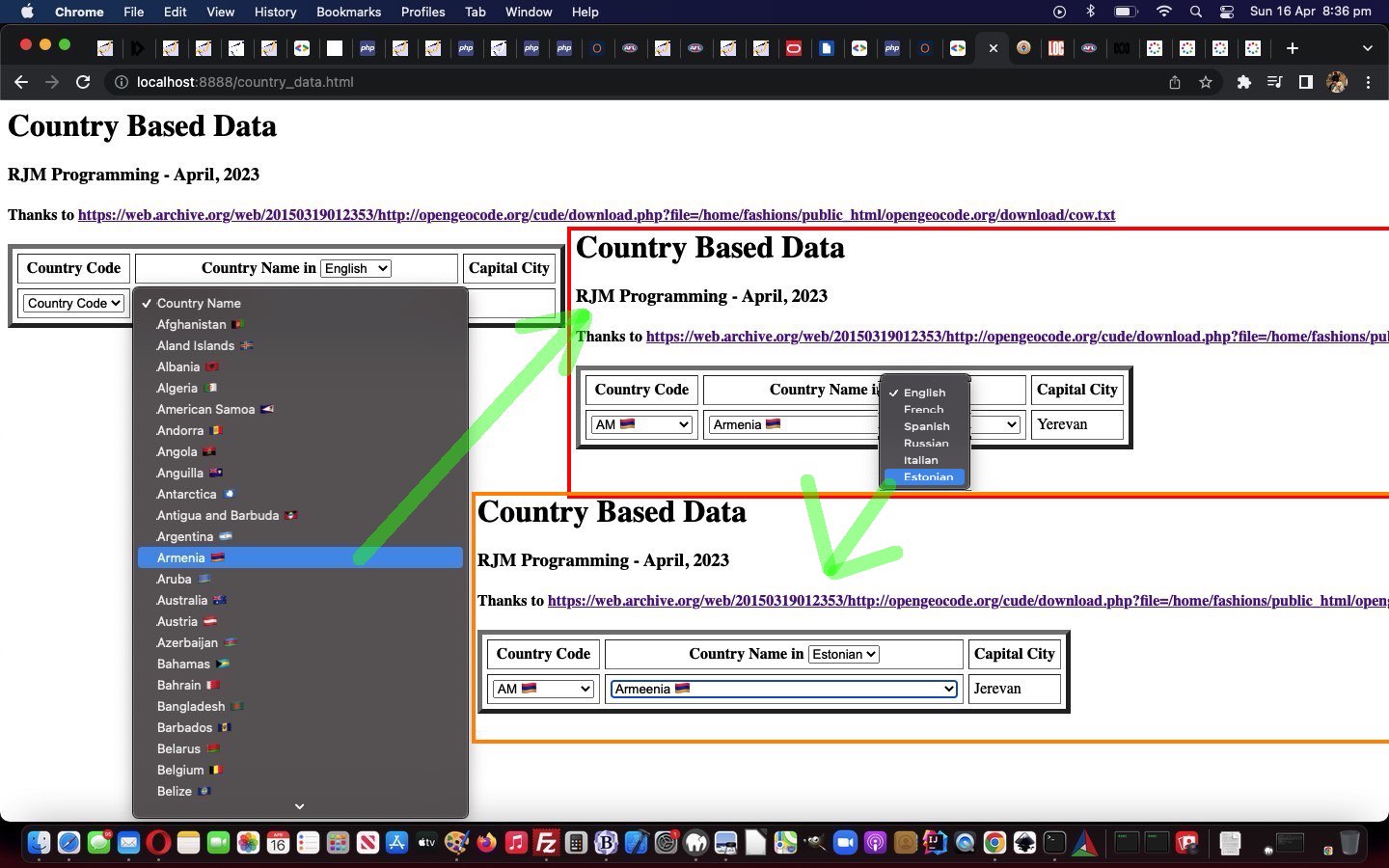
… and imagine we’ll extend its functionality into the near future, onto its proof of concept country_data.html Country Data web application start …
We hope you hang about for the ride?!
If this was interesting you may be interested in this too.



The distinction between course-driven and immersion-driven learning is useful. A small extension to the australia.htm exercise would be a set of named map markers and a text filter: first update the visible markers on an input event, then add a collected/uncollected toggle, and finally persist only that toggle state in localStorage. That gives beginners a concrete reason to learn arrays, DOM updates and browser storage without needing PHP or MySQL first. It is also worth testing empty searches, a page reload and disabled storage separately; those are different failure cases. Disclosure: we maintain the GTA 6 interactive map. I am suggesting it as an example of a map-and-progress interface, not claiming that we used the tutorial code. Would you introduce persistence after the first working interaction, or keep the initial exercise entirely stateless?