
PHP Date Difference Primer Tutorial
When you think of Timezones, do you think of datetime differences?
Okay, well some people must … surely? Anyway, we do. We wonder, thinking about other people in the wooooorrrrllllddd, what time is it for them? Even, what day is it for them, the International Dateline blowing my tiny little mooooiiinnnnddd!
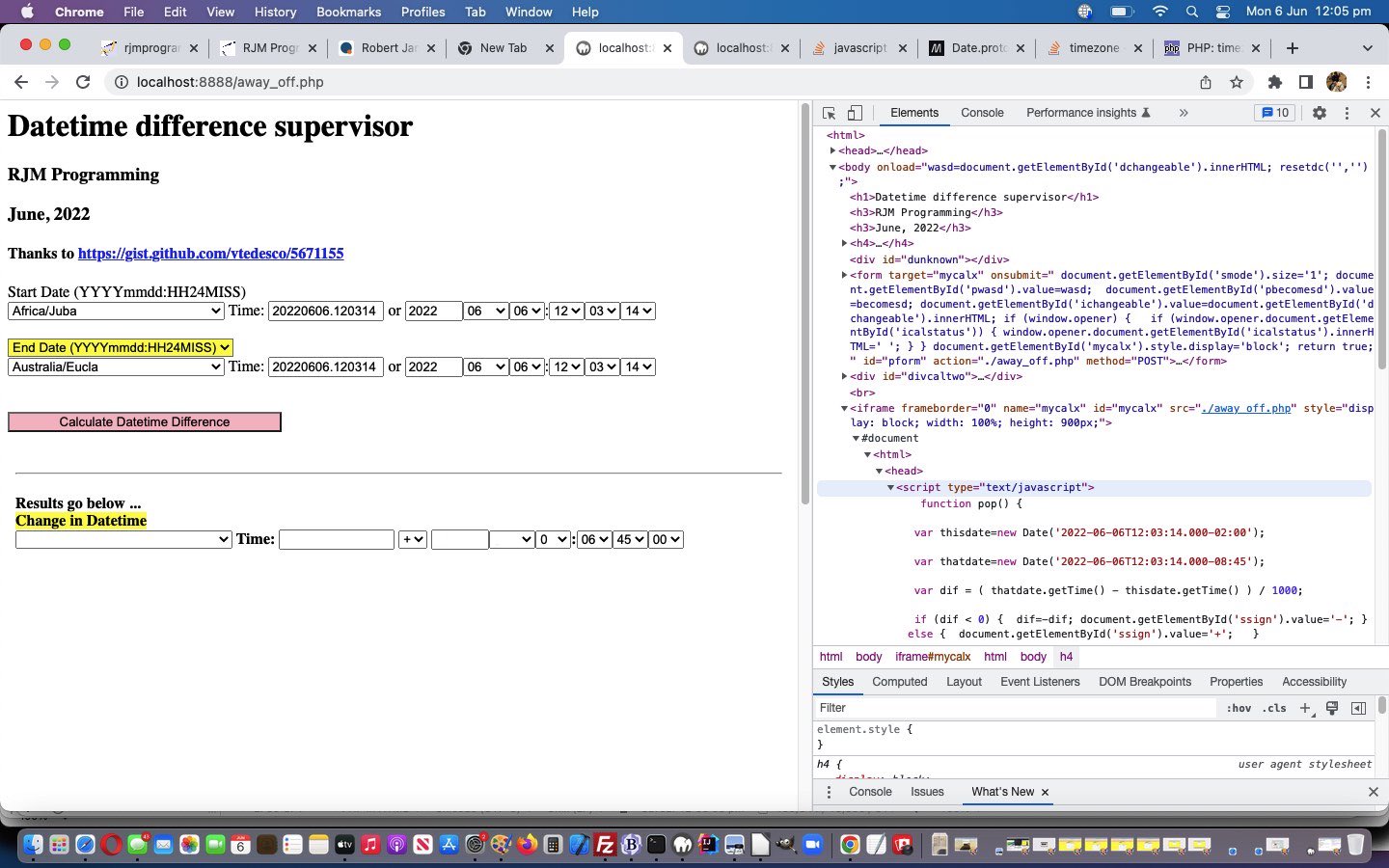
And so we wrote some PHP code to help with datetime differences whether they be related to Timezones or not. We designed a PHP web application that always starts with a defined “Start Datetime” and then allows either …
- End Datetime (deriving Datetime Difference) … or …
- Datetime Difference (deriving End Datetime)
… modes of use. Simple, huh?! And yet, even here, with that first scenario, a pretty fundamental thing was learnt, by yours truly, undertaking this exercise. A Datetime Difference result is only useful to the “Day” point because any one “Month” can be a different length of time to another, and so, becomes difficult to express in terms of a “Month Difference”.
Feel free to try our “proof of concept” PHP web application.
If this was interesting you may be interested in this too.




Naming the things in a bathroom is a smarter vocabulary exercise than it first looks, because every learner already knows the room, so the words attach to objects they can see and touch instead of floating on a flashcard. Asking how many things can you name turns it into a game rather than a test, and the counting itself becomes the motivation: one more word than last time is a visible win. I like the way this kind of lesson uses a photograph as the prompt, since a picture gives every student the same starting point regardless of level, and the stronger students can move on to describing what each thing is for while beginners are still collecting nouns. The bathroom is a good choice of room too, because it is full of everyday words that textbooks often skip, the small objects people actually say out loud every morning. A daily habit of naming five new things around the house would build a working vocabulary faster than memorising lists, and this post is a good template for it.