
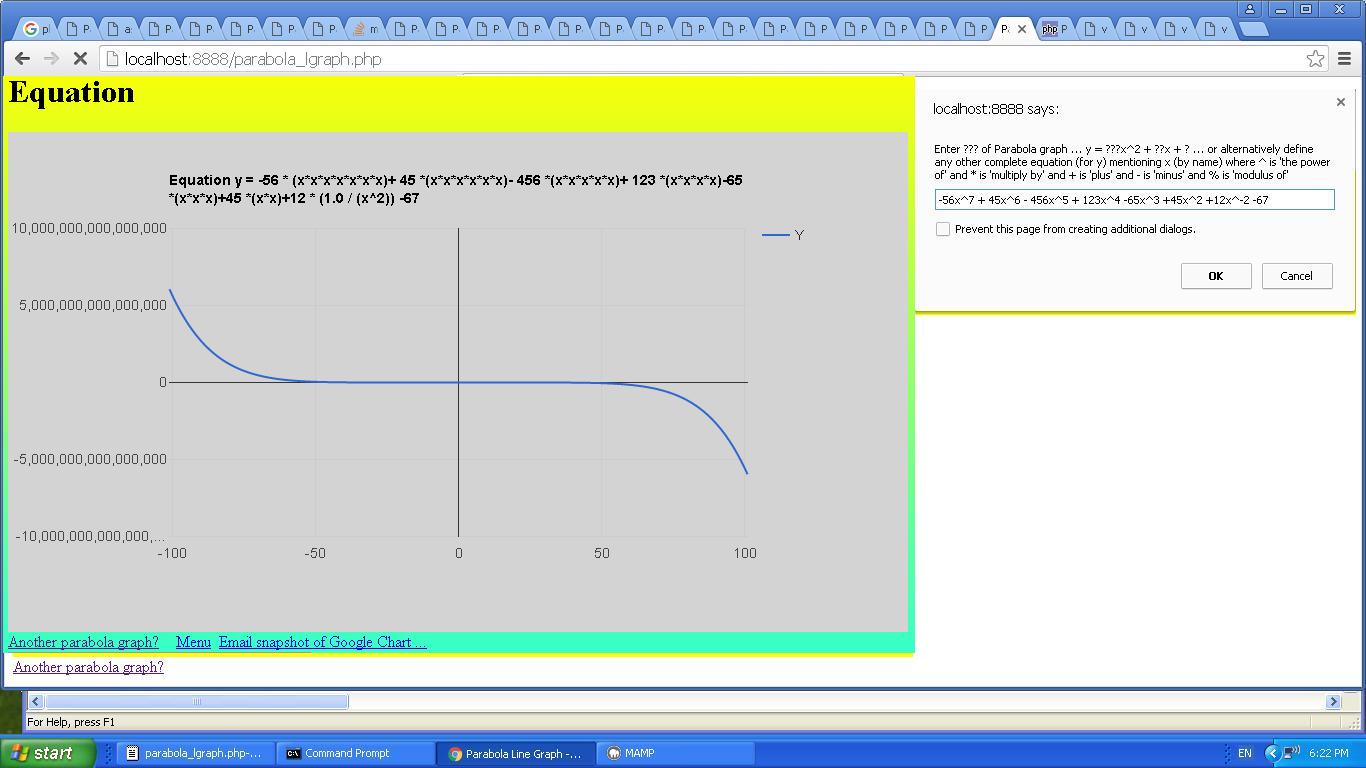
Mathematics Equation Google Chart Line Chart Primer Tutorial
In the recent Mathematics Equation Backtracking Game Primer Tutorial we found that there was not much to do to consider the drawing and display of a straight line by saying the a in …
Y = aX2 + bX + c
… is zero … and this turned the parabola data our Google Chart Parabola Line Graph code was initially designed for, into code that could display a straight line. But what about other equations? Well, we think the same code should suffice for that too, though we have to rearrange a fair bit more for that idea in the code, and ask a lot of the user. They use the ^ for “power of” for instance, and we’re sure we’ll think of more issues with requirements on this as time goes on, but the initial extension to functionality thoughts here swirled around equations where the most complex it gets for a parabola is “to the power of” 2. What about equations of curves of other powers bigger than 2 and less than 1, including negative powers. Given some suitable entries by the user, this is now possible using this same one codebase utilising the Google Chart Line Chart web application interface with this live run that you could call parabola_lgraph.php and which changed in this way. So you can look at today’s tutorial picture, and below we’d like to show you a Cubic Polynomial, as we found discussed at this useful link, thanks.
If this was interesting you may be interested in this too.




Naming the things in a bathroom is a smarter vocabulary exercise than it first looks, because every learner already knows the room, so the words attach to objects they can see and touch instead of floating on a flashcard. Asking how many things can you name turns it into a game rather than a test, and the counting itself becomes the motivation: one more word than last time is a visible win. I like the way this kind of lesson uses a photograph as the prompt, since a picture gives every student the same starting point regardless of level, and the stronger students can move on to describing what each thing is for while beginners are still collecting nouns. The bathroom is a good choice of room too, because it is full of everyday words that textbooks often skip, the small objects people actually say out loud every morning. A daily habit of naming five new things around the house would build a working vocabulary faster than memorising lists, and this post is a good template for it.