
HTML a Link innerHTML Extender and Event Propogation Primer Tutorial
Guess the recent PDF Attachments Add Page Tutorial got me in the mood for “nesting”, and a curiosity I’ve always had, but never “implemented”, is to do a Javascript DOM thing that feels a lot like “linked list” work and involving an HTML “a” link’s innerHTML property.
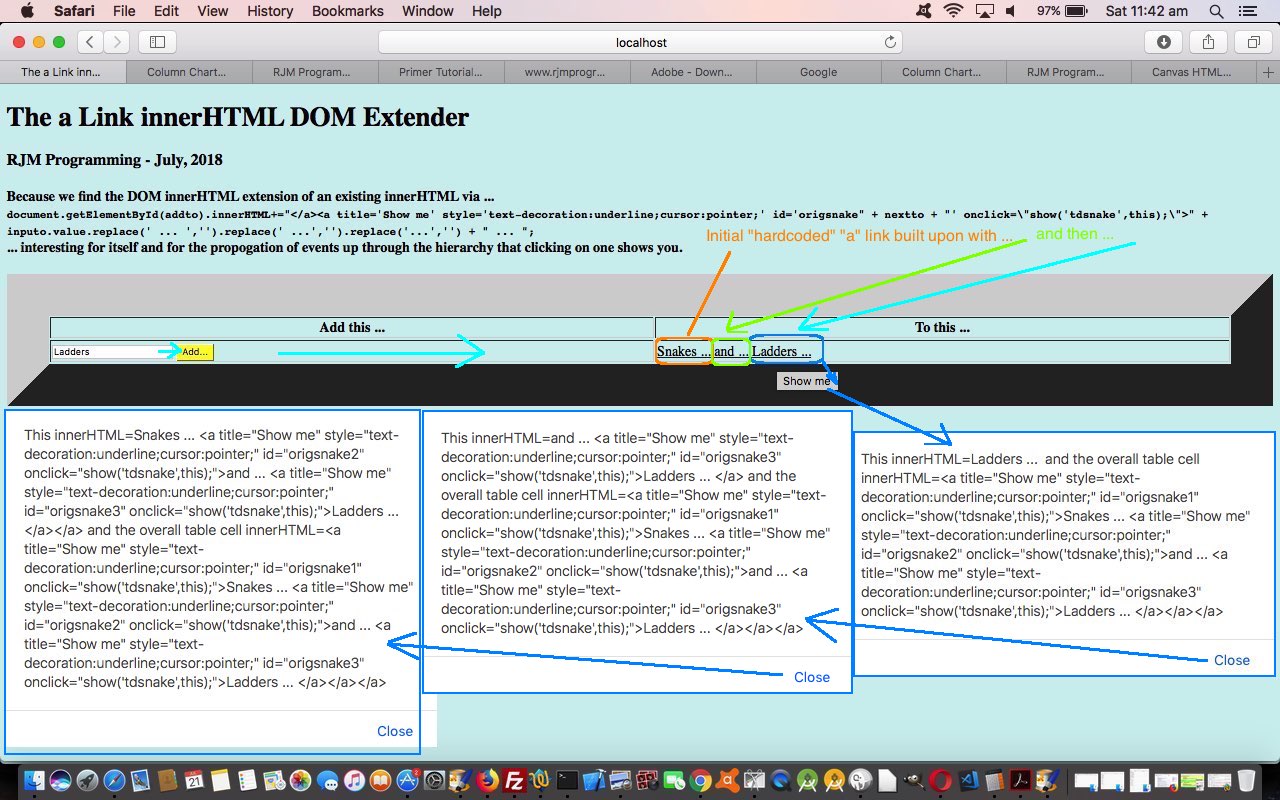
Today’s tutorial picture, we are hoping, is “worth a thousand words”, because this is a bit esoteric explaining purely in words, but will try as a “stepped set of instructions” below …
- start with a “a” link that looks as below …
<a title='Show me' style='text-decoration:underline;cursor:pointer;' id='origsnake1' onclick="show('tdsnake',this);">Snakes ... </a>
- allow for user interaction that offers you to extend that “a” link’s wording as per the HTML …
<input type=text id='iadd' value=''></input> <input style='background-color:yellow;' onclick="addthis(document.getElementById('iadd'));" type='button' value='Add...'></input>
- clicking that button calls on the salient “linked list” feeling Javascript DOM code …
var addto='origsnake1';

function addthis(inputo) {

  var nextto=eval(1 + eval(addto.replace('origsnake','')));

  document.getElementById(addto).innerHTML+="</a><a title='Show me' style='text-decoration:underline;cursor:pointer;' id='origsnake" + nextto + "' onclick=\"show('tdsnake',this);\">" + inputo.value.replace(' ... ','').replace(' ...','').replace('...','') + " ... ";

  addto='origsnake' + nextto;

}
- and the user clicking on one of those “a” links calls on Javascript code …
function show(supervisor,curo) {

  alert("This innerHTML=" + curo.innerHTML + " and the overall table cell innerHTML=" + document.getElementById(supervisor).innerHTML);

}
… that propogates up through the hierarchy of “a” links created on the fly this way
Perhaps you are in “nesting” form too, and find a_extender.html‘s live run interesting too?!
If this was interesting you may be interested in this too.




Naming the things in a bathroom is a smarter vocabulary exercise than it first looks, because every learner already knows the room, so the words attach to objects they can see and touch instead of floating on a flashcard. Asking how many things can you name turns it into a game rather than a test, and the counting itself becomes the motivation: one more word than last time is a visible win. I like the way this kind of lesson uses a photograph as the prompt, since a picture gives every student the same starting point regardless of level, and the stronger students can move on to describing what each thing is for while beginners are still collecting nouns. The bathroom is a good choice of room too, because it is full of everyday words that textbooks often skip, the small objects people actually say out loud every morning. A daily habit of naming five new things around the house would build a working vocabulary faster than memorising lists, and this post is a good template for it.