
Card Sequence Game Sharing Tutorial
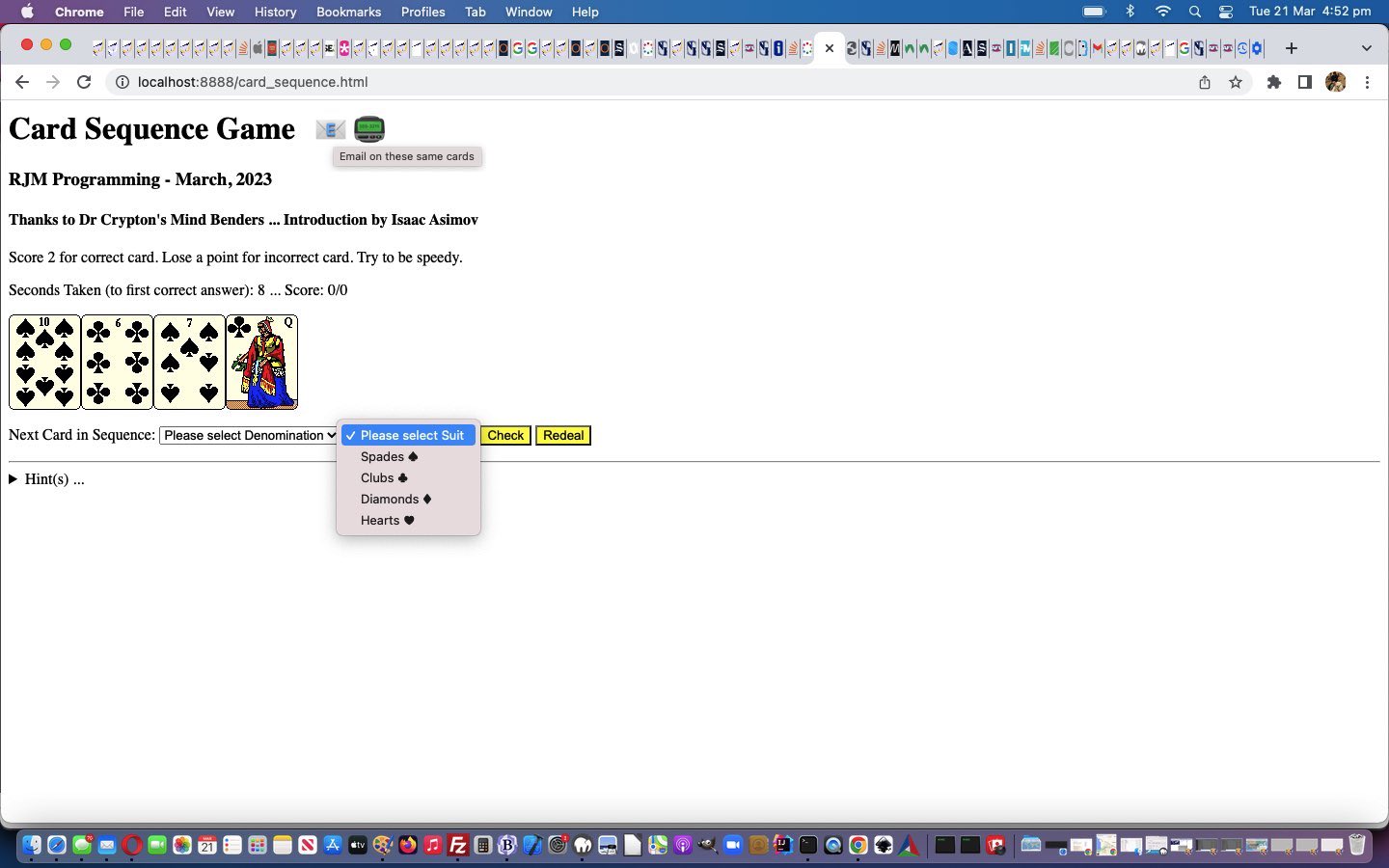
The web application of yesterday’s Card Sequence Game Tutorial had a definite feel as if it could represent …
- a challenge amongst friends … and as such …
- we need to setup a “level playing field” means by which …
- we can share via email (“mailto:” link) or SMS (“sms:” link) clickable link URLs
… as a “sharing” (or for your less competitive friends, “collaborative”) approach to playing our Card Sequence Game.
We also start to use emojis both as …
- buttons for this sharing functionality (for email 📧 and SMS 📟) … and …
- on the card Suit dropdown element content being more Internationally more self-explanatory, the frustration, on some platforms, with a dropdown element being that heart and diamond emojis appear black, and so we added in an HTML span element allowing for these emojis to appear in a more apt red colour, as exemplified by 7♦
You can retry a changed card_sequence.html Card Sequence Game web application better suited to sharing and collaboration and which you can also try below.
Previous relevant Card Sequence Game Tutorial is shown below.
Card Sequence Game Tutorial
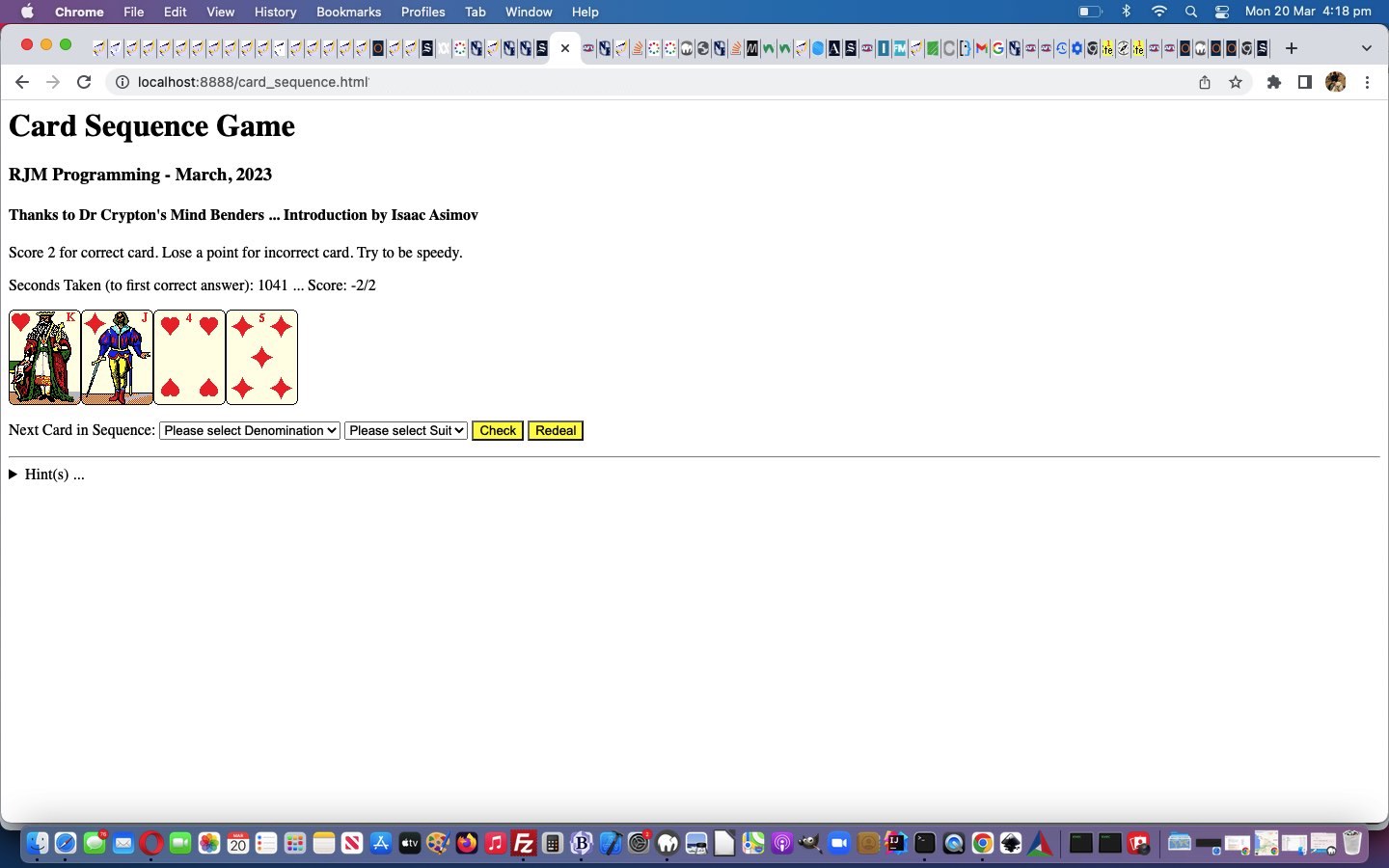
We follow up yesterday’s Date Day of the Week Game Primer Tutorial Dr Crypton’s Mind Benders, Introduction by Isaac Asimov (ISBN 0207146144) lead with a card sequence game we think might be a challenge for you.
Again, we’ve got hints, but you lose score as you consult them. Again we have …
- time (seconds)
- score (two plus for correct and one minus for incorrect)
- goes
… as “bragging rights” data if you are comparing to friends?!
So try the new “proof of concept” web application you can also try below …
Previous relevant Date Day of the Week Game Primer Tutorial is shown below.
Date Day of the Week Game Primer Tutorial
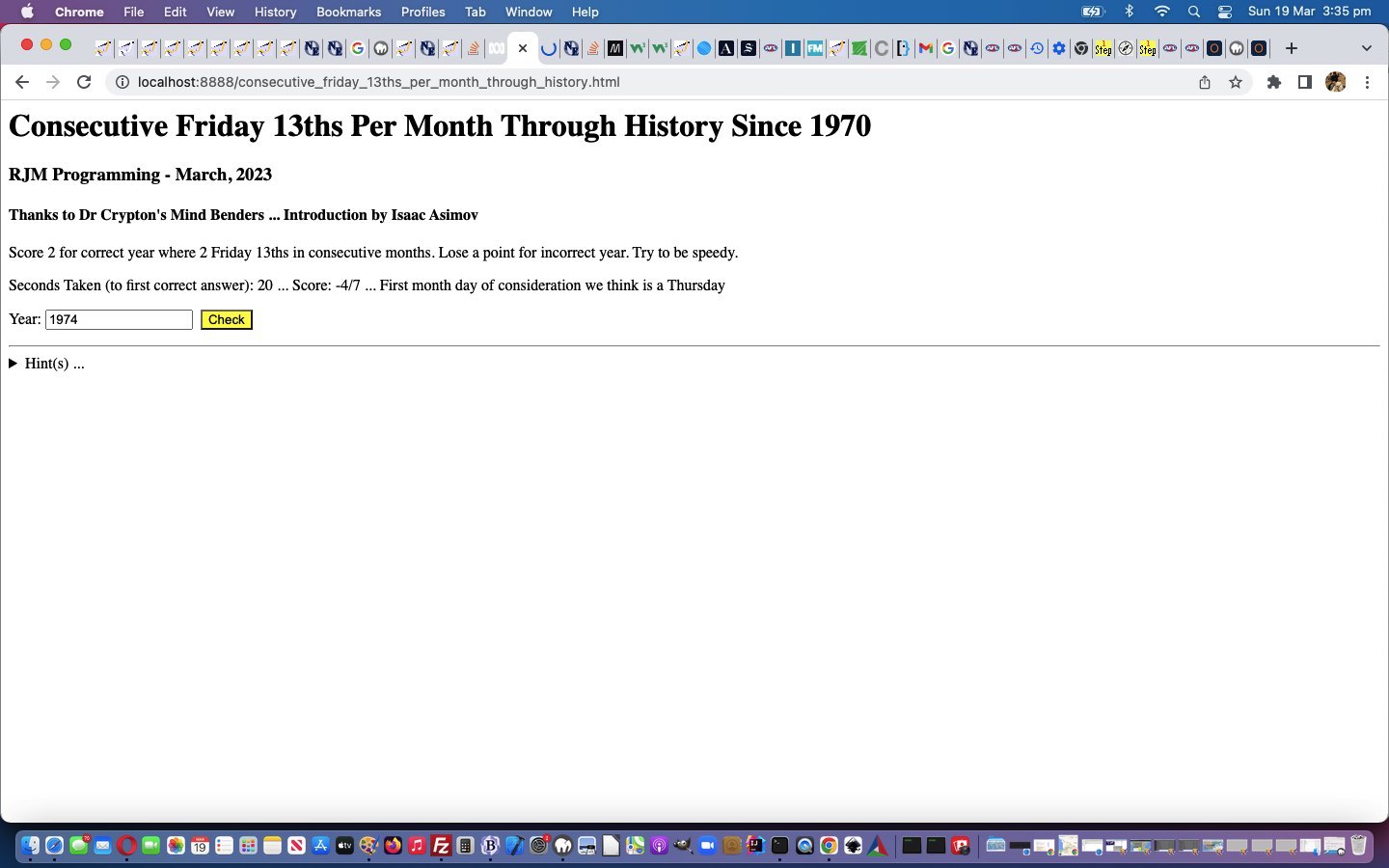
In the category of “Mind Bender”, today, we took inspiration from Dr Crypton’s Mind Benders, Introduction by Isaac Asimov (ISBN 0207146144), thanks, in creating a Date and Day of the Week web application based on …
- Friday the 13th … specifically …
- Which years have 2 consecutive Friday the 13ths occurring in subsequent months?
To say much more would be giving the game away in our new “proof of concept” web application you can also try below …
If this was interesting you may be interested in this too.
If this was interesting you may be interested in this too.
If this was interesting you may be interested in this too.




Naming the things in a bathroom is a smarter vocabulary exercise than it first looks, because every learner already knows the room, so the words attach to objects they can see and touch instead of floating on a flashcard. Asking how many things can you name turns it into a game rather than a test, and the counting itself becomes the motivation: one more word than last time is a visible win. I like the way this kind of lesson uses a photograph as the prompt, since a picture gives every student the same starting point regardless of level, and the stronger students can move on to describing what each thing is for while beginners are still collecting nouns. The bathroom is a good choice of room too, because it is full of everyday words that textbooks often skip, the small objects people actually say out loud every morning. A daily habit of naming five new things around the house would build a working vocabulary faster than memorising lists, and this post is a good template for it.