
C++ Xcode OOP Multiple Inheritance Tutorial
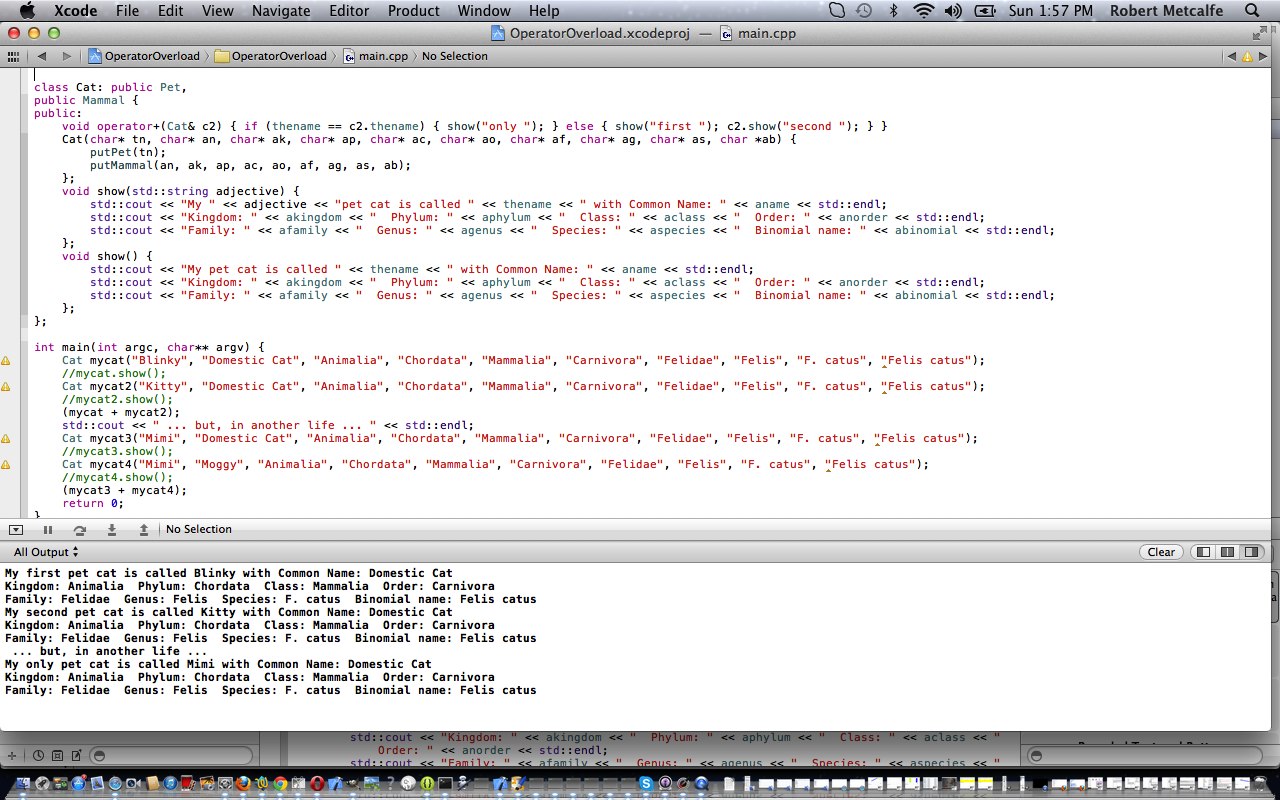
Our C++ Xcode OOP Operator Overloading Tutorial presented here builds off the previous C++ Xcode OOP Multiple Inheritance Tutorial below.
In object-oriented programming, operator overloading—less commonly known as operator ad-hoc polymorphism—is a specific case of polymorphism, where different operators have different implementations depending on their arguments. Operator overloading is generally defined by the language, the programmer, or both.
Operator overloading is claimed to be useful because it allows the developer to program using notation “closer to the target domain”[1] and allows user-defined types a similar level of syntactic support as types built into the language.
Click on picture to see some C++ using Xcode for this, as well as an example of Function Overloading.
Link to some downloadable code … rename to main.cpp for use.
Link to Operator Overloading information … from Wikipedia from which quote above comes.
Link to Function Overloading information … from Wikipedia.
Previous C++ XCode OOP Multiple Inheritance Tutorial below:
C++ Xcode OOP Multiple Inheritance Tutorial
Here is a programming tutorial that introduces you to some more aspects of OOP … oops, forgot to say what OOP stands for … Object Oriented Programming … specifically regarding Multiple Inheritance.
Object-oriented programming (OOP) is a programming paradigm that represents concepts as “objects” that have data fields (attributes that describe the object) and associated procedures known as methods. Objects, which are usually instances of classes, are used to interact with one another to design applications and computer programs.
To me, the beauty of OOP is that it can relate to the nouns in our life. Think of an object that you can touch, like a wristwatch … it has features like its type of design, its size, its weight (ie. its properties), and it has objects that go to make it up, like cogs and wheels (ie. its components), and it has its related classes of objects like clock, alarm clock, oven timer etcetera (ie. its characteristics), and its more fundamental essence, the class of watch (ie. its inheritance).
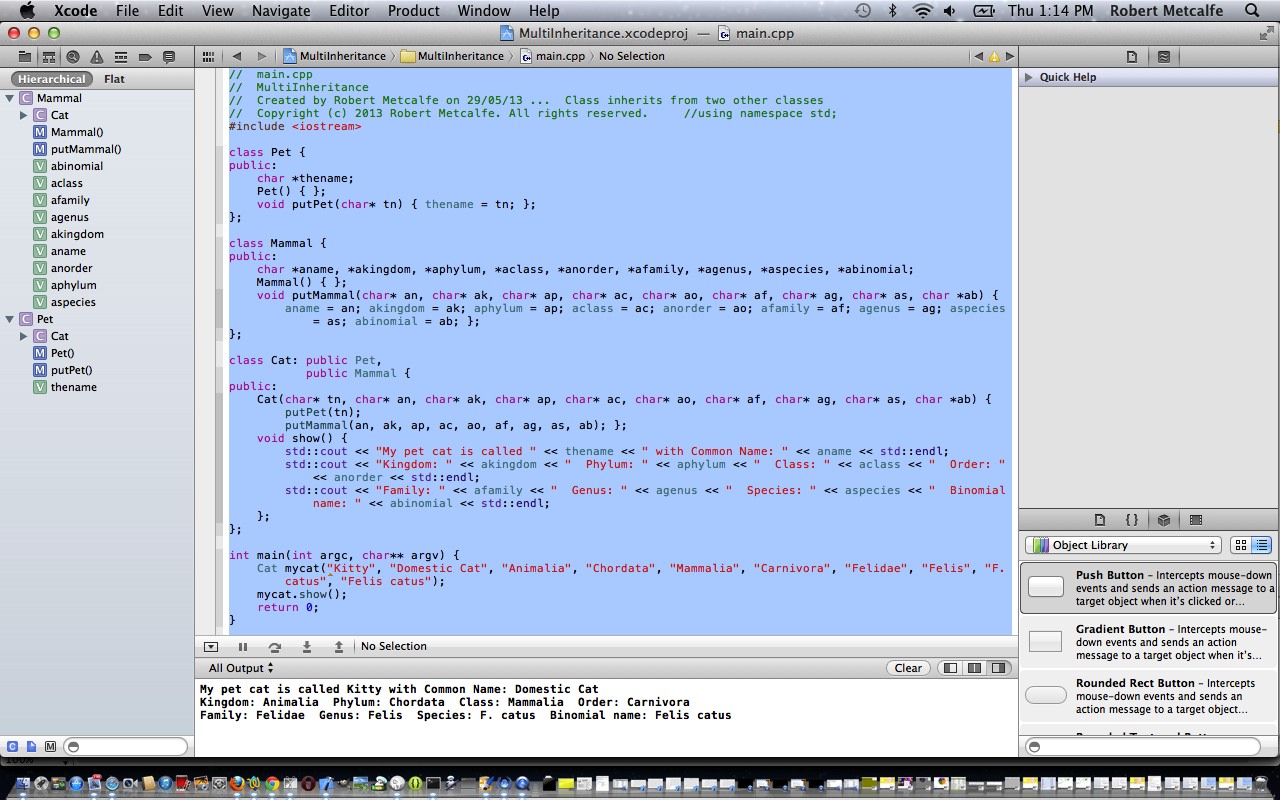
In this tutorial we touch on Multiple Inheritance by the way one class can inherit from more than one other class.
Let’s see some C++ using XCode for this …
Link to Object Oriented Programming information … from Wikipedia from which quote just above comes.
Link to Object Oriented Programming inventor information … Kristen Nygaard.
Also like this link with regard to Multiple Inheritance.
Link to some downloadable code … rename to main.cpp for use.
If this was interesting you may be interested in this too.
If this was interesting you may be interested in this too.




Naming the things in a bathroom is a smarter vocabulary exercise than it first looks, because every learner already knows the room, so the words attach to objects they can see and touch instead of floating on a flashcard. Asking how many things can you name turns it into a game rather than a test, and the counting itself becomes the motivation: one more word than last time is a visible win. I like the way this kind of lesson uses a photograph as the prompt, since a picture gives every student the same starting point regardless of level, and the stronger students can move on to describing what each thing is for while beginners are still collecting nouns. The bathroom is a good choice of room too, because it is full of everyday words that textbooks often skip, the small objects people actually say out loud every morning. A daily habit of naming five new things around the house would build a working vocabulary faster than memorising lists, and this post is a good template for it.