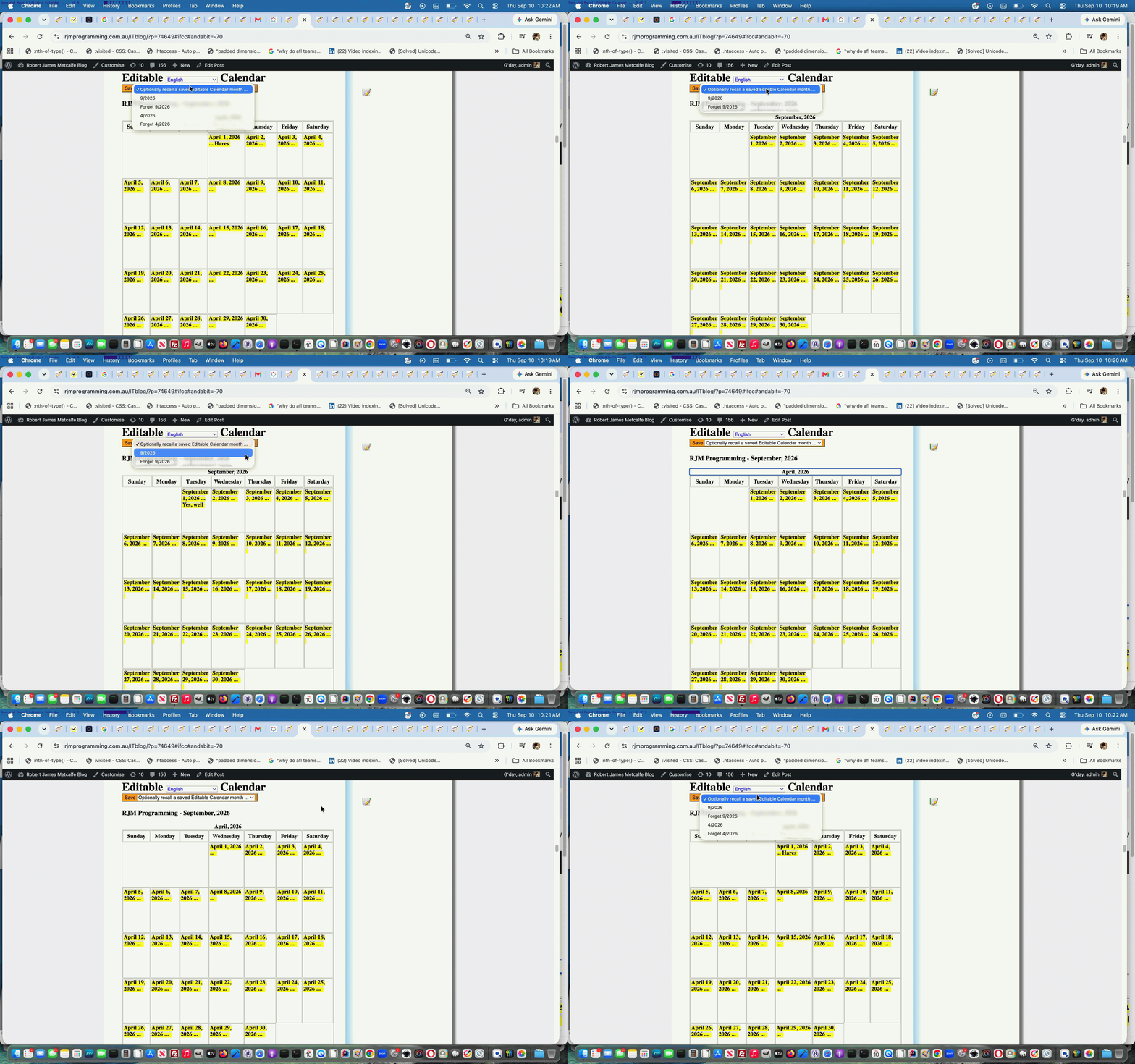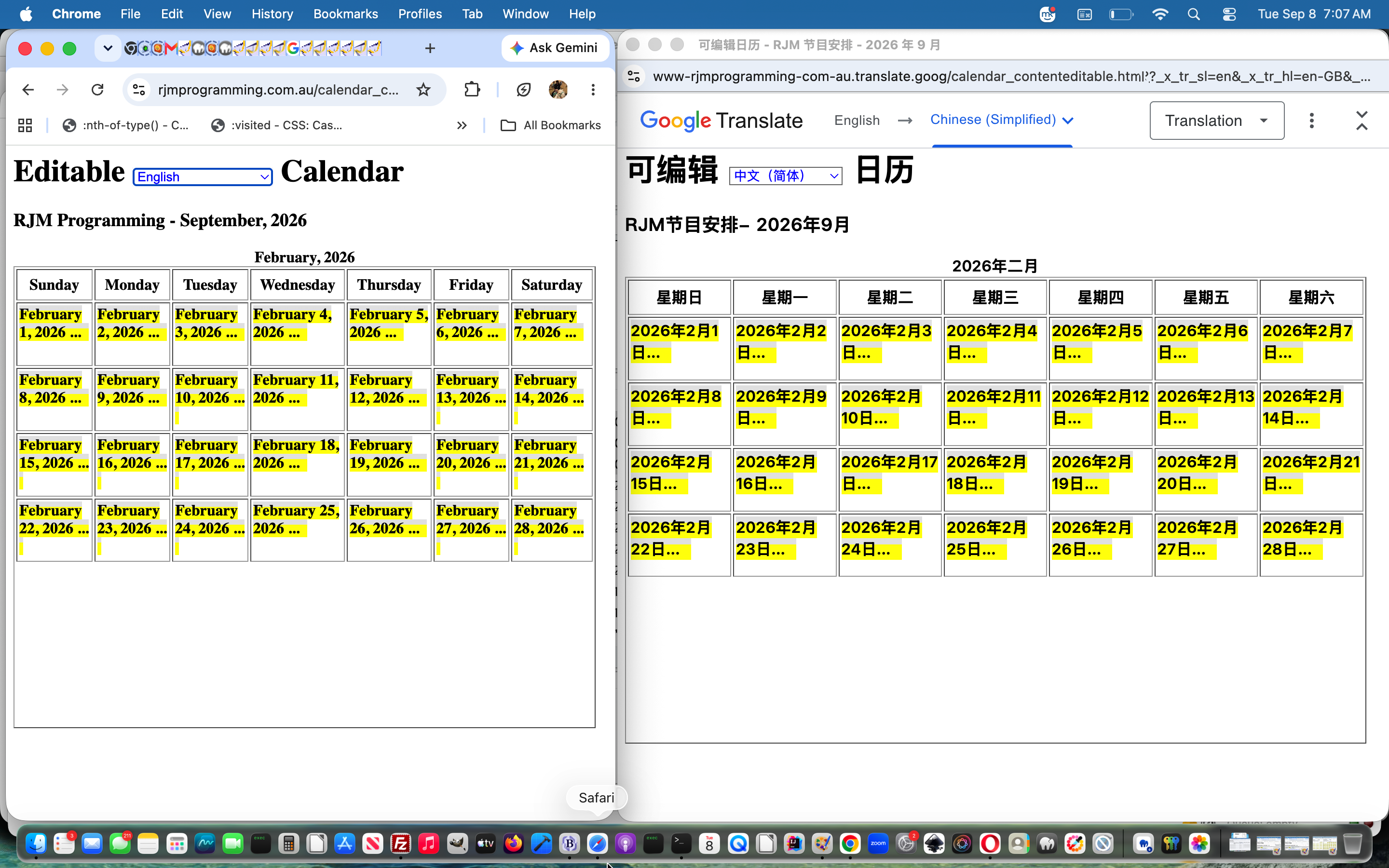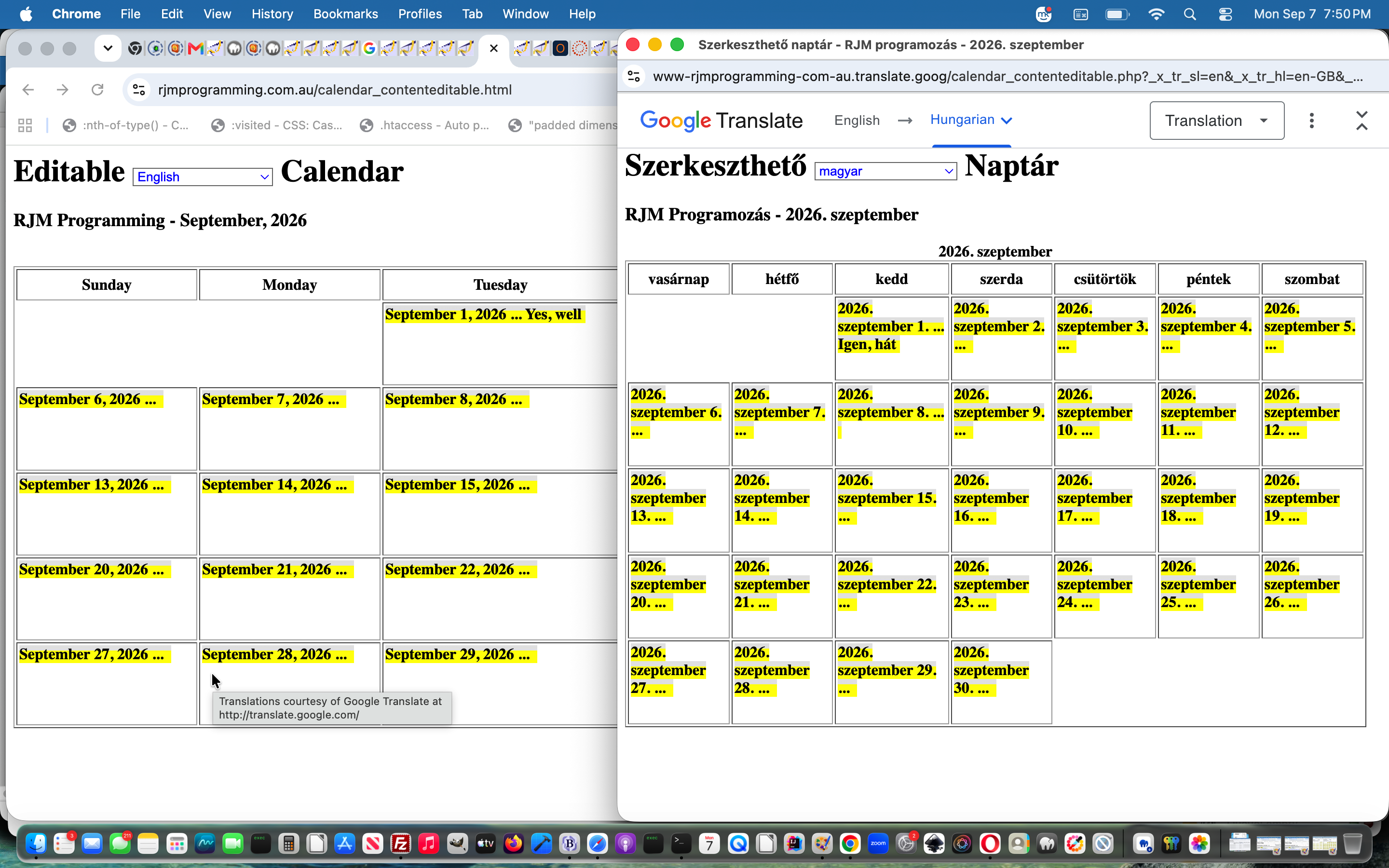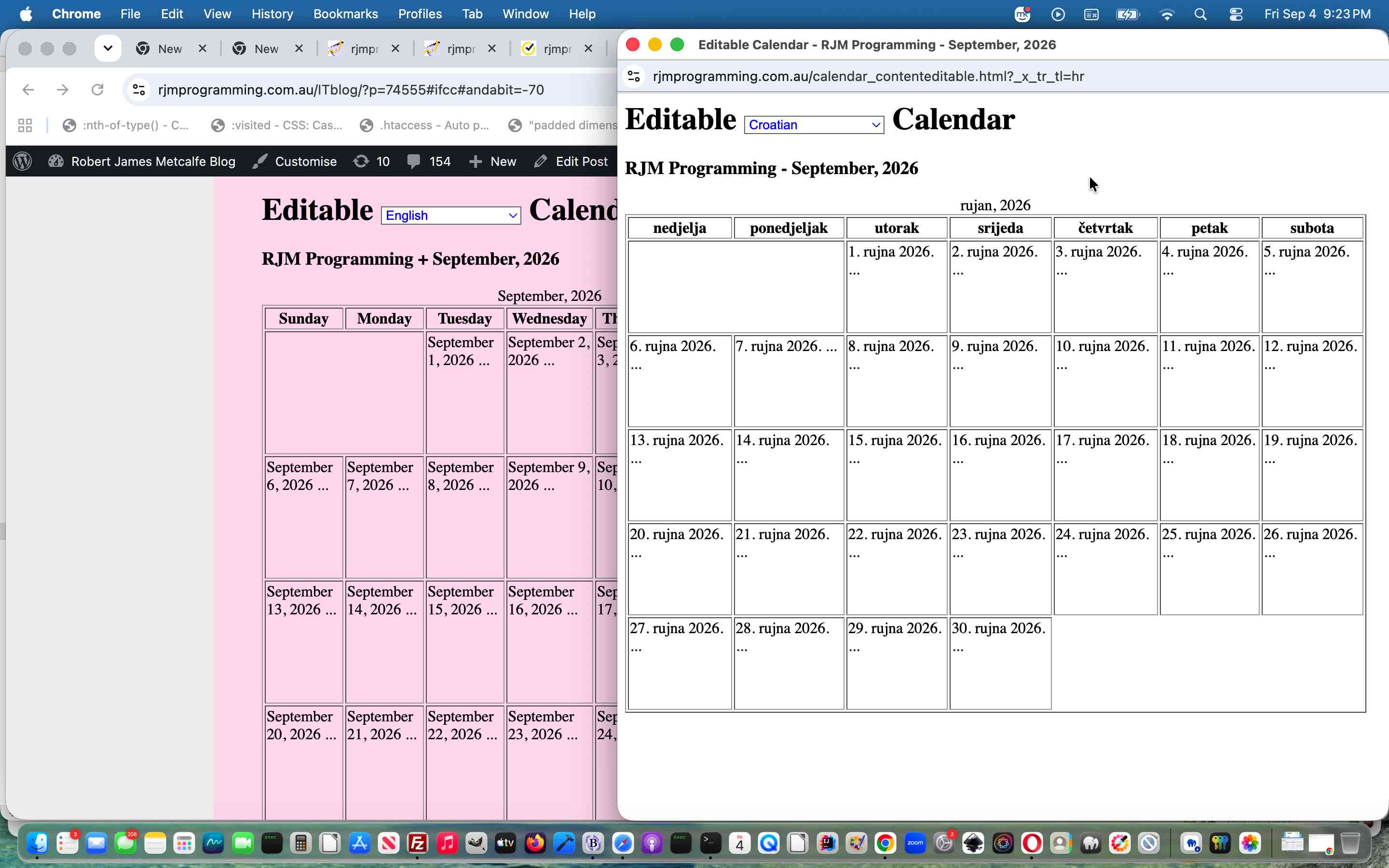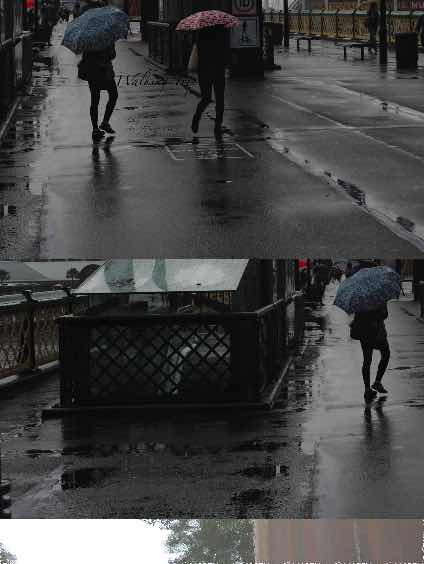
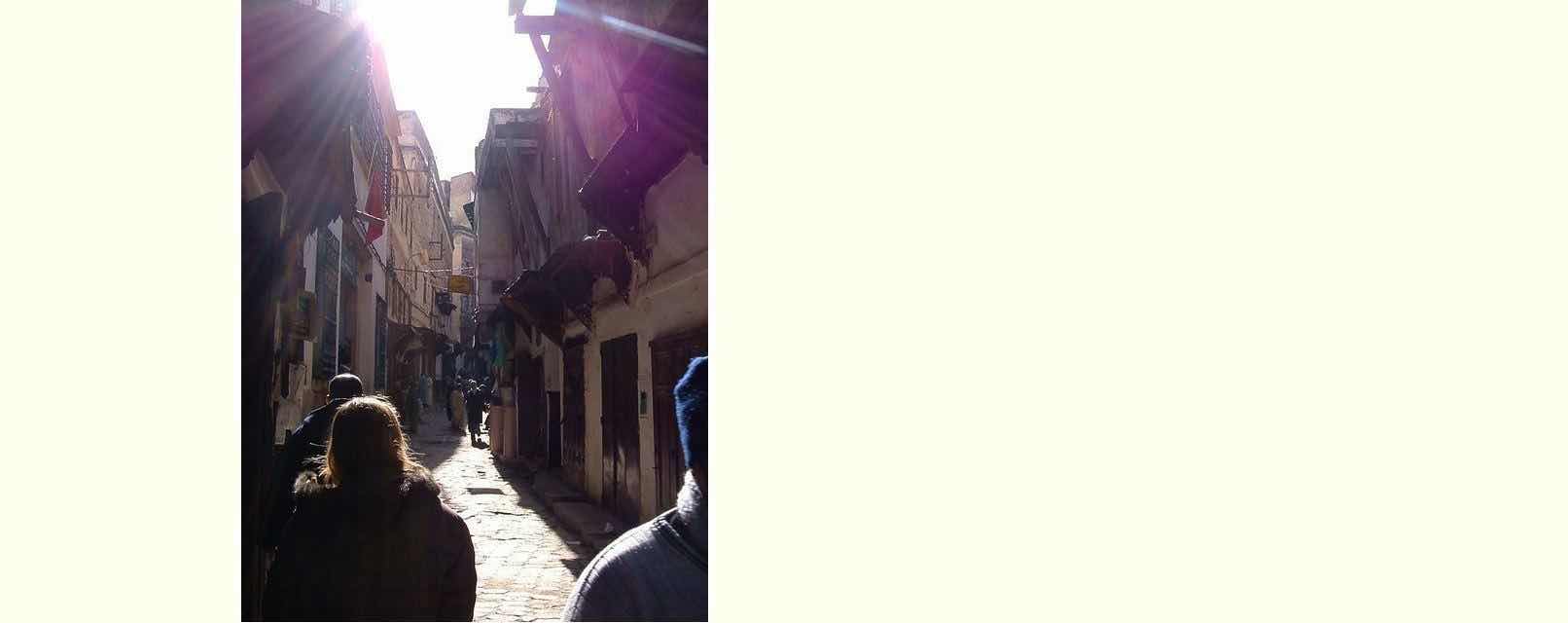
Walking Trip …

Walking Trip

Walking Trip

Offenbach's Suite ... Warts 'n All

Offenbach's Suite ... Warts 'n All

 📅  

If this was interesting you may be interested in this too.

Posted in Photography, Trips | Tagged , , | 34 Comments

Media Multiple Copy and Paste Intranet Feeling Tutorial

Media Multiple Copy and Paste Tutorial

Media Multiple Copy and Paste Intranet Feeling Tutorial

Further to yesterday’s Media Copy and Paste Intranet Feeling Tutorial we wanted to improve on …

  • multiple email attachments
  • email subject, of form, recognition

… making the top PHP block now look like …


<?php
// media_via_pb.php
// RJM Programming
// December, 2025

$incopy='';
$pathbit='';
$basebit='';
$mampfilelist='';
$mampfs=[];

function ourexec($amore) {
global $incopy, $pathbit, $basebit, $mampfilelist, $mampfs;
if ($incopy == '') {
if (strpos($amore, "POSIX file \"") !== false) {
$rbfile=explode("\"", explode("POSIX file \"", $amore)[1])[0];
$basebit=basename($rbfile);
$pathbit=explode($basebit, $rbfile)[0];
//file_put_contents('x.xxx', $pathbit . "\n" . $basebit . "\n" . $rbfile);
}
$incopy=$amore;
}
return exec($amore);
}

function andthenlater($andmore) {
global $incopy, $pathbit, $basebit, $mampfilelist, $mampfs;
$thingos=[''];
$rel='x';
if (PHP_OS == 'Darwin') {
if (strlen($andmore) > 1) {
$thingos=explode(',', $andmore);
}
for ($iwe=0; $iwe<sizeof($thingos); $iwe++) {
$thingo=$thingos[$iwe];
$pbit='';
if (basename($thingo) == $thingo && $pathbit != '') {
$pbit=$pathbit;
}
//file_put_contents('x.xx', $pathbit . "\n" . $basebit . "\n" . $thingo);
if (strlen($thingo) > 1) {
if (strpos(strtolower($thingo), '.png') !== false) {
exec("osascript -e 'tell application \"Finder\" to set the clipboard to (read (POSIX file \"" . $pbit . $thingo . "\") as «class PNGf»)'");
} else if (strpos(strtolower($thingo), '.jp') !== false) {
exec("osascript -e 'tell application \"Finder\" to set the clipboard to (read (POSIX file \"" . $pbit . $thingo . "\") as «class JPEG»)'");
} else if (strpos(strtolower($thingo), '.gif') !== false) {
exec("osascript -e 'tell application \"Finder\" to set the clipboard to (read (POSIX file \"" . $pbit . $thingo . "\") as «class GIF»)'");
}
sleep(5);
}
// Thanks to https://www.google.com/search?q=macos+osascript+paste+from+clipboard+where+the+cursor+is+in+whatever+window&rlz=1C5OZZY_en&oq=macos+osascript+paste+from+clipboard+where+the+cursor+is+in+whatever+window&gs_lcrp=EgZjaHJvbWUyBggAEEUYOdIBCTQ3NDg4ajBqN6gCALACAA&sourceid=chrome&ie=UTF-8
$retis=shell_exec("osascript -e 'tell application \"System Events\"
# Get the name of the current application (which is likely the Script Editor or Automator)
set currentApp to name of current application

# Check if the current app is one of the script runners and hide it to allow the target app to become frontmost
if currentApp is in {\"Script Editor\", \"Automator\", \"Script Debugger\"} then
set visible of process currentApp to false
# Wait a moment for the target app to become active
delay 0.1
end if


# Simulate the Command+V keystroke in the now frontmost application
keystroke \"v\" using command down

# (Optional) Unhide the script application afterward
if currentApp is in {\"Script Editor\", \"Automator\", \"Script Debugger\"} then
set visible of process currentApp to true
end if
end tell
'");
}
if (strlen($andmore) > 1 && $incopy != '') {
return exec($incopy);
}
}
if (strlen($andmore) <= 1 && sizeof($mampfs) > 1 && $basebit != '' && $rel != '') {
$newc='';
for ($ijk=0; $ijk<sizeof($mampfs); $ijk++) {
if (strpos(explode('##',$mampfs[$ijk])[0], $basebit) === false) {
if ($newc == '') {
$newc=explode('##',$mampfs[$ijk])[0];
} else {
$newc=explode('##',$mampfs[$ijk])[0] . ',' . $newc;
}
}
}
sleep(5);
//file_put_contents('x.x', $pathbit . "\n" . $basebit . "\n" . $newc);
andthenlater($newc);
}
return '';
}

$ifmamp="ifmamp";
$ifport=":8888";
$premvp='';
$subjsuff='';
$thingo='';
$mampfilelist='';
$mampfs=[];
$mto="?";


if (isset($_GET['subject'])) {
$subjsuff=urlencode(' ... ') . $_GET['subject'];
file_put_contents($_SERVER['DOCUMENT_ROOT'] . DIRECTORY_SEPARATOR . 'x.xx', $subjsuff . "\n" . $_SERVER['QUERY_STRING']);
} else if (isset($_POST['subject'])) {
$subjsuff=urlencode(' ... ') . $_POST['subject'];
file_put_contents($_SERVER['DOCUMENT_ROOT'] . DIRECTORY_SEPARATOR . 'x.xx', $subjsuff . "\n" . $_SERVER['QUERY_STRING']);
}

//file_put_contents($_SERVER['DOCUMENT_ROOT'] . DIRECTORY_SEPARATOR . 'x.xx', $thingo);
if (PHP_OS == 'Darwin' || substr(strtolower(('' . PHP_OS)),0,3) == 'win') {
if (PHP_OS == 'Darwin') {
$mto="please.change@email.address?cc=please.change@email.address&bcc=please.change@email.address&";
$premvp='public=Y&';
$ifmamp=strtoupper($ifmamp); //"_blank";
} else {
$ifport="";
}
} else {
//$ifmamp="_blank";
$ifmamp=strtoupper($ifmamp); //"_blank";
$premvp='public=y&';
}


if (isset($_GET['paste'])) {
andthenlater(str_replace('+',' ',urldecode($_GET['paste'])));
exit;
} else if ($_POST['paste']) {
andthenlater(str_replace('+',' ',urldecode($_POST['paste'])));
exit;
}


if (isset($_GET['mvp'])) {
//file_put_contents('x.xxxx', $_GET['mvp']);
$mampfilelist=str_replace('+',' ',urldecode($_GET['mvp']));
if ($mampfilelist != '') {
//file_put_contents('zs1.zs0',$mampfilelist);
$mampfs=explode(',', $mampfilelist);
for ($i=0; $i<sizeof($mampfs); $i++) {
if (strpos($mampfs[$i], '##') !== false) {
$fn=explode('##', $mampfs[$i])[0];
$fs=explode('##', $mampfs[$i])[1];
$fd=false;
if (PHP_OS == 'Darwin') {
$onefile=exec("find " . $_SERVER['DOCUMENT_ROOT'] . DIRECTORY_SEPARATOR . " -name '" . $fn . "' -size '" . $fs . "c' 2> /dev/null");
if ($onefile != '') {
$thingo=$onefile;
$fd=true;
} else {
$iti = new RecursiveDirectoryIterator($_SERVER['DOCUMENT_ROOT'] . DIRECTORY_SEPARATOR);
foreach (new RecursiveIteratorIterator($iti) as $file) {
if (!fd) {
foreach (glob($file . $fn) as $file) {
if (!fd) {
if (strpos($file, $fn) !== false && filesize($file) == $fs) {
$thingo=$file;
$fd=true;
}
}
}
}
}
}
} else if (substr(strtolower(('' . PHP_OS)),0,3) == 'win') {
$iti = new RecursiveDirectoryIterator(str_replace("/","\\",$_SERVER['DOCUMENT_ROOT'] . DIRECTORY_SEPARATOR));
foreach (new RecursiveIteratorIterator($iti) as $file) {
if (!fd) {
foreach (glob($file . $fn) as $file) {
if (!fd) {
if (strpos($file, $fn) !== false && filesize($file) == $fs) {
$thingo=$file;
$fd=true;
}
}
}
}
}
}
}
}
}


if ($thingo != '') {
if (strpos(strtolower($thingo), '.png') !== false) {
//file_put_contents($_SERVER['DOCUMENT_ROOT'] . DIRECTORY_SEPARATOR . 'x.x', "osascript -e 'tell application \"Finder\" to set the clipboard to (read (POSIX file \"" . $thingo . "\") as «class PNGf»)'");
if (PHP_OS == 'Darwin') {
ourexec("osascript -e 'tell application \"Finder\" to set the clipboard to (read (POSIX file \"" . $thingo . "\") as «class PNGf»)'");
} else {
//$fp = fopen($thingo, 'r');
//$gcont=fread($fp, filesize($thingo));
//fclose($fp);
$fp = fopen($_SERVER['DOCUMENT_ROOT'] . DIRECTORY_SEPARATOR . 'stop_extravaganza.bzt', 'x');
fwrite($fp, "powershell.exe -windowstyle hidden -Command \"Add-Type -AssemblyName System.Windows.Forms; [Windows.Forms.Clipboard]::SetImage([System.Drawing.Image]::Fromfile('" . $thingo . "'))\" & erase " . str_replace("/","\\",$_SERVER['DOCUMENT_ROOT'] . DIRECTORY_SEPARATOR) . 'stop_extravaganza.b*t');
fclose($fp);
if (isset($_GET['mailto'])) {
sleep(65);
}
}
if (isset($_GET['mailto'])) {
$parstuff='';
if (strlen($_GET['mailto']) > 1) {
$mto=str_replace('please.change@email.address',str_replace('+',' ',urldecode($_GET['mailto'])),$mto);
$parstuff=" parent.document.getElementById('" . str_replace('+',' ',urldecode($_GET['mailto'])) . "').style.textShadow='1px 1px red'; parent.document.getElementById('" . str_replace('+',' ',urldecode($_GET['mailto'])) . "').style.cursor='pointer'; if (parent.document.getElementById('mailtovssms')) { if (parent.document.getElementById('mailtovssms').value.toLowerCase() == parent.document.getElementById('mailtovssms').value) { parent.setlastb('" . str_replace('+',' ',urldecode($_GET['mailto'])) . "'); } } ";
}
if (isset($_GET['public'])) {
andthenlater('');
} else {
echo "<html><body onload=\" if (parent.document.getElementById('mailtovssms')) { if (parent.document.getElementById('mailtovssms').value.toUpperCase() == parent.document.getElementById('mailtovssms').value) { document.getElementById('aemail').href=document.getElementById('aemail').href.replace('please.change@email.address?cc=please.change@email.address&bcc=please.change@email.address&','?'); } } if (parent.document.getElementById('mailtovssms')) { if (parent.document.getElementById('mailtovssms').value.toLowerCase() == 'sms') { if (parent.document.getElementById('mailtovssms').value == 'SMS') { document.getElementById('aemail').href='sms:&body='; } else { document.getElementById('aemail').href='sms:rmetcalfe15@gmail.com&body='; } } } document.getElementById('aemail').click(); location.href=document.URL.split('?')[0].split('#')[0] + '?paste=y'; " . $parstuff . "\"><a style=display:none; id=aemail target=_top href='mailto:" . $mto . "subject=Slide%20" . urlencode(basename($thingo)) . "%20in%20clipboard%20ready%20for%20you%20to%20paste%20as%20attachment%20below&20" . $subjsuff . "%20...&body='>Email</a></body></html>";
}
}
} else if (strpos(strtolower($thingo), '.jp') !== false) {
//file_put_contents($_SERVER['DOCUMENT_ROOT'] . DIRECTORY_SEPARATOR . 'x.x', "osascript -e 'tell application \"Finder\" to set the clipboard to (read (POSIX file \"" . $thingo . "\") as «class JPEG»)'");
if (PHP_OS == 'Darwin') {
ourexec("osascript -e 'tell application \"Finder\" to set the clipboard to (read (POSIX file \"" . $thingo . "\") as «class JPEG»)'");
} else {
//$fp = fopen($thingo, 'r');
//$gcont=fread($fp, filesize($thingo));
//fclose($fp);
$fp = fopen($_SERVER['DOCUMENT_ROOT'] . DIRECTORY_SEPARATOR . 'stop_extravaganza.bzt', 'x');
fwrite($fp, "powershell.exe -windowstyle hidden -Command \"Add-Type -AssemblyName System.Windows.Forms; [Windows.Forms.Clipboard]::SetImage([System.Drawing.Image]::Fromfile('" . $thingo . "'))\" & erase " . str_replace("/","\\",$_SERVER['DOCUMENT_ROOT'] . DIRECTORY_SEPARATOR) . 'stop_extravaganza.b*t');
fclose($fp);
if (isset($_GET['mailto'])) {
sleep(65);
}
}
if (isset($_GET['mailto'])) {
$parstuff='';
if (strlen($_GET['mailto']) > 1) {
$mto=str_replace('please.change@email.address',str_replace('+',' ',urldecode($_GET['mailto'])),$mto);
$parstuff=" parent.document.getElementById('" . str_replace('+',' ',urldecode($_GET['mailto'])) . "').style.textShadow='1px 1px red'; parent.document.getElementById('" . str_replace('+',' ',urldecode($_GET['mailto'])) . "').style.cursor='pointer'; if (parent.document.getElementById('mailtovssms')) { if (parent.document.getElementById('mailtovssms').value.toLowerCase() == parent.document.getElementById('mailtovssms').value) { parent.setlastb('" . str_replace('+',' ',urldecode($_GET['mailto'])) . "'); } } ";
}
if (isset($_GET['public'])) {
andthenlater('');
} else {
echo "<html><body onload=\"if (parent.document.getElementById('mailtovssms')) { if (parent.document.getElementById('mailtovssms').value.toUpperCase() == parent.document.getElementById('mailtovssms').value) { document.getElementById('aemail').href=document.getElementById('aemail').href.replace('please.change@email.address?cc=please.change@email.address&bcc=please.change@email.address&','?'); } } if (parent.document.getElementById('mailtovssms')) { if (parent.document.getElementById('mailtovssms').value.toLowerCase() == 'sms') { if (parent.document.getElementById('mailtovssms').value == 'SMS') { document.getElementById('aemail').href='sms:&body='; } else { document.getElementById('aemail').href='sms:rmetcalfe15@gmail.com&body='; } } } document.getElementById('aemail').click(); location.href=document.URL.split('?')[0].split('#')[0] + '?paste=y'; " . $parstuff . "\"><a style=display:none; id=aemail target=_top href='mailto:" . $mto . "subject=Slide%20" . urlencode(basename($thingo)) . "%20in%20clipboard%20ready%20for%20you%20to%20paste%20as%20attachment%20below&20" . $subjsuff . "%20...&body='>Email</a></body></html>";
}
}
} else if (strpos(strtolower($thingo), '.gif') !== false) {
if (PHP_OS == 'Darwin') {
ourexec("osascript -e 'tell application \"Finder\" to set the clipboard to (read (POSIX file \"" . $thingo . "\") as «class GIF»)'");
} else {
//$fp = fopen($thingo, 'r');
//$gcont=fread($fp, filesize($thingo));
//fclose($fp);
$fp = fopen($_SERVER['DOCUMENT_ROOT'] . DIRECTORY_SEPARATOR . 'stop_extravaganza.bzt', 'x');
fwrite($fp, "powershell.exe -windowstyle hidden -Command \"Add-Type -AssemblyName System.Windows.Forms; [Windows.Forms.Clipboard]::SetImage([System.Drawing.Image]::Fromfile('" . $thingo . "'))\" & erase " . str_replace("/","\\",$_SERVER['DOCUMENT_ROOT'] . DIRECTORY_SEPARATOR) . 'stop_extravaganza.b*t');
fclose($fp);
if (isset($_GET['mailto'])) {
sleep(65);
}
}
if (isset($_GET['mailto'])) {
$parstuff='';
if (strlen($_GET['mailto']) > 1) {
$mto=str_replace('please.change@email.address',str_replace('+',' ',urldecode($_GET['mailto'])),$mto);
$parstuff=" parent.document.getElementById('" . str_replace('+',' ',urldecode($_GET['mailto'])) . "').style.textShadow='1px 1px red'; parent.document.getElementById('" . str_replace('+',' ',urldecode($_GET['mailto'])) . "').style.cursor='pointer'; if (parent.document.getElementById('mailtovssms')) { if (parent.document.getElementById('mailtovssms').value.toLowerCase() == parent.document.getElementById('mailtovssms').value) { parent.setlastb('" . str_replace('+',' ',urldecode($_GET['mailto'])) . "'); } } ";
}
if (isset($_GET['public'])) {
andthenlater('');
} else {
echo "<html><body onload=\"if (parent.document.getElementById('mailtovssms')) { if (parent.document.getElementById('mailtovssms').value.toUpperCase() == parent.document.getElementById('mailtovssms').value) { document.getElementById('aemail').href=document.getElementById('aemail').href.replace('please.change@email.address?cc=please.change@email.address&bcc=please.change@email.address&','?'); } } if (parent.document.getElementById('mailtovssms')) { if (parent.document.getElementById('mailtovssms').value.toLowerCase() == 'sms') { if (parent.document.getElementById('mailtovssms').value == 'SMS') { document.getElementById('aemail').href='sms:&body='; } else { document.getElementById('aemail').href='sms:rmetcalfe15@gmail.com&body='; } } } document.getElementById('aemail').click(); location.href=document.URL.split('?')[0].split('#')[0] + '?paste=y'; " . $parstuff . "\"><a style=display:none; id=aemail target=_top href='mailto:" . $mto . "subject=Slide%20" . urlencode(basename($thingo)) . "%20in%20clipboard%20ready%20for%20you%20to%20paste%20as%20attachment%20below&20" . $subjsuff . "%20...&body='>Email</a></body></html>";
}
}
}
}


exit;
} else if (isset($_POST['mvp'])) {
$mampfilelist=str_replace('+',' ',urldecode($_POST['mvp']));
if ($mampfilelist != '') {
$mampfs=explode(',', $mampfilelist);
for ($i=0; $i<sizeof($mampfs); $i++) {
if (strpos($mampfs[$i], '##') !== false) {
$fn=explode('##', $mampfs[$i])[0];
$fs=explode('##', $mampfs[$i])[1];
$fd=false;
$iti = new RecursiveDirectoryIterator($_SERVER['DOCUMENT_ROOT'] . DIRECTORY_SEPARATOR);
foreach (new RecursiveIteratorIterator($iti) as $file) {
if (!fd) {
foreach (glob($file . $fn) as $file) {
if (!fd) {
if (strpos($file, $fn) !== false && filesize($file) == $fs) {
$thingo=$file;
$fd=true;
}
}
}
}
}
}
}
}


if ($thingo != '') {
if (strpos(strtolower($thingo), '.png') !== false) {
//file_put_contents($_SERVER['DOCUMENT_ROOT'] . DIRECTORY_SEPARATOR . 'x.x', "osascript -e 'tell application \"Finder\" to set the clipboard to (read (POSIX file \"" . $thingo . "\") as «class PNGf»)'");
if (PHP_OS == 'Darwin') {
ourexec("osascript -e 'tell application \"Finder\" to set the clipboard to (read (POSIX file \"" . $thingo . "\") as «class PNGf»)'");
} else {
//$fp = fopen($thingo, 'r');
//$gcont=fread($fp, filesize($thingo));
//fclose($fp);
$fp = fopen($_SERVER['DOCUMENT_ROOT'] . DIRECTORY_SEPARATOR . 'stop_extravaganza.bzt', 'x');
fwrite($fp, "powershell.exe -windowstyle hidden -Command \"Add-Type -AssemblyName System.Windows.Forms; [Windows.Forms.Clipboard]::SetImage([System.Drawing.Image]::Fromfile('" . $thingo . "'))\" & erase " . str_replace("/","\\",$_SERVER['DOCUMENT_ROOT'] . DIRECTORY_SEPARATOR) . 'stop_extravaganza.b*t');
fclose($fp);
if (isset($_POST['mailto'])) {
sleep(65);
}
}
if (isset($_POST['mailto'])) {
$parstuff='';
if (strlen($_POST['mailto']) > 1) {
$mto=str_replace('please.change@email.address',str_replace('+',' ',urldecode($_POST['mailto'])),$mto);
$parstuff=" parent.document.getElementById('" . str_replace('+',' ',urldecode($_POST['mailto'])) . "').style.textShadow='1px 1px red'; parent.document.getElementById('" . str_replace('+',' ',urldecode($_POST['mailto'])) . "').style.cursor='pointer'; if (parent.document.getElementById('mailtovssms')) { if (parent.document.getElementById('mailtovssms').value.toLowerCase() == parent.document.getElementById('mailtovssms').value) { parent.setlastb('" . str_replace('+',' ',urldecode($_POST['mailto'])) . "'); } } ";
}
if (isset($_POST['public'])) {
andthenlater('');
} else {
echo "<html><body onload=\" if (parent.document.getElementById('mailtovssms')) { if (parent.document.getElementById('mailtovssms').value.toUpperCase() == parent.document.getElementById('mailtovssms').value) { document.getElementById('aemail').href=document.getElementById('aemail').href.replace('please.change@email.address?cc=please.change@email.address&bcc=please.change@email.address&','?'); } } if (parent.document.getElementById('mailtovssms')) { if (parent.document.getElementById('mailtovssms').value.toLowerCase() == 'sms') { if (parent.document.getElementById('mailtovssms').value == 'SMS') { document.getElementById('aemail').href='sms:&body='; } else { document.getElementById('aemail').href='sms:rmetcalfe15@gmail.com&body='; } } } document.getElementById('aemail').click(); location.href=document.URL.split('?')[0].split('#')[0] + '?paste=y'; " . $parstuff . "\"><a style=display:none; id=aemail target=_top href='mailto:" . $mto . "subject=Slide%20" . urlencode(basename($thingo)) . "%20in%20clipboard%20ready%20for%20you%20to%20paste%20as%20attachment%20below&20" . $subjsuff . "%20...&body='>Email</a></body></html>";
}
}
} else if (strpos(strtolower($thingo), '.jp') !== false) {
//file_put_contents($_SERVER['DOCUMENT_ROOT'] . DIRECTORY_SEPARATOR . 'x.x', "osascript -e 'tell application \"Finder\" to set the clipboard to (read (POSIX file \"" . $thingo . "\") as «class JPEG»)'");
if (PHP_OS == 'Darwin') {
ourexec("osascript -e 'tell application \"Finder\" to set the clipboard to (read (POSIX file \"" . $thingo . "\") as «class JPEG»)'");
} else {
//$fp = fopen($thingo, 'r');
//$gcont=fread($fp, filesize($thingo));
//fclose($fp);
$fp = fopen($_SERVER['DOCUMENT_ROOT'] . DIRECTORY_SEPARATOR . 'stop_extravaganza.bzt', 'x');
fwrite($fp, "powershell.exe -windowstyle hidden -Command \"Add-Type -AssemblyName System.Windows.Forms; [Windows.Forms.Clipboard]::SetImage([System.Drawing.Image]::Fromfile('" . $thingo . "'))\" & erase " . str_replace("/","\\",$_SERVER['DOCUMENT_ROOT'] . DIRECTORY_SEPARATOR) . 'stop_extravaganza.b*t');
fclose($fp);
if (isset($_POST['mailto'])) {
sleep(65);
}
}
if (isset($_POST['mailto'])) {
$parstuff='';
if (strlen($_POST['mailto']) > 1) {
$mto=str_replace('please.change@email.address',str_replace('+',' ',urldecode($_POST['mailto'])),$mto);
$parstuff=" parent.document.getElementById('" . str_replace('+',' ',urldecode($_POST['mailto'])) . "').style.textShadow='1px 1px red'; parent.document.getElementById('" . str_replace('+',' ',urldecode($_POST['mailto'])) . "').style.cursor='pointer'; if (parent.document.getElementById('mailtovssms')) { if (parent.document.getElementById('mailtovssms').value.toLowerCase() == parent.document.getElementById('mailtovssms').value) { parent.setlastb('" . str_replace('+',' ',urldecode($_POST['mailto'])) . "'); } } ";
}
if (isset($_POST['public'])) {
andthenlater('');
} else {
echo "<html><body onload=\"if (parent.document.getElementById('mailtovssms')) { if (parent.document.getElementById('mailtovssms').value.toUpperCase() == parent.document.getElementById('mailtovssms').value) { document.getElementById('aemail').href=document.getElementById('aemail').href.replace('please.change@email.address?cc=please.change@email.address&bcc=please.change@email.address&','?'); } } if (parent.document.getElementById('mailtovssms')) { if (parent.document.getElementById('mailtovssms').value.toLowerCase() == 'sms') { if (parent.document.getElementById('mailtovssms').value == 'SMS') { document.getElementById('aemail').href='sms:&body='; } else { document.getElementById('aemail').href='sms:rmetcalfe15@gmail.com&body='; } } } document.getElementById('aemail').click(); location.href=document.URL.split('?')[0].split('#')[0] + '?paste=y'; " . $parstuff . "\"><a style=display:none; id=aemail target=_top href='mailto:" . $mto . "subject=Slide%20" . urlencode(basename($thingo)) . "%20in%20clipboard%20ready%20for%20you%20to%20paste%20as%20attachment%20below&20" . $subjsuff . "%20...&body='>Email</a></body></html>";
}
}
} else if (strpos(strtolower($thingo), '.gif') !== false) {
if (PHP_OS == 'Darwin') {
ourexec("osascript -e 'tell application \"Finder\" to set the clipboard to (read (POSIX file \"" . $thingo . "\") as «class GIF»)'");
} else {
//$fp = fopen($thingo, 'r');
//$gcont=fread($fp, filesize($thingo));
//fclose($fp);
$fp = fopen($_SERVER['DOCUMENT_ROOT'] . DIRECTORY_SEPARATOR . 'stop_extravaganza.bzt', 'x');
fwrite($fp, "powershell.exe -windowstyle hidden -Command \"Add-Type -AssemblyName System.Windows.Forms; [Windows.Forms.Clipboard]::SetImage([System.Drawing.Image]::Fromfile('" . $thingo . "'))\" & erase " . str_replace("/","\\",$_SERVER['DOCUMENT_ROOT'] . DIRECTORY_SEPARATOR) . 'stop_extravaganza.b*t');
fclose($fp);
if (isset($_POST['mailto'])) {
sleep(65);
}
}
if (isset($_POST['mailto'])) {
$parstuff='';
if (strlen($_POST['mailto']) > 1) {
$mto=str_replace('please.change@email.address',str_replace('+',' ',urldecode($_POST['mailto'])),$mto);
$parstuff=" parent.document.getElementById('" . str_replace('+',' ',urldecode($_POST['mailto'])) . "').style.textShadow='1px 1px red'; parent.document.getElementById('" . str_replace('+',' ',urldecode($_POST['mailto'])) . "').style.cursor='pointer'; if (parent.document.getElementById('mailtovssms')) { if (parent.document.getElementById('mailtovssms').value.toLowerCase() == parent.document.getElementById('mailtovssms').value) { parent.setlastb('" . str_replace('+',' ',urldecode($_POST['mailto'])) . "'); } } ";
}
if (isset($_POST['public'])) {
andthenlater('');
} else {
echo "<html><body onload=\"if (parent.document.getElementById('mailtovssms')) { if (parent.document.getElementById('mailtovssms').value.toUpperCase() == parent.document.getElementById('mailtovssms').value) { document.getElementById('aemail').href=document.getElementById('aemail').href.replace('please.change@email.address?cc=please.change@email.address&bcc=please.change@email.address&','?'); } } if (parent.document.getElementById('mailtovssms')) { if (parent.document.getElementById('mailtovssms').value.toLowerCase() == 'sms') { if (parent.document.getElementById('mailtovssms').value == 'SMS') { document.getElementById('aemail').href='sms:&body='; } else { document.getElementById('aemail').href='sms:rmetcalfe15@gmail.com&body='; } } } document.getElementById('aemail').click(); location.href=document.URL.split('?')[0].split('#')[0] + '?paste=y'; " . $parstuff . "\"><a style=display:none; id=aemail target=_top href='mailto:" . $mto . "subject=Slide%20" . urlencode(basename($thingo)) . "%20in%20clipboard%20ready%20for%20you%20to%20paste%20as%20attachment%20below&20" . $subjsuff . "%20...&body='>Email</a></body></html>";
}
}
}
}


exit;
}


?>

… in a downloadable changed media_via_pb.php media_via_pb.php web application or a public domain webpage incarnation .


Previous relevant Media Copy and Paste Intranet Feeling Tutorial is shown below.

Media Copy and Paste Tutorial

Media Copy and Paste Intranet Feeling Tutorial

Further to yesterday’s Media Copy and Paste Tutorial, of course, what we’d prefer to be able to do to use it could be …

  • call it from from a public domain via a URL and link such as https://www.rjmprogramming.com.au/Mac/media_via_pb.php … after having …
  • to a local web server (such as MAMP) underlying operating system environments, to the point that an email attachment piece of automation can be worked from a downloaded changed media_via_pb.php media_via_pb.php web application …
  • so that up at the public domain webpage when local media browsing …
  • with email address defined …
  • the “Intranet feeling” window.open(MAMP-get-style-url.php, iframe-name, ‘top=?,width=?,left=?,height=?’) can work it’s magic in amongst, in order …
    1. public domain does window.open as above
    2. public domain webpage does “a” mailto: link click to open email client
    3. MAMP-get-style-url.php in macOS or Windows copies image into Clipboard as graphics
    4. if macOS can go on to paste that Clipboard image into that email body as an attachment

… but only if, as we’ve verified again today and only for sure on macOS Google Chrome web browser so far, otherwise CORS restrictions come into it, MAMP-get-style-url.php only performs PHP stuff and does not try to write out a webpage of any sort. We can arrange it that way in this project but can easily imagine other projects where this can not be wrangled using a public domain webpage incarnation this “Intranet feeling” way.


Previous relevant Media Copy and Paste Tutorial is shown below.

Media Copy and Paste Tutorial

Media Copy and Paste Tutorial

Maybe you recently hovered over the tutorial image idea of Mac OS X Copy to Clipboard and Paste Tutorial below, and read …

Here in December, 2025 we have lost touch with the original media_via_pb.php code from back in November 2018 and we are in the process of repiecing a similar but different set of logics in a similar vein. Please stay tuned for interplay with macOS pbcopy and pbpaste and Windows clip commands or some other methodology involvement not existing in this reconstituted first draft.

Bit sad, but a new opportunity too?!

And so, with that opportunity, we can apply some recent work knowledge, especially regarding a local web server (such as MAMP) underlying operating system environments, to the point that an email attachment piece of automation can be worked from a downloadable changed media_via_pb.php media_via_pb.php web application.


Previous relevant Mac OS X Copy to Clipboard and Paste Tutorial is shown below.

Mac OS X Copy to Clipboard and Paste Tutorial

Mac OS X Copy to Clipboard and Paste Tutorial

Were you an interested reader of Mac OS X Clipboard to File to Datauri Primer Tutorial that we wrote some time ago now? It involved the Mac OS X command line …


pbcopy

… command to “provide copying and pasting to the pasteboard (the Clipboard) from command line” (quoting from “man pbcopy”).

And where there is a “copy” there’s a … anyone, anyone? … yes, Smithers, a “paste”. And so, new to today’s work, we start combining that pbpaste with the brilliant passthru


passthru('pbpaste');

… to position at the place to “plonk” media data into a webpage, often, and let it display.

You’ll notice in today’s PHP (only really suits localhost local web server hosting code, such as MAMP) “Media via pbcopy and pbpaste” web application’s http://localhost:8888/media_via_pb.php code that we code an exec style …


exec('pbcopy < ' . $ourpath . str_replace("+"," ",urldecode($_GET['filename'])));

… then, obscurely (you may think), (roughly) go (for the $_GET versus $_POST arguments) …


$cont=file_get_contents($ourpath . str_replace("+"," ",urldecode($_GET['filename'])));
if (strpos($cont, "data:") !== false) {
// "plonk" these in HTML surrounds supporting the relevant (mimetype derived (via file extension array matching)) element's src property contents
if (strpos($cont, "data:image/") !== false) {
echo '<html><body><img src="';
passthru('pbpaste');
echo '"></img></body></html>';
} else if (strpos($cont, "data:video/") !== false) {
if ($ourmimetype == "") {
echo '<html><body><video controls><source src="';
} else {
echo '<html><body><video controls><source type="' . $ourmimetype . '" src="';
}
passthru('pbpaste');
echo '"></source></video></body></html>';
} else if (strpos($cont, "data:audio/") !== false) {
if ($ourmimetype == "") {
echo '<html><body><audio controls><source src="';
} else {
echo '<html><body><audio controls><source type="' . $ourmimetype . '" src="';
}
passthru('pbpaste');
echo '"></source></audio></body></html>';
} else if (strpos($cont, "data:text/") !== false) {
header('Content-type: text/' . str_replace('jpg','jpeg',$ext));
passthru('pbpaste');
} else if ($ourpath == '' && $ourmimetype == '') {
header('Location: ' . str_replace("+"," ",urldecode($_GET['filename'])));
} else if ($ourmimetype != '') {
header('Content-type: ' . $ourmimetype);
passthru('pbpaste');
} else {
header('Location: ' . str_replace("+"," ",urldecode($_GET['filename'])));
}
} else if ($ourmimetype != '') { // we know mimetype via file extension
header('Content-type: ' . $ourmimetype);
passthru('pbpaste');
} else {
header('Location: ' . str_replace("+"," ",urldecode($_GET['filename'])));
}

… to allow for dataURI file content, as relevant. To get a feel for this, review today’s PDF slideshow that ends with Nala (playing hide and seek) from Zipfiles in PHP Media Gallery MIME Type Tutorial.


Previous relevant Mac OS X Clipboard to File to Datauri Primer Tutorial is shown below.

Mac OS X Clipboard to File to Datauri Primer Tutorial

Mac OS X Clipboard to File to Datauri Primer Tutorial

Today’s tutorial is a lot about the image two below the one above. It looks pretty much like any other image on this web page, I’m sure, at first glance, you’d say?! But the fact is, this image does not involve a web server image file of any sort, though its storage does involve a web server database, because all these blog postings exist in a table of a MySql database that WordPress uses to store information. Has this let you down? Hope not, because this is still a pretty big concept, getting bigger and bigger as time goes on, and spurred on by the mobile device revolution, and that is the rise and rise of the use of datauri based media. Let’s see what Wikipedia says …

The data URI scheme is a uniform resource identifier (URI) scheme that provides a way to include data in-line in web pages as if they were external resources. It is a form of file literal or here document. This technique allows normally separate elements such as images and style sheets to be fetched in a single Hypertext Transfer Protocol (HTTP) request, which may be more efficient than multiple HTTP requests.[1] Data URIs are sometimes referred to incorrectly as “data URLs”.[citation needed] As of 2015, data URIs are fully supported by most major browsers, and partially supported in Internet Explorer and Microsoft Edge.[2]

With this image, two down, we didn’t feel like plonking this as a file on our web server, basically because it was that bit smaller than the usual, and so the basic steps of how we constructed it was …

  • we’d Prnt-Scrn buttoned this part of a screen snapshot on Windows 10 … and then …
  • we emailed it to ourselves, but logged onto our MacBook Pro laptop … and so we …
  • downloaded that email attachment into the Preview desktop application … where we …
  • drew a rectangle around the dialog of interest and used Edit -> Copy to get it into a Mac OS X clipboard … and though we didn’t do this right here and now, we did do before the final step, copy the clipboard into an image file called huh.png (via File -> Save As…) via Paintbrush desktop application’s File -> New from clipboard option … and so then …
  • looked up Google in this way … and the second link in the list got me to …
  • see some incredibly useful Mac OS X Terminal application command line usage … to aim for … and we adapted to, namely …

    openssl base64 < ./huh.png | tr -d '\n' | pbcopy

    … which got into a Mac OS X clipboard the suffix (called [suffix] that gets appended to the prefix [prefix] we’ll talk about in the next step) of an HTML image element of the form <img title=’Datauri image’ src=’[prefix][suffix]‘></img> … leaving us to work out for the png image type we desired the prefix [prefix] could be …
  • found a typical datauri prefix for a base64 encode png image at this really useful link so that prefix [prefix] above could be data:image/png;base64, … the missing piece of being able to HTML code the datauri image two below the one above … and not requiring a web server image file to exist, as the image data exists in this blog posting … brought to you by the wonders of CMS (Content Management Systems).

Hope this interests you, and perhaps that you try out one of these datauri HTML img elements for yourself.


Previous relevant Windows 10 Cortana Primer Tutorial is shown below.

Windows 10 Cortana Primer Tutorial

Windows 10 Cortana Primer Tutorial

In the area of robotics and artificial intelligence, perhaps the best known concept to we “mere mortals” is “voice recognition”. Perhaps because research into it goes back to 1932, before the Second World War … and 66 years before the “Worm Farm Incident of Simmons Street Disaster” … but we digress … and no … “I’m not ready to open up about this at this delicate stage of my life, yet, Brad.”.

Voice recognition has come a long way from those earliest endeavours when the speech recognition relied on training software for an individual voice. This became apparent to me trying out Cortana in Windows 10. Once working, it didn’t seem to matter who in our house asked the same question of Cortana, the speech recognition software recognized and translated the speech into the same text for all of us. Actually, Microsoft describes Cortana this way …

Cortana is your clever new personal assistant.

Cortana will help you find things on your PC, manage your calendar, track packages, find files, chat with you, and tell jokes. The more you use Cortana, the more personalized your experience will be.

To get started, type a question in the search box on the taskbar. Or select the microphone icon and talk to Cortana. (Typing works for all types of PCs, but you need a mic to talk.)

… and I see what they mean by this, because you can work Cortana without the voice recognition part, if you like, or if you have the urge to run for the nearest cupboard before being caught talking into a computer (microphone). Perhaps Cortana should have a special “Darkroom Edition” for people who …

  1. have the urge to run for the nearest cupboard before being caught talking into a computer (microphone) … and who …
  2. have a hobby developing and printing photographs

Anyway, we agree with Microsoft that Cortana is clever, and it’s nice for us to find another use for the microphone (brand called MXL Tempo) we used with WebEx work we talked about with WebEx Presentation with Microphone Tutorial below.

There is not much to setting up Cortana, except, perhaps, for the microphone bit, which we’ll talk more about later. Cortana’s “personal assistant” and interface down next to the Windows icon at the bottom left of the screen guides you well through what you have to do.

We got stuck a bit, regarding setting up the microphone, with a cycle of it presenting this voice recognition test always resulting in a message wondering whether we had the microphone set to “mute on”, which wasn’t the case. But what was the case, and remedied this problem was to use a USB 2 port rather than a USB 3 port … in case this happens to you.

Other than that, Cortana is pretty cute, and could be a good enough reason on its own to upgrade to Windows 10 from Windows 7, Windows 8.1, Windows Phone 8.1 or Windows 9 operating systems before Friday, 29th July 2016 which is the cut off day for free upgrades. Our experience of the upgrade was talked about at Windows 10 Upgrade Primer Tutorial (and backups were discussed at Windows File History Backup Primer Tutorial).

Did you know?

Sadly, some days ago saw the passing of Frank Dickens, the creator of the Bristow cartoon series, forever etched on my brain regarding The Great Tea Trolley Disaster of ’67. R.I.P.


Previous relevant WebEx Presentation with Microphone Tutorial is shown below.

WebEx Presentation with Microphone Tutorial

WebEx Presentation with Microphone Tutorial

We’ve been doing some more WebEx (by Cisco) lately, and realised, at least with using a MacBook Pro laptop, we needed to invest in a microphone, to be heard, as the inbuilt microphone systems were not up to it.

We opted for a USB connected microphone brand called MXL Tempo, sold here in Australia, and have found it to be good, especially mounted on the stand provided … well, no complaints, anyway?! Where it has a 1/8″ (3.5mm) Headphone Jack we plugged in our own speakers, though you could use headphones here as well.

Of course we’ll also be constructing a garage, and buying a guitar, and calling on “tree fellers” karaoke backing track of Peter, Paul and Mary to complete the picture of this week’s project … getting the new microphone to make breakfast in the morning before you even knew you needed breakfast get me on The Voices.

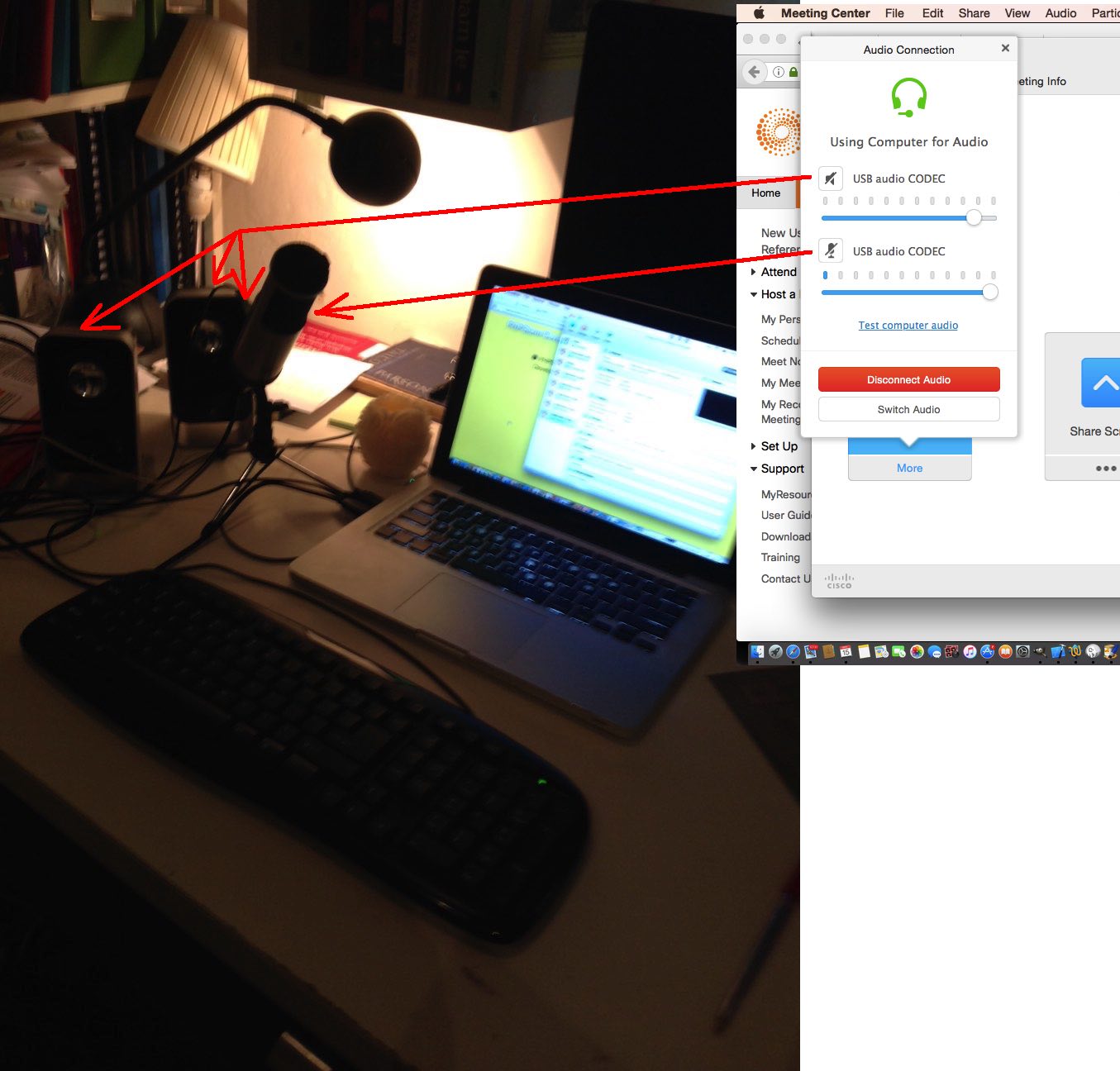
In the WebEx “Audio Connection” menu via “Call Using Computer” option have both input and output audio be handled by “USB audio CODEC” (if they are options … if not, there is a hardware (perhaps configuration) problem with your audio and microphone connection) as you can see at today’s tutorial picture. So long as you succeed and have the USB connected, the audio connection will default to this arrangement for the next time. Cute, huh?!

To make it permanent that the MXL Tempo microphone arrangement is the default device for recordings …

  1. click on System Preferences off the Apple menu
  2. click the Sound option
  3. click the Output tab
  4. pick USB audio CODEC
  5. if you intend using speakers or headphones connected off this microphone from its 1/8″ (3.5mm) Headphone Jack, click the Input tab
  6. pick USB audio CODEC

Being heard never seemed so easy!


Previous relevant WebEx Prerecording Primer Tutorial is shown below.

WebEx Prerecording Primer Tutorial

WebEx Prerecording Primer Tutorial

We’ve been trying out WebEx (by Cisco) prerecording as a video conferencing idea as an alternative to …

… regarding video conferencing products we’ve tried at this blog.

Have to say, WebEx is great, even with respect to the “wide eyed and bushy tailed” reaction “this little black duck” has to all these networky communicaty ideas on the net (at least we spelt “net” correctly).

Have to thank my wife, Maree, for her expertise and the facilities her company, Thomson Reuters, supplies for the serving of WebEx recordings … thanks everyone. Have been assured they are periodically deleted, and my lame impersonations of the old “ducks on the wall” can rest in peace shortly.

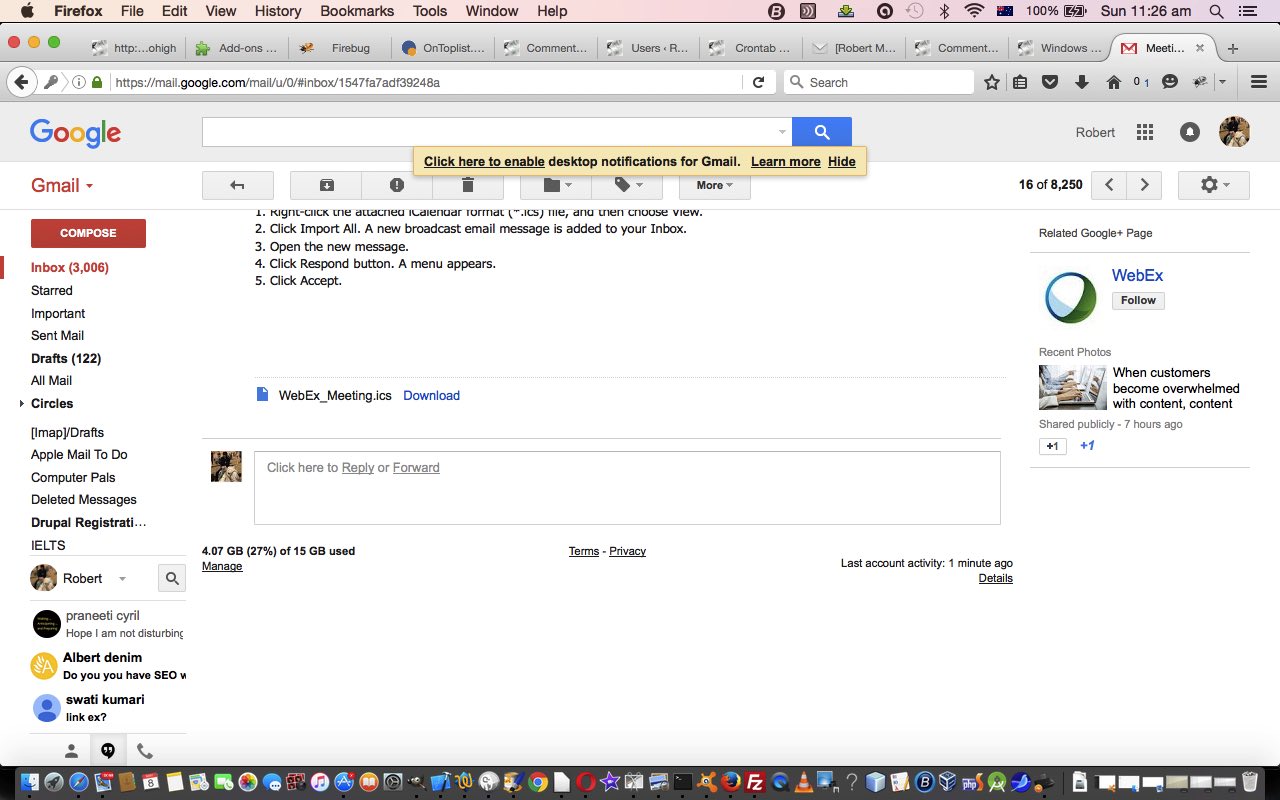
And so, we have a slideshow starting with a WebEx email link to join a meeting, and we pan down the email to show you other WebEx functionalities, such as adding a Calendar reference to the meeting time, and though we haven’t shown you detail here, rest assured it handles timezone scenarios very well, unless you lie about living in Antarctica, that is … sorry, scientists in Antarctica reading this blog posting … all 237 of you.

During this “earlier than today exploration of WebEx” session the necessary software installs just happened for this MacBook Pro Mac OS X laptop as if we were shelling peas … it’s always good to have some handy when installing any software. So we won’t show you this unless we deem it essential at a later date. You can perhaps do as I did, and ask a real WebEx user invite you to a meeting, to set yourself up. In fact, today’s session meeting creation time you may notice is well in the past from that earlier introductory learning session Maree and I had, and you can bring back up that old email, and resurrect that meeting again and again, if you like … am not sure if there is an expiry date on this too, like with server stored WebEx prerecordings.

So also rest assured, WebEx handles …

  • video via webcam on your device
  • audio via microphone on your device (“Use Computer”) or via a phone line
  • the synchronization of the two above
  • mobile devices

Did you know?

A .ics extension file, as you can see being used as an email attachment file extension in is, as explained in this link‘s sublink

ICS is a global format for calendar files widely being utilized by various calendar and email programs including Google Calendar, Apple iCal, and Microsoft Outlook. These files enable users to share and publish information directly from their calendars over email or via uploading it to the world wide web.

… as helping interface meetings to online calendar appointments. Cute, huh?!

If this was interesting you may be interested in this too.


If this was interesting you may be interested in this too.

If this was interesting you may be interested in this too.


If this was interesting you may be interested in this too.

If this was interesting you may be interested in this too.

If this was interesting you may be interested in this too.

If this was interesting you may be interested in this too.

If this was interesting you may be interested in this too.
Posted in eLearning, Event-Driven Programming, Operating System, Tutorials | Tagged , , , , , , , , , , , , , | Leave a comment

Media Copy and Paste Intranet Feeling Tutorial

Media Copy and Paste Tutorial

Media Copy and Paste Intranet Feeling Tutorial

Further to yesterday’s Media Copy and Paste Tutorial, of course, what we’d prefer to be able to do to use it could be …

  • call it from from a public domain via a URL and link such as https://www.rjmprogramming.com.au/Mac/media_via_pb.php … after having …
  • to a local web server (such as MAMP) underlying operating system environments, to the point that an email attachment piece of automation can be worked from a downloaded changed media_via_pb.php media_via_pb.php web application …
  • so that up at the public domain webpage when local media browsing …
  • with email address defined …
  • the “Intranet feeling” window.open(MAMP-get-style-url.php, iframe-name, ‘top=?,width=?,left=?,height=?’) can work it’s magic in amongst, in order …
    1. public domain does window.open as above
    2. public domain webpage does “a” mailto: link click to open email client
    3. MAMP-get-style-url.php in macOS or Windows copies image into Clipboard as graphics
    4. if macOS can go on to paste that Clipboard image into that email body as an attachment

… but only if, as we’ve verified again today and only for sure on macOS Google Chrome web browser so far, otherwise CORS restrictions come into it, MAMP-get-style-url.php only performs PHP stuff and does not try to write out a webpage of any sort. We can arrange it that way in this project but can easily imagine other projects where this can not be wrangled using a public domain webpage incarnation this “Intranet feeling” way.


Previous relevant Media Copy and Paste Tutorial is shown below.

Media Copy and Paste Tutorial

Media Copy and Paste Tutorial

Maybe you recently hovered over the tutorial image idea of Mac OS X Copy to Clipboard and Paste Tutorial below, and read …

Here in December, 2025 we have lost touch with the original media_via_pb.php code from back in November 2018 and we are in the process of repiecing a similar but different set of logics in a similar vein. Please stay tuned for interplay with macOS pbcopy and pbpaste and Windows clip commands or some other methodology involvement not existing in this reconstituted first draft.

Bit sad, but a new opportunity too?!

And so, with that opportunity, we can apply some recent work knowledge, especially regarding a local web server (such as MAMP) underlying operating system environments, to the point that an email attachment piece of automation can be worked from a downloadable changed media_via_pb.php media_via_pb.php web application.


Previous relevant Mac OS X Copy to Clipboard and Paste Tutorial is shown below.

Mac OS X Copy to Clipboard and Paste Tutorial

Mac OS X Copy to Clipboard and Paste Tutorial

Were you an interested reader of Mac OS X Clipboard to File to Datauri Primer Tutorial that we wrote some time ago now? It involved the Mac OS X command line …


pbcopy

… command to “provide copying and pasting to the pasteboard (the Clipboard) from command line” (quoting from “man pbcopy”).

And where there is a “copy” there’s a … anyone, anyone? … yes, Smithers, a “paste”. And so, new to today’s work, we start combining that pbpaste with the brilliant passthru


passthru('pbpaste');

… to position at the place to “plonk” media data into a webpage, often, and let it display.

You’ll notice in today’s PHP (only really suits localhost local web server hosting code, such as MAMP) “Media via pbcopy and pbpaste” web application’s http://localhost:8888/media_via_pb.php code that we code an exec style …


exec('pbcopy < ' . $ourpath . str_replace("+"," ",urldecode($_GET['filename'])));

… then, obscurely (you may think), (roughly) go (for the $_GET versus $_POST arguments) …


$cont=file_get_contents($ourpath . str_replace("+"," ",urldecode($_GET['filename'])));
if (strpos($cont, "data:") !== false) {
// "plonk" these in HTML surrounds supporting the relevant (mimetype derived (via file extension array matching)) element's src property contents
if (strpos($cont, "data:image/") !== false) {
echo '<html><body><img src="';
passthru('pbpaste');
echo '"></img></body></html>';
} else if (strpos($cont, "data:video/") !== false) {
if ($ourmimetype == "") {
echo '<html><body><video controls><source src="';
} else {
echo '<html><body><video controls><source type="' . $ourmimetype . '" src="';
}
passthru('pbpaste');
echo '"></source></video></body></html>';
} else if (strpos($cont, "data:audio/") !== false) {
if ($ourmimetype == "") {
echo '<html><body><audio controls><source src="';
} else {
echo '<html><body><audio controls><source type="' . $ourmimetype . '" src="';
}
passthru('pbpaste');
echo '"></source></audio></body></html>';
} else if (strpos($cont, "data:text/") !== false) {
header('Content-type: text/' . str_replace('jpg','jpeg',$ext));
passthru('pbpaste');
} else if ($ourpath == '' && $ourmimetype == '') {
header('Location: ' . str_replace("+"," ",urldecode($_GET['filename'])));
} else if ($ourmimetype != '') {
header('Content-type: ' . $ourmimetype);
passthru('pbpaste');
} else {
header('Location: ' . str_replace("+"," ",urldecode($_GET['filename'])));
}
} else if ($ourmimetype != '') { // we know mimetype via file extension
header('Content-type: ' . $ourmimetype);
passthru('pbpaste');
} else {
header('Location: ' . str_replace("+"," ",urldecode($_GET['filename'])));
}

… to allow for dataURI file content, as relevant. To get a feel for this, review today’s PDF slideshow that ends with Nala (playing hide and seek) from Zipfiles in PHP Media Gallery MIME Type Tutorial.


Previous relevant Mac OS X Clipboard to File to Datauri Primer Tutorial is shown below.

Mac OS X Clipboard to File to Datauri Primer Tutorial

Mac OS X Clipboard to File to Datauri Primer Tutorial

Today’s tutorial is a lot about the image two below the one above. It looks pretty much like any other image on this web page, I’m sure, at first glance, you’d say?! But the fact is, this image does not involve a web server image file of any sort, though its storage does involve a web server database, because all these blog postings exist in a table of a MySql database that WordPress uses to store information. Has this let you down? Hope not, because this is still a pretty big concept, getting bigger and bigger as time goes on, and spurred on by the mobile device revolution, and that is the rise and rise of the use of datauri based media. Let’s see what Wikipedia says …

The data URI scheme is a uniform resource identifier (URI) scheme that provides a way to include data in-line in web pages as if they were external resources. It is a form of file literal or here document. This technique allows normally separate elements such as images and style sheets to be fetched in a single Hypertext Transfer Protocol (HTTP) request, which may be more efficient than multiple HTTP requests.[1] Data URIs are sometimes referred to incorrectly as “data URLs”.[citation needed] As of 2015, data URIs are fully supported by most major browsers, and partially supported in Internet Explorer and Microsoft Edge.[2]

With this image, two down, we didn’t feel like plonking this as a file on our web server, basically because it was that bit smaller than the usual, and so the basic steps of how we constructed it was …

  • we’d Prnt-Scrn buttoned this part of a screen snapshot on Windows 10 … and then …
  • we emailed it to ourselves, but logged onto our MacBook Pro laptop … and so we …
  • downloaded that email attachment into the Preview desktop application … where we …
  • drew a rectangle around the dialog of interest and used Edit -> Copy to get it into a Mac OS X clipboard … and though we didn’t do this right here and now, we did do before the final step, copy the clipboard into an image file called huh.png (via File -> Save As…) via Paintbrush desktop application’s File -> New from clipboard option … and so then …
  • looked up Google in this way … and the second link in the list got me to …
  • see some incredibly useful Mac OS X Terminal application command line usage … to aim for … and we adapted to, namely …

    openssl base64 < ./huh.png | tr -d '\n' | pbcopy

    … which got into a Mac OS X clipboard the suffix (called [suffix] that gets appended to the prefix [prefix] we’ll talk about in the next step) of an HTML image element of the form <img title=’Datauri image’ src=’[prefix][suffix]‘></img> … leaving us to work out for the png image type we desired the prefix [prefix] could be …
  • found a typical datauri prefix for a base64 encode png image at this really useful link so that prefix [prefix] above could be data:image/png;base64, … the missing piece of being able to HTML code the datauri image two below the one above … and not requiring a web server image file to exist, as the image data exists in this blog posting … brought to you by the wonders of CMS (Content Management Systems).

Hope this interests you, and perhaps that you try out one of these datauri HTML img elements for yourself.


Previous relevant Windows 10 Cortana Primer Tutorial is shown below.

Windows 10 Cortana Primer Tutorial

Windows 10 Cortana Primer Tutorial

In the area of robotics and artificial intelligence, perhaps the best known concept to we “mere mortals” is “voice recognition”. Perhaps because research into it goes back to 1932, before the Second World War … and 66 years before the “Worm Farm Incident of Simmons Street Disaster” … but we digress … and no … “I’m not ready to open up about this at this delicate stage of my life, yet, Brad.”.

Voice recognition has come a long way from those earliest endeavours when the speech recognition relied on training software for an individual voice. This became apparent to me trying out Cortana in Windows 10. Once working, it didn’t seem to matter who in our house asked the same question of Cortana, the speech recognition software recognized and translated the speech into the same text for all of us. Actually, Microsoft describes Cortana this way …

Cortana is your clever new personal assistant.

Cortana will help you find things on your PC, manage your calendar, track packages, find files, chat with you, and tell jokes. The more you use Cortana, the more personalized your experience will be.

To get started, type a question in the search box on the taskbar. Or select the microphone icon and talk to Cortana. (Typing works for all types of PCs, but you need a mic to talk.)

… and I see what they mean by this, because you can work Cortana without the voice recognition part, if you like, or if you have the urge to run for the nearest cupboard before being caught talking into a computer (microphone). Perhaps Cortana should have a special “Darkroom Edition” for people who …

  1. have the urge to run for the nearest cupboard before being caught talking into a computer (microphone) … and who …
  2. have a hobby developing and printing photographs

Anyway, we agree with Microsoft that Cortana is clever, and it’s nice for us to find another use for the microphone (brand called MXL Tempo) we used with WebEx work we talked about with WebEx Presentation with Microphone Tutorial below.

There is not much to setting up Cortana, except, perhaps, for the microphone bit, which we’ll talk more about later. Cortana’s “personal assistant” and interface down next to the Windows icon at the bottom left of the screen guides you well through what you have to do.

We got stuck a bit, regarding setting up the microphone, with a cycle of it presenting this voice recognition test always resulting in a message wondering whether we had the microphone set to “mute on”, which wasn’t the case. But what was the case, and remedied this problem was to use a USB 2 port rather than a USB 3 port … in case this happens to you.

Other than that, Cortana is pretty cute, and could be a good enough reason on its own to upgrade to Windows 10 from Windows 7, Windows 8.1, Windows Phone 8.1 or Windows 9 operating systems before Friday, 29th July 2016 which is the cut off day for free upgrades. Our experience of the upgrade was talked about at Windows 10 Upgrade Primer Tutorial (and backups were discussed at Windows File History Backup Primer Tutorial).

Did you know?

Sadly, some days ago saw the passing of Frank Dickens, the creator of the Bristow cartoon series, forever etched on my brain regarding The Great Tea Trolley Disaster of ’67. R.I.P.


Previous relevant WebEx Presentation with Microphone Tutorial is shown below.

WebEx Presentation with Microphone Tutorial

WebEx Presentation with Microphone Tutorial

We’ve been doing some more WebEx (by Cisco) lately, and realised, at least with using a MacBook Pro laptop, we needed to invest in a microphone, to be heard, as the inbuilt microphone systems were not up to it.

We opted for a USB connected microphone brand called MXL Tempo, sold here in Australia, and have found it to be good, especially mounted on the stand provided … well, no complaints, anyway?! Where it has a 1/8″ (3.5mm) Headphone Jack we plugged in our own speakers, though you could use headphones here as well.

Of course we’ll also be constructing a garage, and buying a guitar, and calling on “tree fellers” karaoke backing track of Peter, Paul and Mary to complete the picture of this week’s project … getting the new microphone to make breakfast in the morning before you even knew you needed breakfast get me on The Voices.

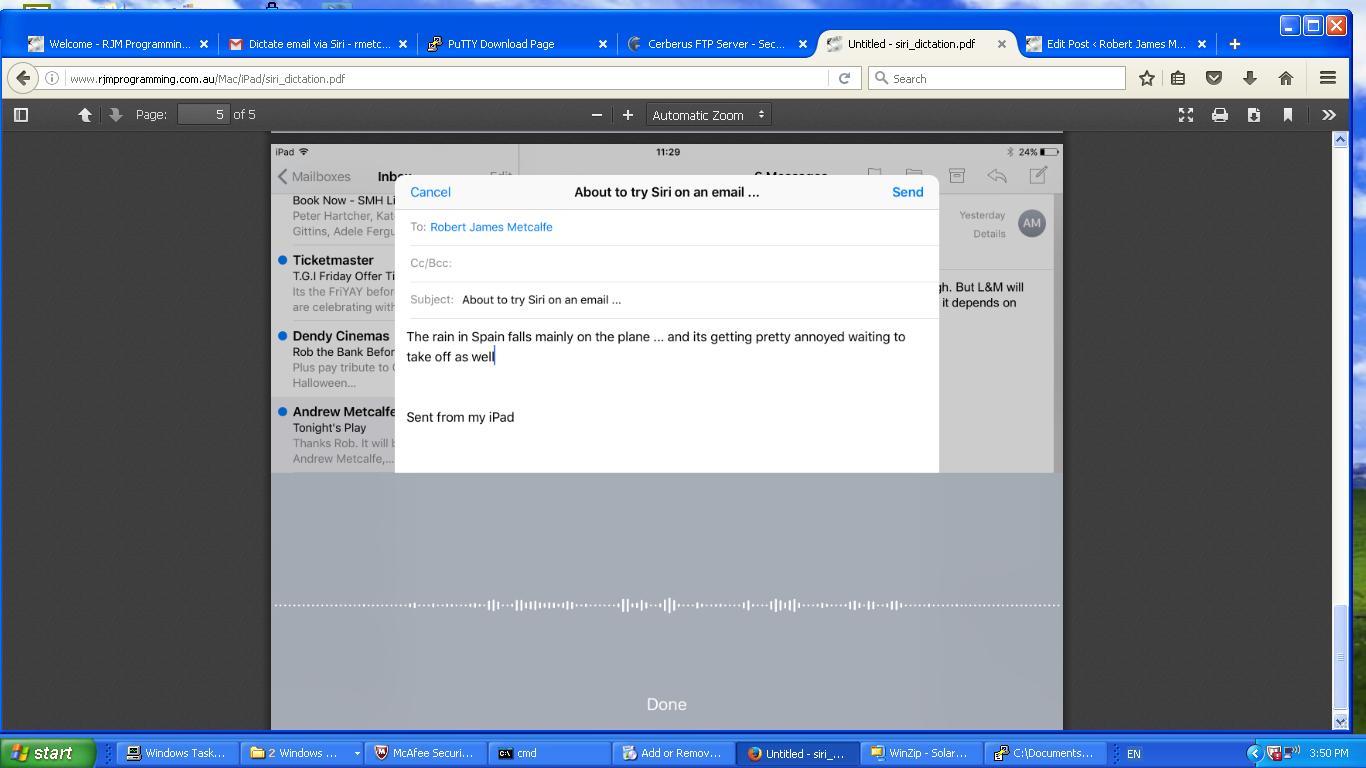
In the WebEx “Audio Connection” menu via “Call Using Computer” option have both input and output audio be handled by “USB audio CODEC” (if they are options … if not, there is a hardware (perhaps configuration) problem with your audio and microphone connection) as you can see at today’s tutorial picture. So long as you succeed and have the USB connected, the audio connection will default to this arrangement for the next time. Cute, huh?!

To make it permanent that the MXL Tempo microphone arrangement is the default device for recordings …

  1. click on System Preferences off the Apple menu
  2. click the Sound option
  3. click the Output tab
  4. pick USB audio CODEC
  5. if you intend using speakers or headphones connected off this microphone from its 1/8″ (3.5mm) Headphone Jack, click the Input tab
  6. pick USB audio CODEC

Being heard never seemed so easy!


Previous relevant WebEx Prerecording Primer Tutorial is shown below.

WebEx Prerecording Primer Tutorial

WebEx Prerecording Primer Tutorial

We’ve been trying out WebEx (by Cisco) prerecording as a video conferencing idea as an alternative to …

… regarding video conferencing products we’ve tried at this blog.

Have to say, WebEx is great, even with respect to the “wide eyed and bushy tailed” reaction “this little black duck” has to all these networky communicaty ideas on the net (at least we spelt “net” correctly).

Have to thank my wife, Maree, for her expertise and the facilities her company, Thomson Reuters, supplies for the serving of WebEx recordings … thanks everyone. Have been assured they are periodically deleted, and my lame impersonations of the old “ducks on the wall” can rest in peace shortly.

And so, we have a slideshow starting with a WebEx email link to join a meeting, and we pan down the email to show you other WebEx functionalities, such as adding a Calendar reference to the meeting time, and though we haven’t shown you detail here, rest assured it handles timezone scenarios very well, unless you lie about living in Antarctica, that is … sorry, scientists in Antarctica reading this blog posting … all 237 of you.

During this “earlier than today exploration of WebEx” session the necessary software installs just happened for this MacBook Pro Mac OS X laptop as if we were shelling peas … it’s always good to have some handy when installing any software. So we won’t show you this unless we deem it essential at a later date. You can perhaps do as I did, and ask a real WebEx user invite you to a meeting, to set yourself up. In fact, today’s session meeting creation time you may notice is well in the past from that earlier introductory learning session Maree and I had, and you can bring back up that old email, and resurrect that meeting again and again, if you like … am not sure if there is an expiry date on this too, like with server stored WebEx prerecordings.

So also rest assured, WebEx handles …

  • video via webcam on your device
  • audio via microphone on your device (“Use Computer”) or via a phone line
  • the synchronization of the two above
  • mobile devices

Did you know?

A .ics extension file, as you can see being used as an email attachment file extension in is, as explained in this link‘s sublink

ICS is a global format for calendar files widely being utilized by various calendar and email programs including Google Calendar, Apple iCal, and Microsoft Outlook. These files enable users to share and publish information directly from their calendars over email or via uploading it to the world wide web.

… as helping interface meetings to online calendar appointments. Cute, huh?!

If this was interesting you may be interested in this too.


If this was interesting you may be interested in this too.

If this was interesting you may be interested in this too.

If this was interesting you may be interested in this too.

If this was interesting you may be interested in this too.

If this was interesting you may be interested in this too.

If this was interesting you may be interested in this too.
Posted in eLearning, Event-Driven Programming, Operating System, Photography, Tutorials | Tagged , , , , , , , , , , , | Leave a comment

Media Copy and Paste Tutorial

Media Copy and Paste Tutorial

Media Copy and Paste Tutorial

Maybe you recently hovered over the tutorial image idea of Mac OS X Copy to Clipboard and Paste Tutorial below, and read …

Here in December, 2025 we have lost touch with the original media_via_pb.php code from back in November 2018 and we are in the process of repiecing a similar but different set of logics in a similar vein. Please stay tuned for interplay with macOS pbcopy and pbpaste and Windows clip commands or some other methodology involvement not existing in this reconstituted first draft.

Bit sad, but a new opportunity too?!

And so, with that opportunity, we can apply some recent work knowledge, especially regarding a local web server (such as MAMP) underlying operating system environments, to the point that an email attachment piece of automation can be worked from a downloadable changed media_via_pb.php media_via_pb.php web application.


Previous relevant Mac OS X Copy to Clipboard and Paste Tutorial is shown below.

Mac OS X Copy to Clipboard and Paste Tutorial

Mac OS X Copy to Clipboard and Paste Tutorial

Were you an interested reader of Mac OS X Clipboard to File to Datauri Primer Tutorial that we wrote some time ago now? It involved the Mac OS X command line …


pbcopy

… command to “provide copying and pasting to the pasteboard (the Clipboard) from command line” (quoting from “man pbcopy”).

And where there is a “copy” there’s a … anyone, anyone? … yes, Smithers, a “paste”. And so, new to today’s work, we start combining that pbpaste with the brilliant passthru


passthru('pbpaste');

… to position at the place to “plonk” media data into a webpage, often, and let it display.

You’ll notice in today’s PHP (only really suits localhost local web server hosting code, such as MAMP) “Media via pbcopy and pbpaste” web application’s http://localhost:8888/media_via_pb.php code that we code an exec style …


exec('pbcopy < ' . $ourpath . str_replace("+"," ",urldecode($_GET['filename'])));

… then, obscurely (you may think), (roughly) go (for the $_GET versus $_POST arguments) …


$cont=file_get_contents($ourpath . str_replace("+"," ",urldecode($_GET['filename'])));
if (strpos($cont, "data:") !== false) {
// "plonk" these in HTML surrounds supporting the relevant (mimetype derived (via file extension array matching)) element's src property contents
if (strpos($cont, "data:image/") !== false) {
echo '<html><body><img src="';
passthru('pbpaste');
echo '"></img></body></html>';
} else if (strpos($cont, "data:video/") !== false) {
if ($ourmimetype == "") {
echo '<html><body><video controls><source src="';
} else {
echo '<html><body><video controls><source type="' . $ourmimetype . '" src="';
}
passthru('pbpaste');
echo '"></source></video></body></html>';
} else if (strpos($cont, "data:audio/") !== false) {
if ($ourmimetype == "") {
echo '<html><body><audio controls><source src="';
} else {
echo '<html><body><audio controls><source type="' . $ourmimetype . '" src="';
}
passthru('pbpaste');
echo '"></source></audio></body></html>';
} else if (strpos($cont, "data:text/") !== false) {
header('Content-type: text/' . str_replace('jpg','jpeg',$ext));
passthru('pbpaste');
} else if ($ourpath == '' && $ourmimetype == '') {
header('Location: ' . str_replace("+"," ",urldecode($_GET['filename'])));
} else if ($ourmimetype != '') {
header('Content-type: ' . $ourmimetype);
passthru('pbpaste');
} else {
header('Location: ' . str_replace("+"," ",urldecode($_GET['filename'])));
}
} else if ($ourmimetype != '') { // we know mimetype via file extension
header('Content-type: ' . $ourmimetype);
passthru('pbpaste');
} else {
header('Location: ' . str_replace("+"," ",urldecode($_GET['filename'])));
}

… to allow for dataURI file content, as relevant. To get a feel for this, review today’s PDF slideshow that ends with Nala (playing hide and seek) from Zipfiles in PHP Media Gallery MIME Type Tutorial.


Previous relevant Mac OS X Clipboard to File to Datauri Primer Tutorial is shown below.

Mac OS X Clipboard to File to Datauri Primer Tutorial

Mac OS X Clipboard to File to Datauri Primer Tutorial

Today’s tutorial is a lot about the image two below the one above. It looks pretty much like any other image on this web page, I’m sure, at first glance, you’d say?! But the fact is, this image does not involve a web server image file of any sort, though its storage does involve a web server database, because all these blog postings exist in a table of a MySql database that WordPress uses to store information. Has this let you down? Hope not, because this is still a pretty big concept, getting bigger and bigger as time goes on, and spurred on by the mobile device revolution, and that is the rise and rise of the use of datauri based media. Let’s see what Wikipedia says …

The data URI scheme is a uniform resource identifier (URI) scheme that provides a way to include data in-line in web pages as if they were external resources. It is a form of file literal or here document. This technique allows normally separate elements such as images and style sheets to be fetched in a single Hypertext Transfer Protocol (HTTP) request, which may be more efficient than multiple HTTP requests.[1] Data URIs are sometimes referred to incorrectly as “data URLs”.[citation needed] As of 2015, data URIs are fully supported by most major browsers, and partially supported in Internet Explorer and Microsoft Edge.[2]

With this image, two down, we didn’t feel like plonking this as a file on our web server, basically because it was that bit smaller than the usual, and so the basic steps of how we constructed it was …

  • we’d Prnt-Scrn buttoned this part of a screen snapshot on Windows 10 … and then …
  • we emailed it to ourselves, but logged onto our MacBook Pro laptop … and so we …
  • downloaded that email attachment into the Preview desktop application … where we …
  • drew a rectangle around the dialog of interest and used Edit -> Copy to get it into a Mac OS X clipboard … and though we didn’t do this right here and now, we did do before the final step, copy the clipboard into an image file called huh.png (via File -> Save As…) via Paintbrush desktop application’s File -> New from clipboard option … and so then …
  • looked up Google in this way … and the second link in the list got me to …
  • see some incredibly useful Mac OS X Terminal application command line usage … to aim for … and we adapted to, namely …

    openssl base64 < ./huh.png | tr -d '\n' | pbcopy

    … which got into a Mac OS X clipboard the suffix (called [suffix] that gets appended to the prefix [prefix] we’ll talk about in the next step) of an HTML image element of the form <img title=’Datauri image’ src=’[prefix][suffix]‘></img> … leaving us to work out for the png image type we desired the prefix [prefix] could be …
  • found a typical datauri prefix for a base64 encode png image at this really useful link so that prefix [prefix] above could be data:image/png;base64, … the missing piece of being able to HTML code the datauri image two below the one above … and not requiring a web server image file to exist, as the image data exists in this blog posting … brought to you by the wonders of CMS (Content Management Systems).

Hope this interests you, and perhaps that you try out one of these datauri HTML img elements for yourself.


Previous relevant Windows 10 Cortana Primer Tutorial is shown below.

Windows 10 Cortana Primer Tutorial

Windows 10 Cortana Primer Tutorial

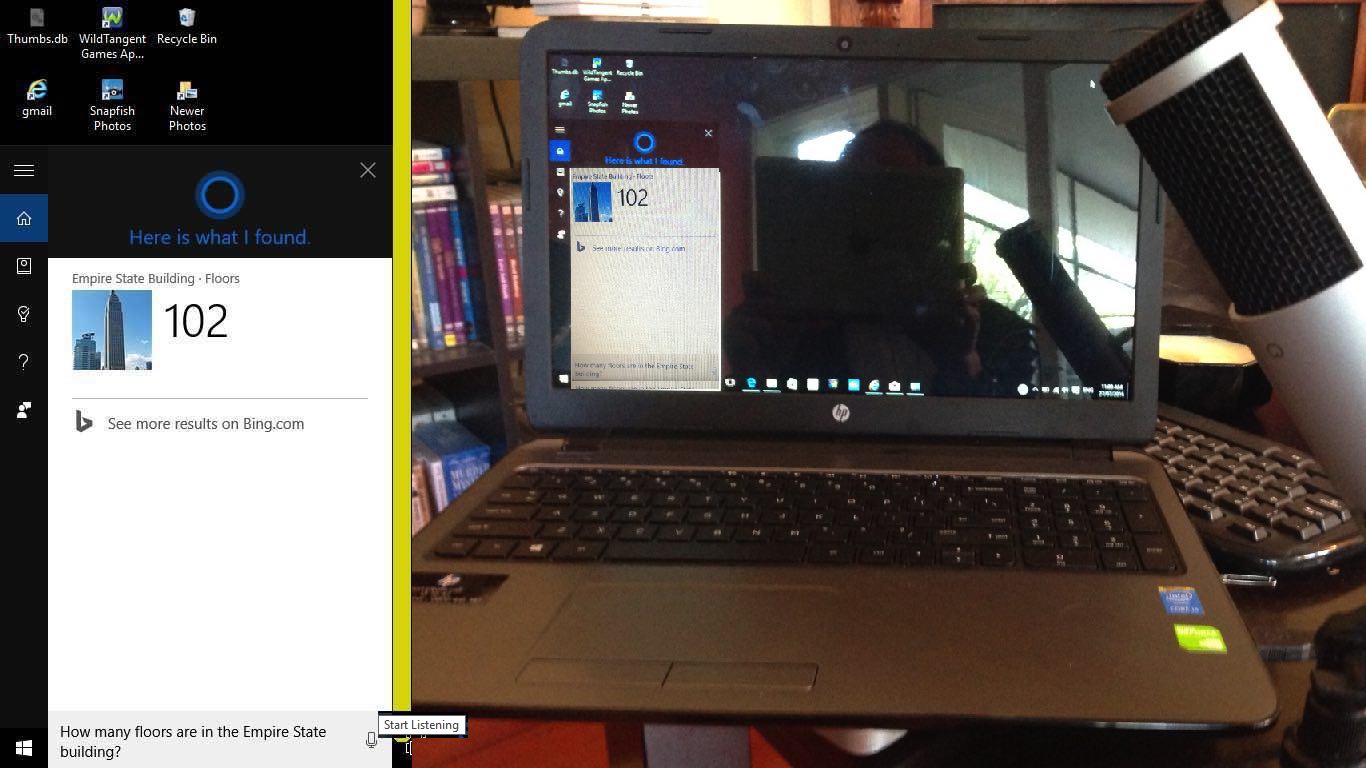
In the area of robotics and artificial intelligence, perhaps the best known concept to we “mere mortals” is “voice recognition”. Perhaps because research into it goes back to 1932, before the Second World War … and 66 years before the “Worm Farm Incident of Simmons Street Disaster” … but we digress … and no … “I’m not ready to open up about this at this delicate stage of my life, yet, Brad.”.

Voice recognition has come a long way from those earliest endeavours when the speech recognition relied on training software for an individual voice. This became apparent to me trying out Cortana in Windows 10. Once working, it didn’t seem to matter who in our house asked the same question of Cortana, the speech recognition software recognized and translated the speech into the same text for all of us. Actually, Microsoft describes Cortana this way …

Cortana is your clever new personal assistant.

Cortana will help you find things on your PC, manage your calendar, track packages, find files, chat with you, and tell jokes. The more you use Cortana, the more personalized your experience will be.

To get started, type a question in the search box on the taskbar. Or select the microphone icon and talk to Cortana. (Typing works for all types of PCs, but you need a mic to talk.)

… and I see what they mean by this, because you can work Cortana without the voice recognition part, if you like, or if you have the urge to run for the nearest cupboard before being caught talking into a computer (microphone). Perhaps Cortana should have a special “Darkroom Edition” for people who …

  1. have the urge to run for the nearest cupboard before being caught talking into a computer (microphone) … and who …
  2. have a hobby developing and printing photographs

Anyway, we agree with Microsoft that Cortana is clever, and it’s nice for us to find another use for the microphone (brand called MXL Tempo) we used with WebEx work we talked about with WebEx Presentation with Microphone Tutorial below.

There is not much to setting up Cortana, except, perhaps, for the microphone bit, which we’ll talk more about later. Cortana’s “personal assistant” and interface down next to the Windows icon at the bottom left of the screen guides you well through what you have to do.

We got stuck a bit, regarding setting up the microphone, with a cycle of it presenting this voice recognition test always resulting in a message wondering whether we had the microphone set to “mute on”, which wasn’t the case. But what was the case, and remedied this problem was to use a USB 2 port rather than a USB 3 port … in case this happens to you.

Other than that, Cortana is pretty cute, and could be a good enough reason on its own to upgrade to Windows 10 from Windows 7, Windows 8.1, Windows Phone 8.1 or Windows 9 operating systems before Friday, 29th July 2016 which is the cut off day for free upgrades. Our experience of the upgrade was talked about at Windows 10 Upgrade Primer Tutorial (and backups were discussed at Windows File History Backup Primer Tutorial).

Did you know?

Sadly, some days ago saw the passing of Frank Dickens, the creator of the Bristow cartoon series, forever etched on my brain regarding The Great Tea Trolley Disaster of ’67. R.I.P.


Previous relevant WebEx Presentation with Microphone Tutorial is shown below.

WebEx Presentation with Microphone Tutorial

WebEx Presentation with Microphone Tutorial

We’ve been doing some more WebEx (by Cisco) lately, and realised, at least with using a MacBook Pro laptop, we needed to invest in a microphone, to be heard, as the inbuilt microphone systems were not up to it.

We opted for a USB connected microphone brand called MXL Tempo, sold here in Australia, and have found it to be good, especially mounted on the stand provided … well, no complaints, anyway?! Where it has a 1/8″ (3.5mm) Headphone Jack we plugged in our own speakers, though you could use headphones here as well.

Of course we’ll also be constructing a garage, and buying a guitar, and calling on “tree fellers” karaoke backing track of Peter, Paul and Mary to complete the picture of this week’s project … getting the new microphone to make breakfast in the morning before you even knew you needed breakfast get me on The Voices.

In the WebEx “Audio Connection” menu via “Call Using Computer” option have both input and output audio be handled by “USB audio CODEC” (if they are options … if not, there is a hardware (perhaps configuration) problem with your audio and microphone connection) as you can see at today’s tutorial picture. So long as you succeed and have the USB connected, the audio connection will default to this arrangement for the next time. Cute, huh?!

To make it permanent that the MXL Tempo microphone arrangement is the default device for recordings …

  1. click on System Preferences off the Apple menu
  2. click the Sound option
  3. click the Output tab
  4. pick USB audio CODEC
  5. if you intend using speakers or headphones connected off this microphone from its 1/8″ (3.5mm) Headphone Jack, click the Input tab
  6. pick USB audio CODEC

Being heard never seemed so easy!


Previous relevant WebEx Prerecording Primer Tutorial is shown below.

WebEx Prerecording Primer Tutorial

WebEx Prerecording Primer Tutorial

We’ve been trying out WebEx (by Cisco) prerecording as a video conferencing idea as an alternative to …

… regarding video conferencing products we’ve tried at this blog.

Have to say, WebEx is great, even with respect to the “wide eyed and bushy tailed” reaction “this little black duck” has to all these networky communicaty ideas on the net (at least we spelt “net” correctly).

Have to thank my wife, Maree, for her expertise and the facilities her company, Thomson Reuters, supplies for the serving of WebEx recordings … thanks everyone. Have been assured they are periodically deleted, and my lame impersonations of the old “ducks on the wall” can rest in peace shortly.

And so, we have a slideshow starting with a WebEx email link to join a meeting, and we pan down the email to show you other WebEx functionalities, such as adding a Calendar reference to the meeting time, and though we haven’t shown you detail here, rest assured it handles timezone scenarios very well, unless you lie about living in Antarctica, that is … sorry, scientists in Antarctica reading this blog posting … all 237 of you.

During this “earlier than today exploration of WebEx” session the necessary software installs just happened for this MacBook Pro Mac OS X laptop as if we were shelling peas … it’s always good to have some handy when installing any software. So we won’t show you this unless we deem it essential at a later date. You can perhaps do as I did, and ask a real WebEx user invite you to a meeting, to set yourself up. In fact, today’s session meeting creation time you may notice is well in the past from that earlier introductory learning session Maree and I had, and you can bring back up that old email, and resurrect that meeting again and again, if you like … am not sure if there is an expiry date on this too, like with server stored WebEx prerecordings.

So also rest assured, WebEx handles …

  • video via webcam on your device
  • audio via microphone on your device (“Use Computer”) or via a phone line
  • the synchronization of the two above
  • mobile devices

Did you know?

A .ics extension file, as you can see being used as an email attachment file extension in is, as explained in this link‘s sublink

ICS is a global format for calendar files widely being utilized by various calendar and email programs including Google Calendar, Apple iCal, and Microsoft Outlook. These files enable users to share and publish information directly from their calendars over email or via uploading it to the world wide web.

… as helping interface meetings to online calendar appointments. Cute, huh?!

If this was interesting you may be interested in this too.


If this was interesting you may be interested in this too.

If this was interesting you may be interested in this too.


If this was interesting you may be interested in this too.


If this was interesting you may be interested in this too.


If this was interesting you may be interested in this too.

Posted in eLearning, Event-Driven Programming, Operating System, Photography, Tutorials | Tagged , , , , , , , , | Leave a comment

Osascript AppleScript Copy and Paste Ideas Tutorial

Osascript AppleScript Copy and Paste Ideas Tutorial

Osascript AppleScript Copy and Paste Ideas Tutorial

Yesterday’s Animated GIF Slide Clipboard Automation Tutorial clipboard themes has spurred today’s interests in …

  • macOS
  • osascript
  • AppleScript
  • command key ideas regarding …
    1. Select All … command-A
    2. Copy … command-C
    3. Paste … command-V

    … thinking

… and whether, back at a webpage it can be useful. So far, we have just made a start with …

So far the jury is out?!


Previous relevant Animated GIF Slide Clipboard Automation Tutorial is shown below.

Animated GIF Slide Clipboard Automation Tutorial

Animated GIF Slide Clipboard Automation Tutorial

Onto yesterday’s Animated GIF Slide Clipboard Tutorial one might say …

We can do better.

… and, well …

Nala

Luna

Do fish swim?

What is the optimal pH range for the denaturation of polymerase in a standard PCR protocol?

… and though Luna’s observations have merit … mind you …

The question seems to be based on a misunderstanding of the standard PCR process. The polymerase used in a standard PCR, such as Taq polymerase, is a thermostable enzyme and is not denatured at the high temperatures and standard pH conditions used in the protocol; its stability at high heat is what makes PCR possible.

… we’re agreeing with Nala (and who knows? … maybe Luna) in saying …

  • regarding Windows (eg. MAMP) incarnations … phase one improvements could happen
  • regarding macOS (eg. MAMP) incarnations … phase one improvements and some quite interesting phase two automation improvements, that, given some permissions yielded over to MAMP, could have the pasting off the Clipboard automated to email or SMS messaging conduits be happening

Yes, in phase one we’ve improved …

  • any slide textbox ending up with a URL prefixed by http://localhost can have right click logic working for it (in addition to the “last one only off a browsed for set of image files” scenario of yesterday)
  • the user can toggle (via the header “… or …” (now, when relevant, span element) new onclick event logic) between “a” link “mailto:” email and “sms:” message conduit modes

… and phase two …

  • uses macOS osascript AppleScript smarts to (perhaps, it depends on Sytem Settings permissions regarding your Apache local web server application’s Accessibility permissions) paste Clipboard contents into email or SMS bodies programmatically ahead of any user control … but …
  • that meant we had to fill out email To: and Cc: and Bcc: and SMS To: fields with data the user is bound to want to override (because we wanted the cursor to be appropriately positioned ahead of the automated pasting from Clipboard automations)

And so, you might think of all this as “nuance” and that could be a fair interpretation, but there is for some, we have no doubt, the chance to get your “automation ideas” flowing too, perhaps?!

Yesterday’s “recall of thyself” now looks like …

<?php

if (isset($_GET['pasteit']) || isset($_POST['pasteit'])) {
$reitis='';
$retis='';
sleep(1);
//$reitis=shell_exec("osascript -e 'tell application \"System Events\" to keystroke \"v\" using command down'");
if (4 == 6) {
// Thanks to https://www.google.com/search?q=macos+osascript+paste+from+graphical+clipboard+where+the+cursor+is+in+Mail+window&sca_esv=a49badc5b1a0e808&rlz=1C5OZZY_en&sxsrf=AE3TifMx00e3y_mcCT_VU614bB_ymYj0cw%3A1766536704547&ei=ADZLabCRIfqd4-EPv5btkAc&ved=0ahUKEwiwkYeG_tSRAxX6zjgGHT9LG3IQ4dUDCBE&uact=5&oq=macos+osascript+paste+from+graphical+clipboard+where+the+cursor+is+in+Mail+window&gs_lp=Egxnd3Mtd2l6LXNlcnAiUW1hY29zIG9zYXNjcmlwdCBwYXN0ZSBmcm9tIGdyYXBoaWNhbCBjbGlwYm9hcmQgd2hlcmUgdGhlIGN1cnNvciBpcyBpbiBNYWlsIHdpbmRvd0iMJFDrA1ifIHABeACQAQCYAfABoAG7EqoBBjAuMTAuM7gBA8gBAPgBAZgCAaACzAHCAg0QIxjwBRiwAhgnGJ4GmAMAiAYBkgcDMi0xoAfYHLIHAzItMbgHzAHCBwMzLTHIBwiACAA&sclient=gws-wiz-serp
$retis=shell_exec("osascript -e 'tell application \"Mail\"
activate
end tell

tell application \"System Events\"
tell process \"Mail\"
-- Bring the frontmost window into focus (e.g., the message composition window)
set frontmost to true
-- Simulate the Command+V (paste) keystroke
keystroke \"v\" using command down
end tell
end tell
'");
}

// Thanks to https://www.google.com/search?q=macos+osascript+paste+from+clipboard+where+the+cursor+is+in+whatever+window&rlz=1C5OZZY_en&oq=macos+osascript+paste+from+clipboard+where+the+cursor+is+in+whatever+window&gs_lcrp=EgZjaHJvbWUyBggAEEUYOdIBCTQ3NDg4ajBqN6gCALACAA&sourceid=chrome&ie=UTF-8
$retis=shell_exec("osascript -e 'tell application \"System Events\"
# Get the name of the current application (which is likely the Script Editor or Automator)
set currentApp to name of current application

# Check if the current app is one of the script runners and hide it to allow the target app to become frontmost
if currentApp is in {\"Script Editor\", \"Automator\", \"Script Debugger\"} then
set visible of process currentApp to false
# Wait a moment for the target app to become active
delay 0.1
end if

# Simulate the Command+V keystroke in the now frontmost application
keystroke \"v\" using command down


# (Optional) Unhide the script application afterward
if currentApp is in {\"Script Editor\", \"Automator\", \"Script Debugger\"} then
set visible of process currentApp to true
end if
end tell
'");

exit;
}

if (isset($_GET['osait'])) { // thanks to https://www.google.com/search?q=windows+graphics+into+clipboard+via+command+line&sca_esv=ef9c456e5bf53dd9&rlz=1C5OZZY_en&sxsrf=AE3TifOUmp2qSnwU3XOr4yUlFd-5cCYEVg%3A1766456241084&ei=sftJacX1BPW8seMP2e_x4Qs&ved=0ahUKEwiFkoum0tKRAxV1XmwGHdl3PLwQ4dUDCBE&uact=5&oq=windows+graphics+into+clipboard+via+command+line&gs_lp=Egxnd3Mtd2l6LXNlcnAiMHdpbmRvd3MgZ3JhcGhpY3MgaW50byBjbGlwYm9hcmQgdmlhIGNvbW1hbmQgbGluZTIKEAAYsAMY1gQYRzIKEAAYsAMY1gQYRzIKEAAYsAMY1gQYRzIKEAAYsAMY1gQYRzIKEAAYsAMY1gQYRzIKEAAYsAMY1gQYRzIKEAAYsAMY1gQYRzIKEAAYsAMY1gQYR0jYAVAAWABwAXgBkAEAmAEAoAEAqgEAuAEDyAEAmAIBoAIImAMAiAYBkAYIkgcBMaAHALIHALgHAMIHAzItMcgHBYAIAA&sclient=gws-wiz-serp
$thingo=str_replace('+',' ',urldecode($_GET['osait']));
$mto="?";
//file_put_contents($_SERVER['DOCUMENT_ROOT'] . DIRECTORY_SEPARATOR . 'x.xx', $thingo);
if (PHP_OS == 'Darwin' || substr(strtolower(('' . PHP_OS)),0,3) == 'win') {
if (PHP_OS == 'Darwin') {
$mto="please.change@email.address?cc=please.change@email.address&bcc=please.change@email.address&";
}
//file_put_contents($_SERVER['DOCUMENT_ROOT'] . DIRECTORY_SEPARATOR . 'x.xxx', $thingo);
if (strpos(strtolower($thingo), '.png') !== false) {
//file_put_contents($_SERVER['DOCUMENT_ROOT'] . DIRECTORY_SEPARATOR . 'x.x', "osascript -e 'tell application \"Finder\" to set the clipboard to (read (POSIX file \"" . $thingo . "\") as «class PNGf»)'");
if (PHP_OS == 'Darwin') {
exec("osascript -e 'tell application \"Finder\" to set the clipboard to (read (POSIX file \"" . $thingo . "\") as «class PNGf»)'");
} else {
//$fp = fopen($thingo, 'r');
//$gcont=fread($fp, filesize($thingo));
//fclose($fp);
$fp = fopen($_SERVER['DOCUMENT_ROOT'] . DIRECTORY_SEPARATOR . 'stop_extravaganza.bzt', 'x');
fwrite($fp, "powershell.exe -windowstyle hidden -Command \"Add-Type -AssemblyName System.Windows.Forms; [Windows.Forms.Clipboard]::SetImage([System.Drawing.Image]::Fromfile('" . $thingo . "'))\" & erase " . str_replace("/","\\",$_SERVER['DOCUMENT_ROOT'] . DIRECTORY_SEPARATOR) . 'stop_extravaganza.b*t');
fclose($fp);
if (isset($_GET['mailto'])) {
sleep(65);
}
}
if (isset($_GET['mailto'])) {
$parstuff='';
if (strlen($_GET['mailto']) > 1) {
$parstuff=" parent.document.getElementById('" . str_replace('+',' ',urldecode($_GET['mailto'])) . "').style.textShadow='1px 1px red'; parent.document.getElementById('" . str_replace('+',' ',urldecode($_GET['mailto'])) . "').style.cursor='pointer'; if (parent.document.getElementById('mailtovssms')) { if (parent.document.getElementById('mailtovssms').value.toLowerCase() == parent.document.getElementById('mailtovssms').value) { parent.setlastb('" . str_replace('+',' ',urldecode($_GET['mailto'])) . "'); } } ";
}
echo "<html><body onload=\" if (parent.document.getElementById('mailtovssms')) { if (parent.document.getElementById('mailtovssms').value.toUpperCase() == parent.document.getElementById('mailtovssms').value) { document.getElementById('aemail').href=document.getElementById('aemail').href.replace('please.change@email.address?cc=please.change@email.address&bcc=please.change@email.address&','?'); } } if (parent.document.getElementById('mailtovssms')) { if (parent.document.getElementById('mailtovssms').value.toLowerCase() == 'sms') { if (parent.document.getElementById('mailtovssms').value == 'SMS') { document.getElementById('aemail').href='sms:&body='; } else { document.getElementById('aemail').href='sms:rmetcalfe15@gmail.com&body='; } } } document.getElementById('aemail').click(); " . $parstuff . "\"><a style=display:none; id=aemail target=_top href='mailto:" . $mto . "subject=Slide%20" . urlencode(basename($thingo)) . "%20in%20clipboard%20ready%20for%20you%20to%20paste%20as%20attachment%20below&20...&body='>Email</a></body></html>";
}
} else if (strpos(strtolower($thingo), '.jp') !== false) {
//file_put_contents($_SERVER['DOCUMENT_ROOT'] . DIRECTORY_SEPARATOR . 'x.x', "osascript -e 'tell application \"Finder\" to set the clipboard to (read (POSIX file \"" . $thingo . "\") as «class JPEG»)'");
if (PHP_OS == 'Darwin') {
exec("osascript -e 'tell application \"Finder\" to set the clipboard to (read (POSIX file \"" . $thingo . "\") as «class JPEG»)'");
} else {
//$fp = fopen($thingo, 'r');
//$gcont=fread($fp, filesize($thingo));
//fclose($fp);
$fp = fopen($_SERVER['DOCUMENT_ROOT'] . DIRECTORY_SEPARATOR . 'stop_extravaganza.bzt', 'x');
fwrite($fp, "powershell.exe -windowstyle hidden -Command \"Add-Type -AssemblyName System.Windows.Forms; [Windows.Forms.Clipboard]::SetImage([System.Drawing.Image]::Fromfile('" . $thingo . "'))\" & erase " . str_replace("/","\\",$_SERVER['DOCUMENT_ROOT'] . DIRECTORY_SEPARATOR) . 'stop_extravaganza.b*t');
fclose($fp);
if (isset($_GET['mailto'])) {
sleep(65);
}
}
if (isset($_GET['mailto'])) {
$parstuff='';
if (strlen($_GET['mailto']) > 1) {
$parstuff=" parent.document.getElementById('" . str_replace('+',' ',urldecode($_GET['mailto'])) . "').style.textShadow='1px 1px red'; parent.document.getElementById('" . str_replace('+',' ',urldecode($_GET['mailto'])) . "').style.cursor='pointer'; if (parent.document.getElementById('mailtovssms')) { if (parent.document.getElementById('mailtovssms').value.toLowerCase() == parent.document.getElementById('mailtovssms').value) { parent.setlastb('" . str_replace('+',' ',urldecode($_GET['mailto'])) . "'); } } ";
}
echo "<html><body onload=\"if (parent.document.getElementById('mailtovssms')) { if (parent.document.getElementById('mailtovssms').value.toUpperCase() == parent.document.getElementById('mailtovssms').value) { document.getElementById('aemail').href=document.getElementById('aemail').href.replace('please.change@email.address?cc=please.change@email.address&bcc=please.change@email.address&','?'); } } if (parent.document.getElementById('mailtovssms')) { if (parent.document.getElementById('mailtovssms').value.toLowerCase() == 'sms') { if (parent.document.getElementById('mailtovssms').value == 'SMS') { document.getElementById('aemail').href='sms:&body='; } else { document.getElementById('aemail').href='sms:rmetcalfe15@gmail.com&body='; } } } document.getElementById('aemail').click(); " . $parstuff . "\"><a style=display:none; id=aemail target=_top href='mailto:" . $mto . "subject=Slide%20" . urlencode(basename($thingo)) . "%20in%20clipboard%20ready%20for%20you%20to%20paste%20as%20attachment%20below&20...&body='>Email</a></body></html>";
}
} else if (strpos(strtolower($thingo), '.gif') !== false) {
if (PHP_OS == 'Darwin') {
exec("osascript -e 'tell application \"Finder\" to set the clipboard to (read (POSIX file \"" . $thingo . "\") as «class GIF»)'");
} else {
//$fp = fopen($thingo, 'r');
//$gcont=fread($fp, filesize($thingo));
//fclose($fp);
$fp = fopen($_SERVER['DOCUMENT_ROOT'] . DIRECTORY_SEPARATOR . 'stop_extravaganza.bzt', 'x');
fwrite($fp, "powershell.exe -windowstyle hidden -Command \"Add-Type -AssemblyName System.Windows.Forms; [Windows.Forms.Clipboard]::SetImage([System.Drawing.Image]::Fromfile('" . $thingo . "'))\" & erase " . str_replace("/","\\",$_SERVER['DOCUMENT_ROOT'] . DIRECTORY_SEPARATOR) . 'stop_extravaganza.b*t');
fclose($fp);
if (isset($_GET['mailto'])) {
sleep(65);
}
}
if (isset($_GET['mailto'])) {
$parstuff='';
if (strlen($_GET['mailto']) > 1) {
$parstuff=" parent.document.getElementById('" . str_replace('+',' ',urldecode($_GET['mailto'])) . "').style.textShadow='1px 1px red'; parent.document.getElementById('" . str_replace('+',' ',urldecode($_GET['mailto'])) . "').style.cursor='pointer'; if (parent.document.getElementById('mailtovssms')) { if (parent.document.getElementById('mailtovssms').value.toLowerCase() == parent.document.getElementById('mailtovssms').value) { parent.setlastb('" . str_replace('+',' ',urldecode($_GET['mailto'])) . "'); } } ";
}
echo "<html><body onload=\"if (parent.document.getElementById('mailtovssms')) { if (parent.document.getElementById('mailtovssms').value.toUpperCase() == parent.document.getElementById('mailtovssms').value) { document.getElementById('aemail').href=document.getElementById('aemail').href.replace('please.change@email.address?cc=please.change@email.address&bcc=please.change@email.address&','?'); } } if (parent.document.getElementById('mailtovssms')) { if (parent.document.getElementById('mailtovssms').value.toLowerCase() == 'sms') { if (parent.document.getElementById('mailtovssms').value == 'SMS') { document.getElementById('aemail').href='sms:&body='; } else { document.getElementById('aemail').href='sms:rmetcalfe15@gmail.com&body='; } } } document.getElementById('aemail').click(); " . $parstuff . "\"><a style=display:none; id=aemail target=_top href='mailto:" . $mto . "subject=Slide%20" . urlencode(basename($thingo)) . "%20in%20clipboard%20ready%20for%20you%20to%20paste%20as%20attachment%20below&20...&body='>Email</a></body></html>";
}
}
exit;
}
} else if (isset($_POST['osait'])) {
$thingo=str_replace('+',' ',urldecode($_POST['osait']));
$mto="?";
if (PHP_OS == 'Darwin' || substr(strtolower(('' . PHP_OS)),0,3) == 'win') {
if (PHP_OS == 'Darwin') {
$mto="please.change@email.address?cc=please.change@email.address&bcc=please.change@email.address&";
}
if (strpos(strtolower($thingo), '.png') !== false) {
if (PHP_OS == 'Darwin') {
exec("osascript -e 'tell application \"Finder\" to set the clipboard to (read (POSIX file \"" . $thingo . "\") as «class PNGf»)'");
} else {
//$fp = fopen($thingo, 'r');
//$gcont=fread($fp, filesize($thingo));
//fclose($fp);
$fp = fopen($_SERVER['DOCUMENT_ROOT'] . DIRECTORY_SEPARATOR . 'stop_extravaganza.bzt', 'x');
fwrite($fp, "powershell.exe -windowstyle hidden -Command \"Add-Type -AssemblyName System.Windows.Forms; [Windows.Forms.Clipboard]::SetImage([System.Drawing.Image]::Fromfile('" . $thingo . "'))\" & erase " . str_replace("/","\\",$_SERVER['DOCUMENT_ROOT'] . DIRECTORY_SEPARATOR) . 'stop_extravaganza.b*t');
fclose($fp);
if (isset($_POST['mailto'])) {
sleep(65);
}
}
if (isset($_POST['mailto'])) {
$parstuff='';
if (strlen($_POST['mailto']) > 1) {
$parstuff=" parent.document.getElementById('" . str_replace('+',' ',urldecode($_POST['mailto'])) . "').style.textShadow='1px 1px red'; parent.document.getElementById('" . str_replace('+',' ',urldecode($_POST['mailto'])) . "').style.cursor='pointer'; if (parent.document.getElementById('mailtovssms')) { if (parent.document.getElementById('mailtovssms').value.toLowerCase() == parent.document.getElementById('mailtovssms').value) { parent.setlastb('" . str_replace('+',' ',urldecode($_POST['mailto'])) . "'); } } ";
}
echo "<html><body onload=\"if (parent.document.getElementById('mailtovssms')) { if (parent.document.getElementById('mailtovssms').value.toUpperCase() == parent.document.getElementById('mailtovssms').value) { document.getElementById('aemail').href=document.getElementById('aemail').href.replace('please.change@email.address?cc=please.change@email.address&bcc=please.change@email.address&','?'); } } if (parent.document.getElementById('mailtovssms')) { if (parent.document.getElementById('mailtovssms').value.toLowerCase() == 'sms') { if (parent.document.getElementById('mailtovssms').value == 'SMS') { document.getElementById('aemail').href='sms:&body='; } else { document.getElementById('aemail').href='sms:rmetcalfe15@gmail.com&body='; } } } document.getElementById('aemail').click(); " . $parstuff . "\"><a style=display:none; id=aemail target=_top href='mailto:" . $mto . "subject=Slide%20" . urlencode(basename($thingo)) . "%20in%20clipboard%20ready%20for%20you%20to%20paste%20as%20attachment%20below&20...&body='>Email</a></body></html>";
}
} else if (strpos(strtolower($thingo), '.jp') !== false) {
if (PHP_OS == 'Darwin') {
exec("osascript -e 'tell application \"Finder\" to set the clipboard to (read (POSIX file \"" . $thingo . "\") as «class JPEG»)'");
} else {
//$fp = fopen($thingo, 'r');
//$gcont=fread($fp, filesize($thingo));
//fclose($fp);
$fp = fopen($_SERVER['DOCUMENT_ROOT'] . DIRECTORY_SEPARATOR . 'stop_extravaganza.bzt', 'x');
fwrite($fp, "powershell.exe -windowstyle hidden -Command \"Add-Type -AssemblyName System.Windows.Forms; [Windows.Forms.Clipboard]::SetImage([System.Drawing.Image]::Fromfile('" . $thingo . "'))\" & erase " . str_replace("/","\\",$_SERVER['DOCUMENT_ROOT'] . DIRECTORY_SEPARATOR) . 'stop_extravaganza.b*t');
fclose($fp);
if (isset($_POST['mailto'])) {
sleep(65);
}
}
if (isset($_POST['mailto'])) {
$parstuff='';
if (strlen($_POST['mailto']) > 1) {
$parstuff=" parent.document.getElementById('" . str_replace('+',' ',urldecode($_POST['mailto'])) . "').style.textShadow='1px 1px red'; parent.document.getElementById('" . str_replace('+',' ',urldecode($_POST['mailto'])) . "').style.cursor='pointer'; if (parent.document.getElementById('mailtovssms')) { if (parent.document.getElementById('mailtovssms').value.toLowerCase() == parent.document.getElementById('mailtovssms').value) { parent.setlastb('" . str_replace('+',' ',urldecode($_POST['mailto'])) . "'); } } ";
}
echo "<html><body onload=\"if (parent.document.getElementById('mailtovssms')) { if (parent.document.getElementById('mailtovssms').value.toUpperCase() == parent.document.getElementById('mailtovssms').value) { document.getElementById('aemail').href=document.getElementById('aemail').href.replace('please.change@email.address?cc=please.change@email.address&bcc=please.change@email.address&','?'); } } if (parent.document.getElementById('mailtovssms')) { if (parent.document.getElementById('mailtovssms').value.toLowerCase() == 'sms') { if (parent.document.getElementById('mailtovssms').value == 'SMS') { document.getElementById('aemail').href='sms:&body='; } else { document.getElementById('aemail').href='sms:rmetcalfe15@gmail.com&body='; } } } document.getElementById('aemail').click(); " . $parstuff . "\"><a style=display:none; id=aemail target=_top href='mailto:" . $mto . "subject=Slide%20" . urlencode(basename($thingo)) . "%20in%20clipboard%20ready%20for%20you%20to%20paste%20as%20attachment%20below&20...&body='>Email</a></body></html>";
}
} else if (strpos(strtolower($thingo), '.gif') !== false) {
if (PHP_OS == 'Darwin') {
exec("osascript -e 'tell application \"Finder\" to set the clipboard to (read (POSIX file \"" . $thingo . "\") as «class GIF»)'");
} else {
//$fp = fopen($thingo, 'r');
//$gcont=fread($fp, filesize($thingo));
//fclose($fp);
$fp = fopen($_SERVER['DOCUMENT_ROOT'] . DIRECTORY_SEPARATOR . 'stop_extravaganza.bzt', 'x');
fwrite($fp, "powershell.exe -windowstyle hidden -Command \"Add-Type -AssemblyName System.Windows.Forms; [Windows.Forms.Clipboard]::SetImage([System.Drawing.Image]::Fromfile('" . $thingo . "'))\" & erase " . str_replace("/","\\",$_SERVER['DOCUMENT_ROOT'] . DIRECTORY_SEPARATOR) . 'stop_extravaganza.b*t');
fclose($fp);
if (isset($_POST['mailto'])) {
sleep(65);
}
}
if (isset($_POST['mailto'])) {
$parstuff='';
if (strlen($_POST['mailto']) > 1) {
$parstuff=" parent.document.getElementById('" . str_replace('+',' ',urldecode($_POST['mailto'])) . "').style.textShadow='1px 1px red'; parent.document.getElementById('" . str_replace('+',' ',urldecode($_POST['mailto'])) . "').style.cursor='pointer'; if (parent.document.getElementById('mailtovssms')) { if (parent.document.getElementById('mailtovssms').value.toLowerCase() == parent.document.getElementById('mailtovssms').value) { parent.setlastb('" . str_replace('+',' ',urldecode($_POST['mailto'])) . "'); } } ";
}
echo "<html><body onload=\"if (parent.document.getElementById('mailtovssms')) { if (parent.document.getElementById('mailtovssms').value.toUpperCase() == parent.document.getElementById('mailtovssms').value) { document.getElementById('aemail').href=document.getElementById('aemail').href.replace('please.change@email.address?cc=please.change@email.address&bcc=please.change@email.address&','?'); } } if (parent.document.getElementById('mailtovssms')) { if (parent.document.getElementById('mailtovssms').value.toLowerCase() == 'sms') { if (parent.document.getElementById('mailtovssms').value == 'SMS') { document.getElementById('aemail').href='sms:&body='; } else { document.getElementById('aemail').href='sms:rmetcalfe15@gmail.com&body='; } } } document.getElementById('aemail').click(); " . $parstuff . "\"><a style=display:none; id=aemail target=_top href='mailto:" . $mto . "subject=Slide%20" . urlencode(basename($thingo)) . "%20in%20clipboard%20ready%20for%20you%20to%20paste%20as%20attachment%20below&20...&body='>Email</a></body></html>";
}
}
exit;
}
}

?>

… and the lead into that (PHP writing out Javascript) looks like …

<?php echo ”

function getlastb() {
if (document.getElementById(lastidbecomes)) {
document.getElementById(lastidbecomes).title=document.getElementById(lastidbecomes).title.replace('Currently in clipboard and right click ', 'Right click ');
document.getElementById(lastidbecomes).style.textShadow='0px 1px orange';
}
return lastidbecomes;
}

function morstoggle(ospn) {
if (document.getElementById('mailtovssms')) {
if (document.getElementById('mailtovssms').value.toLowerCase() == 'sms') {
document.getElementById('mailtovssms').value=document.getElementById('mailtovssms').value.replace('SMS','MAILTO').replace('sms','mailto');
ospn.title=ospn.title.split('it currently being')[0] + 'it currently being mailto:';
} else {
document.getElementById('mailtovssms').value=document.getElementById('mailtovssms').value.replace('MAILTO','SMS').replace('mailto','sms');
ospn.title=ospn.title.split('it currently being')[0] + 'it currently being sms:';
}
}
}

function setlastb(bv) {
if (document.getElementById(lastidbecomes)) {
document.getElementById(lastidbecomes).title=document.getElementById(lastidbecomes).title.replace('Currently in clipboard and right click ', 'Right click ');
document.getElementById(lastidbecomes).style.textShadow='0px 1px orange';
}
lastidbecomes=bv;
if (document.getElementById(lastidbecomes)) {
document.getElementById(lastidbecomes).title=document.getElementById(lastidbecomes).title.replace(/^Right\ click\ /g, 'Currently in clipboard and right click ');
document.getElementById(lastidbecomes).style.textShadow='1px 1px red';
}
\n" . (PHP_OS == 'Darwin' ? " document.getElementById('ifosa').src=document.URL.split('?')[0].split('#')[0] + '?pasteit=' + encodeURIComponent(bv); " : '') . "\n
}

function postselw() {
var ssfx='', numsfx=1, lastsfnd='', sepfrom='/', septo='/', previdbecomes=lastidbecomes, isf=0, sfars=[], srfarlist=',';
if (pdurl.indexOf('//localhost') != -1 && document.getElementById('slideshow')) {
//alert(45); // pdurl, lastfounddarwin
while (document.getElementById(('slideshow' + numsfx).replace(/^slideshow1$/g,'slideshow'))) {
if (document.getElementById(('slideshow' + numsfx).replace(/^slideshow1$/g,'slideshow')).value.trim() != '') {
lastsfnd=document.getElementById(('slideshow' + numsfx).replace(/^slideshow1$/g,'slideshow')).value.trim();
if (lastsfnd.indexOf('//localhost') != -1 && document.getElementById(('slideshow' + numsfx).replace(/^slideshow1$/g,'slideshow')).title.indexOf('ight click ') == -1 && document.getElementById(('slideshow' + numsfx).replace(/^slideshow1$/g,'slideshow')).outerHTML.indexOf(' oncontextmenu=') == -1) {
" . (strtolower(substr(('' . PHP_OS),0,3)) == 'win' ? ' septo=String.fromCharCode(92); ' : '') . "\n
document.getElementById(('slideshow' + numsfx).replace(/^slideshow1$/g,'slideshow')).oncontextmenu=function(event){ event.preventDefault(); event.target.style.cursor='progress'; document.getElementById('ifosa').src=document.URL.split('?')[0].split('#')[0] + '?mailto=' + event.target.id + '&osait=' + encodeURIComponent(('" . $_SERVER['DOCUMENT_ROOT'] . '/' . "' + event.target.value.split('//localhost' + lastsfnd.split('//localhost')[1].split('/')[0] + '/')[1]).replace(sepfrom,septo).replace(sepfrom,septo).replace(sepfrom,septo).replace(sepfrom,septo).replace(sepfrom,septo).replace(sepfrom,septo).replace(sepfrom,septo).replace(sepfrom,septo).replace(sepfrom,septo).replace(sepfrom,septo)); };
srfarlist+=('slideshow' + numsfx).replace(/^slideshow1$/g,'slideshow') + ',';
}
lastidbecomes=('slideshow' + numsfx).replace(/^slideshow1$/g,'slideshow');
}
numsfx++;
}
if (lastsfnd != lastfounddarwin && lastsfnd.indexOf('//localhost') != -1) {
lastfounddarwin=lastsfnd;
if (document.getElementById('ifosa')) {
if (previdbecomes != lastidbecomes && previdbecomes != '') {
document.getElementById(previdbecomes).title=document.getElementById(previdbecomes).title.replace(/^Currently\ in\ clipboard\ and\ right\ click\ can\ set\ up\ email\ attachment\ of\ it\.\ /g,'Right click can set up email or SMS attachment of it. ');
document.getElementById(previdbecomes).style.textShadow='0px 1px orange';
}
document.getElementById(lastidbecomes).style.textShadow='1px 1px red';
if (document.getElementById(lastidbecomes).outerHTML.indexOf(' oncontextmenu=') == -1 && document.getElementById(lastidbecomes).title.indexOf('ight click ') == -1) {
document.getElementById(lastidbecomes).oncontextmenu=function(event){ event.preventDefault(); event.target.style.cursor='progress'; document.getElementById('ifosa').src=document.URL.split('?')[0].split('#')[0] + '?mailto=' + event.target.id + '&osait=' + encodeURIComponent(('" . $_SERVER['DOCUMENT_ROOT'] . '/' . "' + event.target.value.split('//localhost' + lastsfnd.split('//localhost')[1].split('/')[0] + '/')[1]).replace(sepfrom,septo).replace(sepfrom,septo).replace(sepfrom,septo).replace(sepfrom,septo).replace(sepfrom,septo).replace(sepfrom,septo).replace(sepfrom,septo).replace(sepfrom,septo).replace(sepfrom,septo).replace(sepfrom,septo)); };
}
previdbecomes=lastidbecomes;
srfarlist=srfarlist.replace(',' + lastidbecomes + ',', ',');
document.getElementById(lastidbecomes).title='Currently in clipboard and right click can set up email or SMS attachment of it. ' + document.getElementById(lastidbecomes).title;
" . (strtolower(substr(('' . PHP_OS),0,3)) == 'win' ? ' septo=String.fromCharCode(92); ' : '') . "\n
document.getElementById('ifosa').src=document.URL.split('?')[0].split('#')[0] + '?osait=' + encodeURIComponent(('" . $_SERVER['DOCUMENT_ROOT'] . '/' . "' + lastsfnd.split('//localhost' + lastsfnd.split('//localhost')[1].split('/')[0] + '/')[1]).replace(sepfrom,septo).replace(sepfrom,septo).replace(sepfrom,septo).replace(sepfrom,septo).replace(sepfrom,septo).replace(sepfrom,septo).replace(sepfrom,septo).replace(sepfrom,septo).replace(sepfrom,septo).replace(sepfrom,septo));
} else {
if (previdbecomes != lastidbecomes && previdbecomes != '') {
document.getElementById(previdbecomes).title=document.getElementById(previdbecomes).title.replace(/^Currently\ in\ clipboard\ and\ right\ click\ can\ set\ up\ email\ attachment\ of\ it\.\ /g,'Right click can set up email or SMS attachment of it. ');
document.getElementById(previdbecomes).style.textShadow='0px 1px orange';
}
document.getElementById(lastidbecomes).style.textShadow='1px 1px red';
" . (strtolower(substr(('' . PHP_OS),0,3)) == 'win' ? ' septo=String.fromCharCode(92); ' : '') . "\n
if (document.getElementById(lastidbecomes).outerHTML.indexOf(' oncontextmenu=') == -1 && document.getElementById(lastidbecomes).title.indexOf('ight click ') == -1) {
document.getElementById(lastidbecomes).oncontextmenu=function(event){ event.preventDefault(); event.target.style.cursor='progress'; document.getElementById('ifosa').src=document.URL.split('?')[0].split('#')[0] + '?mailto=' + event.target.id + '&osait=' + encodeURIComponent(('" . $_SERVER['DOCUMENT_ROOT'] . '/' . "' + event.target.value.split('//localhost' + lastsfnd.split('//localhost')[1].split('/')[0] + '/')[1]).replace(sepfrom,septo).replace(sepfrom,septo).replace(sepfrom,septo).replace(sepfrom,septo).replace(sepfrom,septo).replace(sepfrom,septo).replace(sepfrom,septo).replace(sepfrom,septo).replace(sepfrom,septo).replace(sepfrom,septo)); };
}
previdbecomes=lastidbecomes;
srfarlist=srfarlist.replace(',' + lastidbecomes + ',', ',');
document.getElementById(lastidbecomes).title='Currently in clipboard and right click can set up email or SMS attachment of it. ' + document.getElementById(lastidbecomes).title;
iizhr = new XMLHttpRequest();
iizform=new FormData();
" . (strtolower(substr(('' . PHP_OS),0,3)) == 'win' ? ' septo=String.fromCharCode(92); ' : '') . "\n
iizform.append('osait', ('" . $_SERVER['DOCUMENT_ROOT'] . '/' . "' + lastsfnd.split('//localhost' + lastsfnd.split('//localhost')[1].split('/')[0] + '/')[1]).replace(sepfrom,septo).replace(sepfrom,septo).replace(sepfrom,septo).replace(sepfrom,septo).replace(sepfrom,septo).replace(sepfrom,septo).replace(sepfrom,septo).replace(sepfrom,septo).replace(sepfrom,septo).replace(sepfrom,septo));
iizhr.open('get', './tutorial_to_animated_gif.php', true);
iizhr.send(iizform);
}
}
sfars=srfarlist.split(',');
for (isf=0; isf<sfars.length; isf++) {
if (sfars[isf].trim() != '' && sfars[isf] != lastidbecomes) {
if (document.getElementById(sfars[isf]).outerHTML.indexOf(' oncontextmenu=') == -1 && document.getElementById(sfars[isf]).title.indexOf('ight click ') == -1) {
document.getElementById(sfars[isf]).title='Right click can set up email or SMS attachment of it. ' + document.getElementById(sfars[isf]).title;
document.getElementById(sfars[isf]).style.textShadow='1px 0px yellow';
}
}
}
lastidbecomes=previdbecomes;
setTimeout(postselw, 5000);
}
}

setTimeout(postselw, 5000);
setInterval(selw, 1000);

“; ?>

… in the changed PHP downloadable (ideally to the, perhaps MAMP, local Apache web server’s Document Root’s PHP subdirectory’s animegif directory) tutorial_to_animated_gif.php inhouse animated GIF creator “public” web application (but not happening in that “public” realm but rather in the “download” local “Intranet feeling” (perhaps MAMP) setup we’re hoping you get to with these Animated GIF creation thoughts). And those Windows provisos still hold, in the MAMP PHP version we have here.


Previous relevant Animated GIF Slide Clipboard Tutorial is shown below.

Animated GIF Slide Clipboard Tutorial

Animated GIF Slide Clipboard Tutorial

The recent excitement in the underlying operating macOS system last talked about at Local Operating System Menu Pbcopy macOS Clipboard Tutorial recently regarding the command line commands …


pbcopy and pbpaste

… we now realize could benefit from a little temporing, along with Window’s “clip” equivalent command because …

  • they only ever work for clipboard data that is “text” … and today’s idea, in our minds, involved graphical (image) data … and so research led us to …
  • macOS Windows
    osascript -e ‘set the clipboard to (read (POSIX file “/path/to/your/image.jpg”) as JPEG picture)’

    Thanks to great advice of pbpaste equivalent for graphics in clipboard
    powershell.exe -Command “Add-Type -AssemblyName System.Windows.Forms; [System.Windows.Forms.Clipboard]::SetImage($([System.Drawing.Image]::Fromfile(‘C:\Path\To\your_image.png’)))”

    Thanks to great advice of windows graphics into clipboard via command line

    … instead, for ideas regarding the clipboard with “graphical” data

We wanted to apply this thinking to any “last defined” slide of an animated GIF creation (via PHP web application discussed with Animated GIF Slide Extraction User Experience Tutorial) session where the user browses for their input image files off the local operating file system in either …

  • macOS
  • Windows

These ideas get used in an HTML iframe “recall of thyself” new snippet of PHP code that looks like …

<?php

if (isset($_GET['osait'])) { // thanks to https://www.google.com/search?q=windows+graphics+into+clipboard+via+command+line&sca_esv=ef9c456e5bf53dd9&rlz=1C5OZZY_en&sxsrf=AE3TifOUmp2qSnwU3XOr4yUlFd-5cCYEVg%3A1766456241084&ei=sftJacX1BPW8seMP2e_x4Qs&ved=0ahUKEwiFkoum0tKRAxV1XmwGHdl3PLwQ4dUDCBE&uact=5&oq=windows+graphics+into+clipboard+via+command+line&gs_lp=Egxnd3Mtd2l6LXNlcnAiMHdpbmRvd3MgZ3JhcGhpY3MgaW50byBjbGlwYm9hcmQgdmlhIGNvbW1hbmQgbGluZTIKEAAYsAMY1gQYRzIKEAAYsAMY1gQYRzIKEAAYsAMY1gQYRzIKEAAYsAMY1gQYRzIKEAAYsAMY1gQYRzIKEAAYsAMY1gQYRzIKEAAYsAMY1gQYRzIKEAAYsAMY1gQYR0jYAVAAWABwAXgBkAEAmAEAoAEAqgEAuAEDyAEAmAIBoAIImAMAiAYBkAYIkgcBMaAHALIHALgHAMIHAzItMcgHBYAIAA&sclient=gws-wiz-serp
$thingo=str_replace('+',' ',urldecode($_GET['osait']));
//file_put_contents($_SERVER['DOCUMENT_ROOT'] . DIRECTORY_SEPARATOR . 'x.xx', $thingo);
if (PHP_OS == 'Darwin' || substr(strtolower(('' . PHP_OS)),0,3) == 'win') {
//file_put_contents($_SERVER['DOCUMENT_ROOT'] . DIRECTORY_SEPARATOR . 'x.xxx', $thingo);
if (strpos(strtolower($thingo), '.png') !== false) {
//file_put_contents($_SERVER['DOCUMENT_ROOT'] . DIRECTORY_SEPARATOR . 'x.x', "osascript -e 'tell application \"Finder\" to set the clipboard to (read (POSIX file \"" . $thingo . "\") as «class PNGf»)'");
if (PHP_OS == 'Darwin') {
exec("osascript -e 'tell application \"Finder\" to set the clipboard to (read (POSIX file \"" . $thingo . "\") as «class PNGf»)'");
} else {
//$fp = fopen($thingo, 'r');
//$gcont=fread($fp, filesize($thingo));
//fclose($fp);
$fp = fopen($_SERVER['DOCUMENT_ROOT'] . DIRECTORY_SEPARATOR . 'stop_extravaganza.bzt', 'x');
fwrite($fp, "powershell.exe -windowstyle hidden -Command \"Add-Type -AssemblyName System.Windows.Forms; [Windows.Forms.Clipboard]::SetImage([System.Drawing.Image]::Fromfile('" . $thingo . "'))\" & erase " . str_replace("/","\\",$_SERVER['DOCUMENT_ROOT'] . DIRECTORY_SEPARATOR) . 'stop_extravaganza.b*t');
fclose($fp);
if (isset($_GET['mailto'])) {
sleep(65);
}
}
if (isset($_GET['mailto'])) {
echo "<html><body onload=\"document.getElementById('aemail').click();\"><a style=display:none; id=aemail target=_top href='mailto:?subject=Slide%20" . urlencode(basename($thingo)) . "%20in%20clipboard%20ready%20for%20you%20to%20paste%20as%20attachment%20below&20...&body='>Email</a></body></html>";
}
} else if (strpos(strtolower($thingo), '.jp') !== false) {
//file_put_contents($_SERVER['DOCUMENT_ROOT'] . DIRECTORY_SEPARATOR . 'x.x', "osascript -e 'tell application \"Finder\" to set the clipboard to (read (POSIX file \"" . $thingo . "\") as «class JPEG»)'");
if (PHP_OS == 'Darwin') {
exec("osascript -e 'tell application \"Finder\" to set the clipboard to (read (POSIX file \"" . $thingo . "\") as «class JPEG»)'");
} else {
//$fp = fopen($thingo, 'r');
//$gcont=fread($fp, filesize($thingo));
//fclose($fp);
$fp = fopen($_SERVER['DOCUMENT_ROOT'] . DIRECTORY_SEPARATOR . 'stop_extravaganza.bzt', 'x');
fwrite($fp, "powershell.exe -windowstyle hidden -Command \"Add-Type -AssemblyName System.Windows.Forms; [Windows.Forms.Clipboard]::SetImage([System.Drawing.Image]::Fromfile('" . $thingo . "'))\" & erase " . str_replace("/","\\",$_SERVER['DOCUMENT_ROOT'] . DIRECTORY_SEPARATOR) . 'stop_extravaganza.b*t');
fclose($fp);
if (isset($_GET['mailto'])) {
sleep(65);
}
}
if (isset($_GET['mailto'])) {
echo "<html><body onload=\"document.getElementById('aemail').click();\"><a style=display:none; id=aemail target=_top href='mailto:?subject=Slide%20" . urlencode(basename($thingo)) . "%20in%20clipboard%20ready%20for%20you%20to%20paste%20as%20attachment%20below&20...&body='>Email</a></body></html>";
}
} else if (strpos(strtolower($thingo), '.gif') !== false) {
if (PHP_OS == 'Darwin') {
exec("osascript -e 'tell application \"Finder\" to set the clipboard to (read (POSIX file \"" . $thingo . "\") as «class GIF»)'");
} else {
//$fp = fopen($thingo, 'r');
//$gcont=fread($fp, filesize($thingo));
//fclose($fp);
$fp = fopen($_SERVER['DOCUMENT_ROOT'] . DIRECTORY_SEPARATOR . 'stop_extravaganza.bzt', 'x');
fwrite($fp, "powershell.exe -windowstyle hidden -Command \"Add-Type -AssemblyName System.Windows.Forms; [Windows.Forms.Clipboard]::SetImage([System.Drawing.Image]::Fromfile('" . $thingo . "'))\" & erase " . str_replace("/","\\",$_SERVER['DOCUMENT_ROOT'] . DIRECTORY_SEPARATOR) . 'stop_extravaganza.b*t');
fclose($fp);
if (isset($_GET['mailto'])) {
sleep(65);
}
}
if (isset($_GET['mailto'])) {
echo "<html><body onload=\"document.getElementById('aemail').click();\"><a style=display:none; id=aemail target=_top href='mailto:?subject=Slide%20" . urlencode(basename($thingo)) . "%20in%20clipboard%20ready%20for%20you%20to%20paste%20as%20attachment%20below&20...&body='>Email</a></body></html>";
}
}
exit;
}
} else if (isset($_POST['osait'])) {
$thingo=str_replace('+',' ',urldecode($_POST['osait']));
if (PHP_OS == 'Darwin' || substr(strtolower(('' . PHP_OS)),0,3) == 'win') {
if (strpos(strtolower($thingo), '.png') !== false) {
if (PHP_OS == 'Darwin') {
exec("osascript -e 'tell application \"Finder\" to set the clipboard to (read (POSIX file \"" . $thingo . "\") as «class PNGf»)'");
} else {
//$fp = fopen($thingo, 'r');
//$gcont=fread($fp, filesize($thingo));
//fclose($fp);
$fp = fopen($_SERVER['DOCUMENT_ROOT'] . DIRECTORY_SEPARATOR . 'stop_extravaganza.bzt', 'x');
fwrite($fp, "powershell.exe -windowstyle hidden -Command \"Add-Type -AssemblyName System.Windows.Forms; [Windows.Forms.Clipboard]::SetImage([System.Drawing.Image]::Fromfile('" . $thingo . "'))\" & erase " . str_replace("/","\\",$_SERVER['DOCUMENT_ROOT'] . DIRECTORY_SEPARATOR) . 'stop_extravaganza.b*t');
fclose($fp);
if (isset($_POST['mailto'])) {
sleep(65);
}
}
if (isset($_POST['mailto'])) {
echo "<html><body onload=\"document.getElementById('aemail').click();\"><a style=display:none; id=aemail target=_top href='mailto:?subject=Slide%20" . urlencode(basename($thingo)) . "%20in%20clipboard%20ready%20for%20you%20to%20paste%20as%20attachment%20below&20...&body='>Email</a></body></html>";
}
} else if (strpos(strtolower($thingo), '.jp') !== false) {
if (PHP_OS == 'Darwin') {
exec("osascript -e 'tell application \"Finder\" to set the clipboard to (read (POSIX file \"" . $thingo . "\") as «class JPEG»)'");
} else {
//$fp = fopen($thingo, 'r');
//$gcont=fread($fp, filesize($thingo));
//fclose($fp);
$fp = fopen($_SERVER['DOCUMENT_ROOT'] . DIRECTORY_SEPARATOR . 'stop_extravaganza.bzt', 'x');
fwrite($fp, "powershell.exe -windowstyle hidden -Command \"Add-Type -AssemblyName System.Windows.Forms; [Windows.Forms.Clipboard]::SetImage([System.Drawing.Image]::Fromfile('" . $thingo . "'))\" & erase " . str_replace("/","\\",$_SERVER['DOCUMENT_ROOT'] . DIRECTORY_SEPARATOR) . 'stop_extravaganza.b*t');
fclose($fp);
if (isset($_POST['mailto'])) {
sleep(65);
}
}
if (isset($_POST['mailto'])) {
echo "<html><body onload=\"document.getElementById('aemail').click();\"><a style=display:none; id=aemail target=_top href='mailto:?subject=Slide%20" . urlencode(basename($thingo)) . "%20in%20clipboard%20ready%20for%20you%20to%20paste%20as%20attachment%20below&20...&body='>Email</a></body></html>";
}
} else if (strpos(strtolower($thingo), '.gif') !== false) {
if (PHP_OS == 'Darwin') {
exec("osascript -e 'tell application \"Finder\" to set the clipboard to (read (POSIX file \"" . $thingo . "\") as «class GIF»)'");
} else {
//$fp = fopen($thingo, 'r');
//$gcont=fread($fp, filesize($thingo));
//fclose($fp);
$fp = fopen($_SERVER['DOCUMENT_ROOT'] . DIRECTORY_SEPARATOR . 'stop_extravaganza.bzt', 'x');
fwrite($fp, "powershell.exe -windowstyle hidden -Command \"Add-Type -AssemblyName System.Windows.Forms; [Windows.Forms.Clipboard]::SetImage([System.Drawing.Image]::Fromfile('" . $thingo . "'))\" & erase " . str_replace("/","\\",$_SERVER['DOCUMENT_ROOT'] . DIRECTORY_SEPARATOR) . 'stop_extravaganza.b*t');
fclose($fp);
if (isset($_POST['mailto'])) {
sleep(65);
}
}
if (isset($_POST['mailto'])) {
echo "<html><body onload=\"document.getElementById('aemail').click();\"><a style=display:none; id=aemail target=_top href='mailto:?subject=Slide%20" . urlencode(basename($thingo)) . "%20in%20clipboard%20ready%20for%20you%20to%20paste%20as%20attachment%20below&20...&body='>Email</a></body></html>";
}
}
exit;
}
}

?>

… so that …

  • the last slide browsed for in macOS or Windows incarnations will get their contents slotted into the operating system Clipboard
  • right click event logic is added so that an “a” “mailto:” link inspired mail client email can be created awaiting the user pasting that Clipboard image contents into the body of the email as an attachment

… in the changed PHP downloadable (ideally to the, perhaps MAMP, local Apache web server’s Document Root’s PHP subdirectory’s animegif directory) tutorial_to_animated_gif.php inhouse animated GIF creator “public” web application (but not happening in that “public” realm but rather in the “download” local “Intranet feeling” (perhaps MAMP) setup we’re hoping you get to with these Animated GIF creation thoughts).

And then, as far as Windows goes with today’s extension of functionality, all the advice of Local Operating System Menu Ffmpeg Windows Front Camera and Audio Recordings Tutorial we refreshed the other day …

… and involved a more savvy and downloadable lookfor_extravaganza.bat arrangement regarding the names of the video and audio devices to stream from …


rem lookfor_extravaganza.bat
rem RJM Programming
rem November, 2025
rem Help out open_extravaganza.php on local Windows MAMP incarnation regarding no file_put_contents nor exec nor shell_exec allowed
rem Installed via ...
rem Win + R
rem shell:startup
rem ... copied into place via advice of ...
rem https://www.google.com/search?q=continuousnning+in+background+at+login&rlz=1C5OZZY_en&oq=continuousnning+in+background++at+login&gs_lcrp=EgZjaHJvbWUyBggAEEUYOTIJCAEQIRgKGKABMgkIAhAhGAoYoAEyCQgDECEYChigAdIBCjc1MjA1ajBqMTWoAgCwAgA&sourceid=chrome&ie=UTF-8
@echo off
cd C:\MAMP\htdocs
echo y > c:\MAMP\htdocs\open_extravaganza.y
if exist c:\MAMP\htdocs\dshow_va.txt erase c:\MAMP\htdocs\dshow_va.txt < c:\MAMP\htdocs\open_extravaganza.y c:\PROGRA~1\IMAGEM~1.0~Q\ffmpeg.exe -f dshow -list_devices true -i dummy 2> c:\MAMP\htdocs\dshow_va.txt
:top
if exist c:\MAMP\htdocs\stop_extravaganza.bzt rename c:\MAMP\htdocs\stop_extravaganza.bzt stop_extravaganza.bat
if exist c:\MAMP\htdocs\stop_extravaganza.bat start "" c:\MAMP\htdocs\stop_extravaganza.bat
:stop
if exist c:\MAMP\htdocs\open_extravaganza.bxt rename c:\MAMP\htdocs\open_extravaganza.bxt open_extravaganza.bat
if exist c:\MAMP\htdocs\open_extravaganza.bat call c:\MAMP\htdocs\open_extravaganza.bat
if exist c:\MAMP\htdocs\open_extravaganza.bat erase c:\MAMP\htdocs\open_extravaganza.bat < c:\MAMP\htdocs\open_extravaganza.y ping /w 5000 127.0.0.1 > NUL
if exist c:\MAMP\htdocs\stop_extravaganza.bat goto stop
goto top

… is made use of in this project too.


Previous relevant Animated GIF Slide Extraction User Experience Tutorial is shown below.

Animated GIF Slide Extraction User Experience Tutorial

Animated GIF Slide Extraction User Experience Tutorial

We often equate the term “user experience” with “niceties”, in that we often find we deal with “user experience” issues well into a project, but you can put more effort into forward design planning so that you deal with it better throughout the project. We found with the Animated GIF Slide Extraction project of yesterday’s Animated GIF Creation Canvas Integration via Slide Extraction Tutorial that issues that had annoyed us for several days past, but which did not stop the web application working, turned into a day where we felt that we were improving the “user experience” by “fixing annoyances” and “adding niceties”, today. As you might imagine, this can be subjective, because just because we think an idea is an improvement does not mean every user out there will think so, and this is where time set aside for real users to try a product (ie. user acceptance testing) ahead of “going live” can be a great idea.

Anyway, there was …

  • an annoyance, on non-mobile, we first introduced when we integrated Animated GIF Creation in with Animated GIF Slide Extraction a couple of days ago … too much cursor:progress; usage … and in fixing we were astonished that cursor:wait; displays the same graphics … anyway, we think it helps when a cursor can help a user get used to identifying wherein the workflow they are situated at any given time …
    <?php echo ”

    function cursorcheck(defisidea) {
    if (window.parent) { if (parent.document.getElementById('cursorchoice')) { if (parent.document.getElementById('cursorchoice').value != '') { return parent.document.getElementById('cursorchoice').value; } } }
    return defisidea;
    }

    “; ?>
    … looking to parent …

    <input data-choice='' type=hidden value='help' id='cursorchoice'></input>
  • we felt better adding <hr> horizontal rule elements above and below the middle HTML iframe we set aside for client browsing functionality … and also …
  • made that iframe less wide enabling us to place to the right of it a hashtag navigational “a” link back up to the top …

    <hr>
    <iframe onload=pcheckit(this); style='display:inline-block;width:80%;height:160px;' id=myifthree src='/PHP/read_exif_off_image_rotate.php#itwo'></iframe> <a id=atotop style='display:inline-block;vertical-align:top;width:15%;text-shadow: -1px 1px 1px #952dff;' onclick="window.scrollTo(0,0);" href='#mydet'>&#11014; Top</a>
    <hr>

    … and …
  • given a background indicative of the goings on with the extracted animated GIF slide …

    function ob(tv) {
    if (tv == '' && intc != '') {
    tv=intc;
    document.getElementById('agname').value=intc;
    document.getElementById('mygimage').src=intc;
    document.getElementById('atotop').style.backgroundImage='linear-gradient(rgba(255,255,255,0.2),rgba(255,255,255,0.2)),URL(' + intc + ')';
    document.getElementById('atotop').style.backgroundSize='contain';
    document.getElementById('atotop').style.backgroundRepeat='no-repeat';

    if (window.parent) {
    if (window.parent != window.self) {
    parent.document.getElementById('myta').setAttribute('data-img', document.getElementById('myta').getAttribute('data-img'));
    parent.document.getElementById('myta').title=document.getElementById('myta').title;
    parent.document.getElementById('agname').value=intc;
    parent.document.getElementById('mygimage').src=intc;
    parent.document.getElementById('atotop').style.backgroundImage='linear-gradient(rgba(255,255,255,0.2),rgba(255,255,255,0.2)),URL(' + intc + ')';
    parent.document.getElementById('atotop').style.backgroundSize='contain';
    parent.document.getElementById('atotop').style.backgroundRepeat='no-repeat';

    parent.document.getElementById('agname').value=intc;
    parent.document.getElementById('mygimage').title='Finding slide ' + eval(1 + eval(eval(-1 + eval('' + gifloc.replace('%',''))) % ij)) + ' of ' + ij + ' ... please wait ...';
    parent.document.getElementById('mysum').innerHTML=appbut('Animated GIF Slide Extraction Display ... RJM Programming - May, 2024 ... Finding slide ' + eval(1 + eval(eval(-1 + eval('' + gifloc.replace('%',''))) % ij)) + ' of ' + ij + ' ... please wait ...');
    parent.document.getElementById('slidenumber').value='' + eval(1 + eval(eval(-1 + eval('' + gifloc.replace('%',''))) % ij));
    parent.unsetit();
    }
    }
    //tv=gifurl;
    ij=0;
    setTimeout(function(){ intc=''; }, 27000);
    }
    if (tv.trim() != '') {
    if (tv.indexOf('data') != 0 && tv.indexOf('//') != -1 && document.URL.indexOf('//') != -1) {
    if (tv.split('//')[1].split('/')[0].toLowerCase().replace(/^www\./g,'') != document.URL.split('//')[1].split('/')[0].toLowerCase().replace(/^www\./g,'')) {
    document.getElementById('myiffour').src='/getex.php?dodu=y&url=' + encodeURIComponent(tv); //window.open('/getex.php?dodu=y&url=' + encodeURIComponent(tv), '_blank');
    } else {
    prefetch(tv);
    }
    } else {
    prefetch(tv);
    }
    }
    }

    … and …
  • should the user click one (of the now two, and colour coded, as below) Animated GIF Creation action buttons now presented in our “reveal” details/summary the scrolling now lands

    function appittwo(iob) {
    if (('' + document.getElementById('agmode').getAttribute('data-mode')) != '') {
    document.getElementById('agmode').setAttribute('data-mode', '');
    document.getElementById('followthrough').value=('' + document.getElementById('agmode').getAttribute('data-mode'));
    } else {
    document.getElementById('agmode').setAttribute('data-mode', 'rcmysubmit');
    document.getElementById('cursorchoice').setAttribute('data-choice', 'rcmysubmit');
    document.getElementById('cursorchoice').value='copy';
    document.getElementById('followthrough').value=('' + document.getElementById('agmode').getAttribute('data-mode'));
    if (document.getElementById('followxthrough')) {
    document.getElementById('followxthrough').value=('' + document.getElementById('agmode').getAttribute('data-mode'));
    }
    document.getElementById('agmode').style.display='none';
    document.getElementById('agmodetwo').style.display='none';
    document.getElementById('agmodethree').style.display='none';
    setTimeout(function(){ document.getElementById('myifthree').scrollIntoView(); }, 8000); //location.href='#myifthree';
    }
    }

    function appit(iob) {
    if (('' + document.getElementById('agmode').getAttribute('data-mode')) != '') {
    document.getElementById('agmode').setAttribute('data-mode', '');
    document.getElementById('followthrough').value=('' + document.getElementById('agmode').getAttribute('data-mode'));
    } else {
    document.getElementById('agmode').setAttribute('data-mode', 'mysubmit');
    document.getElementById('cursorchoice').setAttribute('data-choice', 'mysubmit');
    document.getElementById('cursorchoice').value='copy';
    document.getElementById('followthrough').value=('' + document.getElementById('agmode').getAttribute('data-mode'));
    if (document.getElementById('followxthrough')) {
    document.getElementById('followxthrough').value=('' + document.getElementById('agmode').getAttribute('data-mode'));
    }
    document.getElementById('agmode').style.display='none';
    document.getElementById('agmodetwo').style.display='none';
    document.getElementById('agmodethree').style.display='none';
    setTimeout(function(){ document.getElementById('myifthree').scrollIntoView(); }, 8000); //location.href='#myifthree';
    }
    }

    … at the top of that middle iframe which is short enough so it and the Animated GIF Creation iframe are viewable on many platforms, those button presses created personalized animated GIFs there and then (at least on non-mobile), the user there to see that happening … where …
  • the user clicking the buttons up the top or down the bottom regarding Animate GIF Creation work for the two “submit” button modes can see which one was pressed via new border:5px dotted yellow; styling …
    <?php

    $indone="youllneverfindthis";
    $outdone="youllneverfindthis";


    if (isset($_POST['followthrough']) || isset($_GET['followthrough'])) {
    if (isset($_POST['followthrough'])) {
    if (strlen($_POST['followthrough']) > 0) {
    $indone='#' . $_POST['followthrough'] . " { ba";
    $outdone='#' . $_POST['followthrough'] . " { border:5px dotted yellow; ba";

    if ($_POST['followthrough'] == 'overlayit') {
    $smallfillin="\n setTimeout(function(){ overlaythem(); }, 8000); \n document.getElementById('" . $_POST['followthrough'] . "').style.border='4px dotted pink'; \n";
    } else {
    $smallfillin="\n document.getElementById('" . $_POST['followthrough'] . "').style.border='4px dotted pink'; \n setTimeout(function(){ document.getElementById('" . $_POST['followthrough'] . "').click(); }, 5000); \n";
    }
    }
    } else if (isset($_GET['followthrough'])) {
    if (strlen($_GET['followthrough']) > 0) {
    $indone='#' . $_GET['followthrough'] . " { ba";
    $outdone='#' . $_GET['followthrough'] . " { border:5px dotted yellow; ba";

    if ($_GET['followthrough'] == 'overlayit') {
    $smallfillin="\n setTimeout(function(){ overlaythem(); }, 8000); \n document.getElementById('" . $_GET['followthrough'] . "').style.border='4px dotted pink'; \n";
    } else {
    $smallfillin="\n document.getElementById('" . $_GET['followthrough'] . "').style.border='4px dotted pink'; \n setTimeout(function(){ document.getElementById('" . $_GET['followthrough'] . "').click(); }, 5000); \n";
    }
    }
    }
    }

    ?>
    applied

    <?php echo ”

    <style>
    input[type=submit]:active {
    border: 5px dotted yellow;
    }
    a { padding: 5px 5px 5px 5px; margin: 5px 5px 5px 5px; border: 1px solid red; background-color: #f0f0f0; }
    ::placeholder {
    font-size: 9px;
    }
    ::-webkit-input-placeholder { /* Chrome/Opera/Safari */
    font-size: 9px;
    }
    ::-moz-placeholder { /* Firefox 19+ */
    font-size: 9px;
    }
    :-ms-input-placeholder { /* IE 10+ */
    font-size: 9px;
    }
    :-moz-placeholder { /* Firefox 18- */
    font-size: 9px;
    }" . str_replace($indone, $outdone, "
    #mysubmit { background-color: #98FB98; }
    #rcmysubmit { background-color: #AFEEEE; }
    #overlayit { background-color: #FADADD; }
    #imsel { background-color: cyan; }
    #jmsel { background-color: magenta; }
    #watermarkmode { background-color: olive; }
    #selwhs { background-color: teal; }
    #sfilteris { background-color: lightgreen; } ") . "
    </style>

    “; ?>
    to the relevant bottom button

Codewise we have …


Previous relevant Animated GIF Creation Canvas Integration via Slide Extraction Tutorial is shown below.

Animated GIF Creation Canvas Integration via Slide Extraction Tutorial

Animated GIF Creation Canvas Integration via Slide Extraction Tutorial

Thinking about yesterday’s Animated GIF Creation Data Limits via Slide Extraction Tutorial‘s progress …

What about if the user is happy to use those filled in animated GIF slide textboxes (with delay and title) to create a user created (and downloadable) animated GIF there and then?

Well, we know that user could click their own presented button, but we wanted to flag it up at the parent ahead of time too, in terms of clarity in the changed seventh draft extract_ag_slide_huh_of.html Animated GIF Slide Extraction web application (or Animated GIF Slide Extraction via User Interaction web application version), which you can try below.

So, what’s all this got to do with an HTML canvas element (in case we have readers who take notice of the nuances of blog posting titles, that is)? Well, once you reach the stage with our inhouse Animated GIF Creator web application, where it has created your own animated GIF image, there is an “onclick” subsection of functionality that, in our new scenario, suffered from an error 404 (Bad Request) because the codeline ran as …

<?php echo ”

canvwo.push(window.open('/HTMLCSS/user_of_signature_signature.htm?slide=' + tid.replace(/^slideshow1$/g,'slideshow') + useyourwords, '_blank', 'top=' + eval(screen.height - hw) + ',left=' + eval(screen.width - hw) + ',width=' + hw + ',height=' + hw));

“; ?>

… but got that error because variable useyourwords contains an animated GIF “first slide” data-URI (useful in that a [canvasContext].drawImage() call of it would do what “drawImage” does with animated GIFs anyway (going back to the original point regarding this whole thread of blog postings)) which caused an overshoot of data size limits on conventional ($_GET style) address bar URLs (perhaps involving ? and & arguments (whether they be five minute or ten minute ones)). But regular readers will know, for a happy couple of months now, we recognize we do not always have to call into play serverside PHP and its $_POST mechanisms here, because we can also call on our life changing hashtagging (ie. #) (clientside approach for HTML/Javascript/CSS webpage) ideas now! Yay!!!!! And so, it came to pass, that … yes … there was light on yonder hilland vale … whatever that is … as “we broke bread” … shall we say … let’s … with some new hashtagging code in the changed PHP tutorial_to_animated_gif.php inhouse animated GIF creator web application

<?php echo ”

if (eval('' + ('' + '/HTMLCSS/user_of_signature_signature.htm?slide=' + tid.replace(/^slideshow1$/g,'slideshow') + useyourwords).length) <= 800) {
canvwo.push(window.open('/HTMLCSS/user_of_signature_signature.htm?slide=' + tid.replace(/^slideshow1$/g,'slideshow') + useyourwords, '_blank', 'top=' + eval(screen.height - hw) + ',left=' + eval(screen.width - hw) + ',width=' + hw + ',height=' + hw));
} else {
canvwo.push(window.open('/HTMLCSS/user_of_signature_signature.htm?slide=' + tid.replace(/^slideshow1$/g,'slideshow') + useyourwords.replace('&','#'), '_blank', 'top=' + eval(screen.height - hw) + ',left=' + eval(screen.width - hw) + ',width=' + hw + ',height=' + hw));
}


“; ?>

… as above and with the changed user_of_signature_signature.htm User of Signature Signature inhouse canvas graphic data web application “canvas hoster” …


var thewords=(location.search + location.hash).split('thewords=')[1] ? decodeURIComponent((location.search + location.hash).split('thewords=')[1].split('&')[0]) : "";
if (thewords.indexOf('data') == 0) { thewords=thewords.replace(/\ /g,'+'); }

… to bring “canvas integration” into the mix.


Previous relevant Animated GIF Creation Data Limits via Slide Extraction Tutorial is shown below.

Animated GIF Creation Data Limits via Slide Extraction Tutorial

Animated GIF Creation Data Limits via Slide Extraction Tutorial

Even PHP’s $_POST[] approach to HTML form navigation data sharing has it’s limits, and that can be challenged when considering a whole set of data-URI defined animated GIF slide images.

But, behind the scenes, when $_POST[] does not get filled out with regard to the data limits of the Apache/PHP/MySql (in our case) web server involved, there is still php://input

PHP provides a number of miscellaneous I/O streams that allow access to PHP’s own input and output streams, the standard input, output and error file descriptors, in-memory and disk-backed temporary file streams, and filters that can manipulate other file resources as they are read from and written to.

php://stdin, php://stdout and php://stderr 
php://stdin, php://stdout and php://stderr allow direct access to the corresponding input or output stream of the PHP process. The stream references a duplicate file descriptor, so if you open php://stdin and later close it, you close only your copy of the descriptor-the actual stream referenced by STDIN is unaffected. It is recommended that you simply use the constants STDIN, STDOUT and STDERR instead of manually opening streams using these wrappers.

php://stdin is read-only, whereas php://stdout and php://stderr are write-only.

… we can turn to (thanks, PHP), that can save the day in a lot of these scenarios.

The thing is, which our parent HTML and Javascript can help with, we want to be flagging the scenario where we should be checking that php://input usage might be coming into play. Well, even for an HTML form method=POST action=[ourRelevantPHP] scenario, the PHP global $_SERVER[‘QUERY_STRING’] is honoured, shall we say (separate to any $_GET[] ideas, is what we are getting at here). So we can, at the client HTML and Javascript parent (and client) end, set a unique $_SERVER[‘QUERY_STRING’] condition to test for in a changed sixth draft extract_ag_slide_huh_of.html Animated GIF Slide Extraction web application (or Animated GIF Slide Extraction via User Interaction web application version), which you can try below, nuancing yesterday’s Animated GIF Creation Interfacing via Slide Extraction Tutorial


<form id=agf style=display:none; method=POST data-target=ifconto action='/PHP/animegif/tutorial_to_animated_gif.php?theword=numfillin'>
</form>

… and then, up at that “[ourRelevantPHP]” changed PHP tutorial_to_animated_gif.php inhouse animated GIF creator web application we can test as per

<?php

if (strpos(('' . $_SERVER['QUERY_STRING']), '=numfillin') !== false && !isset($_POST['numfillin']) && !isset($_GET['numfillin'])) {
$fp = fopen("php://input", "r");
$post = "" . file_get_contents("php://input");
fclose($fp);
$prefdelim='?';
$pairings=[];
//file_put_contents('yes.yes', substr($post,0,300));
if (strpos($post, '=') !== false && strpos($post, '?') === false) {
$pairings=explode('=', ('?' . $post));
} else if (strpos($post, '=') !== false) {
$pairings=explode('=', ('' . $post));
}
if (strpos($post, '=') !== false) { // && strpos($post, '?') !== false) {
$post='';
//file_put_contents('yesagain.yes', '' . sizeof($pairings));
for ($ipairings=1; $ipairings<sizeof($pairings); $ipairings++) {
$thisval=explode('&', $pairings[$ipairings])[0];
$thisname=explode($prefdelim, $pairings[-1 + $ipairings])[1];
if (strpos(('~' . $thisval), '~data') !== false) {
$_POST[$thisname]=$thisval;
} else {
$_POST[$thisname]=$thisval;
}
if (strpos($thisname, 'slideshow') !== false) {
//file_put_contents('yes_yet_again.yes', '' . $thisname . ' ' . strlen($thisval));
}
//file_put_contents('yes_again.yes', '' . $thisname . ' ' . strlen($thisval));
$prefdelim='&';
}
$pairings=[];
}
}
$post='';

if (isset($_GET['numfillin'])) { $numfillin=$_GET['numfillin']; }
if (isset($_POST['numfillin'])) { $numfillin=$_POST['numfillin']; }

$nonplus=' ';
$theplus='+';
if ($numfillin >= 2) {
if (isset($_GET['numfillin'])) {
$numfillin=$_GET['numfillin'];
if (isset($_GET['slideshow'])) {
if (str_replace('+',' ',substr(urldecode($_GET['slideshow']),0,1)) == ' ') { $theplus=' '; $nonplus='+'; }
$preurl=str_replace($nonplus,$theplus,urldecode($_GET['slideshow']));
}
$nonplus=' ';
$theplus='+';
if (isset($_GET['slideshow2'])) {
if (str_replace('+',' ',substr(urldecode($_GET['slideshow2']),0,1)) == ' ') { $theplus=' '; $nonplus='+'; }
$bigfillin=str_replace(' value=""',' value="' . str_replace($nonplus,$theplus,urldecode($_GET['slideshow2'])) . '"',$twopattern);
} else {
$bigfillin=$twopattern;
}
} else if (isset($_POST['numfillin'])) {
$numfillin=$_POST['numfillin'];
if (isset($_POST['slideshow'])) {
//file_put_contents('yes_slideshow_again.yes', '' . $numfillin);
if (str_replace('+',' ',substr(urldecode($_POST['slideshow']),0,1)) == ' ') { $theplus=' '; $nonplus='+'; }
$preurl=str_replace($nonplus,$theplus,urldecode($_POST['slideshow']));
}
if (isset($_POST['slideshow2'])) {
//file_put_contents('yes_slideshow2_again.yes', '' . $numfillin);
if (str_replace('+',' ',substr(urldecode($_POST['slideshow2']),0,1)) == ' ') { $theplus=' '; $nonplus='+'; }
$bigfillin=str_replace(' value=""',' value="' . str_replace($nonplus,$theplus,urldecode($_POST['slideshow2'])) . '"',$twopattern);
} else {
$bigfillin=$twopattern;
}
}
$nonplus=' ';
$theplus='+';
for ($ijh=3; $ijh<=$numfillin; $ijh++) {
$pretwopattern='<div id="fdiv' . $ijh . '">';
if (isset($_GET['slideshow' . $ijh])) {
if (str_replace('+',' ',substr(urldecode($_GET['slideshow' . $ijh]),0,1)) == ' ') { $theplus=' '; $nonplus='+'; }
$bigfillin=str_replace('<div id="fdiv' . (-1 + $ijh) . '"></div>', '<div id="fdiv' . (-1 + $ijh). '">' . $pretwopattern . str_replace(' value=""',' value="' . str_replace($nonplus,$theplus,urldecode($_GET['slideshow' . $ijh])) . '"',str_replace('slideshow2"', 'slideshow' . $ijh . '"', str_replace('<div id="fdiv2"', '<div id="fdiv' . $ijh . '"', str_replace('>2<', '>' . $ijh . '<', str_replace('ours2', 'ours' . $ijh, $twopattern))))) . $posttwopattern . '</div>', $bigfillin);
} else if (isset($_POST['slideshow' . $ijh])) {
//file_put_contents('yes_slideshow' . $ijh . '_again.yes', '' . $numfillin);
if (str_replace('+',' ',substr(urldecode($_POST['slideshow' . $ijh]),0,1)) == ' ') { $theplus=' '; $nonplus='+'; }
$bigfillin=str_replace('<div id="fdiv' . (-1 + $ijh) . '"></div>', '<div id="fdiv' . (-1 + $ijh). '">' . $pretwopattern . str_replace(' value=""',' value="' . str_replace($nonplus,$theplus,urldecode($_POST['slideshow' . $ijh])) . '"',str_replace('slideshow2"', 'slideshow' . $ijh . '"', str_replace('<div id="fdiv2"', '<div id="fdiv' . $ijh . '"', str_replace('>2<', '>' . $ijh . '<', str_replace('ours2', 'ours' . $ijh, $twopattern))))) . $posttwopattern . '</div>', $bigfillin);
} else {
$bigfillin=str_replace('<div id="fdiv' . (-1 + $ijh) . '"></div>', '<div id="fdiv' . (-1 + $ijh). '">' . $pretwopattern . str_replace('slideshow2"', 'slideshow' . $ijh . '"', str_replace('<div id="fdiv2"', '<div id="fdiv' . $ijh . '"', str_replace('>2<', '>' . $ijh . '<', str_replace('ours2', 'ours' . $ijh, $twopattern)))) . $posttwopattern . '</div>', $bigfillin);
}
$nonplus=' ';
$theplus='+';
if ($ijh == $numfillin) {
$ijh++;
$bigfillin=str_replace('<div id="fdiv' . (-1 + $ijh) . '"></div>', '<div id="fdiv' . (-1 + $ijh). '">' . $pretwopattern . str_replace('slideshow2"', 'slideshow' . $ijh . '"', str_replace('<div id="fdiv2"', '<div id="fdiv' . $ijh . '"', str_replace('>2<', '>' . $ijh . '<', str_replace('ours2', 'ours' . $ijh, $twopattern)))) . $posttwopattern . '</div>', $bigfillin);
}
}
}

?>

… to cater for more scenarios, we’re hoping!


Previous relevant Animated GIF Creation Interfacing via Slide Extraction Tutorial is shown below.

Animated GIF Creation Interfacing via Slide Extraction Tutorial

Animated GIF Creation Interfacing via Slide Extraction Tutorial

The work of today combines …

… to add the chance for a user to use what ImageMagick produces as an Animated GIF slide and fill this out into the textboxes of the Animated GIF Creator “child” iframe hosted incarnation “quietly” filled out probably “below the fold”, but scrollable toable.

There are data limits to what the Animated GIF Creator can handle, but perhaps it can help a user create their own Animated GIFs, for their own purposes, via other sources.

Sources for courses

… we’d say. But we would say that, wouldn’t we?!

To make this happen, amongst the …

  1. PHP … and …
  2. Korn Shell

… helper components (to get to ImageMagick) we swap the “tidying up of interim files” role Korn Shell used to do, quite successfully (and still does for any interim “whole Animated GIF” files created), passing the responsibilities to the PHP to do (via passing over to the Korn Shell a new extra argument, to tell it this is the new arrangement). And at the changed third draft agtoslides.php PHP (working with the changed third draft agtoslides.ksh), before the “outputting command line” is executed, a whole lot of “child asks stuff of the parent” “programming talk and action” happens (and works, because our Client Pre-emptive Iframe Onload Event logic looks for that iframe document’s document.body.innerHTML as the representation of the extracted slide (of the animated GIF) of interest) …

<?php

$preoutp='';
$postoutp='';

$inn=0;
$ij=0;
$otherstuff="";
if (isset($_GET['delay'])) {
$otherstuff.='delay=' . str_replace('+',' ',urldecode($_GET['delay'])) . '&';
}
if (isset($_POST['delay'])) {
$otherstuff.='delay=' . str_replace('+',' ',urldecode($_POST['delay'])) . '&';
}
if (isset($_GET['title'])) {
$otherstuff.='title=' . str_replace('+',' ',urldecode($_GET['title'])) . '&';
}
if (isset($_POST['title'])) {
$otherstuff.='title=' . str_replace('+',' ',urldecode($_POST['title'])) . '&';
}
if (file_exists('/tmp/agtoslides/xx' . explode(' ',$infill)[0] . '_' . substr(('00000' . $inn),-5) . '.png')) {
while (file_exists('/tmp/agtoslides/xx' . explode(' ',$infill)[0] . '_' . substr(('00000' . $inn),-5) . '.png')) {
$ij++;
$inn++;
}
}
$inn=0;
while (file_exists('/tmp/agtoslides/xx' . explode(' ',$infill)[0] . '_' . substr(('00000' . $inn),-5) . '.png')) {
if ($postoutp == '') {
$postoutp='</body></html>';
$preoutp="<html><body onload=\" parent.agslideshow('slideshow','data:image/" . explode('#',str_replace('jpg','jpeg',strtolower(explode('.','/tmp/agtoslides/xx' . explode(' ',$infill)[0] . '_' . substr(('00000' . $inn),-5) . '.png')[-1 + sizeof(explode('.','/tmp/agtoslides/xx' . explode(' ',$infill)[0] . '_' . substr(('00000' . $inn),-5) . '.png'))])))[0] . ';base64,' . base64_encode(file_get_contents(explode('#','/tmp/agtoslides/xx' . explode(' ',$infill)[0] . '_' . substr(('00000' . $inn),-5) . '.png')[0])) . "'); ";
}
if ($postoutp != '') {
if ($inn > 0) {
$preoutp.=" parent.agslideshow('slideshow" . ('' . (1 + $inn)) . "','data:image/" . explode('#',str_replace('jpg','jpeg',strtolower(explode('.','/tmp/agtoslides/xx' . explode(' ',$infill)[0] . '_' . substr(('00000' . $inn),-5) . '.png')[-1 + sizeof(explode('.','/tmp/agtoslides/xx' . explode(' ',$infill)[0] . '_' . substr(('00000' . $inn),-5) . '.png'))])))[0] . ';base64,' . base64_encode(file_get_contents(explode('#','/tmp/agtoslides/xx' . explode(' ',$infill)[0] . '_' . substr(('00000' . $inn),-5) . '.png')[0])) . "'); ";
}
}
unlink('/tmp/agtoslides/xx' . explode(' ',$infill)[0] . '_' . substr(('00000' . $inn),-5) . '.png');
$inn++;
}
if ($postoutp != '') { $preoutp.=" parent.preagslideshow('/PHP/animegif/tutorial_to_animated_gif.php?" . $otherstuff . "numfillin=" . ('' . $ij) . "'); \">"; }
//file_put_contents('x.x', $preoutp . $outp . $postoutp);
echo $preoutp . $outp . $postoutp;
exit;

?>

… to have the new parent Javascript functions …


function preagslideshow(theurl) {
if (theurl.indexOf('delay=') != -1) {
if (9 == 9) {
document.getElementById('agf').innerHTML+='<input type=hidden name=delay value="' + decodeURIComponent(theurl.split('delay=')[1].split('&')[0]) + '"></input>';
} else {
jjform.append('delay', decodeURIComponent(theurl.split('delay=')[1].split('&')[0]));
}
}
if (theurl.indexOf('title=') != -1) {
if (9 == 9) {
document.getElementById('agf').innerHTML+='<input type=hidden name=title value="' + decodeURIComponent(theurl.split('title=')[1].split('&')[0]) + '"></input>';
} else {
jjform.append('title', decodeURIComponent(theurl.split('title=')[1].split('&')[0]));
}
}
if (theurl.indexOf('numfillin=') != -1) {
if (9 == 9) {
document.getElementById('agf').innerHTML+='<input type=hidden name=numfillin value="' + decodeURIComponent(theurl.split('numfillin=')[1].split('&')[0]) + '"></input>';
} else {
jjform.append('numfillin', decodeURIComponent(theurl.split('numfillin=')[1].split('&')[0]));
}
}
if (9 == 9) {
document.getElementById('agf').innerHTML+='<input type=submit style=display:none; id=mysubag value=Submit></input>';
//alert(document.getElementById('agf').outerHTML);
document.getElementById('mysubag').click();
} else {
jjxhr.onreadystatechange = twoslidedu;
//jjxhr.responseType = "Document";
jjxhr.open('post', theurl.split('?')[0], true);
//document.getElementById('ifconto').src=theurl;
}
}

function agslideshow(thename, thevalue) {
if (1 == 1) {
if (thename == 'slideshow') {
if (9 == 9) {
//alert(thevalue);
document.getElementById('agf').innerHTML='<input type=hidden name=slideshow value="' + thevalue + '"></input>';
} else {
jjform = new FormData();
jjxhr = new XMLHttpRequest();
jjform.append('slideshow', thevalue);
}
} else {
if (9 == 9) {
document.getElementById('agf').innerHTML+='<input type=hidden name=' + thename + ' value="' + thevalue + '"></input>';
} else {
jjform.append(thename, thevalue);
}
}
} else {
agconto.getElementById(thename).value=thevalue;
}
}

… working with the new static HTML …


<form id=agf style=display:none; method=POST data-target=ifconto action='/PHP/animegif/tutorial_to_animated_gif.php'>
</form>

… be able to assist with this new Animated GIF Creator interfacing to happen for the user, should they be interested, in a changed fifth draft extract_ag_slide_huh_of.html Animated GIF Slide Extraction web application (or Animated GIF Slide Extraction via User Interaction web application version), which you can try below.


Previous relevant Animated GIF Slide Extraction Reveal Tutorial is shown below.

Animated GIF Slide Extraction Reveal Tutorial

Animated GIF Slide Extraction Reveal Tutorial

Around here, we’re not ashamed to simplify 90% of web design issues into two categories …

  1. an “overlay” issue … or …
  2. a “reveal” issue

… and today’s improvements, pitted against the progress up until yesterday’s Animated GIF Slide Extraction Absolute URL Tutorial, pitted these two “colossuses” (at least in our mind) against each other as concept ideas towards today’s work’s solution. Which wins? We opted for a “reveal” solution, where the initial position is “reveal”.

We could have “overlayed” but we went for the KISS (“keep it simple simpleton”) principle, where, what you see at the top of a webpage takes prominence for the user. The thing is, though, in this alternate input section, we are not fussed that it stays around, hence the details/summary “reveal” way a user can make it disappear at any given point in time.

Here’s the thing, though, a details/summary “reveal” pairing has that “summary” innerHTML content part that can remain, no matter what, as a status informer mechanism we’re hoping helps out the “formerly obtuse” web application ways of our Animated GIF Extraction web application, in a changed fourth draft extract_ag_slide_huh_of.html Animated GIF Slide Extraction web application (or Animated GIF Slide Extraction via User Interaction web application version), which you can try below.


Previous relevant Animated GIF Slide Extraction Absolute URL Tutorial is shown below.

Animated GIF Slide Extraction Absolute URL Tutorial

Animated GIF Slide Extraction Absolute URL Tutorial

The other user entry the user might do using the Animated GIF Slide Extraction web application of yesterday’s Animated GIF Slide Extraction Browsing Tutorial onto …

  • relative animated GIF URL (within the address bar domain of use or an absolute URL serving similar purposes) … and yesterday’s …
  • browsed for local animated GIF file of interest … is today’s …
  • absolute URL pointing to a domain not the same as the address bar domain of use

As you might guess this last option for the user may not work for a domain with very high security, but being as hotlinking images makes the Internet woooorrrrllllddd go around perhaps the user can try this underlying curl based logic out, to see with a changed third draft extract_ag_slide_huh_of.html Animated GIF Slide Extraction web application (or Animated GIF Slide Extraction via User Interaction web application version), try below.

You may have noticed in our first draft we were not concerned with two incarnations of the web application being executed at once. Back then, one might interfere with the next if interrupted during the serverside ImageMagick phase of creating the png slides off the input animated GIF. Recently, we have started using …


uniquifier

… based logic (but in non-SQL realms) for that ImageMagick work. By and large the internal use only interim file naming in this ImageMagick phase is 99.9999999% sure to be unique to your session, and so not interfering, or accidentally picking up, other sessional data. You might want to look out for a textbox named “random”, in the code, regarding how we make that happen …


user@Users-Air htdocs % fgrep -n "'random'" extract_ag_slide_huh_of.html
157: jjform.append('random', document.getElementById('random').value);
165: document.getElementById('myif').src='./agtoslides.php?agname=' + encodeURIComponent(document.getElementById('agname').value) + '&slidenumber=' + encodeURIComponent(document.getElementById('slidenumber').value) + '&random=' + encodeURIComponent(document.getElementById('random').value);
167: //window.open('//www.rjmprogramming.com.au/Mac/extract_ag_slide_huh_of.html?slide=' + encodeURIComponent(document.getElementById('slidenumber').value) + '&random=' + encodeURIComponent(document.getElementById('random').value) + '#url=' + encodeURIComponent(document.getElementById('agname').value), '_blank', 'top=10,left=10,width=600,height=600');
173: document.getElementById('random').value='' + Math.floor(Math.random() * 198786753);
293: document.getElementById('random').value='' + Math.floor(Math.random() * 198786753);
376:<body onload="document.getElementById('random').value='' + Math.floor(Math.random() * 19878675); setTimeout(askaway,8000); ob(gifurl);">
user@Users-Air htdocs %


Previous relevant Animated GIF Slide Extraction Browsing Tutorial is shown below.

Animated GIF Slide Extraction Browsing Tutorial

Animated GIF Slide Extraction Browsing Tutorial

As of the recent Animated GIF Slide Extraction Primer Tutorial‘s progress with an Extraction of a User Nominated Animated GIF Slide web application’s …

  • input animated GIF URL modus operandi … today we add …
  • local operating system file browsing method of user animated GIF entry

… approach to our web application’s functionality abilities in a changed second draft extract_ag_slide_huh_of.html Animated GIF Slide Extraction web application (or Animated GIF Slide Extraction via User Interaction web application version) helped out, especially via PHP’s acceptance of HTML form method=POST data, by …

… or via arrangements below.


Previous relevant Animated GIF Slide Extraction Primer Tutorial is shown below.

Animated GIF Slide Extraction Primer Tutorial

Animated GIF Slide Extraction Primer Tutorial

Would you believe …

  • the extraction of an HTML video element still is not too hard using that HTML video element object as the first parameter to a [canvasContext].drawImage method call (as you might recall reading the recent Canvas DrawImage First Parameter Primer Tutorial) … whereas …
  • the extraction of an HTML animated GIF image (ie. img) element still is a lot harder, regarding only the clientside Javascript side of web applications because using that animated GIF img object as that first parameter to a [canvasContext].drawImage method call results only in the first still (or slide) of that animated GIF

? And so, to proceed with our “Animated GIF Slide Extraction” web application where a user can ask for the still (or slide) to be honed in on, needed us to design it so that a …

… looking arrangement could fulfil our requirements, so far, where the user can supply …

  1. [animatedGIFimageFileName] … and …
  2. slide number to extract (which can be entered as a percentage, being as our “HTML and Javascript parent (clientside) web application” logics are capable of determining an animated GIF’s …

    • number of slides (PHP extracts) … and, albeit not needed so far, with this project …
    • duration of an animated GIF “run through”

    )

… in …


var ij=0;

/** @param {Uint8Array} uint8 */
function isGifAnimated(uint8) { // thanks to https://stackoverflow.com/questions/69564118/how-to-get-duration-of-gif-image-in-javascript#:~:text=Mainly%20use%20parseGIF()%20%2C%20then,duration%20of%20a%20GIF%20image.
if (origgifloc == '') { origgifloc=gifloc; }
pbefore='';
//ij=0;
let duration = 0;
for (let i = 0, len = uint8.length; i < len; i++) {
if (uint8[i] == 0x21
&& uint8[i + 1] == 0xF9
&& uint8[i + 2] == 0x04
&& uint8[i + 7] == 0x00)
{
const delay = (uint8[i + 5] << 8) | (uint8[i + 4] & 0xFF);
duration += delay < 2 ? 10 : delay;


if (doit || gifloc.indexOf('%') != -1 || 1 == 1) {
ij++;
doit=true;
gifloc=origgifloc;
pbefore='' + ('gifloc=' + gifloc + ' and duration=' + eval(duration / 100) + ' and ij=' + ij + ' ');
if (origgifloc.indexOf('%') != -1) { gifloc='' + Math.round(eval(eval(gifloc.replace('%','')) * eval('' + ij) / 100.0)); }
//document.title='' + pbefore + ' ... ' + gifloc;
}
}
}
if (eval(duration / 100) <= 0.11) {
return 0;
}
//if (gifloc.indexOf('%') != -1) {
// alert('' + eval(duration / 100) + ' vs ' + delay);
// gifloc=gifloc.replace('%','');
//}
if (1 == 5 && canextract > 0) {
alert('' + eval(duration / 100));
} else {

var newimg=new Image();
newimg.onload = function(){
ih=newimg.height;
iw=newimg.width;
document.getElementById('dimg').style.width='' + eval(1 * newimg.width) + 'px';
document.getElementById('dimg').style.height='' + eval(1 * newimg.height) + 'px';
document.getElementById('dimg').style.background='linear-gradient(rgba(255,255,255,0.9),rgba(255,255,255,0.9)),url(' + gifurl + ')';
//document.getElementById('dimg').style.backgroundPosition='' + iw + 'px ' + ih + 'px';
document.getElementById('dimg').style.backgroundPosition='0px 0px';
document.getElementById('dimg').style.backgroundSize='' + newimg.width + 'px ' + newimg.height + 'px';
document.getElementById('dimg').style.backgroundRepeat='no-repeat';
document.getElementById('dimg').src='#';
document.getElementById('dimg').src=gifurl;
document.getElementById('mygimage').style.opacity='0.1';
};

newimg.src=gifurl;
goi=document.getElementById('mygimage');
goisrc=gifurl;
document.getElementById('mygimage').src=gifurl;
//newimg.src=gifurl;
setTimeout(function(){
jjform = new FormData();
jjxhr = new XMLHttpRequest();
document.getElementById('agname').value=gifurl;
document.getElementById('mygimage').title='Finding slide ' + eval(1 + eval(eval(-1 + eval('' + gifloc.replace('%',''))) % ij)) + ' of ' + ij + ' ... please wait ...';
document.getElementById('slidenumber').value='' + eval(1 + eval(eval(-1 + eval('' + gifloc.replace('%',''))) % ij));
jjform.append('agname', gifurl);
jjform.append('slidenumber', '' + eval(1 + eval( eval(-1 + eval('' + gifloc.replace('%',''))) % ij)));
jjxhr.onreadystatechange = oneslidedu;
//jjxhr.responseType = "Document";
jjxhr.open('post', './agtoslides.php', true);
if (1 == 1) {
if (eval('' + document.getElementById('agname').value.length) < 400) {
//document.getElementById('dimg').style.opacity='0.1';
document.body.style.cursor='progress';
document.getElementById('myif').src='./agtoslides.php?agname=' + encodeURIComponent(document.getElementById('agname').value) + '&slidenumber=' + encodeURIComponent(document.getElementById('slidenumber').value);
} else {
//document.getElementById('dimg').style.opacity='0.1';
document.body.style.cursor='progress';
document.getElementById('mysub').click();
}
} else {
jjxhr.send(jjform);
}
}, 5000);
}
return duration / 100; // if 0.1 is not an animated GIF
}

… and to try this out you can turn the iframe below into a user interaction one via a click below

If this was interesting you may be interested in this too.


If this was interesting you may be interested in this too.


If this was interesting you may be interested in this too.


If this was interesting you may be interested in this too.


If this was interesting you may be interested in this too.


If this was interesting you may be interested in this too.


If this was interesting you may be interested in this too.


If this was interesting you may be interested in this too.


If this was interesting you may be interested in this too.


If this was interesting you may be interested in this too.


If this was interesting you may be interested in this too.

Posted in eLearning, Event-Driven Programming, Operating System, Tutorials | Tagged , , , , , , , , , , | Leave a comment

Animated GIF Slide Clipboard Automation Tutorial

Animated GIF Slide Clipboard Automation Tutorial

Animated GIF Slide Clipboard Automation Tutorial

Onto yesterday’s Animated GIF Slide Clipboard Tutorial one might say …

We can do better.

… and, well …

Nala

Luna

Do fish swim?

What is the optimal pH range for the denaturation of polymerase in a standard PCR protocol?

… and though Luna’s observations have merit … mind you …

The question seems to be based on a misunderstanding of the standard PCR process. The polymerase used in a standard PCR, such as Taq polymerase, is a thermostable enzyme and is not denatured at the high temperatures and standard pH conditions used in the protocol; its stability at high heat is what makes PCR possible.

… we’re agreeing with Nala (and who knows? … maybe Luna) in saying …

  • regarding Windows (eg. MAMP) incarnations … phase one improvements could happen
  • regarding macOS (eg. MAMP) incarnations … phase one improvements and some quite interesting phase two automation improvements, that, given some permissions yielded over to MAMP, could have the pasting off the Clipboard automated to email or SMS messaging conduits be happening

Yes, in phase one we’ve improved …

  • any slide textbox ending up with a URL prefixed by http://localhost can have right click logic working for it (in addition to the “last one only off a browsed for set of image files” scenario of yesterday)
  • the user can toggle (via the header “… or …” (now, when relevant, span element) new onclick event logic) between “a” link “mailto:” email and “sms:” message conduit modes

… and phase two …

  • uses macOS osascript AppleScript smarts to (perhaps, it depends on Sytem Settings permissions regarding your Apache local web server application’s Accessibility permissions) paste Clipboard contents into email or SMS bodies programmatically ahead of any user control … but …
  • that meant we had to fill out email To: and Cc: and Bcc: and SMS To: fields with data the user is bound to want to override (because we wanted the cursor to be appropriately positioned ahead of the automated pasting from Clipboard automations)

And so, you might think of all this as “nuance” and that could be a fair interpretation, but there is for some, we have no doubt, the chance to get your “automation ideas” flowing too, perhaps?!

Yesterday’s “recall of thyself” now looks like …

<?php

if (isset($_GET['pasteit']) || isset($_POST['pasteit'])) {
$reitis='';
$retis='';
sleep(1);
//$reitis=shell_exec("osascript -e 'tell application \"System Events\" to keystroke \"v\" using command down'");
if (4 == 6) {
// Thanks to https://www.google.com/search?q=macos+osascript+paste+from+graphical+clipboard+where+the+cursor+is+in+Mail+window&sca_esv=a49badc5b1a0e808&rlz=1C5OZZY_en&sxsrf=AE3TifMx00e3y_mcCT_VU614bB_ymYj0cw%3A1766536704547&ei=ADZLabCRIfqd4-EPv5btkAc&ved=0ahUKEwiwkYeG_tSRAxX6zjgGHT9LG3IQ4dUDCBE&uact=5&oq=macos+osascript+paste+from+graphical+clipboard+where+the+cursor+is+in+Mail+window&gs_lp=Egxnd3Mtd2l6LXNlcnAiUW1hY29zIG9zYXNjcmlwdCBwYXN0ZSBmcm9tIGdyYXBoaWNhbCBjbGlwYm9hcmQgd2hlcmUgdGhlIGN1cnNvciBpcyBpbiBNYWlsIHdpbmRvd0iMJFDrA1ifIHABeACQAQCYAfABoAG7EqoBBjAuMTAuM7gBA8gBAPgBAZgCAaACzAHCAg0QIxjwBRiwAhgnGJ4GmAMAiAYBkgcDMi0xoAfYHLIHAzItMbgHzAHCBwMzLTHIBwiACAA&sclient=gws-wiz-serp
$retis=shell_exec("osascript -e 'tell application \"Mail\"
activate
end tell

tell application \"System Events\"
tell process \"Mail\"
-- Bring the frontmost window into focus (e.g., the message composition window)
set frontmost to true
-- Simulate the Command+V (paste) keystroke
keystroke \"v\" using command down
end tell
end tell
'");
}

// Thanks to https://www.google.com/search?q=macos+osascript+paste+from+clipboard+where+the+cursor+is+in+whatever+window&rlz=1C5OZZY_en&oq=macos+osascript+paste+from+clipboard+where+the+cursor+is+in+whatever+window&gs_lcrp=EgZjaHJvbWUyBggAEEUYOdIBCTQ3NDg4ajBqN6gCALACAA&sourceid=chrome&ie=UTF-8
$retis=shell_exec("osascript -e 'tell application \"System Events\"
# Get the name of the current application (which is likely the Script Editor or Automator)
set currentApp to name of current application

# Check if the current app is one of the script runners and hide it to allow the target app to become frontmost
if currentApp is in {\"Script Editor\", \"Automator\", \"Script Debugger\"} then
set visible of process currentApp to false
# Wait a moment for the target app to become active
delay 0.1
end if

# Simulate the Command+V keystroke in the now frontmost application
keystroke \"v\" using command down


# (Optional) Unhide the script application afterward
if currentApp is in {\"Script Editor\", \"Automator\", \"Script Debugger\"} then
set visible of process currentApp to true
end if
end tell
'");

exit;
}

if (isset($_GET['osait'])) { // thanks to https://www.google.com/search?q=windows+graphics+into+clipboard+via+command+line&sca_esv=ef9c456e5bf53dd9&rlz=1C5OZZY_en&sxsrf=AE3TifOUmp2qSnwU3XOr4yUlFd-5cCYEVg%3A1766456241084&ei=sftJacX1BPW8seMP2e_x4Qs&ved=0ahUKEwiFkoum0tKRAxV1XmwGHdl3PLwQ4dUDCBE&uact=5&oq=windows+graphics+into+clipboard+via+command+line&gs_lp=Egxnd3Mtd2l6LXNlcnAiMHdpbmRvd3MgZ3JhcGhpY3MgaW50byBjbGlwYm9hcmQgdmlhIGNvbW1hbmQgbGluZTIKEAAYsAMY1gQYRzIKEAAYsAMY1gQYRzIKEAAYsAMY1gQYRzIKEAAYsAMY1gQYRzIKEAAYsAMY1gQYRzIKEAAYsAMY1gQYRzIKEAAYsAMY1gQYRzIKEAAYsAMY1gQYR0jYAVAAWABwAXgBkAEAmAEAoAEAqgEAuAEDyAEAmAIBoAIImAMAiAYBkAYIkgcBMaAHALIHALgHAMIHAzItMcgHBYAIAA&sclient=gws-wiz-serp
$thingo=str_replace('+',' ',urldecode($_GET['osait']));
$mto="?";
//file_put_contents($_SERVER['DOCUMENT_ROOT'] . DIRECTORY_SEPARATOR . 'x.xx', $thingo);
if (PHP_OS == 'Darwin' || substr(strtolower(('' . PHP_OS)),0,3) == 'win') {
if (PHP_OS == 'Darwin') {
$mto="please.change@email.address?cc=please.change@email.address&bcc=please.change@email.address&";
}
//file_put_contents($_SERVER['DOCUMENT_ROOT'] . DIRECTORY_SEPARATOR . 'x.xxx', $thingo);
if (strpos(strtolower($thingo), '.png') !== false) {
//file_put_contents($_SERVER['DOCUMENT_ROOT'] . DIRECTORY_SEPARATOR . 'x.x', "osascript -e 'tell application \"Finder\" to set the clipboard to (read (POSIX file \"" . $thingo . "\") as «class PNGf»)'");
if (PHP_OS == 'Darwin') {
exec("osascript -e 'tell application \"Finder\" to set the clipboard to (read (POSIX file \"" . $thingo . "\") as «class PNGf»)'");
} else {
//$fp = fopen($thingo, 'r');
//$gcont=fread($fp, filesize($thingo));
//fclose($fp);
$fp = fopen($_SERVER['DOCUMENT_ROOT'] . DIRECTORY_SEPARATOR . 'stop_extravaganza.bzt', 'x');
fwrite($fp, "powershell.exe -windowstyle hidden -Command \"Add-Type -AssemblyName System.Windows.Forms; [Windows.Forms.Clipboard]::SetImage([System.Drawing.Image]::Fromfile('" . $thingo . "'))\" & erase " . str_replace("/","\\",$_SERVER['DOCUMENT_ROOT'] . DIRECTORY_SEPARATOR) . 'stop_extravaganza.b*t');
fclose($fp);
if (isset($_GET['mailto'])) {
sleep(65);
}
}
if (isset($_GET['mailto'])) {
$parstuff='';
if (strlen($_GET['mailto']) > 1) {
$parstuff=" parent.document.getElementById('" . str_replace('+',' ',urldecode($_GET['mailto'])) . "').style.textShadow='1px 1px red'; parent.document.getElementById('" . str_replace('+',' ',urldecode($_GET['mailto'])) . "').style.cursor='pointer'; if (parent.document.getElementById('mailtovssms')) { if (parent.document.getElementById('mailtovssms').value.toLowerCase() == parent.document.getElementById('mailtovssms').value) { parent.setlastb('" . str_replace('+',' ',urldecode($_GET['mailto'])) . "'); } } ";
}
echo "<html><body onload=\" if (parent.document.getElementById('mailtovssms')) { if (parent.document.getElementById('mailtovssms').value.toUpperCase() == parent.document.getElementById('mailtovssms').value) { document.getElementById('aemail').href=document.getElementById('aemail').href.replace('please.change@email.address?cc=please.change@email.address&bcc=please.change@email.address&','?'); } } if (parent.document.getElementById('mailtovssms')) { if (parent.document.getElementById('mailtovssms').value.toLowerCase() == 'sms') { if (parent.document.getElementById('mailtovssms').value == 'SMS') { document.getElementById('aemail').href='sms:&body='; } else { document.getElementById('aemail').href='sms:rmetcalfe15@gmail.com&body='; } } } document.getElementById('aemail').click(); " . $parstuff . "\"><a style=display:none; id=aemail target=_top href='mailto:" . $mto . "subject=Slide%20" . urlencode(basename($thingo)) . "%20in%20clipboard%20ready%20for%20you%20to%20paste%20as%20attachment%20below&20...&body='>Email</a></body></html>";
}
} else if (strpos(strtolower($thingo), '.jp') !== false) {
//file_put_contents($_SERVER['DOCUMENT_ROOT'] . DIRECTORY_SEPARATOR . 'x.x', "osascript -e 'tell application \"Finder\" to set the clipboard to (read (POSIX file \"" . $thingo . "\") as «class JPEG»)'");
if (PHP_OS == 'Darwin') {
exec("osascript -e 'tell application \"Finder\" to set the clipboard to (read (POSIX file \"" . $thingo . "\") as «class JPEG»)'");
} else {
//$fp = fopen($thingo, 'r');
//$gcont=fread($fp, filesize($thingo));
//fclose($fp);
$fp = fopen($_SERVER['DOCUMENT_ROOT'] . DIRECTORY_SEPARATOR . 'stop_extravaganza.bzt', 'x');
fwrite($fp, "powershell.exe -windowstyle hidden -Command \"Add-Type -AssemblyName System.Windows.Forms; [Windows.Forms.Clipboard]::SetImage([System.Drawing.Image]::Fromfile('" . $thingo . "'))\" & erase " . str_replace("/","\\",$_SERVER['DOCUMENT_ROOT'] . DIRECTORY_SEPARATOR) . 'stop_extravaganza.b*t');
fclose($fp);
if (isset($_GET['mailto'])) {
sleep(65);
}
}
if (isset($_GET['mailto'])) {
$parstuff='';
if (strlen($_GET['mailto']) > 1) {
$parstuff=" parent.document.getElementById('" . str_replace('+',' ',urldecode($_GET['mailto'])) . "').style.textShadow='1px 1px red'; parent.document.getElementById('" . str_replace('+',' ',urldecode($_GET['mailto'])) . "').style.cursor='pointer'; if (parent.document.getElementById('mailtovssms')) { if (parent.document.getElementById('mailtovssms').value.toLowerCase() == parent.document.getElementById('mailtovssms').value) { parent.setlastb('" . str_replace('+',' ',urldecode($_GET['mailto'])) . "'); } } ";
}
echo "<html><body onload=\"if (parent.document.getElementById('mailtovssms')) { if (parent.document.getElementById('mailtovssms').value.toUpperCase() == parent.document.getElementById('mailtovssms').value) { document.getElementById('aemail').href=document.getElementById('aemail').href.replace('please.change@email.address?cc=please.change@email.address&bcc=please.change@email.address&','?'); } } if (parent.document.getElementById('mailtovssms')) { if (parent.document.getElementById('mailtovssms').value.toLowerCase() == 'sms') { if (parent.document.getElementById('mailtovssms').value == 'SMS') { document.getElementById('aemail').href='sms:&body='; } else { document.getElementById('aemail').href='sms:rmetcalfe15@gmail.com&body='; } } } document.getElementById('aemail').click(); " . $parstuff . "\"><a style=display:none; id=aemail target=_top href='mailto:" . $mto . "subject=Slide%20" . urlencode(basename($thingo)) . "%20in%20clipboard%20ready%20for%20you%20to%20paste%20as%20attachment%20below&20...&body='>Email</a></body></html>";
}
} else if (strpos(strtolower($thingo), '.gif') !== false) {
if (PHP_OS == 'Darwin') {
exec("osascript -e 'tell application \"Finder\" to set the clipboard to (read (POSIX file \"" . $thingo . "\") as «class GIF»)'");
} else {
//$fp = fopen($thingo, 'r');
//$gcont=fread($fp, filesize($thingo));
//fclose($fp);
$fp = fopen($_SERVER['DOCUMENT_ROOT'] . DIRECTORY_SEPARATOR . 'stop_extravaganza.bzt', 'x');
fwrite($fp, "powershell.exe -windowstyle hidden -Command \"Add-Type -AssemblyName System.Windows.Forms; [Windows.Forms.Clipboard]::SetImage([System.Drawing.Image]::Fromfile('" . $thingo . "'))\" & erase " . str_replace("/","\\",$_SERVER['DOCUMENT_ROOT'] . DIRECTORY_SEPARATOR) . 'stop_extravaganza.b*t');
fclose($fp);
if (isset($_GET['mailto'])) {
sleep(65);
}
}
if (isset($_GET['mailto'])) {
$parstuff='';
if (strlen($_GET['mailto']) > 1) {
$parstuff=" parent.document.getElementById('" . str_replace('+',' ',urldecode($_GET['mailto'])) . "').style.textShadow='1px 1px red'; parent.document.getElementById('" . str_replace('+',' ',urldecode($_GET['mailto'])) . "').style.cursor='pointer'; if (parent.document.getElementById('mailtovssms')) { if (parent.document.getElementById('mailtovssms').value.toLowerCase() == parent.document.getElementById('mailtovssms').value) { parent.setlastb('" . str_replace('+',' ',urldecode($_GET['mailto'])) . "'); } } ";
}
echo "<html><body onload=\"if (parent.document.getElementById('mailtovssms')) { if (parent.document.getElementById('mailtovssms').value.toUpperCase() == parent.document.getElementById('mailtovssms').value) { document.getElementById('aemail').href=document.getElementById('aemail').href.replace('please.change@email.address?cc=please.change@email.address&bcc=please.change@email.address&','?'); } } if (parent.document.getElementById('mailtovssms')) { if (parent.document.getElementById('mailtovssms').value.toLowerCase() == 'sms') { if (parent.document.getElementById('mailtovssms').value == 'SMS') { document.getElementById('aemail').href='sms:&body='; } else { document.getElementById('aemail').href='sms:rmetcalfe15@gmail.com&body='; } } } document.getElementById('aemail').click(); " . $parstuff . "\"><a style=display:none; id=aemail target=_top href='mailto:" . $mto . "subject=Slide%20" . urlencode(basename($thingo)) . "%20in%20clipboard%20ready%20for%20you%20to%20paste%20as%20attachment%20below&20...&body='>Email</a></body></html>";
}
}
exit;
}
} else if (isset($_POST['osait'])) {
$thingo=str_replace('+',' ',urldecode($_POST['osait']));
$mto="?";
if (PHP_OS == 'Darwin' || substr(strtolower(('' . PHP_OS)),0,3) == 'win') {
if (PHP_OS == 'Darwin') {
$mto="please.change@email.address?cc=please.change@email.address&bcc=please.change@email.address&";
}
if (strpos(strtolower($thingo), '.png') !== false) {
if (PHP_OS == 'Darwin') {
exec("osascript -e 'tell application \"Finder\" to set the clipboard to (read (POSIX file \"" . $thingo . "\") as «class PNGf»)'");
} else {
//$fp = fopen($thingo, 'r');
//$gcont=fread($fp, filesize($thingo));
//fclose($fp);
$fp = fopen($_SERVER['DOCUMENT_ROOT'] . DIRECTORY_SEPARATOR . 'stop_extravaganza.bzt', 'x');
fwrite($fp, "powershell.exe -windowstyle hidden -Command \"Add-Type -AssemblyName System.Windows.Forms; [Windows.Forms.Clipboard]::SetImage([System.Drawing.Image]::Fromfile('" . $thingo . "'))\" & erase " . str_replace("/","\\",$_SERVER['DOCUMENT_ROOT'] . DIRECTORY_SEPARATOR) . 'stop_extravaganza.b*t');
fclose($fp);
if (isset($_POST['mailto'])) {
sleep(65);
}
}
if (isset($_POST['mailto'])) {
$parstuff='';
if (strlen($_POST['mailto']) > 1) {
$parstuff=" parent.document.getElementById('" . str_replace('+',' ',urldecode($_POST['mailto'])) . "').style.textShadow='1px 1px red'; parent.document.getElementById('" . str_replace('+',' ',urldecode($_POST['mailto'])) . "').style.cursor='pointer'; if (parent.document.getElementById('mailtovssms')) { if (parent.document.getElementById('mailtovssms').value.toLowerCase() == parent.document.getElementById('mailtovssms').value) { parent.setlastb('" . str_replace('+',' ',urldecode($_POST['mailto'])) . "'); } } ";
}
echo "<html><body onload=\"if (parent.document.getElementById('mailtovssms')) { if (parent.document.getElementById('mailtovssms').value.toUpperCase() == parent.document.getElementById('mailtovssms').value) { document.getElementById('aemail').href=document.getElementById('aemail').href.replace('please.change@email.address?cc=please.change@email.address&bcc=please.change@email.address&','?'); } } if (parent.document.getElementById('mailtovssms')) { if (parent.document.getElementById('mailtovssms').value.toLowerCase() == 'sms') { if (parent.document.getElementById('mailtovssms').value == 'SMS') { document.getElementById('aemail').href='sms:&body='; } else { document.getElementById('aemail').href='sms:rmetcalfe15@gmail.com&body='; } } } document.getElementById('aemail').click(); " . $parstuff . "\"><a style=display:none; id=aemail target=_top href='mailto:" . $mto . "subject=Slide%20" . urlencode(basename($thingo)) . "%20in%20clipboard%20ready%20for%20you%20to%20paste%20as%20attachment%20below&20...&body='>Email</a></body></html>";
}
} else if (strpos(strtolower($thingo), '.jp') !== false) {
if (PHP_OS == 'Darwin') {
exec("osascript -e 'tell application \"Finder\" to set the clipboard to (read (POSIX file \"" . $thingo . "\") as «class JPEG»)'");
} else {
//$fp = fopen($thingo, 'r');
//$gcont=fread($fp, filesize($thingo));
//fclose($fp);
$fp = fopen($_SERVER['DOCUMENT_ROOT'] . DIRECTORY_SEPARATOR . 'stop_extravaganza.bzt', 'x');
fwrite($fp, "powershell.exe -windowstyle hidden -Command \"Add-Type -AssemblyName System.Windows.Forms; [Windows.Forms.Clipboard]::SetImage([System.Drawing.Image]::Fromfile('" . $thingo . "'))\" & erase " . str_replace("/","\\",$_SERVER['DOCUMENT_ROOT'] . DIRECTORY_SEPARATOR) . 'stop_extravaganza.b*t');
fclose($fp);
if (isset($_POST['mailto'])) {
sleep(65);
}
}
if (isset($_POST['mailto'])) {
$parstuff='';
if (strlen($_POST['mailto']) > 1) {
$parstuff=" parent.document.getElementById('" . str_replace('+',' ',urldecode($_POST['mailto'])) . "').style.textShadow='1px 1px red'; parent.document.getElementById('" . str_replace('+',' ',urldecode($_POST['mailto'])) . "').style.cursor='pointer'; if (parent.document.getElementById('mailtovssms')) { if (parent.document.getElementById('mailtovssms').value.toLowerCase() == parent.document.getElementById('mailtovssms').value) { parent.setlastb('" . str_replace('+',' ',urldecode($_POST['mailto'])) . "'); } } ";
}
echo "<html><body onload=\"if (parent.document.getElementById('mailtovssms')) { if (parent.document.getElementById('mailtovssms').value.toUpperCase() == parent.document.getElementById('mailtovssms').value) { document.getElementById('aemail').href=document.getElementById('aemail').href.replace('please.change@email.address?cc=please.change@email.address&bcc=please.change@email.address&','?'); } } if (parent.document.getElementById('mailtovssms')) { if (parent.document.getElementById('mailtovssms').value.toLowerCase() == 'sms') { if (parent.document.getElementById('mailtovssms').value == 'SMS') { document.getElementById('aemail').href='sms:&body='; } else { document.getElementById('aemail').href='sms:rmetcalfe15@gmail.com&body='; } } } document.getElementById('aemail').click(); " . $parstuff . "\"><a style=display:none; id=aemail target=_top href='mailto:" . $mto . "subject=Slide%20" . urlencode(basename($thingo)) . "%20in%20clipboard%20ready%20for%20you%20to%20paste%20as%20attachment%20below&20...&body='>Email</a></body></html>";
}
} else if (strpos(strtolower($thingo), '.gif') !== false) {
if (PHP_OS == 'Darwin') {
exec("osascript -e 'tell application \"Finder\" to set the clipboard to (read (POSIX file \"" . $thingo . "\") as «class GIF»)'");
} else {
//$fp = fopen($thingo, 'r');
//$gcont=fread($fp, filesize($thingo));
//fclose($fp);
$fp = fopen($_SERVER['DOCUMENT_ROOT'] . DIRECTORY_SEPARATOR . 'stop_extravaganza.bzt', 'x');
fwrite($fp, "powershell.exe -windowstyle hidden -Command \"Add-Type -AssemblyName System.Windows.Forms; [Windows.Forms.Clipboard]::SetImage([System.Drawing.Image]::Fromfile('" . $thingo . "'))\" & erase " . str_replace("/","\\",$_SERVER['DOCUMENT_ROOT'] . DIRECTORY_SEPARATOR) . 'stop_extravaganza.b*t');
fclose($fp);
if (isset($_POST['mailto'])) {
sleep(65);
}
}
if (isset($_POST['mailto'])) {
$parstuff='';
if (strlen($_POST['mailto']) > 1) {
$parstuff=" parent.document.getElementById('" . str_replace('+',' ',urldecode($_POST['mailto'])) . "').style.textShadow='1px 1px red'; parent.document.getElementById('" . str_replace('+',' ',urldecode($_POST['mailto'])) . "').style.cursor='pointer'; if (parent.document.getElementById('mailtovssms')) { if (parent.document.getElementById('mailtovssms').value.toLowerCase() == parent.document.getElementById('mailtovssms').value) { parent.setlastb('" . str_replace('+',' ',urldecode($_POST['mailto'])) . "'); } } ";
}
echo "<html><body onload=\"if (parent.document.getElementById('mailtovssms')) { if (parent.document.getElementById('mailtovssms').value.toUpperCase() == parent.document.getElementById('mailtovssms').value) { document.getElementById('aemail').href=document.getElementById('aemail').href.replace('please.change@email.address?cc=please.change@email.address&bcc=please.change@email.address&','?'); } } if (parent.document.getElementById('mailtovssms')) { if (parent.document.getElementById('mailtovssms').value.toLowerCase() == 'sms') { if (parent.document.getElementById('mailtovssms').value == 'SMS') { document.getElementById('aemail').href='sms:&body='; } else { document.getElementById('aemail').href='sms:rmetcalfe15@gmail.com&body='; } } } document.getElementById('aemail').click(); " . $parstuff . "\"><a style=display:none; id=aemail target=_top href='mailto:" . $mto . "subject=Slide%20" . urlencode(basename($thingo)) . "%20in%20clipboard%20ready%20for%20you%20to%20paste%20as%20attachment%20below&20...&body='>Email</a></body></html>";
}
}
exit;
}
}

?>

… and the lead into that (PHP writing out Javascript) looks like …

<?php echo ”

function getlastb() {
if (document.getElementById(lastidbecomes)) {
document.getElementById(lastidbecomes).title=document.getElementById(lastidbecomes).title.replace('Currently in clipboard and right click ', 'Right click ');
document.getElementById(lastidbecomes).style.textShadow='0px 1px orange';
}
return lastidbecomes;
}

function morstoggle(ospn) {
if (document.getElementById('mailtovssms')) {
if (document.getElementById('mailtovssms').value.toLowerCase() == 'sms') {
document.getElementById('mailtovssms').value=document.getElementById('mailtovssms').value.replace('SMS','MAILTO').replace('sms','mailto');
ospn.title=ospn.title.split('it currently being')[0] + 'it currently being mailto:';
} else {
document.getElementById('mailtovssms').value=document.getElementById('mailtovssms').value.replace('MAILTO','SMS').replace('mailto','sms');
ospn.title=ospn.title.split('it currently being')[0] + 'it currently being sms:';
}
}
}

function setlastb(bv) {
if (document.getElementById(lastidbecomes)) {
document.getElementById(lastidbecomes).title=document.getElementById(lastidbecomes).title.replace('Currently in clipboard and right click ', 'Right click ');
document.getElementById(lastidbecomes).style.textShadow='0px 1px orange';
}
lastidbecomes=bv;
if (document.getElementById(lastidbecomes)) {
document.getElementById(lastidbecomes).title=document.getElementById(lastidbecomes).title.replace(/^Right\ click\ /g, 'Currently in clipboard and right click ');
document.getElementById(lastidbecomes).style.textShadow='1px 1px red';
}
\n" . (PHP_OS == 'Darwin' ? " document.getElementById('ifosa').src=document.URL.split('?')[0].split('#')[0] + '?pasteit=' + encodeURIComponent(bv); " : '') . "\n
}

function postselw() {
var ssfx='', numsfx=1, lastsfnd='', sepfrom='/', septo='/', previdbecomes=lastidbecomes, isf=0, sfars=[], srfarlist=',';
if (pdurl.indexOf('//localhost') != -1 && document.getElementById('slideshow')) {
//alert(45); // pdurl, lastfounddarwin
while (document.getElementById(('slideshow' + numsfx).replace(/^slideshow1$/g,'slideshow'))) {
if (document.getElementById(('slideshow' + numsfx).replace(/^slideshow1$/g,'slideshow')).value.trim() != '') {
lastsfnd=document.getElementById(('slideshow' + numsfx).replace(/^slideshow1$/g,'slideshow')).value.trim();
if (lastsfnd.indexOf('//localhost') != -1 && document.getElementById(('slideshow' + numsfx).replace(/^slideshow1$/g,'slideshow')).title.indexOf('ight click ') == -1 && document.getElementById(('slideshow' + numsfx).replace(/^slideshow1$/g,'slideshow')).outerHTML.indexOf(' oncontextmenu=') == -1) {
" . (strtolower(substr(('' . PHP_OS),0,3)) == 'win' ? ' septo=String.fromCharCode(92); ' : '') . "\n
document.getElementById(('slideshow' + numsfx).replace(/^slideshow1$/g,'slideshow')).oncontextmenu=function(event){ event.preventDefault(); event.target.style.cursor='progress'; document.getElementById('ifosa').src=document.URL.split('?')[0].split('#')[0] + '?mailto=' + event.target.id + '&osait=' + encodeURIComponent(('" . $_SERVER['DOCUMENT_ROOT'] . '/' . "' + event.target.value.split('//localhost' + lastsfnd.split('//localhost')[1].split('/')[0] + '/')[1]).replace(sepfrom,septo).replace(sepfrom,septo).replace(sepfrom,septo).replace(sepfrom,septo).replace(sepfrom,septo).replace(sepfrom,septo).replace(sepfrom,septo).replace(sepfrom,septo).replace(sepfrom,septo).replace(sepfrom,septo)); };
srfarlist+=('slideshow' + numsfx).replace(/^slideshow1$/g,'slideshow') + ',';
}
lastidbecomes=('slideshow' + numsfx).replace(/^slideshow1$/g,'slideshow');
}
numsfx++;
}
if (lastsfnd != lastfounddarwin && lastsfnd.indexOf('//localhost') != -1) {
lastfounddarwin=lastsfnd;
if (document.getElementById('ifosa')) {
if (previdbecomes != lastidbecomes && previdbecomes != '') {
document.getElementById(previdbecomes).title=document.getElementById(previdbecomes).title.replace(/^Currently\ in\ clipboard\ and\ right\ click\ can\ set\ up\ email\ attachment\ of\ it\.\ /g,'Right click can set up email or SMS attachment of it. ');
document.getElementById(previdbecomes).style.textShadow='0px 1px orange';
}
document.getElementById(lastidbecomes).style.textShadow='1px 1px red';
if (document.getElementById(lastidbecomes).outerHTML.indexOf(' oncontextmenu=') == -1 && document.getElementById(lastidbecomes).title.indexOf('ight click ') == -1) {
document.getElementById(lastidbecomes).oncontextmenu=function(event){ event.preventDefault(); event.target.style.cursor='progress'; document.getElementById('ifosa').src=document.URL.split('?')[0].split('#')[0] + '?mailto=' + event.target.id + '&osait=' + encodeURIComponent(('" . $_SERVER['DOCUMENT_ROOT'] . '/' . "' + event.target.value.split('//localhost' + lastsfnd.split('//localhost')[1].split('/')[0] + '/')[1]).replace(sepfrom,septo).replace(sepfrom,septo).replace(sepfrom,septo).replace(sepfrom,septo).replace(sepfrom,septo).replace(sepfrom,septo).replace(sepfrom,septo).replace(sepfrom,septo).replace(sepfrom,septo).replace(sepfrom,septo)); };
}
previdbecomes=lastidbecomes;
srfarlist=srfarlist.replace(',' + lastidbecomes + ',', ',');
document.getElementById(lastidbecomes).title='Currently in clipboard and right click can set up email or SMS attachment of it. ' + document.getElementById(lastidbecomes).title;
" . (strtolower(substr(('' . PHP_OS),0,3)) == 'win' ? ' septo=String.fromCharCode(92); ' : '') . "\n
document.getElementById('ifosa').src=document.URL.split('?')[0].split('#')[0] + '?osait=' + encodeURIComponent(('" . $_SERVER['DOCUMENT_ROOT'] . '/' . "' + lastsfnd.split('//localhost' + lastsfnd.split('//localhost')[1].split('/')[0] + '/')[1]).replace(sepfrom,septo).replace(sepfrom,septo).replace(sepfrom,septo).replace(sepfrom,septo).replace(sepfrom,septo).replace(sepfrom,septo).replace(sepfrom,septo).replace(sepfrom,septo).replace(sepfrom,septo).replace(sepfrom,septo));
} else {
if (previdbecomes != lastidbecomes && previdbecomes != '') {
document.getElementById(previdbecomes).title=document.getElementById(previdbecomes).title.replace(/^Currently\ in\ clipboard\ and\ right\ click\ can\ set\ up\ email\ attachment\ of\ it\.\ /g,'Right click can set up email or SMS attachment of it. ');
document.getElementById(previdbecomes).style.textShadow='0px 1px orange';
}
document.getElementById(lastidbecomes).style.textShadow='1px 1px red';
" . (strtolower(substr(('' . PHP_OS),0,3)) == 'win' ? ' septo=String.fromCharCode(92); ' : '') . "\n
if (document.getElementById(lastidbecomes).outerHTML.indexOf(' oncontextmenu=') == -1 && document.getElementById(lastidbecomes).title.indexOf('ight click ') == -1) {
document.getElementById(lastidbecomes).oncontextmenu=function(event){ event.preventDefault(); event.target.style.cursor='progress'; document.getElementById('ifosa').src=document.URL.split('?')[0].split('#')[0] + '?mailto=' + event.target.id + '&osait=' + encodeURIComponent(('" . $_SERVER['DOCUMENT_ROOT'] . '/' . "' + event.target.value.split('//localhost' + lastsfnd.split('//localhost')[1].split('/')[0] + '/')[1]).replace(sepfrom,septo).replace(sepfrom,septo).replace(sepfrom,septo).replace(sepfrom,septo).replace(sepfrom,septo).replace(sepfrom,septo).replace(sepfrom,septo).replace(sepfrom,septo).replace(sepfrom,septo).replace(sepfrom,septo)); };
}
previdbecomes=lastidbecomes;
srfarlist=srfarlist.replace(',' + lastidbecomes + ',', ',');
document.getElementById(lastidbecomes).title='Currently in clipboard and right click can set up email or SMS attachment of it. ' + document.getElementById(lastidbecomes).title;
iizhr = new XMLHttpRequest();
iizform=new FormData();
" . (strtolower(substr(('' . PHP_OS),0,3)) == 'win' ? ' septo=String.fromCharCode(92); ' : '') . "\n
iizform.append('osait', ('" . $_SERVER['DOCUMENT_ROOT'] . '/' . "' + lastsfnd.split('//localhost' + lastsfnd.split('//localhost')[1].split('/')[0] + '/')[1]).replace(sepfrom,septo).replace(sepfrom,septo).replace(sepfrom,septo).replace(sepfrom,septo).replace(sepfrom,septo).replace(sepfrom,septo).replace(sepfrom,septo).replace(sepfrom,septo).replace(sepfrom,septo).replace(sepfrom,septo));
iizhr.open('get', './tutorial_to_animated_gif.php', true);
iizhr.send(iizform);
}
}
sfars=srfarlist.split(',');
for (isf=0; isf<sfars.length; isf++) {
if (sfars[isf].trim() != '' && sfars[isf] != lastidbecomes) {
if (document.getElementById(sfars[isf]).outerHTML.indexOf(' oncontextmenu=') == -1 && document.getElementById(sfars[isf]).title.indexOf('ight click ') == -1) {
document.getElementById(sfars[isf]).title='Right click can set up email or SMS attachment of it. ' + document.getElementById(sfars[isf]).title;
document.getElementById(sfars[isf]).style.textShadow='1px 0px yellow';
}
}
}
lastidbecomes=previdbecomes;
setTimeout(postselw, 5000);
}
}

setTimeout(postselw, 5000);
setInterval(selw, 1000);

“; ?>

… in the changed PHP downloadable (ideally to the, perhaps MAMP, local Apache web server’s Document Root’s PHP subdirectory’s animegif directory) tutorial_to_animated_gif.php inhouse animated GIF creator “public” web application (but not happening in that “public” realm but rather in the “download” local “Intranet feeling” (perhaps MAMP) setup we’re hoping you get to with these Animated GIF creation thoughts). And those Windows provisos still hold, in the MAMP PHP version we have here.


Previous relevant Animated GIF Slide Clipboard Tutorial is shown below.

Animated GIF Slide Clipboard Tutorial

Animated GIF Slide Clipboard Tutorial

The recent excitement in the underlying operating macOS system last talked about at Local Operating System Menu Pbcopy macOS Clipboard Tutorial recently regarding the command line commands …


pbcopy and pbpaste

… we now realize could benefit from a little temporing, along with Window’s “clip” equivalent command because …

  • they only ever work for clipboard data that is “text” … and today’s idea, in our minds, involved graphical (image) data … and so research led us to …
  • macOS Windows
    osascript -e ‘set the clipboard to (read (POSIX file “/path/to/your/image.jpg”) as JPEG picture)’

    Thanks to great advice of pbpaste equivalent for graphics in clipboard
    powershell.exe -Command “Add-Type -AssemblyName System.Windows.Forms; [System.Windows.Forms.Clipboard]::SetImage($([System.Drawing.Image]::Fromfile(‘C:\Path\To\your_image.png’)))”

    Thanks to great advice of windows graphics into clipboard via command line

    … instead, for ideas regarding the clipboard with “graphical” data

We wanted to apply this thinking to any “last defined” slide of an animated GIF creation (via PHP web application discussed with Animated GIF Slide Extraction User Experience Tutorial) session where the user browses for their input image files off the local operating file system in either …

  • macOS
  • Windows

These ideas get used in an HTML iframe “recall of thyself” new snippet of PHP code that looks like …

<?php

if (isset($_GET['osait'])) { // thanks to https://www.google.com/search?q=windows+graphics+into+clipboard+via+command+line&sca_esv=ef9c456e5bf53dd9&rlz=1C5OZZY_en&sxsrf=AE3TifOUmp2qSnwU3XOr4yUlFd-5cCYEVg%3A1766456241084&ei=sftJacX1BPW8seMP2e_x4Qs&ved=0ahUKEwiFkoum0tKRAxV1XmwGHdl3PLwQ4dUDCBE&uact=5&oq=windows+graphics+into+clipboard+via+command+line&gs_lp=Egxnd3Mtd2l6LXNlcnAiMHdpbmRvd3MgZ3JhcGhpY3MgaW50byBjbGlwYm9hcmQgdmlhIGNvbW1hbmQgbGluZTIKEAAYsAMY1gQYRzIKEAAYsAMY1gQYRzIKEAAYsAMY1gQYRzIKEAAYsAMY1gQYRzIKEAAYsAMY1gQYRzIKEAAYsAMY1gQYRzIKEAAYsAMY1gQYRzIKEAAYsAMY1gQYR0jYAVAAWABwAXgBkAEAmAEAoAEAqgEAuAEDyAEAmAIBoAIImAMAiAYBkAYIkgcBMaAHALIHALgHAMIHAzItMcgHBYAIAA&sclient=gws-wiz-serp
$thingo=str_replace('+',' ',urldecode($_GET['osait']));
//file_put_contents($_SERVER['DOCUMENT_ROOT'] . DIRECTORY_SEPARATOR . 'x.xx', $thingo);
if (PHP_OS == 'Darwin' || substr(strtolower(('' . PHP_OS)),0,3) == 'win') {
//file_put_contents($_SERVER['DOCUMENT_ROOT'] . DIRECTORY_SEPARATOR . 'x.xxx', $thingo);
if (strpos(strtolower($thingo), '.png') !== false) {
//file_put_contents($_SERVER['DOCUMENT_ROOT'] . DIRECTORY_SEPARATOR . 'x.x', "osascript -e 'tell application \"Finder\" to set the clipboard to (read (POSIX file \"" . $thingo . "\") as «class PNGf»)'");
if (PHP_OS == 'Darwin') {
exec("osascript -e 'tell application \"Finder\" to set the clipboard to (read (POSIX file \"" . $thingo . "\") as «class PNGf»)'");
} else {
//$fp = fopen($thingo, 'r');
//$gcont=fread($fp, filesize($thingo));
//fclose($fp);
$fp = fopen($_SERVER['DOCUMENT_ROOT'] . DIRECTORY_SEPARATOR . 'stop_extravaganza.bzt', 'x');
fwrite($fp, "powershell.exe -windowstyle hidden -Command \"Add-Type -AssemblyName System.Windows.Forms; [Windows.Forms.Clipboard]::SetImage([System.Drawing.Image]::Fromfile('" . $thingo . "'))\" & erase " . str_replace("/","\\",$_SERVER['DOCUMENT_ROOT'] . DIRECTORY_SEPARATOR) . 'stop_extravaganza.b*t');
fclose($fp);
if (isset($_GET['mailto'])) {
sleep(65);
}
}
if (isset($_GET['mailto'])) {
echo "<html><body onload=\"document.getElementById('aemail').click();\"><a style=display:none; id=aemail target=_top href='mailto:?subject=Slide%20" . urlencode(basename($thingo)) . "%20in%20clipboard%20ready%20for%20you%20to%20paste%20as%20attachment%20below&20...&body='>Email</a></body></html>";
}
} else if (strpos(strtolower($thingo), '.jp') !== false) {
//file_put_contents($_SERVER['DOCUMENT_ROOT'] . DIRECTORY_SEPARATOR . 'x.x', "osascript -e 'tell application \"Finder\" to set the clipboard to (read (POSIX file \"" . $thingo . "\") as «class JPEG»)'");
if (PHP_OS == 'Darwin') {
exec("osascript -e 'tell application \"Finder\" to set the clipboard to (read (POSIX file \"" . $thingo . "\") as «class JPEG»)'");
} else {
//$fp = fopen($thingo, 'r');
//$gcont=fread($fp, filesize($thingo));
//fclose($fp);
$fp = fopen($_SERVER['DOCUMENT_ROOT'] . DIRECTORY_SEPARATOR . 'stop_extravaganza.bzt', 'x');
fwrite($fp, "powershell.exe -windowstyle hidden -Command \"Add-Type -AssemblyName System.Windows.Forms; [Windows.Forms.Clipboard]::SetImage([System.Drawing.Image]::Fromfile('" . $thingo . "'))\" & erase " . str_replace("/","\\",$_SERVER['DOCUMENT_ROOT'] . DIRECTORY_SEPARATOR) . 'stop_extravaganza.b*t');
fclose($fp);
if (isset($_GET['mailto'])) {
sleep(65);
}
}
if (isset($_GET['mailto'])) {
echo "<html><body onload=\"document.getElementById('aemail').click();\"><a style=display:none; id=aemail target=_top href='mailto:?subject=Slide%20" . urlencode(basename($thingo)) . "%20in%20clipboard%20ready%20for%20you%20to%20paste%20as%20attachment%20below&20...&body='>Email</a></body></html>";
}
} else if (strpos(strtolower($thingo), '.gif') !== false) {
if (PHP_OS == 'Darwin') {
exec("osascript -e 'tell application \"Finder\" to set the clipboard to (read (POSIX file \"" . $thingo . "\") as «class GIF»)'");
} else {
//$fp = fopen($thingo, 'r');
//$gcont=fread($fp, filesize($thingo));
//fclose($fp);
$fp = fopen($_SERVER['DOCUMENT_ROOT'] . DIRECTORY_SEPARATOR . 'stop_extravaganza.bzt', 'x');
fwrite($fp, "powershell.exe -windowstyle hidden -Command \"Add-Type -AssemblyName System.Windows.Forms; [Windows.Forms.Clipboard]::SetImage([System.Drawing.Image]::Fromfile('" . $thingo . "'))\" & erase " . str_replace("/","\\",$_SERVER['DOCUMENT_ROOT'] . DIRECTORY_SEPARATOR) . 'stop_extravaganza.b*t');
fclose($fp);
if (isset($_GET['mailto'])) {
sleep(65);
}
}
if (isset($_GET['mailto'])) {
echo "<html><body onload=\"document.getElementById('aemail').click();\"><a style=display:none; id=aemail target=_top href='mailto:?subject=Slide%20" . urlencode(basename($thingo)) . "%20in%20clipboard%20ready%20for%20you%20to%20paste%20as%20attachment%20below&20...&body='>Email</a></body></html>";
}
}
exit;
}
} else if (isset($_POST['osait'])) {
$thingo=str_replace('+',' ',urldecode($_POST['osait']));
if (PHP_OS == 'Darwin' || substr(strtolower(('' . PHP_OS)),0,3) == 'win') {
if (strpos(strtolower($thingo), '.png') !== false) {
if (PHP_OS == 'Darwin') {
exec("osascript -e 'tell application \"Finder\" to set the clipboard to (read (POSIX file \"" . $thingo . "\") as «class PNGf»)'");
} else {
//$fp = fopen($thingo, 'r');
//$gcont=fread($fp, filesize($thingo));
//fclose($fp);
$fp = fopen($_SERVER['DOCUMENT_ROOT'] . DIRECTORY_SEPARATOR . 'stop_extravaganza.bzt', 'x');
fwrite($fp, "powershell.exe -windowstyle hidden -Command \"Add-Type -AssemblyName System.Windows.Forms; [Windows.Forms.Clipboard]::SetImage([System.Drawing.Image]::Fromfile('" . $thingo . "'))\" & erase " . str_replace("/","\\",$_SERVER['DOCUMENT_ROOT'] . DIRECTORY_SEPARATOR) . 'stop_extravaganza.b*t');
fclose($fp);
if (isset($_POST['mailto'])) {
sleep(65);
}
}
if (isset($_POST['mailto'])) {
echo "<html><body onload=\"document.getElementById('aemail').click();\"><a style=display:none; id=aemail target=_top href='mailto:?subject=Slide%20" . urlencode(basename($thingo)) . "%20in%20clipboard%20ready%20for%20you%20to%20paste%20as%20attachment%20below&20...&body='>Email</a></body></html>";
}
} else if (strpos(strtolower($thingo), '.jp') !== false) {
if (PHP_OS == 'Darwin') {
exec("osascript -e 'tell application \"Finder\" to set the clipboard to (read (POSIX file \"" . $thingo . "\") as «class JPEG»)'");
} else {
//$fp = fopen($thingo, 'r');
//$gcont=fread($fp, filesize($thingo));
//fclose($fp);
$fp = fopen($_SERVER['DOCUMENT_ROOT'] . DIRECTORY_SEPARATOR . 'stop_extravaganza.bzt', 'x');
fwrite($fp, "powershell.exe -windowstyle hidden -Command \"Add-Type -AssemblyName System.Windows.Forms; [Windows.Forms.Clipboard]::SetImage([System.Drawing.Image]::Fromfile('" . $thingo . "'))\" & erase " . str_replace("/","\\",$_SERVER['DOCUMENT_ROOT'] . DIRECTORY_SEPARATOR) . 'stop_extravaganza.b*t');
fclose($fp);
if (isset($_POST['mailto'])) {
sleep(65);
}
}
if (isset($_POST['mailto'])) {
echo "<html><body onload=\"document.getElementById('aemail').click();\"><a style=display:none; id=aemail target=_top href='mailto:?subject=Slide%20" . urlencode(basename($thingo)) . "%20in%20clipboard%20ready%20for%20you%20to%20paste%20as%20attachment%20below&20...&body='>Email</a></body></html>";
}
} else if (strpos(strtolower($thingo), '.gif') !== false) {
if (PHP_OS == 'Darwin') {
exec("osascript -e 'tell application \"Finder\" to set the clipboard to (read (POSIX file \"" . $thingo . "\") as «class GIF»)'");
} else {
//$fp = fopen($thingo, 'r');
//$gcont=fread($fp, filesize($thingo));
//fclose($fp);
$fp = fopen($_SERVER['DOCUMENT_ROOT'] . DIRECTORY_SEPARATOR . 'stop_extravaganza.bzt', 'x');
fwrite($fp, "powershell.exe -windowstyle hidden -Command \"Add-Type -AssemblyName System.Windows.Forms; [Windows.Forms.Clipboard]::SetImage([System.Drawing.Image]::Fromfile('" . $thingo . "'))\" & erase " . str_replace("/","\\",$_SERVER['DOCUMENT_ROOT'] . DIRECTORY_SEPARATOR) . 'stop_extravaganza.b*t');
fclose($fp);
if (isset($_POST['mailto'])) {
sleep(65);
}
}
if (isset($_POST['mailto'])) {
echo "<html><body onload=\"document.getElementById('aemail').click();\"><a style=display:none; id=aemail target=_top href='mailto:?subject=Slide%20" . urlencode(basename($thingo)) . "%20in%20clipboard%20ready%20for%20you%20to%20paste%20as%20attachment%20below&20...&body='>Email</a></body></html>";
}
}
exit;
}
}

?>

… so that …

  • the last slide browsed for in macOS or Windows incarnations will get their contents slotted into the operating system Clipboard
  • right click event logic is added so that an “a” “mailto:” link inspired mail client email can be created awaiting the user pasting that Clipboard image contents into the body of the email as an attachment

… in the changed PHP downloadable (ideally to the, perhaps MAMP, local Apache web server’s Document Root’s PHP subdirectory’s animegif directory) tutorial_to_animated_gif.php inhouse animated GIF creator “public” web application (but not happening in that “public” realm but rather in the “download” local “Intranet feeling” (perhaps MAMP) setup we’re hoping you get to with these Animated GIF creation thoughts).

And then, as far as Windows goes with today’s extension of functionality, all the advice of Local Operating System Menu Ffmpeg Windows Front Camera and Audio Recordings Tutorial we refreshed the other day …

… and involved a more savvy and downloadable lookfor_extravaganza.bat arrangement regarding the names of the video and audio devices to stream from …


rem lookfor_extravaganza.bat
rem RJM Programming
rem November, 2025
rem Help out open_extravaganza.php on local Windows MAMP incarnation regarding no file_put_contents nor exec nor shell_exec allowed
rem Installed via ...
rem Win + R
rem shell:startup
rem ... copied into place via advice of ...
rem https://www.google.com/search?q=continuousnning+in+background+at+login&rlz=1C5OZZY_en&oq=continuousnning+in+background++at+login&gs_lcrp=EgZjaHJvbWUyBggAEEUYOTIJCAEQIRgKGKABMgkIAhAhGAoYoAEyCQgDECEYChigAdIBCjc1MjA1ajBqMTWoAgCwAgA&sourceid=chrome&ie=UTF-8
@echo off
cd C:\MAMP\htdocs
echo y > c:\MAMP\htdocs\open_extravaganza.y
if exist c:\MAMP\htdocs\dshow_va.txt erase c:\MAMP\htdocs\dshow_va.txt < c:\MAMP\htdocs\open_extravaganza.y c:\PROGRA~1\IMAGEM~1.0~Q\ffmpeg.exe -f dshow -list_devices true -i dummy 2> c:\MAMP\htdocs\dshow_va.txt
:top
if exist c:\MAMP\htdocs\stop_extravaganza.bzt rename c:\MAMP\htdocs\stop_extravaganza.bzt stop_extravaganza.bat
if exist c:\MAMP\htdocs\stop_extravaganza.bat start "" c:\MAMP\htdocs\stop_extravaganza.bat
:stop
if exist c:\MAMP\htdocs\open_extravaganza.bxt rename c:\MAMP\htdocs\open_extravaganza.bxt open_extravaganza.bat
if exist c:\MAMP\htdocs\open_extravaganza.bat call c:\MAMP\htdocs\open_extravaganza.bat
if exist c:\MAMP\htdocs\open_extravaganza.bat erase c:\MAMP\htdocs\open_extravaganza.bat < c:\MAMP\htdocs\open_extravaganza.y ping /w 5000 127.0.0.1 > NUL
if exist c:\MAMP\htdocs\stop_extravaganza.bat goto stop
goto top

… is made use of in this project too.


Previous relevant Animated GIF Slide Extraction User Experience Tutorial is shown below.

Animated GIF Slide Extraction User Experience Tutorial

Animated GIF Slide Extraction User Experience Tutorial

We often equate the term “user experience” with “niceties”, in that we often find we deal with “user experience” issues well into a project, but you can put more effort into forward design planning so that you deal with it better throughout the project. We found with the Animated GIF Slide Extraction project of yesterday’s Animated GIF Creation Canvas Integration via Slide Extraction Tutorial that issues that had annoyed us for several days past, but which did not stop the web application working, turned into a day where we felt that we were improving the “user experience” by “fixing annoyances” and “adding niceties”, today. As you might imagine, this can be subjective, because just because we think an idea is an improvement does not mean every user out there will think so, and this is where time set aside for real users to try a product (ie. user acceptance testing) ahead of “going live” can be a great idea.

Anyway, there was …

  • an annoyance, on non-mobile, we first introduced when we integrated Animated GIF Creation in with Animated GIF Slide Extraction a couple of days ago … too much cursor:progress; usage … and in fixing we were astonished that cursor:wait; displays the same graphics … anyway, we think it helps when a cursor can help a user get used to identifying wherein the workflow they are situated at any given time …
    <?php echo ”

    function cursorcheck(defisidea) {
    if (window.parent) { if (parent.document.getElementById('cursorchoice')) { if (parent.document.getElementById('cursorchoice').value != '') { return parent.document.getElementById('cursorchoice').value; } } }
    return defisidea;
    }

    “; ?>
    … looking to parent …

    <input data-choice='' type=hidden value='help' id='cursorchoice'></input>
  • we felt better adding <hr> horizontal rule elements above and below the middle HTML iframe we set aside for client browsing functionality … and also …
  • made that iframe less wide enabling us to place to the right of it a hashtag navigational “a” link back up to the top …

    <hr>
    <iframe onload=pcheckit(this); style='display:inline-block;width:80%;height:160px;' id=myifthree src='/PHP/read_exif_off_image_rotate.php#itwo'></iframe> <a id=atotop style='display:inline-block;vertical-align:top;width:15%;text-shadow: -1px 1px 1px #952dff;' onclick="window.scrollTo(0,0);" href='#mydet'>&#11014; Top</a>
    <hr>

    … and …
  • given a background indicative of the goings on with the extracted animated GIF slide …

    function ob(tv) {
    if (tv == '' && intc != '') {
    tv=intc;
    document.getElementById('agname').value=intc;
    document.getElementById('mygimage').src=intc;
    document.getElementById('atotop').style.backgroundImage='linear-gradient(rgba(255,255,255,0.2),rgba(255,255,255,0.2)),URL(' + intc + ')';
    document.getElementById('atotop').style.backgroundSize='contain';
    document.getElementById('atotop').style.backgroundRepeat='no-repeat';

    if (window.parent) {
    if (window.parent != window.self) {
    parent.document.getElementById('myta').setAttribute('data-img', document.getElementById('myta').getAttribute('data-img'));
    parent.document.getElementById('myta').title=document.getElementById('myta').title;
    parent.document.getElementById('agname').value=intc;
    parent.document.getElementById('mygimage').src=intc;
    parent.document.getElementById('atotop').style.backgroundImage='linear-gradient(rgba(255,255,255,0.2),rgba(255,255,255,0.2)),URL(' + intc + ')';
    parent.document.getElementById('atotop').style.backgroundSize='contain';
    parent.document.getElementById('atotop').style.backgroundRepeat='no-repeat';

    parent.document.getElementById('agname').value=intc;
    parent.document.getElementById('mygimage').title='Finding slide ' + eval(1 + eval(eval(-1 + eval('' + gifloc.replace('%',''))) % ij)) + ' of ' + ij + ' ... please wait ...';
    parent.document.getElementById('mysum').innerHTML=appbut('Animated GIF Slide Extraction Display ... RJM Programming - May, 2024 ... Finding slide ' + eval(1 + eval(eval(-1 + eval('' + gifloc.replace('%',''))) % ij)) + ' of ' + ij + ' ... please wait ...');
    parent.document.getElementById('slidenumber').value='' + eval(1 + eval(eval(-1 + eval('' + gifloc.replace('%',''))) % ij));
    parent.unsetit();
    }
    }
    //tv=gifurl;
    ij=0;
    setTimeout(function(){ intc=''; }, 27000);
    }
    if (tv.trim() != '') {
    if (tv.indexOf('data') != 0 && tv.indexOf('//') != -1 && document.URL.indexOf('//') != -1) {
    if (tv.split('//')[1].split('/')[0].toLowerCase().replace(/^www\./g,'') != document.URL.split('//')[1].split('/')[0].toLowerCase().replace(/^www\./g,'')) {
    document.getElementById('myiffour').src='/getex.php?dodu=y&url=' + encodeURIComponent(tv); //window.open('/getex.php?dodu=y&url=' + encodeURIComponent(tv), '_blank');
    } else {
    prefetch(tv);
    }
    } else {
    prefetch(tv);
    }
    }
    }

    … and …
  • should the user click one (of the now two, and colour coded, as below) Animated GIF Creation action buttons now presented in our “reveal” details/summary the scrolling now lands

    function appittwo(iob) {
    if (('' + document.getElementById('agmode').getAttribute('data-mode')) != '') {
    document.getElementById('agmode').setAttribute('data-mode', '');
    document.getElementById('followthrough').value=('' + document.getElementById('agmode').getAttribute('data-mode'));
    } else {
    document.getElementById('agmode').setAttribute('data-mode', 'rcmysubmit');
    document.getElementById('cursorchoice').setAttribute('data-choice', 'rcmysubmit');
    document.getElementById('cursorchoice').value='copy';
    document.getElementById('followthrough').value=('' + document.getElementById('agmode').getAttribute('data-mode'));
    if (document.getElementById('followxthrough')) {
    document.getElementById('followxthrough').value=('' + document.getElementById('agmode').getAttribute('data-mode'));
    }
    document.getElementById('agmode').style.display='none';
    document.getElementById('agmodetwo').style.display='none';
    document.getElementById('agmodethree').style.display='none';
    setTimeout(function(){ document.getElementById('myifthree').scrollIntoView(); }, 8000); //location.href='#myifthree';
    }
    }

    function appit(iob) {
    if (('' + document.getElementById('agmode').getAttribute('data-mode')) != '') {
    document.getElementById('agmode').setAttribute('data-mode', '');
    document.getElementById('followthrough').value=('' + document.getElementById('agmode').getAttribute('data-mode'));
    } else {
    document.getElementById('agmode').setAttribute('data-mode', 'mysubmit');
    document.getElementById('cursorchoice').setAttribute('data-choice', 'mysubmit');
    document.getElementById('cursorchoice').value='copy';
    document.getElementById('followthrough').value=('' + document.getElementById('agmode').getAttribute('data-mode'));
    if (document.getElementById('followxthrough')) {
    document.getElementById('followxthrough').value=('' + document.getElementById('agmode').getAttribute('data-mode'));
    }
    document.getElementById('agmode').style.display='none';
    document.getElementById('agmodetwo').style.display='none';
    document.getElementById('agmodethree').style.display='none';
    setTimeout(function(){ document.getElementById('myifthree').scrollIntoView(); }, 8000); //location.href='#myifthree';
    }
    }

    … at the top of that middle iframe which is short enough so it and the Animated GIF Creation iframe are viewable on many platforms, those button presses created personalized animated GIFs there and then (at least on non-mobile), the user there to see that happening … where …
  • the user clicking the buttons up the top or down the bottom regarding Animate GIF Creation work for the two “submit” button modes can see which one was pressed via new border:5px dotted yellow; styling …
    <?php

    $indone="youllneverfindthis";
    $outdone="youllneverfindthis";


    if (isset($_POST['followthrough']) || isset($_GET['followthrough'])) {
    if (isset($_POST['followthrough'])) {
    if (strlen($_POST['followthrough']) > 0) {
    $indone='#' . $_POST['followthrough'] . " { ba";
    $outdone='#' . $_POST['followthrough'] . " { border:5px dotted yellow; ba";

    if ($_POST['followthrough'] == 'overlayit') {
    $smallfillin="\n setTimeout(function(){ overlaythem(); }, 8000); \n document.getElementById('" . $_POST['followthrough'] . "').style.border='4px dotted pink'; \n";
    } else {
    $smallfillin="\n document.getElementById('" . $_POST['followthrough'] . "').style.border='4px dotted pink'; \n setTimeout(function(){ document.getElementById('" . $_POST['followthrough'] . "').click(); }, 5000); \n";
    }
    }
    } else if (isset($_GET['followthrough'])) {
    if (strlen($_GET['followthrough']) > 0) {
    $indone='#' . $_GET['followthrough'] . " { ba";
    $outdone='#' . $_GET['followthrough'] . " { border:5px dotted yellow; ba";

    if ($_GET['followthrough'] == 'overlayit') {
    $smallfillin="\n setTimeout(function(){ overlaythem(); }, 8000); \n document.getElementById('" . $_GET['followthrough'] . "').style.border='4px dotted pink'; \n";
    } else {
    $smallfillin="\n document.getElementById('" . $_GET['followthrough'] . "').style.border='4px dotted pink'; \n setTimeout(function(){ document.getElementById('" . $_GET['followthrough'] . "').click(); }, 5000); \n";
    }
    }
    }
    }

    ?>
    applied

    <?php echo ”

    <style>
    input[type=submit]:active {
    border: 5px dotted yellow;
    }
    a { padding: 5px 5px 5px 5px; margin: 5px 5px 5px 5px; border: 1px solid red; background-color: #f0f0f0; }
    ::placeholder {
    font-size: 9px;
    }
    ::-webkit-input-placeholder { /* Chrome/Opera/Safari */
    font-size: 9px;
    }
    ::-moz-placeholder { /* Firefox 19+ */
    font-size: 9px;
    }
    :-ms-input-placeholder { /* IE 10+ */
    font-size: 9px;
    }
    :-moz-placeholder { /* Firefox 18- */
    font-size: 9px;
    }" . str_replace($indone, $outdone, "
    #mysubmit { background-color: #98FB98; }
    #rcmysubmit { background-color: #AFEEEE; }
    #overlayit { background-color: #FADADD; }
    #imsel { background-color: cyan; }
    #jmsel { background-color: magenta; }
    #watermarkmode { background-color: olive; }
    #selwhs { background-color: teal; }
    #sfilteris { background-color: lightgreen; } ") . "
    </style>

    “; ?>
    to the relevant bottom button

Codewise we have …


Previous relevant Animated GIF Creation Canvas Integration via Slide Extraction Tutorial is shown below.

Animated GIF Creation Canvas Integration via Slide Extraction Tutorial

Animated GIF Creation Canvas Integration via Slide Extraction Tutorial

Thinking about yesterday’s Animated GIF Creation Data Limits via Slide Extraction Tutorial‘s progress …

What about if the user is happy to use those filled in animated GIF slide textboxes (with delay and title) to create a user created (and downloadable) animated GIF there and then?

Well, we know that user could click their own presented button, but we wanted to flag it up at the parent ahead of time too, in terms of clarity in the changed seventh draft extract_ag_slide_huh_of.html Animated GIF Slide Extraction web application (or Animated GIF Slide Extraction via User Interaction web application version), which you can try below.

So, what’s all this got to do with an HTML canvas element (in case we have readers who take notice of the nuances of blog posting titles, that is)? Well, once you reach the stage with our inhouse Animated GIF Creator web application, where it has created your own animated GIF image, there is an “onclick” subsection of functionality that, in our new scenario, suffered from an error 404 (Bad Request) because the codeline ran as …

<?php echo ”

canvwo.push(window.open('/HTMLCSS/user_of_signature_signature.htm?slide=' + tid.replace(/^slideshow1$/g,'slideshow') + useyourwords, '_blank', 'top=' + eval(screen.height - hw) + ',left=' + eval(screen.width - hw) + ',width=' + hw + ',height=' + hw));

“; ?>

… but got that error because variable useyourwords contains an animated GIF “first slide” data-URI (useful in that a [canvasContext].drawImage() call of it would do what “drawImage” does with animated GIFs anyway (going back to the original point regarding this whole thread of blog postings)) which caused an overshoot of data size limits on conventional ($_GET style) address bar URLs (perhaps involving ? and & arguments (whether they be five minute or ten minute ones)). But regular readers will know, for a happy couple of months now, we recognize we do not always have to call into play serverside PHP and its $_POST mechanisms here, because we can also call on our life changing hashtagging (ie. #) (clientside approach for HTML/Javascript/CSS webpage) ideas now! Yay!!!!! And so, it came to pass, that … yes … there was light on yonder hilland vale … whatever that is … as “we broke bread” … shall we say … let’s … with some new hashtagging code in the changed PHP tutorial_to_animated_gif.php inhouse animated GIF creator web application

<?php echo ”

if (eval('' + ('' + '/HTMLCSS/user_of_signature_signature.htm?slide=' + tid.replace(/^slideshow1$/g,'slideshow') + useyourwords).length) <= 800) {
canvwo.push(window.open('/HTMLCSS/user_of_signature_signature.htm?slide=' + tid.replace(/^slideshow1$/g,'slideshow') + useyourwords, '_blank', 'top=' + eval(screen.height - hw) + ',left=' + eval(screen.width - hw) + ',width=' + hw + ',height=' + hw));
} else {
canvwo.push(window.open('/HTMLCSS/user_of_signature_signature.htm?slide=' + tid.replace(/^slideshow1$/g,'slideshow') + useyourwords.replace('&','#'), '_blank', 'top=' + eval(screen.height - hw) + ',left=' + eval(screen.width - hw) + ',width=' + hw + ',height=' + hw));
}


“; ?>

… as above and with the changed user_of_signature_signature.htm User of Signature Signature inhouse canvas graphic data web application “canvas hoster” …


var thewords=(location.search + location.hash).split('thewords=')[1] ? decodeURIComponent((location.search + location.hash).split('thewords=')[1].split('&')[0]) : "";
if (thewords.indexOf('data') == 0) { thewords=thewords.replace(/\ /g,'+'); }

… to bring “canvas integration” into the mix.


Previous relevant Animated GIF Creation Data Limits via Slide Extraction Tutorial is shown below.

Animated GIF Creation Data Limits via Slide Extraction Tutorial

Animated GIF Creation Data Limits via Slide Extraction Tutorial

Even PHP’s $_POST[] approach to HTML form navigation data sharing has it’s limits, and that can be challenged when considering a whole set of data-URI defined animated GIF slide images.

But, behind the scenes, when $_POST[] does not get filled out with regard to the data limits of the Apache/PHP/MySql (in our case) web server involved, there is still php://input

PHP provides a number of miscellaneous I/O streams that allow access to PHP’s own input and output streams, the standard input, output and error file descriptors, in-memory and disk-backed temporary file streams, and filters that can manipulate other file resources as they are read from and written to.

php://stdin, php://stdout and php://stderr 
php://stdin, php://stdout and php://stderr allow direct access to the corresponding input or output stream of the PHP process. The stream references a duplicate file descriptor, so if you open php://stdin and later close it, you close only your copy of the descriptor-the actual stream referenced by STDIN is unaffected. It is recommended that you simply use the constants STDIN, STDOUT and STDERR instead of manually opening streams using these wrappers.

php://stdin is read-only, whereas php://stdout and php://stderr are write-only.

… we can turn to (thanks, PHP), that can save the day in a lot of these scenarios.

The thing is, which our parent HTML and Javascript can help with, we want to be flagging the scenario where we should be checking that php://input usage might be coming into play. Well, even for an HTML form method=POST action=[ourRelevantPHP] scenario, the PHP global $_SERVER[‘QUERY_STRING’] is honoured, shall we say (separate to any $_GET[] ideas, is what we are getting at here). So we can, at the client HTML and Javascript parent (and client) end, set a unique $_SERVER[‘QUERY_STRING’] condition to test for in a changed sixth draft extract_ag_slide_huh_of.html Animated GIF Slide Extraction web application (or Animated GIF Slide Extraction via User Interaction web application version), which you can try below, nuancing yesterday’s Animated GIF Creation Interfacing via Slide Extraction Tutorial


<form id=agf style=display:none; method=POST data-target=ifconto action='/PHP/animegif/tutorial_to_animated_gif.php?theword=numfillin'>
</form>

… and then, up at that “[ourRelevantPHP]” changed PHP tutorial_to_animated_gif.php inhouse animated GIF creator web application we can test as per

<?php

if (strpos(('' . $_SERVER['QUERY_STRING']), '=numfillin') !== false && !isset($_POST['numfillin']) && !isset($_GET['numfillin'])) {
$fp = fopen("php://input", "r");
$post = "" . file_get_contents("php://input");
fclose($fp);
$prefdelim='?';
$pairings=[];
//file_put_contents('yes.yes', substr($post,0,300));
if (strpos($post, '=') !== false && strpos($post, '?') === false) {
$pairings=explode('=', ('?' . $post));
} else if (strpos($post, '=') !== false) {
$pairings=explode('=', ('' . $post));
}
if (strpos($post, '=') !== false) { // && strpos($post, '?') !== false) {
$post='';
//file_put_contents('yesagain.yes', '' . sizeof($pairings));
for ($ipairings=1; $ipairings<sizeof($pairings); $ipairings++) {
$thisval=explode('&', $pairings[$ipairings])[0];
$thisname=explode($prefdelim, $pairings[-1 + $ipairings])[1];
if (strpos(('~' . $thisval), '~data') !== false) {
$_POST[$thisname]=$thisval;
} else {
$_POST[$thisname]=$thisval;
}
if (strpos($thisname, 'slideshow') !== false) {
//file_put_contents('yes_yet_again.yes', '' . $thisname . ' ' . strlen($thisval));
}
//file_put_contents('yes_again.yes', '' . $thisname . ' ' . strlen($thisval));
$prefdelim='&';
}
$pairings=[];
}
}
$post='';

if (isset($_GET['numfillin'])) { $numfillin=$_GET['numfillin']; }
if (isset($_POST['numfillin'])) { $numfillin=$_POST['numfillin']; }

$nonplus=' ';
$theplus='+';
if ($numfillin >= 2) {
if (isset($_GET['numfillin'])) {
$numfillin=$_GET['numfillin'];
if (isset($_GET['slideshow'])) {
if (str_replace('+',' ',substr(urldecode($_GET['slideshow']),0,1)) == ' ') { $theplus=' '; $nonplus='+'; }
$preurl=str_replace($nonplus,$theplus,urldecode($_GET['slideshow']));
}
$nonplus=' ';
$theplus='+';
if (isset($_GET['slideshow2'])) {
if (str_replace('+',' ',substr(urldecode($_GET['slideshow2']),0,1)) == ' ') { $theplus=' '; $nonplus='+'; }
$bigfillin=str_replace(' value=""',' value="' . str_replace($nonplus,$theplus,urldecode($_GET['slideshow2'])) . '"',$twopattern);
} else {
$bigfillin=$twopattern;
}
} else if (isset($_POST['numfillin'])) {
$numfillin=$_POST['numfillin'];
if (isset($_POST['slideshow'])) {
//file_put_contents('yes_slideshow_again.yes', '' . $numfillin);
if (str_replace('+',' ',substr(urldecode($_POST['slideshow']),0,1)) == ' ') { $theplus=' '; $nonplus='+'; }
$preurl=str_replace($nonplus,$theplus,urldecode($_POST['slideshow']));
}
if (isset($_POST['slideshow2'])) {
//file_put_contents('yes_slideshow2_again.yes', '' . $numfillin);
if (str_replace('+',' ',substr(urldecode($_POST['slideshow2']),0,1)) == ' ') { $theplus=' '; $nonplus='+'; }
$bigfillin=str_replace(' value=""',' value="' . str_replace($nonplus,$theplus,urldecode($_POST['slideshow2'])) . '"',$twopattern);
} else {
$bigfillin=$twopattern;
}
}
$nonplus=' ';
$theplus='+';
for ($ijh=3; $ijh<=$numfillin; $ijh++) {
$pretwopattern='<div id="fdiv' . $ijh . '">';
if (isset($_GET['slideshow' . $ijh])) {
if (str_replace('+',' ',substr(urldecode($_GET['slideshow' . $ijh]),0,1)) == ' ') { $theplus=' '; $nonplus='+'; }
$bigfillin=str_replace('<div id="fdiv' . (-1 + $ijh) . '"></div>', '<div id="fdiv' . (-1 + $ijh). '">' . $pretwopattern . str_replace(' value=""',' value="' . str_replace($nonplus,$theplus,urldecode($_GET['slideshow' . $ijh])) . '"',str_replace('slideshow2"', 'slideshow' . $ijh . '"', str_replace('<div id="fdiv2"', '<div id="fdiv' . $ijh . '"', str_replace('>2<', '>' . $ijh . '<', str_replace('ours2', 'ours' . $ijh, $twopattern))))) . $posttwopattern . '</div>', $bigfillin);
} else if (isset($_POST['slideshow' . $ijh])) {
//file_put_contents('yes_slideshow' . $ijh . '_again.yes', '' . $numfillin);
if (str_replace('+',' ',substr(urldecode($_POST['slideshow' . $ijh]),0,1)) == ' ') { $theplus=' '; $nonplus='+'; }
$bigfillin=str_replace('<div id="fdiv' . (-1 + $ijh) . '"></div>', '<div id="fdiv' . (-1 + $ijh). '">' . $pretwopattern . str_replace(' value=""',' value="' . str_replace($nonplus,$theplus,urldecode($_POST['slideshow' . $ijh])) . '"',str_replace('slideshow2"', 'slideshow' . $ijh . '"', str_replace('<div id="fdiv2"', '<div id="fdiv' . $ijh . '"', str_replace('>2<', '>' . $ijh . '<', str_replace('ours2', 'ours' . $ijh, $twopattern))))) . $posttwopattern . '</div>', $bigfillin);
} else {
$bigfillin=str_replace('<div id="fdiv' . (-1 + $ijh) . '"></div>', '<div id="fdiv' . (-1 + $ijh). '">' . $pretwopattern . str_replace('slideshow2"', 'slideshow' . $ijh . '"', str_replace('<div id="fdiv2"', '<div id="fdiv' . $ijh . '"', str_replace('>2<', '>' . $ijh . '<', str_replace('ours2', 'ours' . $ijh, $twopattern)))) . $posttwopattern . '</div>', $bigfillin);
}
$nonplus=' ';
$theplus='+';
if ($ijh == $numfillin) {
$ijh++;
$bigfillin=str_replace('<div id="fdiv' . (-1 + $ijh) . '"></div>', '<div id="fdiv' . (-1 + $ijh). '">' . $pretwopattern . str_replace('slideshow2"', 'slideshow' . $ijh . '"', str_replace('<div id="fdiv2"', '<div id="fdiv' . $ijh . '"', str_replace('>2<', '>' . $ijh . '<', str_replace('ours2', 'ours' . $ijh, $twopattern)))) . $posttwopattern . '</div>', $bigfillin);
}
}
}

?>

… to cater for more scenarios, we’re hoping!


Previous relevant Animated GIF Creation Interfacing via Slide Extraction Tutorial is shown below.

Animated GIF Creation Interfacing via Slide Extraction Tutorial

Animated GIF Creation Interfacing via Slide Extraction Tutorial

The work of today combines …

… to add the chance for a user to use what ImageMagick produces as an Animated GIF slide and fill this out into the textboxes of the Animated GIF Creator “child” iframe hosted incarnation “quietly” filled out probably “below the fold”, but scrollable toable.

There are data limits to what the Animated GIF Creator can handle, but perhaps it can help a user create their own Animated GIFs, for their own purposes, via other sources.

Sources for courses

… we’d say. But we would say that, wouldn’t we?!

To make this happen, amongst the …

  1. PHP … and …
  2. Korn Shell

… helper components (to get to ImageMagick) we swap the “tidying up of interim files” role Korn Shell used to do, quite successfully (and still does for any interim “whole Animated GIF” files created), passing the responsibilities to the PHP to do (via passing over to the Korn Shell a new extra argument, to tell it this is the new arrangement). And at the changed third draft agtoslides.php PHP (working with the changed third draft agtoslides.ksh), before the “outputting command line” is executed, a whole lot of “child asks stuff of the parent” “programming talk and action” happens (and works, because our Client Pre-emptive Iframe Onload Event logic looks for that iframe document’s document.body.innerHTML as the representation of the extracted slide (of the animated GIF) of interest) …

<?php

$preoutp='';
$postoutp='';

$inn=0;
$ij=0;
$otherstuff="";
if (isset($_GET['delay'])) {
$otherstuff.='delay=' . str_replace('+',' ',urldecode($_GET['delay'])) . '&';
}
if (isset($_POST['delay'])) {
$otherstuff.='delay=' . str_replace('+',' ',urldecode($_POST['delay'])) . '&';
}
if (isset($_GET['title'])) {
$otherstuff.='title=' . str_replace('+',' ',urldecode($_GET['title'])) . '&';
}
if (isset($_POST['title'])) {
$otherstuff.='title=' . str_replace('+',' ',urldecode($_POST['title'])) . '&';
}
if (file_exists('/tmp/agtoslides/xx' . explode(' ',$infill)[0] . '_' . substr(('00000' . $inn),-5) . '.png')) {
while (file_exists('/tmp/agtoslides/xx' . explode(' ',$infill)[0] . '_' . substr(('00000' . $inn),-5) . '.png')) {
$ij++;
$inn++;
}
}
$inn=0;
while (file_exists('/tmp/agtoslides/xx' . explode(' ',$infill)[0] . '_' . substr(('00000' . $inn),-5) . '.png')) {
if ($postoutp == '') {
$postoutp='</body></html>';
$preoutp="<html><body onload=\" parent.agslideshow('slideshow','data:image/" . explode('#',str_replace('jpg','jpeg',strtolower(explode('.','/tmp/agtoslides/xx' . explode(' ',$infill)[0] . '_' . substr(('00000' . $inn),-5) . '.png')[-1 + sizeof(explode('.','/tmp/agtoslides/xx' . explode(' ',$infill)[0] . '_' . substr(('00000' . $inn),-5) . '.png'))])))[0] . ';base64,' . base64_encode(file_get_contents(explode('#','/tmp/agtoslides/xx' . explode(' ',$infill)[0] . '_' . substr(('00000' . $inn),-5) . '.png')[0])) . "'); ";
}
if ($postoutp != '') {
if ($inn > 0) {
$preoutp.=" parent.agslideshow('slideshow" . ('' . (1 + $inn)) . "','data:image/" . explode('#',str_replace('jpg','jpeg',strtolower(explode('.','/tmp/agtoslides/xx' . explode(' ',$infill)[0] . '_' . substr(('00000' . $inn),-5) . '.png')[-1 + sizeof(explode('.','/tmp/agtoslides/xx' . explode(' ',$infill)[0] . '_' . substr(('00000' . $inn),-5) . '.png'))])))[0] . ';base64,' . base64_encode(file_get_contents(explode('#','/tmp/agtoslides/xx' . explode(' ',$infill)[0] . '_' . substr(('00000' . $inn),-5) . '.png')[0])) . "'); ";
}
}
unlink('/tmp/agtoslides/xx' . explode(' ',$infill)[0] . '_' . substr(('00000' . $inn),-5) . '.png');
$inn++;
}
if ($postoutp != '') { $preoutp.=" parent.preagslideshow('/PHP/animegif/tutorial_to_animated_gif.php?" . $otherstuff . "numfillin=" . ('' . $ij) . "'); \">"; }
//file_put_contents('x.x', $preoutp . $outp . $postoutp);
echo $preoutp . $outp . $postoutp;
exit;

?>

… to have the new parent Javascript functions …


function preagslideshow(theurl) {
if (theurl.indexOf('delay=') != -1) {
if (9 == 9) {
document.getElementById('agf').innerHTML+='<input type=hidden name=delay value="' + decodeURIComponent(theurl.split('delay=')[1].split('&')[0]) + '"></input>';
} else {
jjform.append('delay', decodeURIComponent(theurl.split('delay=')[1].split('&')[0]));
}
}
if (theurl.indexOf('title=') != -1) {
if (9 == 9) {
document.getElementById('agf').innerHTML+='<input type=hidden name=title value="' + decodeURIComponent(theurl.split('title=')[1].split('&')[0]) + '"></input>';
} else {
jjform.append('title', decodeURIComponent(theurl.split('title=')[1].split('&')[0]));
}
}
if (theurl.indexOf('numfillin=') != -1) {
if (9 == 9) {
document.getElementById('agf').innerHTML+='<input type=hidden name=numfillin value="' + decodeURIComponent(theurl.split('numfillin=')[1].split('&')[0]) + '"></input>';
} else {
jjform.append('numfillin', decodeURIComponent(theurl.split('numfillin=')[1].split('&')[0]));
}
}
if (9 == 9) {
document.getElementById('agf').innerHTML+='<input type=submit style=display:none; id=mysubag value=Submit></input>';
//alert(document.getElementById('agf').outerHTML);
document.getElementById('mysubag').click();
} else {
jjxhr.onreadystatechange = twoslidedu;
//jjxhr.responseType = "Document";
jjxhr.open('post', theurl.split('?')[0], true);
//document.getElementById('ifconto').src=theurl;
}
}

function agslideshow(thename, thevalue) {
if (1 == 1) {
if (thename == 'slideshow') {
if (9 == 9) {
//alert(thevalue);
document.getElementById('agf').innerHTML='<input type=hidden name=slideshow value="' + thevalue + '"></input>';
} else {
jjform = new FormData();
jjxhr = new XMLHttpRequest();
jjform.append('slideshow', thevalue);
}
} else {
if (9 == 9) {
document.getElementById('agf').innerHTML+='<input type=hidden name=' + thename + ' value="' + thevalue + '"></input>';
} else {
jjform.append(thename, thevalue);
}
}
} else {
agconto.getElementById(thename).value=thevalue;
}
}

… working with the new static HTML …


<form id=agf style=display:none; method=POST data-target=ifconto action='/PHP/animegif/tutorial_to_animated_gif.php'>
</form>

… be able to assist with this new Animated GIF Creator interfacing to happen for the user, should they be interested, in a changed fifth draft extract_ag_slide_huh_of.html Animated GIF Slide Extraction web application (or Animated GIF Slide Extraction via User Interaction web application version), which you can try below.


Previous relevant Animated GIF Slide Extraction Reveal Tutorial is shown below.

Animated GIF Slide Extraction Reveal Tutorial

Animated GIF Slide Extraction Reveal Tutorial

Around here, we’re not ashamed to simplify 90% of web design issues into two categories …

  1. an “overlay” issue … or …
  2. a “reveal” issue

… and today’s improvements, pitted against the progress up until yesterday’s Animated GIF Slide Extraction Absolute URL Tutorial, pitted these two “colossuses” (at least in our mind) against each other as concept ideas towards today’s work’s solution. Which wins? We opted for a “reveal” solution, where the initial position is “reveal”.

We could have “overlayed” but we went for the KISS (“keep it simple simpleton”) principle, where, what you see at the top of a webpage takes prominence for the user. The thing is, though, in this alternate input section, we are not fussed that it stays around, hence the details/summary “reveal” way a user can make it disappear at any given point in time.

Here’s the thing, though, a details/summary “reveal” pairing has that “summary” innerHTML content part that can remain, no matter what, as a status informer mechanism we’re hoping helps out the “formerly obtuse” web application ways of our Animated GIF Extraction web application, in a changed fourth draft extract_ag_slide_huh_of.html Animated GIF Slide Extraction web application (or Animated GIF Slide Extraction via User Interaction web application version), which you can try below.


Previous relevant Animated GIF Slide Extraction Absolute URL Tutorial is shown below.

Animated GIF Slide Extraction Absolute URL Tutorial

Animated GIF Slide Extraction Absolute URL Tutorial

The other user entry the user might do using the Animated GIF Slide Extraction web application of yesterday’s Animated GIF Slide Extraction Browsing Tutorial onto …

  • relative animated GIF URL (within the address bar domain of use or an absolute URL serving similar purposes) … and yesterday’s …
  • browsed for local animated GIF file of interest … is today’s …
  • absolute URL pointing to a domain not the same as the address bar domain of use

As you might guess this last option for the user may not work for a domain with very high security, but being as hotlinking images makes the Internet woooorrrrllllddd go around perhaps the user can try this underlying curl based logic out, to see with a changed third draft extract_ag_slide_huh_of.html Animated GIF Slide Extraction web application (or Animated GIF Slide Extraction via User Interaction web application version), try below.

You may have noticed in our first draft we were not concerned with two incarnations of the web application being executed at once. Back then, one might interfere with the next if interrupted during the serverside ImageMagick phase of creating the png slides off the input animated GIF. Recently, we have started using …


uniquifier

… based logic (but in non-SQL realms) for that ImageMagick work. By and large the internal use only interim file naming in this ImageMagick phase is 99.9999999% sure to be unique to your session, and so not interfering, or accidentally picking up, other sessional data. You might want to look out for a textbox named “random”, in the code, regarding how we make that happen …


user@Users-Air htdocs % fgrep -n "'random'" extract_ag_slide_huh_of.html
157: jjform.append('random', document.getElementById('random').value);
165: document.getElementById('myif').src='./agtoslides.php?agname=' + encodeURIComponent(document.getElementById('agname').value) + '&slidenumber=' + encodeURIComponent(document.getElementById('slidenumber').value) + '&random=' + encodeURIComponent(document.getElementById('random').value);
167: //window.open('//www.rjmprogramming.com.au/Mac/extract_ag_slide_huh_of.html?slide=' + encodeURIComponent(document.getElementById('slidenumber').value) + '&random=' + encodeURIComponent(document.getElementById('random').value) + '#url=' + encodeURIComponent(document.getElementById('agname').value), '_blank', 'top=10,left=10,width=600,height=600');
173: document.getElementById('random').value='' + Math.floor(Math.random() * 198786753);
293: document.getElementById('random').value='' + Math.floor(Math.random() * 198786753);
376:<body onload="document.getElementById('random').value='' + Math.floor(Math.random() * 19878675); setTimeout(askaway,8000); ob(gifurl);">
user@Users-Air htdocs %


Previous relevant Animated GIF Slide Extraction Browsing Tutorial is shown below.

Animated GIF Slide Extraction Browsing Tutorial

Animated GIF Slide Extraction Browsing Tutorial

As of the recent Animated GIF Slide Extraction Primer Tutorial‘s progress with an Extraction of a User Nominated Animated GIF Slide web application’s …

  • input animated GIF URL modus operandi … today we add …
  • local operating system file browsing method of user animated GIF entry

… approach to our web application’s functionality abilities in a changed second draft extract_ag_slide_huh_of.html Animated GIF Slide Extraction web application (or Animated GIF Slide Extraction via User Interaction web application version) helped out, especially via PHP’s acceptance of HTML form method=POST data, by …

… or via arrangements below.


Previous relevant Animated GIF Slide Extraction Primer Tutorial is shown below.

Animated GIF Slide Extraction Primer Tutorial

Animated GIF Slide Extraction Primer Tutorial

Would you believe …

  • the extraction of an HTML video element still is not too hard using that HTML video element object as the first parameter to a [canvasContext].drawImage method call (as you might recall reading the recent Canvas DrawImage First Parameter Primer Tutorial) … whereas …
  • the extraction of an HTML animated GIF image (ie. img) element still is a lot harder, regarding only the clientside Javascript side of web applications because using that animated GIF img object as that first parameter to a [canvasContext].drawImage method call results only in the first still (or slide) of that animated GIF

? And so, to proceed with our “Animated GIF Slide Extraction” web application where a user can ask for the still (or slide) to be honed in on, needed us to design it so that a …

… looking arrangement could fulfil our requirements, so far, where the user can supply …

  1. [animatedGIFimageFileName] … and …
  2. slide number to extract (which can be entered as a percentage, being as our “HTML and Javascript parent (clientside) web application” logics are capable of determining an animated GIF’s …

    • number of slides (PHP extracts) … and, albeit not needed so far, with this project …
    • duration of an animated GIF “run through”

    )

… in …


var ij=0;

/** @param {Uint8Array} uint8 */
function isGifAnimated(uint8) { // thanks to https://stackoverflow.com/questions/69564118/how-to-get-duration-of-gif-image-in-javascript#:~:text=Mainly%20use%20parseGIF()%20%2C%20then,duration%20of%20a%20GIF%20image.
if (origgifloc == '') { origgifloc=gifloc; }
pbefore='';
//ij=0;
let duration = 0;
for (let i = 0, len = uint8.length; i < len; i++) {
if (uint8[i] == 0x21
&& uint8[i + 1] == 0xF9
&& uint8[i + 2] == 0x04
&& uint8[i + 7] == 0x00)
{
const delay = (uint8[i + 5] << 8) | (uint8[i + 4] & 0xFF);
duration += delay < 2 ? 10 : delay;


if (doit || gifloc.indexOf('%') != -1 || 1 == 1) {
ij++;
doit=true;
gifloc=origgifloc;
pbefore='' + ('gifloc=' + gifloc + ' and duration=' + eval(duration / 100) + ' and ij=' + ij + ' ');
if (origgifloc.indexOf('%') != -1) { gifloc='' + Math.round(eval(eval(gifloc.replace('%','')) * eval('' + ij) / 100.0)); }
//document.title='' + pbefore + ' ... ' + gifloc;
}
}
}
if (eval(duration / 100) <= 0.11) {
return 0;
}
//if (gifloc.indexOf('%') != -1) {
// alert('' + eval(duration / 100) + ' vs ' + delay);
// gifloc=gifloc.replace('%','');
//}
if (1 == 5 && canextract > 0) {
alert('' + eval(duration / 100));
} else {

var newimg=new Image();
newimg.onload = function(){
ih=newimg.height;
iw=newimg.width;
document.getElementById('dimg').style.width='' + eval(1 * newimg.width) + 'px';
document.getElementById('dimg').style.height='' + eval(1 * newimg.height) + 'px';
document.getElementById('dimg').style.background='linear-gradient(rgba(255,255,255,0.9),rgba(255,255,255,0.9)),url(' + gifurl + ')';
//document.getElementById('dimg').style.backgroundPosition='' + iw + 'px ' + ih + 'px';
document.getElementById('dimg').style.backgroundPosition='0px 0px';
document.getElementById('dimg').style.backgroundSize='' + newimg.width + 'px ' + newimg.height + 'px';
document.getElementById('dimg').style.backgroundRepeat='no-repeat';
document.getElementById('dimg').src='#';
document.getElementById('dimg').src=gifurl;
document.getElementById('mygimage').style.opacity='0.1';
};

newimg.src=gifurl;
goi=document.getElementById('mygimage');
goisrc=gifurl;
document.getElementById('mygimage').src=gifurl;
//newimg.src=gifurl;
setTimeout(function(){
jjform = new FormData();
jjxhr = new XMLHttpRequest();
document.getElementById('agname').value=gifurl;
document.getElementById('mygimage').title='Finding slide ' + eval(1 + eval(eval(-1 + eval('' + gifloc.replace('%',''))) % ij)) + ' of ' + ij + ' ... please wait ...';
document.getElementById('slidenumber').value='' + eval(1 + eval(eval(-1 + eval('' + gifloc.replace('%',''))) % ij));
jjform.append('agname', gifurl);
jjform.append('slidenumber', '' + eval(1 + eval( eval(-1 + eval('' + gifloc.replace('%',''))) % ij)));
jjxhr.onreadystatechange = oneslidedu;
//jjxhr.responseType = "Document";
jjxhr.open('post', './agtoslides.php', true);
if (1 == 1) {
if (eval('' + document.getElementById('agname').value.length) < 400) {
//document.getElementById('dimg').style.opacity='0.1';
document.body.style.cursor='progress';
document.getElementById('myif').src='./agtoslides.php?agname=' + encodeURIComponent(document.getElementById('agname').value) + '&slidenumber=' + encodeURIComponent(document.getElementById('slidenumber').value);
} else {
//document.getElementById('dimg').style.opacity='0.1';
document.body.style.cursor='progress';
document.getElementById('mysub').click();
}
} else {
jjxhr.send(jjform);
}
}, 5000);
}
return duration / 100; // if 0.1 is not an animated GIF
}

… and to try this out you can turn the iframe below into a user interaction one via a click below

If this was interesting you may be interested in this too.


If this was interesting you may be interested in this too.


If this was interesting you may be interested in this too.


If this was interesting you may be interested in this too.


If this was interesting you may be interested in this too.


If this was interesting you may be interested in this too.


If this was interesting you may be interested in this too.


If this was interesting you may be interested in this too.


If this was interesting you may be interested in this too.


If this was interesting you may be interested in this too.

Posted in Animation, eLearning, Event-Driven Programming, Operating System, Tutorials | Tagged , , , , , , , , , , , , , , , , , , , , , , , , , , , , , , , , , , , | Leave a comment

Animated GIF Slide Clipboard Tutorial

Animated GIF Slide Clipboard Tutorial

Animated GIF Slide Clipboard Tutorial

The recent excitement in the underlying operating macOS system last talked about at Local Operating System Menu Pbcopy macOS Clipboard Tutorial recently regarding the command line commands …


pbcopy and pbpaste

… we now realize could benefit from a little temporing, along with Window’s “clip” equivalent command because …

  • they only ever work for clipboard data that is “text” … and today’s idea, in our minds, involved graphical (image) data … and so research led us to …
  • macOS Windows
    osascript -e ‘set the clipboard to (read (POSIX file “/path/to/your/image.jpg”) as JPEG picture)’

    Thanks to great advice of pbpaste equivalent for graphics in clipboard
    powershell.exe -Command “Add-Type -AssemblyName System.Windows.Forms; [System.Windows.Forms.Clipboard]::SetImage($([System.Drawing.Image]::Fromfile(‘C:\Path\To\your_image.png’)))”

    Thanks to great advice of windows graphics into clipboard via command line

    … instead, for ideas regarding the clipboard with “graphical” data

We wanted to apply this thinking to any “last defined” slide of an animated GIF creation (via PHP web application discussed with Animated GIF Slide Extraction User Experience Tutorial) session where the user browses for their input image files off the local operating file system in either …

  • macOS
  • Windows

These ideas get used in an HTML iframe “recall of thyself” new snippet of PHP code that looks like …

<?php

if (isset($_GET['osait'])) { // thanks to https://www.google.com/search?q=windows+graphics+into+clipboard+via+command+line&sca_esv=ef9c456e5bf53dd9&rlz=1C5OZZY_en&sxsrf=AE3TifOUmp2qSnwU3XOr4yUlFd-5cCYEVg%3A1766456241084&ei=sftJacX1BPW8seMP2e_x4Qs&ved=0ahUKEwiFkoum0tKRAxV1XmwGHdl3PLwQ4dUDCBE&uact=5&oq=windows+graphics+into+clipboard+via+command+line&gs_lp=Egxnd3Mtd2l6LXNlcnAiMHdpbmRvd3MgZ3JhcGhpY3MgaW50byBjbGlwYm9hcmQgdmlhIGNvbW1hbmQgbGluZTIKEAAYsAMY1gQYRzIKEAAYsAMY1gQYRzIKEAAYsAMY1gQYRzIKEAAYsAMY1gQYRzIKEAAYsAMY1gQYRzIKEAAYsAMY1gQYRzIKEAAYsAMY1gQYRzIKEAAYsAMY1gQYR0jYAVAAWABwAXgBkAEAmAEAoAEAqgEAuAEDyAEAmAIBoAIImAMAiAYBkAYIkgcBMaAHALIHALgHAMIHAzItMcgHBYAIAA&sclient=gws-wiz-serp
$thingo=str_replace('+',' ',urldecode($_GET['osait']));
//file_put_contents($_SERVER['DOCUMENT_ROOT'] . DIRECTORY_SEPARATOR . 'x.xx', $thingo);
if (PHP_OS == 'Darwin' || substr(strtolower(('' . PHP_OS)),0,3) == 'win') {
//file_put_contents($_SERVER['DOCUMENT_ROOT'] . DIRECTORY_SEPARATOR . 'x.xxx', $thingo);
if (strpos(strtolower($thingo), '.png') !== false) {
//file_put_contents($_SERVER['DOCUMENT_ROOT'] . DIRECTORY_SEPARATOR . 'x.x', "osascript -e 'tell application \"Finder\" to set the clipboard to (read (POSIX file \"" . $thingo . "\") as «class PNGf»)'");
if (PHP_OS == 'Darwin') {
exec("osascript -e 'tell application \"Finder\" to set the clipboard to (read (POSIX file \"" . $thingo . "\") as «class PNGf»)'");
} else {
//$fp = fopen($thingo, 'r');
//$gcont=fread($fp, filesize($thingo));
//fclose($fp);
$fp = fopen($_SERVER['DOCUMENT_ROOT'] . DIRECTORY_SEPARATOR . 'stop_extravaganza.bzt', 'x');
fwrite($fp, "powershell.exe -windowstyle hidden -Command \"Add-Type -AssemblyName System.Windows.Forms; [Windows.Forms.Clipboard]::SetImage([System.Drawing.Image]::Fromfile('" . $thingo . "'))\" & erase " . str_replace("/","\\",$_SERVER['DOCUMENT_ROOT'] . DIRECTORY_SEPARATOR) . 'stop_extravaganza.b*t');
fclose($fp);
if (isset($_GET['mailto'])) {
sleep(65);
}
}
if (isset($_GET['mailto'])) {
echo "<html><body onload=\"document.getElementById('aemail').click();\"><a style=display:none; id=aemail target=_top href='mailto:?subject=Slide%20" . urlencode(basename($thingo)) . "%20in%20clipboard%20ready%20for%20you%20to%20paste%20as%20attachment%20below&20...&body='>Email</a></body></html>";
}
} else if (strpos(strtolower($thingo), '.jp') !== false) {
//file_put_contents($_SERVER['DOCUMENT_ROOT'] . DIRECTORY_SEPARATOR . 'x.x', "osascript -e 'tell application \"Finder\" to set the clipboard to (read (POSIX file \"" . $thingo . "\") as «class JPEG»)'");
if (PHP_OS == 'Darwin') {
exec("osascript -e 'tell application \"Finder\" to set the clipboard to (read (POSIX file \"" . $thingo . "\") as «class JPEG»)'");
} else {
//$fp = fopen($thingo, 'r');
//$gcont=fread($fp, filesize($thingo));
//fclose($fp);
$fp = fopen($_SERVER['DOCUMENT_ROOT'] . DIRECTORY_SEPARATOR . 'stop_extravaganza.bzt', 'x');
fwrite($fp, "powershell.exe -windowstyle hidden -Command \"Add-Type -AssemblyName System.Windows.Forms; [Windows.Forms.Clipboard]::SetImage([System.Drawing.Image]::Fromfile('" . $thingo . "'))\" & erase " . str_replace("/","\\",$_SERVER['DOCUMENT_ROOT'] . DIRECTORY_SEPARATOR) . 'stop_extravaganza.b*t');
fclose($fp);
if (isset($_GET['mailto'])) {
sleep(65);
}
}
if (isset($_GET['mailto'])) {
echo "<html><body onload=\"document.getElementById('aemail').click();\"><a style=display:none; id=aemail target=_top href='mailto:?subject=Slide%20" . urlencode(basename($thingo)) . "%20in%20clipboard%20ready%20for%20you%20to%20paste%20as%20attachment%20below&20...&body='>Email</a></body></html>";
}
} else if (strpos(strtolower($thingo), '.gif') !== false) {
if (PHP_OS == 'Darwin') {
exec("osascript -e 'tell application \"Finder\" to set the clipboard to (read (POSIX file \"" . $thingo . "\") as «class GIF»)'");
} else {
//$fp = fopen($thingo, 'r');
//$gcont=fread($fp, filesize($thingo));
//fclose($fp);
$fp = fopen($_SERVER['DOCUMENT_ROOT'] . DIRECTORY_SEPARATOR . 'stop_extravaganza.bzt', 'x');
fwrite($fp, "powershell.exe -windowstyle hidden -Command \"Add-Type -AssemblyName System.Windows.Forms; [Windows.Forms.Clipboard]::SetImage([System.Drawing.Image]::Fromfile('" . $thingo . "'))\" & erase " . str_replace("/","\\",$_SERVER['DOCUMENT_ROOT'] . DIRECTORY_SEPARATOR) . 'stop_extravaganza.b*t');
fclose($fp);
if (isset($_GET['mailto'])) {
sleep(65);
}
}
if (isset($_GET['mailto'])) {
echo "<html><body onload=\"document.getElementById('aemail').click();\"><a style=display:none; id=aemail target=_top href='mailto:?subject=Slide%20" . urlencode(basename($thingo)) . "%20in%20clipboard%20ready%20for%20you%20to%20paste%20as%20attachment%20below&20...&body='>Email</a></body></html>";
}
}
exit;
}
} else if (isset($_POST['osait'])) {
$thingo=str_replace('+',' ',urldecode($_POST['osait']));
if (PHP_OS == 'Darwin' || substr(strtolower(('' . PHP_OS)),0,3) == 'win') {
if (strpos(strtolower($thingo), '.png') !== false) {
if (PHP_OS == 'Darwin') {
exec("osascript -e 'tell application \"Finder\" to set the clipboard to (read (POSIX file \"" . $thingo . "\") as «class PNGf»)'");
} else {
//$fp = fopen($thingo, 'r');
//$gcont=fread($fp, filesize($thingo));
//fclose($fp);
$fp = fopen($_SERVER['DOCUMENT_ROOT'] . DIRECTORY_SEPARATOR . 'stop_extravaganza.bzt', 'x');
fwrite($fp, "powershell.exe -windowstyle hidden -Command \"Add-Type -AssemblyName System.Windows.Forms; [Windows.Forms.Clipboard]::SetImage([System.Drawing.Image]::Fromfile('" . $thingo . "'))\" & erase " . str_replace("/","\\",$_SERVER['DOCUMENT_ROOT'] . DIRECTORY_SEPARATOR) . 'stop_extravaganza.b*t');
fclose($fp);
if (isset($_POST['mailto'])) {
sleep(65);
}
}
if (isset($_POST['mailto'])) {
echo "<html><body onload=\"document.getElementById('aemail').click();\"><a style=display:none; id=aemail target=_top href='mailto:?subject=Slide%20" . urlencode(basename($thingo)) . "%20in%20clipboard%20ready%20for%20you%20to%20paste%20as%20attachment%20below&20...&body='>Email</a></body></html>";
}
} else if (strpos(strtolower($thingo), '.jp') !== false) {
if (PHP_OS == 'Darwin') {
exec("osascript -e 'tell application \"Finder\" to set the clipboard to (read (POSIX file \"" . $thingo . "\") as «class JPEG»)'");
} else {
//$fp = fopen($thingo, 'r');
//$gcont=fread($fp, filesize($thingo));
//fclose($fp);
$fp = fopen($_SERVER['DOCUMENT_ROOT'] . DIRECTORY_SEPARATOR . 'stop_extravaganza.bzt', 'x');
fwrite($fp, "powershell.exe -windowstyle hidden -Command \"Add-Type -AssemblyName System.Windows.Forms; [Windows.Forms.Clipboard]::SetImage([System.Drawing.Image]::Fromfile('" . $thingo . "'))\" & erase " . str_replace("/","\\",$_SERVER['DOCUMENT_ROOT'] . DIRECTORY_SEPARATOR) . 'stop_extravaganza.b*t');
fclose($fp);
if (isset($_POST['mailto'])) {
sleep(65);
}
}
if (isset($_POST['mailto'])) {
echo "<html><body onload=\"document.getElementById('aemail').click();\"><a style=display:none; id=aemail target=_top href='mailto:?subject=Slide%20" . urlencode(basename($thingo)) . "%20in%20clipboard%20ready%20for%20you%20to%20paste%20as%20attachment%20below&20...&body='>Email</a></body></html>";
}
} else if (strpos(strtolower($thingo), '.gif') !== false) {
if (PHP_OS == 'Darwin') {
exec("osascript -e 'tell application \"Finder\" to set the clipboard to (read (POSIX file \"" . $thingo . "\") as «class GIF»)'");
} else {
//$fp = fopen($thingo, 'r');
//$gcont=fread($fp, filesize($thingo));
//fclose($fp);
$fp = fopen($_SERVER['DOCUMENT_ROOT'] . DIRECTORY_SEPARATOR . 'stop_extravaganza.bzt', 'x');
fwrite($fp, "powershell.exe -windowstyle hidden -Command \"Add-Type -AssemblyName System.Windows.Forms; [Windows.Forms.Clipboard]::SetImage([System.Drawing.Image]::Fromfile('" . $thingo . "'))\" & erase " . str_replace("/","\\",$_SERVER['DOCUMENT_ROOT'] . DIRECTORY_SEPARATOR) . 'stop_extravaganza.b*t');
fclose($fp);
if (isset($_POST['mailto'])) {
sleep(65);
}
}
if (isset($_POST['mailto'])) {
echo "<html><body onload=\"document.getElementById('aemail').click();\"><a style=display:none; id=aemail target=_top href='mailto:?subject=Slide%20" . urlencode(basename($thingo)) . "%20in%20clipboard%20ready%20for%20you%20to%20paste%20as%20attachment%20below&20...&body='>Email</a></body></html>";
}
}
exit;
}
}

?>

… so that …

  • the last slide browsed for in macOS or Windows incarnations will get their contents slotted into the operating system Clipboard
  • right click event logic is added so that an “a” “mailto:” link inspired mail client email can be created awaiting the user pasting that Clipboard image contents into the body of the email as an attachment

… in the changed PHP downloadable (ideally to the, perhaps MAMP, local Apache web server’s Document Root’s PHP subdirectory’s animegif directory) tutorial_to_animated_gif.php inhouse animated GIF creator “public” web application (but not happening in that “public” realm but rather in the “download” local “Intranet feeling” (perhaps MAMP) setup we’re hoping you get to with these Animated GIF creation thoughts).

And then, as far as Windows goes with today’s extension of functionality, all the advice of Local Operating System Menu Ffmpeg Windows Front Camera and Audio Recordings Tutorial we refreshed the other day …

… and involved a more savvy and downloadable lookfor_extravaganza.bat arrangement regarding the names of the video and audio devices to stream from …


rem lookfor_extravaganza.bat
rem RJM Programming
rem November, 2025
rem Help out open_extravaganza.php on local Windows MAMP incarnation regarding no file_put_contents nor exec nor shell_exec allowed
rem Installed via ...
rem Win + R
rem shell:startup
rem ... copied into place via advice of ...
rem https://www.google.com/search?q=continuousnning+in+background+at+login&rlz=1C5OZZY_en&oq=continuousnning+in+background++at+login&gs_lcrp=EgZjaHJvbWUyBggAEEUYOTIJCAEQIRgKGKABMgkIAhAhGAoYoAEyCQgDECEYChigAdIBCjc1MjA1ajBqMTWoAgCwAgA&sourceid=chrome&ie=UTF-8
@echo off
cd C:\MAMP\htdocs
echo y > c:\MAMP\htdocs\open_extravaganza.y
if exist c:\MAMP\htdocs\dshow_va.txt erase c:\MAMP\htdocs\dshow_va.txt < c:\MAMP\htdocs\open_extravaganza.y c:\PROGRA~1\IMAGEM~1.0~Q\ffmpeg.exe -f dshow -list_devices true -i dummy 2> c:\MAMP\htdocs\dshow_va.txt
:top
if exist c:\MAMP\htdocs\stop_extravaganza.bzt rename c:\MAMP\htdocs\stop_extravaganza.bzt stop_extravaganza.bat
if exist c:\MAMP\htdocs\stop_extravaganza.bat start "" c:\MAMP\htdocs\stop_extravaganza.bat
:stop
if exist c:\MAMP\htdocs\open_extravaganza.bxt rename c:\MAMP\htdocs\open_extravaganza.bxt open_extravaganza.bat
if exist c:\MAMP\htdocs\open_extravaganza.bat call c:\MAMP\htdocs\open_extravaganza.bat
if exist c:\MAMP\htdocs\open_extravaganza.bat erase c:\MAMP\htdocs\open_extravaganza.bat < c:\MAMP\htdocs\open_extravaganza.y ping /w 5000 127.0.0.1 > NUL
if exist c:\MAMP\htdocs\stop_extravaganza.bat goto stop
goto top

… is made use of in this project too.


Previous relevant Animated GIF Slide Extraction User Experience Tutorial is shown below.

Animated GIF Slide Extraction User Experience Tutorial

Animated GIF Slide Extraction User Experience Tutorial

We often equate the term “user experience” with “niceties”, in that we often find we deal with “user experience” issues well into a project, but you can put more effort into forward design planning so that you deal with it better throughout the project. We found with the Animated GIF Slide Extraction project of yesterday’s Animated GIF Creation Canvas Integration via Slide Extraction Tutorial that issues that had annoyed us for several days past, but which did not stop the web application working, turned into a day where we felt that we were improving the “user experience” by “fixing annoyances” and “adding niceties”, today. As you might imagine, this can be subjective, because just because we think an idea is an improvement does not mean every user out there will think so, and this is where time set aside for real users to try a product (ie. user acceptance testing) ahead of “going live” can be a great idea.

Anyway, there was …

  • an annoyance, on non-mobile, we first introduced when we integrated Animated GIF Creation in with Animated GIF Slide Extraction a couple of days ago … too much cursor:progress; usage … and in fixing we were astonished that cursor:wait; displays the same graphics … anyway, we think it helps when a cursor can help a user get used to identifying wherein the workflow they are situated at any given time …
    <?php echo ”

    function cursorcheck(defisidea) {
    if (window.parent) { if (parent.document.getElementById('cursorchoice')) { if (parent.document.getElementById('cursorchoice').value != '') { return parent.document.getElementById('cursorchoice').value; } } }
    return defisidea;
    }

    “; ?>
    … looking to parent …

    <input data-choice='' type=hidden value='help' id='cursorchoice'></input>
  • we felt better adding <hr> horizontal rule elements above and below the middle HTML iframe we set aside for client browsing functionality … and also …
  • made that iframe less wide enabling us to place to the right of it a hashtag navigational “a” link back up to the top …

    <hr>
    <iframe onload=pcheckit(this); style='display:inline-block;width:80%;height:160px;' id=myifthree src='/PHP/read_exif_off_image_rotate.php#itwo'></iframe> <a id=atotop style='display:inline-block;vertical-align:top;width:15%;text-shadow: -1px 1px 1px #952dff;' onclick="window.scrollTo(0,0);" href='#mydet'>&#11014; Top</a>
    <hr>

    … and …
  • given a background indicative of the goings on with the extracted animated GIF slide …

    function ob(tv) {
    if (tv == '' && intc != '') {
    tv=intc;
    document.getElementById('agname').value=intc;
    document.getElementById('mygimage').src=intc;
    document.getElementById('atotop').style.backgroundImage='linear-gradient(rgba(255,255,255,0.2),rgba(255,255,255,0.2)),URL(' + intc + ')';
    document.getElementById('atotop').style.backgroundSize='contain';
    document.getElementById('atotop').style.backgroundRepeat='no-repeat';

    if (window.parent) {
    if (window.parent != window.self) {
    parent.document.getElementById('myta').setAttribute('data-img', document.getElementById('myta').getAttribute('data-img'));
    parent.document.getElementById('myta').title=document.getElementById('myta').title;
    parent.document.getElementById('agname').value=intc;
    parent.document.getElementById('mygimage').src=intc;
    parent.document.getElementById('atotop').style.backgroundImage='linear-gradient(rgba(255,255,255,0.2),rgba(255,255,255,0.2)),URL(' + intc + ')';
    parent.document.getElementById('atotop').style.backgroundSize='contain';
    parent.document.getElementById('atotop').style.backgroundRepeat='no-repeat';

    parent.document.getElementById('agname').value=intc;
    parent.document.getElementById('mygimage').title='Finding slide ' + eval(1 + eval(eval(-1 + eval('' + gifloc.replace('%',''))) % ij)) + ' of ' + ij + ' ... please wait ...';
    parent.document.getElementById('mysum').innerHTML=appbut('Animated GIF Slide Extraction Display ... RJM Programming - May, 2024 ... Finding slide ' + eval(1 + eval(eval(-1 + eval('' + gifloc.replace('%',''))) % ij)) + ' of ' + ij + ' ... please wait ...');
    parent.document.getElementById('slidenumber').value='' + eval(1 + eval(eval(-1 + eval('' + gifloc.replace('%',''))) % ij));
    parent.unsetit();
    }
    }
    //tv=gifurl;
    ij=0;
    setTimeout(function(){ intc=''; }, 27000);
    }
    if (tv.trim() != '') {
    if (tv.indexOf('data') != 0 && tv.indexOf('//') != -1 && document.URL.indexOf('//') != -1) {
    if (tv.split('//')[1].split('/')[0].toLowerCase().replace(/^www\./g,'') != document.URL.split('//')[1].split('/')[0].toLowerCase().replace(/^www\./g,'')) {
    document.getElementById('myiffour').src='/getex.php?dodu=y&url=' + encodeURIComponent(tv); //window.open('/getex.php?dodu=y&url=' + encodeURIComponent(tv), '_blank');
    } else {
    prefetch(tv);
    }
    } else {
    prefetch(tv);
    }
    }
    }

    … and …
  • should the user click one (of the now two, and colour coded, as below) Animated GIF Creation action buttons now presented in our “reveal” details/summary the scrolling now lands

    function appittwo(iob) {
    if (('' + document.getElementById('agmode').getAttribute('data-mode')) != '') {
    document.getElementById('agmode').setAttribute('data-mode', '');
    document.getElementById('followthrough').value=('' + document.getElementById('agmode').getAttribute('data-mode'));
    } else {
    document.getElementById('agmode').setAttribute('data-mode', 'rcmysubmit');
    document.getElementById('cursorchoice').setAttribute('data-choice', 'rcmysubmit');
    document.getElementById('cursorchoice').value='copy';
    document.getElementById('followthrough').value=('' + document.getElementById('agmode').getAttribute('data-mode'));
    if (document.getElementById('followxthrough')) {
    document.getElementById('followxthrough').value=('' + document.getElementById('agmode').getAttribute('data-mode'));
    }
    document.getElementById('agmode').style.display='none';
    document.getElementById('agmodetwo').style.display='none';
    document.getElementById('agmodethree').style.display='none';
    setTimeout(function(){ document.getElementById('myifthree').scrollIntoView(); }, 8000); //location.href='#myifthree';
    }
    }

    function appit(iob) {
    if (('' + document.getElementById('agmode').getAttribute('data-mode')) != '') {
    document.getElementById('agmode').setAttribute('data-mode', '');
    document.getElementById('followthrough').value=('' + document.getElementById('agmode').getAttribute('data-mode'));
    } else {
    document.getElementById('agmode').setAttribute('data-mode', 'mysubmit');
    document.getElementById('cursorchoice').setAttribute('data-choice', 'mysubmit');
    document.getElementById('cursorchoice').value='copy';
    document.getElementById('followthrough').value=('' + document.getElementById('agmode').getAttribute('data-mode'));
    if (document.getElementById('followxthrough')) {
    document.getElementById('followxthrough').value=('' + document.getElementById('agmode').getAttribute('data-mode'));
    }
    document.getElementById('agmode').style.display='none';
    document.getElementById('agmodetwo').style.display='none';
    document.getElementById('agmodethree').style.display='none';
    setTimeout(function(){ document.getElementById('myifthree').scrollIntoView(); }, 8000); //location.href='#myifthree';
    }
    }

    … at the top of that middle iframe which is short enough so it and the Animated GIF Creation iframe are viewable on many platforms, those button presses created personalized animated GIFs there and then (at least on non-mobile), the user there to see that happening … where …
  • the user clicking the buttons up the top or down the bottom regarding Animate GIF Creation work for the two “submit” button modes can see which one was pressed via new border:5px dotted yellow; styling …
    <?php

    $indone="youllneverfindthis";
    $outdone="youllneverfindthis";


    if (isset($_POST['followthrough']) || isset($_GET['followthrough'])) {
    if (isset($_POST['followthrough'])) {
    if (strlen($_POST['followthrough']) > 0) {
    $indone='#' . $_POST['followthrough'] . " { ba";
    $outdone='#' . $_POST['followthrough'] . " { border:5px dotted yellow; ba";

    if ($_POST['followthrough'] == 'overlayit') {
    $smallfillin="\n setTimeout(function(){ overlaythem(); }, 8000); \n document.getElementById('" . $_POST['followthrough'] . "').style.border='4px dotted pink'; \n";
    } else {
    $smallfillin="\n document.getElementById('" . $_POST['followthrough'] . "').style.border='4px dotted pink'; \n setTimeout(function(){ document.getElementById('" . $_POST['followthrough'] . "').click(); }, 5000); \n";
    }
    }
    } else if (isset($_GET['followthrough'])) {
    if (strlen($_GET['followthrough']) > 0) {
    $indone='#' . $_GET['followthrough'] . " { ba";
    $outdone='#' . $_GET['followthrough'] . " { border:5px dotted yellow; ba";

    if ($_GET['followthrough'] == 'overlayit') {
    $smallfillin="\n setTimeout(function(){ overlaythem(); }, 8000); \n document.getElementById('" . $_GET['followthrough'] . "').style.border='4px dotted pink'; \n";
    } else {
    $smallfillin="\n document.getElementById('" . $_GET['followthrough'] . "').style.border='4px dotted pink'; \n setTimeout(function(){ document.getElementById('" . $_GET['followthrough'] . "').click(); }, 5000); \n";
    }
    }
    }
    }

    ?>
    applied

    <?php echo ”

    <style>
    input[type=submit]:active {
    border: 5px dotted yellow;
    }
    a { padding: 5px 5px 5px 5px; margin: 5px 5px 5px 5px; border: 1px solid red; background-color: #f0f0f0; }
    ::placeholder {
    font-size: 9px;
    }
    ::-webkit-input-placeholder { /* Chrome/Opera/Safari */
    font-size: 9px;
    }
    ::-moz-placeholder { /* Firefox 19+ */
    font-size: 9px;
    }
    :-ms-input-placeholder { /* IE 10+ */
    font-size: 9px;
    }
    :-moz-placeholder { /* Firefox 18- */
    font-size: 9px;
    }" . str_replace($indone, $outdone, "
    #mysubmit { background-color: #98FB98; }
    #rcmysubmit { background-color: #AFEEEE; }
    #overlayit { background-color: #FADADD; }
    #imsel { background-color: cyan; }
    #jmsel { background-color: magenta; }
    #watermarkmode { background-color: olive; }
    #selwhs { background-color: teal; }
    #sfilteris { background-color: lightgreen; } ") . "
    </style>

    “; ?>
    to the relevant bottom button

Codewise we have …


Previous relevant Animated GIF Creation Canvas Integration via Slide Extraction Tutorial is shown below.

Animated GIF Creation Canvas Integration via Slide Extraction Tutorial

Animated GIF Creation Canvas Integration via Slide Extraction Tutorial

Thinking about yesterday’s Animated GIF Creation Data Limits via Slide Extraction Tutorial‘s progress …

What about if the user is happy to use those filled in animated GIF slide textboxes (with delay and title) to create a user created (and downloadable) animated GIF there and then?

Well, we know that user could click their own presented button, but we wanted to flag it up at the parent ahead of time too, in terms of clarity in the changed seventh draft extract_ag_slide_huh_of.html Animated GIF Slide Extraction web application (or Animated GIF Slide Extraction via User Interaction web application version), which you can try below.

So, what’s all this got to do with an HTML canvas element (in case we have readers who take notice of the nuances of blog posting titles, that is)? Well, once you reach the stage with our inhouse Animated GIF Creator web application, where it has created your own animated GIF image, there is an “onclick” subsection of functionality that, in our new scenario, suffered from an error 404 (Bad Request) because the codeline ran as …

<?php echo ”

canvwo.push(window.open('/HTMLCSS/user_of_signature_signature.htm?slide=' + tid.replace(/^slideshow1$/g,'slideshow') + useyourwords, '_blank', 'top=' + eval(screen.height - hw) + ',left=' + eval(screen.width - hw) + ',width=' + hw + ',height=' + hw));

“; ?>

… but got that error because variable useyourwords contains an animated GIF “first slide” data-URI (useful in that a [canvasContext].drawImage() call of it would do what “drawImage” does with animated GIFs anyway (going back to the original point regarding this whole thread of blog postings)) which caused an overshoot of data size limits on conventional ($_GET style) address bar URLs (perhaps involving ? and & arguments (whether they be five minute or ten minute ones)). But regular readers will know, for a happy couple of months now, we recognize we do not always have to call into play serverside PHP and its $_POST mechanisms here, because we can also call on our life changing hashtagging (ie. #) (clientside approach for HTML/Javascript/CSS webpage) ideas now! Yay!!!!! And so, it came to pass, that … yes … there was light on yonder hilland vale … whatever that is … as “we broke bread” … shall we say … let’s … with some new hashtagging code in the changed PHP tutorial_to_animated_gif.php inhouse animated GIF creator web application

<?php echo ”

if (eval('' + ('' + '/HTMLCSS/user_of_signature_signature.htm?slide=' + tid.replace(/^slideshow1$/g,'slideshow') + useyourwords).length) <= 800) {
canvwo.push(window.open('/HTMLCSS/user_of_signature_signature.htm?slide=' + tid.replace(/^slideshow1$/g,'slideshow') + useyourwords, '_blank', 'top=' + eval(screen.height - hw) + ',left=' + eval(screen.width - hw) + ',width=' + hw + ',height=' + hw));
} else {
canvwo.push(window.open('/HTMLCSS/user_of_signature_signature.htm?slide=' + tid.replace(/^slideshow1$/g,'slideshow') + useyourwords.replace('&','#'), '_blank', 'top=' + eval(screen.height - hw) + ',left=' + eval(screen.width - hw) + ',width=' + hw + ',height=' + hw));
}


“; ?>

… as above and with the changed user_of_signature_signature.htm User of Signature Signature inhouse canvas graphic data web application “canvas hoster” …


var thewords=(location.search + location.hash).split('thewords=')[1] ? decodeURIComponent((location.search + location.hash).split('thewords=')[1].split('&')[0]) : "";
if (thewords.indexOf('data') == 0) { thewords=thewords.replace(/\ /g,'+'); }

… to bring “canvas integration” into the mix.


Previous relevant Animated GIF Creation Data Limits via Slide Extraction Tutorial is shown below.

Animated GIF Creation Data Limits via Slide Extraction Tutorial

Animated GIF Creation Data Limits via Slide Extraction Tutorial

Even PHP’s $_POST[] approach to HTML form navigation data sharing has it’s limits, and that can be challenged when considering a whole set of data-URI defined animated GIF slide images.

But, behind the scenes, when $_POST[] does not get filled out with regard to the data limits of the Apache/PHP/MySql (in our case) web server involved, there is still php://input

PHP provides a number of miscellaneous I/O streams that allow access to PHP’s own input and output streams, the standard input, output and error file descriptors, in-memory and disk-backed temporary file streams, and filters that can manipulate other file resources as they are read from and written to.

php://stdin, php://stdout and php://stderr 
php://stdin, php://stdout and php://stderr allow direct access to the corresponding input or output stream of the PHP process. The stream references a duplicate file descriptor, so if you open php://stdin and later close it, you close only your copy of the descriptor-the actual stream referenced by STDIN is unaffected. It is recommended that you simply use the constants STDIN, STDOUT and STDERR instead of manually opening streams using these wrappers.

php://stdin is read-only, whereas php://stdout and php://stderr are write-only.

… we can turn to (thanks, PHP), that can save the day in a lot of these scenarios.

The thing is, which our parent HTML and Javascript can help with, we want to be flagging the scenario where we should be checking that php://input usage might be coming into play. Well, even for an HTML form method=POST action=[ourRelevantPHP] scenario, the PHP global $_SERVER[‘QUERY_STRING’] is honoured, shall we say (separate to any $_GET[] ideas, is what we are getting at here). So we can, at the client HTML and Javascript parent (and client) end, set a unique $_SERVER[‘QUERY_STRING’] condition to test for in a changed sixth draft extract_ag_slide_huh_of.html Animated GIF Slide Extraction web application (or Animated GIF Slide Extraction via User Interaction web application version), which you can try below, nuancing yesterday’s Animated GIF Creation Interfacing via Slide Extraction Tutorial


<form id=agf style=display:none; method=POST data-target=ifconto action='/PHP/animegif/tutorial_to_animated_gif.php?theword=numfillin'>
</form>

… and then, up at that “[ourRelevantPHP]” changed PHP tutorial_to_animated_gif.php inhouse animated GIF creator web application we can test as per

<?php

if (strpos(('' . $_SERVER['QUERY_STRING']), '=numfillin') !== false && !isset($_POST['numfillin']) && !isset($_GET['numfillin'])) {
$fp = fopen("php://input", "r");
$post = "" . file_get_contents("php://input");
fclose($fp);
$prefdelim='?';
$pairings=[];
//file_put_contents('yes.yes', substr($post,0,300));
if (strpos($post, '=') !== false && strpos($post, '?') === false) {
$pairings=explode('=', ('?' . $post));
} else if (strpos($post, '=') !== false) {
$pairings=explode('=', ('' . $post));
}
if (strpos($post, '=') !== false) { // && strpos($post, '?') !== false) {
$post='';
//file_put_contents('yesagain.yes', '' . sizeof($pairings));
for ($ipairings=1; $ipairings<sizeof($pairings); $ipairings++) {
$thisval=explode('&', $pairings[$ipairings])[0];
$thisname=explode($prefdelim, $pairings[-1 + $ipairings])[1];
if (strpos(('~' . $thisval), '~data') !== false) {
$_POST[$thisname]=$thisval;
} else {
$_POST[$thisname]=$thisval;
}
if (strpos($thisname, 'slideshow') !== false) {
//file_put_contents('yes_yet_again.yes', '' . $thisname . ' ' . strlen($thisval));
}
//file_put_contents('yes_again.yes', '' . $thisname . ' ' . strlen($thisval));
$prefdelim='&';
}
$pairings=[];
}
}
$post='';

if (isset($_GET['numfillin'])) { $numfillin=$_GET['numfillin']; }
if (isset($_POST['numfillin'])) { $numfillin=$_POST['numfillin']; }

$nonplus=' ';
$theplus='+';
if ($numfillin >= 2) {
if (isset($_GET['numfillin'])) {
$numfillin=$_GET['numfillin'];
if (isset($_GET['slideshow'])) {
if (str_replace('+',' ',substr(urldecode($_GET['slideshow']),0,1)) == ' ') { $theplus=' '; $nonplus='+'; }
$preurl=str_replace($nonplus,$theplus,urldecode($_GET['slideshow']));
}
$nonplus=' ';
$theplus='+';
if (isset($_GET['slideshow2'])) {
if (str_replace('+',' ',substr(urldecode($_GET['slideshow2']),0,1)) == ' ') { $theplus=' '; $nonplus='+'; }
$bigfillin=str_replace(' value=""',' value="' . str_replace($nonplus,$theplus,urldecode($_GET['slideshow2'])) . '"',$twopattern);
} else {
$bigfillin=$twopattern;
}
} else if (isset($_POST['numfillin'])) {
$numfillin=$_POST['numfillin'];
if (isset($_POST['slideshow'])) {
//file_put_contents('yes_slideshow_again.yes', '' . $numfillin);
if (str_replace('+',' ',substr(urldecode($_POST['slideshow']),0,1)) == ' ') { $theplus=' '; $nonplus='+'; }
$preurl=str_replace($nonplus,$theplus,urldecode($_POST['slideshow']));
}
if (isset($_POST['slideshow2'])) {
//file_put_contents('yes_slideshow2_again.yes', '' . $numfillin);
if (str_replace('+',' ',substr(urldecode($_POST['slideshow2']),0,1)) == ' ') { $theplus=' '; $nonplus='+'; }
$bigfillin=str_replace(' value=""',' value="' . str_replace($nonplus,$theplus,urldecode($_POST['slideshow2'])) . '"',$twopattern);
} else {
$bigfillin=$twopattern;
}
}
$nonplus=' ';
$theplus='+';
for ($ijh=3; $ijh<=$numfillin; $ijh++) {
$pretwopattern='<div id="fdiv' . $ijh . '">';
if (isset($_GET['slideshow' . $ijh])) {
if (str_replace('+',' ',substr(urldecode($_GET['slideshow' . $ijh]),0,1)) == ' ') { $theplus=' '; $nonplus='+'; }
$bigfillin=str_replace('<div id="fdiv' . (-1 + $ijh) . '"></div>', '<div id="fdiv' . (-1 + $ijh). '">' . $pretwopattern . str_replace(' value=""',' value="' . str_replace($nonplus,$theplus,urldecode($_GET['slideshow' . $ijh])) . '"',str_replace('slideshow2"', 'slideshow' . $ijh . '"', str_replace('<div id="fdiv2"', '<div id="fdiv' . $ijh . '"', str_replace('>2<', '>' . $ijh . '<', str_replace('ours2', 'ours' . $ijh, $twopattern))))) . $posttwopattern . '</div>', $bigfillin);
} else if (isset($_POST['slideshow' . $ijh])) {
//file_put_contents('yes_slideshow' . $ijh . '_again.yes', '' . $numfillin);
if (str_replace('+',' ',substr(urldecode($_POST['slideshow' . $ijh]),0,1)) == ' ') { $theplus=' '; $nonplus='+'; }
$bigfillin=str_replace('<div id="fdiv' . (-1 + $ijh) . '"></div>', '<div id="fdiv' . (-1 + $ijh). '">' . $pretwopattern . str_replace(' value=""',' value="' . str_replace($nonplus,$theplus,urldecode($_POST['slideshow' . $ijh])) . '"',str_replace('slideshow2"', 'slideshow' . $ijh . '"', str_replace('<div id="fdiv2"', '<div id="fdiv' . $ijh . '"', str_replace('>2<', '>' . $ijh . '<', str_replace('ours2', 'ours' . $ijh, $twopattern))))) . $posttwopattern . '</div>', $bigfillin);
} else {
$bigfillin=str_replace('<div id="fdiv' . (-1 + $ijh) . '"></div>', '<div id="fdiv' . (-1 + $ijh). '">' . $pretwopattern . str_replace('slideshow2"', 'slideshow' . $ijh . '"', str_replace('<div id="fdiv2"', '<div id="fdiv' . $ijh . '"', str_replace('>2<', '>' . $ijh . '<', str_replace('ours2', 'ours' . $ijh, $twopattern)))) . $posttwopattern . '</div>', $bigfillin);
}
$nonplus=' ';
$theplus='+';
if ($ijh == $numfillin) {
$ijh++;
$bigfillin=str_replace('<div id="fdiv' . (-1 + $ijh) . '"></div>', '<div id="fdiv' . (-1 + $ijh). '">' . $pretwopattern . str_replace('slideshow2"', 'slideshow' . $ijh . '"', str_replace('<div id="fdiv2"', '<div id="fdiv' . $ijh . '"', str_replace('>2<', '>' . $ijh . '<', str_replace('ours2', 'ours' . $ijh, $twopattern)))) . $posttwopattern . '</div>', $bigfillin);
}
}
}

?>

… to cater for more scenarios, we’re hoping!


Previous relevant Animated GIF Creation Interfacing via Slide Extraction Tutorial is shown below.

Animated GIF Creation Interfacing via Slide Extraction Tutorial

Animated GIF Creation Interfacing via Slide Extraction Tutorial

The work of today combines …

… to add the chance for a user to use what ImageMagick produces as an Animated GIF slide and fill this out into the textboxes of the Animated GIF Creator “child” iframe hosted incarnation “quietly” filled out probably “below the fold”, but scrollable toable.

There are data limits to what the Animated GIF Creator can handle, but perhaps it can help a user create their own Animated GIFs, for their own purposes, via other sources.

Sources for courses

… we’d say. But we would say that, wouldn’t we?!

To make this happen, amongst the …

  1. PHP … and …
  2. Korn Shell

… helper components (to get to ImageMagick) we swap the “tidying up of interim files” role Korn Shell used to do, quite successfully (and still does for any interim “whole Animated GIF” files created), passing the responsibilities to the PHP to do (via passing over to the Korn Shell a new extra argument, to tell it this is the new arrangement). And at the changed third draft agtoslides.php PHP (working with the changed third draft agtoslides.ksh), before the “outputting command line” is executed, a whole lot of “child asks stuff of the parent” “programming talk and action” happens (and works, because our Client Pre-emptive Iframe Onload Event logic looks for that iframe document’s document.body.innerHTML as the representation of the extracted slide (of the animated GIF) of interest) …

<?php

$preoutp='';
$postoutp='';

$inn=0;
$ij=0;
$otherstuff="";
if (isset($_GET['delay'])) {
$otherstuff.='delay=' . str_replace('+',' ',urldecode($_GET['delay'])) . '&';
}
if (isset($_POST['delay'])) {
$otherstuff.='delay=' . str_replace('+',' ',urldecode($_POST['delay'])) . '&';
}
if (isset($_GET['title'])) {
$otherstuff.='title=' . str_replace('+',' ',urldecode($_GET['title'])) . '&';
}
if (isset($_POST['title'])) {
$otherstuff.='title=' . str_replace('+',' ',urldecode($_POST['title'])) . '&';
}
if (file_exists('/tmp/agtoslides/xx' . explode(' ',$infill)[0] . '_' . substr(('00000' . $inn),-5) . '.png')) {
while (file_exists('/tmp/agtoslides/xx' . explode(' ',$infill)[0] . '_' . substr(('00000' . $inn),-5) . '.png')) {
$ij++;
$inn++;
}
}
$inn=0;
while (file_exists('/tmp/agtoslides/xx' . explode(' ',$infill)[0] . '_' . substr(('00000' . $inn),-5) . '.png')) {
if ($postoutp == '') {
$postoutp='</body></html>';
$preoutp="<html><body onload=\" parent.agslideshow('slideshow','data:image/" . explode('#',str_replace('jpg','jpeg',strtolower(explode('.','/tmp/agtoslides/xx' . explode(' ',$infill)[0] . '_' . substr(('00000' . $inn),-5) . '.png')[-1 + sizeof(explode('.','/tmp/agtoslides/xx' . explode(' ',$infill)[0] . '_' . substr(('00000' . $inn),-5) . '.png'))])))[0] . ';base64,' . base64_encode(file_get_contents(explode('#','/tmp/agtoslides/xx' . explode(' ',$infill)[0] . '_' . substr(('00000' . $inn),-5) . '.png')[0])) . "'); ";
}
if ($postoutp != '') {
if ($inn > 0) {
$preoutp.=" parent.agslideshow('slideshow" . ('' . (1 + $inn)) . "','data:image/" . explode('#',str_replace('jpg','jpeg',strtolower(explode('.','/tmp/agtoslides/xx' . explode(' ',$infill)[0] . '_' . substr(('00000' . $inn),-5) . '.png')[-1 + sizeof(explode('.','/tmp/agtoslides/xx' . explode(' ',$infill)[0] . '_' . substr(('00000' . $inn),-5) . '.png'))])))[0] . ';base64,' . base64_encode(file_get_contents(explode('#','/tmp/agtoslides/xx' . explode(' ',$infill)[0] . '_' . substr(('00000' . $inn),-5) . '.png')[0])) . "'); ";
}
}
unlink('/tmp/agtoslides/xx' . explode(' ',$infill)[0] . '_' . substr(('00000' . $inn),-5) . '.png');
$inn++;
}
if ($postoutp != '') { $preoutp.=" parent.preagslideshow('/PHP/animegif/tutorial_to_animated_gif.php?" . $otherstuff . "numfillin=" . ('' . $ij) . "'); \">"; }
//file_put_contents('x.x', $preoutp . $outp . $postoutp);
echo $preoutp . $outp . $postoutp;
exit;

?>

… to have the new parent Javascript functions …


function preagslideshow(theurl) {
if (theurl.indexOf('delay=') != -1) {
if (9 == 9) {
document.getElementById('agf').innerHTML+='<input type=hidden name=delay value="' + decodeURIComponent(theurl.split('delay=')[1].split('&')[0]) + '"></input>';
} else {
jjform.append('delay', decodeURIComponent(theurl.split('delay=')[1].split('&')[0]));
}
}
if (theurl.indexOf('title=') != -1) {
if (9 == 9) {
document.getElementById('agf').innerHTML+='<input type=hidden name=title value="' + decodeURIComponent(theurl.split('title=')[1].split('&')[0]) + '"></input>';
} else {
jjform.append('title', decodeURIComponent(theurl.split('title=')[1].split('&')[0]));
}
}
if (theurl.indexOf('numfillin=') != -1) {
if (9 == 9) {
document.getElementById('agf').innerHTML+='<input type=hidden name=numfillin value="' + decodeURIComponent(theurl.split('numfillin=')[1].split('&')[0]) + '"></input>';
} else {
jjform.append('numfillin', decodeURIComponent(theurl.split('numfillin=')[1].split('&')[0]));
}
}
if (9 == 9) {
document.getElementById('agf').innerHTML+='<input type=submit style=display:none; id=mysubag value=Submit></input>';
//alert(document.getElementById('agf').outerHTML);
document.getElementById('mysubag').click();
} else {
jjxhr.onreadystatechange = twoslidedu;
//jjxhr.responseType = "Document";
jjxhr.open('post', theurl.split('?')[0], true);
//document.getElementById('ifconto').src=theurl;
}
}

function agslideshow(thename, thevalue) {
if (1 == 1) {
if (thename == 'slideshow') {
if (9 == 9) {
//alert(thevalue);
document.getElementById('agf').innerHTML='<input type=hidden name=slideshow value="' + thevalue + '"></input>';
} else {
jjform = new FormData();
jjxhr = new XMLHttpRequest();
jjform.append('slideshow', thevalue);
}
} else {
if (9 == 9) {
document.getElementById('agf').innerHTML+='<input type=hidden name=' + thename + ' value="' + thevalue + '"></input>';
} else {
jjform.append(thename, thevalue);
}
}
} else {
agconto.getElementById(thename).value=thevalue;
}
}

… working with the new static HTML …


<form id=agf style=display:none; method=POST data-target=ifconto action='/PHP/animegif/tutorial_to_animated_gif.php'>
</form>

… be able to assist with this new Animated GIF Creator interfacing to happen for the user, should they be interested, in a changed fifth draft extract_ag_slide_huh_of.html Animated GIF Slide Extraction web application (or Animated GIF Slide Extraction via User Interaction web application version), which you can try below.


Previous relevant Animated GIF Slide Extraction Reveal Tutorial is shown below.

Animated GIF Slide Extraction Reveal Tutorial

Animated GIF Slide Extraction Reveal Tutorial

Around here, we’re not ashamed to simplify 90% of web design issues into two categories …

  1. an “overlay” issue … or …
  2. a “reveal” issue

… and today’s improvements, pitted against the progress up until yesterday’s Animated GIF Slide Extraction Absolute URL Tutorial, pitted these two “colossuses” (at least in our mind) against each other as concept ideas towards today’s work’s solution. Which wins? We opted for a “reveal” solution, where the initial position is “reveal”.

We could have “overlayed” but we went for the KISS (“keep it simple simpleton”) principle, where, what you see at the top of a webpage takes prominence for the user. The thing is, though, in this alternate input section, we are not fussed that it stays around, hence the details/summary “reveal” way a user can make it disappear at any given point in time.

Here’s the thing, though, a details/summary “reveal” pairing has that “summary” innerHTML content part that can remain, no matter what, as a status informer mechanism we’re hoping helps out the “formerly obtuse” web application ways of our Animated GIF Extraction web application, in a changed fourth draft extract_ag_slide_huh_of.html Animated GIF Slide Extraction web application (or Animated GIF Slide Extraction via User Interaction web application version), which you can try below.


Previous relevant Animated GIF Slide Extraction Absolute URL Tutorial is shown below.

Animated GIF Slide Extraction Absolute URL Tutorial

Animated GIF Slide Extraction Absolute URL Tutorial

The other user entry the user might do using the Animated GIF Slide Extraction web application of yesterday’s Animated GIF Slide Extraction Browsing Tutorial onto …

  • relative animated GIF URL (within the address bar domain of use or an absolute URL serving similar purposes) … and yesterday’s …
  • browsed for local animated GIF file of interest … is today’s …
  • absolute URL pointing to a domain not the same as the address bar domain of use

As you might guess this last option for the user may not work for a domain with very high security, but being as hotlinking images makes the Internet woooorrrrllllddd go around perhaps the user can try this underlying curl based logic out, to see with a changed third draft extract_ag_slide_huh_of.html Animated GIF Slide Extraction web application (or Animated GIF Slide Extraction via User Interaction web application version), try below.

You may have noticed in our first draft we were not concerned with two incarnations of the web application being executed at once. Back then, one might interfere with the next if interrupted during the serverside ImageMagick phase of creating the png slides off the input animated GIF. Recently, we have started using …


uniquifier

… based logic (but in non-SQL realms) for that ImageMagick work. By and large the internal use only interim file naming in this ImageMagick phase is 99.9999999% sure to be unique to your session, and so not interfering, or accidentally picking up, other sessional data. You might want to look out for a textbox named “random”, in the code, regarding how we make that happen …


user@Users-Air htdocs % fgrep -n "'random'" extract_ag_slide_huh_of.html
157: jjform.append('random', document.getElementById('random').value);
165: document.getElementById('myif').src='./agtoslides.php?agname=' + encodeURIComponent(document.getElementById('agname').value) + '&slidenumber=' + encodeURIComponent(document.getElementById('slidenumber').value) + '&random=' + encodeURIComponent(document.getElementById('random').value);
167: //window.open('//www.rjmprogramming.com.au/Mac/extract_ag_slide_huh_of.html?slide=' + encodeURIComponent(document.getElementById('slidenumber').value) + '&random=' + encodeURIComponent(document.getElementById('random').value) + '#url=' + encodeURIComponent(document.getElementById('agname').value), '_blank', 'top=10,left=10,width=600,height=600');
173: document.getElementById('random').value='' + Math.floor(Math.random() * 198786753);
293: document.getElementById('random').value='' + Math.floor(Math.random() * 198786753);
376:<body onload="document.getElementById('random').value='' + Math.floor(Math.random() * 19878675); setTimeout(askaway,8000); ob(gifurl);">
user@Users-Air htdocs %


Previous relevant Animated GIF Slide Extraction Browsing Tutorial is shown below.

Animated GIF Slide Extraction Browsing Tutorial

Animated GIF Slide Extraction Browsing Tutorial

As of the recent Animated GIF Slide Extraction Primer Tutorial‘s progress with an Extraction of a User Nominated Animated GIF Slide web application’s …

  • input animated GIF URL modus operandi … today we add …
  • local operating system file browsing method of user animated GIF entry

… approach to our web application’s functionality abilities in a changed second draft extract_ag_slide_huh_of.html Animated GIF Slide Extraction web application (or Animated GIF Slide Extraction via User Interaction web application version) helped out, especially via PHP’s acceptance of HTML form method=POST data, by …

… or via arrangements below.


Previous relevant Animated GIF Slide Extraction Primer Tutorial is shown below.

Animated GIF Slide Extraction Primer Tutorial

Animated GIF Slide Extraction Primer Tutorial

Would you believe …

  • the extraction of an HTML video element still is not too hard using that HTML video element object as the first parameter to a [canvasContext].drawImage method call (as you might recall reading the recent Canvas DrawImage First Parameter Primer Tutorial) … whereas …
  • the extraction of an HTML animated GIF image (ie. img) element still is a lot harder, regarding only the clientside Javascript side of web applications because using that animated GIF img object as that first parameter to a [canvasContext].drawImage method call results only in the first still (or slide) of that animated GIF

? And so, to proceed with our “Animated GIF Slide Extraction” web application where a user can ask for the still (or slide) to be honed in on, needed us to design it so that a …

… looking arrangement could fulfil our requirements, so far, where the user can supply …

  1. [animatedGIFimageFileName] … and …
  2. slide number to extract (which can be entered as a percentage, being as our “HTML and Javascript parent (clientside) web application” logics are capable of determining an animated GIF’s …

    • number of slides (PHP extracts) … and, albeit not needed so far, with this project …
    • duration of an animated GIF “run through”

    )

… in …


var ij=0;

/** @param {Uint8Array} uint8 */
function isGifAnimated(uint8) { // thanks to https://stackoverflow.com/questions/69564118/how-to-get-duration-of-gif-image-in-javascript#:~:text=Mainly%20use%20parseGIF()%20%2C%20then,duration%20of%20a%20GIF%20image.
if (origgifloc == '') { origgifloc=gifloc; }
pbefore='';
//ij=0;
let duration = 0;
for (let i = 0, len = uint8.length; i < len; i++) {
if (uint8[i] == 0x21
&& uint8[i + 1] == 0xF9
&& uint8[i + 2] == 0x04
&& uint8[i + 7] == 0x00)
{
const delay = (uint8[i + 5] << 8) | (uint8[i + 4] & 0xFF);
duration += delay < 2 ? 10 : delay;


if (doit || gifloc.indexOf('%') != -1 || 1 == 1) {
ij++;
doit=true;
gifloc=origgifloc;
pbefore='' + ('gifloc=' + gifloc + ' and duration=' + eval(duration / 100) + ' and ij=' + ij + ' ');
if (origgifloc.indexOf('%') != -1) { gifloc='' + Math.round(eval(eval(gifloc.replace('%','')) * eval('' + ij) / 100.0)); }
//document.title='' + pbefore + ' ... ' + gifloc;
}
}
}
if (eval(duration / 100) <= 0.11) {
return 0;
}
//if (gifloc.indexOf('%') != -1) {
// alert('' + eval(duration / 100) + ' vs ' + delay);
// gifloc=gifloc.replace('%','');
//}
if (1 == 5 && canextract > 0) {
alert('' + eval(duration / 100));
} else {

var newimg=new Image();
newimg.onload = function(){
ih=newimg.height;
iw=newimg.width;
document.getElementById('dimg').style.width='' + eval(1 * newimg.width) + 'px';
document.getElementById('dimg').style.height='' + eval(1 * newimg.height) + 'px';
document.getElementById('dimg').style.background='linear-gradient(rgba(255,255,255,0.9),rgba(255,255,255,0.9)),url(' + gifurl + ')';
//document.getElementById('dimg').style.backgroundPosition='' + iw + 'px ' + ih + 'px';
document.getElementById('dimg').style.backgroundPosition='0px 0px';
document.getElementById('dimg').style.backgroundSize='' + newimg.width + 'px ' + newimg.height + 'px';
document.getElementById('dimg').style.backgroundRepeat='no-repeat';
document.getElementById('dimg').src='#';
document.getElementById('dimg').src=gifurl;
document.getElementById('mygimage').style.opacity='0.1';
};

newimg.src=gifurl;
goi=document.getElementById('mygimage');
goisrc=gifurl;
document.getElementById('mygimage').src=gifurl;
//newimg.src=gifurl;
setTimeout(function(){
jjform = new FormData();
jjxhr = new XMLHttpRequest();
document.getElementById('agname').value=gifurl;
document.getElementById('mygimage').title='Finding slide ' + eval(1 + eval(eval(-1 + eval('' + gifloc.replace('%',''))) % ij)) + ' of ' + ij + ' ... please wait ...';
document.getElementById('slidenumber').value='' + eval(1 + eval(eval(-1 + eval('' + gifloc.replace('%',''))) % ij));
jjform.append('agname', gifurl);
jjform.append('slidenumber', '' + eval(1 + eval( eval(-1 + eval('' + gifloc.replace('%',''))) % ij)));
jjxhr.onreadystatechange = oneslidedu;
//jjxhr.responseType = "Document";
jjxhr.open('post', './agtoslides.php', true);
if (1 == 1) {
if (eval('' + document.getElementById('agname').value.length) < 400) {
//document.getElementById('dimg').style.opacity='0.1';
document.body.style.cursor='progress';
document.getElementById('myif').src='./agtoslides.php?agname=' + encodeURIComponent(document.getElementById('agname').value) + '&slidenumber=' + encodeURIComponent(document.getElementById('slidenumber').value);
} else {
//document.getElementById('dimg').style.opacity='0.1';
document.body.style.cursor='progress';
document.getElementById('mysub').click();
}
} else {
jjxhr.send(jjform);
}
}, 5000);
}
return duration / 100; // if 0.1 is not an animated GIF
}

… and to try this out you can turn the iframe below into a user interaction one via a click below

If this was interesting you may be interested in this too.


If this was interesting you may be interested in this too.


If this was interesting you may be interested in this too.


If this was interesting you may be interested in this too.


If this was interesting you may be interested in this too.


If this was interesting you may be interested in this too.


If this was interesting you may be interested in this too.


If this was interesting you may be interested in this too.


If this was interesting you may be interested in this too.

Posted in Animation, eLearning, Event-Driven Programming, Operating System, Photography, Tutorials | Tagged , , , , , , , , , , , , , , , , , , , , , , , , , | Leave a comment

Google Chart Geo Chart Country Move Event Google Earth Tutorial

Google Chart Geo Chart Country Move Event Google Earth Tutorial

Google Chart Geo Chart Country Move Event Google Earth Tutorial

It occurred to us earlier today, further to yesterday’s Google Chart Geo Chart Move Event Google Earth Integration Tutorial

  • yes, within the PHP code, just via rearrangements …
  • we had the resources to also offer “move” logic for Geo Chart single country views … because …
  • in those resources was …
    1. Time Zone places data with ISO 2 letter country codes along with latitude and longitude geographical data items …
    2. ISO 2 letter country code Country Names array

… and that this new extension of functionality will really benefit our TimeZone Places web application we show, below, for Andorra, and capable of these new “move” event smarts …

The changed geo_chart.php inhouse Geo Chart interfacer is definitely worth a reappraisal, below …

… with the interventional PHP now looking like …

<?php

// Long hover country specified (and see below for "whole world") map
$relword="relevant";
$iso_country_codes=['AF','Afghanistan',
'AX','Aland Islands',
... blah blah blah
];

$ourtzlist="<option value=\"Europe/Amsterdam\" data-geo=\"52.36666,4.9,CEST,NL,+1\">Europe/Amsterdam</option> blah blah blah ';

function midrangell($isoin) {
global $relword, $iso_country_codes, $ourtzlist;
$malat=0.0;
$malong=0.0;
$manum=0;
$relplaces=explode(',' . explode(';',$isoin)[0] . ',', $ourtzlist);
if (sizeof($relplaces) > 1) {
for ($iyu=0; $iyu<sizeof($iso_country_codes); $iyu+=2) {
if (strtoupper($iso_country_codes[$iyu]) == strtoupper(explode(';',$isoin)[0])) {
$relword=$iso_country_codes[1 + $iyu];
}
}
for ($iyu=0; $iyu<(-1 + sizeof($relplaces)); $iyu++) {
$malat+=explode(',',substr(explode('data-geo=', $relplaces[$iyu])[-1 + sizeof(explode('data-geo=', $relplaces[$iyu]))],1))[0];
$malong+=explode(',',substr(explode('data-geo=', $relplaces[$iyu])[-1 + sizeof(explode('data-geo=', $relplaces[$iyu]))],1))[1];
$manum++;
}
if ($manum > 0) {
return '' . ($malat / $manum) . ',' . ($malong / $manum);
}
}
return "-999.0,-999.0";
}


// Long hover whole world (and see above for "country specified") map
$omm=" title='Did you know a mouse move long hover can, after 10 seconds, open a " . $relword . " Google Earth window?' ";
$altomm="";
$mrll="-999.0,-999.0";
if (isset($_POST['title']) || isset($_GET['title']) || isset($_POST['shade']) || isset($_GET['shade'])) {
if (isset($_POST['shade'])) {
if (3 == 3) {
$mrll=midrangell(substr(urldecode($_POST['shade']),0),0,2);
if (str_replace("-999.0,-999.0","",$mrll) != '') {
$omm=" title='Did you know a mouse move long hover can, after 10 seconds, open a " . $relword . " Google Earth window?' ";
$altomm=$omm;
} else {
$mrll="-999.0,-999.0";
}
}
$omm=((isset($_POST['title']) ? substr(substr(urldecode($_POST['title']),2),0,1) : ' ') == ';' ? $altomm : $omm);
} else if (isset($_GET['shade'])) {
if (3 == 3) {
$mrll=midrangell(substr(urldecode($_GET['shade']),0),0,2);
if (str_replace("-999.0,-999.0","",$mrll) != '') {
$omm=" title='Did you know a mouse move long hover can, after 10 seconds, open a " . $relword . " Google Earth window?' ";
$altomm=$omm;
} else {
$mrll="-999.0,-999.0";
}
}
$omm=((isset($_GET['title']) ? substr(substr(urldecode($_GET['title']),2),0,1) : ' ') == ';' ? $altomm : $omm);
} else if (isset($_POST['title'])) {
if (substr(substr(urldecode($_POST['title']),2),0,1) == ';') {
$mrll=midrangell(substr(urldecode($_POST['title']),0),0,2);
if (str_replace("-999.0,-999.0","",$mrll) != '') {
$omm=" title='Did you know a mouse move long hover can, after 10 seconds, open a " . $relword . " Google Earth window?' ";
$altomm=$omm;
} else {
$mrll="-999.0,-999.0";
}
}
$omm=((isset($_POST['title']) ? substr(substr(urldecode($_POST['title']),2),0,1) : ' ') == ';' ? $altomm : $omm);
} else if (isset($_GET['title'])) {
if (substr(substr(urldecode($_GET['title']),2),0,1) == ';') {
$mrll=midrangell(substr(urldecode($_GET['title']),0),0,2);
if (str_replace("-999.0,-999.0","",$mrll) != '') {
$omm=" title='Did you know a mouse move long hover can, after 10 seconds, open a " . $relword . " Google Earth window?' ";
$altomm=$omm;
} else {
$mrll="-999.0,-999.0";
}
}
$omm=((isset($_GET['title']) ? substr(substr(urldecode($_GET['title']),2),0,1) : ' ') == ';' ? $altomm : $omm);
} else {
$omm="";
}
}

$longhover="

var mrlat=" . explode(",",$mrll)[0] . ", mrlong=" . explode(",",$mrll)[1] . ", gewo=null, lastgeu='', lhrect=null, lhx=-1, lhy=-1, lhtlx=0, lhtly=0, lhbrx=0, lhbry=0, lhtllong=-180.0, lhtllat=90.0, lhbrlong=180.0, lhbrlat=-90.0, lhmmstart=-1, lhmmend=-1;

function lhwait() {
var whatlat=0, whatlong=0;
lhmmend++;
if (eval(eval('' + lhmmend) - eval('' + lhmmstart)) == 10) {
if (document.body.innerHTML.indexOf('worl' + 'dview(') == -1 && ('" . (isset($_POST['title']) ? substr(substr(urldecode($_POST['title']),2),0,1) : (isset($_GET['title']) ? substr(substr(urldecode($_GET['title']),2),0,1) : ' ')) . "').indexOf(';') != 0) {
whatlong=eval(lhtllong + Math.abs(eval((eval(lhx - lhtlx) / lhrect.width) * eval(lhbrlong - lhtllong))));
whatlat=eval(lhtllat - Math.abs(eval((eval(lhy - lhtly) / lhrect.height) * eval(lhtllat - lhbrlat))));
if (lastgeu != '//earth.google.com/web/@' + ('+' + whatlat).replace('+-','-') + (',+' + whatlong).replace('+-','-') + ',328.51120179a,63169669.71505167d,1y,0h,0t,0r') {
lastgeu='//earth.google.com/web/@' + ('+' + whatlat).replace('+-','-') + (',+' + whatlong).replace('+-','-') + ',328.51120179a,63169669.71505167d,1y,0h,0t,0r';
if (gewo) {
if (!gewo.closed) {
gewo.close();
gewo=null;
}
}
gewo=window.open('//earth.google.com/web/@' + ('+' + whatlat).replace('+-','-') + (',+' + whatlong).replace('+-','-') + ',328.51120179a,63169669.71505167d,1y,0h,0t,0r','_blank','top=180,left=' + eval(-600 + screen.width) + ',width=600,height=600');
}
} else if ('" . $mrll . "' != '-999.0,-999.0') {
whatlong=" . explode(",",$mrll)[1] . ";
whatlat=" . explode(",",$mrll)[0] . ";
if (lastgeu != '//earth.google.com/web/@' + ('+' + whatlat).replace('+-','-') + (',+' + whatlong).replace('+-','-') + ',328.51120179a,63169669.71505167d,1y,0h,0t,0r') {
lastgeu='//earth.google.com/web/@' + ('+' + whatlat).replace('+-','-') + (',+' + whatlong).replace('+-','-') + ',328.51120179a,63169669.71505167d,1y,0h,0t,0r';
if (gewo) {
if (!gewo.closed) {
gewo.close();
gewo=null;
}
}
gewo=window.open('//earth.google.com/web/@' + ('+' + whatlat).replace('+-','-') + (',+' + whatlong).replace('+-','-') + ',328.51120179a,63169669.71505167d,1y,0h,0t,0r','_blank','top=180,left=' + eval(-600 + screen.width) + ',width=600,height=600');
}
}
}
}

function longhover(ev) {
var ps3=0, ps4=0;
if (ev.touches) {
if (ev.touches[0].pageX) {
ps3 = ev.touches[0].pageX;
ps4 = ev.touches[0].pageY;
} else {
ps3 = ev.touches[0].clientX;
ps4 = ev.touches[0].clientY;
}
} else if (ev.clientX || ev.clientY) {
ps3 = ev.clientX;
ps4 = ev.clientY;
} else {
ps3 = ev.pageX;
ps4 = ev.pageY;
}
if ('" . $mrll . "' != '-999.0,-999.0' || ('" . (isset($_POST['title']) ? substr(substr(urldecode($_POST['title']),2),0,1) : (isset($_GET['title']) ? substr(substr(urldecode($_GET['title']),2),0,1) : ' ')) . "').indexOf(';') != 0) {
if (lhx < 0 || lhy < 0) {
lhtllat=83.0; //85.0;
lhbrlat=-60.0; //-56.0;
lhx=eval('' + ps3);
lhy=eval('' + ps4);
lhmmstart=0;
lhmmend=0;
lhrect=ev.target.getBoundingClientRect();
ev.target.title='Did you know a mouse move long hover can, after 10 seconds, open a " . $relevant . " Google Earth window?';
lhtlx=eval('' + lhrect.left);
lhtly=eval('' + lhrect.top);
lhbrx=eval(lhtlx + eval('' + lhrect.width));
lhbry=eval(lhtly + eval('' + lhrect.height));
setInterval(lhwait, 1000);
}
if (ps3 != lhx || ps4 != lhy) {
lhmmstart=0;
lhmmend=0;
lhx=eval('' + ps3);
lhy=eval('' + ps4);
}
}
}

";

?>


Previous relevant Google Chart Geo Chart Move Event Google Earth Integration Tutorial is shown below.

Google Chart Geo Chart Move Event Google Earth Integration Tutorial

Google Chart Geo Chart Move Event Google Earth Integration Tutorial

Onto the last change to the Google Chart Geo Chart interfacing around here, with Earth Scanner Latitude Country Temperature Map Tutorial, today we’re opening up some …

  • so far unused onmousemove (ie. mouse pressed down and moving across map pressed down) and ontouchmove (ie. finger pressed down and moving across map pressed down) event logics (applied to the HTML div hosting the Geo Chart world map render) …
  • for world map renders of the Google Chart Geo Chart …
  • integrating popup window integration of Google Earth windows …
  • and working off a “long hover” finish (of ten seconds) to the user hovering over a position on earth

This style of idea, that being “pick a so far unattended to event type to code logic for” all sounds fine, but part of the testing has to be asking the question …

But does this new event logic in any way interfere with other event logics?

This is a concern for any change, but especially those integrating, primarily, a new “event player” into the web application workings …

<?php


// Long hover whole world map
$omm=" title='Did you know a mouse move long hover can, after 10 seconds, open a relevant Google Earth window?' ";
if (isset($_POST['title']) || isset($_GET['title'])) {
if (isset($_POST['title'])) {
$omm=((isset($_POST['title']) ? substr(substr(urldecode($_POST['title']),2),0,1) : ' ') == ';' ? '' : $omm);
} else if (isset($_GET['title'])) {
$omm=((isset($_GET['title']) ? substr(substr(urldecode($_GET['title']),2),0,1) : ' ') == ';' ? '' : $omm);
} else {
$omm="";
}
}

$longhover="

var gewo=null, lastgeu='', lhrect=null, lhx=-1, lhy=-1, lhtlx=0, lhtly=0, lhbrx=0, lhbry=0, lhtllong=-180.0, lhtllat=90.0, lhbrlong=180.0, lhbrlat=-90.0, lhmmstart=-1, lhmmend=-1;

function lhwait() {
var whatlat=0, whatlong=0;
lhmmend++;
if (eval(eval('' + lhmmend) - eval('' + lhmmstart)) == 10) {
if (document.body.innerHTML.indexOf('worl' + 'dview(') == -1 && ('" . (isset($_POST['title']) ? substr(substr(urldecode($_POST['title']),2),0,1) : (isset($_GET['title']) ? substr(substr(urldecode($_GET['title']),2),0,1) : ' ')) . "').indexOf(';') != 0) {
whatlong=eval(lhtllong + Math.abs(eval((eval(lhx - lhtlx) / lhrect.width) * eval(lhbrlong - lhtllong))));
whatlat=eval(lhtllat - Math.abs(eval((eval(lhy - lhtly) / lhrect.height) * eval(lhtllat - lhbrlat))));
if (lastgeu != '//earth.google.com/web/@' + ('+' + whatlat).replace('+-','-') + (',+' + whatlong).replace('+-','-') + ',328.51120179a,63169669.71505167d,1y,0h,0t,0r') {
lastgeu='//earth.google.com/web/@' + ('+' + whatlat).replace('+-','-') + (',+' + whatlong).replace('+-','-') + ',328.51120179a,63169669.71505167d,1y,0h,0t,0r';
if (gewo) {
if (!gewo.closed) {
gewo.close();
gewo=null;
}
}
gewo=window.open('//earth.google.com/web/@' + ('+' + whatlat).replace('+-','-') + (',+' + whatlong).replace('+-','-') + ',328.51120179a,63169669.71505167d,1y,0h,0t,0r','_blank','top=180,left=' + eval(-600 + screen.width) + ',width=600,height=600');
}
}
}
}

function longhover(ev) {
var ps3=0, ps4=0;
if (ev.touches) {
if (ev.touches[0].pageX) {
ps3 = ev.touches[0].pageX;
ps4 = ev.touches[0].pageY;
} else {
ps3 = ev.touches[0].clientX;
ps4 = ev.touches[0].clientY;
}
} else if (ev.clientX || ev.clientY) {
ps3 = ev.clientX;
ps4 = ev.clientY;
} else {
ps3 = ev.pageX;
ps4 = ev.pageY;
}
if (('" . (isset($_POST['title']) ? substr(substr(urldecode($_POST['title']),2),0,1) : (isset($_GET['title']) ? substr(substr(urldecode($_GET['title']),2),0,1) : ' ')) . "').indexOf(';') != 0) {
if (lhx < 0 || lhy < 0) { lhbrlat=-56.0; lhx=eval('' + ps3); lhy=eval('' + ps4); lhmmstart=0; lhmmend=0; lhrect=ev.target.getBoundingClientRect(); ev.target.title='Did you know a mouse move long hover can, after 10 seconds, open a relevant Google Earth window?'; lhtlx=eval('' + lhrect.left); lhtly=eval('' + lhrect.top); lhbrx=eval(lhtlx + eval('' + lhrect.width)); lhbry=eval(lhtly + eval('' + lhrect.height)); setInterval(lhwait, 1000); } if (ps3 != lhx || ps4 != lhy) { lhmmstart=0; lhmmend=0; lhx=eval('' + ps3); lhy=eval('' + ps4); } } }
";

?>

Again, at least on non-mobile we are pleased to place any new Google Earth popup windows over to the right, and that way, quite possibly not overlaying the Geo Chart, as such.

You can try out “your moves” regarding the changed geo_chart.php inhouse Geo Chart interfacer below …


Previous relevant Earth Scanner Latitude Country Temperature Map Tutorial is shown below.

Earth Scanner Latitude Country Temperature Map Tutorial

Earth Scanner Latitude Country Temperature Map Tutorial

The recent Earth Scanner Longitude Emoji Clock Map Tutorial‘s …

  • longitude right clicked extended functionality to the possibility of an Emoji Clocks Longitude of Interest Map … is matched today by …

    1. latitude right clicked extended functionality to the possibility of an Emoji Clocks Latitude of Interest Map … overlayed by …
    2. latitude right clicked extended functionality to the possibility of an Average Temperature Country of Interest Map

… as fairness would have us contemplate. We’ve overlayed with the Google Chart Geo Chart before, but we turned to a coded for “particularized guise” of the Geo Chart for the circumstances at hand because there was separate interesting click and hover functionality for each of these overlay layers, and so, for the first time we can recall, with the Geo Chart, we implemented a setInterval controlled toggling display of the overlay layer to allow a user to get to both sets of functionality over a period of time. That overlay layer is that bit different too, harkening back to our early days work interfacing to the Geo Chart, and shading countries via data that involved a country’s two letter ISO code, and to get to the temperature data we used the wonderful Trading Economics – Average Temperature by Country resource, thanks, for our changed earth_scanner.html inhouse Earth Scanner web application calling on the changed geo_chart.php inhouse Geo Chart interfacer.


Previous relevant Earth Scanner Longitude Emoji Clock Map Tutorial is shown below.

Earth Scanner Longitude Emoji Clock Map Tutorial

Earth Scanner Longitude Emoji Clock Map Tutorial

The recent Earth Scanner Longitude Prompt Tutorial gets “close” to where …

  • the “where” of the web application world … rubs up against …
  • the “when” of the web application world

… because the Longitude (ie. west to east) aspect to life is related to the “time” aspects to life, and the way humans have split the world east to west into timezones having their own time systems.

So, at this recent new Earth Scanner web application prompt …


function newprompt(inpt, indt) {
var aredows=['Sunday','Monday','Tuesday','Wednesday','Thursday','Friday','Saturday'];
var dowsare=['saturday','Sunday','Monday','Tuesday','Wednesday','Thursday','Friday','Saturday','sunday'];
var urlidea='', thisdtis='', maxdtis='', mindtis='', maxplace='', minplace='', xday='', xdate='', xiis=-1, jnrec=0, jxrec=0;
inpt=inpt.replace(inpt.split(String.fromCharCode(10))[0], inpt.split(String.fromCharCode(10))[0] + ' ( ie. ' + nckname + ' ... add space to show all on map ) ');
reta=prompt(inpt, inpt);
if (reta == null) {
reta='';
return null;
} else if (reta != null) {
if (reta.trim() != '' && reta.trim() != inpt.trim()) {
reta+='youllneverfindthis';
document.getElementById('myimg').click(); // ourprompt(gevent, reta, '');
} else if (reta.trim() != '' && reta.trim() == inpt.trim() && reta != inpt) {
//alert(1);
urlidea='//www.rjmprogramming.com.au/PHP/GeoChart/geo_chart.php#onclick=y&wouldlikeyoutoseekpermission=y&width=556&height=347&country=Places&popularity=&aregeographicals=y&title=Longitude%20' + encodeURIComponent(nckname.replace(String.fromCharCode(10),' ').replace(String.fromCharCode(10),' ').trim()) + '%20Places&lines=y&label=%5B%27Lat%27%2C&value=%27Lon%27%2C+%27Name%27%5D&data=';
if (!navigator.userAgent.match(/Android|BlackBerry|iPhone|iPad|iPod|Opera Mini|IEMobile/i)) {
urlidea='//www.rjmprogramming.com.au/PHP/GeoChart/geo_chart.php#onclick=y&wouldlikeyoutoseekpermission=y&width=' + eval(0.66 * eval('' + screen.width)) + '&height=' + Math.round(eval(eval('' + eval(0.66 * eval('' + screen.width))) * 347 / 556)) + '&country=Places&popularity=&aregeographicals=y&title=Longitude%20' + encodeURIComponent(nckname.replace(String.fromCharCode(10),' ').replace(String.fromCharCode(10),' ').trim()) + '%20Places&lines=y&label=%5B%27Lat%27%2C&value=%27Lon%27%2C+%27Name%27%5D&data=';
}
//alert(urlidea);
var recsarej=inpt.split(String.fromCharCode(10));
for (var jrec=1; jrec<recsarej.length; jrec++) {
if (recsarej[jrec] != recsarej[eval(-1 + jrec)] && recsarej[jrec].trim().indexOf('Meridian') != 0 && recsarej[jrec].trim().indexOf(',') != -1) {
if (recsarej[jrec].split(recsarej[jrec].split(' ')[1] + ' ')[1].indexOf(' am') != -1) {
thisdtis=recsarej[jrec].split(recsarej[jrec].split(' ')[1] + ' ')[1].replace(', ', ', 0').replace(', 010', ', 10').replace(', 011', ', 11').replace(', 012', ', 12').replace(' am', '').replace(',','');
} else if (recsarej[jrec].split(recsarej[jrec].split(' ')[1] + ' ')[1].indexOf(' pm') != -1) {
thisdtis=recsarej[jrec].split(recsarej[jrec].split(' ')[1] + ' ')[1].replace(', 1:', ', 13:').replace(', 2:', ', 14:').replace(', 3:', ', 15:').replace(', 4:', ', 16:').replace(', 5:', ', 17:').replace(', 6:', ', 18:').replace(', 7:', ', 19:').replace(', 8:', ', 20:').replace(', 9:', ', 21:').replace(', 10:', ', 22:').replace(', 11:', ', 23:').replace(', 0:', ', 12:').replace(' pm', '').replace(',','');
} else {
thisdtis=recsarej[jrec].split(recsarej[jrec].split(' ')[1])[1].replace(',','');
}
if (maxdtis == '') {
maxdtis=thisdtis.trim();
mindtis=thisdtis.trim();
maxplace=recsarej[jrec].split(' ')[0];
minplace=recsarej[jrec].split(' ')[0];
jnrec=jrec;
jxrec=jrec;
} else if (thisdtis.trim() > maxdtis.trim()) {
maxdtis=thisdtis.trim();
maxplace=recsarej[jrec].split(' ')[0];
jxrec=jrec;
} else if (thisdtis.trim() < mindtis.trim()) {
mindtis=thisdtis.trim();
minplace=recsarej[jrec].split(' ')[0];
jnrec=jrec;
}
urlidea+=('' + encodeURIComponent(',[' + recsarej[jrec].split(' ')[1].replace(',','|') + '|~' + recsarej[jrec].split(' ')[0] + ' ' + recsarej[jrec].split(recsarej[jrec].split(' ')[1])[1].replace(',','') + '~,1]')).replace(/\~/g,'%7E');
}
}

xday=aredows[eval('' + (new Date()).getDay())];
xiis=dowsare.indexOf(xday);
xdate=('0' + (new Date()).getDate()).slice(-2);


if (maxdtis.trim() == '') {
urlidea=urlidea;
} else if (maxdtis == mindtis) {
if (maxdtis.trim().indexOf(xdate) == 0) {
urlidea=urlidea.replace('%20Places&', '%20Places' + encodeURIComponent(' all have time ' + xday + ' ' + maxdtis) + '&') + ('' + encodeURIComponent(',[' + recsarej[jxrec].split(' ')[1].replace(',','|') + '|~' + recsarej[jxrec].split(' ')[0] + ' ' + recsarej[jxrec].split(recsarej[jxrec].split(' ')[1])[1].replace(',','') + '~,1]')).replace(/\~/g,'%7E');
} else if (xiis > 0 && maxdtis.trim().indexOf(('0' + eval(-1 + eval('' + xdate))).slice(-2)) == 0) {
urlidea=urlidea.replace('%20Places&', '%20Places' + encodeURIComponent(' all have time ' + dowsare[eval(-1 + xiis)].substring(0,1).toUpperCase() + dowsare[eval(-1 + xiis)].substring(1).toLowerCase() + ' ' + maxdtis) + '&') + ('' + encodeURIComponent(',[' + recsarej[jxrec].split(' ')[1].replace(',','|') + '|~' + recsarej[jxrec].split(' ')[0] + ' ' + recsarej[jxrec].split(recsarej[jxrec].split(' ')[1])[1].replace(',','') + '~,1]')).replace(/\~/g,'%7E');
} else if (xiis > 0 && maxdtis.trim().indexOf(('0' + eval(1 + eval('' + xdate))).slice(-2)) == 0) {
urlidea=urlidea.replace('%20Places&', '%20Places' + encodeURIComponent(' all have time ' + dowsare[eval(1 + xiis)].substring(0,1).toUpperCase() + dowsare[eval(1 + xiis)].substring(1).toLowerCase() + ' ' + maxdtis) + '&') + ('' + encodeURIComponent(',[' + recsarej[jxrec].split(' ')[1].replace(',','|') + '|~' + recsarej[jxrec].split(' ')[0] + ' ' + recsarej[jxrec].split(recsarej[jxrec].split(' ')[1])[1].replace(',','') + '~,1]')).replace(/\~/g,'%7E');
} else {
urlidea=urlidea.replace('%20Places&', '%20Places' + encodeURIComponent(' all have time ' + maxdtis) + '&') + ('' + encodeURIComponent(',[' + recsarej[jxrec].split(' ')[1].replace(',','|') + '|~' + recsarej[jxrec].split(' ')[0] + ' ' + recsarej[jxrec].split(recsarej[jxrec].split(' ')[1])[1].replace(',','') + '~,1]')).replace(/\~/g,'%7E');
}
} else {

if (maxdtis.trim() == '') {
maxdtis='';
} else {
if (maxdtis.trim().indexOf(xdate) == 0) {
maxdtis=xday + ' ' + maxdtis;
} else if (xiis > 0 && maxdtis.trim().indexOf(('0' + eval(-1 + eval('' + xdate))).slice(-2)) == 0) {
maxdtis=dowsare[eval(-1 + xiis)].substring(0,1).toUpperCase() + dowsare[eval(-1 + xiis)].substring(1).toLowerCase() + ' ' + maxdtis;
} else if (xiis > 0 && maxdtis.trim().indexOf(('0' + eval(1 + eval('' + xdate))).slice(-2)) == 0) {
maxdtis=dowsare[eval(1 + xiis)].substring(0,1).toUpperCase() + dowsare[eval(1 + xiis)].substring(1).toLowerCase() + ' ' + maxdtis;
} else {
maxdtis=maxdtis;
}
}

if (mindtis.trim() == '') {
mindtis='';
} else {
if (mindtis.trim().indexOf(xdate) == 0) {
mindtis=xday + ' ' + mindtis;
} else if (xiis > 0 && mindtis.trim().indexOf(('0' + eval(-1 + eval('' + xdate))).slice(-2)) == 0) {
mindtis=dowsare[eval(-1 + xiis)].substring(0,1).toUpperCase() + dowsare[eval(-1 + xiis)].substring(1).toLowerCase() + ' ' + mindtis;
} else if (xiis > 0 && mindtis.trim().indexOf(('0' + eval(1 + eval('' + xdate))).slice(-2)) == 0) {
mindtis=dowsare[eval(1 + xiis)].substring(0,1).toUpperCase() + dowsare[eval(1 + xiis)].substring(1).toLowerCase() + ' ' + mindtis;
} else {
mindtis=mindtis;
}
}


urlidea=urlidea.replace('%20Places&', '%20Places' + encodeURIComponent(' have times ranging from ' + minplace + ' ' + mindtis + ' to ' + maxplace + ' ' + maxdtis) + '&');
}

//document.title='' + nckname + ' ' + urlidea.length;
top.window.open(urlidea, '_blank'); //, 'top=100,left=100,width=800,height=800');
//if (urlidea.indexOf('Greenwich') != -1) {
//var qwt=prompt(urlidea, urlidea);
//}
}
}
return reta.replace(/youllneverfindthis$/g, '');
}

… in our changed earth_scanner.html inhouse Earth Scanner web application, we wanted a chance for the user, via appending (or prepending) a space to otherwise unaltered suggested value, to be able to display a map, and we’ve chosen the Google Chart Geo Chart, thanks, as our interfacing conduit into this idea.

The other helpful resource here are the “half hour sensitive” set of clocks of “emoji land” used in the changed geo_chart.php inhouse Geo Chart interfacer

<?php echo ”

const findTimeZoneOffset = (tz,date) => { // thanks to https://stackoverflow.com/questions/57837631/timezone-offset-by-timezone-name-for-a-specific-date-in-javascript
let utcDate = new Date(date.toLocaleString('en-US', { timeZone: \"UTC\" }));
let tzDate = new Date(date.toLocaleString('en-US', { timeZone: tz }));
let diff = ( tzDate.getTime() - utcDate.getTime() ) / 1000 / 60 / 60;
return diff;
};

function emojiclockize(outoh, intime) {
var anem='';
anem=('' + clockit('' + findTimeZoneOffset(intime.split(' ')[0], (new Date())))).trim();
if (intime.indexOf(' am') != -1) {
if (anem != '') { return outoh.replace('#008000','#ffffbf') + '<text><tspan x=\"' + eval(0 + eval('' + outoh.split(' cx=\"')[1].split('\"')[0])) + '\" y=\"' + eval(0 + eval('' + outoh.split(' cy=\"')[1].split('\"')[0])) + '\">' + anem.split(' am')[0].split(' pm')[0] + '</tspan>' + '</text>'; }
return outoh.replace('#008000','#ffffbf');
}
if (anem != '') { return outoh + '<text><tspan x=\"' + eval(0 + eval('' + outoh.split(' cx=\"')[1].split('\"')[0])) + '\" y=\"' + eval(0 + eval('' + outoh.split(' cy=\"')[1].split('\"')[0])) + '\">' + anem.split(' am')[0].split(' pm')[0] + '</tspan>' + '</text>'; }
return outoh;
}

function clockit(hoursoffgmt) {
// 1 o'clock is 🕐
// 2 o'clock is 🕑
// 12 o'clock is 🕛
// 2:30 is 🕝
// 11:30 is 🕦
// 12:30 is 🕧
var along='Saturday,Sunday,Monday,Tuesday,Wednesday,Thursday,Friday,Saturday,Sunday';
var gmtdatetimeis='' + new Date().toUTCString();
var daybit='';
var ampm=' am';
if (gmtdatetimeis.indexOf('day') != -1) {
ampm+=', ' + gmtdatetimeis.split('day')[0].split(' ')[eval(-1 + gmtdatetimeis.split('day')[0].split(' ').length)] + 'day';
} else if (gmtdatetimeis.indexOf(',') != -1) {
ampm+=', ' + (gmtdatetimeis.split(',')[0].split(' ')[eval(-1 + gmtdatetimeis.split(',')[0].split(' ').length)] + '').replace(/^Sat$/g,'Saturday').replace(/^Sun$/g,'Sunday').replace(/^Mon$/g,'Monday').replace(/^Tue$/g,'Tuesday').replace(/^Wed$/g,'Wednesday').replace(/^Thu$/g,'Thursday').replace(/^Fri$/g,'Friday');
}
if (ampm.length > 3) { daybit=ampm.substring(5); }
var minis=eval('' + gmtdatetimeis.split(':')[1]);
var hris=eval(('' + gmtdatetimeis.split(':')[0]).split(' ')[eval(-1 + ('' + gmtdatetimeis.split(':')[0]).split(' ').length)]);
if (('' + hoursoffgmt).indexOf('-') != -1 && eval(eval('' + hoursoffgmt.replace('+','')) + hris) < 0.0) {
ampm=ampm.replace('am', 'pm');
if (daybit != '') { ampm=ampm.replace(daybit, along.split(',' + daybit)[0].split(',')[eval(-1 + along.split(',' + daybit)[0].split(',').length)]); }
} else if (('' + hoursoffgmt).indexOf('-') == -1 && eval(eval('' + hoursoffgmt.replace('+','')) + hris) >= 24) {
if (daybit != '') { ampm=ampm.replace(daybit, along.split(daybit + ',')[1].split(',')[0]); }
} else if (('' + hoursoffgmt).indexOf('-') == -1 && eval(eval('' + hoursoffgmt.replace('+','')) + hris) >= 12) {
ampm=ampm.replace('am', 'pm');
}
hris+=eval(eval(24 + eval('' + hoursoffgmt.replace('+','').split('.')[0])) % 24);
if (('' + hoursoffgmt.replace('+','')).indexOf('.5') != -1) {
if (('' + hoursoffgmt.replace('+','')).indexOf('-') != -1 && minis >= 30) {
minis-=30;
} else if (('' + hoursoffgmt.replace('+','')).indexOf('-') != -1) {
hris--;
if (hris < 24) { hris=23; ampm=ampm.replace('am', 'pm'); if (daybit != '') { ampm=ampm.replace(daybit, along.split(',' + daybit)[0].split(',')[eval(-1 + along.split(',' + daybit)[0].split(',').length)]); } }
minis+=30;
} else if (('' + hoursoffgmt.replace('+','')).indexOf('-') == -1 && minis < 30) {
minis+=30;
} else if (('' + hoursoffgmt.replace('+','')).indexOf('-') != -1) {
hris++;
if (hris > 24) { hris=24; ampm=ampm.replace('pm', 'am'); if (daybit != '') { ampm=ampm.replace(daybit, along.split(daybit + ',')[1].split(',')[0]); } }
minis-=30;
}
} else if (('' + hoursoffgmt.replace('+','')).indexOf('.25') != -1) {
if (('' + hoursoffgmt.replace('+','')).indexOf('-') != -1 && minis >= 15) {
minis-=15;
} else if (('' + hoursoffgmt.replace('+','')).indexOf('-') != -1) {
hris--;
if (hris < 24) { hris=23; ampm=ampm.replace('am', 'pm'); if (daybit != '') { ampm=ampm.replace(daybit, along.split(',' + daybit)[0].split(',')[eval(-1 + along.split(',' + daybit)[0].split(',').length)]); } }
minis+=15;
} else if (('' + hoursoffgmt.replace('+','')).indexOf('-') == -1 && minis < 45) {
minis+=15;
} else if (('' + hoursoffgmt.replace('+','')).indexOf('-') != -1) {
hris++;
if (hris > 24) { hris=24; ampm=ampm.replace('pm', 'am'); if (daybit != '') { ampm=ampm.replace(daybit, along.split(daybit + ',')[1].split(',')[0]); } }
minis-=15;
}
} else if (('' + hoursoffgmt.replace('+','')).indexOf('.75') != -1) {
if (('' + hoursoffgmt.replace('+','')).indexOf('-') != -1 && minis >= 45) {
minis-=45;
} else if (('' + hoursoffgmt.replace('+','')).indexOf('-') != -1) {
hris--;
if (hris < 24) { hris=23; ampm=ampm.replace('am', 'pm'); if (daybit != '') { ampm=ampm.replace(daybit, along.split(',' + daybit)[0].split(',')[eval(-1 + along.split(',' + daybit)[0].split(',').length)]); } }
minis+=45;
} else if (('' + hoursoffgmt.replace('+','')).indexOf('-') == -1 && minis < 15) {
minis+=45;
} else if (('' + hoursoffgmt.replace('+','')).indexOf('-') != -1) {
hris++;
if (hris > 24) { hris=24; ampm=ampm.replace('pm', 'am'); if (daybit != '') { ampm=ampm.replace(daybit, along.split(daybit + ',')[1].split(',')[0]); } }
minis-=45;
}
}
//alert('' + hoursoffgmt + ' ' + hris + ' ' + minis + ' ' + gmtdatetimeis);

if (minis > 45 && eval(hris % 12) == 0) {
return ' ' + String.fromCodePoint(128336) + ampm;
} else if (eval(hris % 12) == 0 && minis <= 15) {
return ' ' + String.fromCodePoint(128347) + ampm;
} else if (eval(hris % 12) == 0) {
return ' ' + String.fromCodePoint(128359) + ampm;
} else if (minis >= 45) {
return ' ' + String.fromCodePoint(eval(eval(hris % 12) + 128336)) + ampm;
} else if (minis <= 15) {
return ' ' + String.fromCodePoint(eval(eval(hris % 12) + 128335)) + ampm;
} else {
return ' ' + String.fromCodePoint(eval(eval(hris % 12) + 128347)) + ampm;
}
return '';
}


function tel(ohpro) {
var outohis=ohpro;
if (ohpro.indexOf(' title=\"') != -1 && ohpro.indexOf('<title>') == -1 && ohpro.indexOf('</') != -1) {
outohis=ohpro.replace('</', '<title>' + ohpro.split(' title=\"')[1].split('\"')[0] + '</title></');
}
if (outohis.indexOf(' stroke=') != -1 && outohis.indexOf(' fill=') == -1 && outohis.indexOf('<circle') != -1) {
outohis=outohis.replace(' stroke=', ' fill=\"#008000\" stroke=');
}
if (outohis.indexOf(' r=\"') != -1 && document.URL.indexOf('invisible=') != -1) {
outohis=outohis.replace(' r=\"' + outohis.split(' r=\"')[1].split('\"')[0], ' r=\"0');
}
// New emoji clocks on a Longitude (Google Chart Geo Chart) Map via Earth Scanner below ...
if (outohis.replace(' am </', ' am</').indexOf(' am</title>') != -1) {
outohis=emojiclockize(outohis.replace('#008000','#ffffbf'), outohis.split('<title>')[1].split('</title>')[0].split('0')[0].split('1')[0].split('2')[0].split('3')[0].split('4')[0].split('5')[0].split('6')[0].split('7')[0].split('8')[0].split('9')[0].trim().replace(/\ /g,'_'));
} else if (outohis.replace(' pm </', ' pm</').replace(' pm</',' pm</').indexOf(' pm</title>') != -1) {
outohis=emojiclockize(outohis, outohis.split('<title>')[1].split('</title>')[0].split('0')[0].split('1')[0].split('2')[0].split('3')[0].split('4')[0].split('5')[0].split('6')[0].split('7')[0].split('8')[0].split('9')[0].trim().replace(/\ /g,'_'));
}
return outohis;
}

“; ?>


Previous relevant Earth Scanner Longitude Prompt Tutorial is shown below.

Earth Scanner Longitude Prompt Tutorial

Earth Scanner Longitude Prompt Tutorial

Sometimes in I.T. you plan for something, and there’s an unplanned for “side benefit”. We more often see this the other way around, where your plan causes “side harm”, but we’ll take today’s “side benefit” of …

Slowing things down (as discussed below)

… anyday, regarding the plan to add some …

  • “when” style logic new functionality … onto the …
  • “where” style functionality … so predominant, in our inhouse Earth Scanner web application …

… we last talked about, recently, with Earth Scanner Initial Placename Popup Window Tutorial.

Yes, as we’ve outlined many times, we think the software of I.T. is best suited to the “where” of life, followed by the “when” of life matters, in that order. And for us, where (tee hee) “where” meets “when” is easiest to grasp, for us, with Timezone places, which PHP is very good at, luckily enough.

So we decided to add in “right click” (ie. oncontextmenu event) (sorry and using ontouchend (happening on a click), mobile users) logic, as a new independent layer of functionality for those curious users who happen to “right click” on our Earth Scanner map …

  • initially, perhaps, anywhere, when they are told if they “right click” …
  • a particuar Longitude, then Timezone place current times of relevance to that Longitude’s value will be shown in a Javascript prompt window

Then, in making this happen for the changed and tweaked


var nckname=' ';

function newprompt(inpt, indt) {
inpt=inpt.replace(inpt.split(String.fromCharCode(10))[0], inpt.split(String.fromCharCode(10))[0] + ' ( ie. ' + nckname + ' ) ');
return prompt(inpt, inpt);
}

function ocm(sthis,intenlong,smlt,lglt) {
var mten=-10, startat=1;
var wasvl='';
var alertbit=" var ap=newprompt('" + intenlong + "'.replace(/\~/g,String.fromCharCode(10)),'" + intenlong + "'.replace(/\~/g,String.fromCharCode(10))); ";
var ijk=1, kcnt=0, tzp='', datetime_str='', xkcnt='';
var findsare=yourtzlist.split((',' + intenlong).replace(/^0/g,'00').replace(/0$/g,''));
if (nckname == ' ') {
nckname='';
document.body.oncontextmenu=function(evt){ evt.stopPropagation(); if (nckname == '') { alert('Right click on Longitudes will show Timezone Place current times of relevance'); } };
}
if (intenlong == 0) { findsare=yourtzlist.split(',+0"'); } else if (intenlong < 0) { mten=10; }
var findsaretwo=yourtzlist.split((',' + eval(mten + intenlong)).replace(/^0/g,'00').replace(/0$/g,''));
for (ijk=1; ijk<findsare.length; ijk++) {
if ((intenlong == 0 || (findsare[ijk].substring(0,1) >= '0' && findsare[ijk].substring(0,1) <= '4' && findsare[ijk].substring(1).substring(0,1) < '0')) && findsare[ijk].indexOf('>') != -1 && findsare[ijk].indexOf('<') != -1) {
tzp=findsare[ijk].split('>')[1].split('<')[0];
if (tzp.indexOf('/') != -1) {
console.log(tzp);
datetime_str = new Date().toLocaleString("en-AU", { timeZone: tzp });
console.log(datetime_str);
if (eval('' + yourtzlist.split(tzp)[1].split('data-geo="')[1].split(',')[0]) >= eval('' + smlt) && eval('' + yourtzlist.split(tzp)[1].split('data-geo="')[1].split(',')[0]) <= eval('' + lglt)) {
wasvl=xkcnt;
xkcnt='~' + tzp + ' ' + yourtzlist.split(tzp)[1].split('data-geo="')[1].split(',')[0] + ',' + yourtzlist.split(tzp)[1].split('data-geo="')[1].split(',')[1] + ' ' + datetime_str + ' ' + wasvl;
} else {
xkcnt+='~' + tzp + ' ' + yourtzlist.split(tzp)[1].split('data-geo="')[1].split(',')[0] + ',' + yourtzlist.split(tzp)[1].split('data-geo="')[1].split(',')[1] + ' ' + datetime_str + ' ';
kcnt++;
}
if (eval('' + findsaretwo.length) > ijk) {
startat++;
if (findsaretwo[ijk].substring(0,1) >= '6' && findsaretwo[ijk].substring(0,1) <= '9' && findsaretwo[ijk].substring(1).substring(0,1) < '0' && findsaretwo[ijk].indexOf('>') != -1 && findsaretwo[ijk].indexOf('<') != -1) {
tzp=findsaretwo[ijk].split('>')[1].split('<')[0];
if (tzp.indexOf('/') != -1) {
datetime_str = new Date().toLocaleString("en-AU", { timeZone: tzp });
if (eval('' + yourtzlist.split(tzp)[1].split('data-geo="')[1].split(',')[0]) >= eval('' + smlt) && eval('' + yourtzlist.split(tzp)[1].split('data-geo="')[1].split(',')[0]) <= eval('' + lglt)) {
wasvl=xkcnt;
xkcnt='~' + tzp + ' ' + yourtzlist.split(tzp)[1].split('data-geo="')[1].split(',')[0] + ',' + yourtzlist.split(tzp)[1].split('data-geo="')[1].split(',')[1] + ' ' + datetime_str + ' ' + wasvl;
} else {
xkcnt+='~' + tzp + ' ' + yourtzlist.split(tzp)[1].split('data-geo="')[1].split(',')[0] + ',' + yourtzlist.split(tzp)[1].split('data-geo="')[1].split(',')[1] + ' ' + ' ' + datetime_str + ' ';
}
kcnt++;
}
}
}
}
}
}
for (ijk=startat; ijk<findsaretwo.length; ijk++) {
if (findsaretwo[ijk].substring(0,1) >= '6' && findsaretwo[ijk].substring(0,1) <= '9' && findsaretwo[ijk].substring(1).substring(0,1) < '0' && findsaretwo[ijk].indexOf('>') != -1 && findsaretwo[ijk].indexOf('<') != -1) {
tzp=findsaretwo[ijk].split('>')[1].split('<')[0];
if (tzp.indexOf('/') != -1) {
datetime_str = new Date().toLocaleString("en-AU", { timeZone: tzp });
if (eval('' + yourtzlist.split(tzp)[1].split('data-geo="')[1].split(',')[0]) >= eval('' + smlt) && eval('' + yourtzlist.split(tzp)[1].split('data-geo="')[1].split(',')[0]) <= eval('' + lglt)) {
wasvl=xkcnt;
xkcnt='~' + tzp + ' ' + yourtzlist.split(tzp)[1].split('data-geo="')[1].split(',')[0] + ',' + yourtzlist.split(tzp)[1].split('data-geo="')[1].split(',')[1] + ' ' + datetime_str + ' ' + wasvl;
} else {
xkcnt+='~' + tzp + ' ' + yourtzlist.split(tzp)[1].split('data-geo="')[1].split(',')[0] + ',' + yourtzlist.split(tzp)[1].split('data-geo="')[1].split(',')[1] + ' ' + ' ' + datetime_str + ' ';
}
kcnt++;
}
}
}
if (navigator.userAgent.match(/Android|BlackBerry|iPhone|iPad|iPod|Opera Mini|IEMobile/i)) {
return ' class=along ontouchend=" nckname=event.target.innerText; event.stopPropagation(); ' + alertbit.replace(/\'\.replace/g, "" + xkcnt + "'.replace") + ' " ';
}
return ' class=along oncontextmenu=" nckname=event.target.innerText; event.stopPropagation(); ' + alertbit.replace(/\'\.replace/g, "" + xkcnt + "'.replace") + ' " ';
}

earth_scanner.html code for the Earth Scanner web application, we realized it was “slowing the progression” of the Earth Scanner’s relentless push to “move on”, and so could help some users who do not necessarily want to “move on” so quickly, and instead want to see what is showing on the Earth Scanner map at the time they “right clicked”. Well, we’d like to say …

And all because you asked for it.

… but we’d be joshing?!


Previous relevant Earth Scanner Initial Placename Popup Window Tutorial is shown below.

Earth Scanner Initial Placename Popup Window Tutorial

Earth Scanner Initial Placename Popup Window Tutorial

With the Earth Bearing Distance Missing Two Hashtagged Mailto Sharing Tutorial it was the same Earth Scanner web application involved as talked about in Earth Scanner Placements Tutorial where it talked about the URL …


https://www.rjmprogramming.com.au/HTMLCSS/earth_scanner.html?nontz=Alice_Springs%7C133.8807%7C_23.6980%7CAU#Alice_Springs
… or equivalent in this case regarding real mantissa … remember rules?

https://www.rjmprogramming.com.au/HTMLCSS/earth_scanner.html?nontz=Alice_Springs%7C133.8807%7C_23.6980%7CAU#Alice_Springs

On revisiting this posting it occurred to us, that an improvement for our Earth Scanner web application would be to acknowledge this …

  • initial place … especially given it might disappear from the maps presented too soon …
  • if possible, and Wikipedia can help, present a popup window featuring background images regarding that place

… to supplement map information with real life photography, thanks Wikipedia. A new Javascript function …


var startwoo=null;

function placetopretz(iois) {
if (iois.src.indexOf('nickname=') != -1) {
var twaconto = (iois.contentWindow || iois.contentDocument);
if (twaconto != null) {
if (twaconto.document) { twaconto = twaconto.document; }
//var xzs=prompt(twaconto.body.outerHTML,twaconto.body.outerHTML);
//alert(89);
if (twaconto.body.outerHTML.indexOf('.style.background') != -1) {
if (!startwoo) {
startwoo=window.open('','_blank','top=50,left=50,width=800,height=800');
//document.getElementById('botif').style.display='block';


//document.getElementById('botif').style.position='absolute';
//document.getElementById('botif').style.top='0px';
//document.getElementById('botif').style.left='0px';
//document.getElementById('botif').style.opacity='0.5';
//document.getElementById('botif').style.zIndex='2222';
console.log(twaconto.body.outerHTML.split('} }')[0].split('>')[0].trim().replace(/parent\./g,'').replace(/\"\;/g,"'").replace(/\&\;/g,"&").slice(-40));
var conlog=('<html>' + (twaconto.body.outerHTML.split('} }')[0].split('>')[0].trim().replace(/parent\./g,'').replace(/\"\;/g,"'").replace(/\&\;/g,"&").replace(/\"/g,"'").replace(" onload='", ' onload="') + ' } }"><div id=ourcanvas style=display:block;width:800px;height:800px;></div><br><div id=stz></div></body></html>').replace(/\'\>/g,'">').replace(/\<\;/g,'<').replace(/\>\;/g,'>').replace(/yourcanvas/g,'ourcanvas').replace(String.fromCharCode(10),' ').replace(String.fromCharCode(10),' ').replace(String.fromCharCode(10),' ').replace(String.fromCharCode(10),' ').replace(String.fromCharCode(10),' '));
var inonl=conlog.split(' onload="')[1].split('"')[0];
if (1 == 1) {
console.log('<html><head><sc' + 'ript type=text/javascr' + 'ipt> function xyz() { ' + inonl.replace(/\ document.getE/g, ' ' + String.fromCharCode(10) + ' document.getE') + ' } </scr' + 'ipt></head>' + conlog.replace(inonl, ' xyz(); '));
startwoo.document.write('<html><head><scri' + 'pt type=text/javascr' + 'ipt> function xyz() { ' + inonl.replace(/\ document.getE/g, ' ' + String.fromCharCode(10) + ' document.getE').replace(/\,URL\(/g, ",' + 'URL(") + ' } setTimeout(xyz,5000); </scr' + 'ipt></head>' + conlog.replace(inonl, ' xyz(); '));
startwoo.document.title=decodeURIComponent(iois.src.split('nickname=')[1].split('&')[0].split('#')[0]).replace(/\_/g,' ');
//document.getElementById('botif').srcdoc=('<html><head><scri' + 'pt type=text/javascr' + 'ipt> function xyz() { ' + inonl.replace(/\ document.getE/g, ' ' + String.fromCharCode(10) + ' document.getE').replace(/\,URL\(/g, ",' + 'URL(") + ' } </scr' + 'ipt></head>' + conlog.replace(inonl, ' xyz(); '));
} else {
console.log('<html>' + (twaconto.body.outerHTML.split('} }')[0].split('>')[0].trim().replace(/parent\./g,'').replace(/\"\;/g,"'").replace(/\&\;/g,"&").replace(/\"/g,"'").replace(" onload='", ' onload="') + ' } }"><div id=ourcanvas style=display:block;width:800px;height:800px;></div><br><div id=stz></div></body></html>').replace(/\'\>/g,'">').replace(/\<\;/g,'<').replace(/\>\;/g,'>').replace(/yourcanvas/g,'ourcanvas').replace(String.fromCharCode(10),' ').replace(String.fromCharCode(10),' ').replace(String.fromCharCode(10),' ').replace(String.fromCharCode(10),' ').replace(String.fromCharCode(10),' '));
startwoo.document.write('<html>' + (twaconto.body.outerHTML.split('} }')[0].split('>')[0].trim().replace(/parent\./g,'').replace(/\"\;/g,"'").replace(/\&\;/g,"&").replace(/\"/g,"'").replace(" onload='", ' onload="') + ' } }"><div id=ourcanvas style=display:block;width:800px;height:800px;></div><br><div id=stz></div></body></html>').replace(/\'\>/g,'">').replace(/\<\;/g,'<').replace(/\>\;/g,'>').replace(/yourcanvas/g,'ourcanvas').replace(String.fromCharCode(10),' ').replace(String.fromCharCode(10),' ').replace(String.fromCharCode(10),' ').replace(String.fromCharCode(10),' ').replace(String.fromCharCode(10),' '));
startwoo.document.title=decodeURIComponent(iois.src.split('nickname=')[1].split('&')[0].split('#')[0]).replace(/\_/g,' ');
//document.getElementById('botif').srcdoc=('<html>' + (twaconto.body.outerHTML.split('} }')[0].split('>')[0].trim().replace(/parent\./g,'').replace(/\"\;/g,"'").replace(/\&\;/g,"&").replace(/\"/g,"'").replace(" onload='", ' onload="') + ' } }"><div id=ourcanvas style=display:block;width:800px;height:800px;></div><br><div id=stz></div></body></html>').replace(/\'\>/g,'">').replace(/\<\;/g,'<').replace(/\>\;/g,'>').replace(/yourcanvas/g,'ourcanvas').replace(String.fromCharCode(10),' ').replace(String.fromCharCode(10),' ').replace(String.fromCharCode(10),' ').replace(String.fromCharCode(10),' ').replace(String.fromCharCode(10),' '));
}
}
}
}
}
}

… helped us with this tweaking of the changed earth_scanner.html code for the Earth Scanner web application.


Previous relevant Earth Bearing Distance Missing Two Hashtagged Mailto Sharing Tutorial is shown below.

Earth Bearing Distance Missing Two Hashtagged Mailto Sharing Tutorial

Earth Bearing Distance Missing Two Hashtagged Mailto Sharing Tutorial

We’re returning to our Missing Two web application, after …

  • the recent Earth Bearing Distance Missing Two Earth Scanner Integration Tutorial Earth Scanner integration … because, today …
  • it becomes our “guinea pig” web application helping out the …
    1. Ajax … and …
    2. FormData … methodologies we use a lot around here in the past …
    3. calling PHP emailhtml.php … to send …
    4. emails containing (HTML perhaps) inline content or attachments … that being the “old way” being helped out by …
    5. intervention in the codes so that an “a” link “mailto:” with hashtagging scenario can augment this (ie. back it up)

    … approaches we use with lots of our web application sharing functionalities

We found, in a “first draft” look at this there were three parts to the solution.

At the PHP code of emailhtml.php PHP mail based email creator code add this near the end
<?php

if ($mailto != '') {
echo "<ht" . "ml>
<he" . "ad>
<scr" . "ipt type='text/javascript'>
function mto() {
document.getElementById('amto').click();
}
</scr" . "ipt>
</he" . "ad>
<bo" . "dy onload=mto();>
<a target=_top style=display:none; href='" . $mailto . "' id=amto>Email</a>
</bo" . "dy></ht" . "ml>";
}


?>
… helped out by, at the correct place
<?php

$mailto='mailto:' . $to . '?subject=' . str_replace('+','%20',urlencode($subject));
$mailto.='&body=https://www.rjmprogramming.com.au/htmlemail.html?rand=' . ('' . time());
$mailto.='#' . base64_encode(urlencode($hcont)); // base64_encode($hcont);


?>
… in the changed emailhtml.php PHP mail email inhouse interfacer
A totally new HTML/Javascript inhouse simple reader of hashtag data to display webpage data …

<html>
<head>
<title>Display Hashtagged HTML Data - RJM Programming - March, 2024</title>
<script type='text/javascript'>
var lh=(('' + location.hash).replace(/^null/g,'').replace(/^undefined/g,'')).replace(/^\#/g,'');
if (lh != '') {
if (lh.indexOf('JTNDY') == 0) {
lh=decodeURIComponent(window.atob(decodeURIComponent(lh))).replace(/\+/g,' ');
} else if (lh.indexOf(window.btoa('<')) == 0 || lh.indexOf('PGJ') == 0) {
lh=window.atob(lh).replace(/\+/g,' ');
} else {
lh=decodeURIComponent(lh).replace(/\+/g,' ');
}
}
var lhdatas=lh.split('data:');
var prefixer='"';
var bodyis='<body></body>', headis='';

for (var ilh=1; ilh<lhdatas.length; ilh++) {
prefixer=lhdatas[eval(-1 + ilh)].slice(-1).replace('(',')').replace('[',']').replace('{','}');
if (lhdatas[ilh].split(prefixer)[0].indexOf(' ') != -1) {
lh=lh.replace(lhdatas[ilh].split(prefixer)[0], lhdatas[ilh].split(prefixer)[0].replace(/\ /g,'+'));
}
}

if (lh.indexOf('</body>') != -1 && lh.indexOf('<body') != -1) {
bodyis='<body' + lh.split('<body')[1].split('</html>')[0];
} else if (lh.trim() != '' && lh.indexOf('<head') == -1) {
bodyis=lh;
}

if (lh.indexOf('</head>') != -1 && lh.indexOf('<head') != -1) {
headis='<head' + lh.split('<head')[1].split('</head>')[0] + '</head>';
document.write(headis.replace(/https\:\/\//g,'//').replace(/http\:\/\//g,'//') + bodyis.replace(/https\:\/\//g,'//').replace(/http\:\/\//g,'//'));
} else if (bodyis != '<body></body>') {
document.write(bodyis.replace(/https\:\/\//g,'//').replace(/http\:\/\//g,'//'));
}

</script>
</head>
<body>
</body>
</html>

… in htmlemail.html Hashtag Email Data Reader and Display “first draft”
Missing Two web application (as an example of what others will try to achieve, as time goes on) this way

var xzhr=null;

xzhr = new XMLHttpRequest();
var xform=new FormData();
xform.append('inline','');
xform.append('to',em.trim());
if (em.trim() != em) {
xform.append('subj','Missing Two');
//var cbgtd=document.getElementById('tdlook').getBoundingClientRect();
xform.append('body','<body>' + document.body.innerHTML.replace(/\ id\=\"mysel\"/g, ' name="mysel" id="mysel"').replace(/\ size\=\"3\"/g, ' size="4"').replace(/\ data\-href\=/g, ' target=_blank href=').replace('</form>', '<br><br><input style=background-color:lightgreen; type=submit value=Solve></input></form>').replace('DISPLAY:table-row','DISPLAY:none').replace(lastfis,lasttis).replace(lasteis,lastenow).replace(lasteis2,lastenow2).replace(lastsis,lastsnow).replace(lastsis2,lastsnow2).replace('absolute;','absolute;display:none;').replace(flatf,tlatf).replace(flongf,tlongf).replace(flatt,tlatt).replace(flongt,tlongt).replace(fbrg,tbrg).replace(fdist,tdist) + '</body>');
} else {
xform.append('subj','Missing Two');
xform.append('body','<body>' + document.body.innerHTML.replace(/\ id\=\"mysel\"/g, ' name="mysel" id="mysel"').replace(/\ size\=\"3\"/g, ' size="4"').replace(/\ data\-href\=/g, ' target=_blank href=').replace('</form>', '<br><br><input style=background-color:lightgreen; type=submit value=Solve></input></form>').replace('DISPLAY:table-row','DISPLAY:none').replace(lastfis,lasttis).replace(lasteis,lastenow).replace(lasteis2,lastenow2).replace(lastsis,lastsnow).replace(lastsis2,lastsnow2).replace('absolute;','absolute;display:none;').replace(flatf,tlatf).replace(flongf,tlongf).replace(flatt,tlatt).replace(flongt,tlongt).replace(fbrg,tbrg).replace(fdist,tdist) + '</body>');
}
xzhr.onreadystatechange=stateChanged;
xzhr.open('post','//www.rjmprogramming.com.au/HTMLCSS/emailhtml.php',true);
xzhr.send(xform);

… Ajax calling of …

function stateChanged() {
if (xzhr.readyState == 4) {
if (xzhr.status == 200) {
//alert(xzhr.response);
if (xzhr.response.indexOf('</a>') != -1) {
document.getElementById('mtodiv').innerHTML='<a' + xzhr.response.split('<a')[eval(-1 + xzhr.response.split('<a').length)].split('</a>')[0] + '</a>';
var alista=document.getElementsByTagName('a');
alista[eval(-1 + alista.length)].click();
}
}
}
}


… in a changed missing_two.html‘s “Missing Two” web application

The hashtagging email story continues!

Stop Press

A tweaked missing_two.html‘s “Missing Two” web application prioritizes timezone place name geolocations over other placename ideas.

Stop Press … 24/2/2025 …

A tweaked missing_two.html‘s “Missing Two” web application fixes up some gyroscope miscalculations, and sorry for the delay!


Previous relevant Earth Bearing Distance Missing Two Earth Scanner Integration Tutorial is shown below.

Earth Bearing Distance Missing Two Earth Scanner Integration Tutorial

Earth Bearing Distance Missing Two Earth Scanner Integration Tutorial

Today we’re combining precedents from …

… where we integrate the first into the second. Yes, you can code for a web application, to start with, normally, as a “topmost” one, but when it is asked to be “called upon” as a tool for another web application, lots of surprises can happen. Our surprise in this integration above, a bit different to a lot we do, was …

  • the Earth Scanner performs well in a popup window … but …
  • the Earth Scanner does not perform well in an iframe

… we guess, because of those calculations for the variables screenwidth and screenheight which are so crucial to the scrolling required for that Earth Scanner.

At first we thought we’d just whack into a popup window from the Missing Two host, a URL to the Earth Scanner relevant to the two places in the Missing Two web application. But then we had some time to think about it, and remembered how the work of Earth Scanner Map Image Margin Tutorial introduced …

  • a sliver of margin applied to the map image (big img element) … and we wondered “who owns that sliver?” … so, in case it was the document.body element, as we hoped, we’d try …
  • img element onclick event arrangement amendment

    document.getElementById('myimg').onclick=function(event) { event.stopPropagation(); movesallowed=false; gmovesallowed=false; if (gdefv != '') { askfor=ourprompt(event,'Earth Scanner - RJM Programming - February, 2024 ... ' + String.fromCharCode(10) + 'Thanks to https://github.com/nvkelso/natural-earth-raster/blob/master/50m_rasters/HYP_50M_SR_W/HYP_50M_SR_W.README.html ... ' + String.fromCharCode(10) + 'Currently top left of screen is (Longitude,Latitude) ' + '(' + eval(-180 + xp * 360 / 100) + ',' + eval(90 - yp * 180 / 100) + ') and bottom right is (' + eval(-180 + screenlong + xp * 360 / 100) + ',' + eval(90 - screenlat - yp * 180 / 100) + ') and around the middle is (' + eval(-180 + eval(screenlong / 2) + xp * 360 / 100) + ',' + eval(90 - eval(screenlat / 2) - yp * 180 / 100) + ').' + String.fromCharCode(10) + 'Where do you want middle of screen to be in terms of Longitude,Latitude? Suffix with space to show meridians and/or prefix with space to not show meridians.', gdefv); gdefv=''; } else { askfor=ourprompt(event,'Earth Scanner - RJM Programming - February, 2024 ... ' + String.fromCharCode(10) + 'Thanks to https://github.com/nvkelso/natural-earth-raster/blob/master/50m_rasters/HYP_50M_SR_W/HYP_50M_SR_W.README.html ... ' + String.fromCharCode(10) + 'Currently top left of screen is (Longitude,Latitude) ' + '(' + eval(-180 + xp * 360 / 100) + ',' + eval(90 - yp * 180 / 100) + ') and bottom right is (' + eval(-180 + screenlong + xp * 360 / 100) + ',' + eval(90 - screenlat - yp * 180 / 100) + ') and around the middle is (' + eval(-180 + eval(screenlong / 2) + xp * 360 / 100) + ',' + eval(90 - eval(screenlat / 2) - yp * 180 / 100) + ').' + String.fromCharCode(10) + 'Where do you want middle of screen to be in terms of Longitude,Latitude? Suffix with space to show meridians and/or prefix with space to not show meridians.', ''); } if (('' + askfor).replace('(','').replace(')','').replace('[','').replace(']','').indexOf(',') != -1) {
    ameridian='';
    acircleoflatitude='';
    enforcedlong=false;
    enforcedxp=-999; } movesallowed=true; gmovesallowed=true; };

    … augmented by …
  • positive action around the “equivalent of document.body onload event” for the Earth Scanner …

    var thecss='';
    var earth_scanner_css=location.search.split('css=')[1] ? (decodeURIComponent(location.search.split('css=')[1].split('&')[0]).replace(/\+/g,' ')) : '';
    thecss=earth_scanner_css;
    var atendest='<input type=hidden id=posturl style=display:none; value=""></input><input type=button id=dbutton onclick=checkforstt(); style=display:none;></input>';
    var atend='<br><br><div id=dc><canvas title="" id=ourcanvas width=' + ('' + eval(-15 + (window.orientation == 0 ? window.screen.height: window.screen.width)) + 'px').replace('pxpx','').replace('px','') + ' height=660 style="width:' + ('' + eval(-15 + (window.orientation == 0 ? window.screen.height: window.screen.width)) + 'px').replace('pxpx','px') + ';height:660px;border:1px solid red;background-color:' + bcol + ';' + extrastyle + '"></canvas></div><div id=xdscriptstuff></div><div id=xdstylestuff></div><textarea id=myta style=display:none; value=""></textarea><iframe onload=scranal(this); id=scrmytaif style=display:none; src=></iframe><iframe onload=styanal(this); id=stymytaif style=display:none; src=></iframe><iframe class="spag" scrolling="no" data-onload="iifopen(this);" id="cbi" frameborder="0" style="position:fixed;top:0px;left:150px;width:173px;height:218px;margin-top:-204px;display:none;" src="/HTMLCSS/client_browsing.htm?straighttext=312160562686"></iframe><textarea id=result1 style=display:none;></textarea><textarea id=result2 style=display:none;></textarea>' + exdstylestuff + exdscriptstuff + atendest;
    var parentiframe='';
    var iol='';
    if (window.opener) {
    var pu=window.opener.document.URL;
    if (pu.indexOf('#') == -1 && ('' + window.opener.location.hash).replace(/^null/g,'').replace(/^undefined/g,'') != '') {
    pu+=('#' + ('' + window.opener.location.hash)).replace(/^\#\#/g, '#');
    }
    thecss+='display:block;';
    parentiframe='<br><iframe id=mtif style="width:100%;height:800px;z-index:987;margin:0 0 0 0;margin-left:10px;margin-top:10px;background-color:rgba(0,0,255,0.5);" src="' + pu + '"></iframe><div id=dhiddens style=display:none;><div id=goagain></div><input type=hidden id=ltf value=></input><input type=hidden id=lgf value=></input><input type=hidden id=ltt value=></input><input type=hidden id=lgt value=></input><div id=slong></div><iframe id=niframe src=></iframe></div>';

    iol=' onload="document.body.onclick=function(){ document.getElementById(' + "'myimg'" + ').style.display=document.getElementById(' + "'myimg'" + ').style.display.replace(' + "'block','NONE'" + ').replace(' + "'none','block'" + ').replace(' + "'NONE','none'" + '); if (1 == 2) { document.getElementById(' + "'dstyle'" + ').style.display=document.getElementById(' + "'dstyle'" + ').style.display.replace(' + "'visible','HIDDEN'" + ').replace(' + "'hidden','visible'" + ').replace(' + "'HIDDEN','hidden'" + '); } if (document.getElementById(' + "'myimg'" + ').style.display == ' + "'none'" + ') { window.scrollTo(0,0); document.body.style.backgroundColor=' + "'rgba(255,0,0,0.5)'" + '; } else { window.scrollTo(cspx, cspy); document.body.style.backgroundColor=' + "'rgba(0,0,255,0.5)'" + '; } } " ';
    setInterval(getcsp, 5000);
    }

    document.write("<img" + iol + " src='/HTMLCSS/HYP_50M_SR_W.jpg' id=myimg width=" + eval(zoomf * 10800) + " height=" + eval(zoomf * 5400) + " style='margin:0 0 0 0;margin-left:10px;margin-top:10px;" + thecss + "'></img><div id=dstyle style=visibility:visible;></div><input id=sdtitle type=hidden value='Earth Scanner'></input><input id=sdtext type=hidden value='Earth Scanner - RJM Programming'></input><input id=sdurl type=hidden value='" + document.URL.split('#')[0] + ('' + location.hash).replace(/^null/g,'').replace(/^undefined/g,'') + "'></input><iframe scrolling=no farmeborder=0 style='z-index:3456;position:fixed;top:55px;left:15px;width:30px;height:24px;' onload='storeshare(this);' src='/HTMLCSS/web_share_api_test.html?emojize=128231'></iframe><input type=hidden id=itworked value=''></input><iframe onload=coordit(this); id=wif style=display:none;margin-left:50px; src='//wikipedia.org/wiki/Saint_George,_Antigua_and_Barbuda'></iframe><iframe onload=coordittwo(this); id=wiftwo style=display:none; src=></iframe><input type=hidden id=placegeo title='' value=''></input>" + atend + parentiframe);

    … calling …

    var cspx=0, cspy=0;

    function getcsp() {
    // Thanks to https://stackoverflow.com/questions/31712287/get-scroll-position-in-javascript
    var ourcspx = eval('' + (document.body.scrollX || document.body.scrollLeft || document.getElementsByTagName("html")[0].scrollLeft));
    var ourcspy = eval('' + (document.body.scrollY || document.body.scrollTop || document.getElementsByTagName("html")[0].scrollTop));
    if (ourcspx > 100) {
    cspx=ourcspx;
    cspy=ourcspy;
    }
    //document.title='cspx=' + cspx + ' and cspy=' + cspy + ' ourcspx=' + ourcspx + ' and ourcspy=' + ourcspy;
    }

… surprising us regarding how much could be done at the “child” to make this popup window arrangement be fitting into the integration so that …

  • user calls the “parent” Missing Two web application …
  • user fills in the two places … now a clickable details/summary “reveal” “Earth Scanner …” arrangement, if clicked …
  • opens new Earth Scanner popup window with the calling URL hosted in a popup window iframe element below it … so that …
  • clicking in the left hand “document.body” element’s “sliver” which might involve “user scrolling to”, to find (and yes, that is where the ownership lies, luckily) toggles the Earth Scanner topmost with Missing Two “clone” topmost …
  • with the scrolling remembered (our testing shows … “for the main part”) … or the user can choose to …
  • close the popup window in order to fall back to calling “parent” Missing Two web application window, only (still with the “Earth Scanner …” details/summary “reveal” arrangement showing)

Codewise …


Previous relevant Earth Bearing Distance Missing Two Trip Geolocation Elevation Tutorial is shown below.

Earth Bearing Distance Missing Two Trip Geolocation Elevation Tutorial

Earth Bearing Distance Missing Two Trip Geolocation Elevation Tutorial

Onto yesterday’s Earth Bearing Distance Missing Two Trip Geolocation Tutorial and its Geolocation progress we started the day with a different course of action to how we ended it. The day’s motivation was to automate a Place Name elevation knowledge in order to help with that …

What’s out there in the distance?

… thinking we talked about, first, at Earth Bearing Distance Missing Two Place Name and Horizon Tutorial.

We suspected that we were naive in our thinking because Google searches lead to nothing with our theory, that theory being that we could combine …

… could derive for us a semi reliable elevation value. There’s theory, though, and then there’s empirical application, and we could not get the application of the former match the aims with the latter, but will leave you with our Javascript attempt via …


function elevviaz(inlat) { // thanks to https://www.physicsclassroom.com/class/circles/Lesson-3/The-Value-of-g
var dsq=0.0, ddsql=0.0;
if (eval('' + zalpha) != 0) {
var cone=0.0000000000667430;
var mone=5980000000000000000000000.0;
var rone=get_radius_at_lat(inlat); //6380000.0000;
//for (var ii=1; ii<=24; ii++) {
// mone*=10.0;
//}
dsq=eval('' + mone);
alert('dsq(1 is big const)=' + dsq);
dsq*=eval('' + cone);
alert('dsq(2 times small const vs 398600441800000.0)=' + dsq);
dsq=398600441800000.0;
dsq/=9.8; //eval('' + zalpha);
alert('dsq(3 divide by iphone ' + zalpha + ')=' + dsq);
dsq=Math.pow(dsq, 0.5);
alert('dsq(4 square root)=' + dsq);
rone=dsq; //dsq-=rone;
alert('dsq(5 minus sea level earth radius ' + rone + ')=' + dsq);

dsq=eval('' + mone);
alert('dsq(1 is big const)=' + dsq);
dsq*=eval('' + cone);
alert('dsq(2 times small const vs 398600441800000.0)=' + dsq);
dsq=398600441800000.0;
dsq/=eval('' + zalpha);
alert('dsq(3 divide by iphone ' + zalpha + ')=' + dsq);
dsq=Math.pow(dsq, 0.5);
alert('dsq(4 square root)=' + dsq);
dsq-=rone;
alert('dsq(5 minus sea level earth radius ' + rone + ')=' + dsq);

}
return dsq;
}

After abandoning this approach, sadly, later in the day some sporadically happier news was that we discovered that the Geolocation API can sometimes pass across a decent elevation value, which we applied as below into our code’s thinking in our changed missing_two.html‘s “Missing Two” web application.


var appendz="";
var iinb=0;


function showPosition(position) {
if (userlatitude == 0.0 && userlongitude == 0.0) {
userlatitude=eval('' + position.coords.latitude);
userlongitude=eval('' + position.coords.longitude);
//alert('' + position.coords.heading);
if (('' + position.coords.altitude).replace('null','') != '' && iinb == -1) {
appendz=";" + ('' + position.coords.altitude).replace('null','');
}

if (userlatitude != 0.0 || userlongitude != 0.0) {
//document.getElementById('you').innerHTML='(0,0)';
if (document.getElementById('spfr').innerHTML.indexOf('rom') != -1) {
if (document.getElementById('latf') && document.getElementById('longf')) {
document.getElementById('latf').focus();
document.getElementById('latf').value=userlatitude;
document.getElementById('longf').focus();
document.getElementById('longf').value=userlongitude;
document.getElementById('latf').focus();
userlatitude=0.0;
userlongitude=0.0;
document.getElementById('ssf').innerHTML='Here';
if (appendz != '') {
fplacen='Here (elevation ' + appendz.substring(1) + ' m)';
document.getElementById('ssf').innerHTML=fplacen;
} else {

fplacen='Here';
}
gllentry='' + document.getElementById('latf').value + ',' + document.getElementById('longf').value + ',' + fplacen;
askit();
//document.getElementById('spfr').innerHTML='to';
}
} else {
if (document.getElementById('latt') && document.getElementById('longt')) {
document.getElementById('latt').focus();
document.getElementById('latt').value=userlatitude;
document.getElementById('longt').focus();
document.getElementById('longt').value=userlongitude;
document.getElementById('latt').focus();
userlatitude=0.0;
userlongitude=0.0;
document.getElementById('sst').innerHTML='Here';
if (appendz != '') {
tplacen='Here (elevation ' + appendz.substring(1) + ' m)';
document.getElementById('sst').innerHTML=tplacen;
} else {

tplacen='Here';
}
gllentry='' + document.getElementById('latt').value + ',' + document.getElementById('longt').value + ',' + tplacen;
askit();
}
}
}
}
}

function getLocation(inb) {
iinb=inb.indexOf(';');
if (navigator.geolocation) {
try {
navigator.geolocation.getCurrentPosition(showPosition);
//setTimeout(later, 1000);
if (appendz != "" && iinb != -1) { appendz=""; }
if (inb != inb.trim() && document.getElementById('spfr').innerHTML.indexOf('rom') != -1) { fplacen+=' '; }
if (inb != inb.trim() && document.getElementById('spfr').innerHTML.indexOf('rom') == -1) { tplacen+=' '; }
if (document.getElementById('spfr').innerHTML.indexOf('rom') != -1) {
document.getElementById('ipn').value=fplacen;
} else {
document.getElementById('ipn').value=tplacen;
}
gid = navigator.geolocation.watchPosition(gsuccess, gerror, goptions);
return false;
} catch(err) {
//setTimeout(later, 1000);
}
} else if (userlatitude != 0.0 || userlongitude != 0.0) {
//document.getElementById('you').innerHTML='(0,0)';
if (document.getElementById('spfr').innerHTML.indexOf('rom') != -1) {
if (document.getElementById('latf') && document.getElementById('longf')) {
document.getElementById('latf').focus();
document.getElementById('latf').value=userlatitude;
document.getElementById('longf').focus();
document.getElementById('longf').value=userlongitude;
document.getElementById('latf').focus();
userlatitude=0.0;
userlongitude=0.0;
document.getElementById('ssf').innerHTML='Here';
if (appendz != '') {
fplacen='Here (elevation ' + appendz.substring(1) + ' m)';
document.getElementById('ssf').innerHTML=fplacen;
} else {

fplacen='Here';
}
gllentry='' + document.getElementById('latf').value + ',' + document.getElementById('longf').value + ',' + fplacen;
askit();
//document.getElementById('spfr').innerHTML='to';
return false;
}
} else {
if (document.getElementById('latt') && document.getElementById('longt')) {
document.getElementById('latt').focus();
document.getElementById('latt').value=userlatitude;
document.getElementById('longt').focus();
document.getElementById('longt').value=userlongitude;
document.getElementById('latt').focus();
userlatitude=0.0;
userlongitude=0.0;
document.getElementById('sst').innerHTML='Here';
if (appendz != '') {
tplacen='Here (elevation ' + appendz.substring(1) + ' m)';
document.getElementById('sst').innerHTML=tplacen;
} else {

tplacen='Here';
}
gllentry='' + document.getElementById('latt').value + ',' + document.getElementById('longt').value + ',' + tplacen;
askit();
return false;
}
}
}
return true;
}


Previous relevant Earth Bearing Distance Missing Two Trip Geolocation Tutorial is shown below.

Earth Bearing Distance Missing Two Trip Geolocation Tutorial

Earth Bearing Distance Missing Two Trip Geolocation Tutorial

Okay, it’s the day where gobsmacked readers of Earth Bearing Distance Missing Two Trip Compass Tutorial and (all) users of its “Missing Two” web application can be relieved of their “gobsmackederhood“?! Yes …

  • on top of our Wikipedia way to glean Latitude and Longitude for a Place Name … today (oh, but the shame of it all, the shame, leaving it for so long … oh, the shame of“okay, that’s it … pull yourself together”) we finally get around to …
  • “Here” Place Name based HTML5 Geolocation API (should the user be allowing Location Services (into their frightfully busy lives) for their web browser of use) … yayyyyyyyy!

… is flagged to the user via that top textbox’s “placeholder” blurb being adjusted (for 7 seconds) as a user focuses there via changed HTML


<h1 id=myh1 style='display:block;'>Missing Two (<font size=1>optional</font> <span onclick="this.innerHTML=this.innerHTML.replace('to','From').replace('from','to').replace('From','from'); document.getElementById('ipn').focus(); " id=spfr title='Click me to toggle between from and to' style='cursor:pointer;'>from</span> <input onfocus='hereit(this,"");' title='Optionally semicolon separate an elevation affecting horizon distance used for Place Name/Bearing (where Compass app might show you this elevation value) input scenarios. Note that a Place Name/Distance scenario shows a Locality Distance Ring map. Append space for gyroscope bearing.' onblur='lkwk(this,"");' style='display:inline-block;width:280px;' placeholder='Place Name' id=ipn value='' type=text></input>) in Table Column <span data-onfocus="document.getElementById('semail').innerHTML='';" data-title='Email to (append a space to just show the table cell with the gradient)?' data-contenteditable=true data-onblur=preemail(this.innerHTML); onclick=emailit(''); id=semail title=Email>&#128231;</span> <span data-onfocus="document.getElementById('semail').innerHTML='';" data-title='SMS to?' data-contenteditable=true data-onblur=preemail(this.innerHTML); onclick=toize(''); id=ssms title=SMS>&#128223;</span><div id=dntable style=display:none;>    <table border=1 id=ntable style="background-color:pink;display:inline-block;font-size:10px;"><tr><td>N</td></tr><tr><td>&#11014;</td></tr></table>    <div style='display:inline-block;cursor:pointer;' id=arrowup title='To Portrait Up ... line up, parallel, with compass N to face North the ideal way' onclick='alert(this.title);'>&#11014;</div></div></h1>

… calling on new Javascript …


var oiqplaceholder='';

function oiqit() {
if (oiqplaceholder != '') {
hereit(document.getElementById('ipn'), oiqplaceholder);
oiqplaceholder='';
} else if (document.getElementById('ipn')) {
if (('' + document.getElementById('ipn').placeholder).indexOf('"Here" ') == 0 && ('' + document.getElementById('ipn').placeholder).indexOf(' Longitude. ') != -1) {
document.getElementById('ipn').placeholder=document.getElementById('ipn').placeholder.split(' Longitude. ')[1];
}
}
}

function hereit(oiq, twopis) {
var wasp='';
if (twopis != '') {
if (('' + oiq.placeholder).indexOf('"Here"') == -1) {
wasp=('' + oiq.placeholder);
oiq.placeholder='"Here" uses Geolocation derived Latitude, Longitude. ' + wasp;
setTimeout(oiqit, 7000);
}
document.getElementById('myh1').style.cursor='pointer';
} else if (oiq.value == '' && document.URL.toLowerCase().indexOf('https') == 0) {
if (('' + oiq.placeholder).indexOf('"Here"') == -1) {
wasp=('' + oiq.placeholder);
oiqplaceholder='"Here" uses Geolocation derived Latitude, Longitude. ' + wasp;
document.getElementById('myh1').style.cursor='progess';
setTimeout(oiqit, 500);
}
}
}

… and if the user types in the Here  we are looking for


function lkwk(oiis, twop) {
var doi=true;
if (oiis.value.trim() != '') {
if ((('' + oiis.value).replace(/\"/g,'').replace(/\'/g,'').replace(';',' ') + ' ').toLowerCase().indexOf('here ') == 0) { doi=false; if (1 == 2) { oiis.value=''; } doi=getLocation(); if (1 == 2) { return ''; } }
if (document.getElementById('tdmid')) {
if (document.getElementById('tdmid').innerHTML.toLowerCase().indexOf('<iframe') != -1) {
if (document.getElementById('spfr')) {
if (document.getElementById('spfr').innerHTML.toLowerCase().indexOf('rom') != -1) {
location.href=document.URL.split('#')[0].split('?')[0] + '?ipn=' + encodeURIComponent(oiis.value);
}
}
}
}
if (oiis.value.trim() != oiis.value) { tplacen=tplacen.trim(); } else { tplacen+=String.fromCharCode(32); }
var ois=oiis.value.trim().split(';');
if (doi) { document.getElementById('ifplacegeo').src=document.getElementById('ifplacegeo').src.split('?')[0].split('#')[0] + '?placegeo=' + encodeURIComponent(ois[0]); }
if (eval('' + ois.length) > 1) { elev=eval('' + ois[1]); evel=Math.max(elev, 2.0); }
if (twop == '') { oiis.value=''; }
if (doi) { document.body.style.cursor='progress'; }
}
}

… new Geolocation API Javascript code swings into action …


var userlatitude=0.0, userlongitude=0.0;

function getLocation() {
if (navigator.geolocation) {
try {
navigator.geolocation.getCurrentPosition(showPosition);
//setTimeout(later, 1000);
return false;
} catch(err) {
//setTimeout(later, 1000);
}
} else if (userlatitude != 0.0 || userlongitude != 0.0) {
//document.getElementById('you').innerHTML='(0,0)';
if (document.getElementById('spfr').innerHTML.indexOf('rom') != -1) {
if (document.getElementById('latf') && document.getElementById('longf')) {
document.getElementById('latf').focus();
document.getElementById('latf').value=userlatitude;
document.getElementById('longf').focus();
document.getElementById('longf').value=userlongitude;
document.getElementById('latf').focus();
userlatitude=0.0;
userlongitude=0.0;
document.getElementById('ssf').innerHTML='Here';
gllentry='' + document.getElementById('latf').value + ',' + document.getElementById('longf').value + ',Here';
askit();
//document.getElementById('spfr').innerHTML='to';
fplacen='Here';
return false;
}
} else {
if (document.getElementById('latt') && document.getElementById('longt')) {
document.getElementById('latt').focus();
document.getElementById('latt').value=userlatitude;
document.getElementById('longt').focus();
document.getElementById('longt').value=userlongitude;
document.getElementById('latt').focus();
userlatitude=0.0;
userlongitude=0.0;
document.getElementById('sst').innerHTML='Here';
gllentry='' + document.getElementById('latt').value + ',' + document.getElementById('longt').value + ',Here';
askit();
tplacen='Here';
return false;
}
}
}
return true;
}


function showPosition(position) {
if (userlatitude == 0.0 && userlongitude == 0.0) {
userlatitude=eval('' + position.coords.latitude);
userlongitude=eval('' + position.coords.longitude);
if (userlatitude != 0.0 || userlongitude != 0.0) {
//document.getElementById('you').innerHTML='(0,0)';
if (document.getElementById('spfr').innerHTML.indexOf('rom') != -1) {
if (document.getElementById('latf') && document.getElementById('longf')) {
document.getElementById('latf').focus();
document.getElementById('latf').value=userlatitude;
document.getElementById('longf').focus();
document.getElementById('longf').value=userlongitude;
document.getElementById('latf').focus();
userlatitude=0.0;
userlongitude=0.0;
document.getElementById('ssf').innerHTML='Here';
gllentry='' + document.getElementById('latf').value + ',' + document.getElementById('longf').value + ',Here';
askit();
//document.getElementById('spfr').innerHTML='to';
fplacen='Here';
}
} else {
if (document.getElementById('latt') && document.getElementById('longt')) {
document.getElementById('latt').focus();
document.getElementById('latt').value=userlatitude;
document.getElementById('longt').focus();
document.getElementById('longt').value=userlongitude;
document.getElementById('latt').focus();
userlatitude=0.0;
userlongitude=0.0;
document.getElementById('sst').innerHTML='Here';
gllentry='' + document.getElementById('latt').value + ',' + document.getElementById('longt').value + ',Here';
askit();
tplacen='Here';
}
}
}
}
}

… into our changed missing_two.html‘s “Missing Two” web application.

What a programmer’s relief!


Previous relevant Earth Bearing Distance Missing Two Trip Compass Tutorial is shown below.

Earth Bearing Distance Missing Two Trip Compass Tutorial

Earth Bearing Distance Missing Two Trip Compass Tutorial

The recent Earth Bearing Distance Missing Two Trip North Point Tutorial set up a …

  • mobile device “North point” additional functionality … and today …
  • more compass use helpers to guide user towards facing North … as well as …
  • allow for Degrees Minutes Seconds as alternative angular method of entry harnessing changed HTML … exemplified by …

    Latitude (decimal degrees): <input title='' style='width:90px;display:inline-block;' onchange='this.style.backgroundColor="pink";cwhat[0]=false; cwhat[1]=false; if (!decided) { if (!cwhat[5]) { cwhat[5]=true; } if (!cwhat[4]) { cwhat[4]=true; } decided=true; } top.document.getElementById("ltf").value=this.value; ' onblur='this.style.backgroundColor="pink"; cwhat[0]=false; cwhat[1]=false; if (!decided) { if (!cwhat[5]) { cwhat[5]=true; } if (!cwhat[4]) { cwhat[4]=true; } decided=true; } top.document.getElementById("ltf").value=mdms(this.value,this); ' id=latf name=latf type=number onfocus='ati=0; atic=[]; atis=[];' onkeydown='couldbedms(event);' min=-90.0000000 max=90.0000000 step=0.0000010 value='0.0000000'></input><br>

    … helped out by new Javascript …

    var ati=0, atis=[], atic=[];

    function mdms(tvis, otvis) {
    var altvl=0.0, dvr=1.0, isv=0;
    if (eval('' + atic.length) >= 1) {
    //alert('ov=' + otvis.value + ' and atic[0]=' + atic[0]);
    if (atic[0].indexOf('-') != -1 && otvis.value.indexOf('-') == -1) {
    isv++;
    } else if (atic[0].indexOf('+') != -1 && otvis.value.indexOf('+') == -1) {
    isv++;
    } else if (eval('' + atis.length) >= 2) {
    if (eval('' + atis[1]) > 60) { isv++; }
    }
    }
    if (eval('' + atic.length) > 1) {
    //alert('Here ' + atic.length + ' last is=' + atic[eval(-1 + atic.length)]);
    for (var ijh=0; ijh<atic.length; ijh++) {
    if (atic[ijh].trim() != '') {
    isv++;
    if (atic[0].indexOf('-') != -1) {
    altvl-=eval(eval('' + dvr) * eval(atic[ijh].replace('-','')));
    } else {
    altvl+=eval(eval('' + dvr) * eval(atic[ijh].replace('-','')));
    }
    //alert('Here ' + altvl);
    dvr/=60.0;
    }
    }
    if (isv > 1) {
    tvis='' + altvl;
    otvis.value='' + altvl;
    }
    }
    ati=0;
    atic=[];
    atis=[];
    return tvis;
    }

    function idms(otvis) {
    var altvl=0.0, dvr=1.0, isv=0;
    if (eval('' + atic.length) >= 1) {
    //alert('Ov=' + otvis.value + ' and Atic[0]=' + atic[0]);
    if (atic[0].indexOf('-') != -1 && otvis.value.indexOf('-') == -1) {
    isv++;
    } else if (atic[0].indexOf('+') != -1 && otvis.value.indexOf('+') == -1) {
    isv++;
    } else if (eval('' + atis.length) >= 2) {
    if (eval('' + atis[1]) > 60) { isv++; }
    }
    }
    if (eval('' + atic.length) > 1) {
    //alert('here ' + atic.length + ' last is=' + atic[eval(-1 + atic.length)]);
    for (var ijh=0; ijh<atic.length; ijh++) {
    if (atic[ijh].trim() != '') {
    isv++;
    if (atic[0].indexOf('-') != -1) {
    altvl-=eval(eval('' + dvr) * eval(atic[ijh].replace('-','').replace('+','')));
    } else {
    altvl+=eval(eval('' + dvr) * eval(atic[ijh].replace('-','').replace('+','')));
    }
    //alert('here ' + altvl);
    dvr/=60.0;
    }
    }
    if (isv > 1) {
    otvis.value='' + altvl;
    }
    }
    ati=0;
    atic=[];
    atis=[];
    return otvis;
    }

    function couldbedms(event) {
    var wasc='';
    if (eval('' + event.keyCode) == 69 || eval('' + event.keyCode) == 78 || eval('' + event.keyCode) == 87 || eval('' + event.keyCode) == 83 || eval('' + event.keyCode) == 187 || eval('' + event.keyCode) == 189 || eval('' + event.keyCode) == 190 || (eval('' + event.keyCode) >= 48 && eval('' + event.keyCode) <= 57)) {
    if (ati == 0) { atis=[]; atis.push(0); atic.push(''); } else if (ati < 0) { ati=0; }
    ati++;
    atis[eval(-1 + atis.length)]=ati;
    if (eval('' + event.keyCode) == 87 || eval('' + event.keyCode) == 83) {
    if (atic[0].indexOf('-') == -1) { wasc=atic[0]; atic[0]='-' + wasc; }
    } else if (eval('' + event.keyCode) == 69 || eval('' + event.keyCode) == 78) {
    if (atic[0].indexOf('+') == -1) { wasc=atic[0]; atic[0]='+' + wasc; }
    } else if (eval('' + event.keyCode) != 187) {
    atic[eval(-1 + atic.length)]+=String.fromCharCode(eval(eval('' + event.keyCode) % 144));
    }
    } else {
    ati=-1;
    if (eval('' + event.keyCode) >= 65 && eval('' + event.keyCode) <= 90) {
    atis.push(eval('' + event.keyCode));
    } else {
    atis.push(0);
    }
    atic.push('');
    }
    }

… improving the functionality and ease of use of our changed missing_two.html‘s “Missing Two” web application when using a mobile platform.


Previous relevant Earth Bearing Distance Missing Two Trip North Point Tutorial is shown below.

Earth Bearing Distance Missing Two Trip North Point Tutorial

Earth Bearing Distance Missing Two Trip North Point Tutorial

We build on the recent Earth Bearing Distance Missing Two Trip Tap Orientation Tutorial and help out those “what’s out there in the distance” dreamers of Earth Bearing Distance Missing Two Trip Details Orientation Tutorial by, today adding a “North point” (HTML table element) to …

… on some mobile platforms, such as the iOS iPad we tested, adding compass like new functionality, as per the new HTML …


<h1 id=myh1 style='display:block;'>Missing Two (<font size=1>optional</font> <span onclick="this.innerHTML=this.innerHTML.replace('to','From').replace('from','to').replace('From','from'); document.getElementById('ipn').focus(); " id=spfr title='Click me to toggle between from and to' style='cursor:pointer;'>from</span> <input title='Optionally semicolon separate an elevation affecting horizon distance used for Place Name/Bearing (where Compass app might show you this elevation value) input scenarios. Note that a Place Name/Distance scenario shows a Locality Distance Ring map. Append space for gyroscope bearing.' onblur='lkwk(this);' style='display:inline-block;width:280px;' placeholder='Place Name' id=ipn value='' type=text></input>) in Table Column <span data-onfocus="document.getElementById('semail').innerHTML='';" data-title='Email to (append a space to just show the table cell with the gradient)?' data-contenteditable=true data-onblur=preemail(this.innerHTML); onclick=emailit(''); id=semail title=Email>&#128231;</span> <span data-onfocus="document.getElementById('semail').innerHTML='';" data-title='SMS to?' data-contenteditable=true data-onblur=preemail(this.innerHTML); onclick=toize(''); id=ssms title=SMS>&#128223;</span><div id=dntable style=display:none;>    <table border=1 id=ntable style="background-color:pink;display:inline-block;font-size:10px;"><tr><td>N</td></tr><tr><td>&#11014;</td></tr></table>    &#11014;</div></h1>

… and Javascript …


var wasthisso='' + (screen.msOrientation || screen.mozOrientation || (screen.orientation || {}).type); //"portrait";
var wasangle=eval(180 - eval('' + window.orientation));


if (1 == 1) {
window.addEventListener("orientationchange", function() {
// Announce the new orientation number
wasangle=eval(180 - eval('' + window.orientation));
var thisso='' + screen.msOrientation || screen.mozOrientation || (screen.orientation || {}).type;
if (('' + thisso) == 'undefined') {
var mql=window.matchMedia("(orientation: portrait)");
// If there are matches, we're in portrait
if (mql.matches) {
thisso="Portrait"; // Portrait orientation
} else {
thisso="Landscape"; // Landscape orientation
}
}


if (thisso != wasthisso) {
wasthisso=thisso;
//alert('ori');
}
}, false);
}

if (window.DeviceOrientationEvent) {
if (1 == 2) { alert(1); }
// Listen for orientation changes ... thanks to https://davidwalsh.name/orientation-change
// Listen for the deviceorientation event and handle the raw data
window.addEventListener('deviceorientation', function(eventData) {
// gamma is the left-to-right tilt in degrees, where right is positive
if (1 == 2) { alert(11); }
if (document.getElementById('ipn')) {
//if (('' + document.getElementById('ipn').placeholder).indexOf('Append space and face north for gyroscope bearing.') == -1) {
if (('' + document.getElementById('ipn').placeholder).indexOf(' and ') == -1) {
document.getElementById('ipn').className='ph';
document.getElementById('ipn').placeholder+='. Append space and portrait face north for gyroscope bearing.';
document.getElementById("myviewport").setAttribute("content", "width=device-width, initial-scale=1.5, minimum-scale=0.1, maximum-scale=8, user-scalable=yes");
setTimeout(asafn, 5000);
}
}
//eventData.absolute=true;


var eventDataalpha = eval(360.0 - eval('' + eventData.alpha)); // lalpha)); //
if (eventData.absolute !== true && +eventData.webkitCompassAccuracy > 0 && +eventData.webkitCompassAccuracy < 50) {
eventDataalpha = eval('' + eventData.webkitCompassHeading || 0);
if (document.getElementById('dntable')) { document.getElementById('dntable').style.display='inline-block'; }
}

if (!datstart) { eventDataalpha-=initial_yaw; }


tiltLeftToRight = eval('' + eventData.gamma);

// beta is the front-to-back tilt in degrees, where front is positive
tiltFrontToBack = eval('' + eventData.beta);

// alpha is the compass direction the device is facing in degrees
lastalpha='' + eventData.alpha; // lalpha; //
dorbrg = eval('' + eventDataalpha); //compassHeading(eval('' + eventDataalpha), tiltFrontToBack, tiltLeftToRight);
if (1 == 2) { alert(dorbrg); }
if (document.URL.indexOf('aleJUNKrt=') != -1) {
alert(dorbrg);
}
if (document.URL.indexOf('upJUNKdate=') != -1 || (fplacen != '' && tplacen == '')) {
if (eventData.absolute || 1 == 1) {
//document.getElementById('brg').value='' + eval(eval(540.0 - eval('' + dorbrg)) % 360.0);
//document.getElementById('brg').value='' + eval(eval(720.0 - eval('' + dorbrg)) % 360.0);
//document.getElementById('brg').value='' + dorbrg;
if (eval(dcnt % 10) == 0) {
document.getElementById('brg').value='' + eval(eval(720.0 + eval('' + dorbrg)) % 360.0);
document.getElementById('brg').style.backgroundColor='yellow';
}
dcnt++;
}
}


if (datstart && (fplacen != '' && tplacen == '')) {
datstart=false;
//initial_yaw=eval(360.0 - eval('' + lalpha)); //eventData.alpha));
//alert('0:' + initial_yaw);
if (!eventData.absolute) {
initial_yaw=eval(360.0 - eval('' + eventData.alpha)); // lalpha)); //
}
//alert('' + initial_yaw);
initial_pitch=Math.round(tiltFrontToBack);
initial_roll=Math.round(tiltLeftToRight);
//alert(initial_yaw + ',' + initial_pitch + ',' + initial_roll);
}


if (document.getElementById('ntable')) {
var ts=450;
if (wasangle != 0) {
ts+=wasangle;
}
try { document.getElementById('ntable').style.webkitTransform = ("rotate(" + eval(ts - Math.round(dorbrg)) + "deg)"); } catch(e10) { }
try { document.getElementById('ntable').style.MozTransform = ("rotate(" + eval(ts - Math.round(dorbrg)) + "deg)"); } catch(e1000) { }
try { document.getElementById('ntable').style.msTransform = ("rotate(" + eval(ts - Math.round(dorbrg)) + "deg)"); } catch(e100) { }
try { document.getElementById('ntable').style.OTransform = ("rotate(" + eval(ts - Math.round(dorbrg)) + "deg)"); } catch(e10000) { }
try { document.getElementById('ntable').style.transform = ("rotate(" + eval(ts - Math.round(dorbrg)) + "deg)"); } catch(e1) { }
}


handleOrientationEvent(tiltFrontToBack, tiltLeftToRight, dorbrg, eventData.absolute);

if ((fplacen != '' && tplacen == '') && document.getElementById('ipn')) {
//if (('' + document.getElementById('ipn').placeholder).indexOf('Append space and face north for gyroscope bearing.') != -1) {
if (('' + document.getElementById('ipn').placeholder).indexOf('Append space and ') != -1) {
document.getElementById('ipn').style.backgroundColor='#f0f0f0';
//document.getElementById('ipn').placeholder=document.getElementById('ipn').placeholder.split('Append space and face north for gyroscope bearing.')[0] + ' Now swivel to direction of interest then tap yellow textbox.';
document.getElementById('ipn').placeholder=document.getElementById('ipn').placeholder.split('Append space and ')[0] + ' Now swivel to direction of interest then tap yellow textbox.';
document.getElementById("myviewport").setAttribute("content", "width=device-width, initial-scale=1.2, minimum-scale=0.1, maximum-scale=8, user-scalable=yes");
//window.scrollBy(0,50); //location.href='#brg';
}
}


}, false);
}


Previous relevant Earth Bearing Distance Missing Two Trip Tap Orientation Tutorial is shown below.

Earth Bearing Distance Missing Two Trip Details Tap Tutorial

Earth Bearing Distance Missing Two Trip Tap Orientation Tutorial

That window.DeviceOrientationEvent event work of the recent Earth Bearing Distance Missing Two Trip Details Orientation Tutorial was missing an important point. We learnt about this point by debugging on an iOS (iPhone 7) Google Chrome web browser, as we showed with yesterday’s Google Chrome on iOS Web Browser Debug Tutorial. That tutorial’s finding lead us to the Google search for …


ERROR NotAllowedError Requesting device

… and onto the excellent How to requestPermission for devicemotion and deviceorientation events in iOS 13+

One more thing

One more thing to keep in mind is that requestPermission could only be called on a user gesture (e.g. click). This is reasonable UX too as we would want to tell users why we are asking for such permissions and let them confirm before prompting them so that they see it coming.

Otherwise you would get this error:

Console error: NotAllowedError: Requesting device orientation or motion access requires a user gesture to prompt

… where we needed to shift our oft-used document.body onload event code placement thinking to allow for this thinking, plus the provision of a button for the user to tap, as required, should the “permission” popup window be required to seek permission to, effectively, access that device’s gyroscope measurements via that window.DeviceOrientationEvent and/or window.DeviceMotionEvent event(s).

This is a similar Apple requirement, as it applies to iOS playing audio files, which we have mentioned quite a bit at this blog. One could say …

We should have known.

… and luckily two is too polite to say …

You blockhead!

… to which we are infinitely grateful, and will install for the rest of the day, that …

Two is our favourite number (for the rest of today, that is).

But it’s not only …

… for you to try for yourself, perhaps there on your mobile device with an accessible gyroscope on a compatible web browser such as Google Chrome (or others, now) on iOS.


Previous relevant Earth Bearing Distance Missing Two Trip Details Orientation Tutorial is shown below.

Earth Bearing Distance Missing Two Trip Details Orientation Tutorial

Earth Bearing Distance Missing Two Trip Details Orientation Tutorial

Humans, particularly before the advent of the mobile devices, were probably (as a whole) more skilled regarding navigation via “landmarks” or “sunmarks” or “moonmarks” working out …

In which direction is North?

Well, the irony here, today, is that the better you have been hanging onto these skills you are, the better you can use our new …

  • mobile phone …
  • containing a gyroscope … but …
  • not an accessible compass (or if so, the knowledge of where North is becomes superfluous below)
  • using a compatible web browser such as Google Chrome …
  • a good indication your scenario is compatible being that at some stage you answer “Allow” to a prompt as below …

    … at some point … using …
  • today’s changed missing_two.html‘s live run link modifications … using …
    1. window.DeviceOrientationEvent event … and perhaps you could use …
    2. window.DeviceMotionEvent event

  • software detection to offer that user …

… the chance to mix technology with human navigational instincts to answer that perennial question similarly asked in Earth Bearing Distance Missing Two Place Name and Horizon Tutorial

What’s out there in the distance?

… via …

  1. using a compatible web browser such as Google Chrome … live run
  2. point your mobile phone in portrait to North (or at least arrange to do this just before tapping the Done link in step below)
  3. enter in a Place Name into that top textbox (to which, it’s good, as known, to append semicolon elevation) and add a space, and because you are on a mobile device, tap the Done link
  4. bearing text will start being updated with bearing of your mobile device portrait mode top pointing direction … so …
  5. when you’ve swivelled the mobile device to be pointing (in portrait) to the (What’s out there in the distance?) direction of interest, tap that yellow bearing textbox, then tap the Done link … resulting in …
  6. Google Chart Map Chart showing your Place Name and (the calculated) Horizon Position in that direction of your choosing

… meaning the combination of …

  • your mobile device’s gyroscope’s angle measuring talent (akin to those theodolite talents Land Surveyors are using) … and …
  • your navigational talents knowing where North is

… save you having to know that awkward “bearing” (in degrees) textbox answer to What’s out there in the distance? Perhaps see what we mean viewing today’s animated GIF presentation.

Onto yesterday’s Earth Bearing Distance Missing Two Trip Details Styling Tutorial and since the last time we ventured into the wooooorrrrrlllldddd of “window.DeviceOrientationEvent” logic we’ve gotten great help Javascript coding for the permissions side to the handling of this event, as per …


if ((navigator.userAgent.match(/Android|BlackBerry|iPhone|iPad|iPod|Opera Mini|IEMobile/i) || document.URL.indexOf('alert=') != -1) && document.URL.toLowerCase().indexOf('https:') != 0) {
location.href=document.URL.replace('http:','https:') + '&random=' + Math.floor(Math.random() * 174765654);
}
if ((navigator.userAgent.match(/Android|BlackBerry|iPhone|iPad|iPod|Opera Mini|IEMobile/i) || document.URL.indexOf('update=') != -1) && document.URL.toLowerCase().indexOf('https:') != 0) {
location.href=document.URL.replace('http:','https:') + '&random=' + Math.floor(Math.random() * 174765654);
}

// Thanks to https://developer.mozilla.org/en-US/docs/Web/JavaScript/Reference/Operators/await and
// https://gist.github.com/Ajasra/ddd616505013a4309c0dda8a8ba626cb

async function myfunction() {
console.log('Inside of myfunction');
//alert(0);
if (window.DeviceOrientationEvent && typeof(DeviceOrientationEvent.requestPermission) === "function") {
//alert(4);
const permissionState = await DeviceOrientationEvent.requestPermission().then(response => {
if (response === 'granted') {
if (1 == 2) { alert('GrAnted'); }
//window.addEventListener('deviceorientation', OrientationHandler, true);
dorh();
} else if (result.state === 'prompt') {
if (1 == 2) { alert("Need prompt!"); }
} else {
if (1 == 2) { alert("Not Supported!"); }
}
}).catch(console.error);

//if (permissionState === "granted") {
// alert('granted');
//} else {
// alert('denied');
//}
} else if (window.DeviceOrientationEvent) {
//alert(44);
dorh();
}

if (window.DeviceMotionEvent && typeof(DeviceMotionEvent.requestPermission) === "function") {
//alert(24);
const permissionStateM = await DeviceMotionEvent.requestPermission().then(response => {
if (response === 'granted') {
if (1 == 2) { alert('GranTed'); }
window.addEventListener('devicemotion', function(event) {
lalpha='' + event.rotationRate.alpha;
});
//window.addEventListener('deviceorientation', OrientationHandler, true);
} else if (result.state === 'prompt') {
if (1 == 2) { alert("NeeD prompt!"); }
} else {
if (1 == 2) { alert("NoT Supported!"); }
}
}).catch(console.error);

//if (permissionStateM === "granted") {
// alert('Granted');
//} else {
// alert('Denied');
//}
} else if (window.DeviceMotionEvent) {
//alert(244);
window.addEventListener('devicemotion', function(event) {
lalpha='' + event.rotationRate.alpha;
});
}

}

// Here we wait for the myfunction to finish
// and then returns a promise that'll be waited for aswell
// It's useless to wait the myfunction to finish before to return
// we can simply returns a promise that will be resolved later

// Also point that we don't use async keyword on the function because
// we can simply returns the promise returned by myfunction
function start() {
return myfunction();
}

// Call start
(async() => {
console.log('before start');

await start();


console.log('after start');
})();

var degtorad = Math.PI / 180; // Degree-to-Radian conversion ... thanks to https://www.w3.org/TR/orientation-event/#worked-example

function dorh() {
//let laSensor = new LinearAccelerationSensor({frequency: 60});

//laSensor.addEventListener('reading', e => {
// console.log("Linear acceleration along the X-axis " + laSensor.x);
// console.log("Linear acceleration along the Y-axis " + laSensor.y);
// console.log("Linear acceleration along the Z-axis " + laSensor.z);
//});
//laSensor.start();


//window.addEventListener('devicemotion', function(event) {
// alert(event.rotationRate.alpha + ' m/s2');
//});


if (1 == 3) {
window.addEventListener("orientationchange", function() {
// Announce the new orientation number
var thisso='' + screen.msOrientation || screen.mozOrientation || (screen.orientation || {}).type;
if (('' + thisso) == 'undefined') {
var mql=window.matchMedia("(orientation: portrait)");
// If there are matches, we're in portrait
if (mql.matches) {
thisso="Portrait"; // Portrait orientation
} else {
thisso="Landscape"; // Landscape orientation
}
}


if (thisso != wasthisso) {
wasthisso=thisso;
alert('ori');
}
}, false);
}

if (window.DeviceOrientationEvent) {
if (1 == 2) { alert(1); }
// Listen for orientation changes ... thanks to https://davidwalsh.name/orientation-change
// Listen for the deviceorientation event and handle the raw data
window.addEventListener('deviceorientation', function(eventData) {
// gamma is the left-to-right tilt in degrees, where right is positive
if (1 == 2) { alert(11); }
if (document.getElementById('ipn')) {
//if (('' + document.getElementById('ipn').placeholder).indexOf('Append space and face north for gyroscope bearing.') == -1) {
if (('' + document.getElementById('ipn').placeholder).indexOf(' and ') == -1) {
document.getElementById('ipn').className='ph';
document.getElementById('ipn').placeholder+='. Append space and portrait face north for gyroscope bearing.';
document.getElementById("myviewport").setAttribute("content", "width=device-width, initial-scale=1.5, minimum-scale=0.1, maximum-scale=8, user-scalable=yes");
setTimeout(asafn, 5000);
}
}
//eventData.absolute=true;


var eventDataalpha = eval(360.0 - eval('' + eventData.alpha)); // lalpha)); //
if (!datstart) { eventDataalpha-=initial_yaw; }


tiltLeftToRight = eval('' + eventData.gamma);

// beta is the front-to-back tilt in degrees, where front is positive
tiltFrontToBack = eval('' + eventData.beta);

// alpha is the compass direction the device is facing in degrees
lastalpha='' + eventData.alpha; // lalpha; //
dorbrg = eval('' + eventDataalpha); //compassHeading(eval('' + eventDataalpha), tiltFrontToBack, tiltLeftToRight);
if (1 == 2) { alert(dorbrg); }
if (document.URL.indexOf('aleJUNKrt=') != -1) {
alert(dorbrg);
}
if (document.URL.indexOf('upJUNKdate=') != -1 || (fplacen != '' && tplacen == '')) {
if (eventData.absolute || 1 == 1) {
//document.getElementById('brg').value='' + eval(eval(540.0 - eval('' + dorbrg)) % 360.0);
//document.getElementById('brg').value='' + eval(eval(720.0 - eval('' + dorbrg)) % 360.0);
//document.getElementById('brg').value='' + dorbrg;
if (eval(dcnt % 10) == 0) {
document.getElementById('brg').value='' + eval(eval(720.0 + eval('' + dorbrg)) % 360.0);
document.getElementById('brg').style.backgroundColor='yellow';
}
dcnt++;
}
}


if (datstart && (fplacen != '' && tplacen == '')) {
datstart=false;
//initial_yaw=eval(360.0 - eval('' + lalpha)); //eventData.alpha));
//alert('0:' + initial_yaw);
if (!eventData.absolute) {
initial_yaw=eval(360.0 - eval('' + eventData.alpha)); // lalpha)); //
}
//alert('' + initial_yaw);
initial_pitch=Math.round(tiltFrontToBack);
initial_roll=Math.round(tiltLeftToRight);
//alert(initial_yaw + ',' + initial_pitch + ',' + initial_roll);
}


handleOrientationEvent(tiltFrontToBack, tiltLeftToRight, dorbrg, eventData.absolute);

if ((fplacen != '' && tplacen == '') && document.getElementById('ipn')) {
//if (('' + document.getElementById('ipn').placeholder).indexOf('Append space and face north for gyroscope bearing.') != -1) {
if (('' + document.getElementById('ipn').placeholder).indexOf('Append space and ') != -1) {
document.getElementById('ipn').style.backgroundColor='#f0f0f0';
//document.getElementById('ipn').placeholder=document.getElementById('ipn').placeholder.split('Append space and face north for gyroscope bearing.')[0] + ' Now swivel to direction of interest then tap yellow textbox.';
document.getElementById('ipn').placeholder=document.getElementById('ipn').placeholder.split('Append space and ')[0] + ' Now swivel to direction of interest then tap yellow textbox.';
document.getElementById("myviewport").setAttribute("content", "width=device-width, initial-scale=1.2, minimum-scale=0.1, maximum-scale=8, user-scalable=yes");
//window.scrollBy(0,50); //location.href='#brg';
}
}


}, false);
}
}

var handleOrientationEvent = function(tiltFrontToBack, tiltLeftToRight, dorbrg, absis) {
// do something amazing
if (1 == 2) { alert(dorbrg); }
if (document.URL.indexOf('alJUNKert=') != -1) {
alert(dorbrg);
}
if (document.URL.indexOf('upJUNKdate=') != -1 || (fplacen != '' && tplacen == '')) {
if (absis || 1 == 1) {
//document.getElementById('brg').value='' + eval(eval(540.0 - eval('' + dorbrg)) % 360.0);
//document.getElementById('brg').value='' + eval(eval(720.0 - eval('' + dorbrg)) % 360.0);
//document.getElementById('brg').value='' + dorbrg;
if (eval(dcnt % 10) == 0) {
document.getElementById('brg').value='' + eval(eval(720.0 + eval('' + dorbrg)) % 360.0);
document.getElementById('brg').style.backgroundColor='yellow';
}
dcnt++;
}
}
};


function asafn() {
if (document.getElementById('ipn')) {
//if (('' + document.getElementById('ipn').placeholder).indexOf('Append space and face north for gyroscope bearing.') == -1) {
if (('' + document.getElementById('ipn').placeholder).indexOf('Append space and portrait face north for ') != -1) {
document.getElementById('ipn').placeholder=document.getElementById('ipn').placeholder.split('Append space and ')[0] + 'Append space and portrait face north onto ;elevation(m)?';
setTimeout(asafn, 5000);
} else if (('' + document.getElementById('ipn').placeholder).indexOf('Append space and ') != -1) {
document.getElementById('ipn').placeholder=document.getElementById('ipn').placeholder.split('Append space and ')[0] + 'Append space and portrait face north for horizon bearing.';
setTimeout(asafn, 5000);
}
}
}

Today we added a meta viewport, and for the first time that we can recall, we started styling the “placeholder” of that top textbox as per (thanks to https://stackoverflow.com/questions/44679144/how-to-make-input-placeholder-font-size-different-from-input-value-font-size) …


<meta id="myviewport" name="viewport" content="width=device-width, initial-scale=1, minimum-scale=0.1, maximum-scale=8, user-scalable=yes" >
<style>
summary { background-color: #f0f0f0; }

.ph::placeholder { /* Chrome, Firefox, Opera, Safari 10.1+ */
color: red;
opacity: 1; /* Firefox */
font-size: 8px;
}

.ph:-ms-input-placeholder { /* Internet Explorer 10-11 */
color: red;
font-size: 8px;
}

.ph::-ms-input-placeholder { /* Microsoft Edge */
color: red;
font-size: 8px;
}

</style>


Previous relevant Earth Bearing Distance Missing Two Trip Details Styling Tutorial is shown below.

Earth Bearing Distance Missing Two Trip Details Styling Tutorial

Earth Bearing Distance Missing Two Trip Details Styling Tutorial

On top of the recent Earth Bearing Distance Missing Two Trip Details Reveal Tutorial, today we discuss styling strategies a little. When and where do you style your webpage? We think you do it all along, but for us, we like “little spurts” at it too, so we might let a web application project progress in a practical approach not worrying about aesthetics too much until we do a “little spurt” bubble of activity regarding styling. Often times ideas for that can be developed away from the laptop you might write the code on. For example, today’s changed missing_two.html‘s live run link modifications were directed by an email we sent to ourselves …

Jobs

Robert Metcalfe
Sun, Sep 12, 8:16 PM (5 days ago)
to me

Vertical-align: top
I frame too high
To after horizon leaves horizon I frame title
Lat long display online-block
Coloured summary background colour
Th header cells text-align center

Sent from my iPhone

… “mind map” type ideas that may or may not be followed through to fruition, depending on …

  • where possible
  • where feasible
  • where wise

This strategy above is for your small projects, else if much bigger, or involving multiple people to produce, or being written to a specification, or being written for a third party, you’d be much better placed to think about styling issues from the start, in a plan. You might want to use wireframes?

On these small projects we also don’t mind just involving the one HTML (or PHP writing HTML) source file and use a combination of …

  • inline <style> CSS styling goes here </style> within the webpage <head></head> header section … or …
  • in amongst the HTML via “style” attribute … eg. <p id=”myp” style=” CSS styling for p element goes here “> Content for p element goes here </p>

… or Javascript DOM code such as …


document.getElementById('myp').style.fontSize='18px';

… and it is very rare, with these small projects, though very good in organizational terms, to write all your CSS styling in an external CSS (styling file) arrangement such as …


<head>
<link href='./my_styling.css' rel='stylesheet' type='text/css'>
</head>

There are many ways to … well, you know what I mean … a cat! Not only were “no cats harmed in the making of this tutorial” but no cats were even roughed up?!


Previous relevant Earth Bearing Distance Missing Two Trip Details Reveal Tutorial is shown below.

Earth Bearing Distance Missing Two Trip Details Reveal Tutorial

Earth Bearing Distance Missing Two Trip Details Reveal Tutorial

Yes, there’s only so long you can use the wonderful details/summary HTML element combination as with the recent Earth Bearing Distance Missing Two Trip Details Summary Tutorial‘s …

we often use to “reveal”, or not, webpage “real estate”, but today we default to the “open” look

… just using that “open” element mode of use, and not want to make use of its “reveal” talents. How so? Well, a bit like the dropdown element, we find that the details/summary combination allows for the containment of lots of data for a controlled amount of “reveal”. In this day and age of responsiveness to limited screen sizes, that is a big advantage.

Today, then, with our changed missing_two.html‘s live run link, we have …

  1. that first (at first) “open” details/summary nesting a Google Chart Map Chart iframe summarizing the entirety of your Trip … today …
  2. festooned with up arrow emoji (⬆) “button” links which, when clicked, zero in (into a new topmost “only open” details/summary nesting Google Chart Map Chart iframe set of data) on any one “leg” of your trip, displaying its own crow fly distance and Google Maps Directions information link, as well as new …
  3. accommodation (🛌) links ala accommodation in Springwood, New South Wales Google image search style links

… to enhance a Trip Planner’s user experience. Perhaps best to explain a bit codewise is to say “follow the Javascript variable interesting in code below” …


function askit() {
var ourdist=0.0, ourbrg=0.0;
//alert(gllentry);
if (gllentry.indexOf(',') != -1) {
if ((1 == 2 && gllonesuffix == 'f') || document.getElementById('spfr').innerHTML == 'from') {
tpurl=origtpurl;
document.getElementById('latf').focus();
document.getElementById('latf').value=gllentry.split(',')[0];
//var mu="//www.rjmprogramming.com.au/PHP/Map/map.php?title=London&label=['Lat',&value='Lon','Name']&data=,[51.5072,-0.1275,~London~]";
mu=mu.replace('[51.5072,','[' + gllentry.split(',')[0] + ',');
document.getElementById('longf').focus();
document.getElementById('longf').value=gllentry.split(',')[1];
mu=mu.replace(',-0.1275,',',' + gllentry.split(',')[1] + ',');
document.getElementById('latf').focus();
gllonesuffix = 't';
document.getElementById('spfr').innerHTML=document.getElementById('spfr').innerHTML.replace('from','to<input type=hidden name=fplacen value="' + gllentry.split(',')[2].replace(/\;/g,',') + '"></input>');
fplacen=gllentry.split(',')[2].replace(/\;/g,',');
document.getElementById('ssf').innerHTML=' ' + gllentry.split(',')[2].replace(/\;/g,',');
mu=mu.replace('=LonJunkdon','=' + encodeURIComponent(gllentry.split(',')[2].replace(/\;/g,','))).replace(',~London~]',',~' + encodeURIComponent(gllentry.split(',')[2].replace(/\;/g,',')) + '~],[051.5072,-00.1275,~LonDon~]');
tpurl=tpurl.replace("Sydney+NSW,+Australia",encodeURIComponent(gllentry.split(',')[2].replace(/\;/g,',')));
if (document.getElementById('sftif') && document.getElementById('iftif')) {
document.getElementById('iftif').src=document.getElementById('iftif').src.replace('&',encodeURIComponent(' from ' + gllentry.split(',')[2].replace(/\;/g,',')) + '&') + ',[' + gllentry.replace(',' + gllentry.split(',')[1] + ',', ',' + gllentry.split(',')[1] + ',~').replace(/\ /g,'%20') + '~]';
document.getElementById('sftif').innerHTML+=' <a target=_blank title=Accomodation onclick=woit(this); data-href="' + accomurl.replace(/Springwood\,\+New\+South\+Wales/g, encodeURIComponent(gllentry.split(',')[2].replace(/\;/g,',')).replace(/\%20/g,'+')) + '">from &#128716;</a> <a target=_blank title="' + gllentry.split(',')[2].replace(/\;/g,',') + '" href="//en.wikipedia.org/wiki/' + encodeURIComponent(gllentry.split(',')[2].replace(/\;/g,',')) + '">' + gllentry.split(',')[2].replace(/\;/g,',') + '</a>';
document.getElementById('brg').value='0.0000000';
document.getElementById('dist').value='0.000';
document.getElementById('brg').style.backgroundColor='white';
document.getElementById('dist').style.backgroundColor='white';
cwhat=[false,false,true,true,false,false];
ourdist=great_circle_distance(document.getElementById(eles[0]).value,document.getElementById(eles[1]).value,document.getElementById(eles[4]).value,document.getElementById(eles[5]).value);
document.getElementById(eles[3]).value='' + ourdist;

//Let ‘R’ be the radius of Earth,
//‘L’ be the longitude,
//‘θ’ be latitude,
//‘β‘ be Bearing.


//Bearing from point A to B, can be calculated as,

//β = atan2(X,Y),

//where, X and Y are two quantities and can be calculated as:

//X = cos θb * sin ∆L

//Y = cos θa * sin θb – sin θa * cos θb * cos ∆L


ourbrg=eval(eval(360.0 + eval(eval(eval(180.0 / Math.PI) * Math.atan2(
eval(eval('' + Math.cos(eval(Math.PI / 180.0) * eval('' + document.getElementById(eles[4]).value))) *
eval('' + Math.sin(eval(Math.PI / 180.0) * eval(eval('' + document.getElementById(eles[5]).value) - eval('' + document.getElementById(eles[1]).value))))),
eval(eval('' + Math.cos(eval(Math.PI / 180.0) * eval('' + document.getElementById(eles[0]).value))) *
eval('' + Math.sin(eval(Math.PI / 180.0) * eval('' + document.getElementById(eles[4]).value)))) -
eval(eval('' + Math.sin(eval(Math.PI / 180.0) * eval('' + document.getElementById(eles[0]).value))) *
eval('' + Math.cos(eval(Math.PI / 180.0) * eval('' + document.getElementById(eles[4]).value))) *
eval('' + Math.cos(eval(Math.PI / 180.0) * eval(eval('' + document.getElementById(eles[5]).value) - eval('' + document.getElementById(eles[1]).value)))))
)))) % 360.0);


document.getElementById('mysel').value='2';
document.getElementById(eles[2]).value='' + ourbrg;
document.getElementById(eles[2]).style.backgroundColor='lightgreen';
document.getElementById(eles[3]).style.backgroundColor='lightgreen';
}
} else {
var interesting=false, waslatt='', waslongt='', wasfplacen='';
if (gllonesuffix == 'f') {
interesting=true;
waslatt=document.getElementById('latt').value;
waslongt=document.getElementById('longt').value;
if (documentURL == document.URL) {
wasfplacen=location.search.split('tplacen=')[1] ? (' ' + decodeURIComponent(location.search.split('tplacen=')[1].split('&')[0]).replace(/\+/g,' ')) : ''; //document.getElementById('tplacen').value;
} else {
wasfplacen=decodeURIComponent(documentURL.split('tplacen=')[eval(-1 + documentURL.split('tplacen=').length)].split('&')[0]);
}
//alert('interesting');
}

mu=mu.replace('=London','=' + encodeURIComponent(fplacen));
document.getElementById('brg').focus();
document.getElementById('dist').focus();
document.getElementById('latt').focus();
document.getElementById('latt').value=gllentry.split(',')[0];
mu=mu.replace('[051.5072,','[' + gllentry.split(',')[0] + ',');
document.getElementById('longt').focus();
document.getElementById('longt').value=gllentry.split(',')[1];
mu=mu.replace(',-00.1275,',',' + gllentry.split(',')[1] + ',');
document.getElementById('latt').focus();
gllonesuffix = 'f';
if (interesting) {
document.getElementById('spfr').innerHTML=document.getElementById('spfr').innerHTML.replace('to','from<input type=hidden id=tplacen name=tplacen value="' + gllentry.split(',')[2].replace(/\;/g,',') + '"></input>');
} else {
document.getElementById('spfr').innerHTML=document.getElementById('spfr').innerHTML.replace('to','from<input type=hidden id=tplacen name=tplacen value="' + gllentry.split(',')[2].replace(/\;/g,',') + '"></input>');
}
document.getElementById('ifill').value='Map Trip';
document.getElementById('sst').innerHTML=' ' + gllentry.split(',')[2].replace(/\;/g,',');
mu=mu.replace(',~LonDon~]',',~' + encodeURIComponent(gllentry.split(',')[2].replace(/\;/g,',')) + '~]');
tpurl=tpurl.replace("Brisbane+QLD,+Australia",encodeURIComponent(gllentry.split(',')[2].replace(/\;/g,',')));
if (document.getElementById('sftif') && document.getElementById('iftif')) {
if (document.getElementById('addafirst')) { document.getElementById('addafirst').style.display='inline-block'; }
if (document.getElementById('addacc')) { document.getElementById('addacc').style.display='inline-block'; }
document.getElementById('iftif').src=document.getElementById('iftif').src.replace('&',encodeURIComponent(' to ' + gllentry.split(',')[2].replace(/\;/g,',')) + '&') + ',[' + gllentry.replace(',' + gllentry.split(',')[1] + ',', ',' + gllentry.split(',')[1] + ',~').replace(/\ /g,'%20') + '~]';
//if (interesting) {
// alert('interesting ... fplacen=' + fplacen);
//}
if (interesting) {
document.getElementById('sftif').innerHTML+=(' from <a target=_blank title="' + wasfplacen + '" href="//en.wikipedia.org/wiki/' + encodeURIComponent(wasfplacen) + '">' + wasfplacen + '</a> ').substring(0,1) + '<a target=_blank title=Accomodation onclick=woit(this); data-href="' + accomurl.replace(/Springwood\,\+New\+South\+Wales/g, encodeURIComponent(wasfplacen).replace(/\%20/g,'+')) + '">&#128716;</a>' + '<a target=_blank title="Google Maps Directions" href="' + tpurl.replace('https:','') + '">to</a><a title="Map of this trip leg" class="adda" onclick="addto(this);" data-from="' + (wasfplacen ? wasfplacen : fplacen) + '" data-to="' + gllentry.split(',')[2].replace(/\;/g,',') + '" style="display:inline-block;cursor:pointer;" data-latf=' + (waslatt ? waslatt : document.getElementById('latf').value) + ' data-longf=' + (waslongt ? waslongt : document.getElementById('longf').value) + ' data-latt=' + document.getElementById('latt').value + ' data-longt=' + document.getElementById('longt').value + ' data-gcd=' + eval(eval('' + great_circle_distance((waslatt ? waslatt : document.getElementById(eles[0]).value),(waslongt ? waslongt : document.getElementById(eles[1]).value),document.getElementById(eles[4]).value,document.getElementById(eles[5]).value)) / 1000.000) + '>&#11014;<a> <a target=_blank title="' + gllentry.split(',')[2].replace(/\;/g,',') + '" href="//en.wikipedia.org/wiki/' + encodeURIComponent(gllentry.split(',')[2].replace(/\;/g,',')) + '">' + gllentry.split(',')[2].replace(/\;/g,',') + '</a> (' + '<a target=_blank title=Accomodation onclick=woit(this); data-href="' + accomurl.replace(/Springwood\,\+New\+South\+Wales/g, encodeURIComponent(gllentry.split(',')[2].replace(/\;/g,',')).replace(/\%20/g,'+')) + '">&#128716;</a> ' + eval(eval('' + great_circle_distance(document.getElementById(eles[0]).value,document.getElementById(eles[1]).value,document.getElementById(eles[4]).value,document.getElementById(eles[5]).value)) / 1000.000) + ' kilometres)';
//alert('interesting ... fplacen=' + wasfplacen);
} else {

document.getElementById('sftif').innerHTML+=' <a target=_blank title="Google Maps Directions" href="' + tpurl.replace('https:','') + '">to</a><a title="Map of this trip leg" class="adda" onclick="addto(this);" data-from="' + (wasfplacen ? wasfplacen : fplacen) + '" data-to="' + gllentry.split(',')[2].replace(/\;/g,',') + '" style="display:inline-block;cursor:pointer;" data-latf=' + (waslatf ? waslatf : document.getElementById('latf').value) + ' data-longf=' + (waslongf ? waslongf : document.getElementById('longf').value) + ' data-latt=' + document.getElementById('latt').value + ' data-longt=' + document.getElementById('longt').value + ' data-gcd=' + eval(eval('' + great_circle_distance((waslatf ? waslatf : document.getElementById(eles[0]).value),(waslongf ? waslongf : document.getElementById(eles[1]).value),document.getElementById(eles[4]).value,document.getElementById(eles[5]).value)) / 1000.000) + '>&#11014;<a> <a target=_blank title="' + gllentry.split(',')[2].replace(/\;/g,',') + '" href="//en.wikipedia.org/wiki/' + encodeURIComponent(gllentry.split(',')[2].replace(/\;/g,',')) + '">' + gllentry.split(',')[2].replace(/\;/g,',') + '</a> (' + '<a target=_blank title=Accomodation onclick=woit(this); data-href="' + accomurl.replace(/Springwood\,\+New\+South\+Wales/g, encodeURIComponent(gllentry.split(',')[2].replace(/\;/g,',')).replace(/\%20/g,'+')) + '">&#128716;</a> ' + eval(eval('' + great_circle_distance(document.getElementById(eles[0]).value,document.getElementById(eles[1]).value,document.getElementById(eles[4]).value,document.getElementById(eles[5]).value)) / 1000.000) + ' kilometres)';
}
document.getElementById('brg').style.backgroundColor='white';
document.getElementById('dist').style.backgroundColor='white';
documentURL+='&tplacen=' + encodeURIComponent(gllentry.split(',')[2].replace(/\;/g,','));
cwhat=[false,false,true,true,false,false];
ourdist=great_circle_distance(document.getElementById(eles[0]).value,document.getElementById(eles[1]).value,document.getElementById(eles[4]).value,document.getElementById(eles[5]).value);
document.getElementById(eles[3]).value='' + ourdist;

//Let ‘R’ be the radius of Earth,
//‘L’ be the longitude,
//‘θ’ be latitude,
//‘β‘ be Bearing.


//Bearing from point A to B, can be calculated as,

//β = atan2(X,Y),

//where, X and Y are two quantities and can be calculated as:

//X = cos θb * sin ∆L

//Y = cos θa * sin θb – sin θa * cos θb * cos ∆L


ourbrg=eval(eval(360.0 + eval(eval(eval(180.0 / Math.PI) * Math.atan2(
eval(eval('' + Math.cos(eval(Math.PI / 180.0) * eval('' + document.getElementById(eles[4]).value))) *
eval('' + Math.sin(eval(Math.PI / 180.0) * eval(eval('' + document.getElementById(eles[5]).value) - eval('' + document.getElementById(eles[1]).value))))),
eval(eval('' + Math.cos(eval(Math.PI / 180.0) * eval('' + document.getElementById(eles[0]).value))) *
eval('' + Math.sin(eval(Math.PI / 180.0) * eval('' + document.getElementById(eles[4]).value)))) -
eval(eval('' + Math.sin(eval(Math.PI / 180.0) * eval('' + document.getElementById(eles[0]).value))) *
eval('' + Math.cos(eval(Math.PI / 180.0) * eval('' + document.getElementById(eles[4]).value))) *
eval('' + Math.cos(eval(Math.PI / 180.0) * eval(eval('' + document.getElementById(eles[5]).value) - eval('' + document.getElementById(eles[1]).value)))))
)))) % 360.0);


document.getElementById('mysel').value='2';
document.getElementById(eles[2]).value='' + ourbrg;
document.getElementById(eles[2]).style.backgroundColor='lightgreen';
document.getElementById(eles[3]).style.backgroundColor='lightgreen';


if (interesting) {
document.getElementById('spfr').innerHTML='to';
document.getElementById('ipn').focus();
}

}
}
document.getElementById('ipn').placeholder=gllentry.split(',')[2].replace(/\;/g,',');
}
gllentry='';
document.getElementById('placegeo').value='';
}


Previous relevant Earth Bearing Distance Missing Two Trip Details Summary Tutorial is shown below.

Earth Bearing Distance Missing Two Trip Details Summary Tutorial

Earth Bearing Distance Missing Two Trip Details Summary Tutorial

The recent Earth Bearing Distance Missing Two Locality Distance Ring Tutorial coalesced “From” Place name functionality for …

  • defined bearing … deriving horizon place
  • defined distance … deriving ring of positions … and today we consider …
  • Trip functionality thoughts via “To” Place name definitions supplementing the already entered “From” Place name

We say “Trip Details Summary” in our blog posting title today as a hint about how we present a nester of Google Chart Map Chart display data.

The details/summary HTML element combination we often use to “reveal”, or not, webpage “real estate”, but today we default to the “open” look and add Wikipedia links and crowfly distance and Google Maps Directions information into the summary tag, for extra interest with your Trip planning.

The user can access this functionality with our changed missing_two.html‘s live run link …

  1. user enters “From” Place Name via new textbox … eg. “Lawson, New South Wales”
  2. user enters “To” Place Name via new textbox … eg. “Katoomba”
  3. user clicks/taps the “Fill” button
  4. optionally the user can add more places to the Map Chart by adding more “From” and/or “To” Place Name definitions


Previous relevant Earth Bearing Distance Missing Two Locality Distance Ring Tutorial is shown below.

Earth Bearing Distance Missing Two Locality Distance Ring Tutorial

Earth Bearing Distance Missing Two Locality Distance Ring Tutorial

The corollary to yesterday’s Earth Bearing Distance Missing Two Place Name and Horizon Tutorial‘s …

  • locality and bearing derivation of a “place on horizon” position … is, today …
  • locality and distance derivation of a “locality distance ring” set of positions

… again, combining the geodata talents of Wikipedia and a Google Chart Map Chart, we figure.

And so a user accessing this functionality with our changed missing_two.html‘s live run link …

  1. user enters “From” Place Name via new textbox … eg. “Lawson, New South Wales”
  2. user enters “Distance” (eg. “5000.000” metres) and tabs out … we use the “onblur” event …

    var dok=true;

    function dfillablemaybe(brgo) {
    if (!dok) { return ''; }
    var i, ourbrg=0.0, ourdist=0.0, j, dvlat='', dvlong='';
    if (('' + brgo.value).replace(/0/g,'').replace('.','') != '') {
    //alert('356:' + document.getElementById('dist').value);
    if (('' + document.getElementById('dist').value).replace(/0/g,'').replace('.','') == '' || (fplacen != '' && tplacen == '')) {
    //alert(456);
    if (('' + document.getElementById('latt').value).replace(/0/g,'').replace('.','') == '' || (fplacen != '' && tplacen == '')) {
    //alert(556);
    if (('' + document.getElementById('longt').value).replace(/0/g,'').replace('.','') == '' || (fplacen != '' && tplacen == '')) {
    //alert(656);
    if (('' + document.getElementById('ssf').innerHTML) != '') {
    //alert(756);
    if (!viastart) {
    //document.getElementById('brg').focus();
    document.getElementById('brg').value='0.0000001';
    //brgo.focus();
    }
    if (mu.indexOf('[051.5072,') != -1) {
    //alert(856);
    if (!viastart) {
    //alert(1);
    document.getElementById('ifill').click();
    //alert(11);
    }
    mu=mu.replace('[051.5072,','[' + eval('' + document.getElementById('latt').value).toFixed(3) + ',');
    mu=mu.replace(',-00.1275,',',' + eval('' + document.getElementById('longt').value).toFixed(3) + ',');
    if (('' + brgo.value).indexOf('000.000') != -1) {
    //mu=mu.replace(encodeURIComponent('looking out North'), encodeURIComponent(('' + brgo.value).split('000.000')[0] + 'km Ring'));
    mu=mu.replace(',~LonDon~]',',~' + encodeURIComponent(fplacen + ' looking North') + '~]');
    mu=mu.replace('=London','=' + encodeURIComponent(fplacen + (' ' + brgo.value).split('000.000')[0] + 'km Ring'));
    } else {
    mu=mu.replace(',~LonDon~]',',~' + encodeURIComponent(fplacen + ' looking North') + '~]');
    mu=mu.replace('=London','=' + encodeURIComponent(fplacen + ' looking out North'));
    }
    //mu=mu.replace(',~LonDon~]',',~' + encodeURIComponent(fplacen + ' looking North') + '~]');
    //mu=mu.replace('=London','=' + encodeURIComponent(fplacen + ' looking out North'));
    //alert('956:' + mu);
    //document.getElementById('hplacen').innerHTML='<input type=hidden name=fplacen value="' + mu + '"></input>';
    //document.getElementById('tdmid').innerHTML='<iframe src="' + mu + '" style="width:100%;height:700px;"></iframe>';
    if (viastart) {
    for (var dbrg=30; dbrg<=330; dbrg+=30) {
    //document.getElementById('brg').value='' + dbrg + '.0000000';

    if (('' + document.getElementById('mysel').value) == '2') {
    ourbrg=eval(eval(540.0 + 180.0 + eval('' + document.getElementById(eles[2]).value)) % 360.0);
    } else {
    ourbrg=eval('' + document.getElementById(eles[2]).value);
    }
    ourbrg=eval('' + dbrg);
    for (j=eval(3 - eval(('' + document.getElementById('mysel').value))); j>=1; j--) {
    ourdist=eval('' + document.getElementById(eles[3]).value);

    //Let first point latitude be la1,
    ///longitude as lo1,
    //d be distance,
    //R as radius of Earth,
    //Ad be the angular distance i.e d/R and.
    //θ be the bearing,

    //Here is the formula to find the second point, when first point, bearing and distance is known:

    //latitude of second point = la2 = asin(sin la1 * cos Ad + cos la1 * sin Ad * cos θ), and
    //longitude of second point = lo2 = lo1 + atan2(sin θ * sin Ad * cos la1 , cos Ad – sin la1 * sin la2)


    dvlat='' +
    eval(eval(eval(180.0 / Math.PI) * Math.asin(
    Math.sin(eval(Math.PI / 180.0) * eval('' + document.getElementById(eles[0]).value)) *
    Math.cos(eval(eval('' + ourdist) / 6371000.0)) +
    Math.cos(eval(Math.PI / 180.0) * eval('' + document.getElementById(eles[0]).value)) *
    Math.sin(eval(eval('' + ourdist) / 6371000.0)) *
    Math.cos(eval(Math.PI / 180.0) * eval('' + ourbrg)))));

    //Let first point latitude be la1,
    //longitude as lo1,
    //d be distance,
    //R as radius of Earth,
    //Ad be the angular distance i.e d/R and
    //θ be the bearing,
    // longitude of second point = lo2 = lo1 + atan2(sin θ * sin Ad * cos la1 , cos Ad – sin la1 * sin la2)

    dvlong='' + eval(eval(180.0 / Math.PI) * eval(eval(eval(Math.PI / 180.0) * eval('' + document.getElementById(eles[1]).value)) +
    Math.atan2(
    eval(eval('' + Math.sin(eval(Math.PI / 180.0) * eval('' + ourbrg)) *
    eval('' + Math.sin(eval(eval('' + ourdist) / 6371000.0)))) *
    eval('' + Math.cos(eval(Math.PI / 180.0) * eval('' + document.getElementById(eles[0]).value)))),
    eval(eval('' + Math.cos(eval(eval('' + ourdist) / 6371000.0))) -
    eval(eval('' + Math.sin(eval(Math.PI / 180.0) * eval('' + document.getElementById(eles[0]).value)))) *
    eval('' + Math.sin(eval(Math.PI / 180.0) * eval('' + document.getElementById(eles[4]).value)))))));
    mu+=',[' + eval('' + dvlat).toFixed(3) + ',' + eval('' + dvlong).toFixed(3) + ',~' + dbrg + '~]';


    }

    }
    document.getElementById('tdmid').innerHTML='<iframe src="' + mu + '" style="width:100%;height:700px;"></iframe>';
    fplacen='';
    }
    }

    }
    }
    }
    }
    }
    }

    … logic of that occurrence to say it is this scenario and above … so …
  3. set bearing to value “0.0000001” (ie. start the locality distance ring looking North)
  4. we programmatically click the yellow “Fill” button
  5. a Google Chart Map Chart is displayed with both …
    • observer position … and this approximate calculated …
    • locality distance ring set of positions at 30 degree intervals around the ring whose radius is the Distance value (in metres) entered by the user


Previous relevant Earth Bearing Distance Missing Two Place Name and Horizon Tutorial is shown below.

Earth Bearing Distance Missing Two Place Name and Horizon Tutorial

Earth Bearing Distance Missing Two Place Name and Horizon Tutorial

Yesterday’s Earth Bearing Distance Missing Two Place Name Tutorial left off with …

We hope so, and there is another reason for this preparatory work that will be explained tomorrow. Stay tuned!

Well, today’s “tomorrow”. Let me ask first, did you read our Compass iOS App Primer Tutorial? Well, the use of the Compass iOS (and am sure Android would have their own version of) mobile app fits into our scenario whereby …

  • we had occasion to be looking at a long distance view into the distance down a road both …
    1. during the day … and also seeing …
    2. lights at night

    … which set us (being of the “where are we” looking curious set) wondering …

  • where are we looking?
  • whipping out the iPhone’s Compass app gave us all of …
    1. bearing to distant view …
    2. elevation in metres … interesting …
    3. latitude, longitude of where we were (though we think we’ll get help from Wikipedia here, thanks)

    … meaning …

  • we could offer the user of our changed missing_two.html‘s live run link the chance to involve data items 1 and 2 above directly and 3 (via Wikipedia) … to have it that …
    1. user enters “From” Place Name via new textbox (and add the Compass app elevation (in metres) as a semicolon separated data item) … eg. “Lawson, New South Wales;740”
    2. user enters “Bearing” (eg. “185” (off the Compass app)) and tabs out … we use the “onblur” event …

      var dok=true;

      function fillablemaybe(brgo) {
      if (('' + brgo.value).replace(/0/g,'').replace('.','') != '') {
      //alert('356:' + document.getElementById('dist').value);
      if (('' + document.getElementById('dist').value).replace(/0/g,'').replace('.','') == '' || (fplacen != '' && tplacen == '')) {
      //alert(456);
      if (('' + document.getElementById('latt').value).replace(/0/g,'').replace('.','') == '' || (fplacen != '' && tplacen == '')) {
      //alert(556);
      if (('' + document.getElementById('longt').value).replace(/0/g,'').replace('.','') == '' || (fplacen != '' && tplacen == '')) {
      //alert(656);
      if (('' + document.getElementById('ssf').innerHTML) != '') {
      //alert(756);
      if (!viastart) {
      dok=false;
      document.getElementById('dist').focus();
      if (1 == 1) { // assume 2m elevation ... thanks to https://en.wikipedia.org/wiki/Horizon
      document.getElementById('dist').value='' + Math.floor(Math.pow(eval(eval(2.0 * eval('' + elev)) * 6371000.0), 0.5)) + '.000';
      } else {
      document.getElementById('dist').value='5000.000';
      }
      elev=2.0;
      brgo.focus();
      }
      if (mu.indexOf('[051.5072,') != -1) {
      //alert(856);
      if (!viastart) {
      document.getElementById('ifill').click();
      }
      mu=mu.replace('[051.5072,','[' + document.getElementById('latt').value + ',');
      mu=mu.replace(',-00.1275,',',' + document.getElementById('longt').value + ',');
      mu=mu.replace(',~LonDon~]',',~' + encodeURIComponent(fplacen + ' looking out at bearing ' + brgo.value + ' degrees towards horizon') + '~]');
      mu=mu.replace('=London','=' + encodeURIComponent(fplacen + ' looking out at bearing ' + brgo.value + ' degrees towards horizon'));
      //alert('956:' + mu);
      //document.getElementById('hplacen').innerHTML='<input type=hidden name=fplacen value="' + mu + '"></input>';
      document.getElementById('tdmid').innerHTML='<iframe src="' + mu + '" style="width:100%;height:700px;"></iframe>';
      if (viastart) {
      fplacen='';
      }
      }
      }
      }
      }
      }
      }
      }

      … logic of that occurrence to say it is this scenario and above … so compute …
    3. the distance to horizon is computed via square root of two times elevation (in meters) times radius of earth (in meters) … then …
    4. we programmatically click the yellow “Fill” button
    5. a Google Chart Map Chart is displayed with both …
      1. observer position … and this approximate calculated …
      2. horizon position

      … to help you un-nut “where are we looking?… we hope

… which you can see the gist of with today’s animated GIF presentation.

Bit like relaxed orienteering, would you say?!


Previous relevant Earth Bearing Distance Missing Two Place Name Tutorial is shown below.

Earth Bearing Distance Missing Two Place Name Tutorial

Earth Bearing Distance Missing Two Place Name Tutorial

It’s often a good news story in I.T. when you can replace or supplement numbers with names (without being too nosy about it, that is!) And so, extending the functionality of our “Missing Two” web application talked about, last, with Earth Bearing Distance Missing Two Trip Share Tutorial we allow the user to enter in Place Names as an alternative to entering in the Latitude and Longitude co-ordinates of that place’s position on the earth, especially apt for any web application purporting to be helpful regarding “trip” functionality.

Being suckers for “the where of life” web applications out there, we’re tickled pink to be offering this “red zone” special extension to functionality, and all because you asked for it (well, that’s my story, and am sticking with it).

As we went along coding for this change, and implications of this into the future, we realized we needed to allow for two more (GET argument) data items to be catered for, the codelines below responsible for “reading them in” …


var fplacen=location.search.split('fplacen=')[1] ? (' ' + decodeURIComponent(location.search.split('fplacen=')[1].split('&')[0]).replace(/\+/g,' ')) : '';
var tplacen=location.search.split('tplacen=')[1] ? (' ' + decodeURIComponent(location.search.split('tplacen=')[1].split('&')[0]).replace(/\+/g,' ')) : '';

… and allowed for within the (static) HTML’s form element‘s HTML as per …


<h1 id=myh1 style='display:block;'>Missing Two (<font size=1>optional</font> <span id=spfr>from</span> <input onblur='lkwk(this);' style='display:inline-block;' placeholder='Place Name' id=ipn value='' type=text></input>) in a Table Column <span data-onfocus="document.getElementById('semail').innerHTML='';" data-title='Email to (append a space to just show the table cell with the gradient)?' data-contenteditable=true data-onblur=preemail(this.innerHTML); onclick=emailit(''); id=semail title=Email>&#128231;</span> <span data-onfocus="document.getElementById('semail').innerHTML='';" data-title='SMS to?' data-contenteditable=true data-onblur=preemail(this.innerHTML); onclick=toize(''); id=ssms title=SMS>&#128223;</span></h1>

… and …


<tr id=trhead style='display:table-row;'><th style='width:30%;text-align:left;background-color:#f0e0d0;'><a title='Show nearest TimeZone places' id=afrom onclick=mapit(this); style='cursor:pointer;text-decoration:underline;'>From</a><span id=ssf></span>> <div id=dfrom style='display:none;'></div></th><th style='width:30%;text-align:left;background-color:#e0d0f0;'> ... On The Way ...</th><th style='text-align:left;background-color:#d0f0e0;'><a title='Show nearest TimeZone places' id=ato onclick=mapit(this); style='cursor:pointer;text-decoration:underline;'>To</a><span id=sst></span> <div id=dto style='display:none;'></div></th></tr>

… and populated via supportive “onload” event based Javascript DOMWikipedia (thanks) based” logic as per …


if (fplacen != '') {
document.getElementById('ssf').innerHTML=fplacen;
fplacen='';
}
if (tplacen != '') {
document.getElementById('sst').innerHTML=tplacen;
tplacen='';
}

… as the incoming code paradigm, living with the outgoing paradigm’s work based on that “lkwk(this);” Javascript function …


var gllentry='';

function askit() {
//alert(gllentry);
if (gllentry.indexOf(',') != -1) {
if (gllonesuffix == 'f') {
document.getElementById('latf').focus();
document.getElementById('latf').value=gllentry.split(',')[0];
document.getElementById('longf').focus();
document.getElementById('longf').value=gllentry.split(',')[1];
document.getElementById('latf').focus();
gllonesuffix = 't';
document.getElementById('spfr').innerHTML=document.getElementById('spfr').innerHTML.replace('from','to<input type=hidden name=fplacen value="' + gllentry.split(',')[2].replace(/\;/g,',') + '"></input>');
document.getElementById('ssf').innerHTML=' ' + gllentry.split(',')[2].replace(/\;/g,',');
} else {
document.getElementById('brg').focus();
document.getElementById('dist').focus();
document.getElementById('latt').focus();

document.getElementById('latt').value=gllentry.split(',')[0];
document.getElementById('longt').focus();
document.getElementById('longt').value=gllentry.split(',')[1];
document.getElementById('latt').focus();
gllonesuffix = 'f';
document.getElementById('spfr').innerHTML=document.getElementById('spfr').innerHTML.replace('to','from<input type=hidden name=tplacen value="' + gllentry.split(',')[2].replace(/\;/g,',') + '"></input>');
document.getElementById('sst').innerHTML=' ' + gllentry.split(',')[2].replace(/\;/g,',');
}
document.getElementById('ipn').placeholder=gllentry.split(',')[2].replace(/\;/g,',');
}
gllentry='';
document.getElementById('placegeo').value='';
}

function lookforg() {
if (document.getElementById('placegeo').value != '') {
gllentry=document.getElementById('placegeo').value + ',' + decodeURIComponent(document.getElementById('ifplacegeo').src.split('?placegeo=')[1]).replace(/\,/g,';');
askit();
} else {
setTimeout(lookforg,1000);
}
}

function checkit(iois) {
if (iois != null) {
if (iois.src.indexOf('?placegeo=') != -1) {
//alert(1);
var aconto = (iois.contentWindow || iois.contentDocument);
//alert(11);
if (aconto != null) {
//alert(111);
if (aconto.document) { aconto = aconto.document; }
//alert(1111);
if (aconto.body != null) {
//alert(2);
document.body.style.cursor='pointer';
if (document.getElementById('placegeo').value != '') {
//alert(3);
gllentry=document.getElementById('placegeo').value + ',' + decodeURIComponent(iois.src.split('?placegeo=')[1]).replace(/\,/g,';');
askit();
} else {
//alert(8);
setTimeout(lookforg,1000);
}
}
}
}
}
}


function lkwk(oiis) {
if (oiis.value.trim() != '') {
document.getElementById('ifplacegeo').src=document.getElementById('ifplacegeo').src.split('?')[0].split('#')[0] + '?placegeo=' + encodeURIComponent(oiis.value);
oiis.value='';
document.body.style.cursor='progress';
}

}

… supporting the relevant (new static) HTML …


<iframe onload='checkit(this);' style='display:none;' id=ifplacegeo src='../PHP/fgc/index.php'></iframe>
<input type=hidden id=placegeo value=''></input>

Believe it or not, with this web application, it is important what input type=text textboxes are “visited”, and up until today, we had no concerns with that “ordering” issue very much, because we only coded for “real user” interactive input, but today’s place name functionality modifications mean that we feel we need to programmatically force the order somewhat in these place name entry scenarios, but we were not sure whether our non-mobile only (and slightly kludgy feeling) [input type=text element].focus(); interventions would/could work. But they did, happily, at least for non-mobile platforms! This means input type=text element “onblur” events must have been triggered, we figure, which is an interesting finding (well, you had to be there, didn’t you?!)

Perhaps, then, the changed missing_two.html‘s live run link will spark your interest? We hope so, and there is another reason for this preparatory work that will be explained tomorrow. Stay tuned!


Previous relevant Earth Bearing Distance Missing Two Trip Share Tutorial is shown below.

Earth Bearing Distance Missing Two Trip Share Tutorial

Earth Bearing Distance Missing Two Trip Share Tutorial

When Ajax came on the scene, HTML form navigation got that bit daggier. But as time has gone on, we’ve started appreciating those more traditional HTML form navigation methodologies more for a few major reasons …

  1. the FormData in the Ajax/FormData combination of navigational methodologies simulates static HTML form element functionality
  2. we’ve grown to really admire “Inline HTML Email” sharing via PHP mail to the email and back again out to the “www” wooooorrrrrlllllddd via an “Inline HTML Email Form” (as widens the scope of use for today’s web application)
  3. we’ve grown to really admire a static HTML form element’s “onsubmit” event to massage an HTML form element’s content on the way through to accepting the “action” form navigational destination, or reject that
  4. we’ve grown to really admire the concept of multiple submit button elements without or with an associated name attribute to be able to detect which submit button was clicked/touched

… and it seems to me there are now in the web application wooooorrrrrllllddd a plethora of navigational functionality choices for programmers out there. Yayyyyy!

And so, onto Earth Bearing Distance Missing Two Trip Tutorial today we add two sharing conduit …

  • email
  • SMS

… means of functionality which call on …


function preemailit(ine) {
if (ine.indexOf('@') != -1) {
emailit(ine);
} else if (ine != '') {
toize(ine);
}
}

function dummyencodeURIComponent(invl) {
return invl;
}

function emailit(defe) {
//document.getElementById('ih').value=document.getElementById('tdlook').innerHTML.replace(/\<br\>/g,String.fromCharCode(10));
var lastfis='youllneverfindthis';
var lasttis='';
var lasteis='youllneverfindthis';
var lastenow='';
var lastsis='youllneverfindthis';
var lastsnow='';
var lasteis2='youllneverfindthis';
var lastenow2='';
var lastsis2='youllneverfindthis';
var lastsnow2='';
var em='';
var suffbits='?latf=' + encodeURIComponent(document.getElementById('latf').value) + '&longf=' + encodeURIComponent(document.getElementById('longf').value) + '&latt=' + encodeURIComponent(document.getElementById('latt').value) + '&longt=' + encodeURIComponent(document.getElementById('longt').value) + '&brg=' + encodeURIComponent(document.getElementById('brg').value) + '&dist=' + encodeURIComponent(document.getElementById('dist').value);
if (defe.indexOf('@') != -1) {
em=defe
} else {
em=prompt('Email to? (all uppercase uses client email else sends an Inline HTML Email Form)', '');
}
if (em == null) { em=''; }
if (em.indexOf('@') != -1) {
//document.getElementById('from').value=em;
if (document.URL.toLowerCase().indexOf('rjmprogramming.com.au') != -1 && em != em.toUpperCase()) {
var xzhr = new XMLHttpRequest();
var xform=new FormData();
xform.append('inline','');
xform.append('to',em.trim());
var flatf=document.getElementById('latf').outerHTML;
var flongf=document.getElementById('longf').outerHTML;
var flatt=document.getElementById('latt').outerHTML;
var flongt=document.getElementById('longt').outerHTML;
var fbrg=document.getElementById('brg').outerHTML;
var fdist=document.getElementById('dist').outerHTML;
var tlatf='<input type=text name=latf id=latf value="' + document.getElementById('latf').value + '"></input>';
var tlongf='<input type=text name=longf id=longf value="' + document.getElementById('longf').value + '"></input>';
var tlatt='<input type=text name=latt id=latt value="' + document.getElementById('latt').value + '"></input>';
var tlongt='<input type=text name=longt id=longt value="' + document.getElementById('longt').value + '"></input>';
var tbrg='<input type=text name=brg id=brg value="' + document.getElementById('brg').value + '"></input>';
var tdist='<input type=text name=dist id=dist value="' + document.getElementById('dist').value + '"></input>';
//if (from.indexOf('@') != -1) { xform.append('cc',from.trim()); }
console.log('tdfrom');
faux=true;
mapit(document.getElementById('tdfrom'));
console.log(document.getElementById('afrom').href);
console.log('tdto');
faux=true;
mapit(document.getElementById('tdto'));
console.log(document.getElementById('ato').href);
if (document.body.innerHTML.indexOf('<tr id="trfoot"') != -1) {
lastfis='<tr id="trfoot"' + document.body.innerHTML.split('<tr id="trfoot"')[1].split('</tr>')[0] + '</tr>';
if (document.getElementById('asms').href.indexOf('sms:') != -1) {
lasteis='<span ';
lastenow='<a target=_blank href="mailto:?subject=' + dummyencodeURIComponent(encodeURIComponent('Missing%20Two')) + '&body=' + dummyencodeURIComponent(encodeURIComponent(document.getElementById('asms').href.split('&body=')[1])) + '" ';
lasteis2='</span>';
lastenow2='</a>';
lastsis='<span ';
lastsnow='<a target=_blank href="' + document.getElementById('asms').href.split('&')[0] + '&body=' + dummyencodeURIComponent(encodeURIComponent(document.getElementById('asms').href.split('&body=')[1])) + '" ';
lastsis2='</span>';
lastsnow2='</a>';
} else if (document.getElementById('asms').href.indexOf('mailto:') != -1) {
lastsis='<span ';
lastsis=document.getElementById('ssms').outerHTML.split('>')[0] + '>';
lastsnow='<a target=_blank href="sms:&body=' + dummyencodeURIComponent(encodeURIComponent(document.getElementById('asms').href.split('&body=')[1])) + '" ';
lastsnow='<input type=submit title=SMS name=sms id=ssms value="';
lastsis2='</span>';
lastsnow2='</a>';
lastsnow2='"></input>';
lasteis='<span ';
lastenow='<a target=_blank href="mailto:' + em.trim() + '?subject=' + dummyencodeURIComponent(encodeURIComponent('Missing%20Two')) + '&body=' + dummyencodeURIComponent(encodeURIComponent(document.getElementById('asms').href.split('&body=')[1])) + '" ';
lasteis2='</span>';
lastenow2='</a>';
}
}
if (em.trim() != em) {
xform.append('subj','Missing Two');
//var cbgtd=document.getElementById('tdlook').getBoundingClientRect();
xform.append('body','<body>' + document.body.innerHTML.replace(/\ id\=\"mysel\"/g, ' name="mysel" id="mysel"').replace(/\ size\=\"3\"/g, ' size="4"').replace(/\ data\-href\=/g, ' target=_blank href=').replace('</form>', '<br><br><input style=background-color:lightgreen; type=submit value=Solve></input></form>').replace('DISPLAY:table-row','DISPLAY:none').replace(lastfis,lasttis).replace(lasteis,lastenow).replace(lasteis2,lastenow2).replace(lastsis,lastsnow).replace(lastsis2,lastsnow2).replace('absolute;','absolute;display:none;').replace(flatf,tlatf).replace(flongf,tlongf).replace(flatt,tlatt).replace(flongt,tlongt).replace(fbrg,tbrg).replace(fdist,tdist) + '</body>');
} else {
xform.append('subj','Missing Two');
xform.append('body','<body>' + document.body.innerHTML.replace(/\ id\=\"mysel\"/g, ' name="mysel" id="mysel"').replace(/\ size\=\"3\"/g, ' size="4"').replace(/\ data\-href\=/g, ' target=_blank href=').replace('</form>', '<br><br><input style=background-color:lightgreen; type=submit value=Solve></input></form>').replace('DISPLAY:table-row','DISPLAY:none').replace(lastfis,lasttis).replace(lasteis,lastenow).replace(lasteis2,lastenow2).replace(lastsis,lastsnow).replace(lastsis2,lastsnow2).replace('absolute;','absolute;display:none;').replace(flatf,tlatf).replace(flongf,tlongf).replace(flatt,tlatt).replace(flongt,tlongt).replace(fbrg,tbrg).replace(fdist,tdist) + '</body>');
}
xzhr.open('post','//www.rjmprogramming.com.au/HTMLCSS/emailhtml.php',true);
xzhr.send(xform);
} else {
document.getElementById('asms').href='mailto:' + em.trim() + '?subject=' + encodeURIComponent('Missing Two') + '&body=' + encodeURIComponent(document.URL.split('#')[0].split('?')[0] + suffbits); // + '?missingtwo=' + encodeURIComponent(encodeURIComponent(document.getElementById('dfix').innerHTML.replace('background: ','').replace('background:','').replace(');',')').replace(';',''))));
document.getElementById('asms').click();
}
}
}

… in the changed missing_two.html‘s live run link.


Previous relevant Earth Bearing Distance Missing Two Trip Tutorial is shown below.

Earth Bearing Distance Missing Two Trip Tutorial

Earth Bearing Distance Missing Two Trip Tutorial

If we were to nominate an “onions of the 4th dimension” improvement on top of the work of Earth Bearing Distance Missing Two Context Tutorial we’d nominate … anyone, anyone … yes, tenticle 5 of The Kraken … we’d want to allow our “Missing Two Geographical places via Bearing and Distance” web application be turned into a trip planner by allowing for multiple legs, perhaps of a trip, to be “represented” by our new incarnation of the web application. As per usual, with extensions of functionality, here, it is optional, and manifested by … anyone, anyone … yes, tenticle 9 3/4 of The Kraken … turning a hardcoded piece of (webpage) text into an HTML element with action logic behind it … our TAHPOWTIAHEWALBI moment, you could say?!

Seriously though, it is rare that a sizeable trip happens as a one leg with the one bearing and distance component, so we turn our old web application into a …

… type of web application, in order to do that other thing we like to do, and that is to have the one (in this case just HTML/Javascript/CSS) codeset handle both simple and (optional) complex usage functionalities.

How do we differentiate a “top.document” parent from an (HTML) iframe (element) child? We use …

  • address bar URL ? and & argument (?latf=[previousToLatitude]&longf=[previousToLongitude]) usage (and analysis) via … checked for via
  • <body onload=’moremaybe();’>

  • function moremaybe() {
    var latto=location.search.split('latf=')[1] ? decodeURIComponent(location.search.split('latf=')[1].split('&')[0]) : '';
    var longto=location.search.split('longf=')[1] ? decodeURIComponent(location.search.split('longf=')[1].split('&')[0]) : '';
    if (latto != '' && longto != '') {
    nextplease();
    top.document.getElementById('goagain').style.display='block';
    document.getElementById('latf').value=latto;
    document.getElementById('latf').style.backgroundColor="pink";
    cwhat[0]=false;
    cwhat[1]=false;
    if (!decided) {
    if (!cwhat[5]) {
    cwhat[5]=true;
    }
    if (!cwhat[4]) {
    cwhat[4]=true;
    }
    decided=true;
    }
    top.document.getElementById("ltf").value=latto;
    document.getElementById('longf').value=longto;
    document.getElementById('longf').style.backgroundColor="pink";
    cwhat[0]=false;
    cwhat[1]=false;
    if (!decided) {
    if (!cwhat[5]) {
    cwhat[5]=true;
    }
    if (!cwhat[4]) {
    cwhat[4]=true;
    }
    decided=true;
    }
    top.document.getElementById("lgf").value=longto;
    document.getElementById('dtop').style.display='none';
    document.getElementById('trhead').style.display='none';
    document.getElementById('trfoot').style.display='none';
    document.getElementById('myt').border=0;
    var recti=parent.document.getElementById('niframe').getBoundingClientRect();
    parent.document.getElementById('niframe').height=eval(200 + eval(('' + recti.height).replace('px',''))) + 'px';
    if (parent.document.getElementById('niframe') != top.document.getElementById('niframe')) {
    var trecti=top.document.getElementById('niframe').getBoundingClientRect();
    top.document.getElementById('niframe').height=eval(200 + eval(('' + trecti.height).replace('px',''))) + 'px';
    }
    setTimeout(checkfill, 500);
    parent.document.getElementById("slong").innerHTML=":";
    parent.document.getElementById("slong").title="";
    parent.document.getElementById("slong").style.textDecoration="none";
    //top.document.title+=' started ';
    }
    }

… where you can see that “top.document” (top) parent is just that … top.document … and that a parent of an (HTML) iframe (element) trip leg is referred to via … parent.document … and what is being done in the here and now of a simple scenario (just in the (top) parent) or a complex (non (top) parent leg) … document … references come into play. That parent.document.getElementById(“slong”) refers to the dynamically changed method of adding legs, by turning the …

  • hardcoded “:” (text) of the To longitude textbox labelling … into a clickable and onclick event working …

  • document.getElementById('slong').style.cursor='pointer';
    document.getElementById('slong').style.textDecoration='underline';
    document.getElementById('slong').title='Click for another leg of a trip, perhaps?';
    document.getElementById('slong').innerHTML='+';

    … optionally used, and dynamic extension to functionality … our “onions of the 4th dimension” moment … who said we don’t care about your health here?!

… so that top.document.getElementById(‘niframe’) is the representation of that “top.document” parent’s first (HTML) iframe (element) child.

Why ask that previous question? To have the one codebase service all the scenarios, we need (the code) to know “where it is at”, so to speak.

The changed missing_two.html‘s live run link can have you planning your own “where of life” trip itinerary of interest yourself.


Previous relevant Earth Bearing Distance Missing Two Context Tutorial is shown below.

Earth Bearing Distance Missing Two Context Tutorial

Earth Bearing Distance Missing Two Context Tutorial

Mapping and navigational apps wouldn’t be as popular as they are without …

  • satellite based geodata available to our mobile and laptop (and cars etcetera) devices and their software … and …
  • the human urge to want to know where they are

… and so to leave yesterday’s Earth Bearing Distance Missing Two Primer Tutorial “proof of concept” web application the way it was, not showing much context to the latitude and longitude form “asks” would be a missed opportunity.

In this sense, we’ve decided to interface this web application to …

… to give the changed missing_two.html‘s live run link that optional map (or visual) extra context. This is accessible off links applied to the previously hardcoded “From” and “To” table headers. Please feel free to give it a go to see what we mean.


Previous relevant Earth Bearing Distance Missing Two Primer Tutorial is shown below.

Earth Bearing Distance Missing Two Primer Tutorial

Earth Bearing Distance Missing Two Primer Tutorial

Get in a conversation with a Land Surveyor, and drop in your sentence, close to each other, the words “bearing” and “distance” and in all likelihood you’ll get a smile. Is it a curved smile? Maybe, they are interested in the geodesic aspects to these two terms. You see, the rules of Euclidean geometry are all fine and good and used by Land Surveyors for small distances involving local mapping or small area mapping, where the curvature of the Earth is not really a factor. In fact, in the early days of Land Surveying, the plotting of an area might have been done using a table resting on a tripod, which hopefully made that table level (all good terrestrial surveying wants you to be perpendicular to the imaginary plumb bob hanging from your instrument, and hanging down in accordance with gravity’s laws). Geodesic interest for Land Surveyors tries to take into account the curvature of the Earth, which we’ll assume for today, is a sphere, though in reality it takes on a spheroidal shape that is not quite a sphere.

Polar co-ordinate designations are an alternative “view” to placing yourself, as distinct from grid co-ordinates, or geographical latitude and longitude.

We talked about some of what we have written a proof of concept web application for today with the PHP Google Map Chart Bearing Distance Tutorial some time back, and revisited its excellent …

very useful link that talks about the Haversine distance formula, as well

… and rereading this excellent webpage, realized that two sets of formulae there (plus the great circle distance calculations before) could help us piece together a useful navigational web application that, out of …

From Latitude, Longitude Bearing, Distance To Latitude, Longitude

… we could get the user to fill out 2 of 3 columns of information above, and calculate the missing one for them.

How is this useful? Well, sometimes you want to know …

  • We are at X. We are crow flying to Y. In which direction do we set out? How far is it?
  • We are at X. That looks like a nice direction to head, so what compass reading is that? If I go however far, where do I end up?

Second one for those dreamers and adventurers (or perhaps, orienteerers) methinks. Anyway, feel free to try the HTML and Javascript ‘s live run link, or down below …


Previous relevant PHP Google Map Chart Bearing Distance Tutorial is shown below.

PHP Google Map Chart Bearing Distance Tutorial

PHP Google Map Chart Bearing Distance Tutorial

There have been three recent things going on, for us, involving software integration of our interface to the great Google Chart Map Chart

As a worker with a background in Land Surveying, of course, the words “bearing” and “distance” were part of the “bread and butter” of this job. The modern day equipment can, at the observer’s tripod, and given the chainperson’s placement of equipment, deal with both of these “measures” at once, but you can still use the old theodolites and distance measuring chains if you like. You take your measurements and use calculations like those underlying the workings of the web application of HTML and Javascript and CSS Survey Traverse Tutorial which are all fine and dandy if the distances are relatively small, because we can think “planar geometry” as we mostly learn at school. But if the measurements involve long enough distances, you need to take into account that Earth is, basically, round … meanwhile, on the phone ….

You don’t say. You don’t say. You don’t say.

“What’d they say?” …

They didn’t say.

When distances are this large we need to turn towards “geodesic calculations” and today …

Here are some “live runs” …

… and here’s the changed PHP map.php changed in this way.


Previous relevant PHP Wikipedia Australian List Integration Tutorial is shown below.

PHP Wikipedia Australian List Integration Tutorial

PHP Wikipedia Australian List Integration Tutorial

Yesterday’s PHP Wikipedia Australian List Makeover Tutorial got us thinking more about “where of life” functionality integration possibilities.

For us, with many “where of life” web applications, the Google Charts Map Chart is a core part of the functionality, as the receptacle, and more and more often as time goes on, also a launching pad out to other concepts, such as …

  • TimeZone … and …
  • Weather

… two of the concepts hovering about our “Other Side of the World” web application we last talked about with Other Side of the World Google Chart Tutorial, whose supervisory HTML other_side_of_the_world.htm‘s live run, changed in this way to tweak the the linking of …

  • latitude and longitude and (anywhere) placename … to …
  • TimeZone place(s) … and then (with great help from Weather Underground (thanks)) onto …
  • direct or nearby weather predictions

… coming off a new Map Chart Google Chart and its select event menu option

  • Nearest TimeZone=Z (and onto Other Side of the World and Weather)
  • YouTube=Y (looking for placename)

… the latter integrating us with YouTube API for Iframe embedded videos interface HTML/Javascript “parent” web application called karaoke_youtube_api.htm HTML iframe elements in another direction additional to yesterday’s usage. Along the way, we tweak the Google Map=G menu option, adding more map type options and zooming in a little less by default, and with the Nearby Airports=A option making the default be a search for 3 (rather than 4) nearby airports. A lot of this all happens because of the changes to

… which all got changed to allow for an “Animate” feature, allowing for an automated right to left “animation” (via hashtagging) of the Wikipedia based slides near the top of this suite of web application’s webpages. We hope you get to try all this out for yourself.


Previous relevant PHP Wikipedia Australian List Makeover Tutorial is shown below.

PHP Wikipedia Australian List Makeover Tutorial

PHP Wikipedia Australian List Makeover Tutorial

Some time back we linked a Wikipedia “list” webpage to the Google Charts Map Chart functionality with PHP Modularization for Lighthouses in Australia Tutorial.

We’re revisiting, and finding some “peer” web applications, linked by a dropdown, that all …

  • access a relevant Wikipedia “list” webpage for Australian “things” and mentioning latitude and longitude … which link to …
  • Google Charts Map Chart

… for all of …

We were inspired to take on this “makeover” of “where of life” functionalities because earlier on today we discovered a stupendous online resource for Australian geography enthusiasts, the Bonzle Digital Atlas of Australia, with incredibly detailed and flexible search mechanisms, thanks heaps!

We’ve decided to include extra buttons (to those already linking to Google Maps links and to the relevant Wikipedia webpage) for that suite of web applications above for …

Great for research and “surfing the Australian world”! Lose yourself!

What happened Javascript (australian_lighthouses.js changed this way) and PHP wise?


Previous relevant PHP Modularization for Lighthouses in Australia Tutorial is shown below.

PHP Modularization for Lighthouses in Australia Tutorial

PHP Modularization for Lighthouses in Australia Tutorial

Today we want to try two more things …

  1. continuing on with our PHP code (you could call australian_lighthouses.php) for our Australian Lighthouses project
  2. talk about PHP glob and its modularization sensibilities

… so let’s talk about the second one first … it’s south of north … chortle, chortle.

What does PHP’s glob do? It is doing functionality like the “underworkings” of any browse button you would see would do when you have a hard disk (in your life) … unfortunately, this is no longer a given (with mobile technology and the “cloud” challenging this thinking, sometimes). Give glob a file specification and a directory to start with, and it will happily (if you were both “globular” and “modular” you would be, too) provide you with a list of filenames, so that we use it to construct this PHP function for use with our lighthouses web application …


function selcreate($def) {
$ret=$def;
$selstr='<select onchange=" window.location=this.value; "><option value="' . str_replace(" ", "_", strtolower($def)) . '_lighthouses.php">' . $def . '</option>';
$cnt=0;
foreach (glob("*_lighthouses.php") as $filename) {
if (strpos(($filename . "*"), (str_replace(" ", "_", strtolower($def)) . '_lighthouses.php*')) === false) {
$cnt++;
$newidea=str_replace("_", " ", str_replace("_lighthouses.php", "", strtolower($filename)));
$newideas=explode(" ", $newidea);
$ideas=strtoupper(substr($newideas[0],0,1)) . strtolower(substr($newideas[0],1));
for ($ii=1; $ii<sizeof($newideas); $ii++) {
$ideas.=(" " . strtoupper(substr($newideas[$ii],0,1)) . strtolower(substr($newideas[$ii],1)));
}
$selstr.='<option value="' . $filename . '">' . $ideas . '</option>';
}
}
if ($cnt > 0) return $selstr . "</select>";
return $ret;
}

… and hope you can see that glob could be used for PHP code to self-detect sibling variation programs, so that, for instance, if we “plonked” (ie. eg. (s)ftp it) an egypt_lighthouses.php (probably with an egypt_lighthouses.js accompanying Javascript file) into the same directory as our …

… it would automatically be added into the functionality of its siblings without you having to change any code of those siblings … and that egypt_lighthouses.php is free to be a web application with a totally different method of functionality … cute, huh?!

As a matter of fact ireland_lighthouses.php is quite different, and if you examine the code, you will see that the Javascript putElement(s)By via PHP Relative URLs Tutorial is more apt to a discussion of its workings.

You see, there are so many many different ways to “skin a cat” in Information Technology, quite often … not always … but “quite often” … and why be cornered into thinking there is only one way to do things?

The other thing you’ll find is that even though ireland_lighthouses.php differs a lot to its nearest matching sibling (in terms of methodology), new_zealand_lighthouses.php the Javascript corresponding codesets called ireland_lighthouses.js and new_zealand_lighthouses.js are only superficially different … in other words our PHP coalesces concepts into a similar “client” look … a “modularization” of sorts … not everybody’s sort, but a sort none the less … and this begs a question?

Why is “modularization” a good thing? Well, to me, you don’t have to have any “modularization” going on at all, and this is fine by me, but you must deal with issues that allow you to modify many many codesets efficiently and accurately in vastly different ways to be efficient, or be “modular” and be able to, perhaps, even, automate your changes, because of these “modular” patterns you’ve created … many people find “modularization” blissful … and often it suits the work patterns for teams of programmers. Perhaps you want to read about MVC (and its like) as a coding modularization idea for PHP (or many other programming languages, for that matter).


Previous releveant PHP/Javascript Asynchronous Lighthouses in Australia Tutorial is shown below.

PHP/Javascript Asynchronous Lighthouses in Australia Tutorial

PHP/Javascript Asynchronous Lighthouses in Australia Tutorial

Today we want to try two things …

  1. continuing on with our PHP code (you could call australian_lighthouses.php) for our Australian Lighthouses project
  2. talk about Javascript asynchronous script tag option

… so let’s talk about the second one first … it’s south … chortle, chortle.

Why should you be interested in the HTML’s script tag attributes …

  • asynch=”asynch”
  • defer=”defer”

? Well, we want our web pages to load as fast as possible. Yaaaaaa?! So if there was the mechanism to do more than one bit of ((client) Javascript) thinking at a time would you avail yourself of the opportunity … or would you pick what’s behind door 3?

Do you want to hear more on this theory wise? It seems to me, there are web application mission critical parts, and there are embellishments, quite often … “nice to haves” but not “mission critical” … well, if those “nice to haves” could be arranged not to hog all the web application designated CPU that would be good, wouldn’t it?! Yaaaaaaaaaaa?!

So, that, in theory, is y why.

Now back to the project at hand … Australian Lighthouses … don’t you think some geographical sorting options and place name sorting options might be useful? Yaaaaaaaaaaaaaaaaa?! But for us it doesn’t feel mission critical … so we …

  • place the logic in some external Javascript called australian_lighthouses.js
  • we load it from the PHP via
    <script type=”text/javascript” src=”australian_lighthouses.js” async=”async”></script>

    … and this amounts to the only change to today’s PHP code from yesterday as per this link

… and this becomes a way to modularize your thinking regarding a project … please don’t think there are not a myriad of other ways … this is just one idea here.

With regard to how we approached our external Javascript we did not demand anything (much) of our parent PHP and this may not be the fastest way to approach this. What we mean by that is that, perhaps, as a general rule, external Javascript can perform faster with the parent PHP or HTML leaving it with a lot more HTML element id=”[elementId]” to hang its hats on, so to speak … instead, here, we acted innocently with our Javascript and used lots of calls to the Javascript DOM method getElementsByTagName() (which results in an array return value). Perhaps calls to getElementById() via (parent) arranged id=”[elementId]” would be faster?! Today, as with the previous Static HTML Javascript Primer Tutorial we concentrated on the “modular” feel to additional external Javascript code ideas.

So try a live run to see what we mean.


Previous relevant PHP Lighthouses in Australia Primer Tutorial is shown below.

PHP Lighthouses in Australia Primer Tutorial

PHP Lighthouses in Australia Primer Tutorial

Today we examine some of the methodology behind a project idea.

Projects need …

  • an idea … ours came from listening to the radio and hearing about Lighthouses, and how the technologies had changed what they look like and how they function these days … to quote Wikipedia with respect to Australian Lighthouses (thanks) …

    The first lighthouse was Macquarie Lighthouse, which was lit in 1793 as a tripod mounted wood and coal fired beacon. The last manned lighthouse was Maatsuyker Island Lighthouse, off the south coast of Tasmania, which was automated in 1996.

  • a means to access information … much easier these days with the search engines … we went with a Google Search as per list of lighthouse positions … which led to …
  • the information source(s) … we settled, and were not surprised about the source, for Wikipedia’s List of lighthouses and lightvessels in Australia – Wikipedia … then, once happy about the quality of the source information, analyzed …
  • the source data format … initially, at least, via View->Page Source, relative to the webpage … to get ideas for how to parse the data … so that we can determine a …
  • programming language of choice … which is PHP … no surprise here … will need a server-side language … and a method like PHP’s file_get_contents() … from there …
  • PHP coding to parse the data and put it into another format that value adds … otherwise why do it, as the Wikipedia information is fine as is … that is where we determine that we should …
  • include an iframe that uses the Google Chart Map Chart to add that extra overall positional view of Lighthouses … a definite asset to the reader’s understanding of the subject … definitely a “where” web application … and in doing this we notice that …
  • Google Chart Map Chart map.php web application needed to be able to handle much larger input data streams than it could in its previous incarnation of only allowing PHP $_GET[] parameters … so we change it to allow $_POST[] parameters … maybe you noticed this with yesterday’s PHP/Javascript/HTML Google Chart Map Onclick Tutorial as shown below … as this meant that …
  • we need an HTML form that POSTs to the iframe with the Google Chart Map Chart map.php web application allowable because we are on the same domain with this thinking … and using an HTML textarea element to store the huge string of Lighthouse data that will be passed across via urldecode($_POST[‘data’]) at map.php … using PHP’s urldecode() and urlencode() methods and Javascript’s decodeURIComponent() method … as well as utilizing …
  • Google Chart Map Chart map.php web application onclick and tooltip functionality we’ve been working on lately … hence the talk about this below … working out what (component) tools could do with a “makeover” is an extremely important part of any project and can be a useful compartmentalizing of the project

… and so we end up with our live run behind which is the PHP programming source code you could call australian_lighthouses.php for your perusal.


Previous relevant PHP/Javascript/HTML Google Chart Map Onclick Tutorial is shown below.

PHP/Javascript/HTML Google Chart Map Onclick Tutorial

PHP/Javascript/HTML Google Chart Map Onclick Tutorial

They say “the knee bone’s connected to the thigh bone” then they say “the thigh bone’s connected to the … hip bone” then they say “let’s call the whole thing off” … sometimes.

Today we say “the onmouseover event is connected to the onclick event” then we say “the onclick event is connected to the online woooooorld” … “do … the hokey pokey” x3 … “that’s what the onclick event preceeded by the onmouseover event within the environs you are encountering … is all about”.

That news is pretty good actually, because it means mobile users are not missing out on much not having easy access to any onmouseover (ie. hover) functionality … they’ll still reach any onclick logic you present them, in the default case of events where onclick is a valid “touch” event as well.

So the data structure of arrangements to allow for this onclick functionality is intrinsically the same as allowed for yesterday with the PHP/Javascript/HTML Google Chart Map Tooltips Tutorial as shown below, but we just check for some more delimitation issue matters, and our updated prompting window logic gets quite “blurby” as per the Javascript (via PHP) …


echo " datalinesuffix = prompt('Enter decimal Latitude,Longitude ' + thisline + extra + ' (for no more hit Cancel button and append with ' + '\\n\\n' + ',\"A tooltip and clicking link for Google Map of <a target=_blank href=https://www.google.com.au/maps/place/' + encodeURIComponent(dlp2) + '>' + dlp2 + '</a>\" ' + '\\n\\n' + ' or maybe perhaps ' + '\\n\\n' + ',\"A tooltip and clicking link for Google Map based on latitude and longitude of <a target=_blank href=https://maps.google.com.au/maps?' + encodeURIComponent('z=15&t=m&q=loc:') + '{latitude}{longitude}>' + dlp2 + '</a>\"' + '\\n\\n' + ' optionally (as (just) two examples of what is possible with HTML included (activates with onclick bit not onmouseover))', thisdef); " . "\n";
echo ' if (datalinesuffix != null) { if (datalinesuffix.indexOf("{latitude}") != -1) { dlsa=datalinesuffix.split(","); if (dlsa[0].indexOf("-") == -1) { datalinesuffix=datalinesuffix.replace("{latitude}",encodeURIComponent("+" + dlsa[0])); } else { datalinesuffix=datalinesuffix.replace("{latitude}",encodeURIComponent(dlsa[0])); } } if (datalinesuffix.indexOf("{longitude}") != -1) { dlsa=datalinesuffix.split(","); if (dlsa.length > 1) { if (dlsa[1].indexOf("-") == -1) { datalinesuffix=datalinesuffix.replace("{longitude}",encodeURIComponent("+" + dlsa[1])); } else { datalinesuffix=datalinesuffix.replace("{longitude}",encodeURIComponent(dlsa[1])); } } } } ' . "\n";

… as again we are making use of $_GET[] parameters coming into the PHP at the server side.

The bigger picture plan for how this helps something else we are trying will become apparent over time … in the fullness of time … at the appropriate juncture of juxtapositions.

Let’s see some PHP code in live action for this tutorial where you define your map characteristics and data.

Link to Google Chart Tools “spiritual home” … via Google.
Link to Google Chart Tools Map information … via Google.
Link to Google Chart tooltips information … via Google.

Link to some downloadable PHP programming code … rename to map.php which changed from yesterday as per this link.


Previous relevant PHP/Javascript/HTML Google Chart Map Tooltips Tutorial is shown below.

PHP/Javascript/HTML Google Chart Map Tooltips Tutorial

PHP/Javascript/HTML Google Chart Map Tooltips Tutorial

Here is a tutorial that is revisiting Google Graphs API, or Google Chart Tools, and its Map functionality, which we first talked about with PHP/Javascript/HTML Google Chart Map Tutorial as shown below. Please read

Google Chart Tools provide a perfect way to visualize data on your website. From simple line charts to complex hierarchical tree maps, the chart galley provides a large number of well-designed chart types. Populating your data is easy using the provided client- and server-side tools.

Why are we revisiting? Well, we are interested in the interactive side to this wonderful product. We are going to start with a look into “tooltips”. Tooltips are those optional informational features of some webpages that happen when hovering over an HTML element, principally through the filling out of an HTML element’s title global attribute.. Google Charts functionality amounts to the use of Javascript, and, these days, SVG HTML elements, so “tooltips” are very relevant to the “user experience” when using Google Charts. With the Map Chart, the latitude, laongitude set is combined with a title, which can be the default “tooltip” shown, as this is all fine for many usages, but we want to extend it so that that title doesn’t have to be the tooltip.

The integration of this added functionality into the Google Chart Map Chart involves adding an extra “string” column to the data table as per the bold bits of the new Javascript (via PHP) snippet …


if (isset($_GET['value']) && (isset($_GET['tooltip']) || strpos($GETdata, "'") !== false)) {
echo " var data = new google.visualization.DataTable(); /" . "/" . $GETlabel . $GETvalue . " \n";
echo " data.addColumn('number', '" . str_replace("'","",str_replace(",","",str_replace("['","",$GETlabel))) . "'); \n";
echo " data.addColumn('number', " . str_replace(",", "); data.addColumn({'type': 'string', 'role': 'tooltip', 'p': {'html': true}}); data.addColumn('string', ", str_replace("]","",$GETvalue)) . "); \n";
echo " data.addRows([ \n";
echo str_replace("''" . "''", "''", str_replace("~", "'", substr($GETdata,1)));
echo " ]); \n";
} else {

echo ' var data = google.visualization.arrayToDataTable([ ' . "\n";
echo " " . $GETlabel . $GETvalue . " \n";
echo str_replace("''" . "''", "''", str_replace("~", "'", $GETdata));
echo " ]);\n";
}

… making use of $_GET[] parameters coming into the PHP at the server side … you’ll find that Javascript loves to work with PHP as one of those Fred and Ginger relationships of the programming world … you’ll be happier writing Javascript from your PHP too … try it and you’ll see the advantages time and again and again and again … did we leave out one? … and again.

The bigger picture plan for how this helps something else we are trying will hopefully become apparent over time.

Let’s see some PHP code in live action for this tutorial where you define your map characteristics and data.

Link to Google Chart Tools “spiritual home” … via Google.
Link to Google Chart Tools Map information … via Google.
Link to Google Chart tooltips information … via Google.

Link to some downloadable PHP programming code … rename to map.php which changed from the days of Google Charts Emailing Primer Tutorial as per this link.


Previous relevant PHP/Javascript/HTML Google Chart Map Tutorial is shown below.

PHP/Javascript/HTML Google Chart Map Tutorial

PHP/Javascript/HTML Google Chart Map Tutorial

Here is a tutorial that introduces you to Google Graphs API, or Google Chart Tools, and its Map functionality.

Google Chart Tools provide a perfect way to visualize data on your website. From simple line charts to complex hierarchical tree maps, the chart galley provides a large number of well-designed chart types. Populating your data is easy using the provided client- and server-side tools.

Let’s see some PHP code in live action for this tutorial where you define your map characteristics and data.

Link to Google Chart Tools “spiritual home” … via Google.
Link to Google Chart Tools Map information … via Google.

Link to some downloadable PHP programming code … rename to map.php.

If this was interesting you may be interested in this too.


If this was interesting you may be interested in this too.


If this was interesting you may be interested in this too.


If this was interesting you may be interested in this too.


If this was interesting you may be interested in this too.


If this was interesting you may be interested in this too.


If this was interesting you may be interested in this too.


If this was interesting you may be interested in this too.


If this was interesting you may be interested in this too.


If this was interesting you may be interested in this too.


If this was interesting you may be interested in this too.


If this was interesting you may be interested in this too.


If this was interesting you may be interested in this too.


If this was interesting you may be interested in this too.


If this was interesting you may be interested in this too.


If this was interesting you may be interested in this too.


If this was interesting you may be interested in this too.


If this was interesting you may be interested in this too.


If this was interesting you may be interested in this too.


If this was interesting you may be interested in this too.


If this was interesting you may be interested in this too.


If this was interesting you may be interested in this too.


If this was interesting you may be interested in this too.


If this was interesting you may be interested in this too.


If this was interesting you may be interested in this too.


If this was interesting you may be interested in this too.


If this was interesting you may be interested in this too.


If this was interesting you may be interested in this too.


If this was interesting you may be interested in this too.


If this was interesting you may be interested in this too.


If this was interesting you may be interested in this too.


If this was interesting you may be interested in this too.


If this was interesting you may be interested in this too.

Posted in eLearning, Event-Driven Programming, Tutorials | Tagged , , , , , , , , , , , , , , , , , , , , , , , , , , , , | Leave a comment

Google Chart Geo Chart Move Event Google Earth Integration Tutorial

Google Chart Geo Chart Move Event Google Earth Integration Tutorial

Google Chart Geo Chart Move Event Google Earth Integration Tutorial

Onto the last change to the Google Chart Geo Chart interfacing around here, with Earth Scanner Latitude Country Temperature Map Tutorial, today we’re opening up some …

  • so far unused onmousemove (ie. mouse pressed down and moving across map pressed down) and ontouchmove (ie. finger pressed down and moving across map pressed down) event logics (applied to the HTML div hosting the Geo Chart world map render) …
  • for world map renders of the Google Chart Geo Chart …
  • integrating popup window integration of Google Earth windows …
  • and working off a “long hover” finish (of ten seconds) to the user hovering over a position on earth

This style of idea, that being “pick a so far unattended to event type to code logic for” all sounds fine, but part of the testing has to be asking the question …

But does this new event logic in any way interfere with other event logics?

This is a concern for any change, but especially those integrating, primarily, a new “event player” into the web application workings …

<?php


// Long hover whole world map
$omm=" title='Did you know a mouse move long hover can, after 10 seconds, open a relevant Google Earth window?' ";
if (isset($_POST['title']) || isset($_GET['title'])) {
if (isset($_POST['title'])) {
$omm=((isset($_POST['title']) ? substr(substr(urldecode($_POST['title']),2),0,1) : ' ') == ';' ? '' : $omm);
} else if (isset($_GET['title'])) {
$omm=((isset($_GET['title']) ? substr(substr(urldecode($_GET['title']),2),0,1) : ' ') == ';' ? '' : $omm);
} else {
$omm="";
}
}

$longhover="

var gewo=null, lastgeu='', lhrect=null, lhx=-1, lhy=-1, lhtlx=0, lhtly=0, lhbrx=0, lhbry=0, lhtllong=-180.0, lhtllat=90.0, lhbrlong=180.0, lhbrlat=-90.0, lhmmstart=-1, lhmmend=-1;

function lhwait() {
var whatlat=0, whatlong=0;
lhmmend++;
if (eval(eval('' + lhmmend) - eval('' + lhmmstart)) == 10) {
if (document.body.innerHTML.indexOf('worl' + 'dview(') == -1 && ('" . (isset($_POST['title']) ? substr(substr(urldecode($_POST['title']),2),0,1) : (isset($_GET['title']) ? substr(substr(urldecode($_GET['title']),2),0,1) : ' ')) . "').indexOf(';') != 0) {
whatlong=eval(lhtllong + Math.abs(eval((eval(lhx - lhtlx) / lhrect.width) * eval(lhbrlong - lhtllong))));
whatlat=eval(lhtllat - Math.abs(eval((eval(lhy - lhtly) / lhrect.height) * eval(lhtllat - lhbrlat))));
if (lastgeu != '//earth.google.com/web/@' + ('+' + whatlat).replace('+-','-') + (',+' + whatlong).replace('+-','-') + ',328.51120179a,63169669.71505167d,1y,0h,0t,0r') {
lastgeu='//earth.google.com/web/@' + ('+' + whatlat).replace('+-','-') + (',+' + whatlong).replace('+-','-') + ',328.51120179a,63169669.71505167d,1y,0h,0t,0r';
if (gewo) {
if (!gewo.closed) {
gewo.close();
gewo=null;
}
}
gewo=window.open('//earth.google.com/web/@' + ('+' + whatlat).replace('+-','-') + (',+' + whatlong).replace('+-','-') + ',328.51120179a,63169669.71505167d,1y,0h,0t,0r','_blank','top=180,left=' + eval(-600 + screen.width) + ',width=600,height=600');
}
}
}
}

function longhover(ev) {
var ps3=0, ps4=0;
if (ev.touches) {
if (ev.touches[0].pageX) {
ps3 = ev.touches[0].pageX;
ps4 = ev.touches[0].pageY;
} else {
ps3 = ev.touches[0].clientX;
ps4 = ev.touches[0].clientY;
}
} else if (ev.clientX || ev.clientY) {
ps3 = ev.clientX;
ps4 = ev.clientY;
} else {
ps3 = ev.pageX;
ps4 = ev.pageY;
}
if (('" . (isset($_POST['title']) ? substr(substr(urldecode($_POST['title']),2),0,1) : (isset($_GET['title']) ? substr(substr(urldecode($_GET['title']),2),0,1) : ' ')) . "').indexOf(';') != 0) {
if (lhx < 0 || lhy < 0) { lhbrlat=-56.0; lhx=eval('' + ps3); lhy=eval('' + ps4); lhmmstart=0; lhmmend=0; lhrect=ev.target.getBoundingClientRect(); ev.target.title='Did you know a mouse move long hover can, after 10 seconds, open a relevant Google Earth window?'; lhtlx=eval('' + lhrect.left); lhtly=eval('' + lhrect.top); lhbrx=eval(lhtlx + eval('' + lhrect.width)); lhbry=eval(lhtly + eval('' + lhrect.height)); setInterval(lhwait, 1000); } if (ps3 != lhx || ps4 != lhy) { lhmmstart=0; lhmmend=0; lhx=eval('' + ps3); lhy=eval('' + ps4); } } }
";

?>

Again, at least on non-mobile we are pleased to place any new Google Earth popup windows over to the right, and that way, quite possibly not overlaying the Geo Chart, as such.

You can try out “your moves” regarding the changed geo_chart.php inhouse Geo Chart interfacer below …


Previous relevant Earth Scanner Latitude Country Temperature Map Tutorial is shown below.

Earth Scanner Latitude Country Temperature Map Tutorial

Earth Scanner Latitude Country Temperature Map Tutorial

The recent Earth Scanner Longitude Emoji Clock Map Tutorial‘s …

  • longitude right clicked extended functionality to the possibility of an Emoji Clocks Longitude of Interest Map … is matched today by …

    1. latitude right clicked extended functionality to the possibility of an Emoji Clocks Latitude of Interest Map … overlayed by …
    2. latitude right clicked extended functionality to the possibility of an Average Temperature Country of Interest Map

… as fairness would have us contemplate. We’ve overlayed with the Google Chart Geo Chart before, but we turned to a coded for “particularized guise” of the Geo Chart for the circumstances at hand because there was separate interesting click and hover functionality for each of these overlay layers, and so, for the first time we can recall, with the Geo Chart, we implemented a setInterval controlled toggling display of the overlay layer to allow a user to get to both sets of functionality over a period of time. That overlay layer is that bit different too, harkening back to our early days work interfacing to the Geo Chart, and shading countries via data that involved a country’s two letter ISO code, and to get to the temperature data we used the wonderful Trading Economics – Average Temperature by Country resource, thanks, for our changed earth_scanner.html inhouse Earth Scanner web application calling on the changed geo_chart.php inhouse Geo Chart interfacer.


Previous relevant Earth Scanner Longitude Emoji Clock Map Tutorial is shown below.

Earth Scanner Longitude Emoji Clock Map Tutorial

Earth Scanner Longitude Emoji Clock Map Tutorial

The recent Earth Scanner Longitude Prompt Tutorial gets “close” to where …

  • the “where” of the web application world … rubs up against …
  • the “when” of the web application world

… because the Longitude (ie. west to east) aspect to life is related to the “time” aspects to life, and the way humans have split the world east to west into timezones having their own time systems.

So, at this recent new Earth Scanner web application prompt …


function newprompt(inpt, indt) {
var aredows=['Sunday','Monday','Tuesday','Wednesday','Thursday','Friday','Saturday'];
var dowsare=['saturday','Sunday','Monday','Tuesday','Wednesday','Thursday','Friday','Saturday','sunday'];
var urlidea='', thisdtis='', maxdtis='', mindtis='', maxplace='', minplace='', xday='', xdate='', xiis=-1, jnrec=0, jxrec=0;
inpt=inpt.replace(inpt.split(String.fromCharCode(10))[0], inpt.split(String.fromCharCode(10))[0] + ' ( ie. ' + nckname + ' ... add space to show all on map ) ');
reta=prompt(inpt, inpt);
if (reta == null) {
reta='';
return null;
} else if (reta != null) {
if (reta.trim() != '' && reta.trim() != inpt.trim()) {
reta+='youllneverfindthis';
document.getElementById('myimg').click(); // ourprompt(gevent, reta, '');
} else if (reta.trim() != '' && reta.trim() == inpt.trim() && reta != inpt) {
//alert(1);
urlidea='//www.rjmprogramming.com.au/PHP/GeoChart/geo_chart.php#onclick=y&wouldlikeyoutoseekpermission=y&width=556&height=347&country=Places&popularity=&aregeographicals=y&title=Longitude%20' + encodeURIComponent(nckname.replace(String.fromCharCode(10),' ').replace(String.fromCharCode(10),' ').trim()) + '%20Places&lines=y&label=%5B%27Lat%27%2C&value=%27Lon%27%2C+%27Name%27%5D&data=';
if (!navigator.userAgent.match(/Android|BlackBerry|iPhone|iPad|iPod|Opera Mini|IEMobile/i)) {
urlidea='//www.rjmprogramming.com.au/PHP/GeoChart/geo_chart.php#onclick=y&wouldlikeyoutoseekpermission=y&width=' + eval(0.66 * eval('' + screen.width)) + '&height=' + Math.round(eval(eval('' + eval(0.66 * eval('' + screen.width))) * 347 / 556)) + '&country=Places&popularity=&aregeographicals=y&title=Longitude%20' + encodeURIComponent(nckname.replace(String.fromCharCode(10),' ').replace(String.fromCharCode(10),' ').trim()) + '%20Places&lines=y&label=%5B%27Lat%27%2C&value=%27Lon%27%2C+%27Name%27%5D&data=';
}
//alert(urlidea);
var recsarej=inpt.split(String.fromCharCode(10));
for (var jrec=1; jrec<recsarej.length; jrec++) {
if (recsarej[jrec] != recsarej[eval(-1 + jrec)] && recsarej[jrec].trim().indexOf('Meridian') != 0 && recsarej[jrec].trim().indexOf(',') != -1) {
if (recsarej[jrec].split(recsarej[jrec].split(' ')[1] + ' ')[1].indexOf(' am') != -1) {
thisdtis=recsarej[jrec].split(recsarej[jrec].split(' ')[1] + ' ')[1].replace(', ', ', 0').replace(', 010', ', 10').replace(', 011', ', 11').replace(', 012', ', 12').replace(' am', '').replace(',','');
} else if (recsarej[jrec].split(recsarej[jrec].split(' ')[1] + ' ')[1].indexOf(' pm') != -1) {
thisdtis=recsarej[jrec].split(recsarej[jrec].split(' ')[1] + ' ')[1].replace(', 1:', ', 13:').replace(', 2:', ', 14:').replace(', 3:', ', 15:').replace(', 4:', ', 16:').replace(', 5:', ', 17:').replace(', 6:', ', 18:').replace(', 7:', ', 19:').replace(', 8:', ', 20:').replace(', 9:', ', 21:').replace(', 10:', ', 22:').replace(', 11:', ', 23:').replace(', 0:', ', 12:').replace(' pm', '').replace(',','');
} else {
thisdtis=recsarej[jrec].split(recsarej[jrec].split(' ')[1])[1].replace(',','');
}
if (maxdtis == '') {
maxdtis=thisdtis.trim();
mindtis=thisdtis.trim();
maxplace=recsarej[jrec].split(' ')[0];
minplace=recsarej[jrec].split(' ')[0];
jnrec=jrec;
jxrec=jrec;
} else if (thisdtis.trim() > maxdtis.trim()) {
maxdtis=thisdtis.trim();
maxplace=recsarej[jrec].split(' ')[0];
jxrec=jrec;
} else if (thisdtis.trim() < mindtis.trim()) {
mindtis=thisdtis.trim();
minplace=recsarej[jrec].split(' ')[0];
jnrec=jrec;
}
urlidea+=('' + encodeURIComponent(',[' + recsarej[jrec].split(' ')[1].replace(',','|') + '|~' + recsarej[jrec].split(' ')[0] + ' ' + recsarej[jrec].split(recsarej[jrec].split(' ')[1])[1].replace(',','') + '~,1]')).replace(/\~/g,'%7E');
}
}

xday=aredows[eval('' + (new Date()).getDay())];
xiis=dowsare.indexOf(xday);
xdate=('0' + (new Date()).getDate()).slice(-2);


if (maxdtis.trim() == '') {
urlidea=urlidea;
} else if (maxdtis == mindtis) {
if (maxdtis.trim().indexOf(xdate) == 0) {
urlidea=urlidea.replace('%20Places&', '%20Places' + encodeURIComponent(' all have time ' + xday + ' ' + maxdtis) + '&') + ('' + encodeURIComponent(',[' + recsarej[jxrec].split(' ')[1].replace(',','|') + '|~' + recsarej[jxrec].split(' ')[0] + ' ' + recsarej[jxrec].split(recsarej[jxrec].split(' ')[1])[1].replace(',','') + '~,1]')).replace(/\~/g,'%7E');
} else if (xiis > 0 && maxdtis.trim().indexOf(('0' + eval(-1 + eval('' + xdate))).slice(-2)) == 0) {
urlidea=urlidea.replace('%20Places&', '%20Places' + encodeURIComponent(' all have time ' + dowsare[eval(-1 + xiis)].substring(0,1).toUpperCase() + dowsare[eval(-1 + xiis)].substring(1).toLowerCase() + ' ' + maxdtis) + '&') + ('' + encodeURIComponent(',[' + recsarej[jxrec].split(' ')[1].replace(',','|') + '|~' + recsarej[jxrec].split(' ')[0] + ' ' + recsarej[jxrec].split(recsarej[jxrec].split(' ')[1])[1].replace(',','') + '~,1]')).replace(/\~/g,'%7E');
} else if (xiis > 0 && maxdtis.trim().indexOf(('0' + eval(1 + eval('' + xdate))).slice(-2)) == 0) {
urlidea=urlidea.replace('%20Places&', '%20Places' + encodeURIComponent(' all have time ' + dowsare[eval(1 + xiis)].substring(0,1).toUpperCase() + dowsare[eval(1 + xiis)].substring(1).toLowerCase() + ' ' + maxdtis) + '&') + ('' + encodeURIComponent(',[' + recsarej[jxrec].split(' ')[1].replace(',','|') + '|~' + recsarej[jxrec].split(' ')[0] + ' ' + recsarej[jxrec].split(recsarej[jxrec].split(' ')[1])[1].replace(',','') + '~,1]')).replace(/\~/g,'%7E');
} else {
urlidea=urlidea.replace('%20Places&', '%20Places' + encodeURIComponent(' all have time ' + maxdtis) + '&') + ('' + encodeURIComponent(',[' + recsarej[jxrec].split(' ')[1].replace(',','|') + '|~' + recsarej[jxrec].split(' ')[0] + ' ' + recsarej[jxrec].split(recsarej[jxrec].split(' ')[1])[1].replace(',','') + '~,1]')).replace(/\~/g,'%7E');
}
} else {

if (maxdtis.trim() == '') {
maxdtis='';
} else {
if (maxdtis.trim().indexOf(xdate) == 0) {
maxdtis=xday + ' ' + maxdtis;
} else if (xiis > 0 && maxdtis.trim().indexOf(('0' + eval(-1 + eval('' + xdate))).slice(-2)) == 0) {
maxdtis=dowsare[eval(-1 + xiis)].substring(0,1).toUpperCase() + dowsare[eval(-1 + xiis)].substring(1).toLowerCase() + ' ' + maxdtis;
} else if (xiis > 0 && maxdtis.trim().indexOf(('0' + eval(1 + eval('' + xdate))).slice(-2)) == 0) {
maxdtis=dowsare[eval(1 + xiis)].substring(0,1).toUpperCase() + dowsare[eval(1 + xiis)].substring(1).toLowerCase() + ' ' + maxdtis;
} else {
maxdtis=maxdtis;
}
}

if (mindtis.trim() == '') {
mindtis='';
} else {
if (mindtis.trim().indexOf(xdate) == 0) {
mindtis=xday + ' ' + mindtis;
} else if (xiis > 0 && mindtis.trim().indexOf(('0' + eval(-1 + eval('' + xdate))).slice(-2)) == 0) {
mindtis=dowsare[eval(-1 + xiis)].substring(0,1).toUpperCase() + dowsare[eval(-1 + xiis)].substring(1).toLowerCase() + ' ' + mindtis;
} else if (xiis > 0 && mindtis.trim().indexOf(('0' + eval(1 + eval('' + xdate))).slice(-2)) == 0) {
mindtis=dowsare[eval(1 + xiis)].substring(0,1).toUpperCase() + dowsare[eval(1 + xiis)].substring(1).toLowerCase() + ' ' + mindtis;
} else {
mindtis=mindtis;
}
}


urlidea=urlidea.replace('%20Places&', '%20Places' + encodeURIComponent(' have times ranging from ' + minplace + ' ' + mindtis + ' to ' + maxplace + ' ' + maxdtis) + '&');
}

//document.title='' + nckname + ' ' + urlidea.length;
top.window.open(urlidea, '_blank'); //, 'top=100,left=100,width=800,height=800');
//if (urlidea.indexOf('Greenwich') != -1) {
//var qwt=prompt(urlidea, urlidea);
//}
}
}
return reta.replace(/youllneverfindthis$/g, '');
}

… in our changed earth_scanner.html inhouse Earth Scanner web application, we wanted a chance for the user, via appending (or prepending) a space to otherwise unaltered suggested value, to be able to display a map, and we’ve chosen the Google Chart Geo Chart, thanks, as our interfacing conduit into this idea.

The other helpful resource here are the “half hour sensitive” set of clocks of “emoji land” used in the changed geo_chart.php inhouse Geo Chart interfacer

<?php echo ”

const findTimeZoneOffset = (tz,date) => { // thanks to https://stackoverflow.com/questions/57837631/timezone-offset-by-timezone-name-for-a-specific-date-in-javascript
let utcDate = new Date(date.toLocaleString('en-US', { timeZone: \"UTC\" }));
let tzDate = new Date(date.toLocaleString('en-US', { timeZone: tz }));
let diff = ( tzDate.getTime() - utcDate.getTime() ) / 1000 / 60 / 60;
return diff;
};

function emojiclockize(outoh, intime) {
var anem='';
anem=('' + clockit('' + findTimeZoneOffset(intime.split(' ')[0], (new Date())))).trim();
if (intime.indexOf(' am') != -1) {
if (anem != '') { return outoh.replace('#008000','#ffffbf') + '<text><tspan x=\"' + eval(0 + eval('' + outoh.split(' cx=\"')[1].split('\"')[0])) + '\" y=\"' + eval(0 + eval('' + outoh.split(' cy=\"')[1].split('\"')[0])) + '\">' + anem.split(' am')[0].split(' pm')[0] + '</tspan>' + '</text>'; }
return outoh.replace('#008000','#ffffbf');
}
if (anem != '') { return outoh + '<text><tspan x=\"' + eval(0 + eval('' + outoh.split(' cx=\"')[1].split('\"')[0])) + '\" y=\"' + eval(0 + eval('' + outoh.split(' cy=\"')[1].split('\"')[0])) + '\">' + anem.split(' am')[0].split(' pm')[0] + '</tspan>' + '</text>'; }
return outoh;
}

function clockit(hoursoffgmt) {
// 1 o'clock is 🕐
// 2 o'clock is 🕑
// 12 o'clock is 🕛
// 2:30 is 🕝
// 11:30 is 🕦
// 12:30 is 🕧
var along='Saturday,Sunday,Monday,Tuesday,Wednesday,Thursday,Friday,Saturday,Sunday';
var gmtdatetimeis='' + new Date().toUTCString();
var daybit='';
var ampm=' am';
if (gmtdatetimeis.indexOf('day') != -1) {
ampm+=', ' + gmtdatetimeis.split('day')[0].split(' ')[eval(-1 + gmtdatetimeis.split('day')[0].split(' ').length)] + 'day';
} else if (gmtdatetimeis.indexOf(',') != -1) {
ampm+=', ' + (gmtdatetimeis.split(',')[0].split(' ')[eval(-1 + gmtdatetimeis.split(',')[0].split(' ').length)] + '').replace(/^Sat$/g,'Saturday').replace(/^Sun$/g,'Sunday').replace(/^Mon$/g,'Monday').replace(/^Tue$/g,'Tuesday').replace(/^Wed$/g,'Wednesday').replace(/^Thu$/g,'Thursday').replace(/^Fri$/g,'Friday');
}
if (ampm.length > 3) { daybit=ampm.substring(5); }
var minis=eval('' + gmtdatetimeis.split(':')[1]);
var hris=eval(('' + gmtdatetimeis.split(':')[0]).split(' ')[eval(-1 + ('' + gmtdatetimeis.split(':')[0]).split(' ').length)]);
if (('' + hoursoffgmt).indexOf('-') != -1 && eval(eval('' + hoursoffgmt.replace('+','')) + hris) < 0.0) {
ampm=ampm.replace('am', 'pm');
if (daybit != '') { ampm=ampm.replace(daybit, along.split(',' + daybit)[0].split(',')[eval(-1 + along.split(',' + daybit)[0].split(',').length)]); }
} else if (('' + hoursoffgmt).indexOf('-') == -1 && eval(eval('' + hoursoffgmt.replace('+','')) + hris) >= 24) {
if (daybit != '') { ampm=ampm.replace(daybit, along.split(daybit + ',')[1].split(',')[0]); }
} else if (('' + hoursoffgmt).indexOf('-') == -1 && eval(eval('' + hoursoffgmt.replace('+','')) + hris) >= 12) {
ampm=ampm.replace('am', 'pm');
}
hris+=eval(eval(24 + eval('' + hoursoffgmt.replace('+','').split('.')[0])) % 24);
if (('' + hoursoffgmt.replace('+','')).indexOf('.5') != -1) {
if (('' + hoursoffgmt.replace('+','')).indexOf('-') != -1 && minis >= 30) {
minis-=30;
} else if (('' + hoursoffgmt.replace('+','')).indexOf('-') != -1) {
hris--;
if (hris < 24) { hris=23; ampm=ampm.replace('am', 'pm'); if (daybit != '') { ampm=ampm.replace(daybit, along.split(',' + daybit)[0].split(',')[eval(-1 + along.split(',' + daybit)[0].split(',').length)]); } }
minis+=30;
} else if (('' + hoursoffgmt.replace('+','')).indexOf('-') == -1 && minis < 30) {
minis+=30;
} else if (('' + hoursoffgmt.replace('+','')).indexOf('-') != -1) {
hris++;
if (hris > 24) { hris=24; ampm=ampm.replace('pm', 'am'); if (daybit != '') { ampm=ampm.replace(daybit, along.split(daybit + ',')[1].split(',')[0]); } }
minis-=30;
}
} else if (('' + hoursoffgmt.replace('+','')).indexOf('.25') != -1) {
if (('' + hoursoffgmt.replace('+','')).indexOf('-') != -1 && minis >= 15) {
minis-=15;
} else if (('' + hoursoffgmt.replace('+','')).indexOf('-') != -1) {
hris--;
if (hris < 24) { hris=23; ampm=ampm.replace('am', 'pm'); if (daybit != '') { ampm=ampm.replace(daybit, along.split(',' + daybit)[0].split(',')[eval(-1 + along.split(',' + daybit)[0].split(',').length)]); } }
minis+=15;
} else if (('' + hoursoffgmt.replace('+','')).indexOf('-') == -1 && minis < 45) {
minis+=15;
} else if (('' + hoursoffgmt.replace('+','')).indexOf('-') != -1) {
hris++;
if (hris > 24) { hris=24; ampm=ampm.replace('pm', 'am'); if (daybit != '') { ampm=ampm.replace(daybit, along.split(daybit + ',')[1].split(',')[0]); } }
minis-=15;
}
} else if (('' + hoursoffgmt.replace('+','')).indexOf('.75') != -1) {
if (('' + hoursoffgmt.replace('+','')).indexOf('-') != -1 && minis >= 45) {
minis-=45;
} else if (('' + hoursoffgmt.replace('+','')).indexOf('-') != -1) {
hris--;
if (hris < 24) { hris=23; ampm=ampm.replace('am', 'pm'); if (daybit != '') { ampm=ampm.replace(daybit, along.split(',' + daybit)[0].split(',')[eval(-1 + along.split(',' + daybit)[0].split(',').length)]); } }
minis+=45;
} else if (('' + hoursoffgmt.replace('+','')).indexOf('-') == -1 && minis < 15) {
minis+=45;
} else if (('' + hoursoffgmt.replace('+','')).indexOf('-') != -1) {
hris++;
if (hris > 24) { hris=24; ampm=ampm.replace('pm', 'am'); if (daybit != '') { ampm=ampm.replace(daybit, along.split(daybit + ',')[1].split(',')[0]); } }
minis-=45;
}
}
//alert('' + hoursoffgmt + ' ' + hris + ' ' + minis + ' ' + gmtdatetimeis);

if (minis > 45 && eval(hris % 12) == 0) {
return ' ' + String.fromCodePoint(128336) + ampm;
} else if (eval(hris % 12) == 0 && minis <= 15) {
return ' ' + String.fromCodePoint(128347) + ampm;
} else if (eval(hris % 12) == 0) {
return ' ' + String.fromCodePoint(128359) + ampm;
} else if (minis >= 45) {
return ' ' + String.fromCodePoint(eval(eval(hris % 12) + 128336)) + ampm;
} else if (minis <= 15) {
return ' ' + String.fromCodePoint(eval(eval(hris % 12) + 128335)) + ampm;
} else {
return ' ' + String.fromCodePoint(eval(eval(hris % 12) + 128347)) + ampm;
}
return '';
}


function tel(ohpro) {
var outohis=ohpro;
if (ohpro.indexOf(' title=\"') != -1 && ohpro.indexOf('<title>') == -1 && ohpro.indexOf('</') != -1) {
outohis=ohpro.replace('</', '<title>' + ohpro.split(' title=\"')[1].split('\"')[0] + '</title></');
}
if (outohis.indexOf(' stroke=') != -1 && outohis.indexOf(' fill=') == -1 && outohis.indexOf('<circle') != -1) {
outohis=outohis.replace(' stroke=', ' fill=\"#008000\" stroke=');
}
if (outohis.indexOf(' r=\"') != -1 && document.URL.indexOf('invisible=') != -1) {
outohis=outohis.replace(' r=\"' + outohis.split(' r=\"')[1].split('\"')[0], ' r=\"0');
}
// New emoji clocks on a Longitude (Google Chart Geo Chart) Map via Earth Scanner below ...
if (outohis.replace(' am </', ' am</').indexOf(' am</title>') != -1) {
outohis=emojiclockize(outohis.replace('#008000','#ffffbf'), outohis.split('<title>')[1].split('</title>')[0].split('0')[0].split('1')[0].split('2')[0].split('3')[0].split('4')[0].split('5')[0].split('6')[0].split('7')[0].split('8')[0].split('9')[0].trim().replace(/\ /g,'_'));
} else if (outohis.replace(' pm </', ' pm</').replace(' pm</',' pm</').indexOf(' pm</title>') != -1) {
outohis=emojiclockize(outohis, outohis.split('<title>')[1].split('</title>')[0].split('0')[0].split('1')[0].split('2')[0].split('3')[0].split('4')[0].split('5')[0].split('6')[0].split('7')[0].split('8')[0].split('9')[0].trim().replace(/\ /g,'_'));
}
return outohis;
}

“; ?>


Previous relevant Earth Scanner Longitude Prompt Tutorial is shown below.

Earth Scanner Longitude Prompt Tutorial

Earth Scanner Longitude Prompt Tutorial

Sometimes in I.T. you plan for something, and there’s an unplanned for “side benefit”. We more often see this the other way around, where your plan causes “side harm”, but we’ll take today’s “side benefit” of …

Slowing things down (as discussed below)

… anyday, regarding the plan to add some …

  • “when” style logic new functionality … onto the …
  • “where” style functionality … so predominant, in our inhouse Earth Scanner web application …

… we last talked about, recently, with Earth Scanner Initial Placename Popup Window Tutorial.

Yes, as we’ve outlined many times, we think the software of I.T. is best suited to the “where” of life, followed by the “when” of life matters, in that order. And for us, where (tee hee) “where” meets “when” is easiest to grasp, for us, with Timezone places, which PHP is very good at, luckily enough.

So we decided to add in “right click” (ie. oncontextmenu event) (sorry and using ontouchend (happening on a click), mobile users) logic, as a new independent layer of functionality for those curious users who happen to “right click” on our Earth Scanner map …

  • initially, perhaps, anywhere, when they are told if they “right click” …
  • a particuar Longitude, then Timezone place current times of relevance to that Longitude’s value will be shown in a Javascript prompt window

Then, in making this happen for the changed and tweaked


var nckname=' ';

function newprompt(inpt, indt) {
inpt=inpt.replace(inpt.split(String.fromCharCode(10))[0], inpt.split(String.fromCharCode(10))[0] + ' ( ie. ' + nckname + ' ) ');
return prompt(inpt, inpt);
}

function ocm(sthis,intenlong,smlt,lglt) {
var mten=-10, startat=1;
var wasvl='';
var alertbit=" var ap=newprompt('" + intenlong + "'.replace(/\~/g,String.fromCharCode(10)),'" + intenlong + "'.replace(/\~/g,String.fromCharCode(10))); ";
var ijk=1, kcnt=0, tzp='', datetime_str='', xkcnt='';
var findsare=yourtzlist.split((',' + intenlong).replace(/^0/g,'00').replace(/0$/g,''));
if (nckname == ' ') {
nckname='';
document.body.oncontextmenu=function(evt){ evt.stopPropagation(); if (nckname == '') { alert('Right click on Longitudes will show Timezone Place current times of relevance'); } };
}
if (intenlong == 0) { findsare=yourtzlist.split(',+0"'); } else if (intenlong < 0) { mten=10; }
var findsaretwo=yourtzlist.split((',' + eval(mten + intenlong)).replace(/^0/g,'00').replace(/0$/g,''));
for (ijk=1; ijk<findsare.length; ijk++) {
if ((intenlong == 0 || (findsare[ijk].substring(0,1) >= '0' && findsare[ijk].substring(0,1) <= '4' && findsare[ijk].substring(1).substring(0,1) < '0')) && findsare[ijk].indexOf('>') != -1 && findsare[ijk].indexOf('<') != -1) {
tzp=findsare[ijk].split('>')[1].split('<')[0];
if (tzp.indexOf('/') != -1) {
console.log(tzp);
datetime_str = new Date().toLocaleString("en-AU", { timeZone: tzp });
console.log(datetime_str);
if (eval('' + yourtzlist.split(tzp)[1].split('data-geo="')[1].split(',')[0]) >= eval('' + smlt) && eval('' + yourtzlist.split(tzp)[1].split('data-geo="')[1].split(',')[0]) <= eval('' + lglt)) {
wasvl=xkcnt;
xkcnt='~' + tzp + ' ' + yourtzlist.split(tzp)[1].split('data-geo="')[1].split(',')[0] + ',' + yourtzlist.split(tzp)[1].split('data-geo="')[1].split(',')[1] + ' ' + datetime_str + ' ' + wasvl;
} else {
xkcnt+='~' + tzp + ' ' + yourtzlist.split(tzp)[1].split('data-geo="')[1].split(',')[0] + ',' + yourtzlist.split(tzp)[1].split('data-geo="')[1].split(',')[1] + ' ' + datetime_str + ' ';
kcnt++;
}
if (eval('' + findsaretwo.length) > ijk) {
startat++;
if (findsaretwo[ijk].substring(0,1) >= '6' && findsaretwo[ijk].substring(0,1) <= '9' && findsaretwo[ijk].substring(1).substring(0,1) < '0' && findsaretwo[ijk].indexOf('>') != -1 && findsaretwo[ijk].indexOf('<') != -1) {
tzp=findsaretwo[ijk].split('>')[1].split('<')[0];
if (tzp.indexOf('/') != -1) {
datetime_str = new Date().toLocaleString("en-AU", { timeZone: tzp });
if (eval('' + yourtzlist.split(tzp)[1].split('data-geo="')[1].split(',')[0]) >= eval('' + smlt) && eval('' + yourtzlist.split(tzp)[1].split('data-geo="')[1].split(',')[0]) <= eval('' + lglt)) {
wasvl=xkcnt;
xkcnt='~' + tzp + ' ' + yourtzlist.split(tzp)[1].split('data-geo="')[1].split(',')[0] + ',' + yourtzlist.split(tzp)[1].split('data-geo="')[1].split(',')[1] + ' ' + datetime_str + ' ' + wasvl;
} else {
xkcnt+='~' + tzp + ' ' + yourtzlist.split(tzp)[1].split('data-geo="')[1].split(',')[0] + ',' + yourtzlist.split(tzp)[1].split('data-geo="')[1].split(',')[1] + ' ' + ' ' + datetime_str + ' ';
}
kcnt++;
}
}
}
}
}
}
for (ijk=startat; ijk<findsaretwo.length; ijk++) {
if (findsaretwo[ijk].substring(0,1) >= '6' && findsaretwo[ijk].substring(0,1) <= '9' && findsaretwo[ijk].substring(1).substring(0,1) < '0' && findsaretwo[ijk].indexOf('>') != -1 && findsaretwo[ijk].indexOf('<') != -1) {
tzp=findsaretwo[ijk].split('>')[1].split('<')[0];
if (tzp.indexOf('/') != -1) {
datetime_str = new Date().toLocaleString("en-AU", { timeZone: tzp });
if (eval('' + yourtzlist.split(tzp)[1].split('data-geo="')[1].split(',')[0]) >= eval('' + smlt) && eval('' + yourtzlist.split(tzp)[1].split('data-geo="')[1].split(',')[0]) <= eval('' + lglt)) {
wasvl=xkcnt;
xkcnt='~' + tzp + ' ' + yourtzlist.split(tzp)[1].split('data-geo="')[1].split(',')[0] + ',' + yourtzlist.split(tzp)[1].split('data-geo="')[1].split(',')[1] + ' ' + datetime_str + ' ' + wasvl;
} else {
xkcnt+='~' + tzp + ' ' + yourtzlist.split(tzp)[1].split('data-geo="')[1].split(',')[0] + ',' + yourtzlist.split(tzp)[1].split('data-geo="')[1].split(',')[1] + ' ' + ' ' + datetime_str + ' ';
}
kcnt++;
}
}
}
if (navigator.userAgent.match(/Android|BlackBerry|iPhone|iPad|iPod|Opera Mini|IEMobile/i)) {
return ' class=along ontouchend=" nckname=event.target.innerText; event.stopPropagation(); ' + alertbit.replace(/\'\.replace/g, "" + xkcnt + "'.replace") + ' " ';
}
return ' class=along oncontextmenu=" nckname=event.target.innerText; event.stopPropagation(); ' + alertbit.replace(/\'\.replace/g, "" + xkcnt + "'.replace") + ' " ';
}

earth_scanner.html code for the Earth Scanner web application, we realized it was “slowing the progression” of the Earth Scanner’s relentless push to “move on”, and so could help some users who do not necessarily want to “move on” so quickly, and instead want to see what is showing on the Earth Scanner map at the time they “right clicked”. Well, we’d like to say …

And all because you asked for it.

… but we’d be joshing?!


Previous relevant Earth Scanner Initial Placename Popup Window Tutorial is shown below.

Earth Scanner Initial Placename Popup Window Tutorial

Earth Scanner Initial Placename Popup Window Tutorial

With the Earth Bearing Distance Missing Two Hashtagged Mailto Sharing Tutorial it was the same Earth Scanner web application involved as talked about in Earth Scanner Placements Tutorial where it talked about the URL …


https://www.rjmprogramming.com.au/HTMLCSS/earth_scanner.html?nontz=Alice_Springs%7C133.8807%7C_23.6980%7CAU#Alice_Springs
… or equivalent in this case regarding real mantissa … remember rules?

https://www.rjmprogramming.com.au/HTMLCSS/earth_scanner.html?nontz=Alice_Springs%7C133.8807%7C_23.6980%7CAU#Alice_Springs

On revisiting this posting it occurred to us, that an improvement for our Earth Scanner web application would be to acknowledge this …

  • initial place … especially given it might disappear from the maps presented too soon …
  • if possible, and Wikipedia can help, present a popup window featuring background images regarding that place

… to supplement map information with real life photography, thanks Wikipedia. A new Javascript function …


var startwoo=null;

function placetopretz(iois) {
if (iois.src.indexOf('nickname=') != -1) {
var twaconto = (iois.contentWindow || iois.contentDocument);
if (twaconto != null) {
if (twaconto.document) { twaconto = twaconto.document; }
//var xzs=prompt(twaconto.body.outerHTML,twaconto.body.outerHTML);
//alert(89);
if (twaconto.body.outerHTML.indexOf('.style.background') != -1) {
if (!startwoo) {
startwoo=window.open('','_blank','top=50,left=50,width=800,height=800');
//document.getElementById('botif').style.display='block';


//document.getElementById('botif').style.position='absolute';
//document.getElementById('botif').style.top='0px';
//document.getElementById('botif').style.left='0px';
//document.getElementById('botif').style.opacity='0.5';
//document.getElementById('botif').style.zIndex='2222';
console.log(twaconto.body.outerHTML.split('} }')[0].split('>')[0].trim().replace(/parent\./g,'').replace(/\"\;/g,"'").replace(/\&\;/g,"&").slice(-40));
var conlog=('<html>' + (twaconto.body.outerHTML.split('} }')[0].split('>')[0].trim().replace(/parent\./g,'').replace(/\"\;/g,"'").replace(/\&\;/g,"&").replace(/\"/g,"'").replace(" onload='", ' onload="') + ' } }"><div id=ourcanvas style=display:block;width:800px;height:800px;></div><br><div id=stz></div></body></html>').replace(/\'\>/g,'">').replace(/\<\;/g,'<').replace(/\>\;/g,'>').replace(/yourcanvas/g,'ourcanvas').replace(String.fromCharCode(10),' ').replace(String.fromCharCode(10),' ').replace(String.fromCharCode(10),' ').replace(String.fromCharCode(10),' ').replace(String.fromCharCode(10),' '));
var inonl=conlog.split(' onload="')[1].split('"')[0];
if (1 == 1) {
console.log('<html><head><sc' + 'ript type=text/javascr' + 'ipt> function xyz() { ' + inonl.replace(/\ document.getE/g, ' ' + String.fromCharCode(10) + ' document.getE') + ' } </scr' + 'ipt></head>' + conlog.replace(inonl, ' xyz(); '));
startwoo.document.write('<html><head><scri' + 'pt type=text/javascr' + 'ipt> function xyz() { ' + inonl.replace(/\ document.getE/g, ' ' + String.fromCharCode(10) + ' document.getE').replace(/\,URL\(/g, ",' + 'URL(") + ' } setTimeout(xyz,5000); </scr' + 'ipt></head>' + conlog.replace(inonl, ' xyz(); '));
startwoo.document.title=decodeURIComponent(iois.src.split('nickname=')[1].split('&')[0].split('#')[0]).replace(/\_/g,' ');
//document.getElementById('botif').srcdoc=('<html><head><scri' + 'pt type=text/javascr' + 'ipt> function xyz() { ' + inonl.replace(/\ document.getE/g, ' ' + String.fromCharCode(10) + ' document.getE').replace(/\,URL\(/g, ",' + 'URL(") + ' } </scr' + 'ipt></head>' + conlog.replace(inonl, ' xyz(); '));
} else {
console.log('<html>' + (twaconto.body.outerHTML.split('} }')[0].split('>')[0].trim().replace(/parent\./g,'').replace(/\"\;/g,"'").replace(/\&\;/g,"&").replace(/\"/g,"'").replace(" onload='", ' onload="') + ' } }"><div id=ourcanvas style=display:block;width:800px;height:800px;></div><br><div id=stz></div></body></html>').replace(/\'\>/g,'">').replace(/\<\;/g,'<').replace(/\>\;/g,'>').replace(/yourcanvas/g,'ourcanvas').replace(String.fromCharCode(10),' ').replace(String.fromCharCode(10),' ').replace(String.fromCharCode(10),' ').replace(String.fromCharCode(10),' ').replace(String.fromCharCode(10),' '));
startwoo.document.write('<html>' + (twaconto.body.outerHTML.split('} }')[0].split('>')[0].trim().replace(/parent\./g,'').replace(/\"\;/g,"'").replace(/\&\;/g,"&").replace(/\"/g,"'").replace(" onload='", ' onload="') + ' } }"><div id=ourcanvas style=display:block;width:800px;height:800px;></div><br><div id=stz></div></body></html>').replace(/\'\>/g,'">').replace(/\<\;/g,'<').replace(/\>\;/g,'>').replace(/yourcanvas/g,'ourcanvas').replace(String.fromCharCode(10),' ').replace(String.fromCharCode(10),' ').replace(String.fromCharCode(10),' ').replace(String.fromCharCode(10),' ').replace(String.fromCharCode(10),' '));
startwoo.document.title=decodeURIComponent(iois.src.split('nickname=')[1].split('&')[0].split('#')[0]).replace(/\_/g,' ');
//document.getElementById('botif').srcdoc=('<html>' + (twaconto.body.outerHTML.split('} }')[0].split('>')[0].trim().replace(/parent\./g,'').replace(/\"\;/g,"'").replace(/\&\;/g,"&").replace(/\"/g,"'").replace(" onload='", ' onload="') + ' } }"><div id=ourcanvas style=display:block;width:800px;height:800px;></div><br><div id=stz></div></body></html>').replace(/\'\>/g,'">').replace(/\<\;/g,'<').replace(/\>\;/g,'>').replace(/yourcanvas/g,'ourcanvas').replace(String.fromCharCode(10),' ').replace(String.fromCharCode(10),' ').replace(String.fromCharCode(10),' ').replace(String.fromCharCode(10),' ').replace(String.fromCharCode(10),' '));
}
}
}
}
}
}

… helped us with this tweaking of the changed earth_scanner.html code for the Earth Scanner web application.


Previous relevant Earth Bearing Distance Missing Two Hashtagged Mailto Sharing Tutorial is shown below.

Earth Bearing Distance Missing Two Hashtagged Mailto Sharing Tutorial

Earth Bearing Distance Missing Two Hashtagged Mailto Sharing Tutorial

We’re returning to our Missing Two web application, after …

  • the recent Earth Bearing Distance Missing Two Earth Scanner Integration Tutorial Earth Scanner integration … because, today …
  • it becomes our “guinea pig” web application helping out the …
    1. Ajax … and …
    2. FormData … methodologies we use a lot around here in the past …
    3. calling PHP emailhtml.php … to send …
    4. emails containing (HTML perhaps) inline content or attachments … that being the “old way” being helped out by …
    5. intervention in the codes so that an “a” link “mailto:” with hashtagging scenario can augment this (ie. back it up)

    … approaches we use with lots of our web application sharing functionalities

We found, in a “first draft” look at this there were three parts to the solution.

At the PHP code of emailhtml.php PHP mail based email creator code add this near the end
<?php

if ($mailto != '') {
echo "<ht" . "ml>
<he" . "ad>
<scr" . "ipt type='text/javascript'>
function mto() {
document.getElementById('amto').click();
}
</scr" . "ipt>
</he" . "ad>
<bo" . "dy onload=mto();>
<a target=_top style=display:none; href='" . $mailto . "' id=amto>Email</a>
</bo" . "dy></ht" . "ml>";
}


?>
… helped out by, at the correct place
<?php

$mailto='mailto:' . $to . '?subject=' . str_replace('+','%20',urlencode($subject));
$mailto.='&body=https://www.rjmprogramming.com.au/htmlemail.html?rand=' . ('' . time());
$mailto.='#' . base64_encode(urlencode($hcont)); // base64_encode($hcont);


?>
… in the changed emailhtml.php PHP mail email inhouse interfacer
A totally new HTML/Javascript inhouse simple reader of hashtag data to display webpage data …

<html>
<head>
<title>Display Hashtagged HTML Data - RJM Programming - March, 2024</title>
<script type='text/javascript'>
var lh=(('' + location.hash).replace(/^null/g,'').replace(/^undefined/g,'')).replace(/^\#/g,'');
if (lh != '') {
if (lh.indexOf('JTNDY') == 0) {
lh=decodeURIComponent(window.atob(decodeURIComponent(lh))).replace(/\+/g,' ');
} else if (lh.indexOf(window.btoa('<')) == 0 || lh.indexOf('PGJ') == 0) {
lh=window.atob(lh).replace(/\+/g,' ');
} else {
lh=decodeURIComponent(lh).replace(/\+/g,' ');
}
}
var lhdatas=lh.split('data:');
var prefixer='"';
var bodyis='<body></body>', headis='';

for (var ilh=1; ilh<lhdatas.length; ilh++) {
prefixer=lhdatas[eval(-1 + ilh)].slice(-1).replace('(',')').replace('[',']').replace('{','}');
if (lhdatas[ilh].split(prefixer)[0].indexOf(' ') != -1) {
lh=lh.replace(lhdatas[ilh].split(prefixer)[0], lhdatas[ilh].split(prefixer)[0].replace(/\ /g,'+'));
}
}

if (lh.indexOf('</body>') != -1 && lh.indexOf('<body') != -1) {
bodyis='<body' + lh.split('<body')[1].split('</html>')[0];
} else if (lh.trim() != '' && lh.indexOf('<head') == -1) {
bodyis=lh;
}

if (lh.indexOf('</head>') != -1 && lh.indexOf('<head') != -1) {
headis='<head' + lh.split('<head')[1].split('</head>')[0] + '</head>';
document.write(headis.replace(/https\:\/\//g,'//').replace(/http\:\/\//g,'//') + bodyis.replace(/https\:\/\//g,'//').replace(/http\:\/\//g,'//'));
} else if (bodyis != '<body></body>') {
document.write(bodyis.replace(/https\:\/\//g,'//').replace(/http\:\/\//g,'//'));
}

</script>
</head>
<body>
</body>
</html>

… in htmlemail.html Hashtag Email Data Reader and Display “first draft”
Missing Two web application (as an example of what others will try to achieve, as time goes on) this way

var xzhr=null;

xzhr = new XMLHttpRequest();
var xform=new FormData();
xform.append('inline','');
xform.append('to',em.trim());
if (em.trim() != em) {
xform.append('subj','Missing Two');
//var cbgtd=document.getElementById('tdlook').getBoundingClientRect();
xform.append('body','<body>' + document.body.innerHTML.replace(/\ id\=\"mysel\"/g, ' name="mysel" id="mysel"').replace(/\ size\=\"3\"/g, ' size="4"').replace(/\ data\-href\=/g, ' target=_blank href=').replace('</form>', '<br><br><input style=background-color:lightgreen; type=submit value=Solve></input></form>').replace('DISPLAY:table-row','DISPLAY:none').replace(lastfis,lasttis).replace(lasteis,lastenow).replace(lasteis2,lastenow2).replace(lastsis,lastsnow).replace(lastsis2,lastsnow2).replace('absolute;','absolute;display:none;').replace(flatf,tlatf).replace(flongf,tlongf).replace(flatt,tlatt).replace(flongt,tlongt).replace(fbrg,tbrg).replace(fdist,tdist) + '</body>');
} else {
xform.append('subj','Missing Two');
xform.append('body','<body>' + document.body.innerHTML.replace(/\ id\=\"mysel\"/g, ' name="mysel" id="mysel"').replace(/\ size\=\"3\"/g, ' size="4"').replace(/\ data\-href\=/g, ' target=_blank href=').replace('</form>', '<br><br><input style=background-color:lightgreen; type=submit value=Solve></input></form>').replace('DISPLAY:table-row','DISPLAY:none').replace(lastfis,lasttis).replace(lasteis,lastenow).replace(lasteis2,lastenow2).replace(lastsis,lastsnow).replace(lastsis2,lastsnow2).replace('absolute;','absolute;display:none;').replace(flatf,tlatf).replace(flongf,tlongf).replace(flatt,tlatt).replace(flongt,tlongt).replace(fbrg,tbrg).replace(fdist,tdist) + '</body>');
}
xzhr.onreadystatechange=stateChanged;
xzhr.open('post','//www.rjmprogramming.com.au/HTMLCSS/emailhtml.php',true);
xzhr.send(xform);

… Ajax calling of …

function stateChanged() {
if (xzhr.readyState == 4) {
if (xzhr.status == 200) {
//alert(xzhr.response);
if (xzhr.response.indexOf('</a>') != -1) {
document.getElementById('mtodiv').innerHTML='<a' + xzhr.response.split('<a')[eval(-1 + xzhr.response.split('<a').length)].split('</a>')[0] + '</a>';
var alista=document.getElementsByTagName('a');
alista[eval(-1 + alista.length)].click();
}
}
}
}


… in a changed missing_two.html‘s “Missing Two” web application

The hashtagging email story continues!

Stop Press

A tweaked missing_two.html‘s “Missing Two” web application prioritizes timezone place name geolocations over other placename ideas.

Stop Press … 24/2/2025 …

A tweaked missing_two.html‘s “Missing Two” web application fixes up some gyroscope miscalculations, and sorry for the delay!


Previous relevant Earth Bearing Distance Missing Two Earth Scanner Integration Tutorial is shown below.

Earth Bearing Distance Missing Two Earth Scanner Integration Tutorial

Earth Bearing Distance Missing Two Earth Scanner Integration Tutorial

Today we’re combining precedents from …

… where we integrate the first into the second. Yes, you can code for a web application, to start with, normally, as a “topmost” one, but when it is asked to be “called upon” as a tool for another web application, lots of surprises can happen. Our surprise in this integration above, a bit different to a lot we do, was …

  • the Earth Scanner performs well in a popup window … but …
  • the Earth Scanner does not perform well in an iframe

… we guess, because of those calculations for the variables screenwidth and screenheight which are so crucial to the scrolling required for that Earth Scanner.

At first we thought we’d just whack into a popup window from the Missing Two host, a URL to the Earth Scanner relevant to the two places in the Missing Two web application. But then we had some time to think about it, and remembered how the work of Earth Scanner Map Image Margin Tutorial introduced …

  • a sliver of margin applied to the map image (big img element) … and we wondered “who owns that sliver?” … so, in case it was the document.body element, as we hoped, we’d try …
  • img element onclick event arrangement amendment

    document.getElementById('myimg').onclick=function(event) { event.stopPropagation(); movesallowed=false; gmovesallowed=false; if (gdefv != '') { askfor=ourprompt(event,'Earth Scanner - RJM Programming - February, 2024 ... ' + String.fromCharCode(10) + 'Thanks to https://github.com/nvkelso/natural-earth-raster/blob/master/50m_rasters/HYP_50M_SR_W/HYP_50M_SR_W.README.html ... ' + String.fromCharCode(10) + 'Currently top left of screen is (Longitude,Latitude) ' + '(' + eval(-180 + xp * 360 / 100) + ',' + eval(90 - yp * 180 / 100) + ') and bottom right is (' + eval(-180 + screenlong + xp * 360 / 100) + ',' + eval(90 - screenlat - yp * 180 / 100) + ') and around the middle is (' + eval(-180 + eval(screenlong / 2) + xp * 360 / 100) + ',' + eval(90 - eval(screenlat / 2) - yp * 180 / 100) + ').' + String.fromCharCode(10) + 'Where do you want middle of screen to be in terms of Longitude,Latitude? Suffix with space to show meridians and/or prefix with space to not show meridians.', gdefv); gdefv=''; } else { askfor=ourprompt(event,'Earth Scanner - RJM Programming - February, 2024 ... ' + String.fromCharCode(10) + 'Thanks to https://github.com/nvkelso/natural-earth-raster/blob/master/50m_rasters/HYP_50M_SR_W/HYP_50M_SR_W.README.html ... ' + String.fromCharCode(10) + 'Currently top left of screen is (Longitude,Latitude) ' + '(' + eval(-180 + xp * 360 / 100) + ',' + eval(90 - yp * 180 / 100) + ') and bottom right is (' + eval(-180 + screenlong + xp * 360 / 100) + ',' + eval(90 - screenlat - yp * 180 / 100) + ') and around the middle is (' + eval(-180 + eval(screenlong / 2) + xp * 360 / 100) + ',' + eval(90 - eval(screenlat / 2) - yp * 180 / 100) + ').' + String.fromCharCode(10) + 'Where do you want middle of screen to be in terms of Longitude,Latitude? Suffix with space to show meridians and/or prefix with space to not show meridians.', ''); } if (('' + askfor).replace('(','').replace(')','').replace('[','').replace(']','').indexOf(',') != -1) {
    ameridian='';
    acircleoflatitude='';
    enforcedlong=false;
    enforcedxp=-999; } movesallowed=true; gmovesallowed=true; };

    … augmented by …
  • positive action around the “equivalent of document.body onload event” for the Earth Scanner …

    var thecss='';
    var earth_scanner_css=location.search.split('css=')[1] ? (decodeURIComponent(location.search.split('css=')[1].split('&')[0]).replace(/\+/g,' ')) : '';
    thecss=earth_scanner_css;
    var atendest='<input type=hidden id=posturl style=display:none; value=""></input><input type=button id=dbutton onclick=checkforstt(); style=display:none;></input>';
    var atend='<br><br><div id=dc><canvas title="" id=ourcanvas width=' + ('' + eval(-15 + (window.orientation == 0 ? window.screen.height: window.screen.width)) + 'px').replace('pxpx','').replace('px','') + ' height=660 style="width:' + ('' + eval(-15 + (window.orientation == 0 ? window.screen.height: window.screen.width)) + 'px').replace('pxpx','px') + ';height:660px;border:1px solid red;background-color:' + bcol + ';' + extrastyle + '"></canvas></div><div id=xdscriptstuff></div><div id=xdstylestuff></div><textarea id=myta style=display:none; value=""></textarea><iframe onload=scranal(this); id=scrmytaif style=display:none; src=></iframe><iframe onload=styanal(this); id=stymytaif style=display:none; src=></iframe><iframe class="spag" scrolling="no" data-onload="iifopen(this);" id="cbi" frameborder="0" style="position:fixed;top:0px;left:150px;width:173px;height:218px;margin-top:-204px;display:none;" src="/HTMLCSS/client_browsing.htm?straighttext=312160562686"></iframe><textarea id=result1 style=display:none;></textarea><textarea id=result2 style=display:none;></textarea>' + exdstylestuff + exdscriptstuff + atendest;
    var parentiframe='';
    var iol='';
    if (window.opener) {
    var pu=window.opener.document.URL;
    if (pu.indexOf('#') == -1 && ('' + window.opener.location.hash).replace(/^null/g,'').replace(/^undefined/g,'') != '') {
    pu+=('#' + ('' + window.opener.location.hash)).replace(/^\#\#/g, '#');
    }
    thecss+='display:block;';
    parentiframe='<br><iframe id=mtif style="width:100%;height:800px;z-index:987;margin:0 0 0 0;margin-left:10px;margin-top:10px;background-color:rgba(0,0,255,0.5);" src="' + pu + '"></iframe><div id=dhiddens style=display:none;><div id=goagain></div><input type=hidden id=ltf value=></input><input type=hidden id=lgf value=></input><input type=hidden id=ltt value=></input><input type=hidden id=lgt value=></input><div id=slong></div><iframe id=niframe src=></iframe></div>';

    iol=' onload="document.body.onclick=function(){ document.getElementById(' + "'myimg'" + ').style.display=document.getElementById(' + "'myimg'" + ').style.display.replace(' + "'block','NONE'" + ').replace(' + "'none','block'" + ').replace(' + "'NONE','none'" + '); if (1 == 2) { document.getElementById(' + "'dstyle'" + ').style.display=document.getElementById(' + "'dstyle'" + ').style.display.replace(' + "'visible','HIDDEN'" + ').replace(' + "'hidden','visible'" + ').replace(' + "'HIDDEN','hidden'" + '); } if (document.getElementById(' + "'myimg'" + ').style.display == ' + "'none'" + ') { window.scrollTo(0,0); document.body.style.backgroundColor=' + "'rgba(255,0,0,0.5)'" + '; } else { window.scrollTo(cspx, cspy); document.body.style.backgroundColor=' + "'rgba(0,0,255,0.5)'" + '; } } " ';
    setInterval(getcsp, 5000);
    }

    document.write("<img" + iol + " src='/HTMLCSS/HYP_50M_SR_W.jpg' id=myimg width=" + eval(zoomf * 10800) + " height=" + eval(zoomf * 5400) + " style='margin:0 0 0 0;margin-left:10px;margin-top:10px;" + thecss + "'></img><div id=dstyle style=visibility:visible;></div><input id=sdtitle type=hidden value='Earth Scanner'></input><input id=sdtext type=hidden value='Earth Scanner - RJM Programming'></input><input id=sdurl type=hidden value='" + document.URL.split('#')[0] + ('' + location.hash).replace(/^null/g,'').replace(/^undefined/g,'') + "'></input><iframe scrolling=no farmeborder=0 style='z-index:3456;position:fixed;top:55px;left:15px;width:30px;height:24px;' onload='storeshare(this);' src='/HTMLCSS/web_share_api_test.html?emojize=128231'></iframe><input type=hidden id=itworked value=''></input><iframe onload=coordit(this); id=wif style=display:none;margin-left:50px; src='//wikipedia.org/wiki/Saint_George,_Antigua_and_Barbuda'></iframe><iframe onload=coordittwo(this); id=wiftwo style=display:none; src=></iframe><input type=hidden id=placegeo title='' value=''></input>" + atend + parentiframe);

    … calling …

    var cspx=0, cspy=0;

    function getcsp() {
    // Thanks to https://stackoverflow.com/questions/31712287/get-scroll-position-in-javascript
    var ourcspx = eval('' + (document.body.scrollX || document.body.scrollLeft || document.getElementsByTagName("html")[0].scrollLeft));
    var ourcspy = eval('' + (document.body.scrollY || document.body.scrollTop || document.getElementsByTagName("html")[0].scrollTop));
    if (ourcspx > 100) {
    cspx=ourcspx;
    cspy=ourcspy;
    }
    //document.title='cspx=' + cspx + ' and cspy=' + cspy + ' ourcspx=' + ourcspx + ' and ourcspy=' + ourcspy;
    }

… surprising us regarding how much could be done at the “child” to make this popup window arrangement be fitting into the integration so that …

  • user calls the “parent” Missing Two web application …
  • user fills in the two places … now a clickable details/summary “reveal” “Earth Scanner …” arrangement, if clicked …
  • opens new Earth Scanner popup window with the calling URL hosted in a popup window iframe element below it … so that …
  • clicking in the left hand “document.body” element’s “sliver” which might involve “user scrolling to”, to find (and yes, that is where the ownership lies, luckily) toggles the Earth Scanner topmost with Missing Two “clone” topmost …
  • with the scrolling remembered (our testing shows … “for the main part”) … or the user can choose to …
  • close the popup window in order to fall back to calling “parent” Missing Two web application window, only (still with the “Earth Scanner …” details/summary “reveal” arrangement showing)

Codewise …


Previous relevant Earth Bearing Distance Missing Two Trip Geolocation Elevation Tutorial is shown below.

Earth Bearing Distance Missing Two Trip Geolocation Elevation Tutorial

Earth Bearing Distance Missing Two Trip Geolocation Elevation Tutorial

Onto yesterday’s Earth Bearing Distance Missing Two Trip Geolocation Tutorial and its Geolocation progress we started the day with a different course of action to how we ended it. The day’s motivation was to automate a Place Name elevation knowledge in order to help with that …

What’s out there in the distance?

… thinking we talked about, first, at Earth Bearing Distance Missing Two Place Name and Horizon Tutorial.

We suspected that we were naive in our thinking because Google searches lead to nothing with our theory, that theory being that we could combine …

… could derive for us a semi reliable elevation value. There’s theory, though, and then there’s empirical application, and we could not get the application of the former match the aims with the latter, but will leave you with our Javascript attempt via …


function elevviaz(inlat) { // thanks to https://www.physicsclassroom.com/class/circles/Lesson-3/The-Value-of-g
var dsq=0.0, ddsql=0.0;
if (eval('' + zalpha) != 0) {
var cone=0.0000000000667430;
var mone=5980000000000000000000000.0;
var rone=get_radius_at_lat(inlat); //6380000.0000;
//for (var ii=1; ii<=24; ii++) {
// mone*=10.0;
//}
dsq=eval('' + mone);
alert('dsq(1 is big const)=' + dsq);
dsq*=eval('' + cone);
alert('dsq(2 times small const vs 398600441800000.0)=' + dsq);
dsq=398600441800000.0;
dsq/=9.8; //eval('' + zalpha);
alert('dsq(3 divide by iphone ' + zalpha + ')=' + dsq);
dsq=Math.pow(dsq, 0.5);
alert('dsq(4 square root)=' + dsq);
rone=dsq; //dsq-=rone;
alert('dsq(5 minus sea level earth radius ' + rone + ')=' + dsq);

dsq=eval('' + mone);
alert('dsq(1 is big const)=' + dsq);
dsq*=eval('' + cone);
alert('dsq(2 times small const vs 398600441800000.0)=' + dsq);
dsq=398600441800000.0;
dsq/=eval('' + zalpha);
alert('dsq(3 divide by iphone ' + zalpha + ')=' + dsq);
dsq=Math.pow(dsq, 0.5);
alert('dsq(4 square root)=' + dsq);
dsq-=rone;
alert('dsq(5 minus sea level earth radius ' + rone + ')=' + dsq);

}
return dsq;
}

After abandoning this approach, sadly, later in the day some sporadically happier news was that we discovered that the Geolocation API can sometimes pass across a decent elevation value, which we applied as below into our code’s thinking in our changed missing_two.html‘s “Missing Two” web application.


var appendz="";
var iinb=0;


function showPosition(position) {
if (userlatitude == 0.0 && userlongitude == 0.0) {
userlatitude=eval('' + position.coords.latitude);
userlongitude=eval('' + position.coords.longitude);
//alert('' + position.coords.heading);
if (('' + position.coords.altitude).replace('null','') != '' && iinb == -1) {
appendz=";" + ('' + position.coords.altitude).replace('null','');
}

if (userlatitude != 0.0 || userlongitude != 0.0) {
//document.getElementById('you').innerHTML='(0,0)';
if (document.getElementById('spfr').innerHTML.indexOf('rom') != -1) {
if (document.getElementById('latf') && document.getElementById('longf')) {
document.getElementById('latf').focus();
document.getElementById('latf').value=userlatitude;
document.getElementById('longf').focus();
document.getElementById('longf').value=userlongitude;
document.getElementById('latf').focus();
userlatitude=0.0;
userlongitude=0.0;
document.getElementById('ssf').innerHTML='Here';
if (appendz != '') {
fplacen='Here (elevation ' + appendz.substring(1) + ' m)';
document.getElementById('ssf').innerHTML=fplacen;
} else {

fplacen='Here';
}
gllentry='' + document.getElementById('latf').value + ',' + document.getElementById('longf').value + ',' + fplacen;
askit();
//document.getElementById('spfr').innerHTML='to';
}
} else {
if (document.getElementById('latt') && document.getElementById('longt')) {
document.getElementById('latt').focus();
document.getElementById('latt').value=userlatitude;
document.getElementById('longt').focus();
document.getElementById('longt').value=userlongitude;
document.getElementById('latt').focus();
userlatitude=0.0;
userlongitude=0.0;
document.getElementById('sst').innerHTML='Here';
if (appendz != '') {
tplacen='Here (elevation ' + appendz.substring(1) + ' m)';
document.getElementById('sst').innerHTML=tplacen;
} else {

tplacen='Here';
}
gllentry='' + document.getElementById('latt').value + ',' + document.getElementById('longt').value + ',' + tplacen;
askit();
}
}
}
}
}

function getLocation(inb) {
iinb=inb.indexOf(';');
if (navigator.geolocation) {
try {
navigator.geolocation.getCurrentPosition(showPosition);
//setTimeout(later, 1000);
if (appendz != "" && iinb != -1) { appendz=""; }
if (inb != inb.trim() && document.getElementById('spfr').innerHTML.indexOf('rom') != -1) { fplacen+=' '; }
if (inb != inb.trim() && document.getElementById('spfr').innerHTML.indexOf('rom') == -1) { tplacen+=' '; }
if (document.getElementById('spfr').innerHTML.indexOf('rom') != -1) {
document.getElementById('ipn').value=fplacen;
} else {
document.getElementById('ipn').value=tplacen;
}
gid = navigator.geolocation.watchPosition(gsuccess, gerror, goptions);
return false;
} catch(err) {
//setTimeout(later, 1000);
}
} else if (userlatitude != 0.0 || userlongitude != 0.0) {
//document.getElementById('you').innerHTML='(0,0)';
if (document.getElementById('spfr').innerHTML.indexOf('rom') != -1) {
if (document.getElementById('latf') && document.getElementById('longf')) {
document.getElementById('latf').focus();
document.getElementById('latf').value=userlatitude;
document.getElementById('longf').focus();
document.getElementById('longf').value=userlongitude;
document.getElementById('latf').focus();
userlatitude=0.0;
userlongitude=0.0;
document.getElementById('ssf').innerHTML='Here';
if (appendz != '') {
fplacen='Here (elevation ' + appendz.substring(1) + ' m)';
document.getElementById('ssf').innerHTML=fplacen;
} else {

fplacen='Here';
}
gllentry='' + document.getElementById('latf').value + ',' + document.getElementById('longf').value + ',' + fplacen;
askit();
//document.getElementById('spfr').innerHTML='to';
return false;
}
} else {
if (document.getElementById('latt') && document.getElementById('longt')) {
document.getElementById('latt').focus();
document.getElementById('latt').value=userlatitude;
document.getElementById('longt').focus();
document.getElementById('longt').value=userlongitude;
document.getElementById('latt').focus();
userlatitude=0.0;
userlongitude=0.0;
document.getElementById('sst').innerHTML='Here';
if (appendz != '') {
tplacen='Here (elevation ' + appendz.substring(1) + ' m)';
document.getElementById('sst').innerHTML=tplacen;
} else {

tplacen='Here';
}
gllentry='' + document.getElementById('latt').value + ',' + document.getElementById('longt').value + ',' + tplacen;
askit();
return false;
}
}
}
return true;
}


Previous relevant Earth Bearing Distance Missing Two Trip Geolocation Tutorial is shown below.

Earth Bearing Distance Missing Two Trip Geolocation Tutorial

Earth Bearing Distance Missing Two Trip Geolocation Tutorial

Okay, it’s the day where gobsmacked readers of Earth Bearing Distance Missing Two Trip Compass Tutorial and (all) users of its “Missing Two” web application can be relieved of their “gobsmackederhood“?! Yes …

  • on top of our Wikipedia way to glean Latitude and Longitude for a Place Name … today (oh, but the shame of it all, the shame, leaving it for so long … oh, the shame of“okay, that’s it … pull yourself together”) we finally get around to …
  • “Here” Place Name based HTML5 Geolocation API (should the user be allowing Location Services (into their frightfully busy lives) for their web browser of use) … yayyyyyyyy!

… is flagged to the user via that top textbox’s “placeholder” blurb being adjusted (for 7 seconds) as a user focuses there via changed HTML


<h1 id=myh1 style='display:block;'>Missing Two (<font size=1>optional</font> <span onclick="this.innerHTML=this.innerHTML.replace('to','From').replace('from','to').replace('From','from'); document.getElementById('ipn').focus(); " id=spfr title='Click me to toggle between from and to' style='cursor:pointer;'>from</span> <input onfocus='hereit(this,"");' title='Optionally semicolon separate an elevation affecting horizon distance used for Place Name/Bearing (where Compass app might show you this elevation value) input scenarios. Note that a Place Name/Distance scenario shows a Locality Distance Ring map. Append space for gyroscope bearing.' onblur='lkwk(this,"");' style='display:inline-block;width:280px;' placeholder='Place Name' id=ipn value='' type=text></input>) in Table Column <span data-onfocus="document.getElementById('semail').innerHTML='';" data-title='Email to (append a space to just show the table cell with the gradient)?' data-contenteditable=true data-onblur=preemail(this.innerHTML); onclick=emailit(''); id=semail title=Email>&#128231;</span> <span data-onfocus="document.getElementById('semail').innerHTML='';" data-title='SMS to?' data-contenteditable=true data-onblur=preemail(this.innerHTML); onclick=toize(''); id=ssms title=SMS>&#128223;</span><div id=dntable style=display:none;>    <table border=1 id=ntable style="background-color:pink;display:inline-block;font-size:10px;"><tr><td>N</td></tr><tr><td>&#11014;</td></tr></table>    <div style='display:inline-block;cursor:pointer;' id=arrowup title='To Portrait Up ... line up, parallel, with compass N to face North the ideal way' onclick='alert(this.title);'>&#11014;</div></div></h1>

… calling on new Javascript …


var oiqplaceholder='';

function oiqit() {
if (oiqplaceholder != '') {
hereit(document.getElementById('ipn'), oiqplaceholder);
oiqplaceholder='';
} else if (document.getElementById('ipn')) {
if (('' + document.getElementById('ipn').placeholder).indexOf('"Here" ') == 0 && ('' + document.getElementById('ipn').placeholder).indexOf(' Longitude. ') != -1) {
document.getElementById('ipn').placeholder=document.getElementById('ipn').placeholder.split(' Longitude. ')[1];
}
}
}

function hereit(oiq, twopis) {
var wasp='';
if (twopis != '') {
if (('' + oiq.placeholder).indexOf('"Here"') == -1) {
wasp=('' + oiq.placeholder);
oiq.placeholder='"Here" uses Geolocation derived Latitude, Longitude. ' + wasp;
setTimeout(oiqit, 7000);
}
document.getElementById('myh1').style.cursor='pointer';
} else if (oiq.value == '' && document.URL.toLowerCase().indexOf('https') == 0) {
if (('' + oiq.placeholder).indexOf('"Here"') == -1) {
wasp=('' + oiq.placeholder);
oiqplaceholder='"Here" uses Geolocation derived Latitude, Longitude. ' + wasp;
document.getElementById('myh1').style.cursor='progess';
setTimeout(oiqit, 500);
}
}
}

… and if the user types in the Here  we are looking for


function lkwk(oiis, twop) {
var doi=true;
if (oiis.value.trim() != '') {
if ((('' + oiis.value).replace(/\"/g,'').replace(/\'/g,'').replace(';',' ') + ' ').toLowerCase().indexOf('here ') == 0) { doi=false; if (1 == 2) { oiis.value=''; } doi=getLocation(); if (1 == 2) { return ''; } }
if (document.getElementById('tdmid')) {
if (document.getElementById('tdmid').innerHTML.toLowerCase().indexOf('<iframe') != -1) {
if (document.getElementById('spfr')) {
if (document.getElementById('spfr').innerHTML.toLowerCase().indexOf('rom') != -1) {
location.href=document.URL.split('#')[0].split('?')[0] + '?ipn=' + encodeURIComponent(oiis.value);
}
}
}
}
if (oiis.value.trim() != oiis.value) { tplacen=tplacen.trim(); } else { tplacen+=String.fromCharCode(32); }
var ois=oiis.value.trim().split(';');
if (doi) { document.getElementById('ifplacegeo').src=document.getElementById('ifplacegeo').src.split('?')[0].split('#')[0] + '?placegeo=' + encodeURIComponent(ois[0]); }
if (eval('' + ois.length) > 1) { elev=eval('' + ois[1]); evel=Math.max(elev, 2.0); }
if (twop == '') { oiis.value=''; }
if (doi) { document.body.style.cursor='progress'; }
}
}

… new Geolocation API Javascript code swings into action …


var userlatitude=0.0, userlongitude=0.0;

function getLocation() {
if (navigator.geolocation) {
try {
navigator.geolocation.getCurrentPosition(showPosition);
//setTimeout(later, 1000);
return false;
} catch(err) {
//setTimeout(later, 1000);
}
} else if (userlatitude != 0.0 || userlongitude != 0.0) {
//document.getElementById('you').innerHTML='(0,0)';
if (document.getElementById('spfr').innerHTML.indexOf('rom') != -1) {
if (document.getElementById('latf') && document.getElementById('longf')) {
document.getElementById('latf').focus();
document.getElementById('latf').value=userlatitude;
document.getElementById('longf').focus();
document.getElementById('longf').value=userlongitude;
document.getElementById('latf').focus();
userlatitude=0.0;
userlongitude=0.0;
document.getElementById('ssf').innerHTML='Here';
gllentry='' + document.getElementById('latf').value + ',' + document.getElementById('longf').value + ',Here';
askit();
//document.getElementById('spfr').innerHTML='to';
fplacen='Here';
return false;
}
} else {
if (document.getElementById('latt') && document.getElementById('longt')) {
document.getElementById('latt').focus();
document.getElementById('latt').value=userlatitude;
document.getElementById('longt').focus();
document.getElementById('longt').value=userlongitude;
document.getElementById('latt').focus();
userlatitude=0.0;
userlongitude=0.0;
document.getElementById('sst').innerHTML='Here';
gllentry='' + document.getElementById('latt').value + ',' + document.getElementById('longt').value + ',Here';
askit();
tplacen='Here';
return false;
}
}
}
return true;
}


function showPosition(position) {
if (userlatitude == 0.0 && userlongitude == 0.0) {
userlatitude=eval('' + position.coords.latitude);
userlongitude=eval('' + position.coords.longitude);
if (userlatitude != 0.0 || userlongitude != 0.0) {
//document.getElementById('you').innerHTML='(0,0)';
if (document.getElementById('spfr').innerHTML.indexOf('rom') != -1) {
if (document.getElementById('latf') && document.getElementById('longf')) {
document.getElementById('latf').focus();
document.getElementById('latf').value=userlatitude;
document.getElementById('longf').focus();
document.getElementById('longf').value=userlongitude;
document.getElementById('latf').focus();
userlatitude=0.0;
userlongitude=0.0;
document.getElementById('ssf').innerHTML='Here';
gllentry='' + document.getElementById('latf').value + ',' + document.getElementById('longf').value + ',Here';
askit();
//document.getElementById('spfr').innerHTML='to';
fplacen='Here';
}
} else {
if (document.getElementById('latt') && document.getElementById('longt')) {
document.getElementById('latt').focus();
document.getElementById('latt').value=userlatitude;
document.getElementById('longt').focus();
document.getElementById('longt').value=userlongitude;
document.getElementById('latt').focus();
userlatitude=0.0;
userlongitude=0.0;
document.getElementById('sst').innerHTML='Here';
gllentry='' + document.getElementById('latt').value + ',' + document.getElementById('longt').value + ',Here';
askit();
tplacen='Here';
}
}
}
}
}

… into our changed missing_two.html‘s “Missing Two” web application.

What a programmer’s relief!


Previous relevant Earth Bearing Distance Missing Two Trip Compass Tutorial is shown below.

Earth Bearing Distance Missing Two Trip Compass Tutorial

Earth Bearing Distance Missing Two Trip Compass Tutorial

The recent Earth Bearing Distance Missing Two Trip North Point Tutorial set up a …

  • mobile device “North point” additional functionality … and today …
  • more compass use helpers to guide user towards facing North … as well as …
  • allow for Degrees Minutes Seconds as alternative angular method of entry harnessing changed HTML … exemplified by …

    Latitude (decimal degrees): <input title='' style='width:90px;display:inline-block;' onchange='this.style.backgroundColor="pink";cwhat[0]=false; cwhat[1]=false; if (!decided) { if (!cwhat[5]) { cwhat[5]=true; } if (!cwhat[4]) { cwhat[4]=true; } decided=true; } top.document.getElementById("ltf").value=this.value; ' onblur='this.style.backgroundColor="pink"; cwhat[0]=false; cwhat[1]=false; if (!decided) { if (!cwhat[5]) { cwhat[5]=true; } if (!cwhat[4]) { cwhat[4]=true; } decided=true; } top.document.getElementById("ltf").value=mdms(this.value,this); ' id=latf name=latf type=number onfocus='ati=0; atic=[]; atis=[];' onkeydown='couldbedms(event);' min=-90.0000000 max=90.0000000 step=0.0000010 value='0.0000000'></input><br>

    … helped out by new Javascript …

    var ati=0, atis=[], atic=[];

    function mdms(tvis, otvis) {
    var altvl=0.0, dvr=1.0, isv=0;
    if (eval('' + atic.length) >= 1) {
    //alert('ov=' + otvis.value + ' and atic[0]=' + atic[0]);
    if (atic[0].indexOf('-') != -1 && otvis.value.indexOf('-') == -1) {
    isv++;
    } else if (atic[0].indexOf('+') != -1 && otvis.value.indexOf('+') == -1) {
    isv++;
    } else if (eval('' + atis.length) >= 2) {
    if (eval('' + atis[1]) > 60) { isv++; }
    }
    }
    if (eval('' + atic.length) > 1) {
    //alert('Here ' + atic.length + ' last is=' + atic[eval(-1 + atic.length)]);
    for (var ijh=0; ijh<atic.length; ijh++) {
    if (atic[ijh].trim() != '') {
    isv++;
    if (atic[0].indexOf('-') != -1) {
    altvl-=eval(eval('' + dvr) * eval(atic[ijh].replace('-','')));
    } else {
    altvl+=eval(eval('' + dvr) * eval(atic[ijh].replace('-','')));
    }
    //alert('Here ' + altvl);
    dvr/=60.0;
    }
    }
    if (isv > 1) {
    tvis='' + altvl;
    otvis.value='' + altvl;
    }
    }
    ati=0;
    atic=[];
    atis=[];
    return tvis;
    }

    function idms(otvis) {
    var altvl=0.0, dvr=1.0, isv=0;
    if (eval('' + atic.length) >= 1) {
    //alert('Ov=' + otvis.value + ' and Atic[0]=' + atic[0]);
    if (atic[0].indexOf('-') != -1 && otvis.value.indexOf('-') == -1) {
    isv++;
    } else if (atic[0].indexOf('+') != -1 && otvis.value.indexOf('+') == -1) {
    isv++;
    } else if (eval('' + atis.length) >= 2) {
    if (eval('' + atis[1]) > 60) { isv++; }
    }
    }
    if (eval('' + atic.length) > 1) {
    //alert('here ' + atic.length + ' last is=' + atic[eval(-1 + atic.length)]);
    for (var ijh=0; ijh<atic.length; ijh++) {
    if (atic[ijh].trim() != '') {
    isv++;
    if (atic[0].indexOf('-') != -1) {
    altvl-=eval(eval('' + dvr) * eval(atic[ijh].replace('-','').replace('+','')));
    } else {
    altvl+=eval(eval('' + dvr) * eval(atic[ijh].replace('-','').replace('+','')));
    }
    //alert('here ' + altvl);
    dvr/=60.0;
    }
    }
    if (isv > 1) {
    otvis.value='' + altvl;
    }
    }
    ati=0;
    atic=[];
    atis=[];
    return otvis;
    }

    function couldbedms(event) {
    var wasc='';
    if (eval('' + event.keyCode) == 69 || eval('' + event.keyCode) == 78 || eval('' + event.keyCode) == 87 || eval('' + event.keyCode) == 83 || eval('' + event.keyCode) == 187 || eval('' + event.keyCode) == 189 || eval('' + event.keyCode) == 190 || (eval('' + event.keyCode) >= 48 && eval('' + event.keyCode) <= 57)) {
    if (ati == 0) { atis=[]; atis.push(0); atic.push(''); } else if (ati < 0) { ati=0; }
    ati++;
    atis[eval(-1 + atis.length)]=ati;
    if (eval('' + event.keyCode) == 87 || eval('' + event.keyCode) == 83) {
    if (atic[0].indexOf('-') == -1) { wasc=atic[0]; atic[0]='-' + wasc; }
    } else if (eval('' + event.keyCode) == 69 || eval('' + event.keyCode) == 78) {
    if (atic[0].indexOf('+') == -1) { wasc=atic[0]; atic[0]='+' + wasc; }
    } else if (eval('' + event.keyCode) != 187) {
    atic[eval(-1 + atic.length)]+=String.fromCharCode(eval(eval('' + event.keyCode) % 144));
    }
    } else {
    ati=-1;
    if (eval('' + event.keyCode) >= 65 && eval('' + event.keyCode) <= 90) {
    atis.push(eval('' + event.keyCode));
    } else {
    atis.push(0);
    }
    atic.push('');
    }
    }

… improving the functionality and ease of use of our changed missing_two.html‘s “Missing Two” web application when using a mobile platform.


Previous relevant Earth Bearing Distance Missing Two Trip North Point Tutorial is shown below.

Earth Bearing Distance Missing Two Trip North Point Tutorial

Earth Bearing Distance Missing Two Trip North Point Tutorial

We build on the recent Earth Bearing Distance Missing Two Trip Tap Orientation Tutorial and help out those “what’s out there in the distance” dreamers of Earth Bearing Distance Missing Two Trip Details Orientation Tutorial by, today adding a “North point” (HTML table element) to …

… on some mobile platforms, such as the iOS iPad we tested, adding compass like new functionality, as per the new HTML …


<h1 id=myh1 style='display:block;'>Missing Two (<font size=1>optional</font> <span onclick="this.innerHTML=this.innerHTML.replace('to','From').replace('from','to').replace('From','from'); document.getElementById('ipn').focus(); " id=spfr title='Click me to toggle between from and to' style='cursor:pointer;'>from</span> <input title='Optionally semicolon separate an elevation affecting horizon distance used for Place Name/Bearing (where Compass app might show you this elevation value) input scenarios. Note that a Place Name/Distance scenario shows a Locality Distance Ring map. Append space for gyroscope bearing.' onblur='lkwk(this);' style='display:inline-block;width:280px;' placeholder='Place Name' id=ipn value='' type=text></input>) in Table Column <span data-onfocus="document.getElementById('semail').innerHTML='';" data-title='Email to (append a space to just show the table cell with the gradient)?' data-contenteditable=true data-onblur=preemail(this.innerHTML); onclick=emailit(''); id=semail title=Email>&#128231;</span> <span data-onfocus="document.getElementById('semail').innerHTML='';" data-title='SMS to?' data-contenteditable=true data-onblur=preemail(this.innerHTML); onclick=toize(''); id=ssms title=SMS>&#128223;</span><div id=dntable style=display:none;>    <table border=1 id=ntable style="background-color:pink;display:inline-block;font-size:10px;"><tr><td>N</td></tr><tr><td>&#11014;</td></tr></table>    &#11014;</div></h1>

… and Javascript …


var wasthisso='' + (screen.msOrientation || screen.mozOrientation || (screen.orientation || {}).type); //"portrait";
var wasangle=eval(180 - eval('' + window.orientation));


if (1 == 1) {
window.addEventListener("orientationchange", function() {
// Announce the new orientation number
wasangle=eval(180 - eval('' + window.orientation));
var thisso='' + screen.msOrientation || screen.mozOrientation || (screen.orientation || {}).type;
if (('' + thisso) == 'undefined') {
var mql=window.matchMedia("(orientation: portrait)");
// If there are matches, we're in portrait
if (mql.matches) {
thisso="Portrait"; // Portrait orientation
} else {
thisso="Landscape"; // Landscape orientation
}
}


if (thisso != wasthisso) {
wasthisso=thisso;
//alert('ori');
}
}, false);
}

if (window.DeviceOrientationEvent) {
if (1 == 2) { alert(1); }
// Listen for orientation changes ... thanks to https://davidwalsh.name/orientation-change
// Listen for the deviceorientation event and handle the raw data
window.addEventListener('deviceorientation', function(eventData) {
// gamma is the left-to-right tilt in degrees, where right is positive
if (1 == 2) { alert(11); }
if (document.getElementById('ipn')) {
//if (('' + document.getElementById('ipn').placeholder).indexOf('Append space and face north for gyroscope bearing.') == -1) {
if (('' + document.getElementById('ipn').placeholder).indexOf(' and ') == -1) {
document.getElementById('ipn').className='ph';
document.getElementById('ipn').placeholder+='. Append space and portrait face north for gyroscope bearing.';
document.getElementById("myviewport").setAttribute("content", "width=device-width, initial-scale=1.5, minimum-scale=0.1, maximum-scale=8, user-scalable=yes");
setTimeout(asafn, 5000);
}
}
//eventData.absolute=true;


var eventDataalpha = eval(360.0 - eval('' + eventData.alpha)); // lalpha)); //
if (eventData.absolute !== true && +eventData.webkitCompassAccuracy > 0 && +eventData.webkitCompassAccuracy < 50) {
eventDataalpha = eval('' + eventData.webkitCompassHeading || 0);
if (document.getElementById('dntable')) { document.getElementById('dntable').style.display='inline-block'; }
}

if (!datstart) { eventDataalpha-=initial_yaw; }


tiltLeftToRight = eval('' + eventData.gamma);

// beta is the front-to-back tilt in degrees, where front is positive
tiltFrontToBack = eval('' + eventData.beta);

// alpha is the compass direction the device is facing in degrees
lastalpha='' + eventData.alpha; // lalpha; //
dorbrg = eval('' + eventDataalpha); //compassHeading(eval('' + eventDataalpha), tiltFrontToBack, tiltLeftToRight);
if (1 == 2) { alert(dorbrg); }
if (document.URL.indexOf('aleJUNKrt=') != -1) {
alert(dorbrg);
}
if (document.URL.indexOf('upJUNKdate=') != -1 || (fplacen != '' && tplacen == '')) {
if (eventData.absolute || 1 == 1) {
//document.getElementById('brg').value='' + eval(eval(540.0 - eval('' + dorbrg)) % 360.0);
//document.getElementById('brg').value='' + eval(eval(720.0 - eval('' + dorbrg)) % 360.0);
//document.getElementById('brg').value='' + dorbrg;
if (eval(dcnt % 10) == 0) {
document.getElementById('brg').value='' + eval(eval(720.0 + eval('' + dorbrg)) % 360.0);
document.getElementById('brg').style.backgroundColor='yellow';
}
dcnt++;
}
}


if (datstart && (fplacen != '' && tplacen == '')) {
datstart=false;
//initial_yaw=eval(360.0 - eval('' + lalpha)); //eventData.alpha));
//alert('0:' + initial_yaw);
if (!eventData.absolute) {
initial_yaw=eval(360.0 - eval('' + eventData.alpha)); // lalpha)); //
}
//alert('' + initial_yaw);
initial_pitch=Math.round(tiltFrontToBack);
initial_roll=Math.round(tiltLeftToRight);
//alert(initial_yaw + ',' + initial_pitch + ',' + initial_roll);
}


if (document.getElementById('ntable')) {
var ts=450;
if (wasangle != 0) {
ts+=wasangle;
}
try { document.getElementById('ntable').style.webkitTransform = ("rotate(" + eval(ts - Math.round(dorbrg)) + "deg)"); } catch(e10) { }
try { document.getElementById('ntable').style.MozTransform = ("rotate(" + eval(ts - Math.round(dorbrg)) + "deg)"); } catch(e1000) { }
try { document.getElementById('ntable').style.msTransform = ("rotate(" + eval(ts - Math.round(dorbrg)) + "deg)"); } catch(e100) { }
try { document.getElementById('ntable').style.OTransform = ("rotate(" + eval(ts - Math.round(dorbrg)) + "deg)"); } catch(e10000) { }
try { document.getElementById('ntable').style.transform = ("rotate(" + eval(ts - Math.round(dorbrg)) + "deg)"); } catch(e1) { }
}


handleOrientationEvent(tiltFrontToBack, tiltLeftToRight, dorbrg, eventData.absolute);

if ((fplacen != '' && tplacen == '') && document.getElementById('ipn')) {
//if (('' + document.getElementById('ipn').placeholder).indexOf('Append space and face north for gyroscope bearing.') != -1) {
if (('' + document.getElementById('ipn').placeholder).indexOf('Append space and ') != -1) {
document.getElementById('ipn').style.backgroundColor='#f0f0f0';
//document.getElementById('ipn').placeholder=document.getElementById('ipn').placeholder.split('Append space and face north for gyroscope bearing.')[0] + ' Now swivel to direction of interest then tap yellow textbox.';
document.getElementById('ipn').placeholder=document.getElementById('ipn').placeholder.split('Append space and ')[0] + ' Now swivel to direction of interest then tap yellow textbox.';
document.getElementById("myviewport").setAttribute("content", "width=device-width, initial-scale=1.2, minimum-scale=0.1, maximum-scale=8, user-scalable=yes");
//window.scrollBy(0,50); //location.href='#brg';
}
}


}, false);
}


Previous relevant Earth Bearing Distance Missing Two Trip Tap Orientation Tutorial is shown below.

Earth Bearing Distance Missing Two Trip Details Tap Tutorial

Earth Bearing Distance Missing Two Trip Tap Orientation Tutorial

That window.DeviceOrientationEvent event work of the recent Earth Bearing Distance Missing Two Trip Details Orientation Tutorial was missing an important point. We learnt about this point by debugging on an iOS (iPhone 7) Google Chrome web browser, as we showed with yesterday’s Google Chrome on iOS Web Browser Debug Tutorial. That tutorial’s finding lead us to the Google search for …


ERROR NotAllowedError Requesting device

… and onto the excellent How to requestPermission for devicemotion and deviceorientation events in iOS 13+

One more thing

One more thing to keep in mind is that requestPermission could only be called on a user gesture (e.g. click). This is reasonable UX too as we would want to tell users why we are asking for such permissions and let them confirm before prompting them so that they see it coming.

Otherwise you would get this error:

Console error: NotAllowedError: Requesting device orientation or motion access requires a user gesture to prompt

… where we needed to shift our oft-used document.body onload event code placement thinking to allow for this thinking, plus the provision of a button for the user to tap, as required, should the “permission” popup window be required to seek permission to, effectively, access that device’s gyroscope measurements via that window.DeviceOrientationEvent and/or window.DeviceMotionEvent event(s).

This is a similar Apple requirement, as it applies to iOS playing audio files, which we have mentioned quite a bit at this blog. One could say …

We should have known.

… and luckily two is too polite to say …

You blockhead!

… to which we are infinitely grateful, and will install for the rest of the day, that …

Two is our favourite number (for the rest of today, that is).

But it’s not only …

… for you to try for yourself, perhaps there on your mobile device with an accessible gyroscope on a compatible web browser such as Google Chrome (or others, now) on iOS.


Previous relevant Earth Bearing Distance Missing Two Trip Details Orientation Tutorial is shown below.

Earth Bearing Distance Missing Two Trip Details Orientation Tutorial

Earth Bearing Distance Missing Two Trip Details Orientation Tutorial

Humans, particularly before the advent of the mobile devices, were probably (as a whole) more skilled regarding navigation via “landmarks” or “sunmarks” or “moonmarks” working out …

In which direction is North?

Well, the irony here, today, is that the better you have been hanging onto these skills you are, the better you can use our new …

  • mobile phone …
  • containing a gyroscope … but …
  • not an accessible compass (or if so, the knowledge of where North is becomes superfluous below)
  • using a compatible web browser such as Google Chrome …
  • a good indication your scenario is compatible being that at some stage you answer “Allow” to a prompt as below …

    … at some point … using …
  • today’s changed missing_two.html‘s live run link modifications … using …
    1. window.DeviceOrientationEvent event … and perhaps you could use …
    2. window.DeviceMotionEvent event

  • software detection to offer that user …

… the chance to mix technology with human navigational instincts to answer that perennial question similarly asked in Earth Bearing Distance Missing Two Place Name and Horizon Tutorial

What’s out there in the distance?

… via …

  1. using a compatible web browser such as Google Chrome … live run
  2. point your mobile phone in portrait to North (or at least arrange to do this just before tapping the Done link in step below)
  3. enter in a Place Name into that top textbox (to which, it’s good, as known, to append semicolon elevation) and add a space, and because you are on a mobile device, tap the Done link
  4. bearing text will start being updated with bearing of your mobile device portrait mode top pointing direction … so …
  5. when you’ve swivelled the mobile device to be pointing (in portrait) to the (What’s out there in the distance?) direction of interest, tap that yellow bearing textbox, then tap the Done link … resulting in …
  6. Google Chart Map Chart showing your Place Name and (the calculated) Horizon Position in that direction of your choosing

… meaning the combination of …

  • your mobile device’s gyroscope’s angle measuring talent (akin to those theodolite talents Land Surveyors are using) … and …
  • your navigational talents knowing where North is

… save you having to know that awkward “bearing” (in degrees) textbox answer to What’s out there in the distance? Perhaps see what we mean viewing today’s animated GIF presentation.

Onto yesterday’s Earth Bearing Distance Missing Two Trip Details Styling Tutorial and since the last time we ventured into the wooooorrrrrlllldddd of “window.DeviceOrientationEvent” logic we’ve gotten great help Javascript coding for the permissions side to the handling of this event, as per …


if ((navigator.userAgent.match(/Android|BlackBerry|iPhone|iPad|iPod|Opera Mini|IEMobile/i) || document.URL.indexOf('alert=') != -1) && document.URL.toLowerCase().indexOf('https:') != 0) {
location.href=document.URL.replace('http:','https:') + '&random=' + Math.floor(Math.random() * 174765654);
}
if ((navigator.userAgent.match(/Android|BlackBerry|iPhone|iPad|iPod|Opera Mini|IEMobile/i) || document.URL.indexOf('update=') != -1) && document.URL.toLowerCase().indexOf('https:') != 0) {
location.href=document.URL.replace('http:','https:') + '&random=' + Math.floor(Math.random() * 174765654);
}

// Thanks to https://developer.mozilla.org/en-US/docs/Web/JavaScript/Reference/Operators/await and
// https://gist.github.com/Ajasra/ddd616505013a4309c0dda8a8ba626cb

async function myfunction() {
console.log('Inside of myfunction');
//alert(0);
if (window.DeviceOrientationEvent && typeof(DeviceOrientationEvent.requestPermission) === "function") {
//alert(4);
const permissionState = await DeviceOrientationEvent.requestPermission().then(response => {
if (response === 'granted') {
if (1 == 2) { alert('GrAnted'); }
//window.addEventListener('deviceorientation', OrientationHandler, true);
dorh();
} else if (result.state === 'prompt') {
if (1 == 2) { alert("Need prompt!"); }
} else {
if (1 == 2) { alert("Not Supported!"); }
}
}).catch(console.error);

//if (permissionState === "granted") {
// alert('granted');
//} else {
// alert('denied');
//}
} else if (window.DeviceOrientationEvent) {
//alert(44);
dorh();
}

if (window.DeviceMotionEvent && typeof(DeviceMotionEvent.requestPermission) === "function") {
//alert(24);
const permissionStateM = await DeviceMotionEvent.requestPermission().then(response => {
if (response === 'granted') {
if (1 == 2) { alert('GranTed'); }
window.addEventListener('devicemotion', function(event) {
lalpha='' + event.rotationRate.alpha;
});
//window.addEventListener('deviceorientation', OrientationHandler, true);
} else if (result.state === 'prompt') {
if (1 == 2) { alert("NeeD prompt!"); }
} else {
if (1 == 2) { alert("NoT Supported!"); }
}
}).catch(console.error);

//if (permissionStateM === "granted") {
// alert('Granted');
//} else {
// alert('Denied');
//}
} else if (window.DeviceMotionEvent) {
//alert(244);
window.addEventListener('devicemotion', function(event) {
lalpha='' + event.rotationRate.alpha;
});
}

}

// Here we wait for the myfunction to finish
// and then returns a promise that'll be waited for aswell
// It's useless to wait the myfunction to finish before to return
// we can simply returns a promise that will be resolved later

// Also point that we don't use async keyword on the function because
// we can simply returns the promise returned by myfunction
function start() {
return myfunction();
}

// Call start
(async() => {
console.log('before start');

await start();


console.log('after start');
})();

var degtorad = Math.PI / 180; // Degree-to-Radian conversion ... thanks to https://www.w3.org/TR/orientation-event/#worked-example

function dorh() {
//let laSensor = new LinearAccelerationSensor({frequency: 60});

//laSensor.addEventListener('reading', e => {
// console.log("Linear acceleration along the X-axis " + laSensor.x);
// console.log("Linear acceleration along the Y-axis " + laSensor.y);
// console.log("Linear acceleration along the Z-axis " + laSensor.z);
//});
//laSensor.start();


//window.addEventListener('devicemotion', function(event) {
// alert(event.rotationRate.alpha + ' m/s2');
//});


if (1 == 3) {
window.addEventListener("orientationchange", function() {
// Announce the new orientation number
var thisso='' + screen.msOrientation || screen.mozOrientation || (screen.orientation || {}).type;
if (('' + thisso) == 'undefined') {
var mql=window.matchMedia("(orientation: portrait)");
// If there are matches, we're in portrait
if (mql.matches) {
thisso="Portrait"; // Portrait orientation
} else {
thisso="Landscape"; // Landscape orientation
}
}


if (thisso != wasthisso) {
wasthisso=thisso;
alert('ori');
}
}, false);
}

if (window.DeviceOrientationEvent) {
if (1 == 2) { alert(1); }
// Listen for orientation changes ... thanks to https://davidwalsh.name/orientation-change
// Listen for the deviceorientation event and handle the raw data
window.addEventListener('deviceorientation', function(eventData) {
// gamma is the left-to-right tilt in degrees, where right is positive
if (1 == 2) { alert(11); }
if (document.getElementById('ipn')) {
//if (('' + document.getElementById('ipn').placeholder).indexOf('Append space and face north for gyroscope bearing.') == -1) {
if (('' + document.getElementById('ipn').placeholder).indexOf(' and ') == -1) {
document.getElementById('ipn').className='ph';
document.getElementById('ipn').placeholder+='. Append space and portrait face north for gyroscope bearing.';
document.getElementById("myviewport").setAttribute("content", "width=device-width, initial-scale=1.5, minimum-scale=0.1, maximum-scale=8, user-scalable=yes");
setTimeout(asafn, 5000);
}
}
//eventData.absolute=true;


var eventDataalpha = eval(360.0 - eval('' + eventData.alpha)); // lalpha)); //
if (!datstart) { eventDataalpha-=initial_yaw; }


tiltLeftToRight = eval('' + eventData.gamma);

// beta is the front-to-back tilt in degrees, where front is positive
tiltFrontToBack = eval('' + eventData.beta);

// alpha is the compass direction the device is facing in degrees
lastalpha='' + eventData.alpha; // lalpha; //
dorbrg = eval('' + eventDataalpha); //compassHeading(eval('' + eventDataalpha), tiltFrontToBack, tiltLeftToRight);
if (1 == 2) { alert(dorbrg); }
if (document.URL.indexOf('aleJUNKrt=') != -1) {
alert(dorbrg);
}
if (document.URL.indexOf('upJUNKdate=') != -1 || (fplacen != '' && tplacen == '')) {
if (eventData.absolute || 1 == 1) {
//document.getElementById('brg').value='' + eval(eval(540.0 - eval('' + dorbrg)) % 360.0);
//document.getElementById('brg').value='' + eval(eval(720.0 - eval('' + dorbrg)) % 360.0);
//document.getElementById('brg').value='' + dorbrg;
if (eval(dcnt % 10) == 0) {
document.getElementById('brg').value='' + eval(eval(720.0 + eval('' + dorbrg)) % 360.0);
document.getElementById('brg').style.backgroundColor='yellow';
}
dcnt++;
}
}


if (datstart && (fplacen != '' && tplacen == '')) {
datstart=false;
//initial_yaw=eval(360.0 - eval('' + lalpha)); //eventData.alpha));
//alert('0:' + initial_yaw);
if (!eventData.absolute) {
initial_yaw=eval(360.0 - eval('' + eventData.alpha)); // lalpha)); //
}
//alert('' + initial_yaw);
initial_pitch=Math.round(tiltFrontToBack);
initial_roll=Math.round(tiltLeftToRight);
//alert(initial_yaw + ',' + initial_pitch + ',' + initial_roll);
}


handleOrientationEvent(tiltFrontToBack, tiltLeftToRight, dorbrg, eventData.absolute);

if ((fplacen != '' && tplacen == '') && document.getElementById('ipn')) {
//if (('' + document.getElementById('ipn').placeholder).indexOf('Append space and face north for gyroscope bearing.') != -1) {
if (('' + document.getElementById('ipn').placeholder).indexOf('Append space and ') != -1) {
document.getElementById('ipn').style.backgroundColor='#f0f0f0';
//document.getElementById('ipn').placeholder=document.getElementById('ipn').placeholder.split('Append space and face north for gyroscope bearing.')[0] + ' Now swivel to direction of interest then tap yellow textbox.';
document.getElementById('ipn').placeholder=document.getElementById('ipn').placeholder.split('Append space and ')[0] + ' Now swivel to direction of interest then tap yellow textbox.';
document.getElementById("myviewport").setAttribute("content", "width=device-width, initial-scale=1.2, minimum-scale=0.1, maximum-scale=8, user-scalable=yes");
//window.scrollBy(0,50); //location.href='#brg';
}
}


}, false);
}
}

var handleOrientationEvent = function(tiltFrontToBack, tiltLeftToRight, dorbrg, absis) {
// do something amazing
if (1 == 2) { alert(dorbrg); }
if (document.URL.indexOf('alJUNKert=') != -1) {
alert(dorbrg);
}
if (document.URL.indexOf('upJUNKdate=') != -1 || (fplacen != '' && tplacen == '')) {
if (absis || 1 == 1) {
//document.getElementById('brg').value='' + eval(eval(540.0 - eval('' + dorbrg)) % 360.0);
//document.getElementById('brg').value='' + eval(eval(720.0 - eval('' + dorbrg)) % 360.0);
//document.getElementById('brg').value='' + dorbrg;
if (eval(dcnt % 10) == 0) {
document.getElementById('brg').value='' + eval(eval(720.0 + eval('' + dorbrg)) % 360.0);
document.getElementById('brg').style.backgroundColor='yellow';
}
dcnt++;
}
}
};


function asafn() {
if (document.getElementById('ipn')) {
//if (('' + document.getElementById('ipn').placeholder).indexOf('Append space and face north for gyroscope bearing.') == -1) {
if (('' + document.getElementById('ipn').placeholder).indexOf('Append space and portrait face north for ') != -1) {
document.getElementById('ipn').placeholder=document.getElementById('ipn').placeholder.split('Append space and ')[0] + 'Append space and portrait face north onto ;elevation(m)?';
setTimeout(asafn, 5000);
} else if (('' + document.getElementById('ipn').placeholder).indexOf('Append space and ') != -1) {
document.getElementById('ipn').placeholder=document.getElementById('ipn').placeholder.split('Append space and ')[0] + 'Append space and portrait face north for horizon bearing.';
setTimeout(asafn, 5000);
}
}
}

Today we added a meta viewport, and for the first time that we can recall, we started styling the “placeholder” of that top textbox as per (thanks to https://stackoverflow.com/questions/44679144/how-to-make-input-placeholder-font-size-different-from-input-value-font-size) …


<meta id="myviewport" name="viewport" content="width=device-width, initial-scale=1, minimum-scale=0.1, maximum-scale=8, user-scalable=yes" >
<style>
summary { background-color: #f0f0f0; }

.ph::placeholder { /* Chrome, Firefox, Opera, Safari 10.1+ */
color: red;
opacity: 1; /* Firefox */
font-size: 8px;
}

.ph:-ms-input-placeholder { /* Internet Explorer 10-11 */
color: red;
font-size: 8px;
}

.ph::-ms-input-placeholder { /* Microsoft Edge */
color: red;
font-size: 8px;
}

</style>


Previous relevant Earth Bearing Distance Missing Two Trip Details Styling Tutorial is shown below.

Earth Bearing Distance Missing Two Trip Details Styling Tutorial

Earth Bearing Distance Missing Two Trip Details Styling Tutorial

On top of the recent Earth Bearing Distance Missing Two Trip Details Reveal Tutorial, today we discuss styling strategies a little. When and where do you style your webpage? We think you do it all along, but for us, we like “little spurts” at it too, so we might let a web application project progress in a practical approach not worrying about aesthetics too much until we do a “little spurt” bubble of activity regarding styling. Often times ideas for that can be developed away from the laptop you might write the code on. For example, today’s changed missing_two.html‘s live run link modifications were directed by an email we sent to ourselves …

Jobs

Robert Metcalfe
Sun, Sep 12, 8:16 PM (5 days ago)
to me

Vertical-align: top
I frame too high
To after horizon leaves horizon I frame title
Lat long display online-block
Coloured summary background colour
Th header cells text-align center

Sent from my iPhone

… “mind map” type ideas that may or may not be followed through to fruition, depending on …

  • where possible
  • where feasible
  • where wise

This strategy above is for your small projects, else if much bigger, or involving multiple people to produce, or being written to a specification, or being written for a third party, you’d be much better placed to think about styling issues from the start, in a plan. You might want to use wireframes?

On these small projects we also don’t mind just involving the one HTML (or PHP writing HTML) source file and use a combination of …

  • inline <style> CSS styling goes here </style> within the webpage <head></head> header section … or …
  • in amongst the HTML via “style” attribute … eg. <p id=”myp” style=” CSS styling for p element goes here “> Content for p element goes here </p>

… or Javascript DOM code such as …


document.getElementById('myp').style.fontSize='18px';

… and it is very rare, with these small projects, though very good in organizational terms, to write all your CSS styling in an external CSS (styling file) arrangement such as …


<head>
<link href='./my_styling.css' rel='stylesheet' type='text/css'>
</head>

There are many ways to … well, you know what I mean … a cat! Not only were “no cats harmed in the making of this tutorial” but no cats were even roughed up?!


Previous relevant Earth Bearing Distance Missing Two Trip Details Reveal Tutorial is shown below.

Earth Bearing Distance Missing Two Trip Details Reveal Tutorial

Earth Bearing Distance Missing Two Trip Details Reveal Tutorial

Yes, there’s only so long you can use the wonderful details/summary HTML element combination as with the recent Earth Bearing Distance Missing Two Trip Details Summary Tutorial‘s …

we often use to “reveal”, or not, webpage “real estate”, but today we default to the “open” look

… just using that “open” element mode of use, and not want to make use of its “reveal” talents. How so? Well, a bit like the dropdown element, we find that the details/summary combination allows for the containment of lots of data for a controlled amount of “reveal”. In this day and age of responsiveness to limited screen sizes, that is a big advantage.

Today, then, with our changed missing_two.html‘s live run link, we have …

  1. that first (at first) “open” details/summary nesting a Google Chart Map Chart iframe summarizing the entirety of your Trip … today …
  2. festooned with up arrow emoji (⬆) “button” links which, when clicked, zero in (into a new topmost “only open” details/summary nesting Google Chart Map Chart iframe set of data) on any one “leg” of your trip, displaying its own crow fly distance and Google Maps Directions information link, as well as new …
  3. accommodation (🛌) links ala accommodation in Springwood, New South Wales Google image search style links

… to enhance a Trip Planner’s user experience. Perhaps best to explain a bit codewise is to say “follow the Javascript variable interesting in code below” …


function askit() {
var ourdist=0.0, ourbrg=0.0;
//alert(gllentry);
if (gllentry.indexOf(',') != -1) {
if ((1 == 2 && gllonesuffix == 'f') || document.getElementById('spfr').innerHTML == 'from') {
tpurl=origtpurl;
document.getElementById('latf').focus();
document.getElementById('latf').value=gllentry.split(',')[0];
//var mu="//www.rjmprogramming.com.au/PHP/Map/map.php?title=London&label=['Lat',&value='Lon','Name']&data=,[51.5072,-0.1275,~London~]";
mu=mu.replace('[51.5072,','[' + gllentry.split(',')[0] + ',');
document.getElementById('longf').focus();
document.getElementById('longf').value=gllentry.split(',')[1];
mu=mu.replace(',-0.1275,',',' + gllentry.split(',')[1] + ',');
document.getElementById('latf').focus();
gllonesuffix = 't';
document.getElementById('spfr').innerHTML=document.getElementById('spfr').innerHTML.replace('from','to<input type=hidden name=fplacen value="' + gllentry.split(',')[2].replace(/\;/g,',') + '"></input>');
fplacen=gllentry.split(',')[2].replace(/\;/g,',');
document.getElementById('ssf').innerHTML=' ' + gllentry.split(',')[2].replace(/\;/g,',');
mu=mu.replace('=LonJunkdon','=' + encodeURIComponent(gllentry.split(',')[2].replace(/\;/g,','))).replace(',~London~]',',~' + encodeURIComponent(gllentry.split(',')[2].replace(/\;/g,',')) + '~],[051.5072,-00.1275,~LonDon~]');
tpurl=tpurl.replace("Sydney+NSW,+Australia",encodeURIComponent(gllentry.split(',')[2].replace(/\;/g,',')));
if (document.getElementById('sftif') && document.getElementById('iftif')) {
document.getElementById('iftif').src=document.getElementById('iftif').src.replace('&',encodeURIComponent(' from ' + gllentry.split(',')[2].replace(/\;/g,',')) + '&') + ',[' + gllentry.replace(',' + gllentry.split(',')[1] + ',', ',' + gllentry.split(',')[1] + ',~').replace(/\ /g,'%20') + '~]';
document.getElementById('sftif').innerHTML+=' <a target=_blank title=Accomodation onclick=woit(this); data-href="' + accomurl.replace(/Springwood\,\+New\+South\+Wales/g, encodeURIComponent(gllentry.split(',')[2].replace(/\;/g,',')).replace(/\%20/g,'+')) + '">from &#128716;</a> <a target=_blank title="' + gllentry.split(',')[2].replace(/\;/g,',') + '" href="//en.wikipedia.org/wiki/' + encodeURIComponent(gllentry.split(',')[2].replace(/\;/g,',')) + '">' + gllentry.split(',')[2].replace(/\;/g,',') + '</a>';
document.getElementById('brg').value='0.0000000';
document.getElementById('dist').value='0.000';
document.getElementById('brg').style.backgroundColor='white';
document.getElementById('dist').style.backgroundColor='white';
cwhat=[false,false,true,true,false,false];
ourdist=great_circle_distance(document.getElementById(eles[0]).value,document.getElementById(eles[1]).value,document.getElementById(eles[4]).value,document.getElementById(eles[5]).value);
document.getElementById(eles[3]).value='' + ourdist;

//Let ‘R’ be the radius of Earth,
//‘L’ be the longitude,
//‘θ’ be latitude,
//‘β‘ be Bearing.


//Bearing from point A to B, can be calculated as,

//β = atan2(X,Y),

//where, X and Y are two quantities and can be calculated as:

//X = cos θb * sin ∆L

//Y = cos θa * sin θb – sin θa * cos θb * cos ∆L


ourbrg=eval(eval(360.0 + eval(eval(eval(180.0 / Math.PI) * Math.atan2(
eval(eval('' + Math.cos(eval(Math.PI / 180.0) * eval('' + document.getElementById(eles[4]).value))) *
eval('' + Math.sin(eval(Math.PI / 180.0) * eval(eval('' + document.getElementById(eles[5]).value) - eval('' + document.getElementById(eles[1]).value))))),
eval(eval('' + Math.cos(eval(Math.PI / 180.0) * eval('' + document.getElementById(eles[0]).value))) *
eval('' + Math.sin(eval(Math.PI / 180.0) * eval('' + document.getElementById(eles[4]).value)))) -
eval(eval('' + Math.sin(eval(Math.PI / 180.0) * eval('' + document.getElementById(eles[0]).value))) *
eval('' + Math.cos(eval(Math.PI / 180.0) * eval('' + document.getElementById(eles[4]).value))) *
eval('' + Math.cos(eval(Math.PI / 180.0) * eval(eval('' + document.getElementById(eles[5]).value) - eval('' + document.getElementById(eles[1]).value)))))
)))) % 360.0);


document.getElementById('mysel').value='2';
document.getElementById(eles[2]).value='' + ourbrg;
document.getElementById(eles[2]).style.backgroundColor='lightgreen';
document.getElementById(eles[3]).style.backgroundColor='lightgreen';
}
} else {
var interesting=false, waslatt='', waslongt='', wasfplacen='';
if (gllonesuffix == 'f') {
interesting=true;
waslatt=document.getElementById('latt').value;
waslongt=document.getElementById('longt').value;
if (documentURL == document.URL) {
wasfplacen=location.search.split('tplacen=')[1] ? (' ' + decodeURIComponent(location.search.split('tplacen=')[1].split('&')[0]).replace(/\+/g,' ')) : ''; //document.getElementById('tplacen').value;
} else {
wasfplacen=decodeURIComponent(documentURL.split('tplacen=')[eval(-1 + documentURL.split('tplacen=').length)].split('&')[0]);
}
//alert('interesting');
}

mu=mu.replace('=London','=' + encodeURIComponent(fplacen));
document.getElementById('brg').focus();
document.getElementById('dist').focus();
document.getElementById('latt').focus();
document.getElementById('latt').value=gllentry.split(',')[0];
mu=mu.replace('[051.5072,','[' + gllentry.split(',')[0] + ',');
document.getElementById('longt').focus();
document.getElementById('longt').value=gllentry.split(',')[1];
mu=mu.replace(',-00.1275,',',' + gllentry.split(',')[1] + ',');
document.getElementById('latt').focus();
gllonesuffix = 'f';
if (interesting) {
document.getElementById('spfr').innerHTML=document.getElementById('spfr').innerHTML.replace('to','from<input type=hidden id=tplacen name=tplacen value="' + gllentry.split(',')[2].replace(/\;/g,',') + '"></input>');
} else {
document.getElementById('spfr').innerHTML=document.getElementById('spfr').innerHTML.replace('to','from<input type=hidden id=tplacen name=tplacen value="' + gllentry.split(',')[2].replace(/\;/g,',') + '"></input>');
}
document.getElementById('ifill').value='Map Trip';
document.getElementById('sst').innerHTML=' ' + gllentry.split(',')[2].replace(/\;/g,',');
mu=mu.replace(',~LonDon~]',',~' + encodeURIComponent(gllentry.split(',')[2].replace(/\;/g,',')) + '~]');
tpurl=tpurl.replace("Brisbane+QLD,+Australia",encodeURIComponent(gllentry.split(',')[2].replace(/\;/g,',')));
if (document.getElementById('sftif') && document.getElementById('iftif')) {
if (document.getElementById('addafirst')) { document.getElementById('addafirst').style.display='inline-block'; }
if (document.getElementById('addacc')) { document.getElementById('addacc').style.display='inline-block'; }
document.getElementById('iftif').src=document.getElementById('iftif').src.replace('&',encodeURIComponent(' to ' + gllentry.split(',')[2].replace(/\;/g,',')) + '&') + ',[' + gllentry.replace(',' + gllentry.split(',')[1] + ',', ',' + gllentry.split(',')[1] + ',~').replace(/\ /g,'%20') + '~]';
//if (interesting) {
// alert('interesting ... fplacen=' + fplacen);
//}
if (interesting) {
document.getElementById('sftif').innerHTML+=(' from <a target=_blank title="' + wasfplacen + '" href="//en.wikipedia.org/wiki/' + encodeURIComponent(wasfplacen) + '">' + wasfplacen + '</a> ').substring(0,1) + '<a target=_blank title=Accomodation onclick=woit(this); data-href="' + accomurl.replace(/Springwood\,\+New\+South\+Wales/g, encodeURIComponent(wasfplacen).replace(/\%20/g,'+')) + '">&#128716;</a>' + '<a target=_blank title="Google Maps Directions" href="' + tpurl.replace('https:','') + '">to</a><a title="Map of this trip leg" class="adda" onclick="addto(this);" data-from="' + (wasfplacen ? wasfplacen : fplacen) + '" data-to="' + gllentry.split(',')[2].replace(/\;/g,',') + '" style="display:inline-block;cursor:pointer;" data-latf=' + (waslatt ? waslatt : document.getElementById('latf').value) + ' data-longf=' + (waslongt ? waslongt : document.getElementById('longf').value) + ' data-latt=' + document.getElementById('latt').value + ' data-longt=' + document.getElementById('longt').value + ' data-gcd=' + eval(eval('' + great_circle_distance((waslatt ? waslatt : document.getElementById(eles[0]).value),(waslongt ? waslongt : document.getElementById(eles[1]).value),document.getElementById(eles[4]).value,document.getElementById(eles[5]).value)) / 1000.000) + '>&#11014;<a> <a target=_blank title="' + gllentry.split(',')[2].replace(/\;/g,',') + '" href="//en.wikipedia.org/wiki/' + encodeURIComponent(gllentry.split(',')[2].replace(/\;/g,',')) + '">' + gllentry.split(',')[2].replace(/\;/g,',') + '</a> (' + '<a target=_blank title=Accomodation onclick=woit(this); data-href="' + accomurl.replace(/Springwood\,\+New\+South\+Wales/g, encodeURIComponent(gllentry.split(',')[2].replace(/\;/g,',')).replace(/\%20/g,'+')) + '">&#128716;</a> ' + eval(eval('' + great_circle_distance(document.getElementById(eles[0]).value,document.getElementById(eles[1]).value,document.getElementById(eles[4]).value,document.getElementById(eles[5]).value)) / 1000.000) + ' kilometres)';
//alert('interesting ... fplacen=' + wasfplacen);
} else {

document.getElementById('sftif').innerHTML+=' <a target=_blank title="Google Maps Directions" href="' + tpurl.replace('https:','') + '">to</a><a title="Map of this trip leg" class="adda" onclick="addto(this);" data-from="' + (wasfplacen ? wasfplacen : fplacen) + '" data-to="' + gllentry.split(',')[2].replace(/\;/g,',') + '" style="display:inline-block;cursor:pointer;" data-latf=' + (waslatf ? waslatf : document.getElementById('latf').value) + ' data-longf=' + (waslongf ? waslongf : document.getElementById('longf').value) + ' data-latt=' + document.getElementById('latt').value + ' data-longt=' + document.getElementById('longt').value + ' data-gcd=' + eval(eval('' + great_circle_distance((waslatf ? waslatf : document.getElementById(eles[0]).value),(waslongf ? waslongf : document.getElementById(eles[1]).value),document.getElementById(eles[4]).value,document.getElementById(eles[5]).value)) / 1000.000) + '>&#11014;<a> <a target=_blank title="' + gllentry.split(',')[2].replace(/\;/g,',') + '" href="//en.wikipedia.org/wiki/' + encodeURIComponent(gllentry.split(',')[2].replace(/\;/g,',')) + '">' + gllentry.split(',')[2].replace(/\;/g,',') + '</a> (' + '<a target=_blank title=Accomodation onclick=woit(this); data-href="' + accomurl.replace(/Springwood\,\+New\+South\+Wales/g, encodeURIComponent(gllentry.split(',')[2].replace(/\;/g,',')).replace(/\%20/g,'+')) + '">&#128716;</a> ' + eval(eval('' + great_circle_distance(document.getElementById(eles[0]).value,document.getElementById(eles[1]).value,document.getElementById(eles[4]).value,document.getElementById(eles[5]).value)) / 1000.000) + ' kilometres)';
}
document.getElementById('brg').style.backgroundColor='white';
document.getElementById('dist').style.backgroundColor='white';
documentURL+='&tplacen=' + encodeURIComponent(gllentry.split(',')[2].replace(/\;/g,','));
cwhat=[false,false,true,true,false,false];
ourdist=great_circle_distance(document.getElementById(eles[0]).value,document.getElementById(eles[1]).value,document.getElementById(eles[4]).value,document.getElementById(eles[5]).value);
document.getElementById(eles[3]).value='' + ourdist;

//Let ‘R’ be the radius of Earth,
//‘L’ be the longitude,
//‘θ’ be latitude,
//‘β‘ be Bearing.


//Bearing from point A to B, can be calculated as,

//β = atan2(X,Y),

//where, X and Y are two quantities and can be calculated as:

//X = cos θb * sin ∆L

//Y = cos θa * sin θb – sin θa * cos θb * cos ∆L


ourbrg=eval(eval(360.0 + eval(eval(eval(180.0 / Math.PI) * Math.atan2(
eval(eval('' + Math.cos(eval(Math.PI / 180.0) * eval('' + document.getElementById(eles[4]).value))) *
eval('' + Math.sin(eval(Math.PI / 180.0) * eval(eval('' + document.getElementById(eles[5]).value) - eval('' + document.getElementById(eles[1]).value))))),
eval(eval('' + Math.cos(eval(Math.PI / 180.0) * eval('' + document.getElementById(eles[0]).value))) *
eval('' + Math.sin(eval(Math.PI / 180.0) * eval('' + document.getElementById(eles[4]).value)))) -
eval(eval('' + Math.sin(eval(Math.PI / 180.0) * eval('' + document.getElementById(eles[0]).value))) *
eval('' + Math.cos(eval(Math.PI / 180.0) * eval('' + document.getElementById(eles[4]).value))) *
eval('' + Math.cos(eval(Math.PI / 180.0) * eval(eval('' + document.getElementById(eles[5]).value) - eval('' + document.getElementById(eles[1]).value)))))
)))) % 360.0);


document.getElementById('mysel').value='2';
document.getElementById(eles[2]).value='' + ourbrg;
document.getElementById(eles[2]).style.backgroundColor='lightgreen';
document.getElementById(eles[3]).style.backgroundColor='lightgreen';


if (interesting) {
document.getElementById('spfr').innerHTML='to';
document.getElementById('ipn').focus();
}

}
}
document.getElementById('ipn').placeholder=gllentry.split(',')[2].replace(/\;/g,',');
}
gllentry='';
document.getElementById('placegeo').value='';
}


Previous relevant Earth Bearing Distance Missing Two Trip Details Summary Tutorial is shown below.

Earth Bearing Distance Missing Two Trip Details Summary Tutorial

Earth Bearing Distance Missing Two Trip Details Summary Tutorial

The recent Earth Bearing Distance Missing Two Locality Distance Ring Tutorial coalesced “From” Place name functionality for …

  • defined bearing … deriving horizon place
  • defined distance … deriving ring of positions … and today we consider …
  • Trip functionality thoughts via “To” Place name definitions supplementing the already entered “From” Place name

We say “Trip Details Summary” in our blog posting title today as a hint about how we present a nester of Google Chart Map Chart display data.

The details/summary HTML element combination we often use to “reveal”, or not, webpage “real estate”, but today we default to the “open” look and add Wikipedia links and crowfly distance and Google Maps Directions information into the summary tag, for extra interest with your Trip planning.

The user can access this functionality with our changed missing_two.html‘s live run link …

  1. user enters “From” Place Name via new textbox … eg. “Lawson, New South Wales”
  2. user enters “To” Place Name via new textbox … eg. “Katoomba”
  3. user clicks/taps the “Fill” button
  4. optionally the user can add more places to the Map Chart by adding more “From” and/or “To” Place Name definitions


Previous relevant Earth Bearing Distance Missing Two Locality Distance Ring Tutorial is shown below.

Earth Bearing Distance Missing Two Locality Distance Ring Tutorial

Earth Bearing Distance Missing Two Locality Distance Ring Tutorial

The corollary to yesterday’s Earth Bearing Distance Missing Two Place Name and Horizon Tutorial‘s …

  • locality and bearing derivation of a “place on horizon” position … is, today …
  • locality and distance derivation of a “locality distance ring” set of positions

… again, combining the geodata talents of Wikipedia and a Google Chart Map Chart, we figure.

And so a user accessing this functionality with our changed missing_two.html‘s live run link …

  1. user enters “From” Place Name via new textbox … eg. “Lawson, New South Wales”
  2. user enters “Distance” (eg. “5000.000” metres) and tabs out … we use the “onblur” event …

    var dok=true;

    function dfillablemaybe(brgo) {
    if (!dok) { return ''; }
    var i, ourbrg=0.0, ourdist=0.0, j, dvlat='', dvlong='';
    if (('' + brgo.value).replace(/0/g,'').replace('.','') != '') {
    //alert('356:' + document.getElementById('dist').value);
    if (('' + document.getElementById('dist').value).replace(/0/g,'').replace('.','') == '' || (fplacen != '' && tplacen == '')) {
    //alert(456);
    if (('' + document.getElementById('latt').value).replace(/0/g,'').replace('.','') == '' || (fplacen != '' && tplacen == '')) {
    //alert(556);
    if (('' + document.getElementById('longt').value).replace(/0/g,'').replace('.','') == '' || (fplacen != '' && tplacen == '')) {
    //alert(656);
    if (('' + document.getElementById('ssf').innerHTML) != '') {
    //alert(756);
    if (!viastart) {
    //document.getElementById('brg').focus();
    document.getElementById('brg').value='0.0000001';
    //brgo.focus();
    }
    if (mu.indexOf('[051.5072,') != -1) {
    //alert(856);
    if (!viastart) {
    //alert(1);
    document.getElementById('ifill').click();
    //alert(11);
    }
    mu=mu.replace('[051.5072,','[' + eval('' + document.getElementById('latt').value).toFixed(3) + ',');
    mu=mu.replace(',-00.1275,',',' + eval('' + document.getElementById('longt').value).toFixed(3) + ',');
    if (('' + brgo.value).indexOf('000.000') != -1) {
    //mu=mu.replace(encodeURIComponent('looking out North'), encodeURIComponent(('' + brgo.value).split('000.000')[0] + 'km Ring'));
    mu=mu.replace(',~LonDon~]',',~' + encodeURIComponent(fplacen + ' looking North') + '~]');
    mu=mu.replace('=London','=' + encodeURIComponent(fplacen + (' ' + brgo.value).split('000.000')[0] + 'km Ring'));
    } else {
    mu=mu.replace(',~LonDon~]',',~' + encodeURIComponent(fplacen + ' looking North') + '~]');
    mu=mu.replace('=London','=' + encodeURIComponent(fplacen + ' looking out North'));
    }
    //mu=mu.replace(',~LonDon~]',',~' + encodeURIComponent(fplacen + ' looking North') + '~]');
    //mu=mu.replace('=London','=' + encodeURIComponent(fplacen + ' looking out North'));
    //alert('956:' + mu);
    //document.getElementById('hplacen').innerHTML='<input type=hidden name=fplacen value="' + mu + '"></input>';
    //document.getElementById('tdmid').innerHTML='<iframe src="' + mu + '" style="width:100%;height:700px;"></iframe>';
    if (viastart) {
    for (var dbrg=30; dbrg<=330; dbrg+=30) {
    //document.getElementById('brg').value='' + dbrg + '.0000000';

    if (('' + document.getElementById('mysel').value) == '2') {
    ourbrg=eval(eval(540.0 + 180.0 + eval('' + document.getElementById(eles[2]).value)) % 360.0);
    } else {
    ourbrg=eval('' + document.getElementById(eles[2]).value);
    }
    ourbrg=eval('' + dbrg);
    for (j=eval(3 - eval(('' + document.getElementById('mysel').value))); j>=1; j--) {
    ourdist=eval('' + document.getElementById(eles[3]).value);

    //Let first point latitude be la1,
    ///longitude as lo1,
    //d be distance,
    //R as radius of Earth,
    //Ad be the angular distance i.e d/R and.
    //θ be the bearing,

    //Here is the formula to find the second point, when first point, bearing and distance is known:

    //latitude of second point = la2 = asin(sin la1 * cos Ad + cos la1 * sin Ad * cos θ), and
    //longitude of second point = lo2 = lo1 + atan2(sin θ * sin Ad * cos la1 , cos Ad – sin la1 * sin la2)


    dvlat='' +
    eval(eval(eval(180.0 / Math.PI) * Math.asin(
    Math.sin(eval(Math.PI / 180.0) * eval('' + document.getElementById(eles[0]).value)) *
    Math.cos(eval(eval('' + ourdist) / 6371000.0)) +
    Math.cos(eval(Math.PI / 180.0) * eval('' + document.getElementById(eles[0]).value)) *
    Math.sin(eval(eval('' + ourdist) / 6371000.0)) *
    Math.cos(eval(Math.PI / 180.0) * eval('' + ourbrg)))));

    //Let first point latitude be la1,
    //longitude as lo1,
    //d be distance,
    //R as radius of Earth,
    //Ad be the angular distance i.e d/R and
    //θ be the bearing,
    // longitude of second point = lo2 = lo1 + atan2(sin θ * sin Ad * cos la1 , cos Ad – sin la1 * sin la2)

    dvlong='' + eval(eval(180.0 / Math.PI) * eval(eval(eval(Math.PI / 180.0) * eval('' + document.getElementById(eles[1]).value)) +
    Math.atan2(
    eval(eval('' + Math.sin(eval(Math.PI / 180.0) * eval('' + ourbrg)) *
    eval('' + Math.sin(eval(eval('' + ourdist) / 6371000.0)))) *
    eval('' + Math.cos(eval(Math.PI / 180.0) * eval('' + document.getElementById(eles[0]).value)))),
    eval(eval('' + Math.cos(eval(eval('' + ourdist) / 6371000.0))) -
    eval(eval('' + Math.sin(eval(Math.PI / 180.0) * eval('' + document.getElementById(eles[0]).value)))) *
    eval('' + Math.sin(eval(Math.PI / 180.0) * eval('' + document.getElementById(eles[4]).value)))))));
    mu+=',[' + eval('' + dvlat).toFixed(3) + ',' + eval('' + dvlong).toFixed(3) + ',~' + dbrg + '~]';


    }

    }
    document.getElementById('tdmid').innerHTML='<iframe src="' + mu + '" style="width:100%;height:700px;"></iframe>';
    fplacen='';
    }
    }

    }
    }
    }
    }
    }
    }

    … logic of that occurrence to say it is this scenario and above … so …
  3. set bearing to value “0.0000001” (ie. start the locality distance ring looking North)
  4. we programmatically click the yellow “Fill” button
  5. a Google Chart Map Chart is displayed with both …
    • observer position … and this approximate calculated …
    • locality distance ring set of positions at 30 degree intervals around the ring whose radius is the Distance value (in metres) entered by the user


Previous relevant Earth Bearing Distance Missing Two Place Name and Horizon Tutorial is shown below.

Earth Bearing Distance Missing Two Place Name and Horizon Tutorial

Earth Bearing Distance Missing Two Place Name and Horizon Tutorial

Yesterday’s Earth Bearing Distance Missing Two Place Name Tutorial left off with …

We hope so, and there is another reason for this preparatory work that will be explained tomorrow. Stay tuned!

Well, today’s “tomorrow”. Let me ask first, did you read our Compass iOS App Primer Tutorial? Well, the use of the Compass iOS (and am sure Android would have their own version of) mobile app fits into our scenario whereby …

  • we had occasion to be looking at a long distance view into the distance down a road both …
    1. during the day … and also seeing …
    2. lights at night

    … which set us (being of the “where are we” looking curious set) wondering …

  • where are we looking?
  • whipping out the iPhone’s Compass app gave us all of …
    1. bearing to distant view …
    2. elevation in metres … interesting …
    3. latitude, longitude of where we were (though we think we’ll get help from Wikipedia here, thanks)

    … meaning …

  • we could offer the user of our changed missing_two.html‘s live run link the chance to involve data items 1 and 2 above directly and 3 (via Wikipedia) … to have it that …
    1. user enters “From” Place Name via new textbox (and add the Compass app elevation (in metres) as a semicolon separated data item) … eg. “Lawson, New South Wales;740”
    2. user enters “Bearing” (eg. “185” (off the Compass app)) and tabs out … we use the “onblur” event …

      var dok=true;

      function fillablemaybe(brgo) {
      if (('' + brgo.value).replace(/0/g,'').replace('.','') != '') {
      //alert('356:' + document.getElementById('dist').value);
      if (('' + document.getElementById('dist').value).replace(/0/g,'').replace('.','') == '' || (fplacen != '' && tplacen == '')) {
      //alert(456);
      if (('' + document.getElementById('latt').value).replace(/0/g,'').replace('.','') == '' || (fplacen != '' && tplacen == '')) {
      //alert(556);
      if (('' + document.getElementById('longt').value).replace(/0/g,'').replace('.','') == '' || (fplacen != '' && tplacen == '')) {
      //alert(656);
      if (('' + document.getElementById('ssf').innerHTML) != '') {
      //alert(756);
      if (!viastart) {
      dok=false;
      document.getElementById('dist').focus();
      if (1 == 1) { // assume 2m elevation ... thanks to https://en.wikipedia.org/wiki/Horizon
      document.getElementById('dist').value='' + Math.floor(Math.pow(eval(eval(2.0 * eval('' + elev)) * 6371000.0), 0.5)) + '.000';
      } else {
      document.getElementById('dist').value='5000.000';
      }
      elev=2.0;
      brgo.focus();
      }
      if (mu.indexOf('[051.5072,') != -1) {
      //alert(856);
      if (!viastart) {
      document.getElementById('ifill').click();
      }
      mu=mu.replace('[051.5072,','[' + document.getElementById('latt').value + ',');
      mu=mu.replace(',-00.1275,',',' + document.getElementById('longt').value + ',');
      mu=mu.replace(',~LonDon~]',',~' + encodeURIComponent(fplacen + ' looking out at bearing ' + brgo.value + ' degrees towards horizon') + '~]');
      mu=mu.replace('=London','=' + encodeURIComponent(fplacen + ' looking out at bearing ' + brgo.value + ' degrees towards horizon'));
      //alert('956:' + mu);
      //document.getElementById('hplacen').innerHTML='<input type=hidden name=fplacen value="' + mu + '"></input>';
      document.getElementById('tdmid').innerHTML='<iframe src="' + mu + '" style="width:100%;height:700px;"></iframe>';
      if (viastart) {
      fplacen='';
      }
      }
      }
      }
      }
      }
      }
      }

      … logic of that occurrence to say it is this scenario and above … so compute …
    3. the distance to horizon is computed via square root of two times elevation (in meters) times radius of earth (in meters) … then …
    4. we programmatically click the yellow “Fill” button
    5. a Google Chart Map Chart is displayed with both …
      1. observer position … and this approximate calculated …
      2. horizon position

      … to help you un-nut “where are we looking?… we hope

… which you can see the gist of with today’s animated GIF presentation.

Bit like relaxed orienteering, would you say?!


Previous relevant Earth Bearing Distance Missing Two Place Name Tutorial is shown below.

Earth Bearing Distance Missing Two Place Name Tutorial

Earth Bearing Distance Missing Two Place Name Tutorial

It’s often a good news story in I.T. when you can replace or supplement numbers with names (without being too nosy about it, that is!) And so, extending the functionality of our “Missing Two” web application talked about, last, with Earth Bearing Distance Missing Two Trip Share Tutorial we allow the user to enter in Place Names as an alternative to entering in the Latitude and Longitude co-ordinates of that place’s position on the earth, especially apt for any web application purporting to be helpful regarding “trip” functionality.

Being suckers for “the where of life” web applications out there, we’re tickled pink to be offering this “red zone” special extension to functionality, and all because you asked for it (well, that’s my story, and am sticking with it).

As we went along coding for this change, and implications of this into the future, we realized we needed to allow for two more (GET argument) data items to be catered for, the codelines below responsible for “reading them in” …


var fplacen=location.search.split('fplacen=')[1] ? (' ' + decodeURIComponent(location.search.split('fplacen=')[1].split('&')[0]).replace(/\+/g,' ')) : '';
var tplacen=location.search.split('tplacen=')[1] ? (' ' + decodeURIComponent(location.search.split('tplacen=')[1].split('&')[0]).replace(/\+/g,' ')) : '';

… and allowed for within the (static) HTML’s form element‘s HTML as per …


<h1 id=myh1 style='display:block;'>Missing Two (<font size=1>optional</font> <span id=spfr>from</span> <input onblur='lkwk(this);' style='display:inline-block;' placeholder='Place Name' id=ipn value='' type=text></input>) in a Table Column <span data-onfocus="document.getElementById('semail').innerHTML='';" data-title='Email to (append a space to just show the table cell with the gradient)?' data-contenteditable=true data-onblur=preemail(this.innerHTML); onclick=emailit(''); id=semail title=Email>&#128231;</span> <span data-onfocus="document.getElementById('semail').innerHTML='';" data-title='SMS to?' data-contenteditable=true data-onblur=preemail(this.innerHTML); onclick=toize(''); id=ssms title=SMS>&#128223;</span></h1>

… and …


<tr id=trhead style='display:table-row;'><th style='width:30%;text-align:left;background-color:#f0e0d0;'><a title='Show nearest TimeZone places' id=afrom onclick=mapit(this); style='cursor:pointer;text-decoration:underline;'>From</a><span id=ssf></span>> <div id=dfrom style='display:none;'></div></th><th style='width:30%;text-align:left;background-color:#e0d0f0;'> ... On The Way ...</th><th style='text-align:left;background-color:#d0f0e0;'><a title='Show nearest TimeZone places' id=ato onclick=mapit(this); style='cursor:pointer;text-decoration:underline;'>To</a><span id=sst></span> <div id=dto style='display:none;'></div></th></tr>

… and populated via supportive “onload” event based Javascript DOMWikipedia (thanks) based” logic as per …


if (fplacen != '') {
document.getElementById('ssf').innerHTML=fplacen;
fplacen='';
}
if (tplacen != '') {
document.getElementById('sst').innerHTML=tplacen;
tplacen='';
}

… as the incoming code paradigm, living with the outgoing paradigm’s work based on that “lkwk(this);” Javascript function …


var gllentry='';

function askit() {
//alert(gllentry);
if (gllentry.indexOf(',') != -1) {
if (gllonesuffix == 'f') {
document.getElementById('latf').focus();
document.getElementById('latf').value=gllentry.split(',')[0];
document.getElementById('longf').focus();
document.getElementById('longf').value=gllentry.split(',')[1];
document.getElementById('latf').focus();
gllonesuffix = 't';
document.getElementById('spfr').innerHTML=document.getElementById('spfr').innerHTML.replace('from','to<input type=hidden name=fplacen value="' + gllentry.split(',')[2].replace(/\;/g,',') + '"></input>');
document.getElementById('ssf').innerHTML=' ' + gllentry.split(',')[2].replace(/\;/g,',');
} else {
document.getElementById('brg').focus();
document.getElementById('dist').focus();
document.getElementById('latt').focus();

document.getElementById('latt').value=gllentry.split(',')[0];
document.getElementById('longt').focus();
document.getElementById('longt').value=gllentry.split(',')[1];
document.getElementById('latt').focus();
gllonesuffix = 'f';
document.getElementById('spfr').innerHTML=document.getElementById('spfr').innerHTML.replace('to','from<input type=hidden name=tplacen value="' + gllentry.split(',')[2].replace(/\;/g,',') + '"></input>');
document.getElementById('sst').innerHTML=' ' + gllentry.split(',')[2].replace(/\;/g,',');
}
document.getElementById('ipn').placeholder=gllentry.split(',')[2].replace(/\;/g,',');
}
gllentry='';
document.getElementById('placegeo').value='';
}

function lookforg() {
if (document.getElementById('placegeo').value != '') {
gllentry=document.getElementById('placegeo').value + ',' + decodeURIComponent(document.getElementById('ifplacegeo').src.split('?placegeo=')[1]).replace(/\,/g,';');
askit();
} else {
setTimeout(lookforg,1000);
}
}

function checkit(iois) {
if (iois != null) {
if (iois.src.indexOf('?placegeo=') != -1) {
//alert(1);
var aconto = (iois.contentWindow || iois.contentDocument);
//alert(11);
if (aconto != null) {
//alert(111);
if (aconto.document) { aconto = aconto.document; }
//alert(1111);
if (aconto.body != null) {
//alert(2);
document.body.style.cursor='pointer';
if (document.getElementById('placegeo').value != '') {
//alert(3);
gllentry=document.getElementById('placegeo').value + ',' + decodeURIComponent(iois.src.split('?placegeo=')[1]).replace(/\,/g,';');
askit();
} else {
//alert(8);
setTimeout(lookforg,1000);
}
}
}
}
}
}


function lkwk(oiis) {
if (oiis.value.trim() != '') {
document.getElementById('ifplacegeo').src=document.getElementById('ifplacegeo').src.split('?')[0].split('#')[0] + '?placegeo=' + encodeURIComponent(oiis.value);
oiis.value='';
document.body.style.cursor='progress';
}

}

… supporting the relevant (new static) HTML …


<iframe onload='checkit(this);' style='display:none;' id=ifplacegeo src='../PHP/fgc/index.php'></iframe>
<input type=hidden id=placegeo value=''></input>

Believe it or not, with this web application, it is important what input type=text textboxes are “visited”, and up until today, we had no concerns with that “ordering” issue very much, because we only coded for “real user” interactive input, but today’s place name functionality modifications mean that we feel we need to programmatically force the order somewhat in these place name entry scenarios, but we were not sure whether our non-mobile only (and slightly kludgy feeling) [input type=text element].focus(); interventions would/could work. But they did, happily, at least for non-mobile platforms! This means input type=text element “onblur” events must have been triggered, we figure, which is an interesting finding (well, you had to be there, didn’t you?!)

Perhaps, then, the changed missing_two.html‘s live run link will spark your interest? We hope so, and there is another reason for this preparatory work that will be explained tomorrow. Stay tuned!


Previous relevant Earth Bearing Distance Missing Two Trip Share Tutorial is shown below.

Earth Bearing Distance Missing Two Trip Share Tutorial

Earth Bearing Distance Missing Two Trip Share Tutorial

When Ajax came on the scene, HTML form navigation got that bit daggier. But as time has gone on, we’ve started appreciating those more traditional HTML form navigation methodologies more for a few major reasons …

  1. the FormData in the Ajax/FormData combination of navigational methodologies simulates static HTML form element functionality
  2. we’ve grown to really admire “Inline HTML Email” sharing via PHP mail to the email and back again out to the “www” wooooorrrrrlllllddd via an “Inline HTML Email Form” (as widens the scope of use for today’s web application)
  3. we’ve grown to really admire a static HTML form element’s “onsubmit” event to massage an HTML form element’s content on the way through to accepting the “action” form navigational destination, or reject that
  4. we’ve grown to really admire the concept of multiple submit button elements without or with an associated name attribute to be able to detect which submit button was clicked/touched

… and it seems to me there are now in the web application wooooorrrrrllllddd a plethora of navigational functionality choices for programmers out there. Yayyyyy!

And so, onto Earth Bearing Distance Missing Two Trip Tutorial today we add two sharing conduit …

  • email
  • SMS

… means of functionality which call on …


function preemailit(ine) {
if (ine.indexOf('@') != -1) {
emailit(ine);
} else if (ine != '') {
toize(ine);
}
}

function dummyencodeURIComponent(invl) {
return invl;
}

function emailit(defe) {
//document.getElementById('ih').value=document.getElementById('tdlook').innerHTML.replace(/\<br\>/g,String.fromCharCode(10));
var lastfis='youllneverfindthis';
var lasttis='';
var lasteis='youllneverfindthis';
var lastenow='';
var lastsis='youllneverfindthis';
var lastsnow='';
var lasteis2='youllneverfindthis';
var lastenow2='';
var lastsis2='youllneverfindthis';
var lastsnow2='';
var em='';
var suffbits='?latf=' + encodeURIComponent(document.getElementById('latf').value) + '&longf=' + encodeURIComponent(document.getElementById('longf').value) + '&latt=' + encodeURIComponent(document.getElementById('latt').value) + '&longt=' + encodeURIComponent(document.getElementById('longt').value) + '&brg=' + encodeURIComponent(document.getElementById('brg').value) + '&dist=' + encodeURIComponent(document.getElementById('dist').value);
if (defe.indexOf('@') != -1) {
em=defe
} else {
em=prompt('Email to? (all uppercase uses client email else sends an Inline HTML Email Form)', '');
}
if (em == null) { em=''; }
if (em.indexOf('@') != -1) {
//document.getElementById('from').value=em;
if (document.URL.toLowerCase().indexOf('rjmprogramming.com.au') != -1 && em != em.toUpperCase()) {
var xzhr = new XMLHttpRequest();
var xform=new FormData();
xform.append('inline','');
xform.append('to',em.trim());
var flatf=document.getElementById('latf').outerHTML;
var flongf=document.getElementById('longf').outerHTML;
var flatt=document.getElementById('latt').outerHTML;
var flongt=document.getElementById('longt').outerHTML;
var fbrg=document.getElementById('brg').outerHTML;
var fdist=document.getElementById('dist').outerHTML;
var tlatf='<input type=text name=latf id=latf value="' + document.getElementById('latf').value + '"></input>';
var tlongf='<input type=text name=longf id=longf value="' + document.getElementById('longf').value + '"></input>';
var tlatt='<input type=text name=latt id=latt value="' + document.getElementById('latt').value + '"></input>';
var tlongt='<input type=text name=longt id=longt value="' + document.getElementById('longt').value + '"></input>';
var tbrg='<input type=text name=brg id=brg value="' + document.getElementById('brg').value + '"></input>';
var tdist='<input type=text name=dist id=dist value="' + document.getElementById('dist').value + '"></input>';
//if (from.indexOf('@') != -1) { xform.append('cc',from.trim()); }
console.log('tdfrom');
faux=true;
mapit(document.getElementById('tdfrom'));
console.log(document.getElementById('afrom').href);
console.log('tdto');
faux=true;
mapit(document.getElementById('tdto'));
console.log(document.getElementById('ato').href);
if (document.body.innerHTML.indexOf('<tr id="trfoot"') != -1) {
lastfis='<tr id="trfoot"' + document.body.innerHTML.split('<tr id="trfoot"')[1].split('</tr>')[0] + '</tr>';
if (document.getElementById('asms').href.indexOf('sms:') != -1) {
lasteis='<span ';
lastenow='<a target=_blank href="mailto:?subject=' + dummyencodeURIComponent(encodeURIComponent('Missing%20Two')) + '&body=' + dummyencodeURIComponent(encodeURIComponent(document.getElementById('asms').href.split('&body=')[1])) + '" ';
lasteis2='</span>';
lastenow2='</a>';
lastsis='<span ';
lastsnow='<a target=_blank href="' + document.getElementById('asms').href.split('&')[0] + '&body=' + dummyencodeURIComponent(encodeURIComponent(document.getElementById('asms').href.split('&body=')[1])) + '" ';
lastsis2='</span>';
lastsnow2='</a>';
} else if (document.getElementById('asms').href.indexOf('mailto:') != -1) {
lastsis='<span ';
lastsis=document.getElementById('ssms').outerHTML.split('>')[0] + '>';
lastsnow='<a target=_blank href="sms:&body=' + dummyencodeURIComponent(encodeURIComponent(document.getElementById('asms').href.split('&body=')[1])) + '" ';
lastsnow='<input type=submit title=SMS name=sms id=ssms value="';
lastsis2='</span>';
lastsnow2='</a>';
lastsnow2='"></input>';
lasteis='<span ';
lastenow='<a target=_blank href="mailto:' + em.trim() + '?subject=' + dummyencodeURIComponent(encodeURIComponent('Missing%20Two')) + '&body=' + dummyencodeURIComponent(encodeURIComponent(document.getElementById('asms').href.split('&body=')[1])) + '" ';
lasteis2='</span>';
lastenow2='</a>';
}
}
if (em.trim() != em) {
xform.append('subj','Missing Two');
//var cbgtd=document.getElementById('tdlook').getBoundingClientRect();
xform.append('body','<body>' + document.body.innerHTML.replace(/\ id\=\"mysel\"/g, ' name="mysel" id="mysel"').replace(/\ size\=\"3\"/g, ' size="4"').replace(/\ data\-href\=/g, ' target=_blank href=').replace('</form>', '<br><br><input style=background-color:lightgreen; type=submit value=Solve></input></form>').replace('DISPLAY:table-row','DISPLAY:none').replace(lastfis,lasttis).replace(lasteis,lastenow).replace(lasteis2,lastenow2).replace(lastsis,lastsnow).replace(lastsis2,lastsnow2).replace('absolute;','absolute;display:none;').replace(flatf,tlatf).replace(flongf,tlongf).replace(flatt,tlatt).replace(flongt,tlongt).replace(fbrg,tbrg).replace(fdist,tdist) + '</body>');
} else {
xform.append('subj','Missing Two');
xform.append('body','<body>' + document.body.innerHTML.replace(/\ id\=\"mysel\"/g, ' name="mysel" id="mysel"').replace(/\ size\=\"3\"/g, ' size="4"').replace(/\ data\-href\=/g, ' target=_blank href=').replace('</form>', '<br><br><input style=background-color:lightgreen; type=submit value=Solve></input></form>').replace('DISPLAY:table-row','DISPLAY:none').replace(lastfis,lasttis).replace(lasteis,lastenow).replace(lasteis2,lastenow2).replace(lastsis,lastsnow).replace(lastsis2,lastsnow2).replace('absolute;','absolute;display:none;').replace(flatf,tlatf).replace(flongf,tlongf).replace(flatt,tlatt).replace(flongt,tlongt).replace(fbrg,tbrg).replace(fdist,tdist) + '</body>');
}
xzhr.open('post','//www.rjmprogramming.com.au/HTMLCSS/emailhtml.php',true);
xzhr.send(xform);
} else {
document.getElementById('asms').href='mailto:' + em.trim() + '?subject=' + encodeURIComponent('Missing Two') + '&body=' + encodeURIComponent(document.URL.split('#')[0].split('?')[0] + suffbits); // + '?missingtwo=' + encodeURIComponent(encodeURIComponent(document.getElementById('dfix').innerHTML.replace('background: ','').replace('background:','').replace(');',')').replace(';',''))));
document.getElementById('asms').click();
}
}
}

… in the changed missing_two.html‘s live run link.


Previous relevant Earth Bearing Distance Missing Two Trip Tutorial is shown below.

Earth Bearing Distance Missing Two Trip Tutorial

Earth Bearing Distance Missing Two Trip Tutorial

If we were to nominate an “onions of the 4th dimension” improvement on top of the work of Earth Bearing Distance Missing Two Context Tutorial we’d nominate … anyone, anyone … yes, tenticle 5 of The Kraken … we’d want to allow our “Missing Two Geographical places via Bearing and Distance” web application be turned into a trip planner by allowing for multiple legs, perhaps of a trip, to be “represented” by our new incarnation of the web application. As per usual, with extensions of functionality, here, it is optional, and manifested by … anyone, anyone … yes, tenticle 9 3/4 of The Kraken … turning a hardcoded piece of (webpage) text into an HTML element with action logic behind it … our TAHPOWTIAHEWALBI moment, you could say?!

Seriously though, it is rare that a sizeable trip happens as a one leg with the one bearing and distance component, so we turn our old web application into a …

… type of web application, in order to do that other thing we like to do, and that is to have the one (in this case just HTML/Javascript/CSS) codeset handle both simple and (optional) complex usage functionalities.

How do we differentiate a “top.document” parent from an (HTML) iframe (element) child? We use …

  • address bar URL ? and & argument (?latf=[previousToLatitude]&longf=[previousToLongitude]) usage (and analysis) via … checked for via
  • <body onload=’moremaybe();’>

  • function moremaybe() {
    var latto=location.search.split('latf=')[1] ? decodeURIComponent(location.search.split('latf=')[1].split('&')[0]) : '';
    var longto=location.search.split('longf=')[1] ? decodeURIComponent(location.search.split('longf=')[1].split('&')[0]) : '';
    if (latto != '' && longto != '') {
    nextplease();
    top.document.getElementById('goagain').style.display='block';
    document.getElementById('latf').value=latto;
    document.getElementById('latf').style.backgroundColor="pink";
    cwhat[0]=false;
    cwhat[1]=false;
    if (!decided) {
    if (!cwhat[5]) {
    cwhat[5]=true;
    }
    if (!cwhat[4]) {
    cwhat[4]=true;
    }
    decided=true;
    }
    top.document.getElementById("ltf").value=latto;
    document.getElementById('longf').value=longto;
    document.getElementById('longf').style.backgroundColor="pink";
    cwhat[0]=false;
    cwhat[1]=false;
    if (!decided) {
    if (!cwhat[5]) {
    cwhat[5]=true;
    }
    if (!cwhat[4]) {
    cwhat[4]=true;
    }
    decided=true;
    }
    top.document.getElementById("lgf").value=longto;
    document.getElementById('dtop').style.display='none';
    document.getElementById('trhead').style.display='none';
    document.getElementById('trfoot').style.display='none';
    document.getElementById('myt').border=0;
    var recti=parent.document.getElementById('niframe').getBoundingClientRect();
    parent.document.getElementById('niframe').height=eval(200 + eval(('' + recti.height).replace('px',''))) + 'px';
    if (parent.document.getElementById('niframe') != top.document.getElementById('niframe')) {
    var trecti=top.document.getElementById('niframe').getBoundingClientRect();
    top.document.getElementById('niframe').height=eval(200 + eval(('' + trecti.height).replace('px',''))) + 'px';
    }
    setTimeout(checkfill, 500);
    parent.document.getElementById("slong").innerHTML=":";
    parent.document.getElementById("slong").title="";
    parent.document.getElementById("slong").style.textDecoration="none";
    //top.document.title+=' started ';
    }
    }

… where you can see that “top.document” (top) parent is just that … top.document … and that a parent of an (HTML) iframe (element) trip leg is referred to via … parent.document … and what is being done in the here and now of a simple scenario (just in the (top) parent) or a complex (non (top) parent leg) … document … references come into play. That parent.document.getElementById(“slong”) refers to the dynamically changed method of adding legs, by turning the …

  • hardcoded “:” (text) of the To longitude textbox labelling … into a clickable and onclick event working …

  • document.getElementById('slong').style.cursor='pointer';
    document.getElementById('slong').style.textDecoration='underline';
    document.getElementById('slong').title='Click for another leg of a trip, perhaps?';
    document.getElementById('slong').innerHTML='+';

    … optionally used, and dynamic extension to functionality … our “onions of the 4th dimension” moment … who said we don’t care about your health here?!

… so that top.document.getElementById(‘niframe’) is the representation of that “top.document” parent’s first (HTML) iframe (element) child.

Why ask that previous question? To have the one codebase service all the scenarios, we need (the code) to know “where it is at”, so to speak.

The changed missing_two.html‘s live run link can have you planning your own “where of life” trip itinerary of interest yourself.


Previous relevant Earth Bearing Distance Missing Two Context Tutorial is shown below.

Earth Bearing Distance Missing Two Context Tutorial

Earth Bearing Distance Missing Two Context Tutorial

Mapping and navigational apps wouldn’t be as popular as they are without …

  • satellite based geodata available to our mobile and laptop (and cars etcetera) devices and their software … and …
  • the human urge to want to know where they are

… and so to leave yesterday’s Earth Bearing Distance Missing Two Primer Tutorial “proof of concept” web application the way it was, not showing much context to the latitude and longitude form “asks” would be a missed opportunity.

In this sense, we’ve decided to interface this web application to …

… to give the changed missing_two.html‘s live run link that optional map (or visual) extra context. This is accessible off links applied to the previously hardcoded “From” and “To” table headers. Please feel free to give it a go to see what we mean.


Previous relevant Earth Bearing Distance Missing Two Primer Tutorial is shown below.

Earth Bearing Distance Missing Two Primer Tutorial

Earth Bearing Distance Missing Two Primer Tutorial

Get in a conversation with a Land Surveyor, and drop in your sentence, close to each other, the words “bearing” and “distance” and in all likelihood you’ll get a smile. Is it a curved smile? Maybe, they are interested in the geodesic aspects to these two terms. You see, the rules of Euclidean geometry are all fine and good and used by Land Surveyors for small distances involving local mapping or small area mapping, where the curvature of the Earth is not really a factor. In fact, in the early days of Land Surveying, the plotting of an area might have been done using a table resting on a tripod, which hopefully made that table level (all good terrestrial surveying wants you to be perpendicular to the imaginary plumb bob hanging from your instrument, and hanging down in accordance with gravity’s laws). Geodesic interest for Land Surveyors tries to take into account the curvature of the Earth, which we’ll assume for today, is a sphere, though in reality it takes on a spheroidal shape that is not quite a sphere.

Polar co-ordinate designations are an alternative “view” to placing yourself, as distinct from grid co-ordinates, or geographical latitude and longitude.

We talked about some of what we have written a proof of concept web application for today with the PHP Google Map Chart Bearing Distance Tutorial some time back, and revisited its excellent …

very useful link that talks about the Haversine distance formula, as well

… and rereading this excellent webpage, realized that two sets of formulae there (plus the great circle distance calculations before) could help us piece together a useful navigational web application that, out of …

From Latitude, Longitude Bearing, Distance To Latitude, Longitude

… we could get the user to fill out 2 of 3 columns of information above, and calculate the missing one for them.

How is this useful? Well, sometimes you want to know …

  • We are at X. We are crow flying to Y. In which direction do we set out? How far is it?
  • We are at X. That looks like a nice direction to head, so what compass reading is that? If I go however far, where do I end up?

Second one for those dreamers and adventurers (or perhaps, orienteerers) methinks. Anyway, feel free to try the HTML and Javascript ‘s live run link, or down below …


Previous relevant PHP Google Map Chart Bearing Distance Tutorial is shown below.

PHP Google Map Chart Bearing Distance Tutorial

PHP Google Map Chart Bearing Distance Tutorial

There have been three recent things going on, for us, involving software integration of our interface to the great Google Chart Map Chart

As a worker with a background in Land Surveying, of course, the words “bearing” and “distance” were part of the “bread and butter” of this job. The modern day equipment can, at the observer’s tripod, and given the chainperson’s placement of equipment, deal with both of these “measures” at once, but you can still use the old theodolites and distance measuring chains if you like. You take your measurements and use calculations like those underlying the workings of the web application of HTML and Javascript and CSS Survey Traverse Tutorial which are all fine and dandy if the distances are relatively small, because we can think “planar geometry” as we mostly learn at school. But if the measurements involve long enough distances, you need to take into account that Earth is, basically, round … meanwhile, on the phone ….

You don’t say. You don’t say. You don’t say.

“What’d they say?” …

They didn’t say.

When distances are this large we need to turn towards “geodesic calculations” and today …

Here are some “live runs” …

… and here’s the changed PHP map.php changed in this way.


Previous relevant PHP Wikipedia Australian List Integration Tutorial is shown below.

PHP Wikipedia Australian List Integration Tutorial

PHP Wikipedia Australian List Integration Tutorial

Yesterday’s PHP Wikipedia Australian List Makeover Tutorial got us thinking more about “where of life” functionality integration possibilities.

For us, with many “where of life” web applications, the Google Charts Map Chart is a core part of the functionality, as the receptacle, and more and more often as time goes on, also a launching pad out to other concepts, such as …

  • TimeZone … and …
  • Weather

… two of the concepts hovering about our “Other Side of the World” web application we last talked about with Other Side of the World Google Chart Tutorial, whose supervisory HTML other_side_of_the_world.htm‘s live run, changed in this way to tweak the the linking of …

  • latitude and longitude and (anywhere) placename … to …
  • TimeZone place(s) … and then (with great help from Weather Underground (thanks)) onto …
  • direct or nearby weather predictions

… coming off a new Map Chart Google Chart and its select event menu option

  • Nearest TimeZone=Z (and onto Other Side of the World and Weather)
  • YouTube=Y (looking for placename)

… the latter integrating us with YouTube API for Iframe embedded videos interface HTML/Javascript “parent” web application called karaoke_youtube_api.htm HTML iframe elements in another direction additional to yesterday’s usage. Along the way, we tweak the Google Map=G menu option, adding more map type options and zooming in a little less by default, and with the Nearby Airports=A option making the default be a search for 3 (rather than 4) nearby airports. A lot of this all happens because of the changes to

… which all got changed to allow for an “Animate” feature, allowing for an automated right to left “animation” (via hashtagging) of the Wikipedia based slides near the top of this suite of web application’s webpages. We hope you get to try all this out for yourself.


Previous relevant PHP Wikipedia Australian List Makeover Tutorial is shown below.

PHP Wikipedia Australian List Makeover Tutorial

PHP Wikipedia Australian List Makeover Tutorial

Some time back we linked a Wikipedia “list” webpage to the Google Charts Map Chart functionality with PHP Modularization for Lighthouses in Australia Tutorial.

We’re revisiting, and finding some “peer” web applications, linked by a dropdown, that all …

  • access a relevant Wikipedia “list” webpage for Australian “things” and mentioning latitude and longitude … which link to …
  • Google Charts Map Chart

… for all of …

We were inspired to take on this “makeover” of “where of life” functionalities because earlier on today we discovered a stupendous online resource for Australian geography enthusiasts, the Bonzle Digital Atlas of Australia, with incredibly detailed and flexible search mechanisms, thanks heaps!

We’ve decided to include extra buttons (to those already linking to Google Maps links and to the relevant Wikipedia webpage) for that suite of web applications above for …

Great for research and “surfing the Australian world”! Lose yourself!

What happened Javascript (australian_lighthouses.js changed this way) and PHP wise?


Previous relevant PHP Modularization for Lighthouses in Australia Tutorial is shown below.

PHP Modularization for Lighthouses in Australia Tutorial

PHP Modularization for Lighthouses in Australia Tutorial

Today we want to try two more things …

  1. continuing on with our PHP code (you could call australian_lighthouses.php) for our Australian Lighthouses project
  2. talk about PHP glob and its modularization sensibilities

… so let’s talk about the second one first … it’s south of north … chortle, chortle.

What does PHP’s glob do? It is doing functionality like the “underworkings” of any browse button you would see would do when you have a hard disk (in your life) … unfortunately, this is no longer a given (with mobile technology and the “cloud” challenging this thinking, sometimes). Give glob a file specification and a directory to start with, and it will happily (if you were both “globular” and “modular” you would be, too) provide you with a list of filenames, so that we use it to construct this PHP function for use with our lighthouses web application …


function selcreate($def) {
$ret=$def;
$selstr='<select onchange=" window.location=this.value; "><option value="' . str_replace(" ", "_", strtolower($def)) . '_lighthouses.php">' . $def . '</option>';
$cnt=0;
foreach (glob("*_lighthouses.php") as $filename) {
if (strpos(($filename . "*"), (str_replace(" ", "_", strtolower($def)) . '_lighthouses.php*')) === false) {
$cnt++;
$newidea=str_replace("_", " ", str_replace("_lighthouses.php", "", strtolower($filename)));
$newideas=explode(" ", $newidea);
$ideas=strtoupper(substr($newideas[0],0,1)) . strtolower(substr($newideas[0],1));
for ($ii=1; $ii<sizeof($newideas); $ii++) {
$ideas.=(" " . strtoupper(substr($newideas[$ii],0,1)) . strtolower(substr($newideas[$ii],1)));
}
$selstr.='<option value="' . $filename . '">' . $ideas . '</option>';
}
}
if ($cnt > 0) return $selstr . "</select>";
return $ret;
}

… and hope you can see that glob could be used for PHP code to self-detect sibling variation programs, so that, for instance, if we “plonked” (ie. eg. (s)ftp it) an egypt_lighthouses.php (probably with an egypt_lighthouses.js accompanying Javascript file) into the same directory as our …

… it would automatically be added into the functionality of its siblings without you having to change any code of those siblings … and that egypt_lighthouses.php is free to be a web application with a totally different method of functionality … cute, huh?!

As a matter of fact ireland_lighthouses.php is quite different, and if you examine the code, you will see that the Javascript putElement(s)By via PHP Relative URLs Tutorial is more apt to a discussion of its workings.

You see, there are so many many different ways to “skin a cat” in Information Technology, quite often … not always … but “quite often” … and why be cornered into thinking there is only one way to do things?

The other thing you’ll find is that even though ireland_lighthouses.php differs a lot to its nearest matching sibling (in terms of methodology), new_zealand_lighthouses.php the Javascript corresponding codesets called ireland_lighthouses.js and new_zealand_lighthouses.js are only superficially different … in other words our PHP coalesces concepts into a similar “client” look … a “modularization” of sorts … not everybody’s sort, but a sort none the less … and this begs a question?

Why is “modularization” a good thing? Well, to me, you don’t have to have any “modularization” going on at all, and this is fine by me, but you must deal with issues that allow you to modify many many codesets efficiently and accurately in vastly different ways to be efficient, or be “modular” and be able to, perhaps, even, automate your changes, because of these “modular” patterns you’ve created … many people find “modularization” blissful … and often it suits the work patterns for teams of programmers. Perhaps you want to read about MVC (and its like) as a coding modularization idea for PHP (or many other programming languages, for that matter).


Previous releveant PHP/Javascript Asynchronous Lighthouses in Australia Tutorial is shown below.

PHP/Javascript Asynchronous Lighthouses in Australia Tutorial

PHP/Javascript Asynchronous Lighthouses in Australia Tutorial

Today we want to try two things …

  1. continuing on with our PHP code (you could call australian_lighthouses.php) for our Australian Lighthouses project
  2. talk about Javascript asynchronous script tag option

… so let’s talk about the second one first … it’s south … chortle, chortle.

Why should you be interested in the HTML’s script tag attributes …

  • asynch=”asynch”
  • defer=”defer”

? Well, we want our web pages to load as fast as possible. Yaaaaaa?! So if there was the mechanism to do more than one bit of ((client) Javascript) thinking at a time would you avail yourself of the opportunity … or would you pick what’s behind door 3?

Do you want to hear more on this theory wise? It seems to me, there are web application mission critical parts, and there are embellishments, quite often … “nice to haves” but not “mission critical” … well, if those “nice to haves” could be arranged not to hog all the web application designated CPU that would be good, wouldn’t it?! Yaaaaaaaaaaa?!

So, that, in theory, is y why.

Now back to the project at hand … Australian Lighthouses … don’t you think some geographical sorting options and place name sorting options might be useful? Yaaaaaaaaaaaaaaaaa?! But for us it doesn’t feel mission critical … so we …

  • place the logic in some external Javascript called australian_lighthouses.js
  • we load it from the PHP via
    <script type=”text/javascript” src=”australian_lighthouses.js” async=”async”></script>

    … and this amounts to the only change to today’s PHP code from yesterday as per this link

… and this becomes a way to modularize your thinking regarding a project … please don’t think there are not a myriad of other ways … this is just one idea here.

With regard to how we approached our external Javascript we did not demand anything (much) of our parent PHP and this may not be the fastest way to approach this. What we mean by that is that, perhaps, as a general rule, external Javascript can perform faster with the parent PHP or HTML leaving it with a lot more HTML element id=”[elementId]” to hang its hats on, so to speak … instead, here, we acted innocently with our Javascript and used lots of calls to the Javascript DOM method getElementsByTagName() (which results in an array return value). Perhaps calls to getElementById() via (parent) arranged id=”[elementId]” would be faster?! Today, as with the previous Static HTML Javascript Primer Tutorial we concentrated on the “modular” feel to additional external Javascript code ideas.

So try a live run to see what we mean.


Previous relevant PHP Lighthouses in Australia Primer Tutorial is shown below.

PHP Lighthouses in Australia Primer Tutorial

PHP Lighthouses in Australia Primer Tutorial

Today we examine some of the methodology behind a project idea.

Projects need …

  • an idea … ours came from listening to the radio and hearing about Lighthouses, and how the technologies had changed what they look like and how they function these days … to quote Wikipedia with respect to Australian Lighthouses (thanks) …

    The first lighthouse was Macquarie Lighthouse, which was lit in 1793 as a tripod mounted wood and coal fired beacon. The last manned lighthouse was Maatsuyker Island Lighthouse, off the south coast of Tasmania, which was automated in 1996.

  • a means to access information … much easier these days with the search engines … we went with a Google Search as per list of lighthouse positions … which led to …
  • the information source(s) … we settled, and were not surprised about the source, for Wikipedia’s List of lighthouses and lightvessels in Australia – Wikipedia … then, once happy about the quality of the source information, analyzed …
  • the source data format … initially, at least, via View->Page Source, relative to the webpage … to get ideas for how to parse the data … so that we can determine a …
  • programming language of choice … which is PHP … no surprise here … will need a server-side language … and a method like PHP’s file_get_contents() … from there …
  • PHP coding to parse the data and put it into another format that value adds … otherwise why do it, as the Wikipedia information is fine as is … that is where we determine that we should …
  • include an iframe that uses the Google Chart Map Chart to add that extra overall positional view of Lighthouses … a definite asset to the reader’s understanding of the subject … definitely a “where” web application … and in doing this we notice that …
  • Google Chart Map Chart map.php web application needed to be able to handle much larger input data streams than it could in its previous incarnation of only allowing PHP $_GET[] parameters … so we change it to allow $_POST[] parameters … maybe you noticed this with yesterday’s PHP/Javascript/HTML Google Chart Map Onclick Tutorial as shown below … as this meant that …
  • we need an HTML form that POSTs to the iframe with the Google Chart Map Chart map.php web application allowable because we are on the same domain with this thinking … and using an HTML textarea element to store the huge string of Lighthouse data that will be passed across via urldecode($_POST[‘data’]) at map.php … using PHP’s urldecode() and urlencode() methods and Javascript’s decodeURIComponent() method … as well as utilizing …
  • Google Chart Map Chart map.php web application onclick and tooltip functionality we’ve been working on lately … hence the talk about this below … working out what (component) tools could do with a “makeover” is an extremely important part of any project and can be a useful compartmentalizing of the project

… and so we end up with our live run behind which is the PHP programming source code you could call australian_lighthouses.php for your perusal.


Previous relevant PHP/Javascript/HTML Google Chart Map Onclick Tutorial is shown below.

PHP/Javascript/HTML Google Chart Map Onclick Tutorial

PHP/Javascript/HTML Google Chart Map Onclick Tutorial

They say “the knee bone’s connected to the thigh bone” then they say “the thigh bone’s connected to the … hip bone” then they say “let’s call the whole thing off” … sometimes.

Today we say “the onmouseover event is connected to the onclick event” then we say “the onclick event is connected to the online woooooorld” … “do … the hokey pokey” x3 … “that’s what the onclick event preceeded by the onmouseover event within the environs you are encountering … is all about”.

That news is pretty good actually, because it means mobile users are not missing out on much not having easy access to any onmouseover (ie. hover) functionality … they’ll still reach any onclick logic you present them, in the default case of events where onclick is a valid “touch” event as well.

So the data structure of arrangements to allow for this onclick functionality is intrinsically the same as allowed for yesterday with the PHP/Javascript/HTML Google Chart Map Tooltips Tutorial as shown below, but we just check for some more delimitation issue matters, and our updated prompting window logic gets quite “blurby” as per the Javascript (via PHP) …


echo " datalinesuffix = prompt('Enter decimal Latitude,Longitude ' + thisline + extra + ' (for no more hit Cancel button and append with ' + '\\n\\n' + ',\"A tooltip and clicking link for Google Map of <a target=_blank href=https://www.google.com.au/maps/place/' + encodeURIComponent(dlp2) + '>' + dlp2 + '</a>\" ' + '\\n\\n' + ' or maybe perhaps ' + '\\n\\n' + ',\"A tooltip and clicking link for Google Map based on latitude and longitude of <a target=_blank href=https://maps.google.com.au/maps?' + encodeURIComponent('z=15&t=m&q=loc:') + '{latitude}{longitude}>' + dlp2 + '</a>\"' + '\\n\\n' + ' optionally (as (just) two examples of what is possible with HTML included (activates with onclick bit not onmouseover))', thisdef); " . "\n";
echo ' if (datalinesuffix != null) { if (datalinesuffix.indexOf("{latitude}") != -1) { dlsa=datalinesuffix.split(","); if (dlsa[0].indexOf("-") == -1) { datalinesuffix=datalinesuffix.replace("{latitude}",encodeURIComponent("+" + dlsa[0])); } else { datalinesuffix=datalinesuffix.replace("{latitude}",encodeURIComponent(dlsa[0])); } } if (datalinesuffix.indexOf("{longitude}") != -1) { dlsa=datalinesuffix.split(","); if (dlsa.length > 1) { if (dlsa[1].indexOf("-") == -1) { datalinesuffix=datalinesuffix.replace("{longitude}",encodeURIComponent("+" + dlsa[1])); } else { datalinesuffix=datalinesuffix.replace("{longitude}",encodeURIComponent(dlsa[1])); } } } } ' . "\n";

… as again we are making use of $_GET[] parameters coming into the PHP at the server side.

The bigger picture plan for how this helps something else we are trying will become apparent over time … in the fullness of time … at the appropriate juncture of juxtapositions.

Let’s see some PHP code in live action for this tutorial where you define your map characteristics and data.

Link to Google Chart Tools “spiritual home” … via Google.
Link to Google Chart Tools Map information … via Google.
Link to Google Chart tooltips information … via Google.

Link to some downloadable PHP programming code … rename to map.php which changed from yesterday as per this link.


Previous relevant PHP/Javascript/HTML Google Chart Map Tooltips Tutorial is shown below.

PHP/Javascript/HTML Google Chart Map Tooltips Tutorial

PHP/Javascript/HTML Google Chart Map Tooltips Tutorial

Here is a tutorial that is revisiting Google Graphs API, or Google Chart Tools, and its Map functionality, which we first talked about with PHP/Javascript/HTML Google Chart Map Tutorial as shown below. Please read

Google Chart Tools provide a perfect way to visualize data on your website. From simple line charts to complex hierarchical tree maps, the chart galley provides a large number of well-designed chart types. Populating your data is easy using the provided client- and server-side tools.

Why are we revisiting? Well, we are interested in the interactive side to this wonderful product. We are going to start with a look into “tooltips”. Tooltips are those optional informational features of some webpages that happen when hovering over an HTML element, principally through the filling out of an HTML element’s title global attribute.. Google Charts functionality amounts to the use of Javascript, and, these days, SVG HTML elements, so “tooltips” are very relevant to the “user experience” when using Google Charts. With the Map Chart, the latitude, laongitude set is combined with a title, which can be the default “tooltip” shown, as this is all fine for many usages, but we want to extend it so that that title doesn’t have to be the tooltip.

The integration of this added functionality into the Google Chart Map Chart involves adding an extra “string” column to the data table as per the bold bits of the new Javascript (via PHP) snippet …


if (isset($_GET['value']) && (isset($_GET['tooltip']) || strpos($GETdata, "'") !== false)) {
echo " var data = new google.visualization.DataTable(); /" . "/" . $GETlabel . $GETvalue . " \n";
echo " data.addColumn('number', '" . str_replace("'","",str_replace(",","",str_replace("['","",$GETlabel))) . "'); \n";
echo " data.addColumn('number', " . str_replace(",", "); data.addColumn({'type': 'string', 'role': 'tooltip', 'p': {'html': true}}); data.addColumn('string', ", str_replace("]","",$GETvalue)) . "); \n";
echo " data.addRows([ \n";
echo str_replace("''" . "''", "''", str_replace("~", "'", substr($GETdata,1)));
echo " ]); \n";
} else {

echo ' var data = google.visualization.arrayToDataTable([ ' . "\n";
echo " " . $GETlabel . $GETvalue . " \n";
echo str_replace("''" . "''", "''", str_replace("~", "'", $GETdata));
echo " ]);\n";
}

… making use of $_GET[] parameters coming into the PHP at the server side … you’ll find that Javascript loves to work with PHP as one of those Fred and Ginger relationships of the programming world … you’ll be happier writing Javascript from your PHP too … try it and you’ll see the advantages time and again and again and again … did we leave out one? … and again.

The bigger picture plan for how this helps something else we are trying will hopefully become apparent over time.

Let’s see some PHP code in live action for this tutorial where you define your map characteristics and data.

Link to Google Chart Tools “spiritual home” … via Google.
Link to Google Chart Tools Map information … via Google.
Link to Google Chart tooltips information … via Google.

Link to some downloadable PHP programming code … rename to map.php which changed from the days of Google Charts Emailing Primer Tutorial as per this link.


Previous relevant PHP/Javascript/HTML Google Chart Map Tutorial is shown below.

PHP/Javascript/HTML Google Chart Map Tutorial

PHP/Javascript/HTML Google Chart Map Tutorial

Here is a tutorial that introduces you to Google Graphs API, or Google Chart Tools, and its Map functionality.

Google Chart Tools provide a perfect way to visualize data on your website. From simple line charts to complex hierarchical tree maps, the chart galley provides a large number of well-designed chart types. Populating your data is easy using the provided client- and server-side tools.

Let’s see some PHP code in live action for this tutorial where you define your map characteristics and data.

Link to Google Chart Tools “spiritual home” … via Google.
Link to Google Chart Tools Map information … via Google.

Link to some downloadable PHP programming code … rename to map.php.

If this was interesting you may be interested in this too.


If this was interesting you may be interested in this too.


If this was interesting you may be interested in this too.


If this was interesting you may be interested in this too.


If this was interesting you may be interested in this too.


If this was interesting you may be interested in this too.


If this was interesting you may be interested in this too.


If this was interesting you may be interested in this too.


If this was interesting you may be interested in this too.


If this was interesting you may be interested in this too.


If this was interesting you may be interested in this too.


If this was interesting you may be interested in this too.


If this was interesting you may be interested in this too.


If this was interesting you may be interested in this too.


If this was interesting you may be interested in this too.


If this was interesting you may be interested in this too.


If this was interesting you may be interested in this too.


If this was interesting you may be interested in this too.


If this was interesting you may be interested in this too.


If this was interesting you may be interested in this too.


If this was interesting you may be interested in this too.


If this was interesting you may be interested in this too.


If this was interesting you may be interested in this too.


If this was interesting you may be interested in this too.


If this was interesting you may be interested in this too.


If this was interesting you may be interested in this too.


If this was interesting you may be interested in this too.


If this was interesting you may be interested in this too.


If this was interesting you may be interested in this too.


If this was interesting you may be interested in this too.


If this was interesting you may be interested in this too.


If this was interesting you may be interested in this too.

Posted in eLearning, Event-Driven Programming, Tutorials | Tagged , , , , , , , , , , , , , , , , , , , , , , | Leave a comment