C++ XCode OOP Composite Objects Tutorial
Here is a tutorial that introduces you to some aspects of OOP … oops, forgot to say what OOP stands for … Object Oriented Programming.
Object-oriented programming (OOP) is a programming paradigm that represents concepts as “objects” that have data fields (attributes that describe the object) and associated procedures known as methods. Objects, which are usually instances of classes, are used to interact with one another to design applications and computer programs.
To me, the beauty of OOP is that it can relate to the nouns in our life. Think of an object that you can touch, like a wristwatch … it has features like its type of design, its size, its weight (ie. its properties), and it has objects that go to make it up, like cogs and wheels (ie. its components), and it has its related classes of objects like clock, alarm clock, oven timer etcetera (ie. its characteristics), and its more fundamental essence, the class of watch (ie. its inheritance).
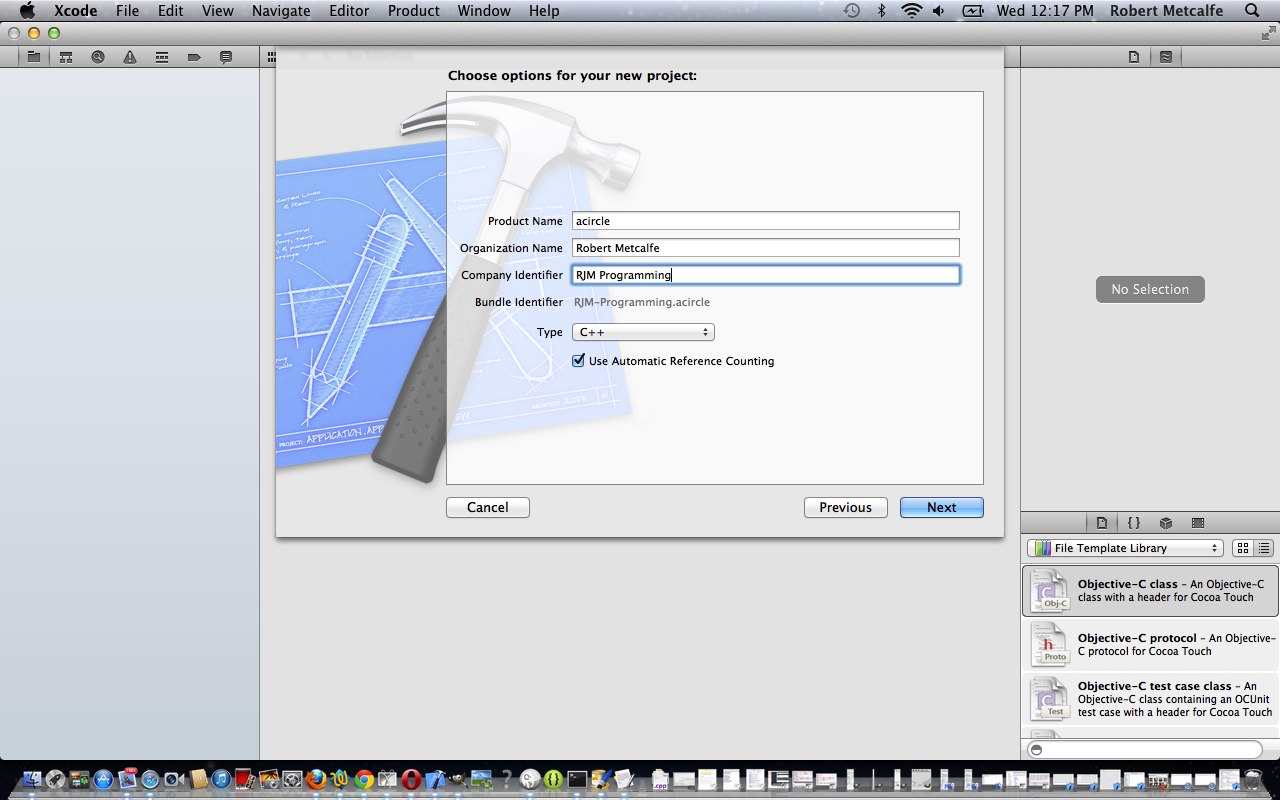
In this tutorial we touch on the “components” aspect of an object circle, whose class we are going to call acircle, and we will introduce a component class of point as a component of a circle. This is the tip of the iceberg of discussing objects and OOP, but is, perhaps, the easiest concept to start getting your head around how good OOP techniques can be for imagining what your programming should achieve.
By the way, do as I say rather than I do … when you have a classname give it a capital letter. You’ll see why when you program a lot … was a bad male human and didn’t do that in this tutorial. Non-snap. Non-snap. Non-snap. Somehow, don’t think non-snap will catch on quite as well!
Let’s see some C++ using XCode for this …
Link to Object Oriented Programming information … from Wikipedia from which quote above comes.
Link to Object Oriented Programming inventor information … Kristen Nygaard.
Link to some downloadable programming code … rename to main.cpp for use.
If this was interesting you may be interested in this too.




Revisiting your Worldwide Country Quiz so that the Geo Chart still draws a map even for a small country such as Andorra, and adding Wikipedia images after an answer, keeps the focus on a working world-country quiz rather than only on the surrounding code. I work on World Geography; our world map quiz is a free, untimed browser option for adults and does not need an account. It is another practice link, not a programming tutorial and not a replacement for the Worldwide Country Quiz you are building here.