
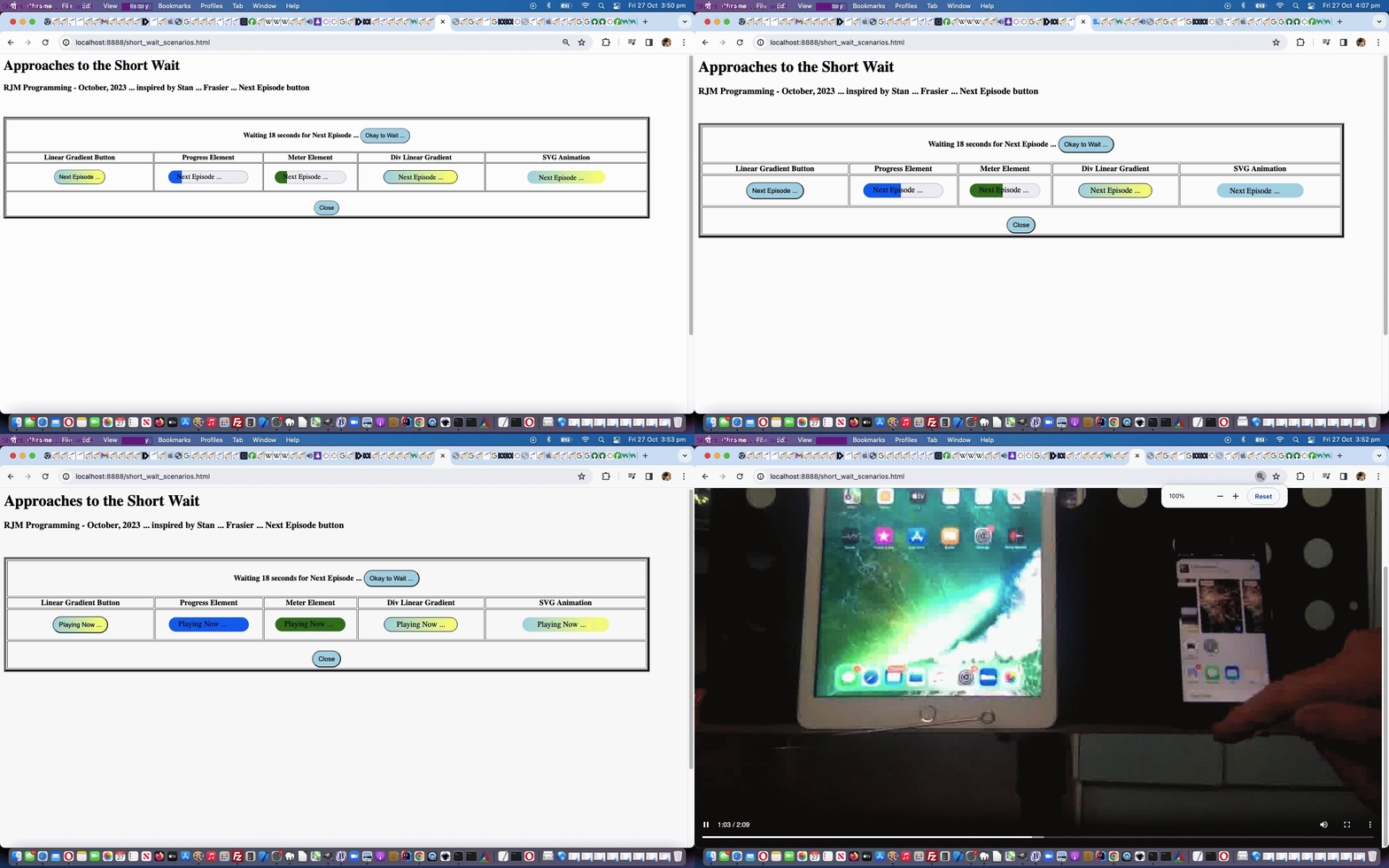
Next Episode Button Scenarios Primer Tutorial
We were streaming episodes of Frasier, effectively “binge watching”, the other day, on Stan, and were impressed by the cuteness of the …
Next episode …
… button “linear gradient” look. So we wrote a “proof of concept” Short Wait Scenario web application featuring five ideas we’ve had …
- button … using linear-gradient background-image … using “keyframes” and “transitions”
- progress … with overlayed span text
- meter … with overlayed span text
- div … using linear-gradient background-image … using “keyframes” and “transitions”
- SVG … using text subelement SVG element class pointing at linear-gradient background-image … using “keyframes” and “transitions”
… to “semi-simulate” what that Stan button achieves (but we can’t entirely with the current restriction with video playing on modern web browsers that a real user created button press should happen on the webpage before any media playing … hence the “Okay to Wait …” button we’re asking you to press to simulate Stan binge watching mode) and found the keyframes transition work not fast enough on this first draft. We’ll do some more research, here.
If this was interesting you may be interested in this too.




The distinction between course-driven and immersion-driven learning is useful. A small extension to the australia.htm exercise would be a set of named map markers and a text filter: first update the visible markers on an input event, then add a collected/uncollected toggle, and finally persist only that toggle state in localStorage. That gives beginners a concrete reason to learn arrays, DOM updates and browser storage without needing PHP or MySQL first. It is also worth testing empty searches, a page reload and disabled storage separately; those are different failure cases. Disclosure: we maintain the GTA 6 interactive map. I am suggesting it as an example of a map-and-progress interface, not claiming that we used the tutorial code. Would you introduce persistence after the first working interaction, or keep the initial exercise entirely stateless?