CSS Embossed Text Primer Tutorial
Sometimes it is good to give a 3D embossed effect (with text shadowing) to some text HTML elements for the purpose of attracting the user’s attention and giving that 3D effect for vibrancy.
Today we’ve applied some CSS to do this in a number of combinations:
- With WordPress Blog title via changes to header.php as per the bold code below …
<link rel="stylesheet" type="text/css" media="all" href="<?php bloginfo( 'stylesheet_url' ); ?>" />

<style>

.mypclass { color:rgb(185,127,206); }

#mypid { color:rgb(185,127,206); }

.mypclass2 { background-color:rgb(185,127,206); color:'black'; }

.mypclass22 { background-color:rgb(185,127,206); color:'black'; }

#mypid2 {  background-color:rgb(185,127,206); color:'black';  }


#ahomeis {

    color: #ffffff;

    font: 24pt Arial;

    text-shadow: 0 1px 0 #ccc, 0 2px 0 #c9c9c9, 0 3px 0 #bbb, 0 4px 0 #b9b9b9, 0 5px 0 #aaa, 0 6px 1px rgba(0, 0, 0, 0.1), 0 0 5px rgba(0, 0, 0, 0.1), 0 1px 3px rgba(0, 0, 0, 0.3), 0 3px 5px rgba(0, 0, 0, 0.2), 0 5px 10px rgba(0, 0, 0, 0.25), 0 10px 10px rgba(0, 0, 0, 0.2), 0 20px 20px rgba(0, 0, 0, 0.15);

}


</style>

<link rel="pingback" href="<?php bloginfo( 'pingback_url' ); ?>" />
- Landing Page (and other) HTML of www.rjmprogramming.com.au …
<style>

#rjmp {

    color: #777777;

    font: 24pt Arial;

    text-shadow: 0 1px 0 #ccc, 0 2px 0 #c9c9c9, 0 3px 0 #bbb, 0 4px 0 #b9b9b9, 0 5px 0 #aaa, 0 6px 1px rgba(0, 0, 0, 0.1), 0 0 5px rgba(0, 0, 0, 0.1), 0 1px 3px rgba(0, 0, 0, 0.3), 0 3px 5px rgba(0, 0, 0, 0.2), 0 5px 10px rgba(0, 0, 0, 0.25), 0 10px 10px rgba(0, 0, 0, 0.2), 0 20px 20px rgba(0, 0, 0, 0.15);

}

</style>
- File Information Table fileinfotable.php changes can be seen via fileinfotable.php using emboss_h1.css
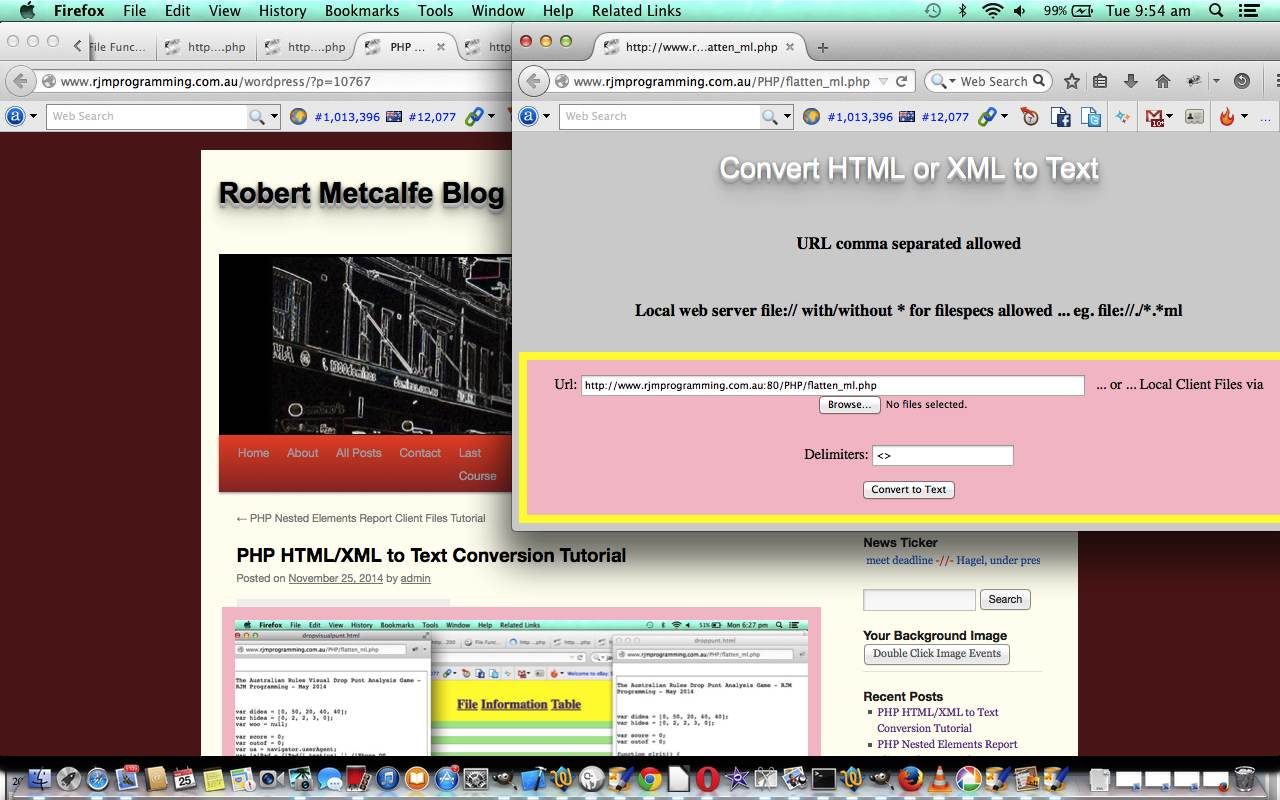
- HTML/XML to Text Conversion flatten_ml.php changes can be seen via flatten_ml.php
Hope you enjoy today’s tutorial.
If this was interesting you may be interested in this too.




The distinction between course-driven and immersion-driven learning is useful. A small extension to the australia.htm exercise would be a set of named map markers and a text filter: first update the visible markers on an input event, then add a collected/uncollected toggle, and finally persist only that toggle state in localStorage. That gives beginners a concrete reason to learn arrays, DOM updates and browser storage without needing PHP or MySQL first. It is also worth testing empty searches, a page reload and disabled storage separately; those are different failure cases. Disclosure: we maintain the GTA 6 interactive map. I am suggesting it as an example of a map-and-progress interface, not claiming that we used the tutorial code. Would you introduce persistence after the first working interaction, or keep the initial exercise entirely stateless?