Android Application Primer Tutorial
Android Applications run on many of today’s mobile (smart) phones. More and more the Internet traffic of the world arises because of mobile phone usage.
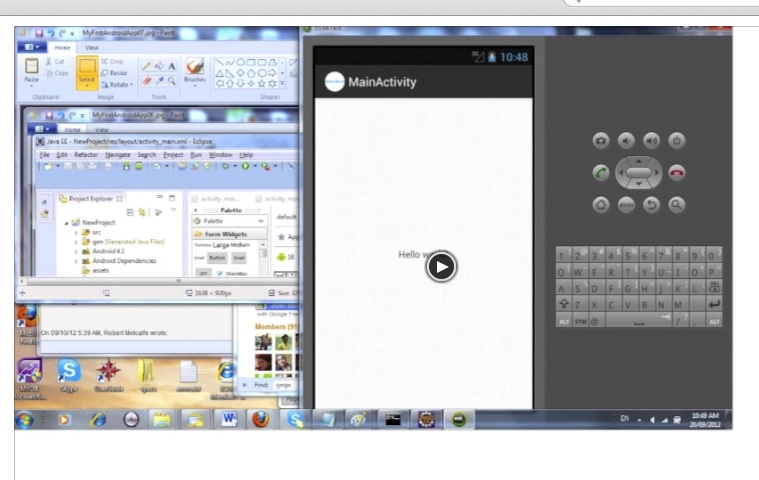
This video is a primer showing a “stream-of-consciousness” view of installing the necessary software components on a Windows laptop in order to create an Android Application that will run on many of today’s (smart) mobile phones. These components, for my setup, include:
- Java Runtime Environment
- Eclipse IDE
- Android SDK
- Android ADT Plugin
When doing your research and development on your favourite search engine enter
“Android SDK” “Eclipse” “Java”
to find out more. Here is one good relevant page.
Below is a summary of the “slides” of the video above (NB. as you install you may come across some/all of these scenarios, but it may or may not be in the order shown in this video):
- Download Java Runtime
- Eclipse Zip File
- Android SDK Manager
- Eclipse ADT Plugin
- Android App: Configure Launcher Icon
- Android App: activity_main.xml
- Android App: Run As – Android Application
- Android App: MainActivity.java
- Android App: Simulator Loading
- Android App: Uploading and Installing the .apk
- Android App: Hello World! on Simulator
Word of advice is that the simulator can be quite slow, and you may (really) need to wait for it!
If this was interesting you may be interested in this too.




The distinction between course-driven and immersion-driven learning is useful. A small extension to the australia.htm exercise would be a set of named map markers and a text filter: first update the visible markers on an input event, then add a collected/uncollected toggle, and finally persist only that toggle state in localStorage. That gives beginners a concrete reason to learn arrays, DOM updates and browser storage without needing PHP or MySQL first. It is also worth testing empty searches, a page reload and disabled storage separately; those are different failure cases. Disclosure: we maintain the GTA 6 interactive map. I am suggesting it as an example of a map-and-progress interface, not claiming that we used the tutorial code. Would you introduce persistence after the first working interaction, or keep the initial exercise entirely stateless?