
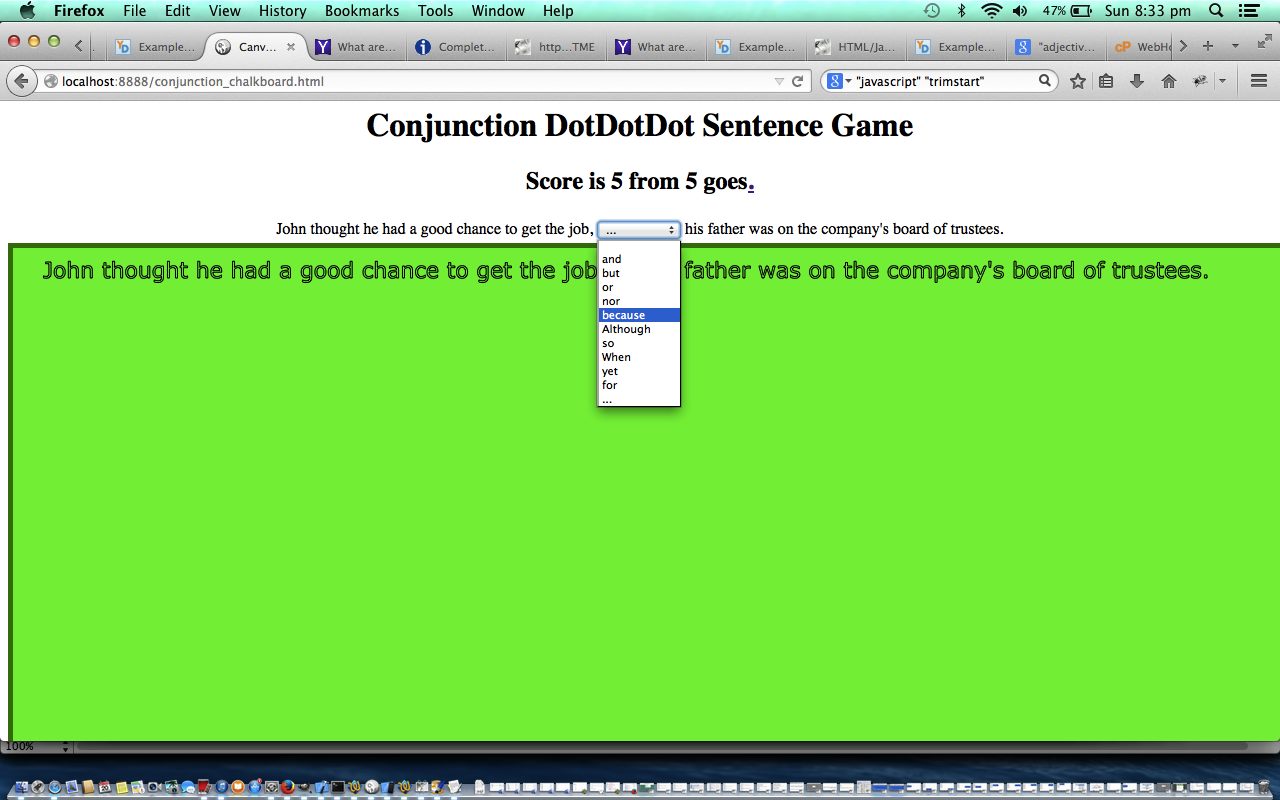
HTML/Javascript Sentence Conjunction Game Tutorial
The easiest English games to design are those that involve discrete words, because then dictionaries and thesauruses can be used. Learning English (for students whose first language is not English (ESL)) is obviously more useful when the student can piece together sentences, so, here, with today’s tutorial, we piece together sentences where conjunctions come into play in the makeup of the complete English sentence. Today’s game asks you to fill in the game’s missing start, middle word, or end to your sentences, in order to complete those sentences (correctly, hopefully?!), and we’ll call the game “The Conjunction DotDotDot Game” (too snappy for you?!) … and you score points for each correct sentence you form (we may not have thought of all sentences you may construct, and if this happens avail yourself of the Complaints Department). It uses English sentences, and we invite you to play with another player, and add your own, maybe while they aren’t looking?! (Hint: Try the middle Dot).
Today’s data source inspiration is from this link, as well as from The Good Grammar Book by Michael Swan and from Søren Kierkegaard Quotes … thanks a lot.
This game uses HTML and Javascript programming languages.
Hopefully you can figure the rules when you click the picture above for a live run.
Anyway, see how you go with this ESL sentence game that makes use of a (HTML canvas element) chalkboard!
Here is a link to some downloadable HTML (with Javascript) programming code you could rename to conjunction_chalkboard.html (please note that some of the utf-8 characters may be better seen with View->Page Source).
Some utf-8 coding considerations came into play with the code above, and in this respect, take a look at:
- Complete Character List for UTF-8 (is a good resource to know about)
- Have a look at meta tag in header that looks like …
<meta charset="UTF-8"> - Have a look at code line …
context.strokeText(pseudo_sentence.replace("ø", "ø"),gpx,gpy);
andcontext.strokeText(real_sentence.replace("ø", "ø"),gpx,gpy);
If this was interesting you may be interested in this too.




Naming the things in a bathroom is a smarter vocabulary exercise than it first looks, because every learner already knows the room, so the words attach to objects they can see and touch instead of floating on a flashcard. Asking how many things can you name turns it into a game rather than a test, and the counting itself becomes the motivation: one more word than last time is a visible win. I like the way this kind of lesson uses a photograph as the prompt, since a picture gives every student the same starting point regardless of level, and the stronger students can move on to describing what each thing is for while beginners are still collecting nouns. The bathroom is a good choice of room too, because it is full of everyday words that textbooks often skip, the small objects people actually say out loud every morning. A daily habit of naming five new things around the house would build a working vocabulary faster than memorising lists, and this post is a good template for it.