
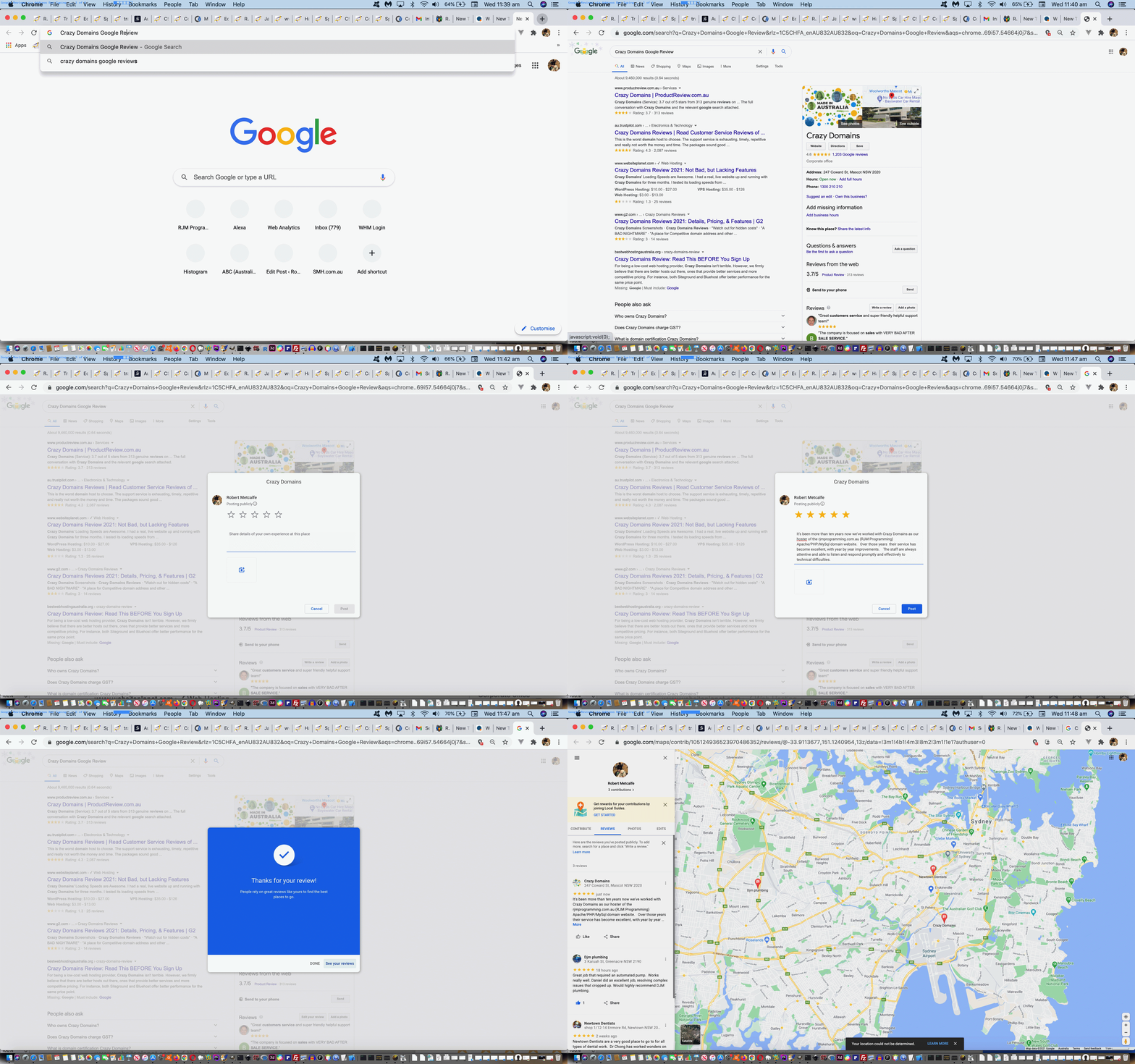
Google Reviews Primer Tutorial
Have you been asked to leave a Google Review? It’s usage is linked to an associated Google My Business account and locations are controlled within the scope of … (you guessed it) … Google Maps.
It’s not a natural fit for me, but we appreciate it might be different for other businesses “that are worth a hoy”. It’s a pretty easy thing to do if you have webmail Gmail always connected, and any Google software product can link into that as an identifier should we want to review somebody else’s service.
Today’s animated GIF presentation above shows us leaving a Google Review for our website hoster, Crazy Domains, after we passed the ten year association anniversary. How can a user like me best get to the place to leave the review …
Just type into your web browser (which could be Google Chrome) address bar typing of the form Company Name Google Review … in the case of Crazy Domains …
Crazy Domains Google Review
… and you’ll see a “Write a Review” button (possibly only if you have Google as your default search engine, in that web browser’s preferences) down the resultant webpage presented.
Easy as falling off a log, huh?!
If this was interesting you may be interested in this too.




Naming the things in a bathroom is a smarter vocabulary exercise than it first looks, because every learner already knows the room, so the words attach to objects they can see and touch instead of floating on a flashcard. Asking how many things can you name turns it into a game rather than a test, and the counting itself becomes the motivation: one more word than last time is a visible win. I like the way this kind of lesson uses a photograph as the prompt, since a picture gives every student the same starting point regardless of level, and the stronger students can move on to describing what each thing is for while beginners are still collecting nouns. The bathroom is a good choice of room too, because it is full of everyday words that textbooks often skip, the small objects people actually say out loud every morning. A daily habit of naming five new things around the house would build a working vocabulary faster than memorising lists, and this post is a good template for it.