
Voice Memo on iPhone Primer Tutorial
If you are on the go with a mobile device such as the iPhone 6 of today’s tutorial, and think of an idea, you may want to consider dictating your thoughts into a Voice Memo.
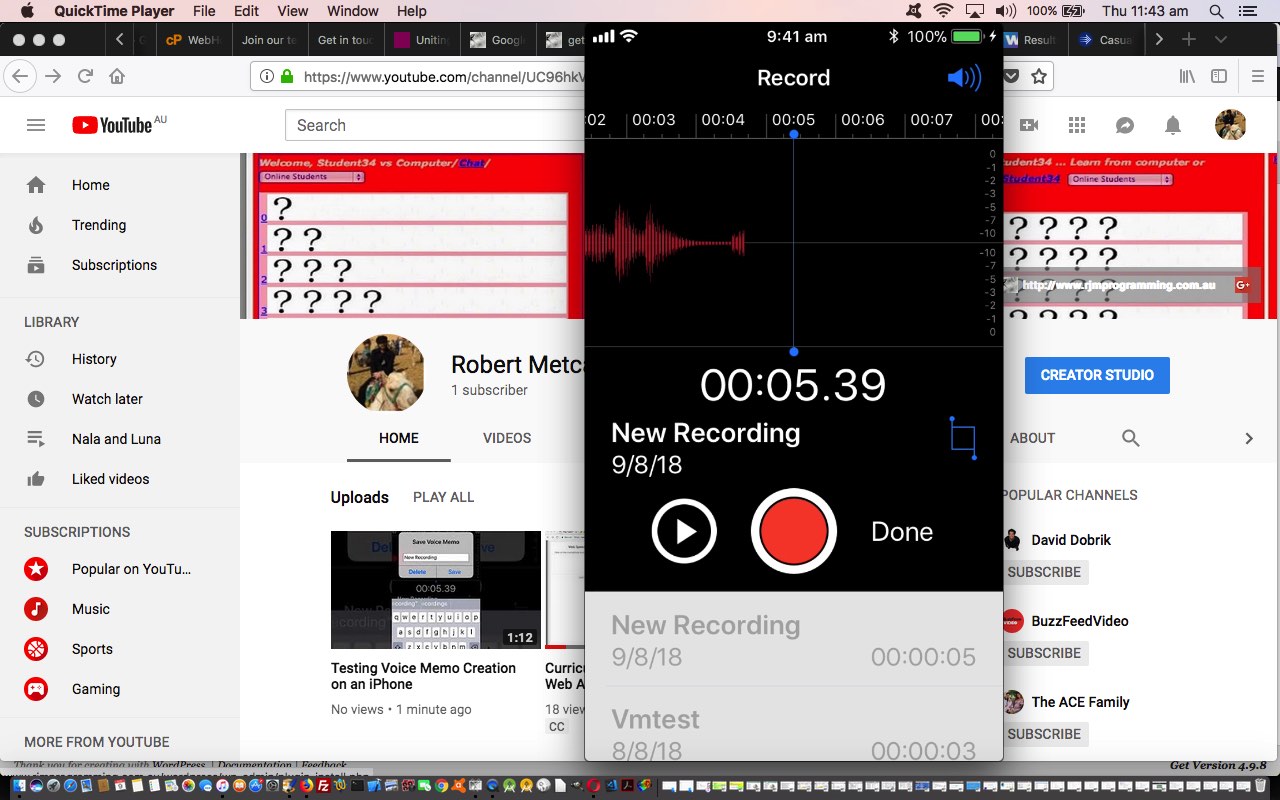
Today, we’ve used QuickTime Player on a MacBook Pro connected to the iPhone 6 via an Apple white lead to make the YouTube video below …
… to show you how to …
- be at the iPhone desktop (via Home button taps)
- tap (touch) “Extras” (maybe “Utilities”) folder to reveal a Voice Memos icon …
- tap “voice Memos” icon …
- tap speakers icon at top right and set to “iPhone” (and you may need to ensure the volume is up enough for a dictation type of audio recording) then …
- as necessary drag start of Voice Memo to zero seconds and …
- tap red circle record button (it goes square) …
- dictate what you want to record then …
- tap (that now square) red button to stop recording the Voice Memo …
- optionally play it back via dragging pointing back to zero seconds again before tapping left pointing play button to hear back the Voice Memo … and …
- if you want to Save the Voice Memo tap the “Done” link and fill out a Voice Memo filename saved to your iPhone and that you will see listed as you re-enter the Voice Memo app the next time
Useful, we hope, huh?!
If this was interesting you may be interested in this too.




Naming the things in a bathroom is a smarter vocabulary exercise than it first looks, because every learner already knows the room, so the words attach to objects they can see and touch instead of floating on a flashcard. Asking how many things can you name turns it into a game rather than a test, and the counting itself becomes the motivation: one more word than last time is a visible win. I like the way this kind of lesson uses a photograph as the prompt, since a picture gives every student the same starting point regardless of level, and the stronger students can move on to describing what each thing is for while beginners are still collecting nouns. The bathroom is a good choice of room too, because it is full of everyday words that textbooks often skip, the small objects people actually say out loud every morning. A daily habit of naming five new things around the house would build a working vocabulary faster than memorising lists, and this post is a good template for it.