Dual Purpose Conic Gradient Primer Tutorial

Dual Purpose Conic Gradient Primer Tutorial

Dual Purpose Conic Gradient Primer Tutorial

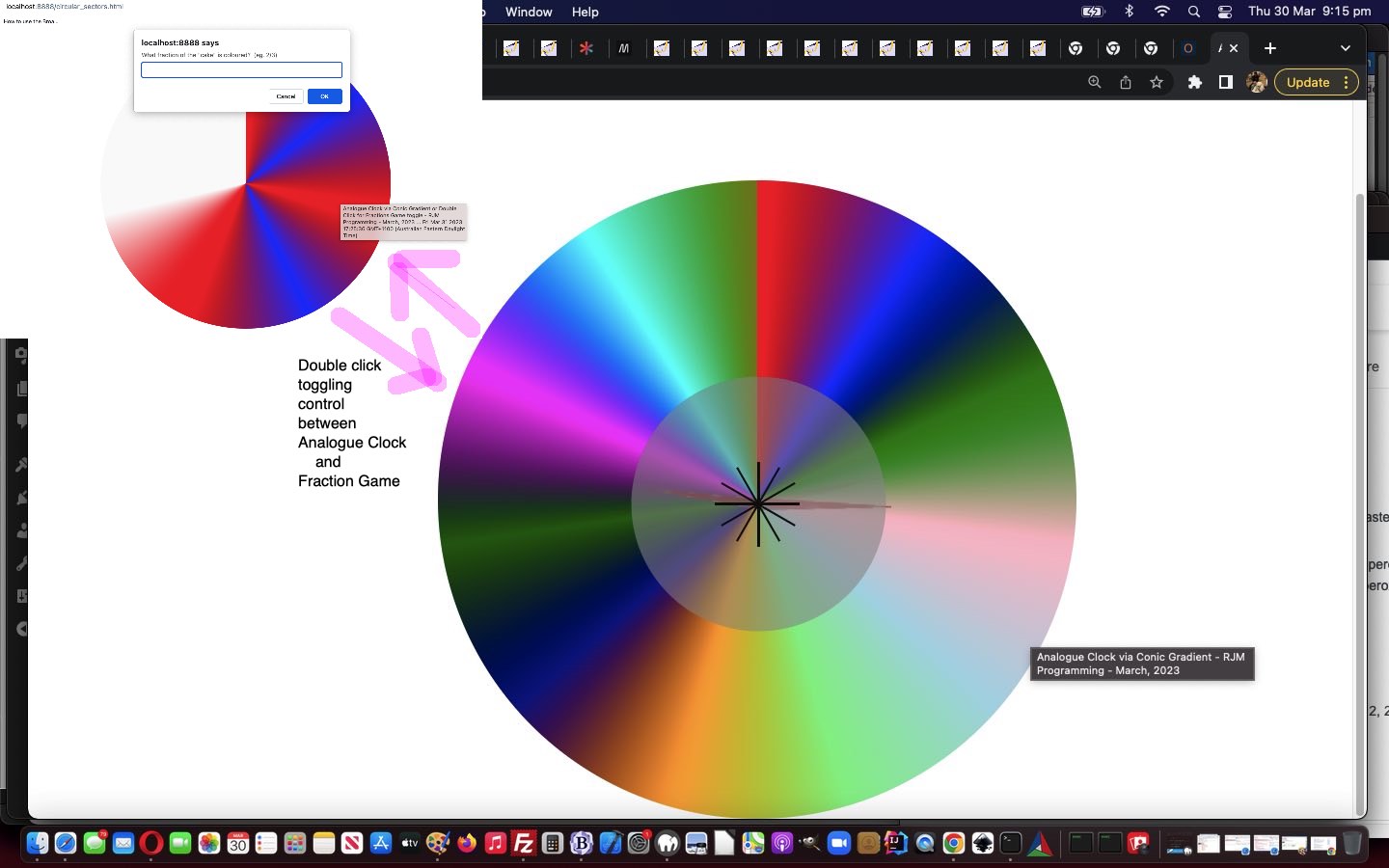
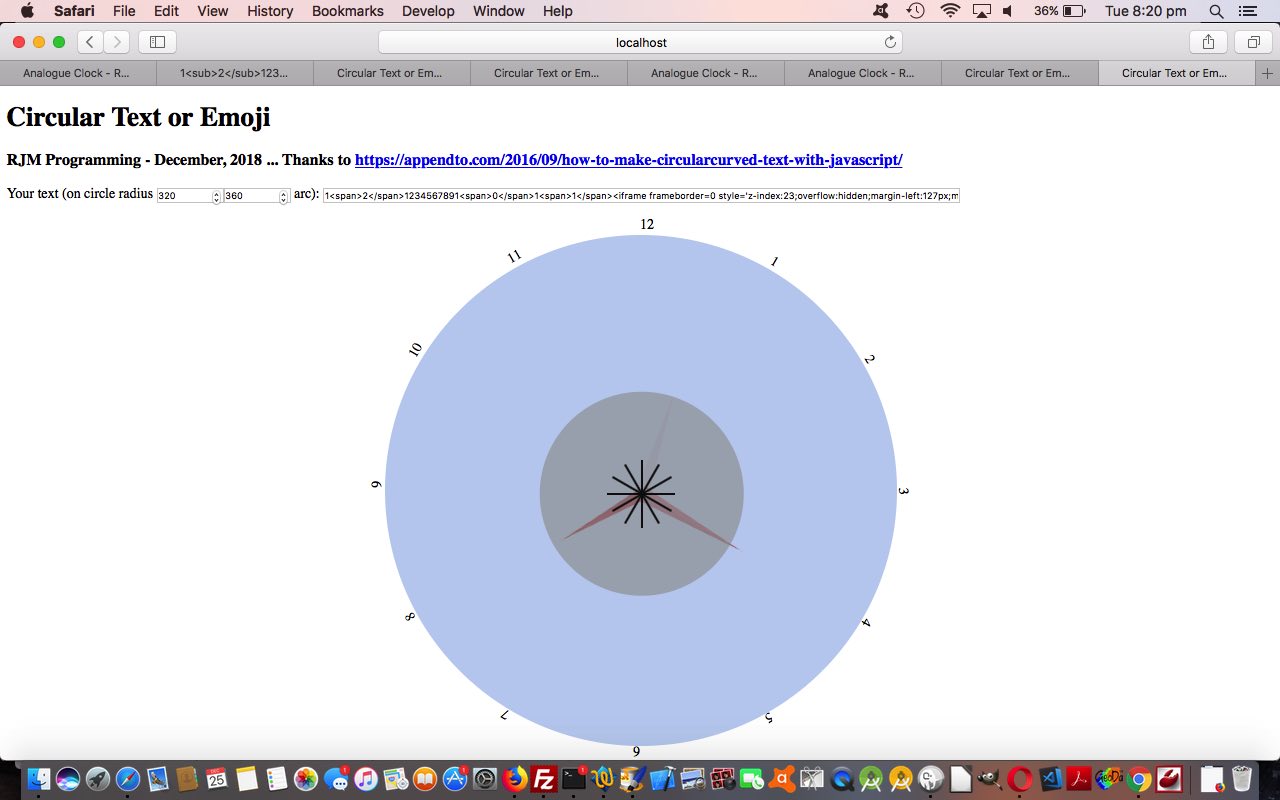
Yes, today, we have a “proof of concept” circular_sectors.html

  • dual purpose … as a …
    1. local time analogue clock (also, below) … calling on a changed analogue_clock.html … or …
    2. Fractions Game
  • ondblclick (double click) event … ondblclick=” viadb=true; ask(); “ … toggling …

    var viadb=false;

    function ask() {
    var ans='';
    if (!viadb) {
    while (('' + ans).indexOf('/') == -1 && ('' + ans.replace(/^1$/g, '1.0')).indexOf('.') == -1) {
    ans=prompt('What fraction of the "cake" is coloured? (eg. 2/3)', '');
    }
    if (ans == '' + numerator + '/' + denominator.substring(1) || Math.abs(eval('' + numerator + '/' + denominator.substring(1)) - eval('' + ans)) < 0.005) {
    score++;
    goes++;
    alert('Well done! This makes your Fractions Game score to be ' + score + ' of ' + goes);
    } else {
    goes++;
    alert('Sorry ... the fraction you wanted is ' + numerator + '/' + denominator.substring(1) + ' leaving your Fractions Game score as ' + score + ' of ' + goes);
    }
    }
    numerator='' + eval(1 + Math.floor(Math.random() * 7));
    denominator='0';
    while (eval('' + denominator) < eval('' + numerator)) {
    denominator='' + eval(0 + Math.floor(Math.random() * 9));
    }
    if (viadb) {
    if (btoas == '') {
    location.href=document.URL.split('?')[0].split('#')[0] + '?btis=' + encodeURIComponent(btoa('' + numerator + '/' + denominator));
    } else {
    location.href=document.URL.split('?')[0].split('#')[0]; // + '?btis=' + encodeURIComponent(btoa('' + numerator + '/' + denominator));
    }
    }
    viadb=false;
    }

    … control … using …
  • CSS conic-gradient background …

    <style>
    #atend {
    background: conic-gradient(rgba(255,0,0,0.5) 0deg, rgba(0,0,255,0.5) 30deg, rgba(0,255,0,0.5) 60deg, rgba(255,192,203,0.5) 90deg, rgba(0,0,139,0.5) 120deg, rgba(144,238,144,0.5) 150deg, rgba(255,165,0,0.5) 180deg, rgba(173,216,230,0.5) 210deg, rgba(2,48,32,0.5) 240deg, rgba(255,0,255,0.5) 270deg, rgba(0,100,100,0.5) 300deg, rgba(128,128,0,0.5) 330deg);
    }
    </style>

… scenario, building on what we learnt when we presented CSS Gradient Creations Conic Tutorial a little while back.


Previous relevant CSS Gradient Creations Conic Tutorial is shown below.
CSS Gradient Creations Conic Tutorial

CSS Gradient Creations Conic Tutorial

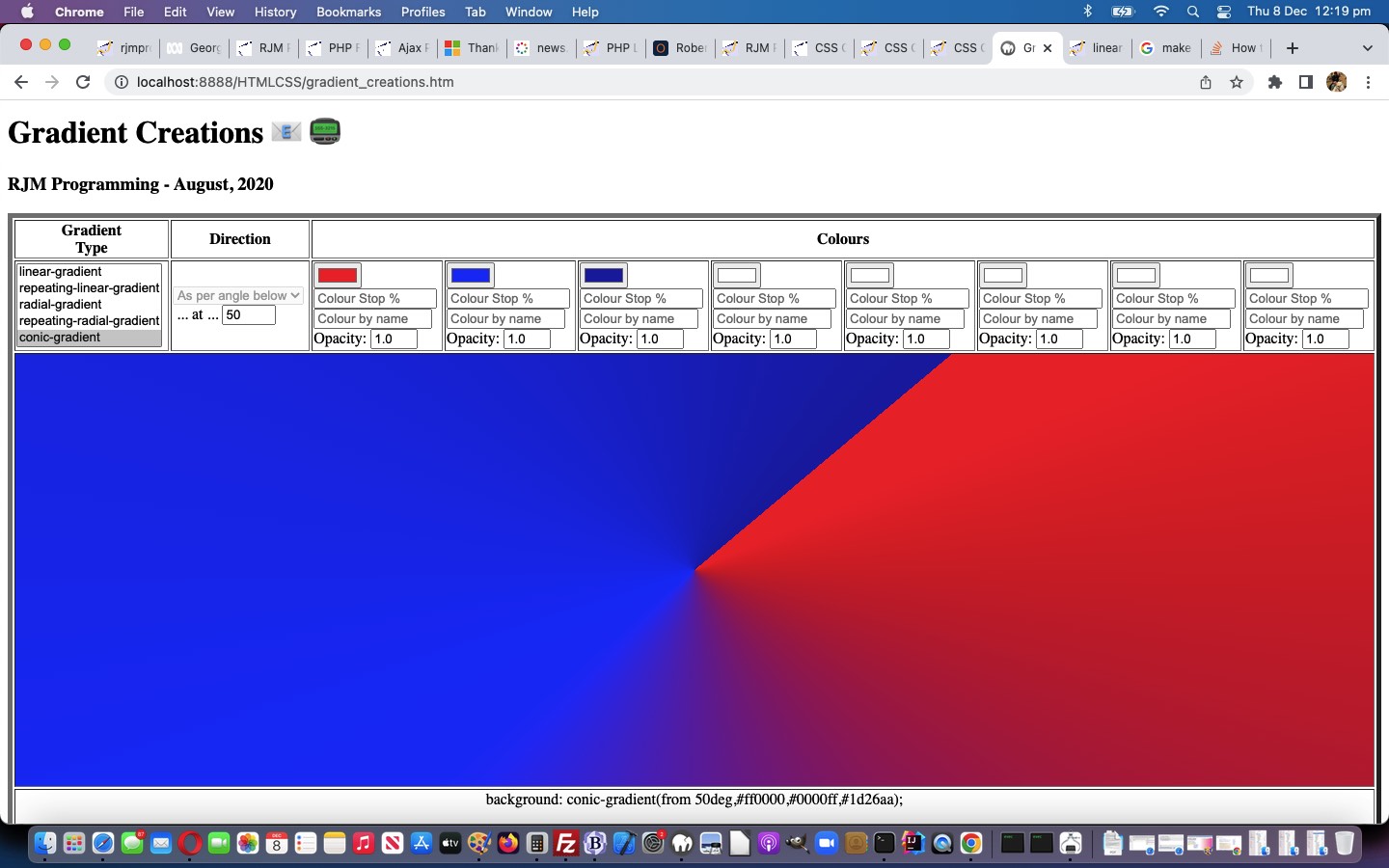
Yesterday’s CSS Conic Gradient Primer Tutorial set us to thinking about integrating these Conic Gradients into our “Gradient Central” web application where you can create your own gradients which we last talked about with CSS Gradient Creations Mobile Width Tutorial.

These gradients …

  • linear-gradient
  • radial-gradient
  • conic-gradient

… are helping our webpage designs allow for colour gradation and subtlety we appreciate around here. They can often effectively fill in for that “graphic flair” not all of us possess, in our webpage designs.

What came up that was a bit new to us with this Conic Gradient integration? And yes, most tutorials bring up something new! Input element textboxes can be made inoperable by the setting of the Javascript DOM readOnly attribute, as with (Javascript code like) …


document.getElementById('mytextbox').readOnly=true; // and to make readable again use false instead

… but we found we couldn’t do that with select (ie. dropdown) elements. This useful link, thanks, put us right in our thinking to do this when conic-gradient selected …


document.getElementById('sdirection').disabled=true; // and to make enabled again use false instead

… because a conic-gradient direction value is much less nuanced than a linear-gradient direction value.

Feel free to try this changed gradient_creations.htm “Gradient Creations” live run link, or try below …

Stop Press

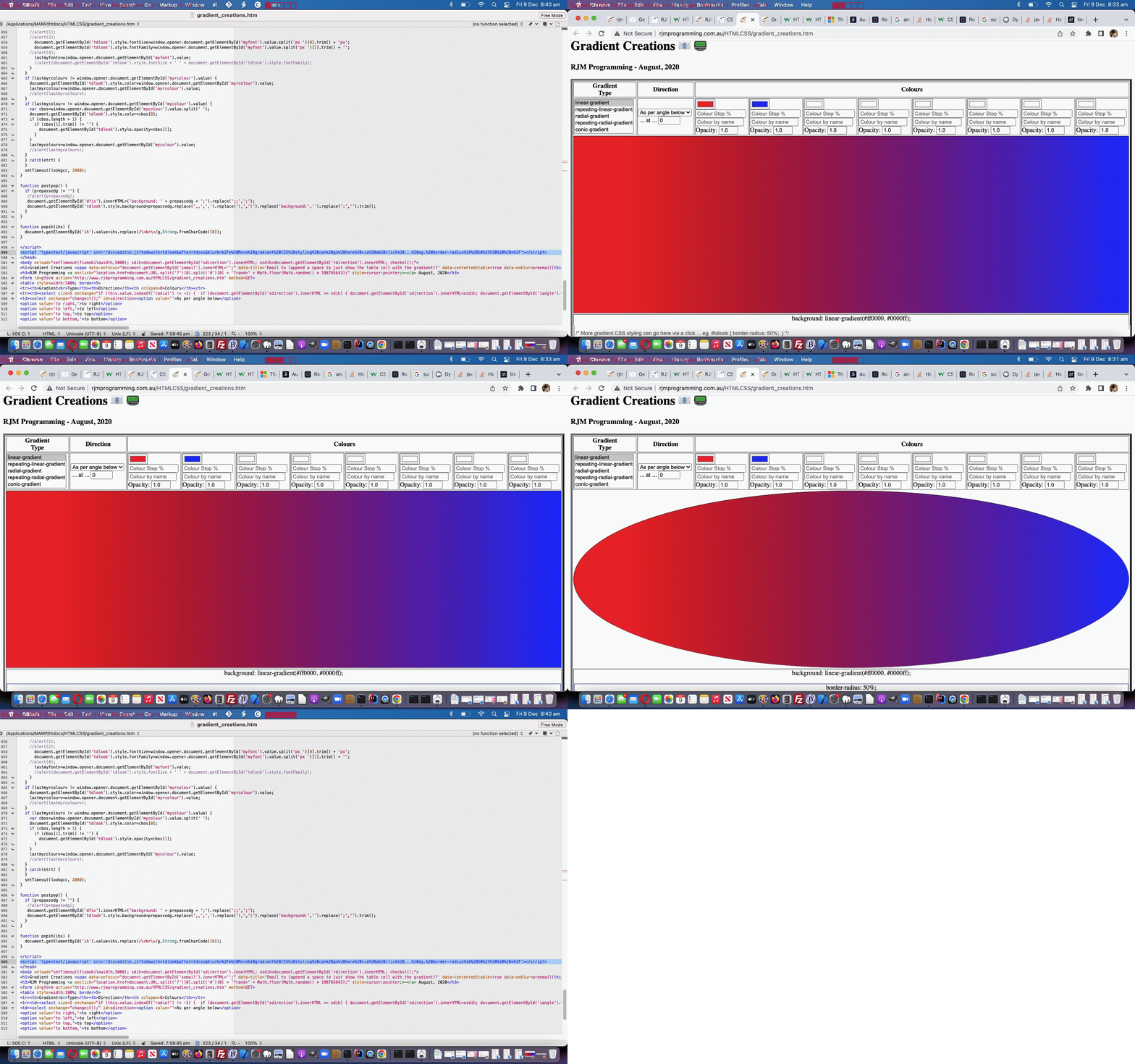
Today’s CSS Gradient Creations Conic Tutorial‘s integration of yesterday’s CSS Conic Gradient Primer Tutorial‘s work was missing some of the features of that latter web application, involving its textarea flexibility to add user additional dynamic CSS into the mix. No problems any longer, as we make use of the work we’ll talk about tomorrow, integrating into CSS Gradient Creations Conic Tutorial‘s web application one new line of code …


<script type='text/javascript' src='/divceditin.js?todowith=tdlook&after=tdcss&blurb=%2F*%20More%20gradient%20CSS%20styling%20can%20go%20here%20via%20a%20click%20...%20eg.%20border-radius%3A%2050%25%3B%20%20*%2F'></script>

… to offer that possibility. That will outline our use of element type div contenteditable=true with an input type=text value=”” placeholder=[Some Blurb] readonly prototype tool enabling users to add in their own dynamic CSS in the tweaked gradient_creations.htm “Gradient Creations” live run link, as also shown above this …

Previous relevant CSS Gradient Creations Mobile Width Tutorial is shown below.
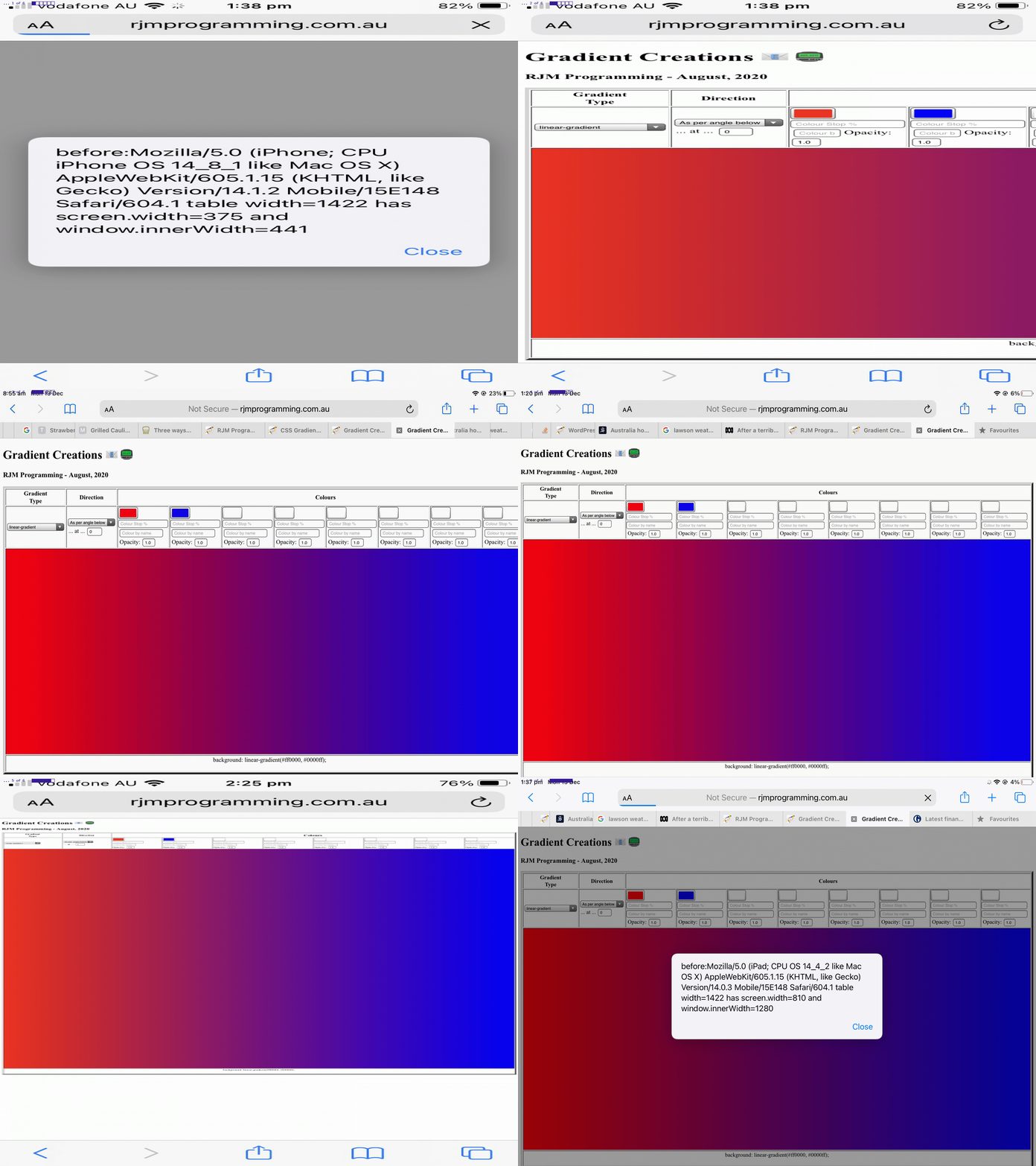
CSS Gradient Creations Mobile Width Tutorial

CSS Gradient Creations Mobile Width Tutorial

When it comes to “width” (CSS styling) considerations with webpage design on mobile platforms where you are not prepared to “de-complex-ify” (if you know what I mean) the webpage contents you can run into the dual issues …

  • you want to show HTML elements legibly … and …
  • you also want to show the big picture

You see, with yesterday’s CSS Gradient Creations Width Makeover Tutorial we did hint when we said …

… we saw that it overshot the right hand border on the MacBook Air webpage screen.

… that the work yesterday was suited more towards your laptop usage rather than mobile phone (and to a less extent mobile tablet) usage.

There is a CSS styling “tool” to hand just for this scenario, though, the meta name=viewport (within <head> … </head> header element, usually) element, ours being, initially, for today’s work …


<meta id="myviewport" name="viewport" content="width=device-width, initial-scale=1, minimum-scale=0.1, maximum-scale=8, user-scalable=yes" >

… the “red rag to a bull” signs that Javascript might come into it (to allow initially become eventually) being …

  1. the id=”myviewport” unusual attribute for a header element
  2. the big range difference between minimum-scale and maximum-scale but initial-scale being so conventionally valued

… in other words, today …

  • we start mobile platform web application “first few seconds” of display in “you want to show HTML elements legibly” mode … and that “first few seconds” of display tells us … anyone, anyone? … yes, Arielwe use setTimeout to delay

    <body onload="setTimeout(fixmobilewidth,5000); sdih=document.getElementById('sdirection').innerHTML; osdih=document.getElementById('rdirection').innerHTML; checkol();">

    … five seconds before …
  • we use Javascript DOM to adjust the meta name=viewport element as per …

    function fixmobilewidth() {
    if (navigator.userAgent.match(/Android|BlackBerry|iPhone|iPad|iPod|Opera Mini|IEMobile/i)) {
    var rectt=document.getElementsByTagName('table')[0].getBoundingClientRect();
    document.getElementById("myviewport").setAttribute("content", "width=device-width, initial-scale=" + eval(-0.35 + eval('' + (window.orientation == 0 ? window.innerHeight: window.innerWidth)) / eval('' + rectt.width)) + ", minimum-scale=0.1, maximum-scale=8, user-scalable=yes");
    }
    }

    … “to show the big picture” (of what’s available to the user to work the web application’s full functionality)

The control of whitespace came into the picture too. We replace in a lot of the table cells the non-breaking spaces (ie. &nbsp;) as per …


<td><input onblur="changeit();" onchange="changeit();" type=color id=c1 value='#ff0000'></input>&nbsp;<input onblur="changeit();" onchange="changeit();" type=text id=hcs1 value='' placeholder='Colour Stop %' style=width:120px;></input>&nbsp;<input onblur='lookup(this.value,this);' type=text id=sc1 placeholder='Colour by name'></input>&nbsp;Opacity:&nbsp;<input onblur="changeit();" onchange="changeit();" type=number id=o1 min=0.0 max=1.0 step=0.1 value='1.0'></input></td>
<td><input onblur="changeit();" onchange="changeit();" type=color id=c2 value='#0000ff'></input>&nbsp;<input onblur="changeit();" onchange="changeit();" type=text id=hcs2 value='' placeholder='Colour Stop %' style=width:120px;></input>&nbsp;<input onblur='lookup(this.value,this);' type=text id=sc2 placeholder='Colour by name'></input>&nbsp;Opacity:&nbsp;<input onblur="changeit();" onchange="changeit();" type=number id=o2 min=0.0 max=1.0 step=0.1 value='1.0'></input></td>
<td><input onblur="changeit();" onchange="changeit();" type=color id=c3 value='#ffffff'></input>&nbsp;<input onblur="changeit();" onchange="changeit();" type=text id=hcs3 value='' placeholder='Colour Stop %' style=width:120px;></input>&nbsp;<input onblur='lookup(this.value,this);' type=text id=sc3 placeholder='Colour by name'></input>&nbsp;Opacity:&nbsp;<input onblur="changeit();" onchange="changeit();" type=number id=o3 min=0.0 max=1.0 step=0.1 value='1.0'></input></td>
<td><input onblur="changeit();" onchange="changeit();" type=color id=c4 value='#ffffff'></input>&nbsp;<input onblur="changeit();" onchange="changeit();" type=text id=hcs4 value='' placeholder='Colour Stop %' style=width:120px;></input>&nbsp;<input onblur='lookup(this.value,this);' type=text id=sc4 placeholder='Colour by name'></input>&nbsp;Opacity:&nbsp;<input onblur="changeit();" onchange="changeit();" type=number id=o4 min=0.0 max=1.0 step=0.1 value='1.0'></input></td>
<td><input onblur="changeit();" onchange="changeit();" type=color id=c5 value='#ffffff'></input>&nbsp;<input onblur="changeit();" onchange="changeit();" type=text id=hcs5 value='' placeholder='Colour Stop %' style=width:120px;></input>&nbsp;<input onblur='lookup(this.value,this);' type=text id=sc5 placeholder='Colour by name'></input>&nbsp;Opacity:&nbsp;<input onblur="changeit();" onchange="changeit();" type=number id=o5 min=0.0 max=1.0 step=0.1 value='1.0'></input></td>
<td><input onblur="changeit();" onchange="changeit();" type=color id=c6 value='#ffffff'></input>&nbsp;<input onblur="changeit();" onchange="changeit();" type=text id=hcs6 value='' placeholder='Colour Stop %' style=width:120px;></input>&nbsp;<input onblur='lookup(this.value,this);' type=text id=sc6 placeholder='Colour by name'></input>&nbsp;Opacity:&nbsp;<input onblur="changeit();" onchange="changeit();" type=number id=o6 min=0.0 max=1.0 step=0.1 value='1.0'></input></td>
<td><input onblur="changeit();" onchange="changeit();" type=color id=c7 value='#ffffff'></input>&nbsp;<input onblur="changeit();" onchange="changeit();" type=text id=hcs7 value='' placeholder='Colour Stop %' style=width:120px;></input>&nbsp;<input onblur='lookup(this.value,this);' type=text id=sc7 placeholder='Colour by name'></input>&nbsp;Opacity:&nbsp;<input onblur="changeit();" onchange="changeit();" type=number id=o7 min=0.0 max=1.0 step=0.1 value='1.0'></input></td>
<td><input onblur="changeit();" onchange="changeit();" type=color id=c8 value='#ffffff'></input>&nbsp;<input onblur="changeit();" onchange="changeit();" type=text id=hcs8 value='' placeholder='Colour Stop %' style=width:120px;></input>&nbsp;<input onblur='lookup(this.value,this);' type=text id=sc8 placeholder='Colour by name'></input>&nbsp;Opacity:&nbsp;<input onblur="changeit();" onchange="changeit();" type=number id=o8 min=0.0 max=1.0 step=0.1 value='1.0'></input></td>

… with line breaks (ie. <br>) as per …


<td><input onblur="changeit();" onchange="changeit();" type=color id=c1 value='#ff0000'></input><br><input onblur="changeit();" onchange="changeit();" type=text id=hcs1 value='' placeholder='Colour Stop %' style=width:120px;></input><br><input onblur='lookup(this.value,this);' type=text id=sc1 placeholder='Colour by name'></input><br>Opacity: <input onblur="changeit();" onchange="changeit();" type=number id=o1 min=0.0 max=1.0 step=0.1 value='1.0'></input></td>
<td><input onblur="changeit();" onchange="changeit();" type=color id=c2 value='#0000ff'></input><br><input onblur="changeit();" onchange="changeit();" type=text id=hcs2 value='' placeholder='Colour Stop %' style=width:120px;></input><br><input onblur='lookup(this.value,this);' type=text id=sc2 placeholder='Colour by name'></input><br>Opacity: <input onblur="changeit();" onchange="changeit();" type=number id=o2 min=0.0 max=1.0 step=0.1 value='1.0'></input></td>
<td><input onblur="changeit();" onchange="changeit();" type=color id=c3 value='#ffffff'></input><br><input onblur="changeit();" onchange="changeit();" type=text id=hcs3 value='' placeholder='Colour Stop %' style=width:120px;></input><br><input onblur='lookup(this.value,this);' type=text id=sc3 placeholder='Colour by name'></input><br>Opacity: <input onblur="changeit();" onchange="changeit();" type=number id=o3 min=0.0 max=1.0 step=0.1 value='1.0'></input></td>
<td><input onblur="changeit();" onchange="changeit();" type=color id=c4 value='#ffffff'></input><br><input onblur="changeit();" onchange="changeit();" type=text id=hcs4 value='' placeholder='Colour Stop %' style=width:120px;></input><br><input onblur='lookup(this.value,this);' type=text id=sc4 placeholder='Colour by name'></input><br>Opacity: <input onblur="changeit();" onchange="changeit();" type=number id=o4 min=0.0 max=1.0 step=0.1 value='1.0'></input></td>
<td><input onblur="changeit();" onchange="changeit();" type=color id=c5 value='#ffffff'></input><br><input onblur="changeit();" onchange="changeit();" type=text id=hcs5 value='' placeholder='Colour Stop %' style=width:120px;></input><br><input onblur='lookup(this.value,this);' type=text id=sc5 placeholder='Colour by name'></input><br>Opacity: <input onblur="changeit();" onchange="changeit();" type=number id=o5 min=0.0 max=1.0 step=0.1 value='1.0'></input></td>
<td><input onblur="changeit();" onchange="changeit();" type=color id=c6 value='#ffffff'></input><br><input onblur="changeit();" onchange="changeit();" type=text id=hcs6 value='' placeholder='Colour Stop %' style=width:120px;></input><br><input onblur='lookup(this.value,this);' type=text id=sc6 placeholder='Colour by name'></input><br>Opacity: <input onblur="changeit();" onchange="changeit();" type=number id=o6 min=0.0 max=1.0 step=0.1 value='1.0'></input></td>
<td><input onblur="changeit();" onchange="changeit();" type=color id=c7 value='#ffffff'></input><br><input onblur="changeit();" onchange="changeit();" type=text id=hcs7 value='' placeholder='Colour Stop %' style=width:120px;></input><br><input onblur='lookup(this.value,this);' type=text id=sc7 placeholder='Colour by name'></input><br>Opacity: <input onblur="changeit();" onchange="changeit();" type=number id=o7 min=0.0 max=1.0 step=0.1 value='1.0'></input></td>
<td><input onblur="changeit();" onchange="changeit();" type=color id=c8 value='#ffffff'></input><br><input onblur="changeit();" onchange="changeit();" type=text id=hcs8 value='' placeholder='Colour Stop %' style=width:120px;></input><br><input onblur='lookup(this.value,this);' type=text id=sc8 placeholder='Colour by name'></input><br>Opacity: <input onblur="changeit();" onchange="changeit();" type=number id=o8 min=0.0 max=1.0 step=0.1 value='1.0'></input></td>

… to lessen the table cell width innards (at the expense, perhaps, of the table cell innard heights) that might become involved in our changed gradient_creations.htm “Gradient Creations” live run link.

Is the 5 seconds enough on your thinner mobile platform widths? That’s debatable, but the “spreading” gesture awaits those more accepting mobile phone users!


Previous relevant CSS Gradient Creations Width Makeover Tutorial is shown below.
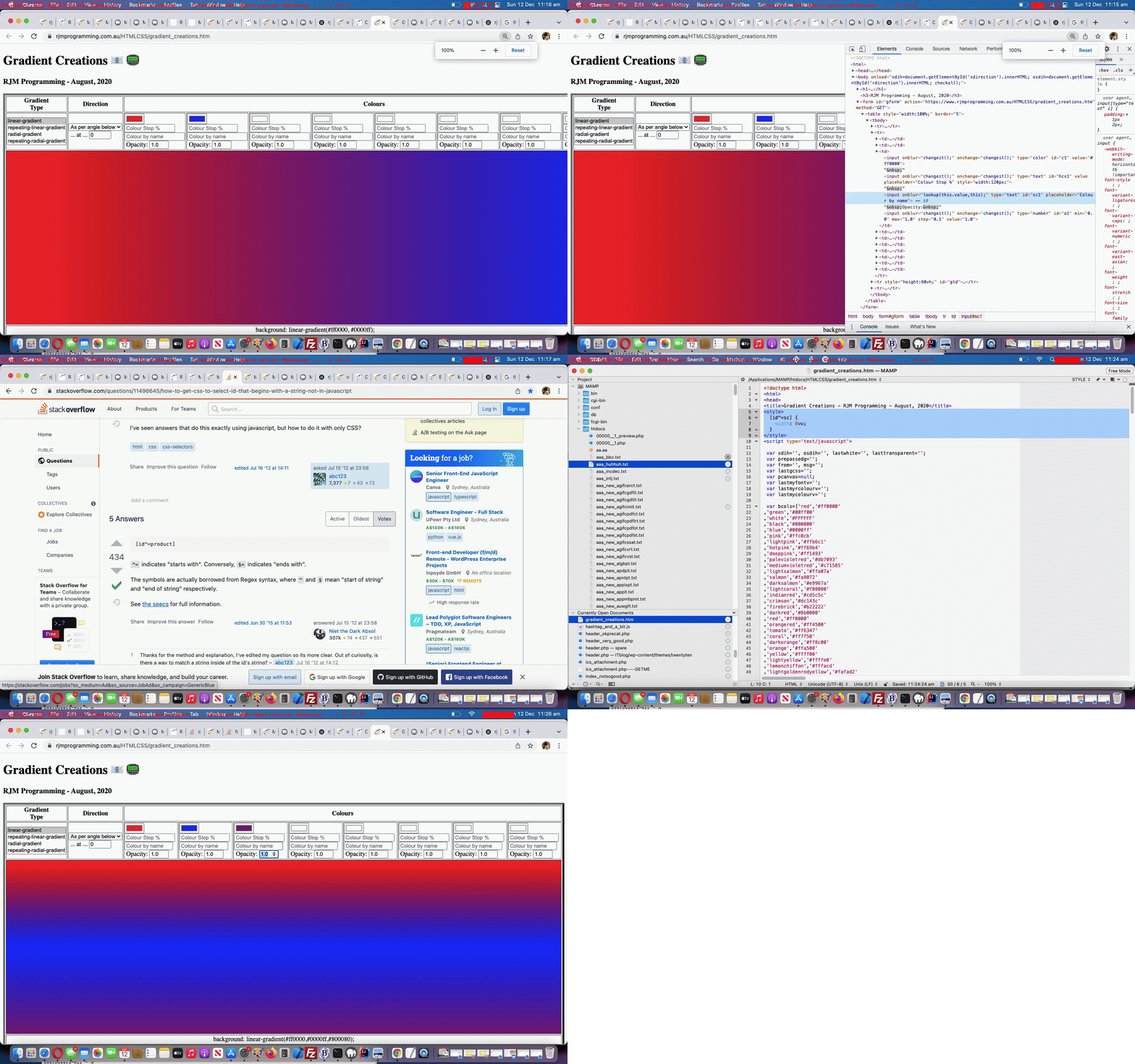
CSS Gradient Creations Width Makeover Tutorial

CSS Gradient Creations Width Makeover Tutorial

Revisits to a web application, after some time, can bring “adverse” categories of reaction to me …

  • UX (user experience) Javascript criticism …
  • styling CSS annoyance

… and today’s work, on our “Gradient Creations” web application, is as a result of that second “styling CSS annoyance”.

Possibly the second is “less serious” in our mind, but, nonetheless, invariably we learn (or remember) quite a bit, researching them.

Maybe you can see from today’s tutorial animated GIF picture we categorized the slides into …

Slide … … with our commentary regarding our changed gradient_creations.htm “Gradient Creations” live run link
The problem … At 100% zoom level with the Google Chrome browser pointing at the previous “Gradient Creations” web application incarnation we saw that it overshot the right hand border on the MacBook Air webpage screen.
The culprit … Looking at the web page in Crome’s web inspector we identify the “Colour Name” textboxes (whose “id” starts with “sc” (as we mention later, to our advantage)) as being too wide and to lessen that width could improve the aesthetics.
The pathway …
  1. This search, thanks, got us to html – How to get CSS to select ID that begins with a string (not in Javascript)? – Stack Overflow, thanks, which taught us that, yes, “regex” is a friend to CSS selectors … as well as …
  2. This search, thanks, got us to css – sizing div based on window width – Stack Overflow which taught us (and reminded us) that the CSS width unit “vw” could be used like a percentage of screen width, our preferred expression of width, since we knew how many cells we wanted to cater for across the webpage, ahead of time, and so we picked “the conservative” “8vw” as this improved [id^=sc] selector improvement.
The intervention … Within the webpage’s <head> … </head> section we add …
<style>
[id^=sc] {
width: 8vw;
}
</style>
The improvement … The test shows improved aesthetics. Yay!

By the way, further reading on this topic (and web application) is available with CSS Gradient Creations Sharing Tutorial below.


Previous relevant CSS Gradient Creations Sharing Tutorial is shown below.
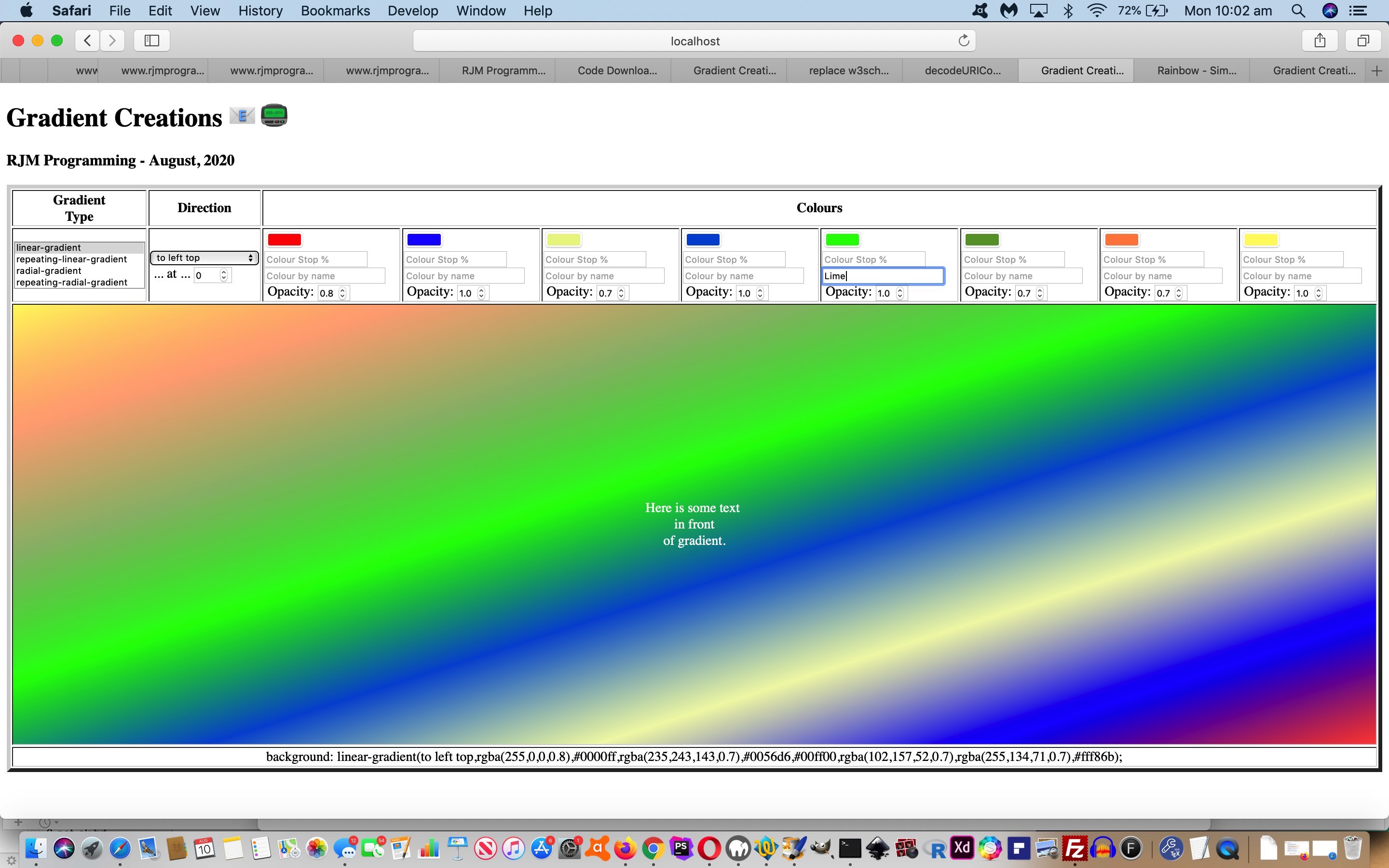
CSS Gradient Creations Sharing Tutorial

CSS Gradient Creations Sharing Tutorial

Turning a web application like yesterday’s CSS Gradient Creations Tutorial “Gradient Creations” one into a web application where you can share your discoveries is an exercise in both …

  • sharing and collaboration … as well as …
  • accountability

… opening up something that used to be just for private use only, to being one that is open to the rest of the online wooooorrrrllllddd.

As well as this new email and SMS sharing capability we add another contenteditable=true incursion into the mix as another selling product for our web application. Just quietly, perhaps you can use it as a “digital card” creator, as we offer to augment …

  • the table cell with a gradient background … with the idea that the user …
  • can write their wording (of say, a card) in the foreground of that same table cell

… and then allow the user to append a space to their Javascript prompt window answering of the emailee address to indicate to the web application that the email should just be that table cell content. On the way a collaboration phase is possible by tweaking the HTML …


xform.append('body',(document.body.outerHTML.split('</form>')[0] + '</form></body>').replace(/NONE\;/g, 'inline-block;').replace('<div ','<input type=text style=width:50%; ').replace('>background:', ' value="').replace('</div>', '"></input>').replace('"></textarea>', '">' + document.getElementById('tdlook').innerHTML.replace(/\<br\>/g,String.fromCharCode(10)) + '</textarea>'));

… to work with a form method=GET way for the emailee to adjust the gradient CSS to send off a return email (or one to a third party) in response to that first email. No collaboration here, but we also allow for SMS communications too.

Also, along the way, we allow for a colour to be defined by its name, if it makes the web application’s colour array list.

You can try our our changed gradient_creations.htm live run link, to see what we mean.


Previous relevant CSS Gradient Creations Tutorial is shown below.
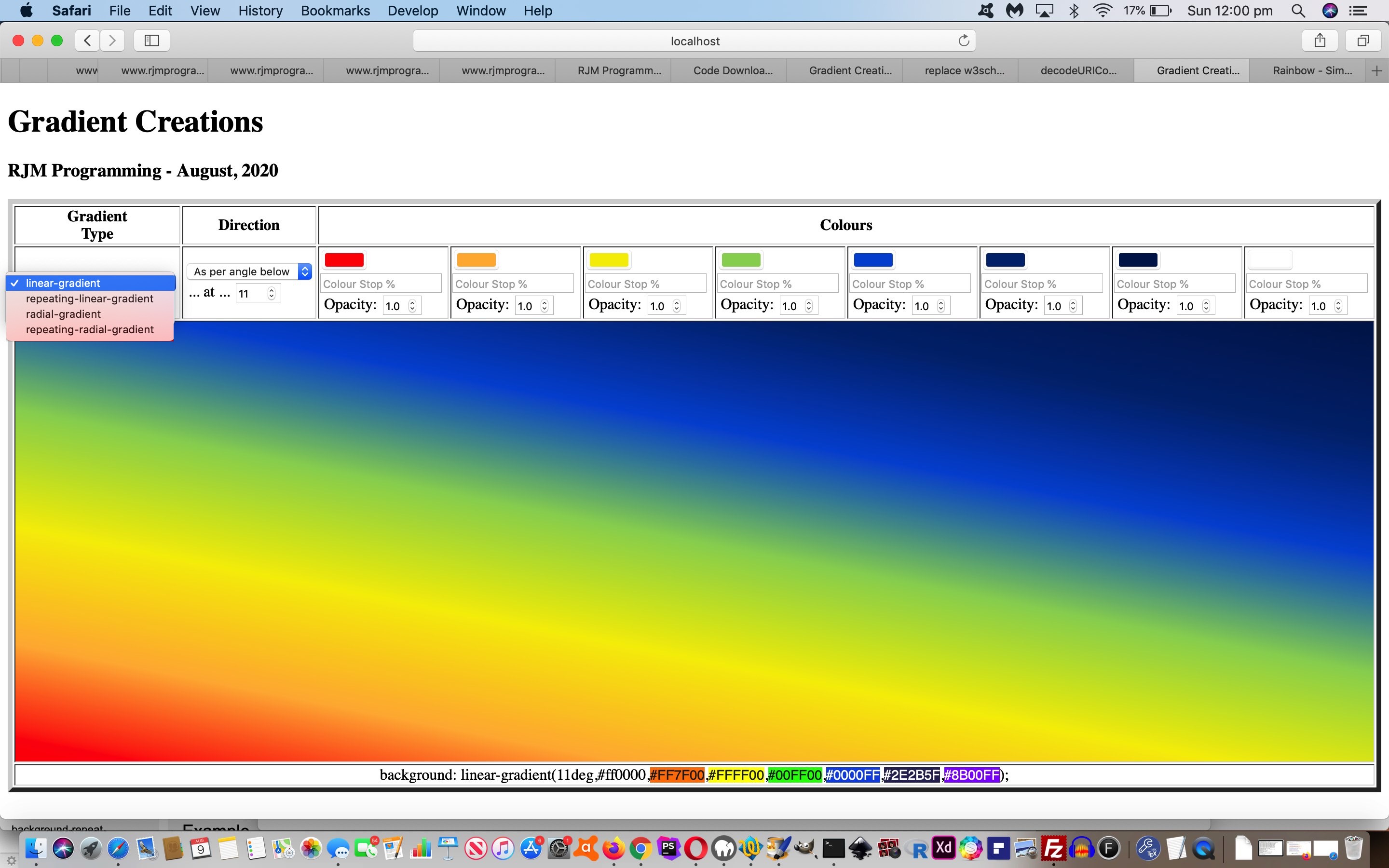
CSS Gradient Creations Tutorial

CSS Gradient Creations Tutorial

The great CSS background “gradient” functionalities can come in four forms, those being …

  • linear gradient (and repeating linear gradient)
  • radial gradient (and repeating radial gradient)

… as a means to add background interest, even to the point where the background can have some (different) transparency (level) compared to the foreground, as per example CSS like …


<style>
html::before {
background: linear-gradient(rgba(255,255,255,0.8),rgba(255,255,255,0.8)),URL('//www.rjmprogramming.com.au/MyBusinessUnidad/Welcome_files/logo.jpg') repeat;
}
</style>

With tutorials like CSS Repeating Radial Gradients Primer Tutorial we allowed you to create some gradients, but we wanted a more detailed approach that was generic in its approach and left you with some CSS of use, which is often not the go with many other (albeit useful and inspiring) websites on the net.

There are a whole range of what you might call “directional” nuances you can apply to your gradients. There is opacity to allow for. There are “hard colour stops” you can apply. For linear gradients you can apply a variable angle. For radial gradients there are positional nuances that can be applied.

And then there are the colours. We are not sure of the limits, but we allow for up to eight colours. Enough to simulate the seven colours of the rainbow we go for with today’s tutorial picture arrangement whereby it tweaked with us that the HTML input type=color elements are all well and good but we needed to allow our CSS be editable by nesting into an HTML div contenteditable=true elements that can be tweaked for exact rgb or rgba colour definitions (thanks, Wikipedia), as we could look up for the purposes of displaying a rainbow coloured gradient background (we hope you like)!

Or see a repeating radial gradient example below …
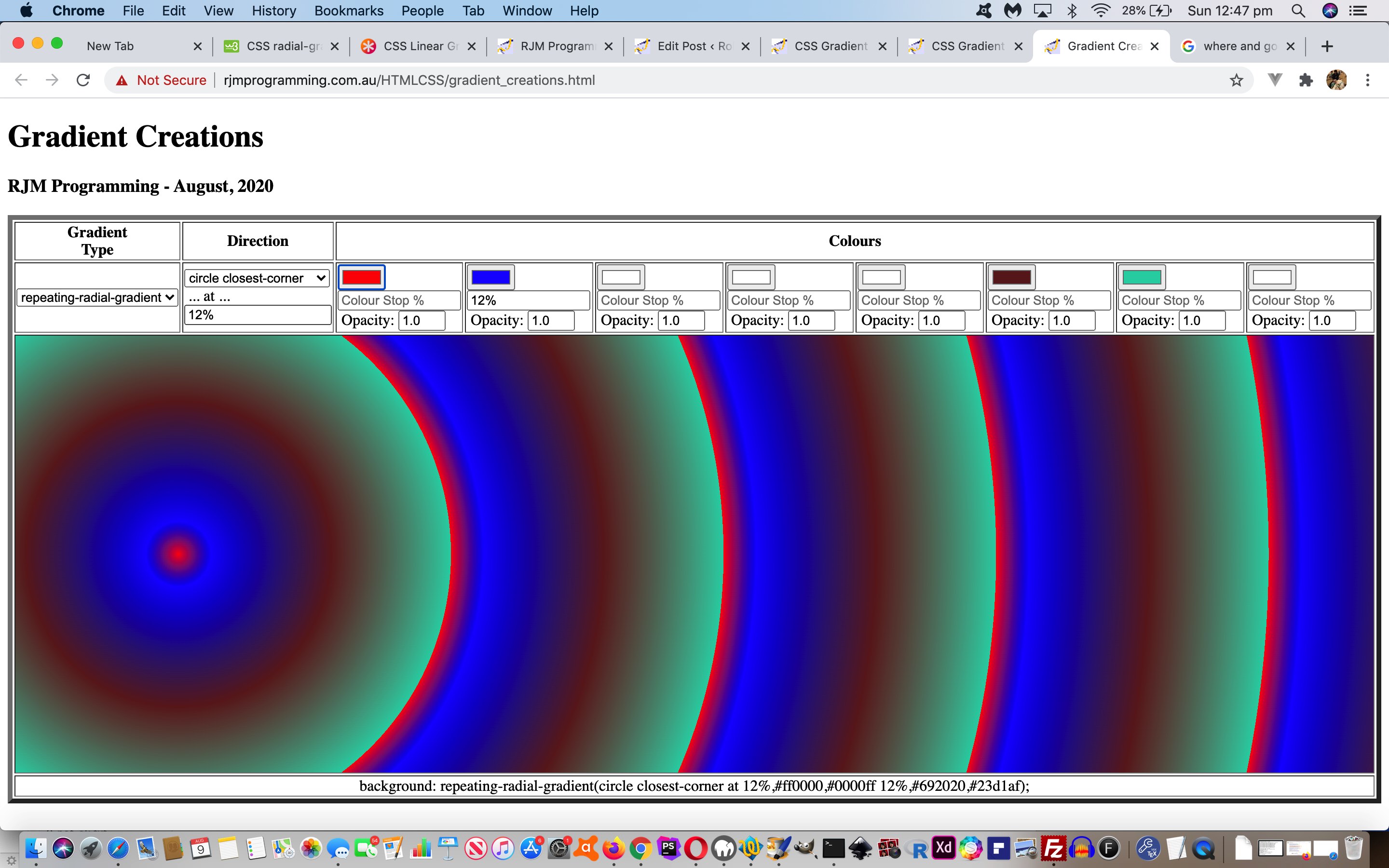
So feel free to try our gradient_creations.html live run link, to see what we mean.


Previous relevant “CSS Gradient Creations Tutorial is shown below.

CSS Radial Gradients Primer Tutorial

CSS Repeating Radial Gradients Primer Tutorial

Way back when with HTML/Javascript Canvas Rainbow Primer Tutorial we talked about CSS linear gradients and radial gradients in the one blog posting, but ever since then, it has so much more that linear gradients have been useful to us here at this blog.

Today, though, we turn a bit of attention to radial gradients, specifically repeated radial gradients.

We’ve got a simple web application to play around with them in terms of …

  • ellipse versus circle
  • coloured versus black and white
  • extent keyword (closest-corner, closest-side, farthest-corner, farthest-side)

Below is one example of the CSS …


.circlefarthest-corner {
background: repeating-radial-gradient(circle farthest-corner,
red, black 5%, blue 5%, green 10%);
}

Feel free to play away at this live run that has this radial_gradients.html downloadable underlying HTML and CSS (and event logic Javascript that changes the HTML div element className property, to suit).


Previous relevant HTML/Javascript Canvas Rainbow Primer Tutorial is shown below.
HTML/Javascript Canvas Rainbow Primer Tutorial

HTML/Javascript Canvas Rainbow Primer Tutorial

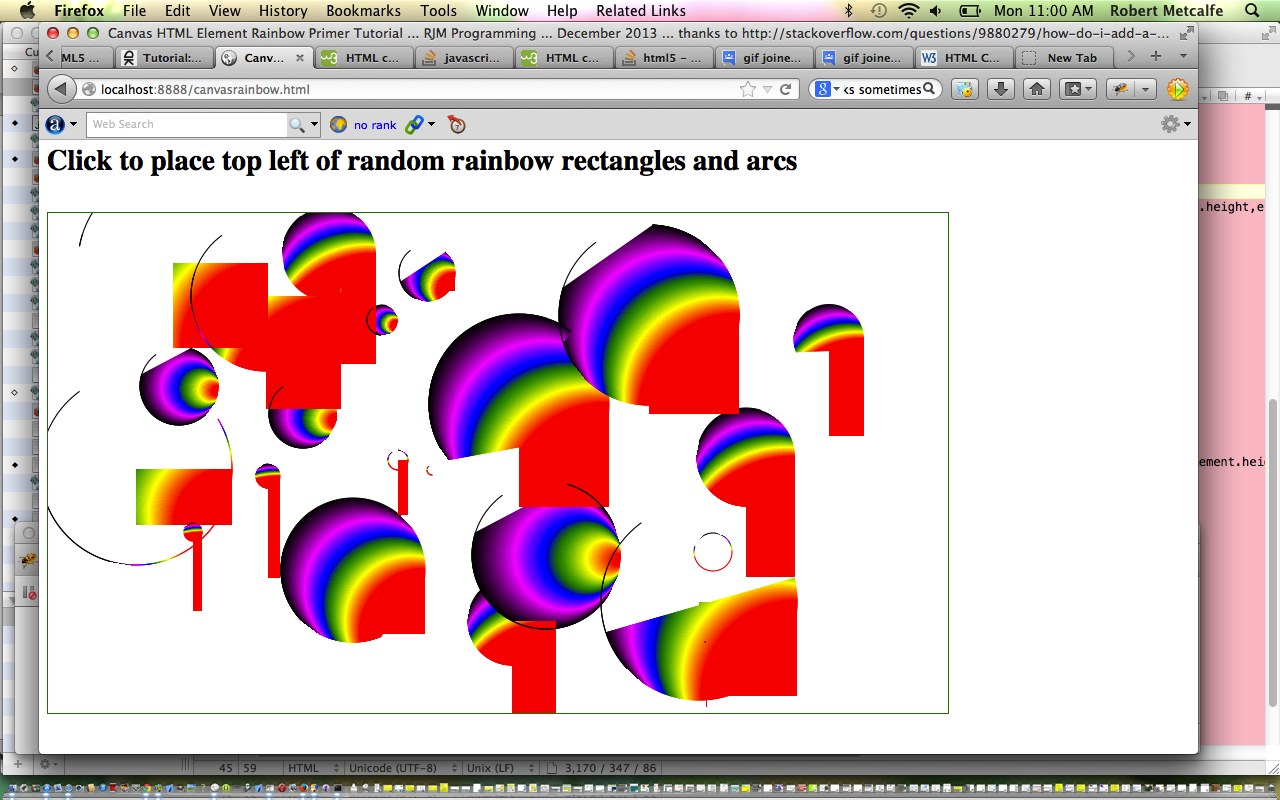
The Canvas HTML element tag can be used as the container to draw graphics on the fly usually via the use of Javascript functions for rendering and event management.

In today’s tutorial we touch on a couple of the two dimensional Javascript functions to draw a rectangle or arc, but in the two dimensional context, canvas HTML elements can be used to draw text, lines, boxes and circles as well. We also touch on two functions to create a linear or radial gradient to the fillStyle and/or strokeStyle of your HTML element placed onto the canvas.

You may want to read more at HTML Canvas Reference as a generic reference, or here, at the tutorial javascript – How do I add a simple onClick event handler to a canvas element? – Stack Overflow.

As you can imagine, this HTML canvas element, new to HTML5, can be very useful for some practical client-side web functionality.

Link to some downloadable HTML programming code … rename to canvasrainbow.html

Here is a new link to some downloadable HTML programming source code explaining changes made (from HTML/Javascript Canvas Primer Tutorial) here.

You’ll notice heavy use of the Javascript Math.random() function.

We hope you enjoy this tutorial as a rainbow coloured live run.

Yes … you’ve reached the end … have a top supportive rainbow coloured day!

If this was interesting you may be interested in this too.


If this was interesting you may be interested in this too.

If this was interesting you may be interested in this too.

If this was interesting you may be interested in this too.

If this was interesting you may be interested in this too.

If this was interesting you may be interested in this too.

If this was interesting you may be interested in this too.

If this was interesting you may be interested in this too.
Posted in eLearning, Event-Driven Programming, Games, Tutorials | Tagged , , , , , , , , , , , , , | Leave a comment

Chemistry Wonder Periodic Table Quiz Tutorial

Chemistry Wonder Periodic Table Quiz Tutorial

Chemistry Wonder Periodic Table Quiz Tutorial

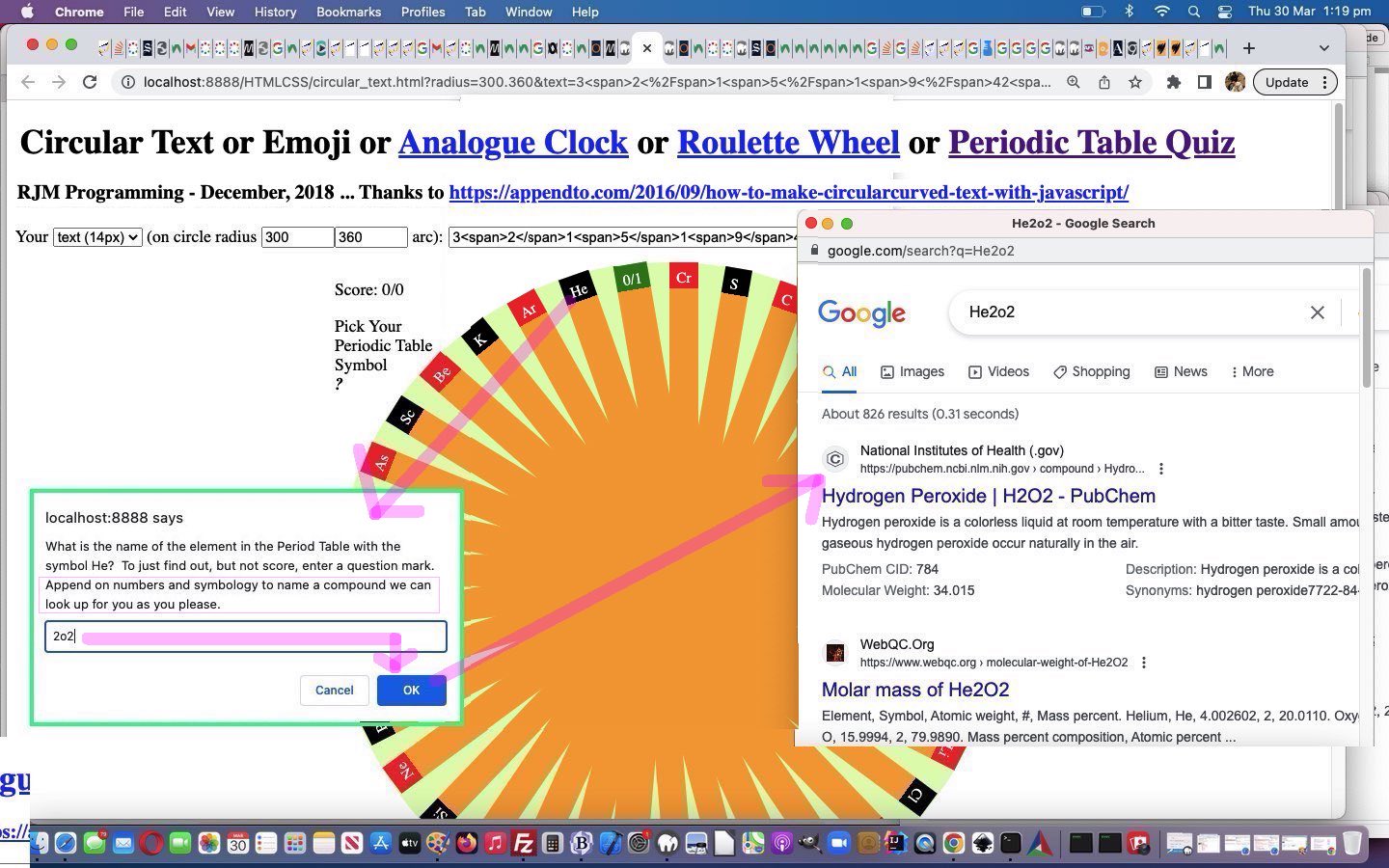
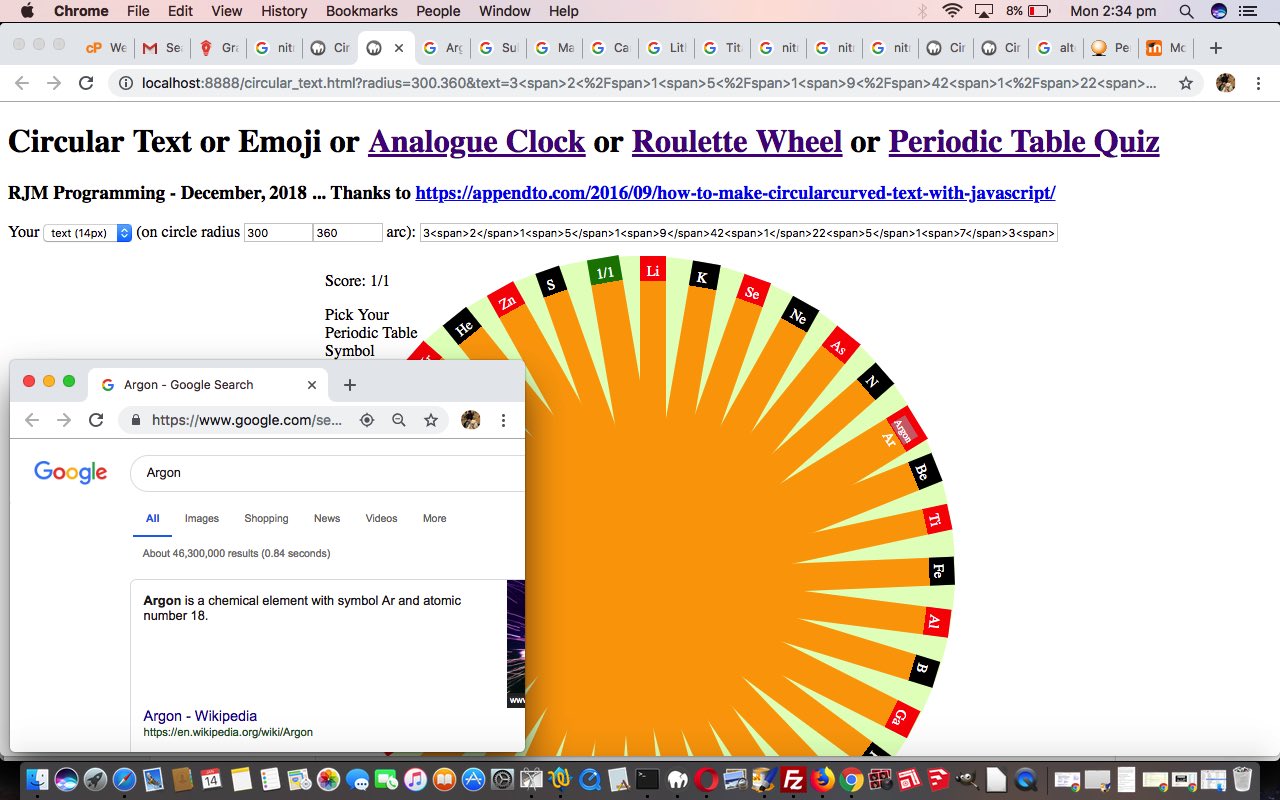
We had occasion to revisit Circular Text or Emoji Periodic Table Quiz Tutorial and it set us to wondering if you can just feed a chemical equation or formula into the Google search engine and …

  • find out good chemistry based information … Spoiler Alert: yes
  • even be set right that an inputted formula is probably inaccurate and a “nearby” known compound equation or formula is such and such … Spoiler Alert: yes

And so we added “dead end” but “non interfering” Javascript code, such code often working off window.prompt user interactive entry functionality, to add this feature into the existant “Periodic Table Quiz” functionality, as per


function huhd(dv) {
var formula='', nonformula='', wds=[], prevanswer='';
var answer='',ans='',wasih='';
if (isThirtySeven) {
if (dv.trim().length <= 2 && dv.indexOf('/') == -1) {
answer=prompt('What is the name of the element in the Period Table with the symbol ' + dv.trim() + '? To just find out, but not score, enter a question mark. Append on numbers and symbology to name a compound we can look up for you as you please.', '');
if (answer == null) { answer='' }
goes++;
wds=answer.split(' ');
prevanswer=answer;
answer=answer.replace(wds[eval(-1 + wds.length)], dv.trim() + wds[eval(-1 + wds.length)]).replace(/NaCl$/g, 'NaCl()').replace(/KBr$/g, 'KBr()').replace(/CsF$/g, 'CsF()').replace(/CdS$/g, 'CdS()').replace(/Nacl$/g, 'Nacl()').replace(/Kbr$/g, 'Kbr()').replace(/Csf$/g, 'Csf()').replace(/Cds$/g, 'Cds()').replace(/NaCL$/g, 'NaCL()').replace(/KBR$/g, 'KBR()').replace(dv.trim() + wds[eval(-1 + wds.length)], wds[eval(-1 + wds.length)]);
//alert(answer);
if (answer.replace('?','').trim() != '' && answer.replace('(','').replace(')','').replace('0','').replace('1','').replace('2','').replace('3','').replace('4','').replace('5','').replace('6','').replace('7','').replace('8','').replace('9','') != answer) {
nonformula=answer.split('0')[0].split('1')[0].split('2')[0].split('3')[0].split('4')[0].split('5')[0].split('6')[0].split('7')[0].split('8')[0].split('9')[0].split('()')[0];
//alert('nonformula=' + nonformula + ' dv=' + dv.trim());
if (prevanswer != answer || 8 == 8) {
formula=dv.trim() + answer.split(' ')[eval(-1 + answer.split(' ').length)]; //.split('()')[0];
answer=answer.replace(answer.split(' ')[eval(-1 + answer.split(' ').length)], '');
formula=formula.split('()')[0];
} else {
formula=dv.trim() + answer.substring(nonformula.length).split('()')[0];
answer=nonformula.trim();
}
//alert('formula=' + formula + ' dv=' + dv.trim());
window.open('//www.google.com/search?q=' + encodeURIComponent(formula), '_blank', 'top=50,left=50,width=600,height=600');
}

if (answer.trim() == '?') {
goes--;
answer='';
ans=document.head.innerHTML.replace(/\"/g,"'").split("'" + dv.trim() + ":")[1].split("'")[0];
}
if (document.head.innerHTML.toLowerCase().replace(/\"/g,"'").indexOf("'" + dv.trim().toLowerCase() + ":" + (answer + ans).toLowerCase() + "'") != -1) {
if (answer.trim() != '') { score++; }
wasih=lastois.innerHTML;
lastois.innerHTML='<font size=1><a title="Click here for Google search" target=_blank style="color:white;text-decoration:none;cursor:pointer;" href="https://www.google.com/search?q=' + encodeURIComponent(answer + ans) + '">' + answer + ans + '</a></font><br>' + wasih;
}
document.getElementById('pscore').innerHTML='Score: ' + score + '/' + goes;
document.getElementById('p36').innerHTML='' + score + '/' + goes;
}
userpicked='';
} else {
if (dv.trim() == '') {
if (userpicked != '') {
document.getElementById('mynum').innerHTML=userpicked;
} else {
document.getElementById('mynum').innerHTML='?';
}
} else if (dv.toLowerCase() == 'red' || dv.toLowerCase() == 'green' || dv.toLowerCase() == 'black') {
userpicked=dv.toLowerCase();
} else if (dv.substring(0,1) >= '0' && dv.substring(0,1) <= '9') {
var huhi=eval('' + dv);
if (huhi >= 0 && huhi <= 36) {
userpicked=dv;
document.getElementById('mynum').innerHTML=userpicked;
} else {
if (userpicked != '') {
document.getElementById('mynum').innerHTML=userpicked;
} else {
document.getElementById('mynum').innerHTML='?';
}
}
} else {
if (userpicked != '') {
document.getElementById('mynum').innerHTML=userpicked;
} else {
document.getElementById('mynum').innerHTML='?';
}
}
}
}

… in today’s changed Javascript circular_text.html‘s Periodic Table Quiz live run link for you to try the Periodic Table Quiz (now featuring new improved “Chemistry Compound Formula Wonder” prompting) part of the functionality yourself at a link up the top of the webpage.


Previous relevant Circular Text or Emoji Periodic Table Quiz Tutorial is shown below.

Circular Text or Emoji Periodic Table Quiz Tutorial

Circular Text or Emoji Periodic Table Quiz Tutorial

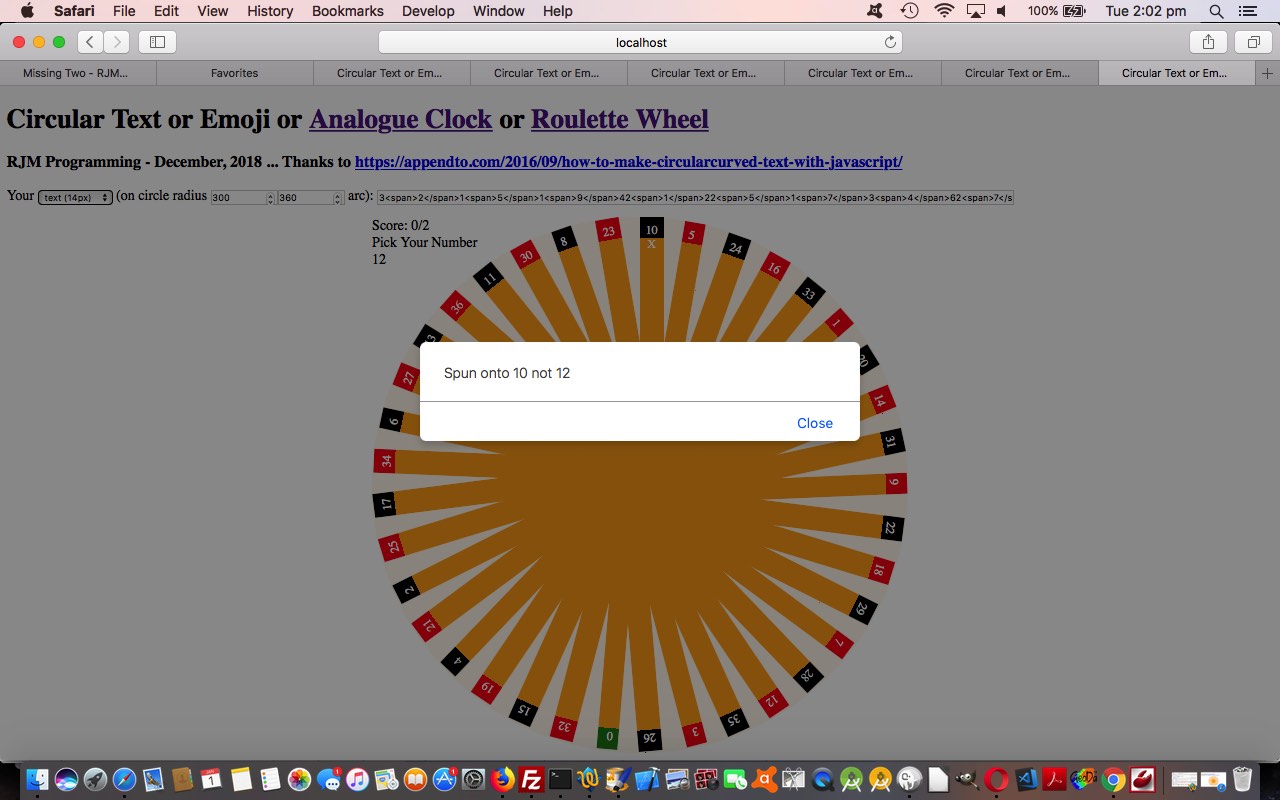
Meanwhile, back at Circular Text ideas we were wondering if we could add more interest to a quiz by making the circular ends to a similar wheel as the roulette wheel (as discussed with Circular Text or Emoji Roulette Animation Tutorial) be clickable as the user’s way to learn about some Periodic Table symbols and correspondent names.

We are forever wondering about ways to hide answers from users, for quizzes and games. Well, at least for those users not venturing to any Webpage -> View Source ideas, that is. Today’s sort of clunky, yet satisfying, way is to hide the Periodic Table element names, along with their symbols, in a single dimension array. Then we use that, scouring the whole <head> </head> using the DOM document.head.innerHTML reference approach, in the way below (and we warn that if you do not want help with the game avert your gaze below 1.734523417cm down the webpage)


var pts=['H:Hydrogen','He:Helium','Li:Lithium','Be:Beryllium','B:Boron','C:Carbon','N:Nitrogen','O:Oxygen','F:Fluorine','Ne:Neon','Na:Sodium','Mg:Magnesium','Al:Aluminium','Si:Silicon','P:Phosphorus','S:Sulphur','Cl:Chlorine','Ar:Argon','K:Potassium','Ca:Calcium','Sc:Scandium','Ti:Titanium','V:Vanadium','Cr:Chromium','Mn:Manganese','Fe:Iron','Co:Cobalt','Ni:Nickel','Cu:Copper','Zn:Zinc','Ga:Gallium','Ge:Germanium','As:Arsenic','Se:Selenium','Br:Bromine','Kr:Krypton'];

function huhd(dv) {
var answer='',ans='',wasih='';
if (isThirtySeven) { // Periodic Table Quiz logic
if (dv.trim().length <= 2 && dv.indexOf('/') == -1) {
answer=prompt('What is the name of the element in the Period Table with the symbol ' + dv.trim() + '? To just find out, but not score, enter a question mark.', '');
if (answer == null) { answer='' }
goes++;
if (answer == '?') {
answer='';
ans=document.head.innerHTML.replace(/\"/g,"'").split("'" + dv.trim() + ":")[1].split("'")[0];
}
if (document.head.innerHTML.toLowerCase().replace(/\"/g,"'").indexOf("'" + dv.trim().toLowerCase() + ":" + (answer + ans).toLowerCase() + "'") != -1) {
if (answer != '') { score++; }
wasih=lastois.innerHTML;
lastois.innerHTML='<font size=1><a title="Click here for Google search" target=_blank style="color:white;text-decoration:none;cursor:pointer;" href="https://www.google.com/search?q=' + encodeURIComponent(answer + ans) + '">' + answer + ans + '</a></font><br>' + wasih;
}
document.getElementById('pscore').innerHTML='Score: ' + score + '/' + goes;
document.getElementById('p36').innerHTML='' + score + '/' + goes;
}
userpicked='';
}
// rest for Roulette logic
}

… and the other way this array is used is to populate the content of the wheel outer rim, starting with the Roulette Wheel content as a template, via …


function reworked(intis) { // RE: pts array Period Table symbol/name quiz
// 3<span>2</span>1<span>5</span>1<span>9</span>42<span>1</span>22<span>5</span>1<span>7</span>3<span>4</span>62<span>7</span>1<span>3</span>3<span>6</span>1<span>1</span>3<span>0</span>82<span>3</span>1<span>0</span>52<span>4</span>1<span>6</span>3<span>3</span>12<span>0</span>1<span>4</span>3<span>1</span>92<span>2</span>1<span>8</span>2<span>9</span>72<span>8</span>1<span>2</span>3<span>5</span>32<span>6</span>0
var okayis=false, outtis=intis + '<span>/0</span>', sofar=',', iso=-1;
var outtisa='3<span>2</span>;1<span>5</span>;1<span>9</span>;4;2<span>1</span>;2;2<span>5</span>;1<span>7</span>;3<span>4</span>;6;2<span>7</span>;1<span>3</span>;3<span>6</span>;1<span>1</span>;3<span>0</span>;8;2<span>3</span>;1<span>0</span>;5;2<span>4</span>;1<span>6</span>;3<span>3</span>;1;2<span>0</span>;1<span>4</span>;3<span>1</span>;9;2<span>2</span>;1<span>8</span>;2<span>9</span>;7;2<span>8</span>;1<span>2</span>;3<span>5</span>;3;2<span>6</span>'.split(';'); //;0<span>/0</span>';
for (var i=0; i<pts.length; i++) {
okayis=false;
while (!okayis) {
iso=Math.floor(Math.random() * pts.length);
if (sofar.indexOf(',' + iso + ',') == -1) { okayis=true; sofar+='' + iso + ','; }
}
if (pts[iso].split(':')[0].length == 1) {
outtis=outtis.replace(outtisa[i], pts[iso].split(':')[0]);
} else {
outtis=outtis.replace(outtisa[i], pts[iso].split(':')[0].substring(0,1) + '<span>' + pts[iso].split(':')[0].substring(1) + '</span>');
}
}
return outtis;
}

… also illustrating our sofar variable oft used technique of appending to a delimited single string that is “indexOf”ed against to determine if an action has previously been taken, and, in this case here, not do it more than once.

Today’s changed HTML and CSS circular_text.html‘s live run link for you to try the Periodic Table Quiz part of the functionality yourself at a link up the top of the webpage.


Previous relevant Circular Text or Emoji Roulette Animation Tutorial is shown below.

Circular Text or Emoji Roulette Animation Tutorial

Circular Text or Emoji Roulette Animation Tutorial

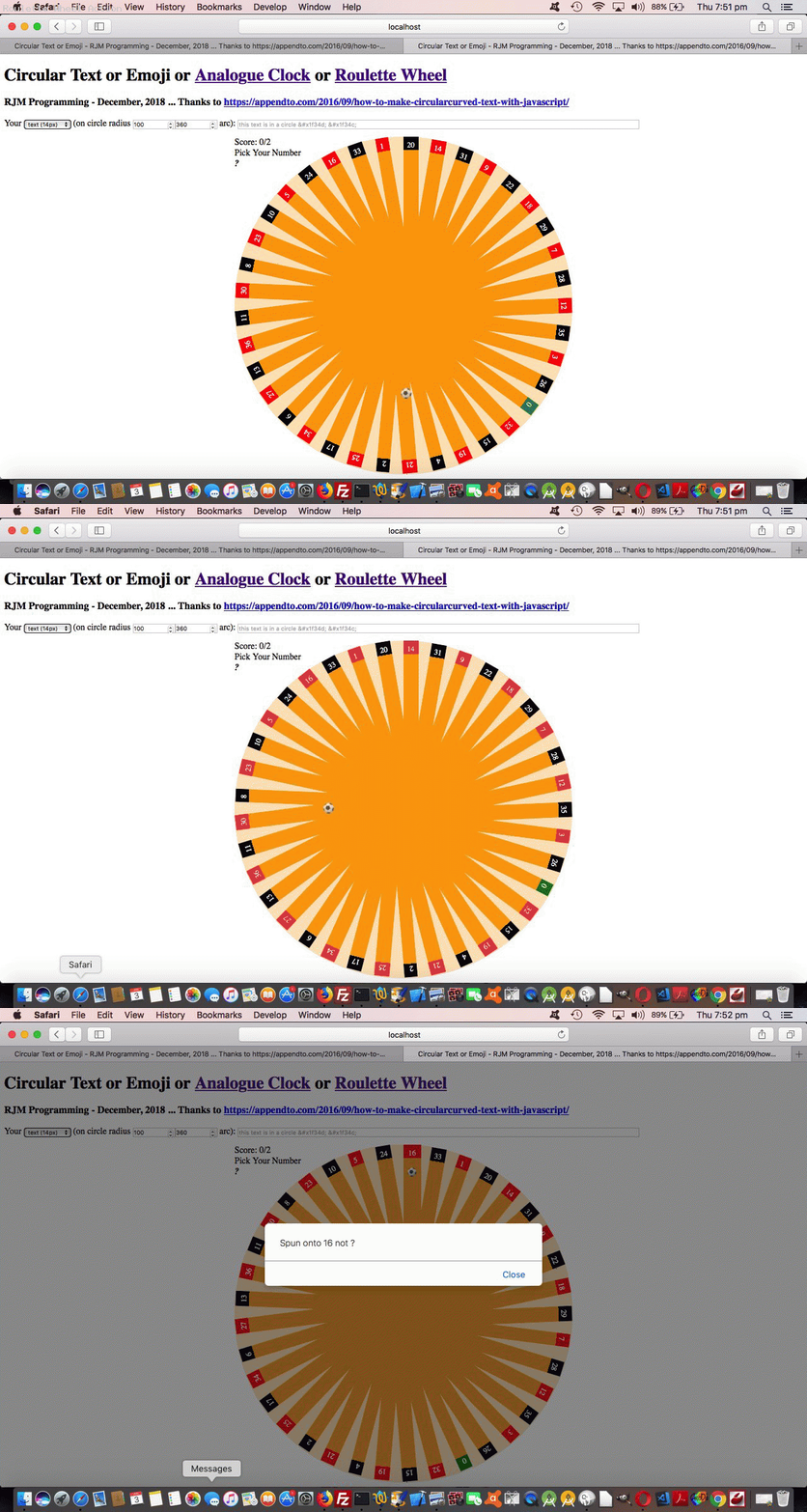
As we left off with the recent Circular Text or Emoji Roulette Game Tutorial we wanted to improve on the animation aspects to representing the roulette wheel ball, but still only involve …

… and it was this in orbit bit that daunted us most. That is, until we …

  • read the great advice of this link, thanks … and enjoyed the wonder of …
  • how dynamic and easy dynamic CSS styling can be simply by adding <style> </style> encased styling to the end of document.body.innerHTML … via …

    function animateonorbit(bid, ccl, cct, anrad, fhl) { // thanks to https://www.useragentman.com/blog/2013/03/03/animating-circular-paths-using-css3-transitions/
    var dba='<style> #' + bid + ' { display:block; top:' + cct + 'px; ';
    dba+=' left:' + ccl + 'px; position:absolute; -moz-border-radius: 12px; border-radius: 12px; ';
    dba+=' filter: alpha(opacity=80); -moz-opacity:0.8; -khtml-opacity: 0.8; opacity: 0.8; transform: rotate(45deg) translateX(' + anrad + 'px) rotate(-45deg); ';
    dba+=' animation:animateonorbit ' + fhl + 's linear infinite; -webkit-animation:animateonorbit ' + fhl + 's linear infinite; z-index:79; } ';
    dba+=' @keyframes animateonorbit { from { transform: rotate(0deg) translateX(' + anrad + 'px) rotate(0deg); } ';
    dba+=' to { transform: rotate(360deg) translateX(' + anrad + 'px) rotate(-360deg); } ';
    dba+=' @-webkit-keyframes animateonorbit { from { -webkit-transform: rotate(0deg) translateX(' + anrad + 'px) rotate(0deg); } ';
    dba+=' to { -webkit-transform: rotate(360deg) translateX(' + anrad + 'px) rotate(-360deg); } </style> ';
    document.body.innerHTML+=dba;
    lasto=document.getElementById(bid);
    document.getElementById(bid).style.display='block';
    }

Today’s changed HTML and CSS circular_text.html‘s live run link for you to try the Roulette Wheel (and its animated ball) part of the functionality yourself at a link up the top of the webpage.


Previous relevant Circular Text or Emoji Roulette Game Tutorial is shown below.

Circular Text or Emoji Roulette Game Tutorial

Circular Text or Emoji Roulette Game Tutorial

Extending the recent Circular Text or Emoji Onclick Tutorial circular text ideas, today we are starting out on a game that uses a Roulette Wheel as its basic web page component. To all those “graphically challenged” users, like me, we do not use any homegrown imagery of any sort, instead just use …

  • HTML basis of design …
  • CSS as …
    1. <head> </head> styling …

      <style>
      .roulettered { color:white; background:linear-gradient(to top,orange 92%,red 8%); }
      .rouletteblack { color:white; background:linear-gradient(to top,orange 92%,black 8%); }
      .roulettegreen { color:white; background:linear-gradient(to top,orange 92%,green 8%); }
      </style>
    2. inline HTML styling
  • Javascript DOM dynamic styling and animation (the roulette wheel is sent spinning via setTimeout Javascript timer logic)

… involving our original …

  • “circular text” as the numbers near the outer rim of the roulette wheel
  • background border-radius parts in the middle (‘atend’ element) as the ribbing bits that form the rest of the roulette wheel

… and, so far, the one ball emoji at the end of a user turn. This last bit is where we feel we shall work at more improvement.

Today’s changed HTML circular_text.html‘s live run link for you to try the Roulette Wheel part of the functionality yourself at a link up the top of the webpage. You can guess a number or red or black or green colours, and odds based scoring is applied.


Previous relevant Circular Text or Emoji Onclick Tutorial is shown below.

Circular Text or Emoji Onclick Tutorial

Circular Text or Emoji Onclick Tutorial

In this increasingly connected online world, it can be surprising when an image looking part of a webpage cannot be linked to. The unusual thing about emojis is their way to …

  • be part of the textual web armoury … yet …
  • look like an image

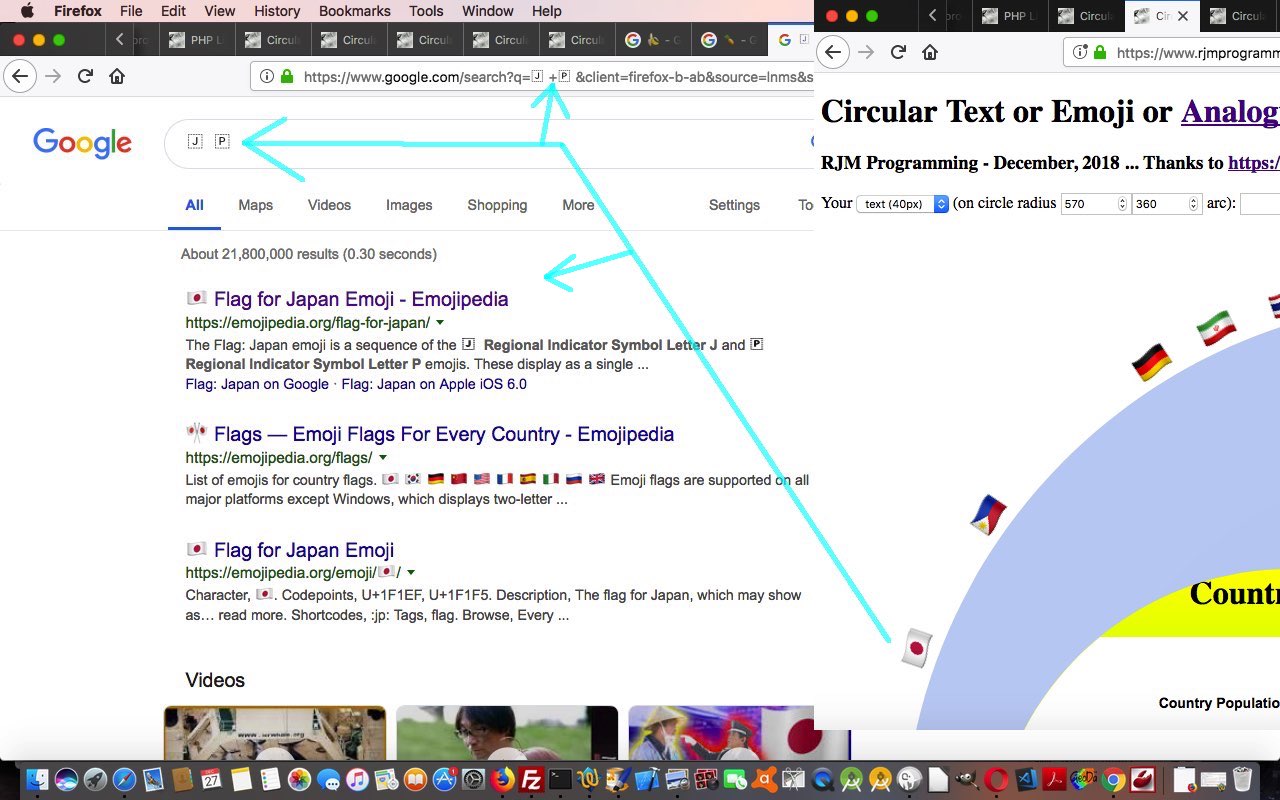
… and, as such, it would definitely not offend, maybe even “tickle pink” the user to have an emoji be linked to further information. In the case of the emojis featuring in yesterday’s Circular Text or Emojis Genericity Tutorial which are country flags (that are compound emojis) you can query the Google search engine with the contents of the Iemoji website webpages (such as Japan’s flag emoji one) with the right column data next to the “Decimal HTML Entity” left column. In fact, as we often urge our students, just copy this Decimal HTML Entity value straight up into the address bar, and your favourite search engine is likely to come up with a (in my case Google) search engine URL like …


https://www.google.com/search?client=firefox-b-ab&q=%26%23127471%3B+%26%23127477%3B

… getting you (emoji onclick event) links to some pretty pertinent information about Japan within seconds, let alone what you might find under the Images and/or Videos menu subsearches. Notice how integrated this is with the Google search engine webpages …

The Flag: Japan emoji is a sequence of the 🇯 Regional Indicator Symbol Letter J and 🇵 Regional Indicator Symbol Letter P emojis. These display as a single emoji on supported platforms.

… showing you how ISO 2-letter codes are linked to emoji country flag Decimal HTML Entity creation construction rules.

Today’s changed HTML circular_text.html‘s live run link for you to try yourself (or try the changed PHP circular_text.php‘s live run), then, features …

  • changed emoji linking, the one thing left to say about this being, that the “missing link” between text and link HTML elements can be that elements that start as text can be made to act like linked elements (later) via (definitely the first, and sometimes, but not today, the second) CSS styling (via inline HTML CSS style=””) …
    1. cursor:pointer;
    2. text-decoration:underline;

    … we make happen within the webpage’s Javascript (DOM) code

  • functionality to be able to increase or decease the circular text’s font size (that being the way to control an emoji size as well, that reminds you that emojis are text, just not that very small part of the text world with ascii codes less than 256)
  • a very subtle radial gradient background replaces the single colour background colour for the HTML ‘atend’ div element within the circular text as per

    if (document.getElementById('atend').innerHTML != '') { document.getElementById('atend').style.background='radial-gradient(circle,#c0d0f0,#c3d3f3)'; } //#c0d0f0'; } //'transparent';

Previous relevant Circular Text or Emojis Genericity Tutorial is shown below.

Circular Text or Emojis Genericity Tutorial

Circular Text or Emojis Genericity Tutorial

A major consideration in any “genericity” drive you have for your web applications is to allow for a large amount of user entered data, perhaps a surprising amount. If you offer a textbox to enter data, then a user may enter a hugely long, and perhaps valid, field. If we’d left it at the scenario of yesterday’s Circular Text or Emojis Analogue Clock Tutorial, though, we’d have been restricted to a textbox entry of about 800 characters for the rjmprogramming.com.au domain. In the first of the improvements below, then, we try to cater for this via …

  • for textbox entries that are long we now populate an HTML form method=POST action=circular_text.php where we intervene at appropriate places with the large data items … and today we also …
  • make sure compound emojis like the country flags work (where the great Iemoji website webpages such as Japan’s flag emoji one, become so useful) … and we test that out with a …
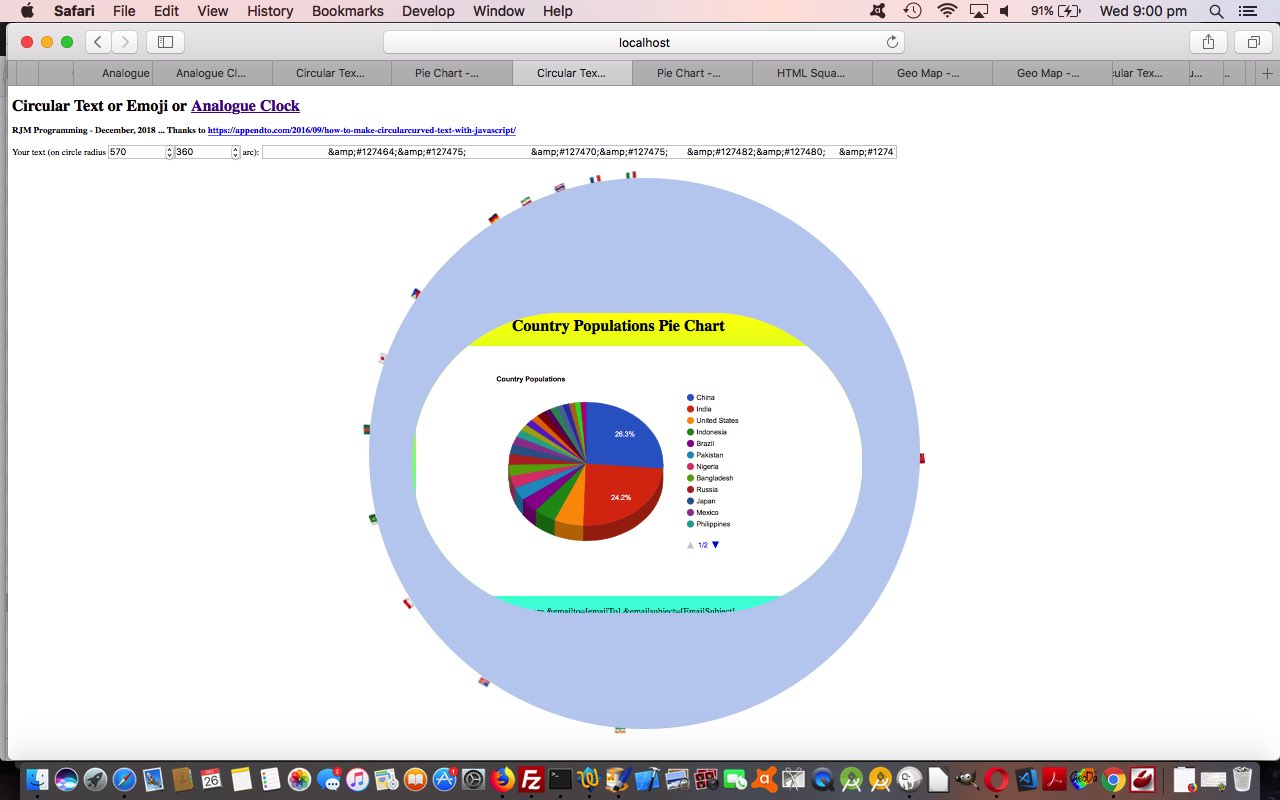
  • Google Chart Pie Chart content inside the circular text

… and an interesting thing happened with the “getting to work” of today’s textbox entry (for a radius value of 570) you can try …


                        &#127464;&#127475;                        &#127470;&#127475;       &#127482;&#127480;     &#127470;&#127465;     &#127463;&#127479;    &#127477;&#127472;    &#127475;&#127468;    &#127463;&#127465;    &#127479;&#127482;   &#127471;&#127477;   &#127474;&#127485;   &#127477;&#127469;  &#127483;&#127475;  &#127466;&#127481;  &#127465;&#127466;  &#127466;&#127468; &#127470;&#127479; &#127481;&#127479; &#127481;&#127469; &#127464;&#127465; &#127467;&#127479; &#127468;&#127463; &#127470;&#127481;<iframe frameborder=0 style=border-radius:600px;width:900px;height:600px;z-index:23;margin-left:87px;margin-top:270px; src=https://www.rjmprogramming.com.au/PHP/PieChart/pie_chart.php?title=%c2%a0%c2%a0%c2%a0%c2%a0%c2%a0%c2%a0%c2%a0%c2%a0%c2%a0%c2%a0%c2%a0%c2%a0%c2%a0%c2%a0%c2%a0%c2%a0%c2%a0%c2%a0%c2%a0%c2%a0%c2%a0%c2%a0%c2%a0%c2%a0Country%20Populations&onclick=y&task=Country&desc=Populations&data=,%20[~https;China,1347000000,India,1241000000,United%20States,312000000,Indonesia,238000000,Brazil,197000000,Pakistan,177000000,Nigeria,162000000,Bangladesh,151000000,Russia,143000000,Japan,128000000,Mexico,115000000,Philippines,96000000,Vietnam,88000000,Ethiopia,87000000,Germany,81800000,Egypt,82600000,Iran,78000000,Turkey,74000000,Thailand,69500000,Congo,67800000,France,63300000,United%20Kingdom,62700000,Italy,60800000~,100]#bitsatend></iframe>

… where the use of %c2%a0 creates whitespace but isn’t cleared by your normal trim functions, which is how we managed to get our Pie Chart title centralized enough not to be cut off by the HTML iframe border-radius applied to it. Cute, huh?!

Here is today’s changed circular_text.html‘s live run link for you to try yourself.


Previous relevant Circular Text or Emojis Analogue Clock Tutorial is shown below.

Circular Text or Emojis Analogue Clock Tutorial

Circular Text or Emojis Analogue Clock Tutorial

Often a good way to proceed to challenge genericity issues with a web application you think has potential to be more than it appears is to make it be the missing piece to another web application and interface to it. This is the scenario, today, putting together yesterday’s …

This interfacing match is great, as it fills in a gap, but there are a couple of things to overcome, those being …

  1. allow for a circular text component consist of more than one character, and here we allow the user to put …

    1<span>2</span>

    … to show “12” for example
  2. allow for an element like the HTML iframe “child” element be the contents within a newly introduced HTML div element for today’s changed circular_text.html‘s live run placed into the … anyone, anyone? … yes, Franklin D. Roosevelt, that would be in the circle the circular text goes around, and we do that stylewise via (on the fly Javascript) code making use of the centrally justified circular text element (curiously causing rect.width and rect.height below to be zero) …


    var rect=document.getElementById('test').getBoundingClientRect();
    document.getElementById('atend').style.position='absolute';
    document.getElementById('atend').style.left=eval(-rad + 20 + rect.left) + 'px';
    document.getElementById('atend').style.top=eval(38 + rect.top) + 'px';
    document.getElementById('atend').style.width=eval(2 * rad - 38) + 'px';
    document.getElementById('atend').style.height=eval(2 * rad - 38) + 'px';
    document.getElementById('atend').style.borderRadius=eval(2 * rad - 28) + 'px';
    if (document.getElementById('atend').innerHTML != '') { document.getElementById('atend').style.backgroundColor='#c0d0f0'; } //'transparent';

    … and ahead of this our user entered data needed for the Analogue Clock has an HTML (child) iframe element part …


    1<span>2</span>1234567891<span>0</span>1<span>1</span><iframe scrolling=no frameborder=0 style='z-index:23;margin-left:127px;margin-top:130px;height:400px;' src=analogue_clock.htm#xbody></iframe>

    … that we figure, because it is HTML containing spaces in its non-innerHTML parts, is meant as content for that new ‘atend’ HTML div element located in the middle of the circular text, and created via the codeline reached in this scenario …


    function justinnertextish(intx, within) {
    var sone=1, tagis='', iit=0, less=false, ioffset=0;
    outx=intx;
    it=[];
    if (intx.indexOf('</') != -1) {
    outx="";
    for (iit=0; iit<intx.length; iit+=sone) {
    if (intx.substring(iit, eval(1 + iit)) == '<') {
    tagis=intx.substring(iit).substring(1).split('>')[0];
    less=false;
    if (tagis.indexOf(' ') != -1 || within) {
    less=true;
    document.getElementById('atend').innerHTML='<' + tagis + '>' + intx.substring(eval(iit + 2 + tagis.length)).split('>')[0] + '>';

    // etcetera etcetera etcetera

Got the time?


Previous relevant Circular Text or Emojis Primer Tutorial is shown below.

Circular Text or Emojis Primer Tutorial

Circular Text or Emojis Primer Tutorial

We’ve got a “proof of concept” tutorial for you today, because we got put onto an idea for something by How to Make Circular/Curved Text with JavaScript, thanks. We wanted to extend the logic of that …

  • ascii codes (of characters) less than 256, text handling … to, now, be able to handle …
  • emoji data (or that’s what we like to “nickname” it … sorry if this annoys, but it really concerns UTF-8 characters really

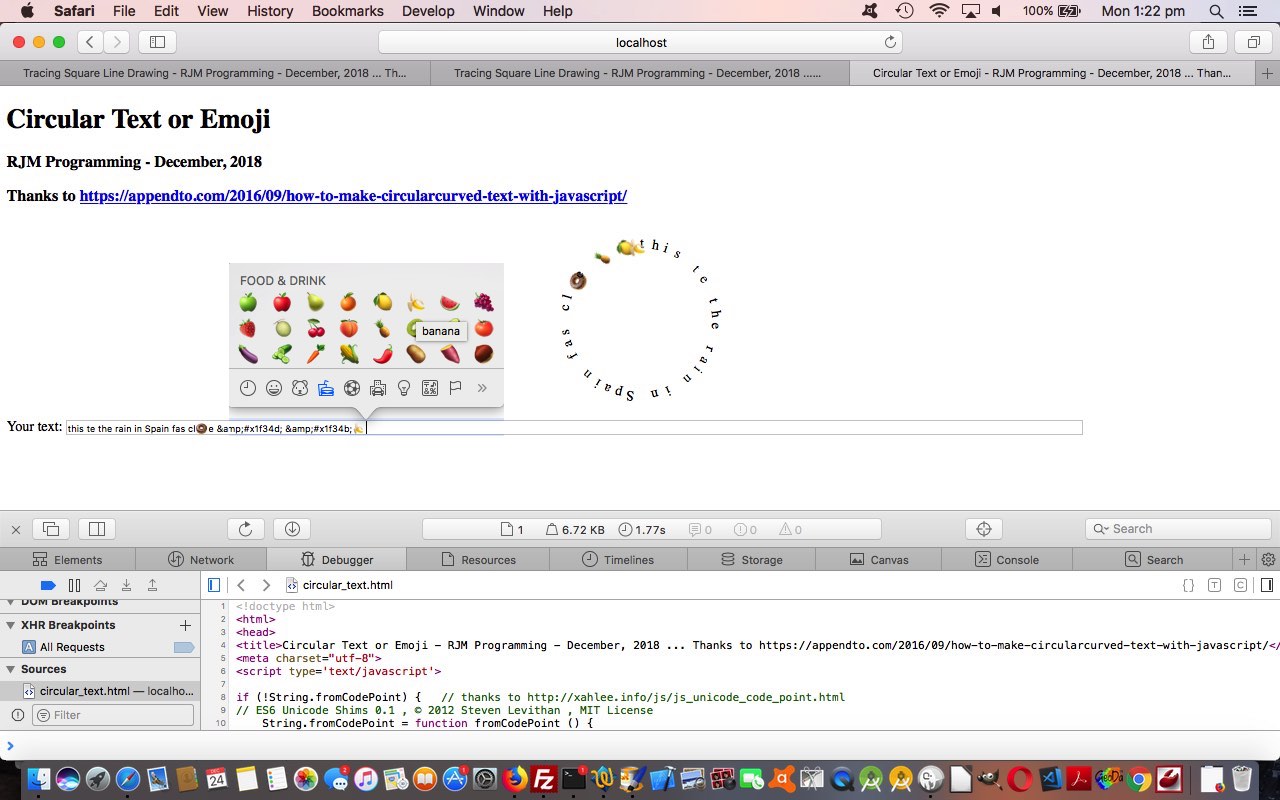
We resisted the Sushi Train Circuit Game Tutorial ideas, because it isn’t lunchtime, and opted to allow the user to enter their own text (including any emojis (available via Command-Control-Space menu here at Mac OS X) or via &#[CodePoint]; HTML Entity (decimal or hexidecimal (CodePoint)) entries (where we’d like you to put &amp; rather than just & if you are going to do this, and if you want to do this, but need tips on how you might approach this, please consult our previous Karaoke via YouTube API in Iframe Emoji Tutorial where we often start at good ol’ emojipedia).

Maybe there will be some sequels, but for the meantime you can examine the HTML and Javascript circular_text.html code (including more thank you links), that you can try for yourself at this live run link.

With that in mind, take a look at us creeping through the text characters you enter, and notice how an emoji will have two bytes in a row with ascii code greater than 255 …


var etxt=intxt.replace(/\&amp\;/g,'&').replace(/\;\&\#/g,',').split('&#'); // intxt is your text
var txt=[], zero=0; // changed elsewhere as well

var one=1;
for (kk=zero; kk<etxt[k].length; kk+=one) {
if (etxt[k].substring(kk, eval(1 + kk)).charCodeAt(0) > 255) { // emoji found
txt.push(String.fromCodePoint(eval('' + etxt[k].substring(kk).charCodeAt(0)),eval('' + etxt[k].substring(kk).substring(1).charCodeAt(0)) ));
one=2;
} else { // normal ascii text
txt.push(etxt[k].substring(kk, eval(1 + kk)));
one=1;
}
}
}
one=1;
zero=0;

You can also see this play out at WordPress 4.1.1’s Circular Text or Emojis Primer Tutorial.

If this was interesting you may be interested in this too.


If this was interesting you may be interested in this too.

If this was interesting you may be interested in this too.

If this was interesting you may be interested in this too.

If this was interesting you may be interested in this too.

If this was interesting you may be interested in this too.

If this was interesting you may be interested in this too.

If this was interesting you may be interested in this too.
Posted in eLearning, Tutorials | Tagged , , , , , , , , , , , , , , , , , | Leave a comment

Onclick Event Propagation Event Curbs Tutorial

Onclick Event Propagation Event Curbs Tutorial

Onclick Event Propagation Event Curbs Tutorial

As as with yesterday’s Onclick Event Propagation Event Nuance Tutorial encouraging event “events” Javascript allows for at least two “curbs on that enthusiasm”

  • event.preventDefault();

    The preventDefault() method cancels the event if it is cancelable, meaning that the default action that belongs to the event will not occur.

    For example, this can be useful when:

    Clicking on a “Submit” button, prevent it from submitting a form
    Clicking on a link, prevent the link from following the URL
    Note: Not all events are cancelable. Use the cancelable property to find out if an event is cancelable.

    Note: The preventDefault() method does not prevent further propagation of an event through the DOM. Use the stopPropagation() method to handle this.

  • event.stopPropagation();

    The stopPropagation() method prevents propagation of the same event from being called.

    Propagation means bubbling up to parent elements or capturing down to child elements.

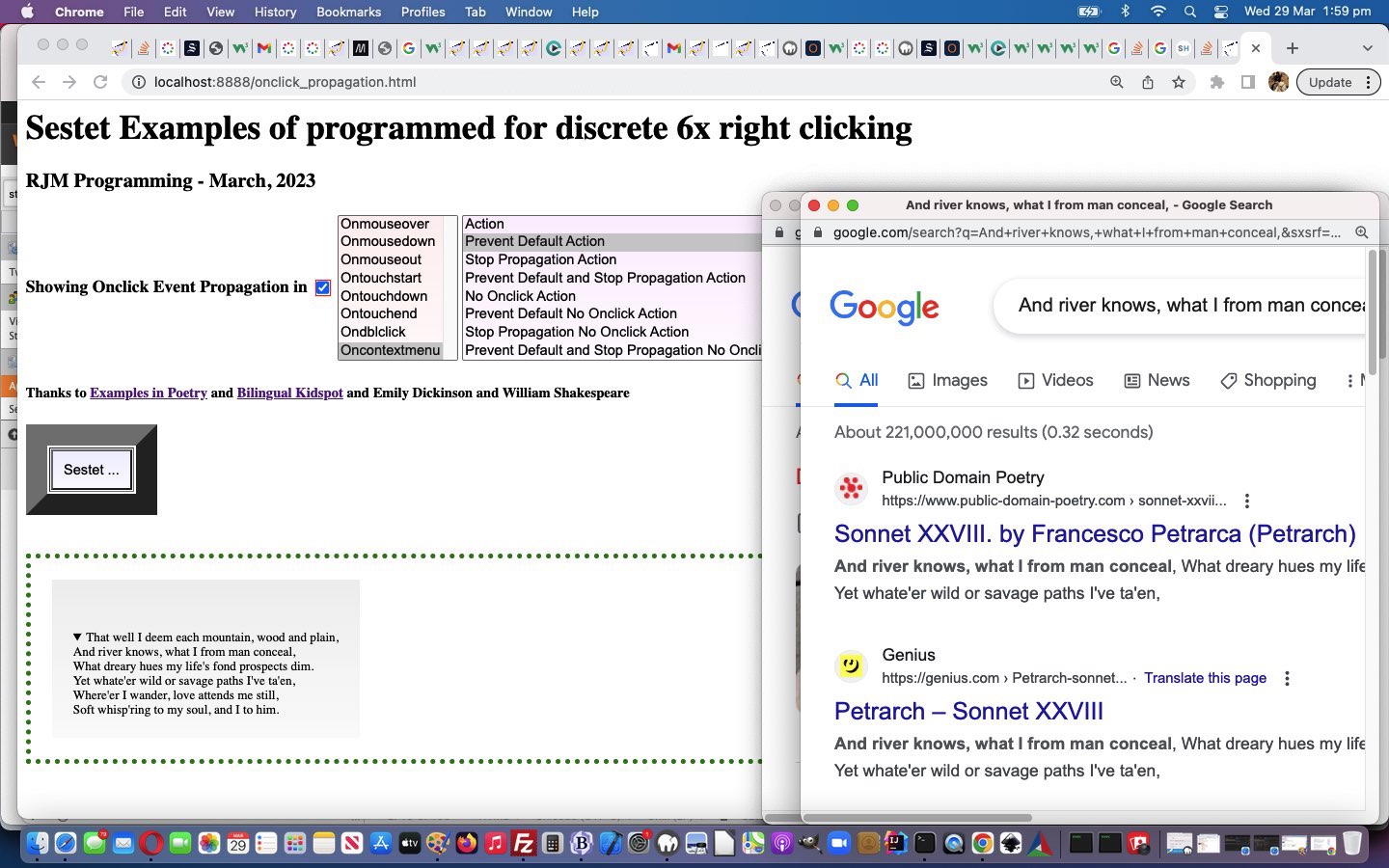
Both, as well as an inhouse “No Onclick” option become ways, via a dropdown choice, to tailor their “event” potencies. We make event.preventDefault() usage the default, for instance, if the user selects to get interested in the (what we like to call the “right click”) oncontextmenu event, to stifle the operating system menu that normally appears with a “right click” operation in the webpage …


if (document.getElementById('actionsel').value.indexOf('preventDefault') != -1) { event.preventDefault(); }
if (document.getElementById('actionsel').value.indexOf('stopPropagation') != -1) { event.stopPropagation(); }

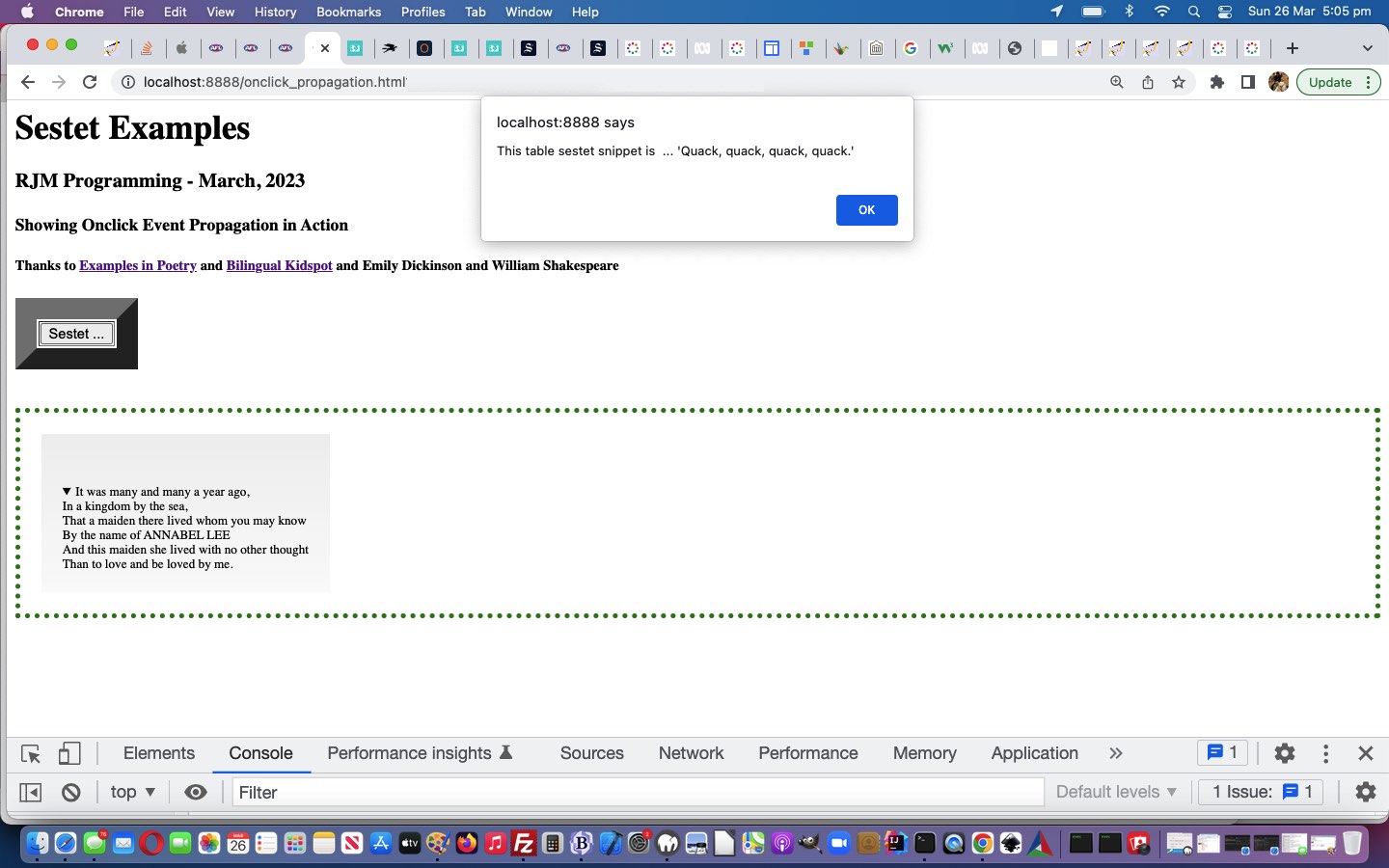
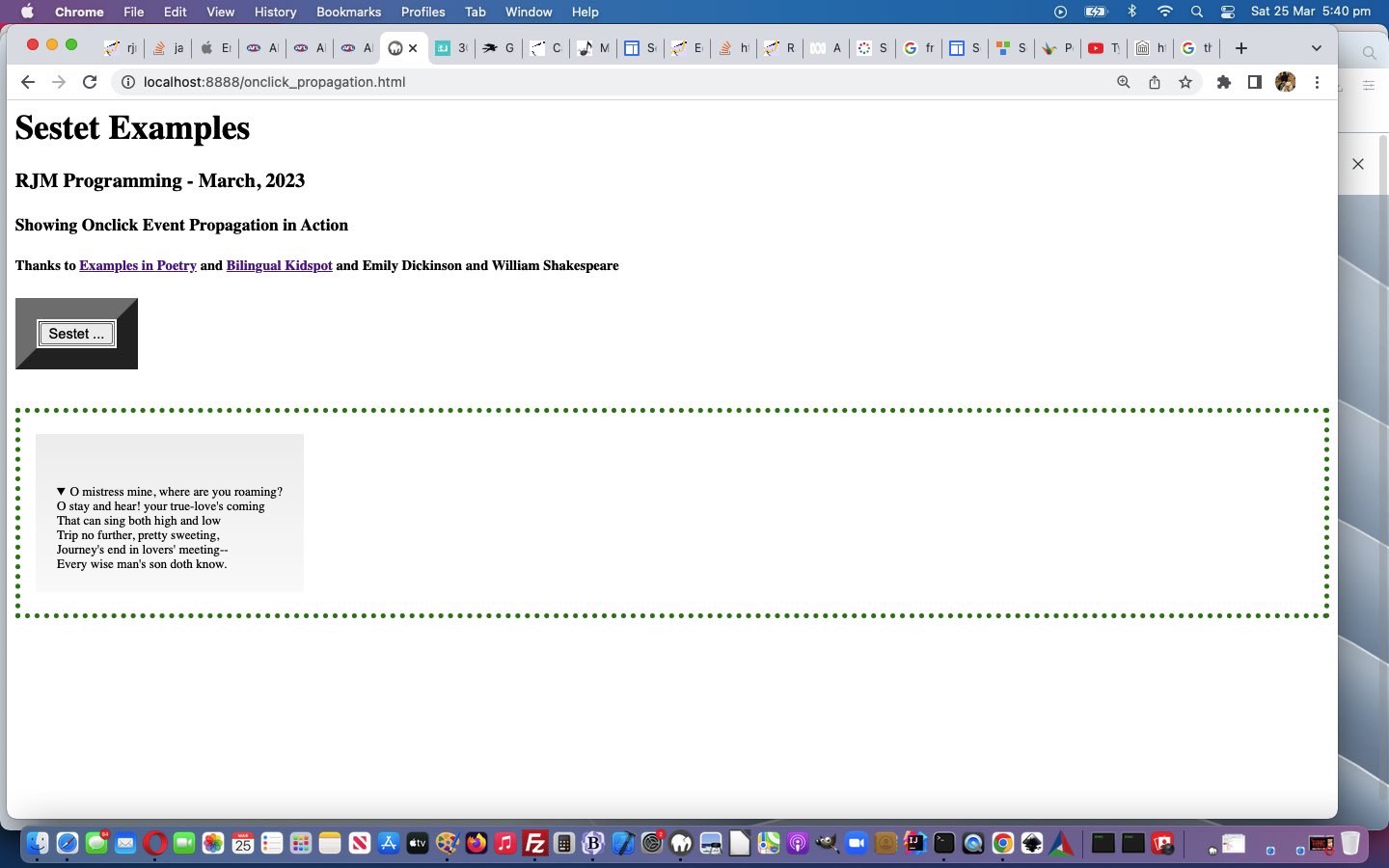
… in the changed “proof of concept” onclick_propagation.html Sestet web application you can also try below.


Previous relevant Onclick Event Propagation Event Type Tutorial is shown below.

Onclick Event Propagation Event Type Tutorial

Onclick Event Propagation Event Type Tutorial

On top of yesterday’s Onclick Event Propagation Event Target Tutorial

  • event.target … theme, today we have a …
  • event.type

… theme, the added bonus being that we finally got to use the word “touchdown“, in all seriousness, in a blog posting’s code logic … yay!!! Yes, as we hadn’t used before (in our memory) but available to use (and today we do) is the idea of …

  • a single event Javascript function … that can “multipurpose” itself, even further than the “event.target” helped with this, via …
  • event.type recognition of HTML added to as per

    <body onclick="moi(this);" onmouseover="moi(this);" onmouseout="moi(this);" onmousedown="moi(this);" ontouchdown="moi(this);" ontouchstart="moi(this);" ontouchend="moi(this);">

… making itself useful adding optional window.open popup Google search functionality as per


function commonev(othis) {
if (eval('' + jdc) >= eval('' + lotsofsix.length)) { jdc=0; }
jdc=Math.floor(Math.random() * lotsofsix.length);
if ((',' + cindxs + ',').indexOf(',' + othis.outerHTML.substring(1).split(' ')[0].split('>')[0] + ':') != -1) {
if (lastajax != lotsofsix[jdc].split(';')[eval((',' + cindxs + ',').split(',' + othis.outerHTML.substring(1).split(' ')[0].split('>')[0] + ':')[1].split(',')[0])].replace(/\<br\>/g, String.fromCharCode(10))) {
lastajax=lotsofsix[jdc].split(';')[eval((',' + cindxs + ',').split(',' + othis.outerHTML.substring(1).split(' ')[0].split('>')[0] + ':')[1].split(',')[0])].replace(/\<br\>/g, String.fromCharCode(10));
ajaxit(lotsofsix[jdc].split(';')[eval((',' + cindxs + ',').split(',' + othis.outerHTML.substring(1).split(' ')[0].split('>')[0] + ':')[1].split(',')[0])].replace(/\<br\>/g, String.fromCharCode(10)));
}
}
}


function moi(othis) {
var extras='';

switch ('' + event.type) {
case 'mouseover':
if (document.getElementById('mycbomo').checked && document.getElementById('eventtype').value == ('' + event.type)) {
commonev(othis);
}
break;

case 'mousedown':
if (document.getElementById('mycbomo').checked && document.getElementById('eventtype').value == ('' + event.type)) {
commonev(othis);
}
break;

case 'mouseoout':
if (document.getElementById('mycbomo').checked && document.getElementById('eventtype').value == ('' + event.type)) {
commonev(othis);
}
break;

case 'touchstart':
if (document.getElementById('mycbomo').checked && document.getElementById('eventtype').value == ('' + event.type)) {
commonev(othis);
}
break;

case '
touchdown':
if (document.getElementById('mycbomo').checked && document.getElementById('eventtype').value == ('' + event.type)) {
commonev(othis);
}
break;

case 'touchend':
if (document.getElementById('mycbomo').checked && document.getElementById('eventtype').value == ('' + event.type)) {
commonev(othis);
}
break;


case 'click':

//document.getElementById('myh1').innerHTML+=' ' + event.target.outerHTML.substring(1).split(' ')[0].split('>')[0];
if (('' + event.target.outerHTML).substring(1).split(' ')[0].split('>')[0] != 'button') {
if (eval('' + jdc) >= eval('' + lotsofsix.length)) { jdc=0; }
//alert('2967 ' + othis.outerHTML.substring(1).split(' ')[0].split('>')[0]);
if ((',' + cindxs + ',').indexOf(',' + othis.outerHTML.substring(1).split(' ')[0].split('>')[0] + ':') != -1) {
//alert((',' + cindxs + ',').split(',' + othis.outerHTML.substring(1).split(' ')[0].split('>')[0] + ':')[1].split(',')[0] + ' ' + jdc + ' ' + lotsofsix[jdc]);
jdc=Math.floor(Math.random() * lotsofsix.length);
thisalert('This ' + othis.outerHTML.substring(1).split(' ')[0].split('>')[0] + ' sestet snippet is ... ' + lotsofsix[jdc].split(';')[eval((',' + cindxs + ',').split(',' + othis.outerHTML.substring(1).split(' ')[0].split('>')[0] + ':')[1].split(',')[0])].replace(/\<br\>/g, String.fromCharCode(10)));
}
} else if (othis.outerHTML.substring(1).split(' ')[0].split('>')[0] == 'details' || (othis.outerHTML.substring(1).split(' ')[0].split('>')[0] == 'body' && blurbsuffix == '') || noway) {
//alert(1967);
noway=true;
if (othis.outerHTML.substring(1).split(' ')[0].split('>')[0] == 'body') { noway=false; }
} else {
//alert(blurbsuffix + ' ... ' + othis.outerHTML.substring(1).split(' ')[0].split('>')[0]);
if (('' + othis.id) != '') { extras=' ID=' + othis.id; idfound=true; } else {
if (eval('' + jdc) >= eval('' + lotsofsix.length)) { jdc=0; }
if (eval('' + detnum) > 0) {
if (lotsofsix[jdc].split(';')[idc].indexOf('<br>') != -1) {
if (document.getElementById('det' + eval(-1 + detnum))) {
document.getElementById('det' + eval(-1 + detnum)).open=false;
}
}
}
blurb+='<br>' + lotsofsix[jdc].split(';')[idc].replace('<br>', '<br><details onclick="noway=false;" id=det' + detnum + ' open><summary>') + detsuffix; detsuffix='';
}
detsuffix='';
if (othis.outerHTML.substring(1).split(' ')[0].split('>')[0] == 'body' && !idfound) {
var suf=tableize(blurb.replace('</summary><br>', '</summary>') + blurbsuffix);
if (suf != '') { document.getElementById('results').innerHTML+=suf; }
//alert(document.getElementById('results').innerHTML);
detsuffix='';
blurbsuffix='';
detnum++;
} else if (idfound) {
detsuffix='';
blurbsuffix='';
document.getElementById('results').innerHTML+=othis.outerHTML.substring(1).split(' ')[0].split('>')[0] + extras + ' clicked.<br>';
} else if (('' + event.target.outerHTML).substring(1).split(' ')[0].split('>')[0] != 'button') {
//alert(967);
if ((',' + cindxs + ',').indexOf(',' + othis.outerHTML.substring(1).split(' ')[0].split('>')[0] + ':') != -1) {
jdc=Math.floor(Math.random() * lotsofsix.length);
thisalert('This ' + othis.outerHTML.substring(1).split(' ')[0].split('>')[0] + ' sestet snippet is ... ' + lotsofsix[jdc].split(';')[eval((',' + cindxs + ',').split(',' + othis.outerHTML.substring(1).split(' ')[0].split('>')[0] + ':')[1].split(',')[0])].replace(/\<br\>/g, String.fromCharCode(10)));
}
}
jdc++;
}
break;


default:
break;
}

}

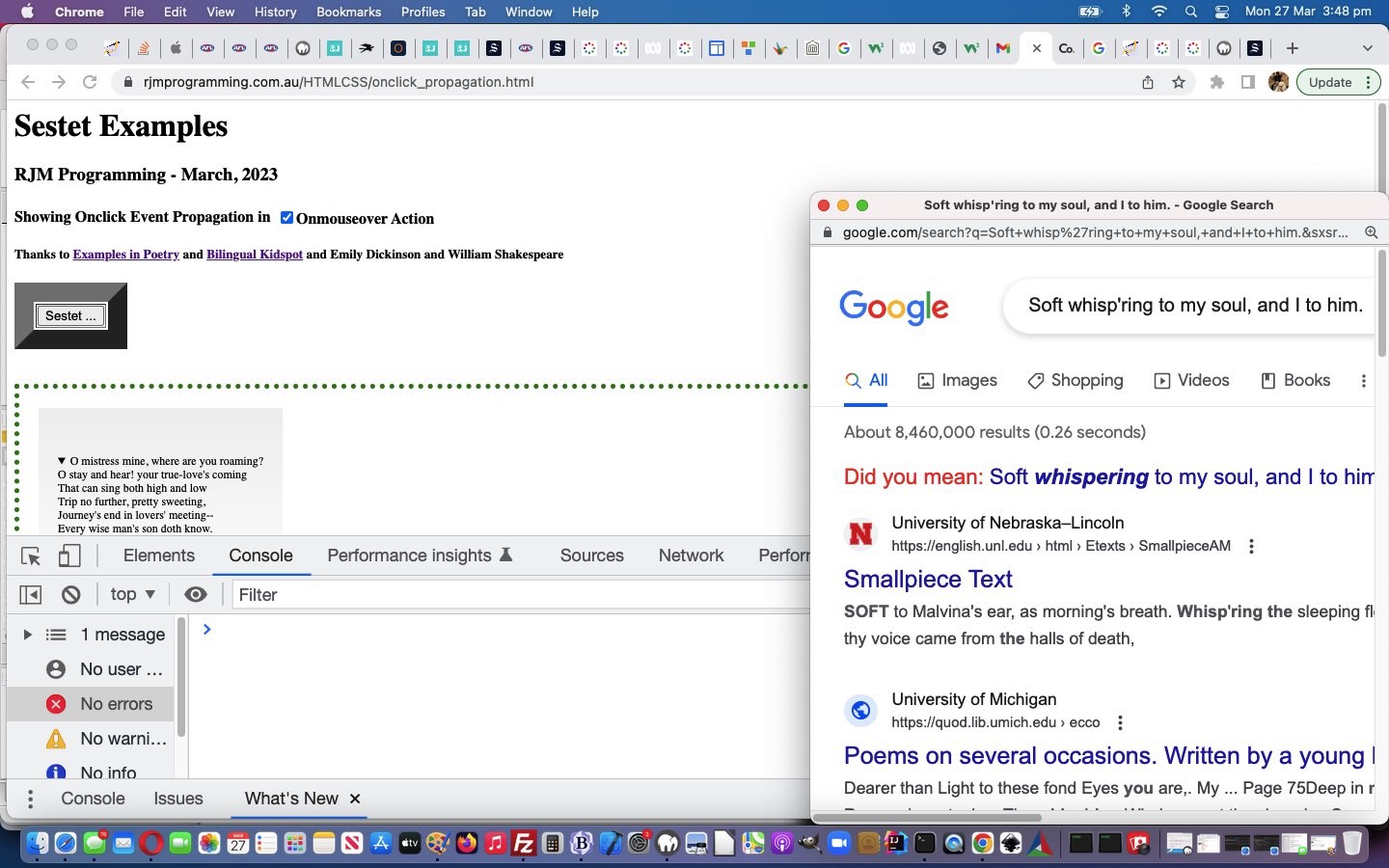
… in the changed “proof of concept” onclick_propagation.html Sestet web application you can also try below.


Previous relevant Onclick Event Propagation Event Target Tutorial is shown below.

Onclick Event Propagation Event Target Tutorial

Onclick Event Propagation Event Target Tutorial

Yesterday’s Onclick Event Propagation Primer Tutorial approach to harnessing the “powers of propagation” was a bit “scattergun”. We never referenced the very useful …


event.target

… global variable that can be used in Javascript event logic to get the element where the event originated, as distinct from function moi‘s “othis” argument, which points at the HTML webpage element calling the “onclick” event logic.

Its use can add nuance to the reworked “onclick” event sharing Javascript function …


function moi(othis) {
var extras='';
//document.getElementById('myh1').innerHTML+=' ' + event.target.outerHTML.substring(1).split(' ')[0].split('>')[0];
if (('' + event.target.outerHTML).substring(1).split(' ')[0].split('>')[0] != 'button') {
if (eval('' + jdc) >= eval('' + lotsofsix.length)) { jdc=0; }
//alert('2967 ' + othis.outerHTML.substring(1).split(' ')[0].split('>')[0]);
if ((',' + cindxs + ',').indexOf(',' + othis.outerHTML.substring(1).split(' ')[0].split('>')[0] + ':') != -1) {
//alert((',' + cindxs + ',').split(',' + othis.outerHTML.substring(1).split(' ')[0].split('>')[0] + ':')[1].split(',')[0] + ' ' + jdc + ' ' + lotsofsix[jdc]);
jdc=Math.floor(Math.random() * lotsofsix.length);
alert('This ' + othis.outerHTML.substring(1).split(' ')[0].split('>')[0] + ' sestet snippet is ... ' + lotsofsix[jdc].split(';')[eval((',' + cindxs + ',').split(',' + othis.outerHTML.substring(1).split(' ')[0].split('>')[0] + ':')[1].split(',')[0])].replace(/\<br\>/g, String.fromCharCode(10)));
}
} else
if (othis.outerHTML.substring(1).split(' ')[0].split('>')[0] == 'details' || (othis.outerHTML.substring(1).split(' ')[0].split('>')[0] == 'body' && blurbsuffix == '') || noway) {
//alert(1967);
noway=true;
if (othis.outerHTML.substring(1).split(' ')[0].split('>')[0] == 'body') { noway=false; }
} else {
//alert(blurbsuffix + ' ... ' + othis.outerHTML.substring(1).split(' ')[0].split('>')[0]);
if (('' + othis.id) != '') { extras=' ID=' + othis.id; idfound=true; } else {
if (eval('' + jdc) >= eval('' + lotsofsix.length)) { jdc=0; }
if (eval('' + detnum) > 0) {
if (lotsofsix[jdc].split(';')[idc].indexOf('<br>') != -1) {
if (document.getElementById('det' + eval(-1 + detnum))) {
document.getElementById('det' + eval(-1 + detnum)).open=false;
}
}
}
blurb+='<br>' + lotsofsix[jdc].split(';')[idc].replace('<br>', '<br><details onclick="noway=false;" id=det' + detnum + ' open><summary>') + detsuffix; detsuffix='';
}
detsuffix='';
if (othis.outerHTML.substring(1).split(' ')[0].split('>')[0] == 'body' && !idfound) {
var suf=tableize(blurb.replace('</summary><br>', '</summary>') + blurbsuffix);
if (suf != '') { document.getElementById('results').innerHTML+=suf; }
//alert(document.getElementById('results').innerHTML);
detsuffix='';
blurbsuffix='';
detnum++;
} else if (idfound) {
detsuffix='';
blurbsuffix='';
document.getElementById('results').innerHTML+=othis.outerHTML.substring(1).split(' ')[0].split('>')[0] + extras + ' clicked.<br>';
} else if (('' + event.target.outerHTML).substring(1).split(' ')[0].split('>')[0] != 'button') {
//alert(967);
if ((',' + cindxs + ',').indexOf(',' + othis.outerHTML.substring(1).split(' ')[0].split('>')[0] + ':') != -1) {
jdc=Math.floor(Math.random() * lotsofsix.length);
alert('This ' + othis.outerHTML.substring(1).split(' ')[0].split('>')[0] + ' sestet snippet is ... ' + lotsofsix[jdc].split(';')[eval((',' + cindxs + ',').split(',' + othis.outerHTML.substring(1).split(' ')[0].split('>')[0] + ':')[1].split(',')[0])].replace(/\<br\>/g, String.fromCharCode(10)));
}

}
jdc++;
}
}

… in the changed “proof of concept” onclick_propagation.html Sestet web application you can also try below.


Previous relevant Onclick Event Propagation Primer Tutorial is shown below.

Onclick Event Propagation Primer Tutorial

Onclick Event Propagation Primer Tutorial

A basis for web application event driven programming strategies references …

  • element nesting and inheritance …
  • the default event propagation up through the element hierarchy

Of course you can ignore how this event “bubbling” can be harnessed, and indeed, we normally do not harness this event programming abilities in webpages, but not today! Today, we want to harness, via “onclick” event (sharing a common …


function moi(othis) {
var extras='';
if (othis.outerHTML.substring(1).split(' ')[0].split('>')[0] == 'details' || (othis.outerHTML.substring(1).split(' ')[0].split('>')[0] == 'body' && blurbsuffix == '') || noway) {
noway=true;
if (othis.outerHTML.substring(1).split(' ')[0].split('>')[0] == 'body') { noway=false; }
} else {
//alert(blurbsuffix + ' ... ' + othis.outerHTML.substring(1).split(' ')[0].split('>')[0]);
if (('' + othis.id) != '') { extras=' ID=' + othis.id; idfound=true; } else {
if (eval('' + jdc) >= eval('' + lotsofsix.length)) { jdc=0; }
if (eval('' + detnum) > 0) {
if (lotsofsix[jdc].split(';')[idc].indexOf('<br>') != -1) {
if (document.getElementById('det' + eval(-1 + detnum))) {
document.getElementById('det' + eval(-1 + detnum)).open=false;
}
}
}
blurb+='<br>' + lotsofsix[jdc].split(';')[idc].replace('<br>', '<br><details onclick="noway=false;" id=det' + detnum + ' open><summary>') + detsuffix; detsuffix='';
}
detsuffix='';
if (othis.outerHTML.substring(1).split(' ')[0].split('>')[0] == 'body' && !idfound) {
var suf=tableize(blurb.replace('</summary><br>', '</summary>') + blurbsuffix);
if (suf != '') { document.getElementById('results').innerHTML+=suf; }
//alert(document.getElementById('results').innerHTML);
detsuffix='';
blurbsuffix='';
detnum++;
} else if (idfound) {
detsuffix='';
blurbsuffix='';
document.getElementById('results').innerHTML+=othis.outerHTML.substring(1).split(' ')[0].split('>')[0] + extras + ' clicked.<br>';
}
jdc++;
}
}

… event “onclick” logic Javascript function, as above) propagation, the sharing of piecing together the content display of …


Sestet poems and rhymes

… where the six lines of poetry are written out by the “onclick” events of …

  1. button
  2. td
  3. tr
  4. tbody
  5. table
  6. body

… in hierarchical order in the “proof of concept” onclick_propagation.html Sestet web application you can also try below …

If this was interesting you may be interested in this too.


If this was interesting you may be interested in this too.

If this was interesting you may be interested in this too.

If this was interesting you may be interested in this too.

If this was interesting you may be interested in this too.
Posted in eLearning, Event-Driven Programming, Tutorials | Tagged , , , , , , , , , , , , , , , , , , , , , , , , , , , , , , , , , , | Leave a comment

Onclick Event Propagation Event Nuance Tutorial

Onclick Event Propagation Event Nuance Tutorial

Onclick Event Propagation Event Nuance Tutorial

When mobile technology became big, so too did “touch” screen technology, and the concept of a “gesture” (in the event driven programming woooooorrrrrlllldddd) such as a “pinch” or “spread” gesture, and “two finger” or more, gestures. And though we’re (just starting with) tipping our toes into a vast “ocean of possibility” here, nevertheless, even with non-mobile event work, centralizing the event logic, whether it be propagated or not, we have the “event” object tools, now, to offer more nuance as to what the user is doing as regards their pointing device, here, with our experimental new web application we are developing currently, on top of the progress onto yesterday’s Onclick Event Propagation Event Type Tutorial.

We want to creep up on logic to discern “double click” (as an “ondblclick” event possibility, or via the “onclick” event) or “discrete click” (or even non-mobile “hover”) ideas, as far as “user behaviour” goes, as per


function ttlook() {
var tspecific=' pinch';
if (wasscale > isscale) {
tspecific=' Pinch';
} else if (isscale > wasscale) {
tspecific=' Spread';
} else if (eval('' + ote.split(':').length) >= 5) {
if (eval(ote.split(':')[1].split(',')[0].trim()) > eval(ote.split(':')[3].split(',')[0].trim())) {
if (eval(ote.split(':')[1].split(',')[1].split(' ')[0].trim()) <= eval(ote.split(':')[3].split(',')[1].split(' ')[0].trim())) {
tspecific=' spread';
}
} else if (eval(ote.split(':')[1].split(',')[0].trim()) < eval(ote.split(':')[3].split(',')[0].trim())) {
if (eval(ote.split(':')[1].split(',')[1].split(' ')[0].trim()) >= eval(ote.split(':')[3].split(',')[1].split(' ')[0].trim())) {
tspecific=' spread';
}
}
} else {
tspecific='';
}
document.getElementById('numbers').innerHTML='of touch' + tspecific + ' gesture ';
document.getElementById('numberst').innerHTML='of touch' + tspecific + ' gesture ';
//document.getElementById('numbers').innerHTML+=ote; //('(' + event.targetTouches.length + ') ' + event.targetTouches[0].clientX + ',' + event.targetTouches[0].clientY + ' to ' + event.targetTouches[1].clientX + ',' + event.targetTouches[1].clientY);
ote='';
}


function assesslater() {
saveuntil-=100;
if (saveuntil > 0) {
setTimeout(assesslater, 100);
} else {
if (numtype.indexOf(',') != -1 || numtype.indexOf('touch') != -1) { // multiple event analysis
document.getElementById('numberst').innerHTML='';
var numtypeslength=numtypes.length;
for (var ii=0; ii<eval(-1 + numtypes.length); ii++) {
if (numtypes[eval(-1 + numtypes.length)] != numtypes[ii]) { numtypeslength--; }
}
//if (numtypes[0] == numtypes[1]) {
// document.getElementById('myh1').innerHTML+=' Multiple event ' + numtypes[0] + ' ' + ('' + new Date());
//}
if (numtypes[eval(-1 + numtypes.length)].indexOf('dblclick') != -1) {
if (numtypes[eval(-1 + numtypes.length)].split(':')[2] == numtypes[eval(-2 + numtypes.length)].split(':')[2]) {
document.getElementById('numbers').innerHTML='of programmed for double click';
} else {
document.getElementById('numbers').innerHTML='of quick programmed for propagated clicking';
}
} else if (numtypes[eval(-1 + numtypes.length)].indexOf('click') != -1) {
if (numtypes[eval(-1 + numtypes.length)] == numtypes[eval(-2 + numtypes.length)]) {
document.getElementById('numbers').innerHTML='of programmed for discrete ' + numtypeslength + 'x clicking';
} else if (numtypes[eval(-1 + numtypes.length)].split(':')[2] == numtypes[eval(-2 + numtypes.length)].split(':')[2]) {
document.getElementById('numbers').innerHTML='of programmed for click';
} else {
document.getElementById('numbers').innerHTML='of fast programmed for propagated clicking';
}
} else if (numtypes[eval(-1 + numtypes.length)].indexOf('contextmenu') != -1) {
if (numtypes[eval(-1 + numtypes.length)] == numtypes[eval(-2 + numtypes.length)]) {
document.getElementById('numbers').innerHTML='of programmed for discrete ' + numtypeslength + 'x right clicking';
} else if (numtypes[eval(-1 + numtypes.length)].split(':')[2] == numtypes[eval(-2 + numtypes.length)].split(':')[2]) {
document.getElementById('numbers').innerHTML='of programmed for right click';
} else {
document.getElementById('numbers').innerHTML='of fast programmed for propagated right clicking';
}
} else if (numtypes[eval(-1 + numtypes.length)].indexOf('mouseo') != -1) {
if (numtypes[eval(-1 + numtypes.length)] == numtypes[eval(-2 + numtypes.length)]) {
document.getElementById('numbers').innerHTML='of programmed for discrete ' + numtypeslength + 'x hovering';
} else if (numtypes[eval(-1 + numtypes.length)].split(':')[2] == numtypes[eval(-2 + numtypes.length)].split(':')[2]) {
document.getElementById('numbers').innerHTML='of programmed for hovering';
} else {
document.getElementById('numbers').innerHTML='of fast programmed for roaming type of hovering';
}
} else if (numtypes[eval(-1 + numtypes.length)].indexOf('touchend') != -1) {
ttlook();
document.getElementById('numberst').innerHTML=document.getElementById('numbers').innerHTML;
} else {
document.getElementById('numbers').innerHTML='';
document.getElementById('numberst').innerHTML='';
}
}
numtype='';
numtypes=[];
saveuntil=2000;
}
}

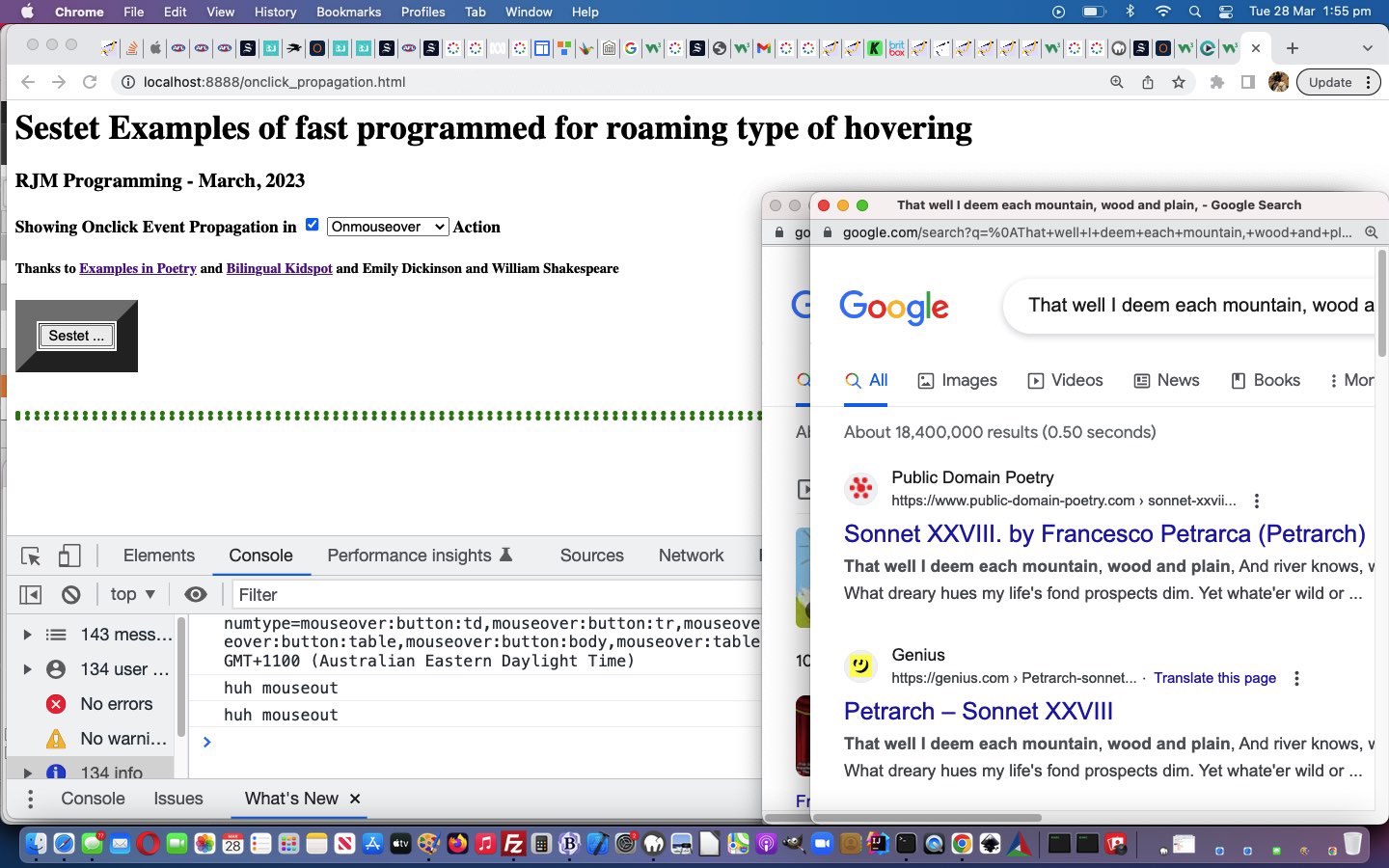
… in the changed “proof of concept” onclick_propagation.html Sestet web application you can also try below.


Previous relevant Onclick Event Propagation Event Type Tutorial is shown below.

Onclick Event Propagation Event Type Tutorial

Onclick Event Propagation Event Type Tutorial

On top of yesterday’s Onclick Event Propagation Event Target Tutorial

  • event.target … theme, today we have a …
  • event.type

… theme, the added bonus being that we finally got to use the word “touchdown“, in all seriousness, in a blog posting’s code logic … yay!!! Yes, as we hadn’t used before (in our memory) but available to use (and today we do) is the idea of …

  • a single event Javascript function … that can “multipurpose” itself, even further than the “event.target” helped with this, via …
  • event.type recognition of HTML added to as per

    <body onclick="moi(this);" onmouseover="moi(this);" onmouseout="moi(this);" onmousedown="moi(this);" ontouchdown="moi(this);" ontouchstart="moi(this);" ontouchend="moi(this);">

… making itself useful adding optional window.open popup Google search functionality as per


function commonev(othis) {
if (eval('' + jdc) >= eval('' + lotsofsix.length)) { jdc=0; }
jdc=Math.floor(Math.random() * lotsofsix.length);
if ((',' + cindxs + ',').indexOf(',' + othis.outerHTML.substring(1).split(' ')[0].split('>')[0] + ':') != -1) {
if (lastajax != lotsofsix[jdc].split(';')[eval((',' + cindxs + ',').split(',' + othis.outerHTML.substring(1).split(' ')[0].split('>')[0] + ':')[1].split(',')[0])].replace(/\<br\>/g, String.fromCharCode(10))) {
lastajax=lotsofsix[jdc].split(';')[eval((',' + cindxs + ',').split(',' + othis.outerHTML.substring(1).split(' ')[0].split('>')[0] + ':')[1].split(',')[0])].replace(/\<br\>/g, String.fromCharCode(10));
ajaxit(lotsofsix[jdc].split(';')[eval((',' + cindxs + ',').split(',' + othis.outerHTML.substring(1).split(' ')[0].split('>')[0] + ':')[1].split(',')[0])].replace(/\<br\>/g, String.fromCharCode(10)));
}
}
}


function moi(othis) {
var extras='';

switch ('' + event.type) {
case 'mouseover':
if (document.getElementById('mycbomo').checked && document.getElementById('eventtype').value == ('' + event.type)) {
commonev(othis);
}
break;

case 'mousedown':
if (document.getElementById('mycbomo').checked && document.getElementById('eventtype').value == ('' + event.type)) {
commonev(othis);
}
break;

case 'mouseoout':
if (document.getElementById('mycbomo').checked && document.getElementById('eventtype').value == ('' + event.type)) {
commonev(othis);
}
break;

case 'touchstart':
if (document.getElementById('mycbomo').checked && document.getElementById('eventtype').value == ('' + event.type)) {
commonev(othis);
}
break;

case '
touchdown':
if (document.getElementById('mycbomo').checked && document.getElementById('eventtype').value == ('' + event.type)) {
commonev(othis);
}
break;

case 'touchend':
if (document.getElementById('mycbomo').checked && document.getElementById('eventtype').value == ('' + event.type)) {
commonev(othis);
}
break;


case 'click':

//document.getElementById('myh1').innerHTML+=' ' + event.target.outerHTML.substring(1).split(' ')[0].split('>')[0];
if (('' + event.target.outerHTML).substring(1).split(' ')[0].split('>')[0] != 'button') {
if (eval('' + jdc) >= eval('' + lotsofsix.length)) { jdc=0; }
//alert('2967 ' + othis.outerHTML.substring(1).split(' ')[0].split('>')[0]);
if ((',' + cindxs + ',').indexOf(',' + othis.outerHTML.substring(1).split(' ')[0].split('>')[0] + ':') != -1) {
//alert((',' + cindxs + ',').split(',' + othis.outerHTML.substring(1).split(' ')[0].split('>')[0] + ':')[1].split(',')[0] + ' ' + jdc + ' ' + lotsofsix[jdc]);
jdc=Math.floor(Math.random() * lotsofsix.length);
thisalert('This ' + othis.outerHTML.substring(1).split(' ')[0].split('>')[0] + ' sestet snippet is ... ' + lotsofsix[jdc].split(';')[eval((',' + cindxs + ',').split(',' + othis.outerHTML.substring(1).split(' ')[0].split('>')[0] + ':')[1].split(',')[0])].replace(/\<br\>/g, String.fromCharCode(10)));
}
} else if (othis.outerHTML.substring(1).split(' ')[0].split('>')[0] == 'details' || (othis.outerHTML.substring(1).split(' ')[0].split('>')[0] == 'body' && blurbsuffix == '') || noway) {
//alert(1967);
noway=true;
if (othis.outerHTML.substring(1).split(' ')[0].split('>')[0] == 'body') { noway=false; }
} else {
//alert(blurbsuffix + ' ... ' + othis.outerHTML.substring(1).split(' ')[0].split('>')[0]);
if (('' + othis.id) != '') { extras=' ID=' + othis.id; idfound=true; } else {
if (eval('' + jdc) >= eval('' + lotsofsix.length)) { jdc=0; }
if (eval('' + detnum) > 0) {
if (lotsofsix[jdc].split(';')[idc].indexOf('<br>') != -1) {
if (document.getElementById('det' + eval(-1 + detnum))) {
document.getElementById('det' + eval(-1 + detnum)).open=false;
}
}
}
blurb+='<br>' + lotsofsix[jdc].split(';')[idc].replace('<br>', '<br><details onclick="noway=false;" id=det' + detnum + ' open><summary>') + detsuffix; detsuffix='';
}
detsuffix='';
if (othis.outerHTML.substring(1).split(' ')[0].split('>')[0] == 'body' && !idfound) {
var suf=tableize(blurb.replace('</summary><br>', '</summary>') + blurbsuffix);
if (suf != '') { document.getElementById('results').innerHTML+=suf; }
//alert(document.getElementById('results').innerHTML);
detsuffix='';
blurbsuffix='';
detnum++;
} else if (idfound) {
detsuffix='';
blurbsuffix='';
document.getElementById('results').innerHTML+=othis.outerHTML.substring(1).split(' ')[0].split('>')[0] + extras + ' clicked.<br>';
} else if (('' + event.target.outerHTML).substring(1).split(' ')[0].split('>')[0] != 'button') {
//alert(967);
if ((',' + cindxs + ',').indexOf(',' + othis.outerHTML.substring(1).split(' ')[0].split('>')[0] + ':') != -1) {
jdc=Math.floor(Math.random() * lotsofsix.length);
thisalert('This ' + othis.outerHTML.substring(1).split(' ')[0].split('>')[0] + ' sestet snippet is ... ' + lotsofsix[jdc].split(';')[eval((',' + cindxs + ',').split(',' + othis.outerHTML.substring(1).split(' ')[0].split('>')[0] + ':')[1].split(',')[0])].replace(/\<br\>/g, String.fromCharCode(10)));
}
}
jdc++;
}
break;


default:
break;
}

}

… in the changed “proof of concept” onclick_propagation.html Sestet web application you can also try below.


Previous relevant Onclick Event Propagation Event Target Tutorial is shown below.

Onclick Event Propagation Event Target Tutorial

Onclick Event Propagation Event Target Tutorial

Yesterday’s Onclick Event Propagation Primer Tutorial approach to harnessing the “powers of propagation” was a bit “scattergun”. We never referenced the very useful …


event.target

… global variable that can be used in Javascript event logic to get the element where the event originated, as distinct from function moi‘s “othis” argument, which points at the HTML webpage element calling the “onclick” event logic.

Its use can add nuance to the reworked “onclick” event sharing Javascript function …


function moi(othis) {
var extras='';
//document.getElementById('myh1').innerHTML+=' ' + event.target.outerHTML.substring(1).split(' ')[0].split('>')[0];
if (('' + event.target.outerHTML).substring(1).split(' ')[0].split('>')[0] != 'button') {
if (eval('' + jdc) >= eval('' + lotsofsix.length)) { jdc=0; }
//alert('2967 ' + othis.outerHTML.substring(1).split(' ')[0].split('>')[0]);
if ((',' + cindxs + ',').indexOf(',' + othis.outerHTML.substring(1).split(' ')[0].split('>')[0] + ':') != -1) {
//alert((',' + cindxs + ',').split(',' + othis.outerHTML.substring(1).split(' ')[0].split('>')[0] + ':')[1].split(',')[0] + ' ' + jdc + ' ' + lotsofsix[jdc]);
jdc=Math.floor(Math.random() * lotsofsix.length);
alert('This ' + othis.outerHTML.substring(1).split(' ')[0].split('>')[0] + ' sestet snippet is ... ' + lotsofsix[jdc].split(';')[eval((',' + cindxs + ',').split(',' + othis.outerHTML.substring(1).split(' ')[0].split('>')[0] + ':')[1].split(',')[0])].replace(/\<br\>/g, String.fromCharCode(10)));
}
} else
if (othis.outerHTML.substring(1).split(' ')[0].split('>')[0] == 'details' || (othis.outerHTML.substring(1).split(' ')[0].split('>')[0] == 'body' && blurbsuffix == '') || noway) {
//alert(1967);
noway=true;
if (othis.outerHTML.substring(1).split(' ')[0].split('>')[0] == 'body') { noway=false; }
} else {
//alert(blurbsuffix + ' ... ' + othis.outerHTML.substring(1).split(' ')[0].split('>')[0]);
if (('' + othis.id) != '') { extras=' ID=' + othis.id; idfound=true; } else {
if (eval('' + jdc) >= eval('' + lotsofsix.length)) { jdc=0; }
if (eval('' + detnum) > 0) {
if (lotsofsix[jdc].split(';')[idc].indexOf('<br>') != -1) {
if (document.getElementById('det' + eval(-1 + detnum))) {
document.getElementById('det' + eval(-1 + detnum)).open=false;
}
}
}
blurb+='<br>' + lotsofsix[jdc].split(';')[idc].replace('<br>', '<br><details onclick="noway=false;" id=det' + detnum + ' open><summary>') + detsuffix; detsuffix='';
}
detsuffix='';
if (othis.outerHTML.substring(1).split(' ')[0].split('>')[0] == 'body' && !idfound) {
var suf=tableize(blurb.replace('</summary><br>', '</summary>') + blurbsuffix);
if (suf != '') { document.getElementById('results').innerHTML+=suf; }
//alert(document.getElementById('results').innerHTML);
detsuffix='';
blurbsuffix='';
detnum++;
} else if (idfound) {
detsuffix='';
blurbsuffix='';
document.getElementById('results').innerHTML+=othis.outerHTML.substring(1).split(' ')[0].split('>')[0] + extras + ' clicked.<br>';
} else if (('' + event.target.outerHTML).substring(1).split(' ')[0].split('>')[0] != 'button') {
//alert(967);
if ((',' + cindxs + ',').indexOf(',' + othis.outerHTML.substring(1).split(' ')[0].split('>')[0] + ':') != -1) {
jdc=Math.floor(Math.random() * lotsofsix.length);
alert('This ' + othis.outerHTML.substring(1).split(' ')[0].split('>')[0] + ' sestet snippet is ... ' + lotsofsix[jdc].split(';')[eval((',' + cindxs + ',').split(',' + othis.outerHTML.substring(1).split(' ')[0].split('>')[0] + ':')[1].split(',')[0])].replace(/\<br\>/g, String.fromCharCode(10)));
}

}
jdc++;
}
}

… in the changed “proof of concept” onclick_propagation.html Sestet web application you can also try below.


Previous relevant Onclick Event Propagation Primer Tutorial is shown below.

Onclick Event Propagation Primer Tutorial

Onclick Event Propagation Primer Tutorial

A basis for web application event driven programming strategies references …

  • element nesting and inheritance …
  • the default event propagation up through the element hierarchy

Of course you can ignore how this event “bubbling” can be harnessed, and indeed, we normally do not harness this event programming abilities in webpages, but not today! Today, we want to harness, via “onclick” event (sharing a common …


function moi(othis) {
var extras='';
if (othis.outerHTML.substring(1).split(' ')[0].split('>')[0] == 'details' || (othis.outerHTML.substring(1).split(' ')[0].split('>')[0] == 'body' && blurbsuffix == '') || noway) {
noway=true;
if (othis.outerHTML.substring(1).split(' ')[0].split('>')[0] == 'body') { noway=false; }
} else {
//alert(blurbsuffix + ' ... ' + othis.outerHTML.substring(1).split(' ')[0].split('>')[0]);
if (('' + othis.id) != '') { extras=' ID=' + othis.id; idfound=true; } else {
if (eval('' + jdc) >= eval('' + lotsofsix.length)) { jdc=0; }
if (eval('' + detnum) > 0) {
if (lotsofsix[jdc].split(';')[idc].indexOf('<br>') != -1) {
if (document.getElementById('det' + eval(-1 + detnum))) {
document.getElementById('det' + eval(-1 + detnum)).open=false;
}
}
}
blurb+='<br>' + lotsofsix[jdc].split(';')[idc].replace('<br>', '<br><details onclick="noway=false;" id=det' + detnum + ' open><summary>') + detsuffix; detsuffix='';
}
detsuffix='';
if (othis.outerHTML.substring(1).split(' ')[0].split('>')[0] == 'body' && !idfound) {
var suf=tableize(blurb.replace('</summary><br>', '</summary>') + blurbsuffix);
if (suf != '') { document.getElementById('results').innerHTML+=suf; }
//alert(document.getElementById('results').innerHTML);
detsuffix='';
blurbsuffix='';
detnum++;
} else if (idfound) {
detsuffix='';
blurbsuffix='';
document.getElementById('results').innerHTML+=othis.outerHTML.substring(1).split(' ')[0].split('>')[0] + extras + ' clicked.<br>';
}
jdc++;
}
}

… event “onclick” logic Javascript function, as above) propagation, the sharing of piecing together the content display of …


Sestet poems and rhymes

… where the six lines of poetry are written out by the “onclick” events of …

  1. button
  2. td
  3. tr
  4. tbody
  5. table
  6. body

… in hierarchical order in the “proof of concept” onclick_propagation.html Sestet web application you can also try below …

If this was interesting you may be interested in this too.


If this was interesting you may be interested in this too.

If this was interesting you may be interested in this too.


If this was interesting you may be interested in this too.

Posted in eLearning, Event-Driven Programming, Tutorials | Tagged , , , , , , , , , , , , , , , , , , , , , , , , , , , , | Leave a comment

Onclick Event Propagation Event Type Tutorial

Onclick Event Propagation Event Type Tutorial

Onclick Event Propagation Event Type Tutorial

On top of yesterday’s Onclick Event Propagation Event Target Tutorial

  • event.target … theme, today we have a …
  • event.type

… theme, the added bonus being that we finally got to use the word “touchdown“, in all seriousness, in a blog posting’s code logic … yay!!! Yes, as we hadn’t used before (in our memory) but available to use (and today we do) is the idea of …

  • a single event Javascript function … that can “multipurpose” itself, even further than the “event.target” helped with this, via …
  • event.type recognition of HTML added to as per

    <body onclick="moi(this);" onmouseover="moi(this);" onmouseout="moi(this);" onmousedown="moi(this);" ontouchdown="moi(this);" ontouchstart="moi(this);" ontouchend="moi(this);">

… making itself useful adding optional window.open popup Google search functionality as per


function commonev(othis) {
if (eval('' + jdc) >= eval('' + lotsofsix.length)) { jdc=0; }
jdc=Math.floor(Math.random() * lotsofsix.length);
if ((',' + cindxs + ',').indexOf(',' + othis.outerHTML.substring(1).split(' ')[0].split('>')[0] + ':') != -1) {
if (lastajax != lotsofsix[jdc].split(';')[eval((',' + cindxs + ',').split(',' + othis.outerHTML.substring(1).split(' ')[0].split('>')[0] + ':')[1].split(',')[0])].replace(/\<br\>/g, String.fromCharCode(10))) {
lastajax=lotsofsix[jdc].split(';')[eval((',' + cindxs + ',').split(',' + othis.outerHTML.substring(1).split(' ')[0].split('>')[0] + ':')[1].split(',')[0])].replace(/\<br\>/g, String.fromCharCode(10));
ajaxit(lotsofsix[jdc].split(';')[eval((',' + cindxs + ',').split(',' + othis.outerHTML.substring(1).split(' ')[0].split('>')[0] + ':')[1].split(',')[0])].replace(/\<br\>/g, String.fromCharCode(10)));
}
}
}


function moi(othis) {
var extras='';

switch ('' + event.type) {
case 'mouseover':
if (document.getElementById('mycbomo').checked && document.getElementById('eventtype').value == ('' + event.type)) {
commonev(othis);
}
break;

case 'mousedown':
if (document.getElementById('mycbomo').checked && document.getElementById('eventtype').value == ('' + event.type)) {
commonev(othis);
}
break;

case 'mouseoout':
if (document.getElementById('mycbomo').checked && document.getElementById('eventtype').value == ('' + event.type)) {
commonev(othis);
}
break;

case 'touchstart':
if (document.getElementById('mycbomo').checked && document.getElementById('eventtype').value == ('' + event.type)) {
commonev(othis);
}
break;

case '
touchdown':
if (document.getElementById('mycbomo').checked && document.getElementById('eventtype').value == ('' + event.type)) {
commonev(othis);
}
break;

case 'touchend':
if (document.getElementById('mycbomo').checked && document.getElementById('eventtype').value == ('' + event.type)) {
commonev(othis);
}
break;


case 'click':

//document.getElementById('myh1').innerHTML+=' ' + event.target.outerHTML.substring(1).split(' ')[0].split('>')[0];
if (('' + event.target.outerHTML).substring(1).split(' ')[0].split('>')[0] != 'button') {
if (eval('' + jdc) >= eval('' + lotsofsix.length)) { jdc=0; }
//alert('2967 ' + othis.outerHTML.substring(1).split(' ')[0].split('>')[0]);
if ((',' + cindxs + ',').indexOf(',' + othis.outerHTML.substring(1).split(' ')[0].split('>')[0] + ':') != -1) {
//alert((',' + cindxs + ',').split(',' + othis.outerHTML.substring(1).split(' ')[0].split('>')[0] + ':')[1].split(',')[0] + ' ' + jdc + ' ' + lotsofsix[jdc]);
jdc=Math.floor(Math.random() * lotsofsix.length);
thisalert('This ' + othis.outerHTML.substring(1).split(' ')[0].split('>')[0] + ' sestet snippet is ... ' + lotsofsix[jdc].split(';')[eval((',' + cindxs + ',').split(',' + othis.outerHTML.substring(1).split(' ')[0].split('>')[0] + ':')[1].split(',')[0])].replace(/\<br\>/g, String.fromCharCode(10)));
}
} else if (othis.outerHTML.substring(1).split(' ')[0].split('>')[0] == 'details' || (othis.outerHTML.substring(1).split(' ')[0].split('>')[0] == 'body' && blurbsuffix == '') || noway) {
//alert(1967);
noway=true;
if (othis.outerHTML.substring(1).split(' ')[0].split('>')[0] == 'body') { noway=false; }
} else {
//alert(blurbsuffix + ' ... ' + othis.outerHTML.substring(1).split(' ')[0].split('>')[0]);
if (('' + othis.id) != '') { extras=' ID=' + othis.id; idfound=true; } else {
if (eval('' + jdc) >= eval('' + lotsofsix.length)) { jdc=0; }
if (eval('' + detnum) > 0) {
if (lotsofsix[jdc].split(';')[idc].indexOf('<br>') != -1) {
if (document.getElementById('det' + eval(-1 + detnum))) {
document.getElementById('det' + eval(-1 + detnum)).open=false;
}
}
}
blurb+='<br>' + lotsofsix[jdc].split(';')[idc].replace('<br>', '<br><details onclick="noway=false;" id=det' + detnum + ' open><summary>') + detsuffix; detsuffix='';
}
detsuffix='';
if (othis.outerHTML.substring(1).split(' ')[0].split('>')[0] == 'body' && !idfound) {
var suf=tableize(blurb.replace('</summary><br>', '</summary>') + blurbsuffix);
if (suf != '') { document.getElementById('results').innerHTML+=suf; }
//alert(document.getElementById('results').innerHTML);
detsuffix='';
blurbsuffix='';
detnum++;
} else if (idfound) {
detsuffix='';
blurbsuffix='';
document.getElementById('results').innerHTML+=othis.outerHTML.substring(1).split(' ')[0].split('>')[0] + extras + ' clicked.<br>';
} else if (('' + event.target.outerHTML).substring(1).split(' ')[0].split('>')[0] != 'button') {
//alert(967);
if ((',' + cindxs + ',').indexOf(',' + othis.outerHTML.substring(1).split(' ')[0].split('>')[0] + ':') != -1) {
jdc=Math.floor(Math.random() * lotsofsix.length);
thisalert('This ' + othis.outerHTML.substring(1).split(' ')[0].split('>')[0] + ' sestet snippet is ... ' + lotsofsix[jdc].split(';')[eval((',' + cindxs + ',').split(',' + othis.outerHTML.substring(1).split(' ')[0].split('>')[0] + ':')[1].split(',')[0])].replace(/\<br\>/g, String.fromCharCode(10)));
}
}
jdc++;
}
break;


default:
break;
}

}

… in the changed “proof of concept” onclick_propagation.html Sestet web application you can also try below.


Previous relevant Onclick Event Propagation Event Target Tutorial is shown below.

Onclick Event Propagation Event Target Tutorial

Onclick Event Propagation Event Target Tutorial

Yesterday’s Onclick Event Propagation Primer Tutorial approach to harnessing the “powers of propagation” was a bit “scattergun”. We never referenced the very useful …


event.target

… global variable that can be used in Javascript event logic to get the element where the event originated, as distinct from function moi‘s “othis” argument, which points at the HTML webpage element calling the “onclick” event logic.

Its use can add nuance to the reworked “onclick” event sharing Javascript function …


function moi(othis) {
var extras='';
//document.getElementById('myh1').innerHTML+=' ' + event.target.outerHTML.substring(1).split(' ')[0].split('>')[0];
if (('' + event.target.outerHTML).substring(1).split(' ')[0].split('>')[0] != 'button') {
if (eval('' + jdc) >= eval('' + lotsofsix.length)) { jdc=0; }
//alert('2967 ' + othis.outerHTML.substring(1).split(' ')[0].split('>')[0]);
if ((',' + cindxs + ',').indexOf(',' + othis.outerHTML.substring(1).split(' ')[0].split('>')[0] + ':') != -1) {
//alert((',' + cindxs + ',').split(',' + othis.outerHTML.substring(1).split(' ')[0].split('>')[0] + ':')[1].split(',')[0] + ' ' + jdc + ' ' + lotsofsix[jdc]);
jdc=Math.floor(Math.random() * lotsofsix.length);
alert('This ' + othis.outerHTML.substring(1).split(' ')[0].split('>')[0] + ' sestet snippet is ... ' + lotsofsix[jdc].split(';')[eval((',' + cindxs + ',').split(',' + othis.outerHTML.substring(1).split(' ')[0].split('>')[0] + ':')[1].split(',')[0])].replace(/\<br\>/g, String.fromCharCode(10)));
}
} else
if (othis.outerHTML.substring(1).split(' ')[0].split('>')[0] == 'details' || (othis.outerHTML.substring(1).split(' ')[0].split('>')[0] == 'body' && blurbsuffix == '') || noway) {
//alert(1967);
noway=true;
if (othis.outerHTML.substring(1).split(' ')[0].split('>')[0] == 'body') { noway=false; }
} else {
//alert(blurbsuffix + ' ... ' + othis.outerHTML.substring(1).split(' ')[0].split('>')[0]);
if (('' + othis.id) != '') { extras=' ID=' + othis.id; idfound=true; } else {
if (eval('' + jdc) >= eval('' + lotsofsix.length)) { jdc=0; }
if (eval('' + detnum) > 0) {
if (lotsofsix[jdc].split(';')[idc].indexOf('<br>') != -1) {
if (document.getElementById('det' + eval(-1 + detnum))) {
document.getElementById('det' + eval(-1 + detnum)).open=false;
}
}
}
blurb+='<br>' + lotsofsix[jdc].split(';')[idc].replace('<br>', '<br><details onclick="noway=false;" id=det' + detnum + ' open><summary>') + detsuffix; detsuffix='';
}
detsuffix='';
if (othis.outerHTML.substring(1).split(' ')[0].split('>')[0] == 'body' && !idfound) {
var suf=tableize(blurb.replace('</summary><br>', '</summary>') + blurbsuffix);
if (suf != '') { document.getElementById('results').innerHTML+=suf; }
//alert(document.getElementById('results').innerHTML);
detsuffix='';
blurbsuffix='';
detnum++;
} else if (idfound) {
detsuffix='';
blurbsuffix='';
document.getElementById('results').innerHTML+=othis.outerHTML.substring(1).split(' ')[0].split('>')[0] + extras + ' clicked.<br>';
} else if (('' + event.target.outerHTML).substring(1).split(' ')[0].split('>')[0] != 'button') {
//alert(967);
if ((',' + cindxs + ',').indexOf(',' + othis.outerHTML.substring(1).split(' ')[0].split('>')[0] + ':') != -1) {
jdc=Math.floor(Math.random() * lotsofsix.length);
alert('This ' + othis.outerHTML.substring(1).split(' ')[0].split('>')[0] + ' sestet snippet is ... ' + lotsofsix[jdc].split(';')[eval((',' + cindxs + ',').split(',' + othis.outerHTML.substring(1).split(' ')[0].split('>')[0] + ':')[1].split(',')[0])].replace(/\<br\>/g, String.fromCharCode(10)));
}

}
jdc++;
}
}

… in the changed “proof of concept” onclick_propagation.html Sestet web application you can also try below.


Previous relevant Onclick Event Propagation Primer Tutorial is shown below.

Onclick Event Propagation Primer Tutorial

Onclick Event Propagation Primer Tutorial

A basis for web application event driven programming strategies references …

  • element nesting and inheritance …
  • the default event propagation up through the element hierarchy

Of course you can ignore how this event “bubbling” can be harnessed, and indeed, we normally do not harness this event programming abilities in webpages, but not today! Today, we want to harness, via “onclick” event (sharing a common …


function moi(othis) {
var extras='';
if (othis.outerHTML.substring(1).split(' ')[0].split('>')[0] == 'details' || (othis.outerHTML.substring(1).split(' ')[0].split('>')[0] == 'body' && blurbsuffix == '') || noway) {
noway=true;
if (othis.outerHTML.substring(1).split(' ')[0].split('>')[0] == 'body') { noway=false; }
} else {
//alert(blurbsuffix + ' ... ' + othis.outerHTML.substring(1).split(' ')[0].split('>')[0]);
if (('' + othis.id) != '') { extras=' ID=' + othis.id; idfound=true; } else {
if (eval('' + jdc) >= eval('' + lotsofsix.length)) { jdc=0; }
if (eval('' + detnum) > 0) {
if (lotsofsix[jdc].split(';')[idc].indexOf('<br>') != -1) {
if (document.getElementById('det' + eval(-1 + detnum))) {
document.getElementById('det' + eval(-1 + detnum)).open=false;
}
}
}
blurb+='<br>' + lotsofsix[jdc].split(';')[idc].replace('<br>', '<br><details onclick="noway=false;" id=det' + detnum + ' open><summary>') + detsuffix; detsuffix='';
}
detsuffix='';
if (othis.outerHTML.substring(1).split(' ')[0].split('>')[0] == 'body' && !idfound) {
var suf=tableize(blurb.replace('</summary><br>', '</summary>') + blurbsuffix);
if (suf != '') { document.getElementById('results').innerHTML+=suf; }
//alert(document.getElementById('results').innerHTML);
detsuffix='';
blurbsuffix='';
detnum++;
} else if (idfound) {
detsuffix='';
blurbsuffix='';
document.getElementById('results').innerHTML+=othis.outerHTML.substring(1).split(' ')[0].split('>')[0] + extras + ' clicked.<br>';
}
jdc++;
}
}

… event “onclick” logic Javascript function, as above) propagation, the sharing of piecing together the content display of …


Sestet poems and rhymes

… where the six lines of poetry are written out by the “onclick” events of …

  1. button
  2. td
  3. tr
  4. tbody
  5. table
  6. body

… in hierarchical order in the “proof of concept” onclick_propagation.html Sestet web application you can also try below …

If this was interesting you may be interested in this too.


If this was interesting you may be interested in this too.


If this was interesting you may be interested in this too.

Posted in eLearning, Event-Driven Programming, Tutorials | Tagged , , , , , , , , , , , , , , , , , , , , , , , , , , | Leave a comment

Onclick Event Propagation Event Target Tutorial

Onclick Event Propagation Event Target Tutorial

Onclick Event Propagation Event Target Tutorial

Yesterday’s Onclick Event Propagation Primer Tutorial approach to harnessing the “powers of propagation” was a bit “scattergun”. We never referenced the very useful …


event.target

… global variable that can be used in Javascript event logic to get the element where the event originated, as distinct from function moi‘s “othis” argument, which points at the HTML webpage element calling the “onclick” event logic.

Its use can add nuance to the reworked “onclick” event sharing Javascript function …


function moi(othis) {
var extras='';
//document.getElementById('myh1').innerHTML+=' ' + event.target.outerHTML.substring(1).split(' ')[0].split('>')[0];
if (('' + event.target.outerHTML).substring(1).split(' ')[0].split('>')[0] != 'button') {
if (eval('' + jdc) >= eval('' + lotsofsix.length)) { jdc=0; }
//alert('2967 ' + othis.outerHTML.substring(1).split(' ')[0].split('>')[0]);
if ((',' + cindxs + ',').indexOf(',' + othis.outerHTML.substring(1).split(' ')[0].split('>')[0] + ':') != -1) {
//alert((',' + cindxs + ',').split(',' + othis.outerHTML.substring(1).split(' ')[0].split('>')[0] + ':')[1].split(',')[0] + ' ' + jdc + ' ' + lotsofsix[jdc]);
jdc=Math.floor(Math.random() * lotsofsix.length);
alert('This ' + othis.outerHTML.substring(1).split(' ')[0].split('>')[0] + ' sestet snippet is ... ' + lotsofsix[jdc].split(';')[eval((',' + cindxs + ',').split(',' + othis.outerHTML.substring(1).split(' ')[0].split('>')[0] + ':')[1].split(',')[0])].replace(/\<br\>/g, String.fromCharCode(10)));
}
} else
if (othis.outerHTML.substring(1).split(' ')[0].split('>')[0] == 'details' || (othis.outerHTML.substring(1).split(' ')[0].split('>')[0] == 'body' && blurbsuffix == '') || noway) {
//alert(1967);
noway=true;
if (othis.outerHTML.substring(1).split(' ')[0].split('>')[0] == 'body') { noway=false; }
} else {
//alert(blurbsuffix + ' ... ' + othis.outerHTML.substring(1).split(' ')[0].split('>')[0]);
if (('' + othis.id) != '') { extras=' ID=' + othis.id; idfound=true; } else {
if (eval('' + jdc) >= eval('' + lotsofsix.length)) { jdc=0; }
if (eval('' + detnum) > 0) {
if (lotsofsix[jdc].split(';')[idc].indexOf('<br>') != -1) {
if (document.getElementById('det' + eval(-1 + detnum))) {
document.getElementById('det' + eval(-1 + detnum)).open=false;
}
}
}
blurb+='<br>' + lotsofsix[jdc].split(';')[idc].replace('<br>', '<br><details onclick="noway=false;" id=det' + detnum + ' open><summary>') + detsuffix; detsuffix='';
}
detsuffix='';
if (othis.outerHTML.substring(1).split(' ')[0].split('>')[0] == 'body' && !idfound) {
var suf=tableize(blurb.replace('</summary><br>', '</summary>') + blurbsuffix);
if (suf != '') { document.getElementById('results').innerHTML+=suf; }
//alert(document.getElementById('results').innerHTML);
detsuffix='';
blurbsuffix='';
detnum++;
} else if (idfound) {
detsuffix='';
blurbsuffix='';
document.getElementById('results').innerHTML+=othis.outerHTML.substring(1).split(' ')[0].split('>')[0] + extras + ' clicked.<br>';
} else if (('' + event.target.outerHTML).substring(1).split(' ')[0].split('>')[0] != 'button') {
//alert(967);
if ((',' + cindxs + ',').indexOf(',' + othis.outerHTML.substring(1).split(' ')[0].split('>')[0] + ':') != -1) {
jdc=Math.floor(Math.random() * lotsofsix.length);
alert('This ' + othis.outerHTML.substring(1).split(' ')[0].split('>')[0] + ' sestet snippet is ... ' + lotsofsix[jdc].split(';')[eval((',' + cindxs + ',').split(',' + othis.outerHTML.substring(1).split(' ')[0].split('>')[0] + ':')[1].split(',')[0])].replace(/\<br\>/g, String.fromCharCode(10)));
}

}
jdc++;
}
}

… in the changed “proof of concept” onclick_propagation.html Sestet web application you can also try below.


Previous relevant Onclick Event Propagation Primer Tutorial is shown below.

Onclick Event Propagation Primer Tutorial

Onclick Event Propagation Primer Tutorial

A basis for web application event driven programming strategies references …

  • element nesting and inheritance …
  • the default event propagation up through the element hierarchy

Of course you can ignore how this event “bubbling” can be harnessed, and indeed, we normally do not harness this event programming abilities in webpages, but not today! Today, we want to harness, via “onclick” event (sharing a common …


function moi(othis) {
var extras='';
if (othis.outerHTML.substring(1).split(' ')[0].split('>')[0] == 'details' || (othis.outerHTML.substring(1).split(' ')[0].split('>')[0] == 'body' && blurbsuffix == '') || noway) {
noway=true;
if (othis.outerHTML.substring(1).split(' ')[0].split('>')[0] == 'body') { noway=false; }
} else {
//alert(blurbsuffix + ' ... ' + othis.outerHTML.substring(1).split(' ')[0].split('>')[0]);
if (('' + othis.id) != '') { extras=' ID=' + othis.id; idfound=true; } else {
if (eval('' + jdc) >= eval('' + lotsofsix.length)) { jdc=0; }
if (eval('' + detnum) > 0) {
if (lotsofsix[jdc].split(';')[idc].indexOf('<br>') != -1) {
if (document.getElementById('det' + eval(-1 + detnum))) {
document.getElementById('det' + eval(-1 + detnum)).open=false;
}
}
}
blurb+='<br>' + lotsofsix[jdc].split(';')[idc].replace('<br>', '<br><details onclick="noway=false;" id=det' + detnum + ' open><summary>') + detsuffix; detsuffix='';
}
detsuffix='';
if (othis.outerHTML.substring(1).split(' ')[0].split('>')[0] == 'body' && !idfound) {
var suf=tableize(blurb.replace('</summary><br>', '</summary>') + blurbsuffix);
if (suf != '') { document.getElementById('results').innerHTML+=suf; }
//alert(document.getElementById('results').innerHTML);
detsuffix='';
blurbsuffix='';
detnum++;
} else if (idfound) {
detsuffix='';
blurbsuffix='';
document.getElementById('results').innerHTML+=othis.outerHTML.substring(1).split(' ')[0].split('>')[0] + extras + ' clicked.<br>';
}
jdc++;
}
}

… event “onclick” logic Javascript function, as above) propagation, the sharing of piecing together the content display of …


Sestet poems and rhymes

… where the six lines of poetry are written out by the “onclick” events of …

  1. button
  2. td
  3. tr
  4. tbody
  5. table
  6. body

… in hierarchical order in the “proof of concept” onclick_propagation.html Sestet web application you can also try below …

If this was interesting you may be interested in this too.


If this was interesting you may be interested in this too.

Posted in eLearning, Event-Driven Programming, Tutorials | Tagged , , , , , , , , , , , , , , , , , , , | Leave a comment

Onclick Event Propagation Primer Tutorial

Onclick Event Propagation Primer Tutorial

Onclick Event Propagation Primer Tutorial

A basis for web application event driven programming strategies references …

  • element nesting and inheritance …
  • the default event propagation up through the element hierarchy

Of course you can ignore how this event “bubbling” can be harnessed, and indeed, we normally do not harness this event programming abilities in webpages, but not today! Today, we want to harness, via “onclick” event (sharing a common …


function moi(othis) {
var extras='';
if (othis.outerHTML.substring(1).split(' ')[0].split('>')[0] == 'details' || (othis.outerHTML.substring(1).split(' ')[0].split('>')[0] == 'body' && blurbsuffix == '') || noway) {
noway=true;
if (othis.outerHTML.substring(1).split(' ')[0].split('>')[0] == 'body') { noway=false; }
} else {
//alert(blurbsuffix + ' ... ' + othis.outerHTML.substring(1).split(' ')[0].split('>')[0]);
if (('' + othis.id) != '') { extras=' ID=' + othis.id; idfound=true; } else {
if (eval('' + jdc) >= eval('' + lotsofsix.length)) { jdc=0; }
if (eval('' + detnum) > 0) {
if (lotsofsix[jdc].split(';')[idc].indexOf('<br>') != -1) {
if (document.getElementById('det' + eval(-1 + detnum))) {
document.getElementById('det' + eval(-1 + detnum)).open=false;
}
}
}
blurb+='<br>' + lotsofsix[jdc].split(';')[idc].replace('<br>', '<br><details onclick="noway=false;" id=det' + detnum + ' open><summary>') + detsuffix; detsuffix='';
}
detsuffix='';
if (othis.outerHTML.substring(1).split(' ')[0].split('>')[0] == 'body' && !idfound) {
var suf=tableize(blurb.replace('</summary><br>', '</summary>') + blurbsuffix);
if (suf != '') { document.getElementById('results').innerHTML+=suf; }
//alert(document.getElementById('results').innerHTML);
detsuffix='';
blurbsuffix='';
detnum++;
} else if (idfound) {
detsuffix='';
blurbsuffix='';
document.getElementById('results').innerHTML+=othis.outerHTML.substring(1).split(' ')[0].split('>')[0] + extras + ' clicked.<br>';
}
jdc++;
}
}

… event “onclick” logic Javascript function, as above) propagation, the sharing of piecing together the content display of …


Sestet poems and rhymes

… where the six lines of poetry are written out by the “onclick” events of …

  1. button
  2. td
  3. tr
  4. tbody
  5. table
  6. body

… in hierarchical order in the “proof of concept” onclick_propagation.html Sestet web application you can also try below …

If this was interesting you may be interested in this too.

Posted in eLearning, Event-Driven Programming, Tutorials | Tagged , , , , , , , , , , , , , , , , , | Leave a comment

Emoji Sequence Game Primer Tutorial

Emoji Sequence Game Primer Tutorial

Emoji Sequence Game Primer Tutorial

It’s another layer of cloning happening today with our new “Emoji Sequence Game” on top of the cloning with yesterday’s Number Sequence Game Primer Tutorial, but there was a minor improvement to the “middleperson” clone before “Hello Dolly” appeared!

We normally involve …


encodeURIComponent() ... to encode data on the way out of the originator web application ... before that data reaches the ...
decodeURIComponent() ... to decode at the destination web application

… in both the clientside wooooorrrrllllddd of Javascript and lots of the time in the serverside wooooorrrrllllddd of a language such as PHP, though our plan to improve, below, takes ideas from PHP base64_encode and base64_decode (though “atob” is not as good as base64-decode) alternative ideas.

We don’t use them much but …


btoa ... to encode data (in a base 64 way) on the way out of the originator web application ... before that data reaches the ...
atob ... to decode (in a base 64 way) at the destination web application

… has a twofold improvement, to our mind, with that minor improvement to the “middleperson” clone work …

  • we make the game less obvious to decouple for the recipient of an email or SMS sharing (GET web browser address bar URL) call (starting to encode these means by which to too obviously solve the game’s sequence … doh!) …
  • very simple output data (like ours, for this lot of web applications) of “atob” already suits “decodeURIComponent”, as does “btoa” already suits “encodeURIComponent” …

    <script type='text/javascript'>
    // At sender webpage ...
    var argstring='';
    var atobarg=btoa(argstring); // '';
    var encatobarg=encodeURIComponent(btoa(argstring)); //'';
    // ... now imagine above passed to receiver.html?sendthis=
    // ------------------------------------------------------------------
    // At receiver webpage receiver.html ...
    var inarg=location.search.split('sendthis=')[1] ? (location.search.split('sendthis=')[1].split('&')[0]) : ""; //
    var atobarg=window.atob(inarg); //'';
    var deatobarg=decodeURIComponent(window.atob(inarg)); //'';
    </script>


    … but we have to warn with more complex data you need all 4 working together ( btoa -> encodeURIComponent | decodeURIComponent -> atob ) as per …

    <script type='text/javascript'>
    // At sender webpage ...
    var argstring='';
    var btoaarg=btoa(argstring); // '';
    var encbtoaarg=encodeURIComponent(btoa(argstring)); //'';
    // ... now imagine above passed to receiver.html?sendthis=
    // ------------------------------------------------------------------
    // At receiver webpage receiver.html ...
    var inarg=location.search.split('sendthis=')[1] ? decodeURIComponent(location.search.split('sendthis=')[1].split('&')[0]) : ""; //
    var deatobarg=window.atob(inarg); //'';
    </script>


    … and so can be a simple one for one replacement of it, in arrangements … and believe it or not, we have never used it in that way before, to our living memory (but am not vouching for any dead memories here!)

… ideas affecting all of (these web applications inspired by Dr Crypton’s Mind Benders, Introduction by Isaac Asimov (ISBN 0207146144) … thanks) …

Did you know?

With all this encoding going on, what is left to ease the burden for the programmer testing the logic, so that they have not “painted themselves into a corner”, so to speak? Well, there is your modern web browser’s (perhaps Develop menu residing) Web Inspector functionality. Of course, to advertise this in your game, is not the best, as it might remove the challenge for the game player, but you, as the coder, will know enough about the game’s innards to be able to “watch” a global variable, and then know how to answer for the scenarios you need to know web application behaviour for, at the very least …

  • wrong answer
  • correct answer


Previous relevant Number Sequence Game Primer Tutorial is shown below.

Number Sequence Game Primer Tutorial

Number Sequence Game Primer Tutorial

During the day before yesterday’s Card Sequence Game Multicoloured Dropdown and Mobile Tutorial we kept a snapshot of the code aside. Why? Well, it suited as the clone to work with, in order to develop today’s new Number Sequence game we were inspired by Dr Crypton’s Mind Benders, Introduction by Isaac Asimov (ISBN 0207146144) to write.

Web application games, even this simple, are a challenge regarding …

  • the idea for a game
  • the design of the game
  • developing media for the game (which we often simplify to the bone)

Again, we’d be giving the game away to say much more about it, though the webpage layout up the top will look familiar to readers following these Dr Crypton’s Mind Benders, Introduction by Isaac Asimov (ISBN 0207146144) inspired games of recent times.

So, feel free to try our cloned “proof of concept” Number Sequence Game you can also try below …


Previous relevant Card Sequence Game Multicoloured Dropdown and Mobile Tutorial is shown below.

Card Sequence Game Multicoloured Dropdown and Mobile Tutorial

Card Sequence Game Multicoloured Dropdown and Mobile Tutorial

We’ve spent a day, onto the progress to yesterday’s Card Sequence Game Sharing Tutorial, with our Card Sequence game web application, improving on the card suit hearts and diamonds suit emojis, fundamentally black, but CSS achievable as red (as we are mostly familiar) …

  • for non-mobile we could get a better “red hearts and diamonds card suit emoji” result with the dropdown by starting to use the “size” attribute … which unfortunately is a “tutti-frutti dropdown effect” which does not work for mobile … so …
  • for mobile we overlayed (an unordered list) “ul -> li” nested arrangement to replace the dropdown …

    function select_to_ul(sid) {
    var thisv='';
    var sois=document.getElementById(sid);
    var srect=sois.getBoundingClientRect();
    var bdbit='';
    var ninety=90;
    if (eval('' + screen.width) <= 750) { ninety=120; }
    if (sid == 'scard') { bdbit='background-color:rgba(255,0,0,0.1);'; } else { bdbit='border:1px solid rgba(255,0,0,0.1);'; }
    // var div_uls='<ul id=u' + sid + ' style="' + bdbit + 'list-style-type:none;cursor:pointer;z-index:987;position:absolute;top:' + srect.top + 'px;left:' + srect.left + 'px;width:' + srect.width + 'px;height:' + srect.height + 'px;"></ul>';
    var div_uls='<ul id=u' + sid + ' style="' + bdbit + 'list-style-type:none;cursor:pointer;z-index:987;position:absolute;top:' + eval(ninety + eval('' + srect.top)) + 'px;left:' + srect.left + 'px;width:' + srect.width + 'px;"></ul>';
    var sih=sois.innerHTML;
    var sihopts=sih.split('</option>');
    for (var iho=0; iho<sihopts.length; iho++) {
    if (sihopts[iho].trim() != '') {
    thisv=sihopts[iho].split(' value="')[1].split('"')[0];
    if (sid == 'scard') {
    div_uls=div_uls.replace('</ul>', '<li' + ' id=u' + sid + iho + ' onclick="document.getElementById(oc(' + "'" + sid + "'" + ',this)).value=' + "'" + thisv + "'" + '; preemojiit(document.getElementById(' + "'" + sid + "'" + '));" ' + sihopts[iho].split('<option')[1].replace(' style="', ' style="z-index:987;').replace(' value="', ' data-value="').replace(' select ',' pick ') + '</li></ul>');
    } else if (thisv != ' ') {
    div_uls=div_uls.replace('</ul>', '<li' + ' id=u' + sid + iho + ' onclick="document.getElementById(oc(' + "'" + sid + "'" + ',this)).value=' + "'" + thisv + "'" + '; emojiit(document.getElementById(' + "'" + sid + "'" + '));" ' + sihopts[iho].split('<option')[1].replace(' style="', ' style="z-index:987;').replace(' value="', ' data-value="').replace(' select ',' pick ') + '</li></ul>');
    }
    }
    }
    //alert(div_uls);
    document.getElementById('uls').innerHTML+=div_uls;
    document.getElementById('uls').style.height='' + eval(16 * 14) + 'px';
    document.getElementById(sid).style.visibility='hidden';
    document.getElementById('myhr').style.visibility='hidden';
    document.getElementById('mysummary').innerHTML+='<br><br><br><br>';
    document.getElementById('spacer').innerHTML+='';
    document.getElementById('sspan').style.textAlign='top';
    document.getElementById('sspan').style.marginTop='-55px';
    //document.getElementById('hint').style.marginTop='-15px';
    document.getElementById('sspan').style.position='absolute';
    document.getElementById('dbut').style.position='absolute';
    //document.getElementById('bchk').style.position='absolute';
    //document.getElementById('bred').style.position='absolute';
    srect=document.getElementById('u' + sid).getBoundingClientRect();
    var srectsspan=document.getElementById('sspan').getBoundingClientRect();
    var srectdbut=document.getElementById('dbut').getBoundingClientRect();
    //var srectbred=document.getElementById('bred').getBoundingClientRect();
    //var srectbchk=document.getElementById('bchk').getBoundingClientRect();
    document.getElementById('sspan').style.top='' + srect.bottom + 'px';
    document.getElementById('dbut').style.top='' + srect.bottom + 'px';
    //document.getElementById('bchk').style.top='' + srect.bottom + 'px';
    //document.getElementById('bred').style.top='' + srect.bottom + 'px';
    document.getElementById('dbut').style.left='' + srectdbut.left + 'px';
    document.getElementById('sspan').style.left='' + srectsspan.left + 'px';
    //document.getElementById('bchk').style.left='' + srectbchk.left + 'px';
    //document.getElementById('bred').style.left='' + srectbred.left + 'px';
    }

    … at least in a display sense, though event logic maps back to the dropdown event logics of yesterday

… as a way forward with improvement on this project.

We also had a look, in the same sense, at changing the alert popup for a successful mapping to an “h4” element content (capable of the red hearts and diamonds card suit emojis), and some new “tooltip” type CSS …


<style>
/* Thanks to https://stackoverflow.com/questions/2011142/how-to-change-the-style-of-the-title-attribute-inside-an-anchor-tag */

[data-title]:hover:after {
opacity: 1;
transition: all 0.1s ease 0.5s;
visibility: visible;
}

[data-title]:after {
content: attr(data-title);
background-color: #00FF00;
color: red;
font-size: 100%;
position: absolute;
padding: 1px 5px 2px 5px;
bottom: -1.6em;
left: 100%;
white-space: nowrap;
box-shadow: 1px 1px 3px #222222;
opacity: 0;
border: 1px solid #111111;
z-index: 99999;
visibility: hidden;
}

[data-title] {
position: relative;
}

.red2 {
/*This causes the wrapping element to be the same size as what it contains.*/
display: inline-block;
}

.red3 {
/*This causes the wrapping element to be the same size as what it contains.*/
display: inline-block;
}

option.red3 {
margin-top: -16px;
}
</style>

… to supplement the non-mobile hover “title” attribute “black renditions of the hearts and diamonds card suit emojis” and (document.body onload event logic) Javascript, as below linking up to that arrangement preparing the dropdown (ie. HTML select) element option subelement creating code (which flows through to the overlayed ul -> li mobile arrangement code above) …


function setup() {
var ij=0;
if (!navigator.userAgent.match(/Android|BlackBerry|iPhone|iPad|iPod|Opera Mini|IEMobile/i)) {
document.getElementById('scard').size=document.getElementById('scard').getAttribute('data-size');
document.getElementById('ssuit').size=document.getElementById('ssuit').getAttribute('data-size');
document.getElementById('scard').style.overflow='hidden';
document.getElementById('ssuit').style.overflow='hidden';
} else {
document.getElementById('brs').innerHTML='';
}
document.getElementById('bchk').style.border='1px solid black';
document.getElementById('bred').style.border='1px dashed black';
for (ij=0; ij<denominations.length; ij++) {
document.getElementById('scard').innerHTML+='<option title=' + denominations[ij].replace('Ace','A').replace('Two','2').replace('Three','3').replace('Four','4').replace('Five','5').replace('Six','6').replace('Seven','7').replace('Eight','8').replace('Nine','9').replace('Ten','10').replace('Jack','J').replace('Queen','Q').replace('King','K') + ' value=' + suffixes[ij].split(':')[1] + ' style=color:black;>' + denominations[ij] + '</option>';
}
denominations=denominations.sort();
//document.getElementById('ssuit').innerHTML+='<optgroup label="Type" class="type_slct">';
for (ij=0; ij<suits.length; ij++) {
if (suits[ij].toLowerCase().substring(0,1) == 'h' || suits[ij].toLowerCase().substring(0,1) == 'd') {
document.getElementById('ssuit').innerHTML+='<option onmouseover=omo(this); class=red' + ij + ' data-title="" id=o' + suits[ij].toLowerCase() + ' value=' + suits[ij].toLowerCase().substring(0,1) + ('>' + suits[ij]).replace('>Hearts',' style=color:red;>Hearts').replace('>Diamonds',' style=color:red;>Diamonds').replace('>Spades',' style=color:black;>Spades').replace('>Clubs',' style=color:black;>Clubs') + ' ' + suits[ij].replace('Spades','&#9824;').replace('Clubs','&#9827;').replace('Diamonds','&#9830;').replace('Hearts','&#9829;') + '</option><option style=visibility=hidden; value=" "></option>';
document.getElementById('o' + suits[ij].toLowerCase()).setAttribute('data-title',document.getElementById('o' + suits[ij].toLowerCase()).innerText.split(' ')[1]);
document.getElementById('o' + suits[ij].toLowerCase()).title=document.getElementById('o' + suits[ij].toLowerCase()).innerText.split(' ')[1];
} else {

document.getElementById('ssuit').innerHTML+='<option onmouseover=omo(this); title="" id=o' + suits[ij].toLowerCase() + ' value=' + suits[ij].toLowerCase().substring(0,1) + ('>' + suits[ij]).replace('>Hearts',' style=color:red;>Hearts').replace('>Diamonds',' style=color:red;>Diamonds').replace('>Spades',' style=color:black;>Spades').replace('>Clubs',' style=color:black;>Clubs') + ' ' + suits[ij].replace('Spades','&#9824;').replace('Clubs','&#9827;').replace('Diamonds','&#9830;').replace('Hearts','&#9829;') + '</option>';
document.getElementById('o' + suits[ij].toLowerCase()).title=document.getElementById('o' + suits[ij].toLowerCase()).innerText.split(' ')[1];
}

}
//document.getElementById('ssuit').innerHTML+='</optgroup>';
//document.getElementById('scard').disabled=false;
//document.getElementById('ssuit').disabled=false;
if (navigator.userAgent.match(/Android|BlackBerry|iPhone|iPad|iPod|Opera Mini|IEMobile/i)) {
if (1 == 1) {
document.getElementById('scard').style.visibility='hidden';
document.getElementById('ssuit').style.visibility='hidden';
setTimeout(andthen, 5000);
} else {
select_to_ul('ssuit');
select_to_ul('scard');
populate();
}
} else {
populate();
}
}

… in the changed (non-mobile “onmouseover” event sensitive) card_sequence.html Card Sequence Game web application better suited to sharing and collaboration and which you can also try below.


Previous relevant Card Sequence Game Sharing Tutorial is shown below.

Card Sequence Game Sharing Tutorial

Card Sequence Game Sharing Tutorial

The web application of yesterday’s Card Sequence Game Tutorial had a definite feel as if it could represent …

  • a challenge amongst friends … and as such …
  • we need to setup a “level playing field” means by which …
  • we can share via email (“mailto:” link) or SMS (“sms:” link) clickable link URLs

… as a “sharing” (or for your less competitive friends, “collaborative”) approach to playing our Card Sequence Game.

We also start to use emojis both as …

  • buttons for this sharing functionality (for email 📧 and SMS 📟) … and …
  • on the card Suit dropdown element content being more Internationally more self-explanatory, the frustration, on some platforms, with a dropdown element being that heart and diamond emojis appear black, and so we added in an HTML span element allowing for these emojis to appear in a more apt red colour, as exemplified by 7♦

You can retry a changed card_sequence.html Card Sequence Game web application better suited to sharing and collaboration and which you can also try below.


Previous relevant Card Sequence Game Tutorial is shown below.

Card Sequence Game Tutorial

Card Sequence Game Tutorial

We follow up yesterday’s Date Day of the Week Game Primer Tutorial Dr Crypton’s Mind Benders, Introduction by Isaac Asimov (ISBN 0207146144) lead with a card sequence game we think might be a challenge for you.

Again, we’ve got hints, but you lose score as you consult them. Again we have …

  • time (seconds)
  • score (two plus for correct and one minus for incorrect)
  • goes

… as “bragging rights” data if you are comparing to friends?!

So try the new “proof of concept” web application you can also try below …


Previous relevant Date Day of the Week Game Primer Tutorial is shown below.

Date Day of the Week Game Primer Tutorial

Date Day of the Week Game Primer Tutorial

In the category of “Mind Bender”, today, we took inspiration from Dr Crypton’s Mind Benders, Introduction by Isaac Asimov (ISBN 0207146144), thanks, in creating a Date and Day of the Week web application based on …

  • Friday the 13th … specifically …
  • Which years have 2 consecutive Friday the 13ths occurring in subsequent months?

To say much more would be giving the game away in our new “proof of concept” web application you can also try below …

If this was interesting you may be interested in this too.


If this was interesting you may be interested in this too.


If this was interesting you may be interested in this too.


If this was interesting you may be interested in this too.


If this was interesting you may be interested in this too.


If this was interesting you may be interested in this too.

Posted in eLearning, Event-Driven Programming, Games, Tutorials | Tagged , , , , , , , , , , , , , , , , , , , , , , , , , , , , , , , , , , , , , | Leave a comment